

Retirement
Turning 65? 5 Common Medicare Mistakes to Avoid

Millions of Americans pay Medicare late enrollment penalties for life after missing key deadlines (MedPAC March 2026 report to Congress). The 7-month window opens 3 months before your 65th birthday. Here is what to know before it closes.
Turning 65 is a milestone worth celebrating. It is also the moment when one of the most complex and consequential benefits decisions of your financial life lands in your lap, with a ticking clock and very little formal guidance. Medicare — the federal health insurance programme for Americans 65 and older — is not a single plan. It is a system of parts, windows, penalties, and choices that interact in ways most people do not fully understand until they have already made a costly mistake. MedPAC’s March 2026 report to Congress documented that millions of people pay Medicare late enrollment penalties for life after missing key deadlines. The same report confirmed that many 65-year-olds will not be notified of upcoming Medicare eligibility three months before turning 65. In other words, the government knows you are turning 65. It may not remind you of what you need to do about it. This article covers the five most common Medicare mistakes people make when turning 65, the specific penalties and costs attached to each one, and the concrete actions that prevent them.
The five mistakes in this article are not obscure edge cases. They are the most commonly made errors by intelligent people who did not know what they did not know. Each one has a specific, preventable cause and a specific, actionable solution.
MedPAC March 2026 report to Congress: millions of Americans pay Medicare late enrollment penalties for life after missing key deadlines. Many 65-year-olds will NOT be notified of upcoming Medicare eligibility 3 months before turning 65. The government knows your age. It may not send the reminder. Not legal advice.
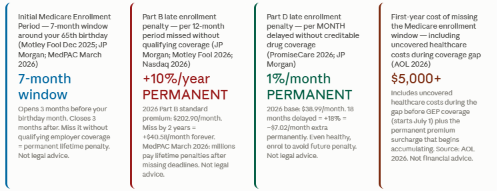
Part B late enrollment penalty: 10% per 12-month period of missed eligibility — PERMANENT (JP Morgan; Motley Fool 2026; Nasdaq). Part D late penalty: 1% of $38.99/month per month delayed — also permanent (promisecare.com 2026). MedPAC March 2026: millions pay Medicare late enrollment penalties for life. First-year cost of missing enrollment: $5,000+ including coverage gap costs (AOL 2026).
Mark the calendar now. If your 65th birthday is on any date in 2026 or 2027, your IEP window begins 3 months before that birthday month. Go to Medicare.gov to enroll online. If already receiving Social Security, confirm auto-enrollment in writing. If not receiving Social Security, do not assume automatic enrollment. Verify with SSA.gov or call 1-800-MEDICARE.
Missing by 1 year: +10% permanent Part B premium surcharge = +$20.29/month on the 2026 standard premium of $202.90 = $243.48/year in extra premiums for life. Missing by 2 years: +20% = +$40.58/month = $486.96/year for life. Plus any uncovered healthcare costs during the coverage gap. Source: JP Morgan; promisecare.com; Nasdaq 2026.
COBRA does NOT protect against Part B late enrollment penalty (AOL 2026; promisecare.com). Qualifying employer plan: must be active employment + employer with 20+ employees. SEP window: 8 months from when qualifying employer coverage ends (promisecare.com). MedPAC March 2026: complexity of Medicare enrollment is a documented federal policy concern.
Before delaying Medicare past 65, get written confirmation from your employer's HR department that your coverage qualifies as creditable coverage for Medicare Part B delay purposes. Do not rely on your understanding of the plan — get it in writing. If on COBRA, do not delay: enroll in Medicare during your IEP. If you lose qualifying employer coverage, track your 8-month SEP window from the date coverage ends.
Delaying on non-qualifying coverage for 12 months triggers the same 10% per year permanent penalty as simply missing enrollment. On the 2026 Part B premium of $202.90: +$20.29/month permanently for one year of mistaken delay. If your plan does not qualify, every month you delay adds to the permanent penalty. Source: JP Morgan; AOL 2026; promisecare.com.
Part D national base beneficiary premium 2026: $38.99/month (promisecare.com citing CMS 2026). Late penalty: 1% × $38.99 per month delayed = permanent surcharge. 18 months delayed: +$7.02/month permanently (18% × $38.99). 36 months: +$14.04/month permanently. Penalty is PERMANENT (JP Morgan; promisecare.com 2026).
If you are enrolling in Medicare at 65 and do not currently take prescriptions, still enrol in a low-cost Part D plan to avoid the future penalty. Low-premium Part D plans exist for as little as a few dollars per month. The small monthly premium is your insurance against a large permanent penalty that begins accumulating from day one of missed eligibility. Search at Medicare.gov/plan-compare.
Delaying Part D for 3 years (36 months): 36% × $38.99 = ~$14.04/month permanent surcharge. If you then enrol at 68 and stay on Medicare for 20 years: $14.04/month × 240 months = ~$3,370 in penalty payments alone, on top of your normal premiums. Compare: 3 years of low-cost Part D at $10/month = $360. The maths strongly favours enrolling early.
Original Medicare has NO annual out-of-pocket maximum (JP Morgan; Motley Fool 2026). Medicare Advantage DOES cap annual out-of-pocket spending (Motley Fool 2026; JP Morgan). Medigap open enrolment window: 6 months from when you are 65+ AND enrolled in Part B — guaranteed issue, no medical underwriting (Motley Fool 2026; JP Morgan). Original Medicare does not cover: dental, vision, hearing, long-term care beyond 100 days.
Research Medigap and Medicare Advantage plans BEFORE your Medigap open enrolment window opens (the 6-month window starting when you are 65+ and have Part B). After this window closes, insurers in most states can use medical underwriting — meaning pre-existing conditions could increase your premium or result in denial. Use the 6-month window to compare plans at Medicare.gov/medigap or via your state's SHIP (State Health Insurance Assistance Program).
A serious illness under Original Medicare without a Medigap policy: a 60-day hospital stay involves a Part A deductible of $1,676 (2026) plus coinsurance beyond day 60 at $419/day (2026 rates, subject to annual adjustment). No out-of-pocket maximum means costs can accumulate without limit.
Annual Medicare Advantage/Part D enrollment period: October 15 – December 7 each year (Nasdaq 2026). Switching from Medicare Advantage back to Original Medicare may trigger Medigap underwriting in most states (JP Morgan). Plans change annually: formularies, premiums, networks, and cost-sharing all subject to yearly revision.
Set a calendar reminder every September to review your Medicare plan before the October 15 enrollment period opens. Check: (1) Is your doctor still in-network? (2) Are your prescriptions still on the formulary at the same tier? (3) Has the premium or out-of-pocket maximum changed? (4) Are there plans offering better value for your current health needs? Medicare.gov/plan-compare lets you compare plans. Your state SHIP provides free, unbiased counselling.
Not reviewing annually: a medication moved from Tier 2 to Tier 3 on a Part D formulary can increase your monthly out-of-pocket cost by $40-$100/month for that single drug. A Medicare Advantage premium increase of $30/month = $360/year in higher costs for no change in coverage. Annual review takes about 30 minutes and is free.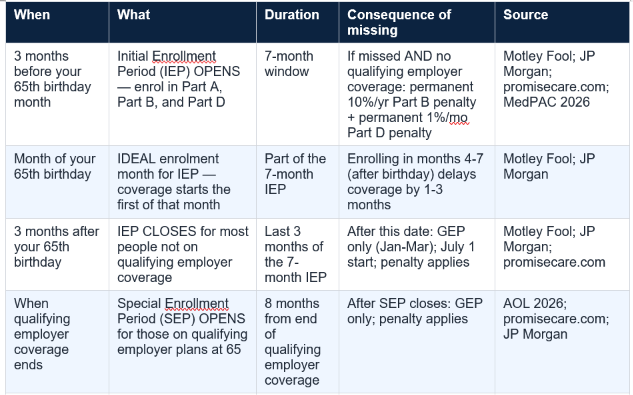
The preventive investment is small. Mark the calendar three months before your 65th birthday. Visit Medicare.gov or call 1-800-MEDICARE. If you have employer coverage, get written confirmation that it qualifies as creditable coverage before choosing to delay. Enrol in a Part D plan even if your medicine cabinet is empty. Use the six-month Medigap guaranteed issue window before it closes. Review your plan every October. These actions collectively take less than two hours in total and prevent the financial consequences that the millions of people currently paying lifetime penalties did not take.
Not for everyone. If you are already receiving Social Security benefits before you turn 65, you will be automatically enrolled in Medicare Part A and Part B and should receive your card about three months before your 65th birthday. If you are NOT receiving Social Security benefits at 65 — for example, you are still working and have not claimed Social Security — you must actively enrol. Nasdaq's 2026 coverage confirms: 'The government will not automatically enrol you in Medicare when you turn 65.' PromiseCare's 2026 Medicare guide adds that many people believe Medicare enrollment happens automatically at 65 — this is one of the most costly assumptions. Visit Medicare.gov or call 1-800-MEDICARE to confirm your status.
Does COBRA coverage protect me from the Medicare late enrollment penalty?
No. This is one of the most important and most misunderstood rules in Medicare. AOL's 2026 reporting is explicit: 'If you retire at 65 and rely on COBRA while delaying Medicare enrollment, you will likely face the penalty.' COBRA is continuation coverage from your former employer — it is not active employment-based coverage under a current employer's group health plan with 20+ employees. The Special Enrollment Period that allows penalty-free delay only applies to active employment with a qualifying employer group plan. The moment you stop working and take COBRA, your Medicare enrollment clock is running. You have an 8-month Special Enrollment Period from the end of your active employer coverage to enrol without penalty.
What happens if I miss my Medicare enrollment window?
If you miss the Initial Enrollment Period and do not have a qualifying Special Enrollment Period, you must wait for the General Enrollment Period (January 1 – March 31 each year). Coverage under the GEP begins July 1 — meaning you may have months without coverage. You will also face the permanent Part B late enrollment penalty: 10% added to your monthly premium for every full 12-month period you were eligible but did not enrol. On the 2026 Part B premium of $202.90, one missed year adds $20.29/month permanently. Two years: $40.58/month permanently. This penalty never goes away. Source: JP Morgan; Motley Fool 2026; AOL 2026. Not legal advice — consult Medicare.gov.
What does Medicare not cover that I should plan for?
Original Medicare (Parts A and B) does not cover dental care, vision exams and eyeglasses, hearing aids, routine foot care (beyond specific medical conditions), and long-term care in a nursing home beyond 100 days. Critically, Original Medicare has no annual out-of-pocket maximum — meaning a serious illness can generate unlimited out-of-pocket costs without a cap. The Motley Fool's 2026 guide identifies this as one of the major surprises for new Medicare enrollees: deductibles and coinsurance 'could add up and eat into your Social Security benefits in a scary way.' Medigap (Supplemental Insurance) covers many of these cost-sharing gaps but charges additional premiums. Medicare Advantage plans cap out-of-pocket spending but restrict provider networks. Neither is universally better — compare plans at Medicare.gov using your actual health needs and provider preferences.
What is the Medigap open enrollment window and why does it matter?
The Medigap open enrollment window is a six-month period that begins the month you are both aged 65 or older AND enrolled in Medicare Part B. During this window, Medigap insurers must sell you a policy at standard rates regardless of your health history — this is called 'guaranteed issue.' After this window closes, in most states, Medigap insurers can use medical underwriting: they can charge you more based on pre-existing conditions, or deny you coverage entirely. JP Morgan's Medicare pitfall analysis notes that this same underwriting rule applies when switching back from a Medicare Advantage plan to Original Medicare in most states. The Motley Fool's 2026 guide puts it plainly: 'Your initial Medigap enrollment window spans six months, and it starts the month you're 65 or older and have Part B coverage.' The practical implication: if you want Medigap coverage, get it during those six months at standard rates. Waiting means underwriting risk.
Turning 65 is a milestone worth celebrating. It is also the moment when one of the most complex and consequential benefits decisions of your financial life lands in your lap, with a ticking clock and very little formal guidance. Medicare — the federal health insurance programme for Americans 65 and older — is not a single plan. It is a system of parts, windows, penalties, and choices that interact in ways most people do not fully understand until they have already made a costly mistake. MedPAC’s March 2026 report to Congress documented that millions of people pay Medicare late enrollment penalties for life after missing key deadlines. The same report confirmed that many 65-year-olds will not be notified of upcoming Medicare eligibility three months before turning 65. In other words, the government knows you are turning 65. It may not remind you of what you need to do about it. This article covers the five most common Medicare mistakes people make when turning 65, the specific penalties and costs attached to each one, and the concrete actions that prevent them.
Table of Contents
- Why Medicare at 65 Is More Complicated Than You Were Told
- The Medicare Parts: A Plain-English Reference
- Mistake 1 Missing the 7-Month Initial Enrollment Window
- Mistake 2 Assuming Your Non-Qualifying Coverage Allows You to Delay
- Mistake 3 Skipping Part D Prescription Drug Coverage
- Mistake 4 Not Understanding What Medicare Does Not Cover
- Mistake 5 Failing to Review Your Plan Annually
- The Medicare Timeline: Every Critical Window at a Glance
- Conclusion: The 30-Minute Investment That Prevents Lifetime Penalties
- Frequently Asked Questions
Why Medicare at 65 Is More Complicated Than You Were Told
There is a reasonable expectation, shared by most Americans approaching 65, that Medicare works roughly like other government benefits: you become eligible at a certain age, you get enrolled, you are covered. The reality is more demanding. Medicare has multiple parts with separate enrollment decisions. Those decisions have separate windows. Missing those windows creates financial penalties that are not temporary — they are permanent adjustments to your premium for the rest of your life. And the government does not reliably remind you when those windows open. Nasdaq’s 2026 coverage of Medicare mistakes makes the core point directly: ‘The government will not automatically enrol you in Medicare when you turn 65.’ This is not a bureaucratic technicality. It is the source of a systematic problem documented in MedPAC’s March 2026 report to Congress: millions of people pay Medicare late enrollment penalties for life after missing key deadlines.The five mistakes in this article are not obscure edge cases. They are the most commonly made errors by intelligent people who did not know what they did not know. Each one has a specific, preventable cause and a specific, actionable solution.
MedPAC March 2026 report to Congress: millions of Americans pay Medicare late enrollment penalties for life after missing key deadlines. Many 65-year-olds will NOT be notified of upcoming Medicare eligibility 3 months before turning 65. The government knows your age. It may not send the reminder. Not legal advice.
The Medicare Parts: A Plain-English Reference
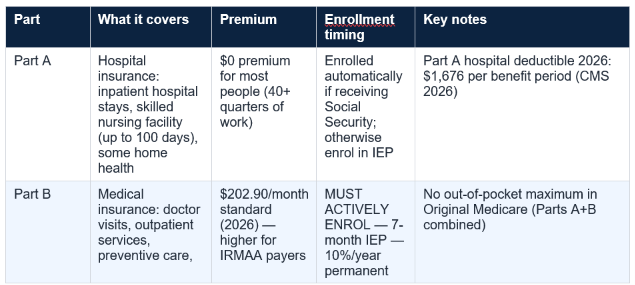
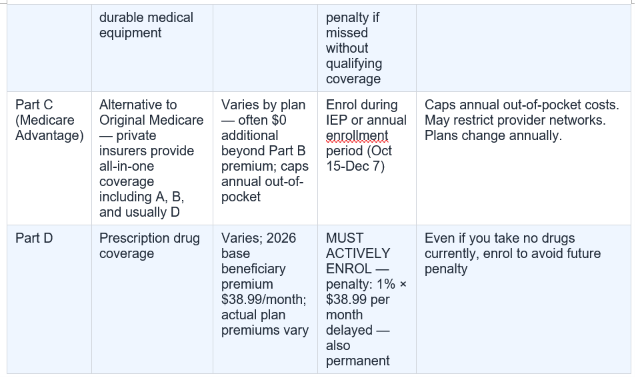
Before the mistakes make sense, the parts need to be clear. Medicare is not one thing. It has four primary components, and each one has separate enrollment considerations.
Mistake 1 Missing the 7-Month Initial Enrollment Window
This is the mistake that creates the most lasting financial damage, and it is strikingly easy to make through simple ignorance rather than negligence. Most people assume Medicare enrollment happens automatically when they turn 65. It does not — not for most people. The government does not automatically enroll you in Medicare at 65, according to Nasdaq’s coverage of common Medicare mistakes. PromiseCare’s 2026 Medicare guide confirms: ‘Many people mistakenly believe these coverage types protect them from late enrollment penalties.’ MedPAC’s March 2026 report to Congress specifically documented that many 65-year-olds will not be notified of upcoming Medicare eligibility three months before turning 65 — a policy gap that leaves individuals responsible for tracking their own deadline. The exception: if you are already receiving Social Security benefits before you turn 65, you will be automatically enrolled in Medicare Part A and Part B. If you are not yet taking Social Security, you must actively enroll. The window is seven months: three months before the month of your 65th birthday, the birthday month itself, and three months after. Enrolling in the first three months of this window — before your birthday month — gives you the cleanest start date for coverage. Waiting until the months after your birthday can delay coverage by up to three months. If you miss the window entirely, you face the General Enrollment Period (January through March each year), with coverage starting July 1 — and the permanent late enrollment penalty that follows you for the rest of your life.Part B late enrollment penalty: 10% per 12-month period of missed eligibility — PERMANENT (JP Morgan; Motley Fool 2026; Nasdaq). Part D late penalty: 1% of $38.99/month per month delayed — also permanent (promisecare.com 2026). MedPAC March 2026: millions pay Medicare late enrollment penalties for life. First-year cost of missing enrollment: $5,000+ including coverage gap costs (AOL 2026).
Mark the calendar now. If your 65th birthday is on any date in 2026 or 2027, your IEP window begins 3 months before that birthday month. Go to Medicare.gov to enroll online. If already receiving Social Security, confirm auto-enrollment in writing. If not receiving Social Security, do not assume automatic enrollment. Verify with SSA.gov or call 1-800-MEDICARE.
Missing by 1 year: +10% permanent Part B premium surcharge = +$20.29/month on the 2026 standard premium of $202.90 = $243.48/year in extra premiums for life. Missing by 2 years: +20% = +$40.58/month = $486.96/year for life. Plus any uncovered healthcare costs during the coverage gap. Source: JP Morgan; promisecare.com; Nasdaq 2026.
Mistake 2 Assuming Your Non-Qualifying Coverage Allows You to Delay
The rules around delaying Medicare without penalty are specific and frequently misunderstood — and the cost of getting them wrong is the same permanent penalty as simply missing the window entirely. There is a legitimate Special Enrollment Period (SEP) that allows you to delay Medicare Part B without penalty: it applies if you or your spouse is actively employed with an employer that has 20 or more employees, and you are covered under that employer’s group health plan. The key word is ‘employer’ — and it must be current, active employment with a qualifying group plan. AOL’s 2026 coverage of Medicare enrollment mistakes is direct: ‘If you retire at 65 and rely on COBRA while delaying Medicare enrollment, you will likely face the penalty.’ The Motley Fool’s 2026 guide confirms: ‘make sure your employer plan meets that requirement before delaying your enrollment.’ The coverage types that do NOT qualify as creditable coverage for delaying Part B enrollment include: COBRA continuation coverage, marketplace or ACA exchange plans, retiree health plans (in most cases), individual health insurance, and coverage through a spouse’s retiree plan. This is a critical and costly distinction. Many people retire at 65, take COBRA to bridge to the next year, and delay Medicare assuming COBRA protects them. It does not. The eight-month Special Enrollment Period applies when you stop working or lose qualifying employer coverage — giving you a window to enrol after the qualifying event without penalty.COBRA does NOT protect against Part B late enrollment penalty (AOL 2026; promisecare.com). Qualifying employer plan: must be active employment + employer with 20+ employees. SEP window: 8 months from when qualifying employer coverage ends (promisecare.com). MedPAC March 2026: complexity of Medicare enrollment is a documented federal policy concern.
Before delaying Medicare past 65, get written confirmation from your employer's HR department that your coverage qualifies as creditable coverage for Medicare Part B delay purposes. Do not rely on your understanding of the plan — get it in writing. If on COBRA, do not delay: enroll in Medicare during your IEP. If you lose qualifying employer coverage, track your 8-month SEP window from the date coverage ends.
Delaying on non-qualifying coverage for 12 months triggers the same 10% per year permanent penalty as simply missing enrollment. On the 2026 Part B premium of $202.90: +$20.29/month permanently for one year of mistaken delay. If your plan does not qualify, every month you delay adds to the permanent penalty. Source: JP Morgan; AOL 2026; promisecare.com.
Mistake 3 Skipping Part D Prescription Drug Coverage
Medicare Part D is prescription drug coverage, and it is optional in the technical sense that you choose whether to enrol in it. But ‘optional’ does not mean consequence-free if you skip it. The late enrollment penalty for Part D is calculated differently from Part B but is equally permanent: it equals 1% of the national base beneficiary premium for each full month you delayed enrollment without creditable drug coverage, and that amount is added to your monthly Part D premium for as long as you have Part D. In 2026, the national base beneficiary premium is $38.99 per month (promisecare.com citing CMS 2026), compared to $36.78 in 2025 (JP Morgan). Eighteen months delayed means an 18% permanent surcharge — approximately $7.02/month added to your premium for life. Thirty-six months adds 36% permanently. The reasoning many people use for skipping Part D is that they do not currently take many prescriptions. This logic has two problems. First, a drug diagnosis or a health event in later retirement can dramatically change your prescription costs; entering Part D coverage at that point with a large late penalty makes the coverage more expensive exactly when you need it most. Second, the cost of enrolling and paying a small monthly premium while healthy is typically far lower than the accumulated penalty that builds during healthy years. PromiseCare’s 2026 Medicare guide identifies this as one of the most financially damaging long-term mistakes.Part D national base beneficiary premium 2026: $38.99/month (promisecare.com citing CMS 2026). Late penalty: 1% × $38.99 per month delayed = permanent surcharge. 18 months delayed: +$7.02/month permanently (18% × $38.99). 36 months: +$14.04/month permanently. Penalty is PERMANENT (JP Morgan; promisecare.com 2026).
If you are enrolling in Medicare at 65 and do not currently take prescriptions, still enrol in a low-cost Part D plan to avoid the future penalty. Low-premium Part D plans exist for as little as a few dollars per month. The small monthly premium is your insurance against a large permanent penalty that begins accumulating from day one of missed eligibility. Search at Medicare.gov/plan-compare.
Delaying Part D for 3 years (36 months): 36% × $38.99 = ~$14.04/month permanent surcharge. If you then enrol at 68 and stay on Medicare for 20 years: $14.04/month × 240 months = ~$3,370 in penalty payments alone, on top of your normal premiums. Compare: 3 years of low-cost Part D at $10/month = $360. The maths strongly favours enrolling early.
Mistake 4 Not Understanding What Medicare Does Not Cover
Medicare is comprehensive health insurance by most standards. It is not complete health insurance. The gaps in Original Medicare — Parts A and B — are significant enough that most financial planners and Medicare counsellors recommend supplemental coverage from the first day of enrolment. The Motley Fool’s 2026 guide on Medicare mistakes is explicit: ‘There are numerous costs you might incur as a Medicare enrollee for covered services like hospital care and diagnostic tests. Those deductibles and coinsurance costs could add up and eat into your Social Security benefits in a scary way.’ The specific gaps that catch people off-guard include: dental care (not covered under Original Medicare), vision care and eyeglasses (not covered), hearing aids (not covered), routine foot care beyond specific medical conditions (not covered), and long-term care in a nursing home beyond 100 days (not covered after the 100-day Medicare-covered skilled nursing facility benefit). Original Medicare also has no annual out-of-pocket maximum, meaning a serious illness or extended hospital stay can generate costs that accumulate without a ceiling. JP Morgan’s Medicare pitfall analysis summarises the trade-off between the two major supplemental options: Medigap (supplement) provides broader access to providers but means total premiums are higher; Medicare Advantage caps annual out-of-pocket spending but may restrict provider networks and can mean variable out-of-pocket expenses for less healthy enrollees. Neither is universally superior — the right choice depends on your health, geography, and financial situation.Original Medicare has NO annual out-of-pocket maximum (JP Morgan; Motley Fool 2026). Medicare Advantage DOES cap annual out-of-pocket spending (Motley Fool 2026; JP Morgan). Medigap open enrolment window: 6 months from when you are 65+ AND enrolled in Part B — guaranteed issue, no medical underwriting (Motley Fool 2026; JP Morgan). Original Medicare does not cover: dental, vision, hearing, long-term care beyond 100 days.
Research Medigap and Medicare Advantage plans BEFORE your Medigap open enrolment window opens (the 6-month window starting when you are 65+ and have Part B). After this window closes, insurers in most states can use medical underwriting — meaning pre-existing conditions could increase your premium or result in denial. Use the 6-month window to compare plans at Medicare.gov/medigap or via your state's SHIP (State Health Insurance Assistance Program).
A serious illness under Original Medicare without a Medigap policy: a 60-day hospital stay involves a Part A deductible of $1,676 (2026) plus coinsurance beyond day 60 at $419/day (2026 rates, subject to annual adjustment). No out-of-pocket maximum means costs can accumulate without limit.
Mistake 5 Failing to Review Your Plan Annually
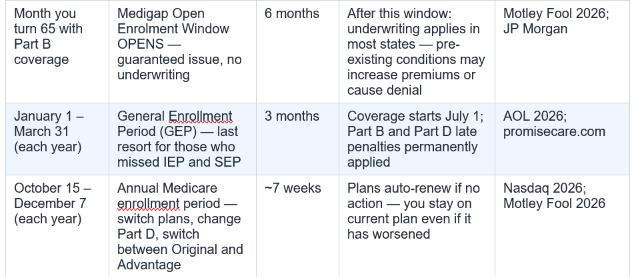
Medicare is not a set-it-and-forget-it programme. Plans change every year — and the plan that was the right choice when you enrolled may not be the right choice twelve months later. Nasdaq’s coverage of Medicare mistakes makes this point directly: ‘It’s vital to review your Medicare plans if you want to keep your costs down. Part of planning for retirement is controlling costs where you can, and Medicare is one such area. Many Medicare plans, particularly those under Medicare Advantage, change annually.’ The annual Medicare enrollment period runs from October 15 through December 7 each year. During this window, you can switch between Original Medicare and Medicare Advantage, switch Medicare Advantage plans, and switch or drop Part D plans. Changes take effect on January 1. The consequences of not reviewing annually are concrete: a drug you take may be removed from your plan’s formulary, meaning you now pay full price for it. A provider you rely on may be dropped from your Advantage plan’s network. Your plan’s premium or cost-sharing structure may have changed. JP Morgan’s Medicare pitfall analysis adds a specific warning about switching back from Medicare Advantage to Original Medicare: ‘In most states, these rules similarly apply to individuals previously covered by a Medicare Advantage plan and switching over to Original Medicare during the annual enrollment period’ — meaning Medigap medical underwriting can apply at that point, unlike the original 6-month guaranteed issue window.Annual Medicare Advantage/Part D enrollment period: October 15 – December 7 each year (Nasdaq 2026). Switching from Medicare Advantage back to Original Medicare may trigger Medigap underwriting in most states (JP Morgan). Plans change annually: formularies, premiums, networks, and cost-sharing all subject to yearly revision.
Set a calendar reminder every September to review your Medicare plan before the October 15 enrollment period opens. Check: (1) Is your doctor still in-network? (2) Are your prescriptions still on the formulary at the same tier? (3) Has the premium or out-of-pocket maximum changed? (4) Are there plans offering better value for your current health needs? Medicare.gov/plan-compare lets you compare plans. Your state SHIP provides free, unbiased counselling.
Not reviewing annually: a medication moved from Tier 2 to Tier 3 on a Part D formulary can increase your monthly out-of-pocket cost by $40-$100/month for that single drug. A Medicare Advantage premium increase of $30/month = $360/year in higher costs for no change in coverage. Annual review takes about 30 minutes and is free.
The Medicare Timeline: Every Critical Window at a Glance
Conclusion
Every mistake in this article shares a common origin: not knowing the rules before the window opened. Medicare’s complexity is documented at the federal level — MedPAC’s March 2026 report to Congress identifies it as an active policy concern. The penalties that result from that complexity are not temporary surcharges. They are permanent adjustments to your monthly premium for the rest of your life. On the 2026 Part B premium of $202.90, a two-year delay adds $40.58 every single month, permanently. Over a twenty-year retirement, that one mistake costs approximately $9,739 in extra premium payments above what you would have paid.The preventive investment is small. Mark the calendar three months before your 65th birthday. Visit Medicare.gov or call 1-800-MEDICARE. If you have employer coverage, get written confirmation that it qualifies as creditable coverage before choosing to delay. Enrol in a Part D plan even if your medicine cabinet is empty. Use the six-month Medigap guaranteed issue window before it closes. Review your plan every October. These actions collectively take less than two hours in total and prevent the financial consequences that the millions of people currently paying lifetime penalties did not take.
Frequently Asked Questions
Does Medicare automatically start when I turn 65?Not for everyone. If you are already receiving Social Security benefits before you turn 65, you will be automatically enrolled in Medicare Part A and Part B and should receive your card about three months before your 65th birthday. If you are NOT receiving Social Security benefits at 65 — for example, you are still working and have not claimed Social Security — you must actively enrol. Nasdaq's 2026 coverage confirms: 'The government will not automatically enrol you in Medicare when you turn 65.' PromiseCare's 2026 Medicare guide adds that many people believe Medicare enrollment happens automatically at 65 — this is one of the most costly assumptions. Visit Medicare.gov or call 1-800-MEDICARE to confirm your status.
Does COBRA coverage protect me from the Medicare late enrollment penalty?
No. This is one of the most important and most misunderstood rules in Medicare. AOL's 2026 reporting is explicit: 'If you retire at 65 and rely on COBRA while delaying Medicare enrollment, you will likely face the penalty.' COBRA is continuation coverage from your former employer — it is not active employment-based coverage under a current employer's group health plan with 20+ employees. The Special Enrollment Period that allows penalty-free delay only applies to active employment with a qualifying employer group plan. The moment you stop working and take COBRA, your Medicare enrollment clock is running. You have an 8-month Special Enrollment Period from the end of your active employer coverage to enrol without penalty.
What happens if I miss my Medicare enrollment window?
If you miss the Initial Enrollment Period and do not have a qualifying Special Enrollment Period, you must wait for the General Enrollment Period (January 1 – March 31 each year). Coverage under the GEP begins July 1 — meaning you may have months without coverage. You will also face the permanent Part B late enrollment penalty: 10% added to your monthly premium for every full 12-month period you were eligible but did not enrol. On the 2026 Part B premium of $202.90, one missed year adds $20.29/month permanently. Two years: $40.58/month permanently. This penalty never goes away. Source: JP Morgan; Motley Fool 2026; AOL 2026. Not legal advice — consult Medicare.gov.
What does Medicare not cover that I should plan for?
Original Medicare (Parts A and B) does not cover dental care, vision exams and eyeglasses, hearing aids, routine foot care (beyond specific medical conditions), and long-term care in a nursing home beyond 100 days. Critically, Original Medicare has no annual out-of-pocket maximum — meaning a serious illness can generate unlimited out-of-pocket costs without a cap. The Motley Fool's 2026 guide identifies this as one of the major surprises for new Medicare enrollees: deductibles and coinsurance 'could add up and eat into your Social Security benefits in a scary way.' Medigap (Supplemental Insurance) covers many of these cost-sharing gaps but charges additional premiums. Medicare Advantage plans cap out-of-pocket spending but restrict provider networks. Neither is universally better — compare plans at Medicare.gov using your actual health needs and provider preferences.
What is the Medigap open enrollment window and why does it matter?
The Medigap open enrollment window is a six-month period that begins the month you are both aged 65 or older AND enrolled in Medicare Part B. During this window, Medigap insurers must sell you a policy at standard rates regardless of your health history — this is called 'guaranteed issue.' After this window closes, in most states, Medigap insurers can use medical underwriting: they can charge you more based on pre-existing conditions, or deny you coverage entirely. JP Morgan's Medicare pitfall analysis notes that this same underwriting rule applies when switching back from a Medicare Advantage plan to Original Medicare in most states. The Motley Fool's 2026 guide puts it plainly: 'Your initial Medigap enrollment window spans six months, and it starts the month you're 65 or older and have Part B coverage.' The practical implication: if you want Medigap coverage, get it during those six months at standard rates. Waiting means underwriting risk.
0 Comments
Be the first to share your thoughts on this article.