

Professional & Career Development
UK: What Makes Teachers Apply for Jobs? 2026 Guide

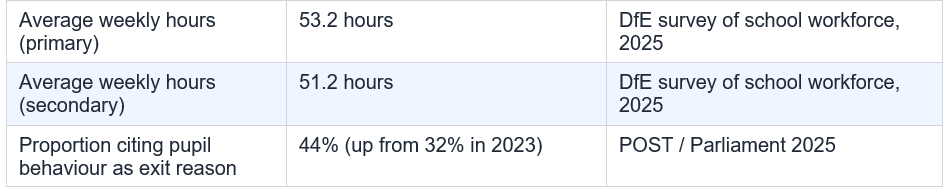
Key Statistics (August 2026): Median classroom teacher pay 2024/25: £48,892 (DfE, June 2025). Teacher pay fell 10.4% in real terms 2010/11–2022/23, recovering 5% in real terms 2022/23–2024/25 (House of Commons Library, July 2026). 9% of teachers left the state sector in 2023/24, down from 9.3% in prior years (DfE via Commons Library). 30–33% of teachers leave within their first five years (DfE, School Workforce Census). Only 61% of teachers expect to be teaching in 3 years, vs approximately 75% pre-pandemic (Teacher Tapp 2026). Secondary teacher job advertisements: down 31% vs prior year; 22% below 2018/19 pre-pandemic levels (Teacher Tapp 2025). 37% of deputy/assistant headteachers aspire to headship, down from 55% in 2017 (Teacher Tapp 2026). Government financial incentives package 2025/26: £233 million (up £37 million). Tax-free bursaries: up to £29,000; scholarships: up to £31,000 (Parliament, January 2025). Targeted Retention Incentives (TRIs): up to £6,000 after tax for STEM teachers in disadvantaged schools (DfE). 84% of 18–24 year olds would not rule out becoming a teacher (PLMR polling). STEM subjects continue to dominate unfilled vacancies. Average primary teacher works 53.2 hours/week; average secondary teacher 51.2 hours/week (DfE survey, 2025). 60% of schoolteachers feel they spend too much time following up on pupil behaviour (POST/Parliament). Proportion of ex-teachers citing pupil behaviour as reason for leaving rose from 32% to 44% between 2023 and 2024.
The United Kingdom’s state school system is facing a structural tension in teacher recruitment that has no simple resolution. On one side: teacher training numbers are rising, with the 2025/26 Initial Teacher Training Census showing the second consecutive year of growth following post-pandemic declines. On the other: only 61 percent of current teachers expect to still be teaching in three years’ time, compared with approximately 75 percent before the pandemic. More teachers are entering the system. Fewer feel confident they will stay.
This tension is the context in which every teacher job application is made and every school recruitment decision happens in 2026. Understanding what makes teachers apply for jobs — not just what brings them into the profession initially, but what makes them choose one school, one opportunity, one position over another — is the most commercially and operationally important question in school recruitment.
This guide examines the current evidence, drawing on government data, academic research, sector surveys, and parliamentary committee findings, to identify the specific factors that motivate UK teachers to apply for positions. For school leaders and HR professionals, it provides the framework for building recruitment strategies that work. For teachers considering a move, it frames the criteria that should shape the decision.
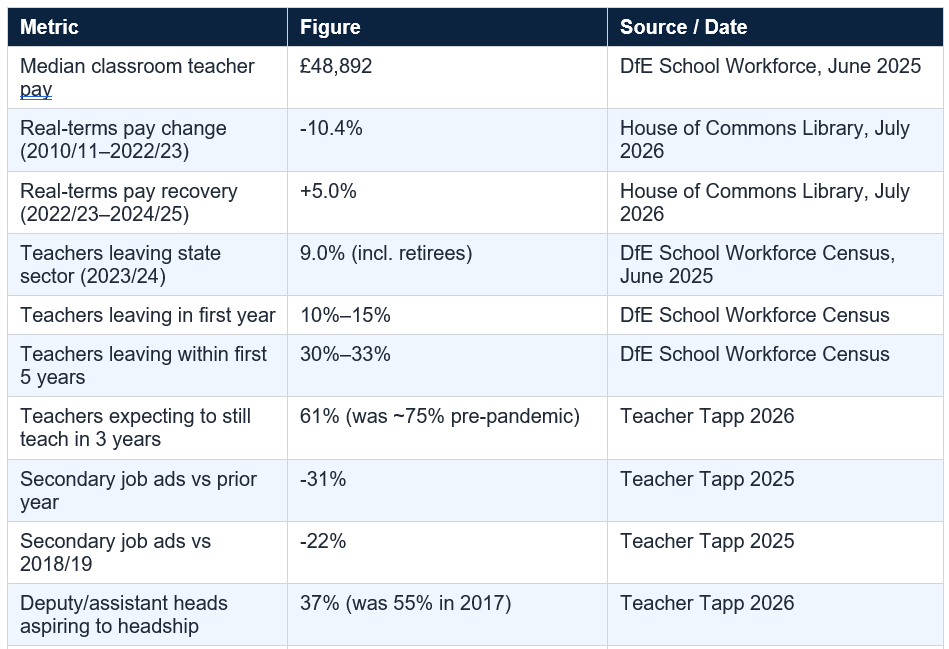
The market context shapes the supply and demand dynamics of every teacher job search. Schools are advertising fewer positions — secondary job advertisements are down 31 percent on the prior year and 22 percent below pre-pandemic 2018/19 levels — but teachers do not report feeling better staffed. The fewer advertisements reflect budget pressures and reduced pupil number forecasts in some areas, not a resolved staffing situation.
PLMR’s polling on factors influencing decisions to become teachers found that better pay was the highest-scoring factor — above professional status and flexible working. This finding carries across into job applications: teachers are more likely to apply for positions at schools or MATs that offer competitive salaries, clear pay progression, and visible TLR (Teaching and Learning Responsibility) payments for taking on additional responsibilities.
The government’s response to the pay deficit has been financial incentives for specific subjects and career stages:
Critically, the BERA analysis of school job advertisements found that while salary is cited as a major factor, some teachers would be more interested in a supportive work environment than higher pay. This is not evidence that pay does not matter. It is evidence that pay is a baseline condition, not a differentiating factor. Schools that pay below competitive rates lose candidates. Schools that pay competitively but offer a poor culture also lose candidates.
For Schools: When advertising positions, schools should be explicit about the salary range, any TLR payments, TRI eligibility, progression opportunities, and any additional perks. Ambiguity about salary increases the dropout rate of otherwise interested candidates.
School culture operates as a recruitment factor even before a candidate has visited the school, through two primary mechanisms: word of mouth and the job advertisement itself. Teacher Tapp’s 2026 report noted that teachers talk, and reputations travel quickly. A school with a reputation for poor leadership, high turnover, or a difficult working environment will find it significantly harder to attract high-quality candidates, regardless of the salary it advertises. Conversely, schools with strong retention records attract candidates more easily and benefit from referrals.
The specific cultural signals that teachers use to evaluate a potential employer in 2026:
Teaching has historically been characterised by rigid working patterns tied to the school timetable, making it difficult to offer the kind of flexibility available in other professional roles. But the schools and MATs (Multi-Academy Trusts) that have found creative ways to implement flexible working — including PPA (Planning, Preparation and Assessment) time taken remotely, compressed timetables, job-share arrangements, and part-time positions — report a competitive advantage in recruitment. The government’s Parliament evidence confirmed commitment to supporting schools in implementing flexible working practices.
The specific forms of flexible working that attract applications in 2026:
The Teacher Tapp 2026 data on the narrowing leadership pipeline is striking: only 37 percent of deputy and assistant headteachers aspire to headship, down from 55 percent in 2017. This does not mean teachers have abandoned career ambition. It means the specific career pathway toward headship has become less attractive than it was a decade ago. Teachers apply for jobs that offer career development within parameters that feel manageable — subject leadership, TLR responsibilities, curriculum coordination, mentoring roles for ECTs — rather than necessarily the most senior leadership positions.
What teachers look for in professional development terms:

School type is also relevant. Academy chains (MATs) and free schools can offer different pay structures and career pathways from maintained schools, as they are not bound by the national pay structure in the same way. Some MATs have developed reputations as employers of choice, with well-funded CPD, strong leadership development pipelines, and genuine flexible working. These MATs attract applications at a rate that maintained schools with equivalent vacancies cannot match.
Schools in disadvantaged areas, particularly outside London, face the steepest recruitment challenges. The BERA analysis of schools in disadvantaged communities found that teacher recruitment and retention difficulties are particularly acute in these settings, creating a cycle in which vacancy rates rise, workload increases for remaining staff, culture suffers, and recruitment becomes even harder. The government’s TRI scheme specifically targets this dynamic by paying STEM teachers an additional £6,000 to work in disadvantaged schools.
Rural schools face a specific location challenge: a limited local pool of qualified teachers, little public transport, and relocation requirements for candidates from further afield. Schools in these settings are increasingly investing in relocation support packages and are being explicit about it in job advertisements.
The specific factors that make career changers apply for teaching positions differ somewhat from those that motivate existing teachers to move roles:
Pay matters — particularly the real-terms fall of the past decade, which has left teaching less competitive relative to comparable graduate professions than it was in 2010. Financial incentives for STEM subjects have partially addressed the most acute shortages. But pay is a baseline, not a differentiator. The schools that attract the most and the best applications are those that pay competitively and offer something more: a culture of collaboration, meaningful professional development, workload that is challenging but not excessive, and leadership that is visible and supportive.
The 61 percent figure from Teacher Tapp — teachers expecting to still be teaching in three years — is both a warning and an opportunity. A profession that retains people sends a powerful signal to prospective applicants. Every improvement in teacher experience that increases retention also improves recruitment, because the same qualities that make people stay are the ones that make people apply.
The median classroom teacher pay in England was £48,892 in 2024/25, according to the DfE School Workforce Statistics published in June 2025 (cited by the House of Commons Library, July 2026). Teacher pay fell 10.4% in real terms between 2010/11 and 2022/23 and has since recovered approximately 5% in real terms. Pay varies by pay range, responsibility payments (TLRs), and location (Inner London, Outer London, Fringe, and Main pay ranges).
What financial incentives exist for UK teachers in 2026?
The government’s financial incentives package for 2025/26 was worth £233 million, including: tax-free bursaries worth up to £29,000 for trainees in mathematics, physics, chemistry, and computing; scholarships worth up to £31,000; and Targeted Retention Incentives (TRIs) of up to £6,000 after tax for STEM teachers in their first five years who work in disadvantaged schools. Student loan reimbursement schemes are also available. Details are available via the Get Into Teaching service at gov.uk.
Why are schools struggling to recruit teachers in 2026?
Multiple factors compound recruitment difficulties. Only 61% of teachers expect to still be teaching in three years (Teacher Tapp 2026). Around 30-33% of teachers leave within their first five years (DfE). Secondary job advertisements were down 31% on the prior year in 2025. Contributing factors include the real-terms pay fall of the past decade, workload pressures (average 51-53 hours/week), concerns about pupil behaviour (cited by 60% of teachers as consuming excessive time), limited flexible working, and alternative career options in better-paying private sector roles for STEM graduates.
What subjects have the most UK teacher vacancies?
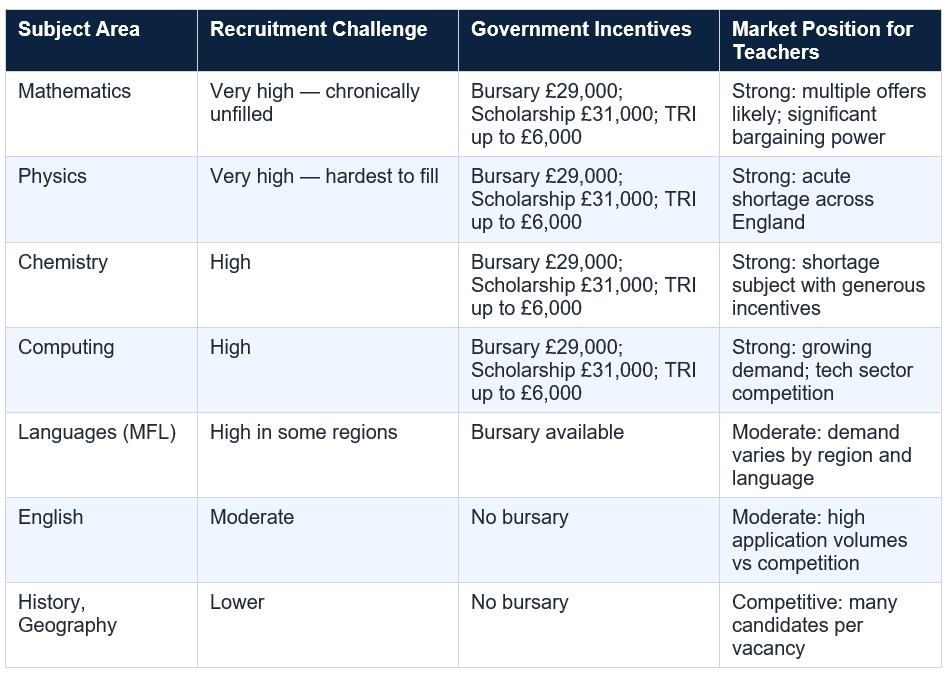
STEM subjects — mathematics, physics, chemistry, and computing — consistently have the highest levels of unfilled vacancies across England, as identified by the 2026 Prospero Teaching analysis and government evidence to the STRB. Modern foreign languages also have significant shortfalls in some regions. Teachers in these subjects have greater bargaining power, more choice of position, and access to the most generous financial incentives. Humanities, arts, and PE subjects generally have higher applicant-to-vacancy ratios.
How important is flexible working to teacher job applications?
Flexible working is identified as the third most important factor influencing decisions to become or remain a teacher, according to PLMR polling. Since the Flexible Working Act updates of April 2024, all employees have the right to request flexible working from day one. Schools and MATs that offer concrete flexible arrangements — remote PPA time, part-time positions, job-share structures — have a competitive advantage in attracting experienced teachers who are most selective about working conditions.
What do schools do wrong in teacher job advertisements?
Common errors identified by BERA research and sector analysis include: using generic language about culture and wellbeing that has become meaningless through overuse; listing FTE salary without the actual pro-rata figure for term-time working; failing to specify flexible working arrangements concretely; not mentioning financial incentives such as TRI eligibility, bursaries for career changers, or student loan reimbursement; and leading with bureaucratic requirements rather than what makes the school distinctive. Specific, evidenced claims about staff retention, workload management, and culture are significantly more effective than generic statements.
Table of Contents
- A Profession at a Crossroads
- The State of the UK Teacher Labour Market in 2026
- Factor 1: Salary and Financial Incentives
- Factor 2: School Culture and Leadership
- Factor 3: Flexible Working
- Factor 4: Career Development and Professional Growth
- Factor 5: Subject and School Type
- Factor 6: Location and Commute
- What Motivates Career Changers to Become Teachers
- What STEM Teachers Are Looking For
- What Schools Are Getting Wrong in Their Job Advertisements
- The Role of the Job Advertisement Itself
- What Schools Can Do Differently
- Conclusion: Teachers Apply Where They Feel Valued
- Frequently Asked Questions
A Profession at a Crossroads
The United Kingdom’s state school system is facing a structural tension in teacher recruitment that has no simple resolution. On one side: teacher training numbers are rising, with the 2025/26 Initial Teacher Training Census showing the second consecutive year of growth following post-pandemic declines. On the other: only 61 percent of current teachers expect to still be teaching in three years’ time, compared with approximately 75 percent before the pandemic. More teachers are entering the system. Fewer feel confident they will stay.This tension is the context in which every teacher job application is made and every school recruitment decision happens in 2026. Understanding what makes teachers apply for jobs — not just what brings them into the profession initially, but what makes them choose one school, one opportunity, one position over another — is the most commercially and operationally important question in school recruitment.
This guide examines the current evidence, drawing on government data, academic research, sector surveys, and parliamentary committee findings, to identify the specific factors that motivate UK teachers to apply for positions. For school leaders and HR professionals, it provides the framework for building recruitment strategies that work. For teachers considering a move, it frames the criteria that should shape the decision.
The State of the UK Teacher Labour Market in 2026
The 2026 teacher labour market has several structural characteristics that directly shape why and when teachers apply for positions:The market context shapes the supply and demand dynamics of every teacher job search. Schools are advertising fewer positions — secondary job advertisements are down 31 percent on the prior year and 22 percent below pre-pandemic 2018/19 levels — but teachers do not report feeling better staffed. The fewer advertisements reflect budget pressures and reduced pupil number forecasts in some areas, not a resolved staffing situation.
Factor 1: Salary and Financial Incentives
Pay is consistently identified as a primary motivation for teacher job applications, but the evidence on its precise role is more nuanced than any single survey suggests. The House of Commons Library’s July 2026 briefing confirms that median classroom teacher pay stood at £48,892 in 2024/25 — a meaningful figure in absolute terms but one that sits in the context of a 10.4 percent real-terms pay fall between 2010/11 and 2022/23. The partial recovery of 5 percent in real terms between 2022/23 and 2024/25 has not yet restored the purchasing power that two decades of below-inflation settlements eroded.PLMR’s polling on factors influencing decisions to become teachers found that better pay was the highest-scoring factor — above professional status and flexible working. This finding carries across into job applications: teachers are more likely to apply for positions at schools or MATs that offer competitive salaries, clear pay progression, and visible TLR (Teaching and Learning Responsibility) payments for taking on additional responsibilities.
The government’s response to the pay deficit has been financial incentives for specific subjects and career stages:
- Bursaries: up to £29,000 tax-free for trainees in eligible shortage subjects (mathematics, physics, chemistry, computing) for the 2026/27 cycle.
- Scholarships: up to £31,000 tax-free for the most competitive candidates in the same subjects.
- Targeted Retention Incentives (TRIs): up to £6,000 after tax for mathematics, physics, chemistry and computing teachers in their first five years who choose to work in disadvantaged schools. The government’s total financial incentives package for 2025/26 was £233 million — a £37 million increase on the previous cycle.
Critically, the BERA analysis of school job advertisements found that while salary is cited as a major factor, some teachers would be more interested in a supportive work environment than higher pay. This is not evidence that pay does not matter. It is evidence that pay is a baseline condition, not a differentiating factor. Schools that pay below competitive rates lose candidates. Schools that pay competitively but offer a poor culture also lose candidates.
For Schools: When advertising positions, schools should be explicit about the salary range, any TLR payments, TRI eligibility, progression opportunities, and any additional perks. Ambiguity about salary increases the dropout rate of otherwise interested candidates.
Factor 2: School Culture and Leadership
The most consistent finding across all major UK teacher recruitment research is that school culture and leadership quality are decisive factors in whether teachers apply for — and whether they accept — a position. The BERA analysis is explicit: teachers feel more valued and are more likely to stay through challenges when schools are run with a focus on support and collaboration. Gu and Day’s research (2013) found that collaborative school environments are among the strongest predictors of teacher retention.School culture operates as a recruitment factor even before a candidate has visited the school, through two primary mechanisms: word of mouth and the job advertisement itself. Teacher Tapp’s 2026 report noted that teachers talk, and reputations travel quickly. A school with a reputation for poor leadership, high turnover, or a difficult working environment will find it significantly harder to attract high-quality candidates, regardless of the salary it advertises. Conversely, schools with strong retention records attract candidates more easily and benefit from referrals.
The specific cultural signals that teachers use to evaluate a potential employer in 2026:
- Staff wellbeing policy: is there a visible, specific wellbeing offer or is it general language? Teachers have become skilled at distinguishing between performative wellbeing statements and genuine structural commitments.
- Leadership stability: a school with a new headteacher in their second or third year signals a better environment than one in which the headship has turned over multiple times.
- Ofsted category: schools in ‘Requires Improvement’ or ‘Inadequate’ categories have a demonstrably harder time recruiting, because teachers correctly anticipate higher pressure, more change, and more external accountability.
Factor 3: Flexible Working
Flexible working has moved from a secondary consideration to a primary recruitment driver in the post-pandemic UK job market. The PLMR polling found it as the third-highest factor influencing decisions to become or remain a teacher. The Flexible Working Act updates of April 2024, which gave all employees the right to request flexible working from day one of employment, have changed the baseline expectation of the workforce entering teaching.Teaching has historically been characterised by rigid working patterns tied to the school timetable, making it difficult to offer the kind of flexibility available in other professional roles. But the schools and MATs (Multi-Academy Trusts) that have found creative ways to implement flexible working — including PPA (Planning, Preparation and Assessment) time taken remotely, compressed timetables, job-share arrangements, and part-time positions — report a competitive advantage in recruitment. The government’s Parliament evidence confirmed commitment to supporting schools in implementing flexible working practices.
The specific forms of flexible working that attract applications in 2026:
- Remote PPA: allowing teachers to take their planning time at home rather than in school has become one of the most frequently valued flexible arrangements, as it reduces commuting time and allows greater control over the working day.
- Part-time and job-share positions: teachers returning from parental leave, those caring for dependants, or those managing health conditions are more likely to apply for and accept positions that offer part-time or job-share structures.
- Flexible start or finish times where timetable permits: even marginal flexibility can be the deciding factor between two otherwise comparable positions.
Factor 4: Career Development and Professional Growth
Career development is a significant motivation for teacher job applications, particularly for early-career teachers (ECTs) who entered teaching under the Early Career Teacher Entitlement (ECTE) framework introduced in September 2025, and for mid-career teachers seeking their first leadership position.The Teacher Tapp 2026 data on the narrowing leadership pipeline is striking: only 37 percent of deputy and assistant headteachers aspire to headship, down from 55 percent in 2017. This does not mean teachers have abandoned career ambition. It means the specific career pathway toward headship has become less attractive than it was a decade ago. Teachers apply for jobs that offer career development within parameters that feel manageable — subject leadership, TLR responsibilities, curriculum coordination, mentoring roles for ECTs — rather than necessarily the most senior leadership positions.
What teachers look for in professional development terms:
- Continuing Professional Development (CPD): access to subject-specific CPD, research-informed practice development, and structured learning time. Schools that provide CPD within the working day rather than requiring teachers to attend evening or weekend sessions are more attractive.
- Subject leadership opportunities: particularly in primary schools, the chance to lead a subject across the school is a powerful career development motivator.
- ECT mentor quality: for newly qualified teachers, the calibre of their ECT mentor is a decisive factor. Schools with strong mentoring reputations attract more early-career applications.
- Research and teacher learning communities: schools that participate in research networks, lesson study groups, or professional learning communities signal an intellectual culture that appeals to the most academically motivated teachers.
Factor 5: Subject and School Type
Subject specialism is one of the most powerful determinants of the job application experience a teacher has. STEM teachers in 2026 face a genuinely different market from teachers in other subjects. Mathematics, physics, computing, and chemistry teachers have significantly more bargaining power, more applications, and more choice of role than teachers in humanities or arts subjects. Prospero Teaching’s March 2026 analysis confirms that STEM subjects continue to dominate the list of hardest roles to fill in schools.School type is also relevant. Academy chains (MATs) and free schools can offer different pay structures and career pathways from maintained schools, as they are not bound by the national pay structure in the same way. Some MATs have developed reputations as employers of choice, with well-funded CPD, strong leadership development pipelines, and genuine flexible working. These MATs attract applications at a rate that maintained schools with equivalent vacancies cannot match.
Factor 6: Location and Commute
Geography shapes teacher applications in ways that are sometimes underestimated by school recruitment teams. Teacher Tapp’s 2025 report noted that schools in areas like London are anticipating future declines in pupil numbers and adjusting staffing plans accordingly. The London premium — where Inner and Outer London weighting is added to the national pay scale — partially compensates for higher living costs, but teachers still evaluate the commute, local housing costs, and personal geography in deciding whether to apply.Schools in disadvantaged areas, particularly outside London, face the steepest recruitment challenges. The BERA analysis of schools in disadvantaged communities found that teacher recruitment and retention difficulties are particularly acute in these settings, creating a cycle in which vacancy rates rise, workload increases for remaining staff, culture suffers, and recruitment becomes even harder. The government’s TRI scheme specifically targets this dynamic by paying STEM teachers an additional £6,000 to work in disadvantaged schools.
Rural schools face a specific location challenge: a limited local pool of qualified teachers, little public transport, and relocation requirements for candidates from further afield. Schools in these settings are increasingly investing in relocation support packages and are being explicit about it in job advertisements.
What Motivates Career Changers to Become Teachers
Career changers represent a significant and growing segment of the teacher applicant pool. They bring subject expertise from other fields, professional credibility, and often genuine passion for the subject that attracted them to their original career. The government’s Get Into Teaching marketing campaign, which signposts candidates including career changers, is an important pipeline.The specific factors that make career changers apply for teaching positions differ somewhat from those that motivate existing teachers to move roles:
- Purpose and impact: career changers most frequently cite the desire to make a positive contribution to society and ensure pupils have a rewarding education. This idealistic motivation is genuine and should be acknowledged explicitly in school recruitment messaging.
- Stability and security: compared to some private sector roles, teaching offers perceived job security, a defined pension (Teachers’ Pension Scheme), and term-time holidays that align with family life.
- Subject mastery: many career changers are drawn by the opportunity to work deeply in a subject they love. STEM career changers, in particular, are motivated by the chance to transfer specialist knowledge.
- Financial route to entry: bursaries and scholarships make the training year financially accessible in a way that career change into other public sector professions often is not.
What STEM Teachers Are Looking For
STEM teachers in 2026 are the most sought-after teachers in England, and they know it. The factors they weigh when deciding to apply are shaped by this market position:- Salary competitiveness with the private sector: a physicist or mathematician who could earn £60,000 to £100,000+ in finance or technology has a concrete alternative to compare with a teaching salary. Schools and MATs that can offer the upper end of the teacher pay scale, plus TLR payments and TRI eligibility, are more competitive.
- Extracurricular enrichment: STEM teachers are attracted by schools that value and resource extracurricular activities — coding clubs, robotics groups, STEM competitions, CERN or astronomy trips. These activities signal a school culture that takes their subject seriously.
- Resources and technology: well-equipped laboratories, updated computing infrastructure, and access to modern equipment matter to STEM teachers considering a school. Schools that can make the case for their resource investment are more attractive.
- Retention incentive awareness: not all STEM teachers are aware of the TRI scheme. Schools in disadvantaged areas that explicitly advertise TRI eligibility in their job postings see significantly more applications from eligible candidates.
What Schools Are Getting Wrong in Their Job Advertisements
The BERA analysis of school job advertisements in disadvantaged areas identified several patterns in how schools present themselves that reduce application rates. These findings are broadly applicable across school recruitment:- Vague culture language: phrases like ‘supportive environment’ and ‘committed to wellbeing’ appear so frequently in teacher job advertisements that they have ceased to carry information. Teachers have become skilled at filtering generic language. Specific, evidenced claims — ‘average teacher stays 5.8 years’ or ‘no cover for absent colleagues: we use supply’ — are more credible and more compelling.
- Incomplete salary information: as OTJR Online’s January 2026 analysis noted, many school job advertisements list an FTE salary without the actual or pro-rata figure for term-time working. This creates suspicion and reduces applications. Always include the actual annual salary alongside the FTE figure.
- Failing to describe flexible working concretely: saying the school ‘supports flexible working’ is less effective than specifying that PPA can be taken remotely and that part-time arrangements can be considered.
- Underemphasising financial incentives: particularly in STEM subjects, schools often fail to mention TRI eligibility, bursary availability for career changers, or student loan reimbursement entitlements. These are significant financial benefits that could be decisive for the right candidate.
The Role of the Job Advertisement Itself
Teacher Tapp’s analysis and the BERA research both point to the job advertisement as a much more consequential document than most schools treat it. It is often the first and only impression a prospective applicant forms of a school before deciding to apply. Research from the education sector suggests that the most effective job advertisements:- Lead with culture, not bureaucracy: the most effective advertisements open with a compelling description of what makes the school distinctive, not with a list of administrative requirements.
- Use specific language rather than generic claims: ‘We reduced teacher marking load by introducing whole-school live marking in 2024’ is more persuasive than ‘We take workload seriously.’
- Explicitly state what they offer candidates, not just what they expect: many school job advertisements are written primarily as a list of requirements. Effective advertisements balance requirements with a clear description of what the school provides.
- Include a personal invitation from the headteacher: a short, specific message from the head — not a generic greeting — signals accessible leadership and humanises the application process.
What Schools Can Do Differently
Based on the current evidence, schools that want to attract more and better applications in 2026 should consider:- Audit their retention data and use it in recruitment: a school with demonstrably low turnover has a powerful story to tell. Average teacher tenure, the proportion of staff who have been at the school for more than five years, and ECT completion rates are all credible signals of school quality.
- Invest in the application experience: slow, complex, or unrewarding application processes lose candidates. Online applications that are genuinely streamlined, quick acknowledgement of receipt, and early communication about timeline all improve the candidate experience.
- Involve teachers in the recruitment message: video testimonials from current teachers, honest descriptions of what they value about the school, and specific examples of how the school has responded to teacher feedback are more persuasive than any marketing language.
- Think about who is not applying: if the school has a persistent shortage in a specific subject, the answer is rarely ‘there are no qualified candidates.’ More often, the school has not reached the candidates, has not offered what they need, or has not communicated what it offers.
Conclusion
The evidence on what makes UK teachers apply for jobs in 2026 points consistently in one direction: teachers apply where they believe they will be valued, supported, and given the conditions to do the work they entered the profession to do. This is not a sentiment. It is a practical conclusion drawn from data on pay, culture, flexibility, career development, and workload.Pay matters — particularly the real-terms fall of the past decade, which has left teaching less competitive relative to comparable graduate professions than it was in 2010. Financial incentives for STEM subjects have partially addressed the most acute shortages. But pay is a baseline, not a differentiator. The schools that attract the most and the best applications are those that pay competitively and offer something more: a culture of collaboration, meaningful professional development, workload that is challenging but not excessive, and leadership that is visible and supportive.
The 61 percent figure from Teacher Tapp — teachers expecting to still be teaching in three years — is both a warning and an opportunity. A profession that retains people sends a powerful signal to prospective applicants. Every improvement in teacher experience that increases retention also improves recruitment, because the same qualities that make people stay are the ones that make people apply.
Frequently Asked Questions
What is the median teacher salary in the UK in 2026?The median classroom teacher pay in England was £48,892 in 2024/25, according to the DfE School Workforce Statistics published in June 2025 (cited by the House of Commons Library, July 2026). Teacher pay fell 10.4% in real terms between 2010/11 and 2022/23 and has since recovered approximately 5% in real terms. Pay varies by pay range, responsibility payments (TLRs), and location (Inner London, Outer London, Fringe, and Main pay ranges).
What financial incentives exist for UK teachers in 2026?
The government’s financial incentives package for 2025/26 was worth £233 million, including: tax-free bursaries worth up to £29,000 for trainees in mathematics, physics, chemistry, and computing; scholarships worth up to £31,000; and Targeted Retention Incentives (TRIs) of up to £6,000 after tax for STEM teachers in their first five years who work in disadvantaged schools. Student loan reimbursement schemes are also available. Details are available via the Get Into Teaching service at gov.uk.
Why are schools struggling to recruit teachers in 2026?
Multiple factors compound recruitment difficulties. Only 61% of teachers expect to still be teaching in three years (Teacher Tapp 2026). Around 30-33% of teachers leave within their first five years (DfE). Secondary job advertisements were down 31% on the prior year in 2025. Contributing factors include the real-terms pay fall of the past decade, workload pressures (average 51-53 hours/week), concerns about pupil behaviour (cited by 60% of teachers as consuming excessive time), limited flexible working, and alternative career options in better-paying private sector roles for STEM graduates.
What subjects have the most UK teacher vacancies?
STEM subjects — mathematics, physics, chemistry, and computing — consistently have the highest levels of unfilled vacancies across England, as identified by the 2026 Prospero Teaching analysis and government evidence to the STRB. Modern foreign languages also have significant shortfalls in some regions. Teachers in these subjects have greater bargaining power, more choice of position, and access to the most generous financial incentives. Humanities, arts, and PE subjects generally have higher applicant-to-vacancy ratios.
How important is flexible working to teacher job applications?
Flexible working is identified as the third most important factor influencing decisions to become or remain a teacher, according to PLMR polling. Since the Flexible Working Act updates of April 2024, all employees have the right to request flexible working from day one. Schools and MATs that offer concrete flexible arrangements — remote PPA time, part-time positions, job-share structures — have a competitive advantage in attracting experienced teachers who are most selective about working conditions.
What do schools do wrong in teacher job advertisements?
Common errors identified by BERA research and sector analysis include: using generic language about culture and wellbeing that has become meaningless through overuse; listing FTE salary without the actual pro-rata figure for term-time working; failing to specify flexible working arrangements concretely; not mentioning financial incentives such as TRI eligibility, bursaries for career changers, or student loan reimbursement; and leading with bureaucratic requirements rather than what makes the school distinctive. Specific, evidenced claims about staff retention, workload management, and culture are significantly more effective than generic statements.
0 Comments
Be the first to share your thoughts on this article.