

Planning
Ways to Make a Financial Plan More Resilient to Life Changes

Unemployment 4.2% (7.1 million people) in a 4.1%–4.3% range since March; payrolls +29,000 (a “low-hire, low-fire” market); 1.9 million people (27.1% of the unemployed) out of work 27 weeks or longer, about six months; job openings 7.52 million with 1.05 openings per unemployed worker; layoffs 1.64 million, the lowest since March 2025. Household cushions: only 46% of Americans could cover three months of expenses and 27% six months (Bankrate); 37% could not cover a $400 expense entirely in cash (Fed SHED 2025, secondary); personal saving rate 3.8% in September (secondary); 19.5% of 401(k) savers have a loan; card APR about 20.9%; inflation 3.7%. My arithmetic: six months of $3,000 essentials is $18,000, which earns about $783 a year at 4.35%; cutting fixed costs by $500 stretches that fund from 6.0 to 7.2 months; skipping one year of $9,610 of retirement saving costs about $73,000 after 30 years at 7%; a plan assuming 7.8% that earns 6.0% falls about $213,000 short on $500 a month over 30 years.
A resilient plan assumes something will change and leaves room for it. This guide offers nine ways to build that room, using fresh labor-market data to show why it matters now and simple arithmetic to show what each step is worth. None requires a high income; most are about structure, not size.
Households have thin cushions. Bankrate found only 46% of Americans could cover three months of expenses and 27% six months, and the Fed’s 2025 survey, as summarized in a compilation, found 37% of adults would not cover a $400 emergency entirely with cash. The personal saving rate was 3.8% in September, per the same compilation, and inflation 3.7%. A long job search with a small cushion and rising prices is exactly what breaks a plan, but resilience is built from small, boring steps.
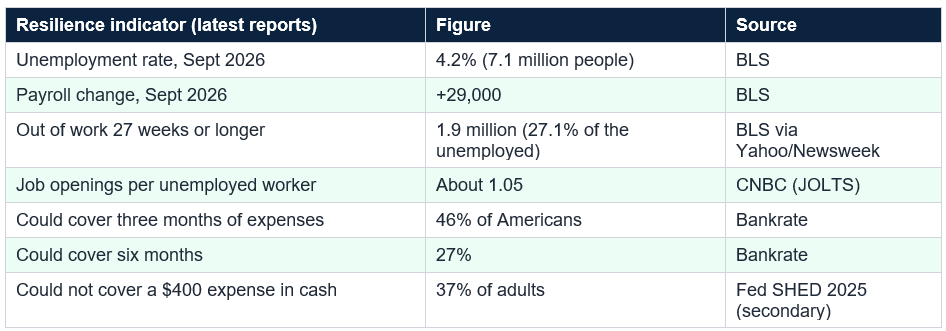
BLS September 2026: unemployment 4.2%, payrolls +29,000. 1.9 million Americans (27.1% of the unemployed) had been out of work 27 weeks or longer, about six months. Only 46% of Americans could cover three months of expenses and 27% six months.
Keep the cushion in an insured high-yield savings account, which paid about 4.35% at the top in early November against a 0.59% national average. At that rate $18,000 earns about $783 a year, modest, but the goal is access and safety, not growth. Build it in stages and automate the transfers. If six months feels impossible, every layer still helps: each month of cushion is a month of choices.
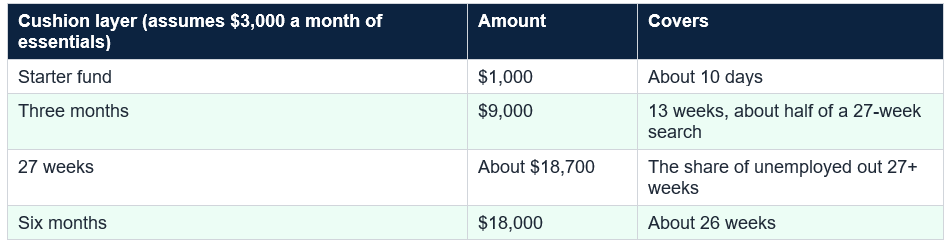
In my illustration, an $18,000 fund lasts six months at $3,000 a month of essentials, 7.2 months at $2,500 and nine months at $2,000, so cutting fixed costs by $500 adds 1.2 months of runway without saving another dollar. That is one reason to be wary of lifestyle inflation: each new fixed commitment, such as a bigger car payment, raises the bar for every future crisis.

Consider disability insurance too, which in my general knowledge replaces part of your income if illness or injury stops you working; check what your employer provides and whether it is enough. And know where to turn if you lose a job: in my general knowledge, you can file for state unemployment benefits promptly and may qualify for health coverage through a special enrollment period, with details at the Department of Labor and HealthCare.gov, linked below.
A health savings account can help if you have a high-deductible health plan. The 2027 limits are reported at $4,500 for self-only coverage and $9,000 for family coverage, up from $4,400 and $8,750 in 2026, and the money can pay qualifying medical costs. It is not a substitute for insurance but a way to prepare for the deductible. Insurance is the least exciting part of a plan and the one that matters most on the worst day.
Be careful with borrowing from your future. Fidelity found 19.5% of 401(k) savers have a loan outstanding, 25.7% for Gen X, and these loans pull money out of compounding and can cause problems if you leave a job. For any large loan, a fixed rate and a payment you could still make on a reduced income are more resilient than a variable payment that could jump.
This protects you in two ways: you can meet a shock without selling long-term investments at a bad time, and you reduce single points of failure, such as one employer, one bank or one stock. You do not need dozens of accounts, only a deliberate set.
The rules are made calmly, and they help a partner understand the plan. In my illustration, pausing a full year of $9,610 of retirement saving costs about $73,000 after 30 years at a constant 7%, so a rule to cut by half rather than stop, about $36,600 of lost value, protects your future while giving relief now. Match the rule to the severity of the shock and write down when you will restart.
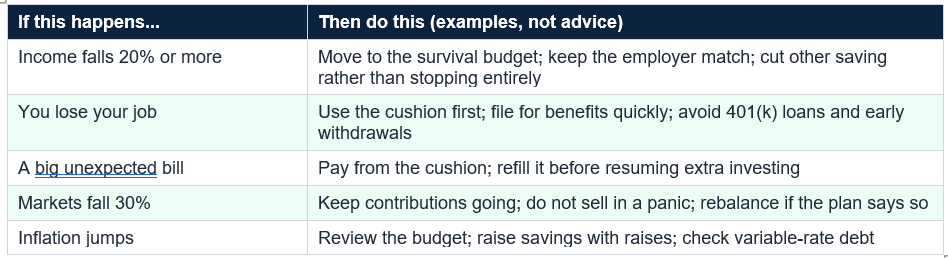
Run the scenarios one at a time and then combined. Where the plan fails, you have found a weak point to fix, whether a larger cushion, lower costs, more insurance or more saving. DALBAR found the average investor earned about 6.8% a year over 30 years against 10.2% for the S&P 500, so test with lower numbers than you hope for. The aim is to learn how much bad luck your plan can absorb.
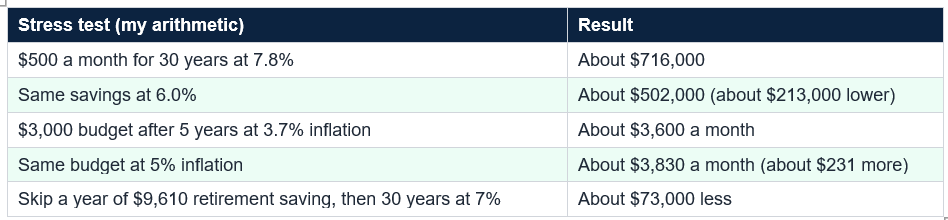
Stress tests use assumed numbers. Their purpose is to find weak points, not to predict outcomes. Rerun them when your income, goals or the economy change.
Keep the paperwork current too. In my general knowledge, that means updating beneficiary designations, having a will and powers of attorney in place and making sure someone you trust knows where accounts, passwords and documents are. These steps cost little and are often what family needs most in a crisis: a resilient plan is one that others can pick up when you cannot.
write your survival budget, the number of months your cushion covers and one if-then rule for a 20% income drop. Those three items are the core of a resilient plan.
Common mistakes include building a plan that works only if nothing changes, relying on a three-month fund when your income is at risk, taking on fixed costs that leave no margin, skipping insurance, borrowing from a 401(k), keeping all money in one place, stopping all saving in a crisis without a restart plan and never testing the plan. A plan is a living document: a yearly review and a short list of life-event triggers keep it alive.
In my illustration, six months of $3,000 essentials is $18,000, trimming $500 of fixed costs stretches it by 1.2 months, a plan that assumes 7.8% but earns 6.0% falls about $213,000 short and pausing a year of retirement saving costs about $73,000 over 30 years. Start with the cushion and the survival budget, write one if-then rule and set a review date. None of this predicts the future; it prepares you for several of them.
A resilient plan keeps working when your assumptions fail. It has a cash cushion sized to a realistic setback, low fixed costs, flexible rules that adjust to income changes, protection against big risks and a regular review. It does not try to predict the future. It prepares for several versions of it.
How big should my emergency fund be?
Three to six months of essential spending is the usual range, and the data suggest leaning toward six if your income is at risk. BLS data show 27.1% of unemployed Americans had been out of work 27 weeks or more in September, about six months. At $3,000 a month of essentials, six months is $18,000. Bankrate found only 27% of Americans could cover six months.
Should I stop investing if I lose my job?
Not automatically. First use your cash cushion and cut spending, and consider pausing extra investing, but try to keep contributions that earn an employer match while you are still employed. In my illustration, skipping one year of $9,610 of retirement saving costs about $73,000 of value after 30 years at a constant 7%, so pause with care and restart as soon as you can.
What life events should trigger a review of my plan?
Marriage or partnership, a child, divorce, a new job or job loss, a move, buying or selling a home, a health event, caring for a parent, an inheritance or a death in the family. Review your budget, insurance, beneficiaries and goals after each. Many people also review once a year on a fixed date. This is general education, not personal advice.
Is a high-yield savings account a good home for a resilience fund?
For most people, yes, because the money is insured up to limits, available anytime and earns something: top accounts paid about 4.35% in early November. Rates are variable and can fall, and after tax they roughly match inflation of 3.7%. The goal of a resilience fund is access and safety, not growth.
Table of Contents
- Why Plans Break
- The Short Answer: Nine Ways
- Why Resilience Matters Right Now
- Way 1: Layer Your Cash Cushion
- Way 2: Keep Fixed Costs Low
- Way 3: Protect Your Income
- Way 4: Transfer the Big Risks
- Way 5: Keep Debt Flexible
- Way 6: Spread Money Across Accounts
- Way 7: Write If-Then Rules
- Way 8: Stress-Test the Plan
- Way 9: Review on a Schedule and at Life Events
- Life Events and Moves
- Common Mistakes
- Conclusion
- Frequently Asked Questions
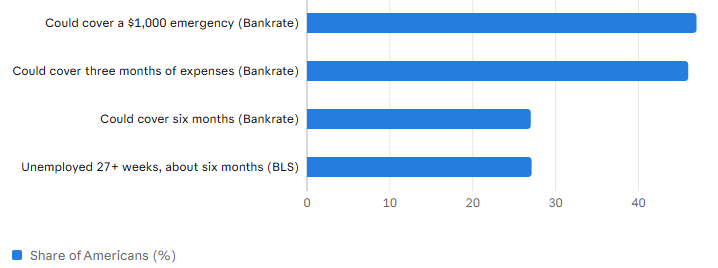
The cushion gap: what households can cover vs. how long job searches run (%)
% by Bankrate 2026 Emergency Savings Report; BLS September 2026 via Yahoo/Newsweek (27.1% of the unemployed); the last bar is a share of the unemployed, not of all Americans
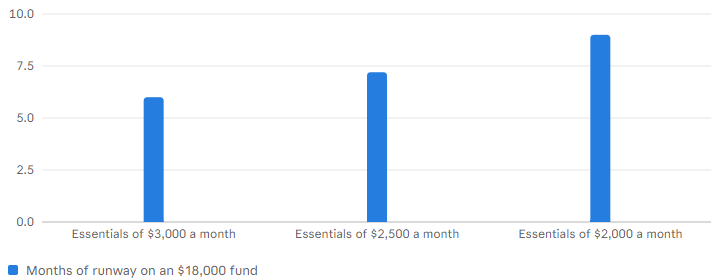
Lower fixed costs buy time: runway on an $18,000 cushion (months)
Months by my arithmetic: $18,000 / monthly essentials; cutting fixed costs by $500 adds about 1.2 months without saving another dollar; not a forecast
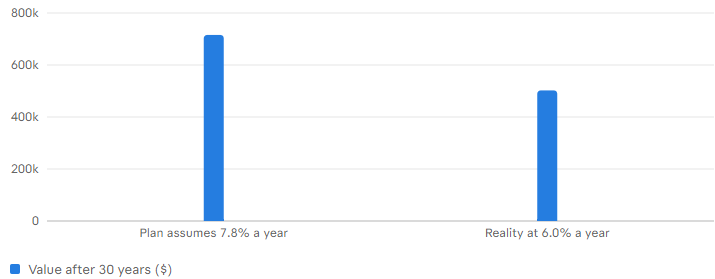
Stress test: $500 a month for 30 years if returns fall short of the plan ($)
Ending value ($) by my hypothetical arithmetic with monthly compounding; the shortfall is about $213,000; not a forecast
Why Plans Break
Most financial plans are written on a good day, assuming steady income, steady health, steady markets and a life that stays the same. Then a job disappears, a baby arrives, a marriage ends, a parent needs care or a medical bill lands, and the spreadsheet stops matching reality. The plan was not wrong when you wrote it. It was brittle: it worked only if nothing changed.A resilient plan assumes something will change and leaves room for it. This guide offers nine ways to build that room, using fresh labor-market data to show why it matters now and simple arithmetic to show what each step is worth. None requires a high income; most are about structure, not size.
The Short Answer: Nine Ways
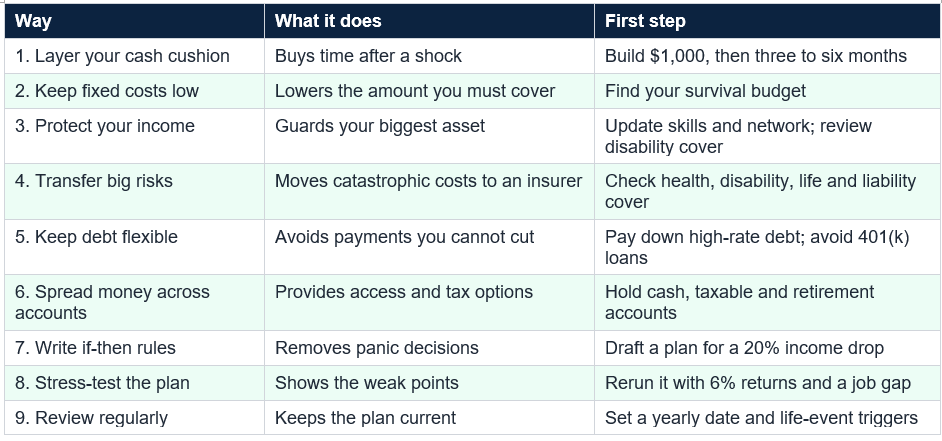
Make your plan resilient by layering a cash cushion, keeping fixed costs low, protecting your income, transferring big risks through insurance, keeping debt flexible, spreading money across accounts, writing if-then rules for hard times, stress-testing with lower returns and shocks and reviewing the plan on a schedule and after major life events. The cushion and fixed costs do most of the work: in my illustration, six months of $3,000 essentials is $18,000, and trimming fixed costs by $500 stretches it to 7.2 months.
Why Resilience Matters Right Now
The labor market is steady on the surface and fragile underneath. The BLS put the unemployment rate at 4.2% in September, within a 4.1% to 4.3% range since March, with 7.1 million people unemployed, but employers added only 29,000 jobs in what commentators call a “low-hire, low-fire” market. Job openings were 7.52 million and layoffs 1.64 million, the lowest since March 2025, per CNBC, which is reassuring. But finding a job takes time: 1.9 million Americans, or 27.1% of the unemployed, had been out of work for 27 weeks or longer, a share that has risen since 2023, according to a MyPerfectResume analysis.Households have thin cushions. Bankrate found only 46% of Americans could cover three months of expenses and 27% six months, and the Fed’s 2025 survey, as summarized in a compilation, found 37% of adults would not cover a $400 emergency entirely with cash. The personal saving rate was 3.8% in September, per the same compilation, and inflation 3.7%. A long job search with a small cushion and rising prices is exactly what breaks a plan, but resilience is built from small, boring steps.
BLS September 2026: unemployment 4.2%, payrolls +29,000. 1.9 million Americans (27.1% of the unemployed) had been out of work 27 weeks or longer, about six months. Only 46% of Americans could cover three months of expenses and 27% six months.
Way 1: Layer Your Cash Cushion
The cushion is the foundation, built in layers. First, a starter fund of about $1,000 keeps a car repair or medical copay off a card at about 20.9%. Second, three months of essential spending, and third, six months, which matters because 27 weeks is about six months, so a three-month fund covers only about half of a long job search. At $3,000 a month of essentials, three months is $9,000, six months $18,000 and 27 weeks about $18,700.Keep the cushion in an insured high-yield savings account, which paid about 4.35% at the top in early November against a 0.59% national average. At that rate $18,000 earns about $783 a year, modest, but the goal is access and safety, not growth. Build it in stages and automate the transfers. If six months feels impossible, every layer still helps: each month of cushion is a month of choices.
Way 2: Keep Fixed Costs Low
The cushion you need depends on what you must pay each month. Fixed costs, such as rent or mortgage, loan payments, insurance and utilities, are the ones you cannot easily cut when income falls, so lowering them is one of the most powerful resilience moves: it reduces what you need to cover and leaves more to save. Write down your survival budget, the bare minimum to keep housing, food, transport, health care and minimum debt payments going.In my illustration, an $18,000 fund lasts six months at $3,000 a month of essentials, 7.2 months at $2,500 and nine months at $2,000, so cutting fixed costs by $500 adds 1.2 months of runway without saving another dollar. That is one reason to be wary of lifestyle inflation: each new fixed commitment, such as a bigger car payment, raises the bar for every future crisis.
Way 3: Protect Your Income
For most people, the biggest asset is not a house or a portfolio but the ability to earn. In a low-hire market, protecting it means keeping skills current, maintaining a professional network and knowing what your market looks like before you need it. It can also mean a second source of income, whether a side project or a partner’s job, so no single loss is fatal.Consider disability insurance too, which in my general knowledge replaces part of your income if illness or injury stops you working; check what your employer provides and whether it is enough. And know where to turn if you lose a job: in my general knowledge, you can file for state unemployment benefits promptly and may qualify for health coverage through a special enrollment period, with details at the Department of Labor and HealthCare.gov, linked below.
Way 4: Transfer the Big Risks
Some risks are too large to self-insure with savings: a serious illness, a disability, a liability claim or the loss of a household earner can cost far more than any emergency fund. Insurance moves those catastrophic costs to a company for a premium. A basic checklist, from general knowledge, includes health, disability, life insurance if others depend on your income, home or renters and liability coverage. Review the deductibles: a high deductible only works if your cushion can cover it.A health savings account can help if you have a high-deductible health plan. The 2027 limits are reported at $4,500 for self-only coverage and $9,000 for family coverage, up from $4,400 and $8,750 in 2026, and the money can pay qualifying medical costs. It is not a substitute for insurance but a way to prepare for the deductible. Insurance is the least exciting part of a plan and the one that matters most on the worst day.
Way 5: Keep Debt Flexible
Debt turns a bad month into a bad year, because payments continue whether or not you are earning. A resilient plan keeps debt low, avoids high interest and favors terms you can survive. Credit cards averaged about 20.9% APR in the second quarter, so a balance grows quickly if you cannot pay it: pay down the highest-rate debt first, avoid new balances and keep a buffer so a surprise does not go on a card.Be careful with borrowing from your future. Fidelity found 19.5% of 401(k) savers have a loan outstanding, 25.7% for Gen X, and these loans pull money out of compounding and can cause problems if you leave a job. For any large loan, a fixed rate and a payment you could still make on a reduced income are more resilient than a variable payment that could jump.
Way 6: Spread Money Across Accounts
Resilience also means access. If all your money is in one retirement account, you cannot use it without penalties and taxes, and if it is all in one bank, an outage or freeze can lock you out. Spread it across a few buckets: cash for the near term, with a backup account at a different provider; a taxable investment account for the medium term; and tax-advantaged retirement accounts for the long term, each with different rules (general knowledge).This protects you in two ways: you can meet a shock without selling long-term investments at a bad time, and you reduce single points of failure, such as one employer, one bank or one stock. You do not need dozens of accounts, only a deliberate set.
Way 7: Write If-Then Rules
Panic is the enemy of good decisions, and the best defense is deciding in advance. Write if-then rules: if income drops by 20% or more, cut spending to the survival budget, pause extra debt payments but keep minimums and keep contributions that earn an employer match; if I lose my job, use the cash cushion first, file for benefits within a week and not touch retirement accounts for at least three months; if the market falls 30%, keep investing the same amount and do not sell.The rules are made calmly, and they help a partner understand the plan. In my illustration, pausing a full year of $9,610 of retirement saving costs about $73,000 after 30 years at a constant 7%, so a rule to cut by half rather than stop, about $36,600 of lost value, protects your future while giving relief now. Match the rule to the severity of the shock and write down when you will restart.
Way 8: Stress-Test the Plan
A resilient plan has been tested against bad luck. Change the assumptions. What if returns are 6% instead of 7.8%? In my illustration, $500 a month for 30 years grows to about $716,000 at 7.8% but about $502,000 at 6.0%, a shortfall of about $213,000. What if inflation runs at 5% instead of 3.7%? A $3,000 monthly budget would reach about $3,830 in five years rather than about $3,600, an extra $231 a month. What if you lose your job for six months, or a $10,000 bill hits at the same time?Run the scenarios one at a time and then combined. Where the plan fails, you have found a weak point to fix, whether a larger cushion, lower costs, more insurance or more saving. DALBAR found the average investor earned about 6.8% a year over 30 years against 10.2% for the S&P 500, so test with lower numbers than you hope for. The aim is to learn how much bad luck your plan can absorb.
Stress tests use assumed numbers. Their purpose is to find weak points, not to predict outcomes. Rerun them when your income, goals or the economy change.
Way 9: Review on a Schedule and at Life Events
Plans go stale. Set a yearly review date and look at four things: your cushion, your costs, your insurance and beneficiaries and your savings rate. Also review whenever a major life event occurs, since marriage, a baby, divorce, a new job, a move, a health event, a death in the family or an inheritance each changes your numbers and your needs.Keep the paperwork current too. In my general knowledge, that means updating beneficiary designations, having a will and powers of attorney in place and making sure someone you trust knows where accounts, passwords and documents are. These steps cost little and are often what family needs most in a crisis: a resilient plan is one that others can pick up when you cannot.
Life Events and Moves
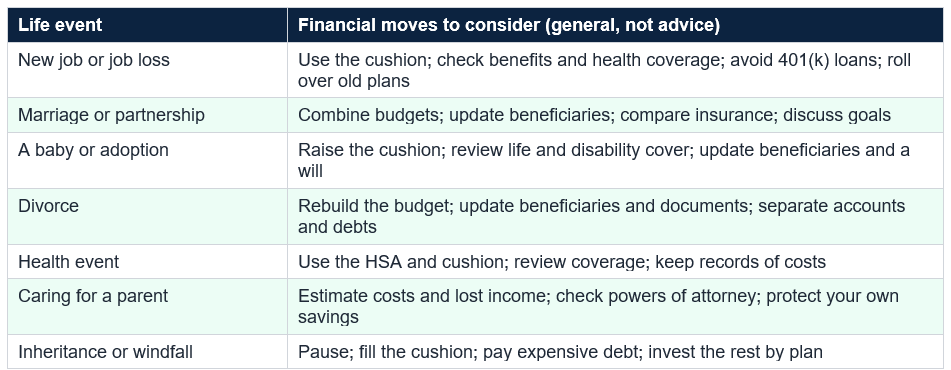
Different events call for different moves. A new baby raises spending and may lower income, so it calls for a bigger cushion, life and disability insurance and a plan for child costs; a divorce splits assets and income and requires updating beneficiaries and a new budget; a job loss triggers the cushion and benefits; a health event tests insurance and the HSA; caring for a parent can reduce your hours and add costs. Each calls for checking the plan, not starting over.write your survival budget, the number of months your cushion covers and one if-then rule for a 20% income drop. Those three items are the core of a resilient plan.
Common mistakes include building a plan that works only if nothing changes, relying on a three-month fund when your income is at risk, taking on fixed costs that leave no margin, skipping insurance, borrowing from a 401(k), keeping all money in one place, stopping all saving in a crisis without a restart plan and never testing the plan. A plan is a living document: a yearly review and a short list of life-event triggers keep it alive.
Conclusion
A financial plan is resilient when it keeps working after life changes. The labor market shows why that matters: unemployment is 4.2%, but hiring is weak and 1.9 million Americans, 27.1% of the unemployed, have been out of work for six months or more, while only 46% of households could cover three months of expenses. The nine ways turn a brittle plan into one that bends.In my illustration, six months of $3,000 essentials is $18,000, trimming $500 of fixed costs stretches it by 1.2 months, a plan that assumes 7.8% but earns 6.0% falls about $213,000 short and pausing a year of retirement saving costs about $73,000 over 30 years. Start with the cushion and the survival budget, write one if-then rule and set a review date. None of this predicts the future; it prepares you for several of them.
Frequently Asked Questions
What makes a financial plan resilient?A resilient plan keeps working when your assumptions fail. It has a cash cushion sized to a realistic setback, low fixed costs, flexible rules that adjust to income changes, protection against big risks and a regular review. It does not try to predict the future. It prepares for several versions of it.
How big should my emergency fund be?
Three to six months of essential spending is the usual range, and the data suggest leaning toward six if your income is at risk. BLS data show 27.1% of unemployed Americans had been out of work 27 weeks or more in September, about six months. At $3,000 a month of essentials, six months is $18,000. Bankrate found only 27% of Americans could cover six months.
Should I stop investing if I lose my job?
Not automatically. First use your cash cushion and cut spending, and consider pausing extra investing, but try to keep contributions that earn an employer match while you are still employed. In my illustration, skipping one year of $9,610 of retirement saving costs about $73,000 of value after 30 years at a constant 7%, so pause with care and restart as soon as you can.
What life events should trigger a review of my plan?
Marriage or partnership, a child, divorce, a new job or job loss, a move, buying or selling a home, a health event, caring for a parent, an inheritance or a death in the family. Review your budget, insurance, beneficiaries and goals after each. Many people also review once a year on a fixed date. This is general education, not personal advice.
Is a high-yield savings account a good home for a resilience fund?
For most people, yes, because the money is insured up to limits, available anytime and earns something: top accounts paid about 4.35% in early November. Rates are variable and can fall, and after tax they roughly match inflation of 3.7%. The goal of a resilience fund is access and safety, not growth.
0 Comments
Be the first to share your thoughts on this article.