

Professional & Career Development
What Freelance Rate Do You Need to Match Your Salary?

Dividing your old salary by 2,080 hours is the most dangerous calculation in freelancing. It ignores self-employment tax, benefits, unpaid admin time, and irregular income. Here is the real number — and exactly how to calculate it for your salary.

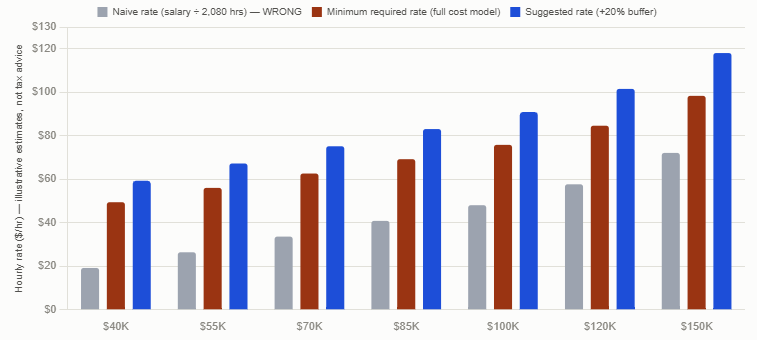
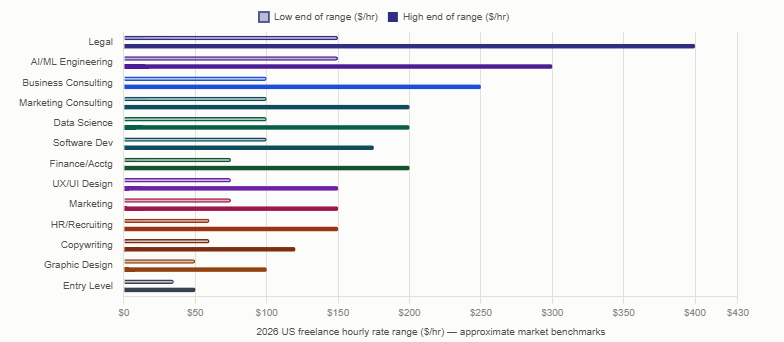 Table of Contents
It is wrong because it ignores the 15.3 percent self-employment tax that replaces the employer’s FICA contribution. It ignores the $6,000 to $18,000 annual cost of individual health insurance on the ACA marketplace. It ignores the employer retirement match that no longer arrives. It ignores the paid vacation, paid sick days, and paid holidays that W-2 employees receive and freelancers do not. And it ignores the 25 to 40 percent of working time that goes to administration, client acquisition, invoicing, and other non-billable activities that do not generate revenue.
Accounting for all of these factors, a freelancer who wants to match the financial position of a $70,000 W-2 salary typically needs to charge $75 to $95 per hour — more than twice the naive calculation. This guide builds that calculation step by step, provides a reference table for common salary levels, and contextualises the result against 2026 market rate data by field.
The Numbers: 72.9–76.4 million Americans now freelance in some capacity (MBO Partners 2025 / DemandSage 2026) — approximately 36% of the US workforce. Average US freelancer annual income: $108,028. 78% of skilled freelancers report pay satisfaction vs 64% of full-time employees (Upwork). High-earning freelancers ($100K+) surged 87% in five years: 3M (2020) to 5.6M (2025).
The income data shows that freelancing, at the skilled knowledge-work level, is financially competitive with and often superior to traditional employment:
There are two separate distortions in the naive calculation:
Formula: Required Gross Revenue = (Target Take-Home + Benefits Costs + Business Overhead) ÷ (1 − Effective Tax Rate). Example: ($50,000 take-home + $10,000 health + $3,000 retirement + $4,000 overhead) ÷ (1 − 0.30) = $67,000 ÷ 0.70 = $95,714 required gross revenue.
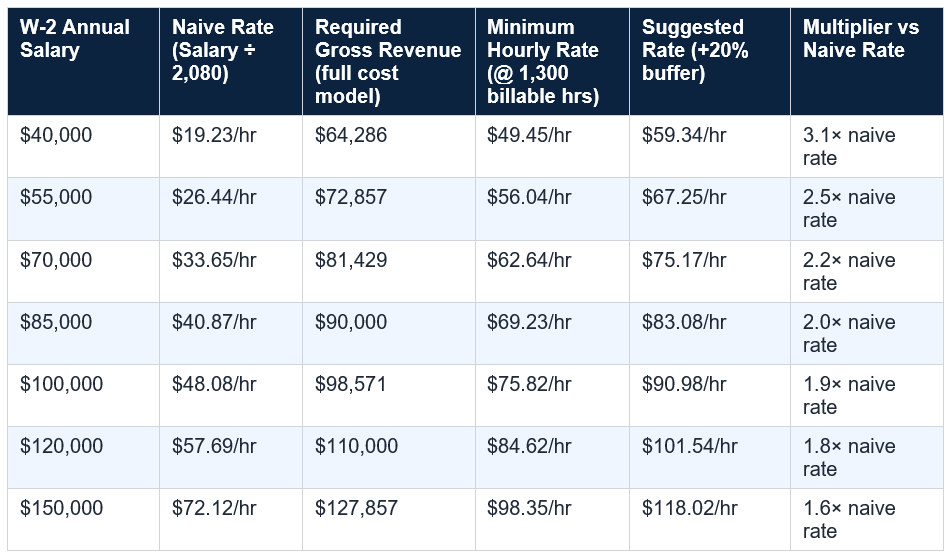
The pattern is clear: lower-salary W-2 workers need a proportionally higher rate multiplier because benefits represent a larger share of their total compensation at lower salary levels. A $40,000 W-2 employee needs to charge more than three times their naive hourly rate to break even as a freelancer. A $150,000 W-2 employee needs to charge approximately 1.6 times. This does not mean higher-salary workers have a smaller challenge — it means their absolute required rate is substantially higher.
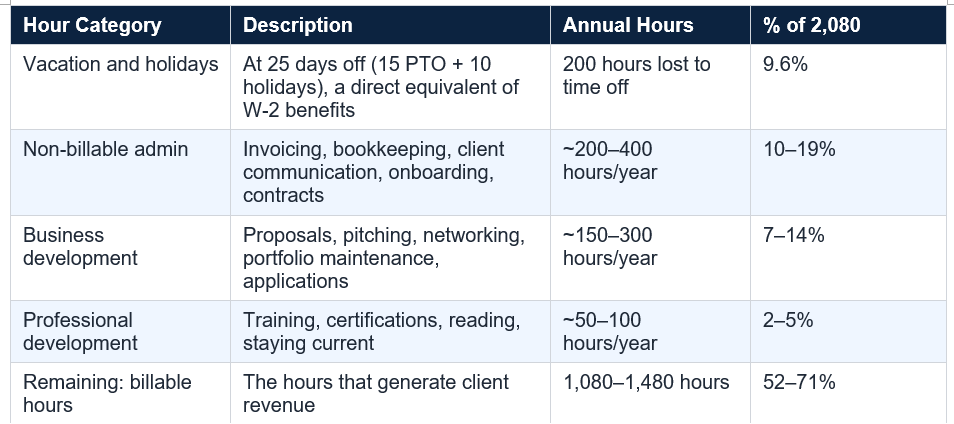
At 75 percent billable efficiency (optimistic for most freelancers): 1,560 billable hours. At 65 percent (more realistic for established freelancers): 1,352 hours. At 60 percent (realistic for new freelancers still building a client base): 1,248 hours. CalcHeadquarters’ June 2026 guide notes that 20 to 30 billable hours per week is the norm for most freelancers when all non-billed work is accounted for — representing an effective billable rate of 50 to 75 percent.
Common Mistake: New freelancers almost always overestimate billable hours in year one. Building a client pipeline, setting up business infrastructure, and learning to run a business takes more time than expected, especially in the first six months. Use 1,000 to 1,200 billable hours as the planning assumption for year one, not 1,560. If you beat it, great. If you planned for it, you will not be in financial crisis.
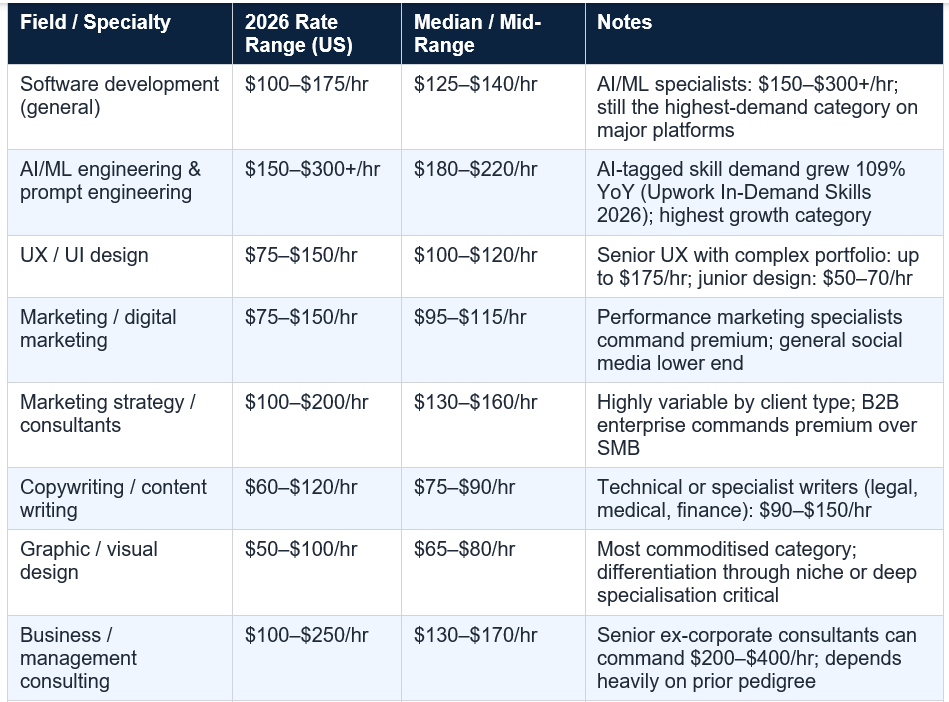
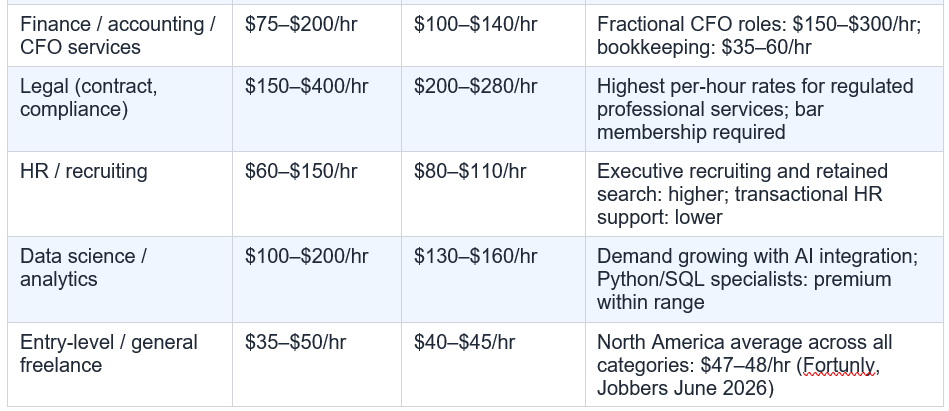
The comparison between your required rate (from the calculation above) and the market range for your field determines the feasibility of your freelance transition. If your required rate falls within the normal market range for your field, the transition is financially viable. If your required rate exceeds the typical market range, the transition requires either reducing costs, increasing specialisation to command premium rates, or taking a temporary income reduction while building toward higher market rates.
The correct sequence: calculate the rate that is mathematically required to meet your actual financial obligations, set that as your floor, research whether that rate is achievable in your market, and if it is achievable, charge it — from the first client.
Two practical adaptations:
The specific mechanics that protect client relationships during rate increases:
The phrase ‘done correctly’ depends primarily on the rate. A freelancer who charges the naive salary-divided-by-hours-figure is not self-employed in any meaningful financial sense; they are an employee without the benefits. The break-even calculation in this guide — accounting for self-employment tax, health insurance, retirement, paid time off, and realistic billable hours — produces a required rate that typically lands 1.5 to 2 times the naive calculation. For most fields, that required rate falls within the normal market range.
Set the right rate, understand what you are actually selling (billable hours, not total working hours), and build the financial infrastructure that variable income requires. The freelancers who are dissatisfied with their income are almost never operating in a market that will not pay enough. They are almost always operating at a rate that is not enough.
The full calculation: (1) Start with your target take-home income (net W-2 paycheck amount). (2) Add back the annual cost of health insurance as a solo purchaser ($8,400–$12,000 is a working assumption for ACA individual coverage). (3) Add retirement contributions you want to make (minimum: equivalent to any employer match you received). (4) Add business overhead (software, equipment, professional fees: typically $2,000–$8,000/year). (5) Gross up for taxes: divide the total by (1 minus your estimated effective tax rate). At 30% effective rate: divide by 0.70. (6) Divide the resulting gross revenue target by realistic billable hours — most established freelancers bill 1,200 to 1,400 hours per year (not 2,080). (7) Add 15–20% buffer for negotiation and scope creep. The result is your suggested hourly rate. The naive calculation (salary ÷ 2,080) typically understates the required rate by 50 to 100 percent.
How much more than my salary do I need to charge as a freelancer?
Based on the full cost model applied to common salary levels, freelancers typically need to generate 1.5 to 2× their W-2 hourly equivalent in gross revenue to match their W-2 financial position. The multiplier is higher at lower salary levels because benefits represent a larger share of total compensation for lower earners. At $40,000: the required hourly rate is approximately 3.1× the naive calculation. At $70,000: approximately 2.2× the naive calculation. At $120,000: approximately 1.8× the naive calculation. These are illustrative estimates based on standardised benefit and tax assumptions; individual results vary significantly by state, filing status, health insurance age rating, and actual overhead costs.
What is the self-employment tax rate in 2026?
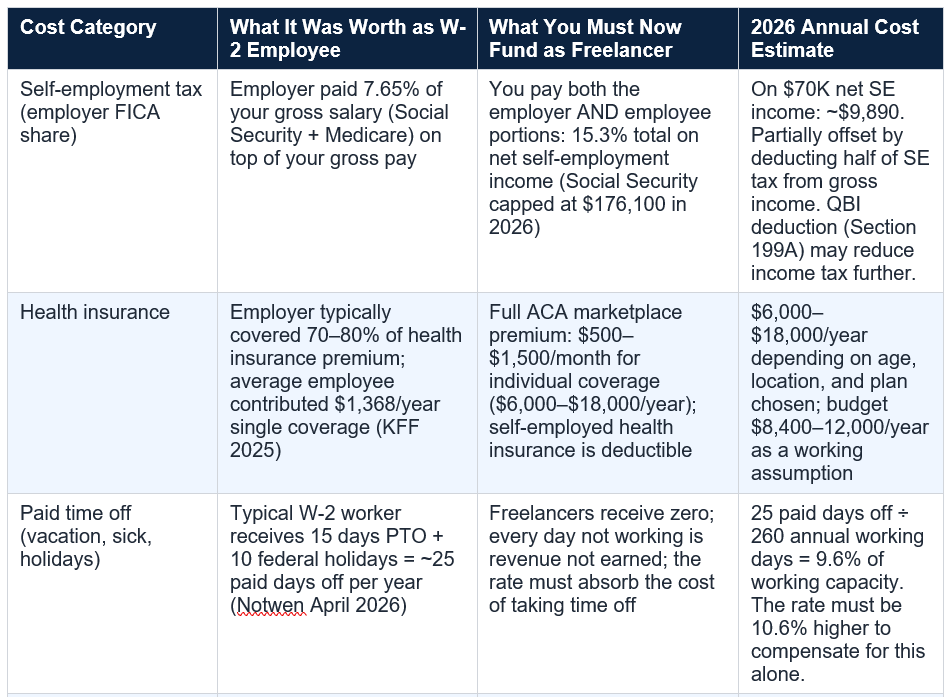
Self-employed individuals in the US pay self-employment (SE) tax of 15.3% on net self-employment income (up to the Social Security wage base of $176,100 in 2026). This combines the employee portion (7.65%) and the employer portion (7.65%) of Social Security and Medicare taxes. As a W-2 employee, your employer paid the 7.65% employer portion in addition to your salary — it was never visible to you but was a real cost of your employment. As a freelancer, you pay both portions. However, two tax provisions partially offset this: you can deduct half of SE tax from your gross income before calculating income tax, and the QBI (Section 199A) deduction allows eligible self-employed individuals to deduct up to 20% of qualified business income from federal taxable income. These deductions reduce but do not eliminate the SE tax burden. Consult a CPA for your specific situation.
How many billable hours per year can a freelancer realistically expect?
Most established freelancers bill 60 to 75 percent of their total working time, according to Upwork and FreelanceCalc (June 2026). At a standard 40-hour week and 47 working weeks (accounting for vacation): 75% billable = approximately 1,410 hours/year; 65% billable = approximately 1,222 hours/year; 60% billable = approximately 1,128 hours/year. CalcHeadquarters (June 2026) notes that 20 to 30 billable hours per week is the norm for most freelancers when all non-billed work is included. For new freelancers in year one, 1,000 to 1,200 billable hours is a more realistic planning assumption because client acquisition and business infrastructure take more time than expected. The right billable hours assumption for your situation is the most important single variable in the rate calculation — being optimistic about billable hours will systematically understate the required rate.
What are average freelance hourly rates by field in 2026?
Based on 2026 market data from Rize, CalcHeadquarters, FreelanceCalc, and Upwork: software development: $100–$175/hr; AI/ML engineering: $150–$300+/hr (fastest growing, +109% YoY demand); UX/UI design: $75–$150/hr; marketing consultants: $100–$200/hr; copywriting: $60–$120/hr; graphic design: $50–$100/hr; business consulting: $100–$250/hr; legal: $150–$400/hr; data science: $100–$200/hr; entry-level/general: $35–$50/hr. The North America average across all freelance categories is approximately $47–$48/hour (Fortunly March 2026; Jobbers June 2026). High-demand, highly-specialised skills command 2–3× the general average. The key benchmark is whether your required rate (from the calculation above) falls within the market range for your specific field and specialisation.
How do I handle slow months as a freelancer?
Slow months are predictable — Q1 (January/February after holiday budget cycles) and summer are historically softer for many fields. The practical response has two components: (1) Revenue smoothing: maintain a business account buffer of 2–3 months of required revenue. During high-revenue months, replenish the buffer. During slow months, draw from it for personal income. This decouples your personal spending from your monthly billing cycle and eliminates the panic-driven rate-cutting that slow months often trigger. (2) Adjusted rate targeting: if you realistically expect to be fully booked for 9 months rather than 12, your annual revenue target must be achievable in 9 months. Divide your annual revenue target by 9, not 12, to determine your monthly target during active months. This builds the slow-month income automatically into the rate structure rather than treating slow months as financial emergencies.
Table of Contents
- The Salary Number That Quietly Becomes the Wrong Number
- The Scale of the Freelance Economy in 2026
- Why Your Old Hourly Rate Is the Wrong Starting Point
- The Seven Costs a W-2 Salary Hides From You
- Step-by-Step: The Rate Calculation That Actually Works
- The Real Rate by Salary: A Reference Table
- Billable Hours — The Variable That Changes Everything
- Freelance Hourly Rate Benchmarks by Field (2026)
- Beyond Break-Even: What to Charge to Actually Build Wealth
- The Mistake Most Freelancers Make in the First Year
- Adjusting Your Rate for Irregular Income and Slow Months
- How to Raise Your Rate Without Losing Your Best Clients
- Conclusion: The Rate Is Not Just a Number — It’s a Business Decision
- Frequently Asked Questions
Rate Needed By Salary level
Market rate By Field 2026
Table of Contents
The Salary Number That Quietly Becomes the Wrong Number
The calculation seems obvious. You earn $70,000 per year as a W-2 employee. Divide by 2,080 annual working hours and you get $33.65 per hour. Charge $34 per hour as a freelancer and you have replaced your salary. This is the most dangerous calculation in freelancing, and it is wrong by approximately 60 to 80 percent.It is wrong because it ignores the 15.3 percent self-employment tax that replaces the employer’s FICA contribution. It ignores the $6,000 to $18,000 annual cost of individual health insurance on the ACA marketplace. It ignores the employer retirement match that no longer arrives. It ignores the paid vacation, paid sick days, and paid holidays that W-2 employees receive and freelancers do not. And it ignores the 25 to 40 percent of working time that goes to administration, client acquisition, invoicing, and other non-billable activities that do not generate revenue.
Accounting for all of these factors, a freelancer who wants to match the financial position of a $70,000 W-2 salary typically needs to charge $75 to $95 per hour — more than twice the naive calculation. This guide builds that calculation step by step, provides a reference table for common salary levels, and contextualises the result against 2026 market rate data by field.
The Numbers: 72.9–76.4 million Americans now freelance in some capacity (MBO Partners 2025 / DemandSage 2026) — approximately 36% of the US workforce. Average US freelancer annual income: $108,028. 78% of skilled freelancers report pay satisfaction vs 64% of full-time employees (Upwork). High-earning freelancers ($100K+) surged 87% in five years: 3M (2020) to 5.6M (2025).
The Scale of the Freelance Economy in 2026
Freelancing has completed the transition from side hustle to mainstream career structure. The numbers are unambiguous: 72.9 to 76.4 million Americans freelance in some capacity (MBO Partners State of Independence 2025, widely cited), representing approximately 36 percent of the total US workforce. DemandSage’s July 2026 analysis projects US freelancers will represent approximately 48.5 percent of the total workforce by late 2026, with the broader gig economy growing three times faster than the traditional workforce, according to Freelance Economy Statistics 2026.The income data shows that freelancing, at the skilled knowledge-work level, is financially competitive with and often superior to traditional employment:
- Average US freelancer annual income: approximately $108,028 (DemandSage/ZipRecruiter 2025 data, Jobbers.io June 2026) — more than double the US median personal income of $42,220.
- Full-time skilled freelancers: median income approximately $85,000 in 2024 (Upwork Future Workforce Index, April 2025).
- High-earning freelancers (above $100,000): surged from 3 million in 2020 to 5.6 million in 2025, an 87 percent increase in five years (The Interview Guys, State of the Gig Economy 2025).
- 78 percent of skilled freelancers report satisfaction with their pay, versus 64 percent of full-time employees (Upwork Future Workforce Index).
Why Your Old Hourly Rate Is the Wrong Starting Point
The instinct to start with ‘what I was earning divided by hours worked’ is understandable. It is the number that feels concrete and familiar. But the W-2 hourly rate is the rate after your employer has already covered a substantial package of costs that now fall entirely to you as a freelancer. The Rize freelance rate calculator (July 2026) summarises the issue precisely: ‘W-2 employees receive employer-paid benefits worth 25–40% of their salary — including half of FICA taxes, health insurance, retirement matching, and paid time off.’There are two separate distortions in the naive calculation:
- The cost distortion: the employer was paying costs on your behalf that you must now pay yourself. Self-employment tax (the employer’s FICA share), health insurance, retirement contributions, and the value of paid time off all disappear from your compensation package and must be rebuilt from freelance revenue.
- The billable hours distortion: as a W-2 employee, you were paid for 2,080 hours per year including meetings, internal administration, and training. As a freelancer, you only generate revenue from the hours you bill to clients. The administrative hours — client emails, invoicing, proposals, marketing, bookkeeping, professional development — are unpaid. Upwork and FreelanceCalc both note that freelancers bill approximately 60 to 75 percent of their working time; the rest is non-billable overhead.
The Seven Costs a W-2 Salary Hides From You
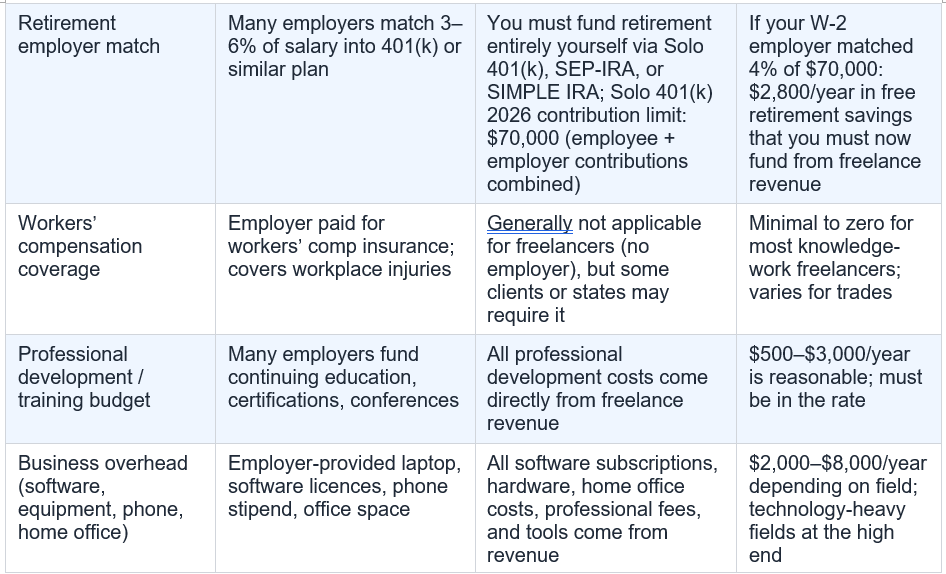
Before calculating the required rate, each of the seven W-2 benefit components must be quantified:
Step-by-Step: The Rate Calculation That Actually Works
The correct freelance rate calculation, adapted from Notwen (April 2026), Rize (July 2026), MyTaxQuarter (July 2026), and Upwork’s rate-setting guide, works backward from desired take-home income:Step 1: Determine your target take-home income
This is the after-tax, after-expense figure you need to match your W-2 financial position. Start with the net take-home from your W-2 paycheck — the actual amount deposited after all deductions.Step 2: Add back all the costs your employer was covering
Add to your target take-home:- Health insurance annual premium as a solo purchaser (budget $8,400 to $12,000 per year).
- Retirement contributions you want to make (equivalent to the former employer match, minimum).
- Professional development and training costs.
- Business overhead (software, equipment, office).
Step 3: Gross up for taxes
Freelancers pay federal and state income tax plus self-employment tax on net profit. Because these taxes are not withheld, they must be included in the rate calculation. A commonly used gross-up rule: set aside 25 to 35 percent of gross revenue for taxes (the right number depends on filing status, state, deductions, and income level per MyTaxQuarter July 2026). To gross up: divide your required pre-tax income by (1 minus your effective tax rate). At 30 percent effective rate: divide by 0.70. This produces the total gross revenue required.Formula: Required Gross Revenue = (Target Take-Home + Benefits Costs + Business Overhead) ÷ (1 − Effective Tax Rate). Example: ($50,000 take-home + $10,000 health + $3,000 retirement + $4,000 overhead) ÷ (1 − 0.30) = $67,000 ÷ 0.70 = $95,714 required gross revenue.
Step 4: Calculate billable hours
Determine realistic billable hours — not total working hours. At 40 hours per week, the naive calculation yields 2,080 annual hours. In practice, most freelancers bill 60 to 75 percent of working time (Upwork; FreelanceCalc June 2026), producing 1,248 to 1,560 billable hours per year. Subtract planned vacation: 3 weeks off reduces by 120 hours. A realistic figure for most established freelancers: 1,200 to 1,400 billable hours per year.Step 5: Divide required revenue by billable hours
Formula: Required Hourly Rate = Required Gross Revenue ÷ Billable Hours. Using the example above: $95,714 ÷ 1,300 billable hours = $73.63/hour minimum. Add a 15–20% buffer for negotiation and scope creep: $73.63 × 1.175 = $86.50/hour suggested rate.The Real Rate by Salary: A Reference Table
The table below applies the full calculation model to common W-2 salary levels. Assumptions: 30% effective tax rate (federal + state + SE tax net of deductions); $10,000 annual health insurance; $3,000 retirement; $4,000 overhead; 25 days PTO equivalent absorbed into rate; 1,300 billable hours per year (a realistic working assumption for an established freelancer). All figures are illustrative estimates; individual results vary significantly by state, filing status, deductions, and actual overhead.The pattern is clear: lower-salary W-2 workers need a proportionally higher rate multiplier because benefits represent a larger share of their total compensation at lower salary levels. A $40,000 W-2 employee needs to charge more than three times their naive hourly rate to break even as a freelancer. A $150,000 W-2 employee needs to charge approximately 1.6 times. This does not mean higher-salary workers have a smaller challenge — it means their absolute required rate is substantially higher.
Billable Hours — The Variable That Changes Everything
The billable hours assumption is the most powerful single variable in the rate calculation, and it is the one most optimistically overestimated by new freelancers. A standard year has 2,080 total working hours. Here is what actually happens to those hours:At 75 percent billable efficiency (optimistic for most freelancers): 1,560 billable hours. At 65 percent (more realistic for established freelancers): 1,352 hours. At 60 percent (realistic for new freelancers still building a client base): 1,248 hours. CalcHeadquarters’ June 2026 guide notes that 20 to 30 billable hours per week is the norm for most freelancers when all non-billed work is accounted for — representing an effective billable rate of 50 to 75 percent.
Common Mistake: New freelancers almost always overestimate billable hours in year one. Building a client pipeline, setting up business infrastructure, and learning to run a business takes more time than expected, especially in the first six months. Use 1,000 to 1,200 billable hours as the planning assumption for year one, not 1,560. If you beat it, great. If you planned for it, you will not be in financial crisis.
Freelance Hourly Rate Benchmarks by Field (2026)
Knowing your required rate is the floor. Knowing the market rate is the ceiling — and determines whether your required rate is achievable in your field. The 2026 market data from Rize (July 2026), CalcHeadquarters (June 2026), FreelanceCalc (June 2026), and Upwork provides the following field benchmarks:The comparison between your required rate (from the calculation above) and the market range for your field determines the feasibility of your freelance transition. If your required rate falls within the normal market range for your field, the transition is financially viable. If your required rate exceeds the typical market range, the transition requires either reducing costs, increasing specialisation to command premium rates, or taking a temporary income reduction while building toward higher market rates.
Beyond Break-Even: What to Charge to Actually Build Wealth
The calculation in Section 5 produces a break-even rate — the rate at which freelance income matches the W-2 financial position. A break-even rate is not a wealth-building rate. Several additional components must be added to move from financial parity to financial progress as a freelancer:- Emergency fund build-up: W-2 employees with employer health insurance and PTO can maintain a smaller emergency fund. Freelancers with variable income and no employer backstop need a larger one — typically six months of total expenses. The cost of building this fund should be included in the rate calculation during the first one to two years of freelancing.
- Retirement savings above the employer-match equivalent: the Solo 401(k) allows freelancers to contribute up to $70,000 in 2026 (employee + employer-equivalent contributions combined). Taking advantage of this requires revenue above the break-even figure. Tax-advantaged retirement savings is one of the most powerful freelance financial tools available.
- Rate progression premium: a 10 to 20 percent buffer above the break-even minimum accommodates scope creep (client requests that expand the work beyond the quoted scope without additional compensation), slow months (Q1 and summer are historically softer for many freelancers), and rate increase events (market rate inflation over time).
The Mistake Most Freelancers Make in the First Year
CalcHeadquarters’ June 2026 guide identifies the most consistent first-year pricing error: ‘Undercharging to ‘get started.’ Low rates attract low-quality clients who demand the most work.’ The logic of undercharging feels sound: charge less than the market to attract initial clients, build a portfolio, and raise rates later. In practice, this strategy has three compounding problems:- Low rates attract clients who are primarily price-sensitive. These clients are the most likely to scope-creep, the most likely to be difficult to work with, and the least likely to provide referrals to premium-rate clients. The portfolio built from low-rate clients does not position the freelancer for premium-rate clients.
- Raising rates on existing clients is psychologically and commercially difficult. A client who hired you at $50 per hour has calibrated their budget and their perception of your value to $50 per hour. Moving to $80 per hour requires either a significant perceived-value jump (new capabilities, demonstrated results) or an acceptance of client turnover.
- The financial stress of undercharging compromises the quality of the work. A freelancer who is financially stressed takes on more clients at a lower rate to compensate for the shortfall, creating a cycle of overwork at low margins that is the opposite of the freelance model’s advantage.
The correct sequence: calculate the rate that is mathematically required to meet your actual financial obligations, set that as your floor, research whether that rate is achievable in your market, and if it is achievable, charge it — from the first client.
Adjusting Your Rate for Irregular Income and Slow Months
The single most structurally different feature of freelance income relative to W-2 income is variability. A W-2 paycheck arrives on a predictable schedule in a predictable amount. Freelance income varies by month, by client, and by season. Seventy-six percent of freelancers worry about saving enough, and 75 percent say retirement savings is a major concern — both reflecting the difficulty of long-term financial planning on variable income (Freelance Economy Statistics 2026).Two practical adaptations:
- Revenue smoothing: calculate your required monthly income and maintain a business account buffer of two to three months of that figure. When high-revenue months arrive, replenish the buffer rather than spending the surplus. When slow months arrive, draw from the buffer rather than from the rate. This decouples your personal spending from your monthly billing cycle.
- Average rate adjustment for capacity utilisation: if you expect to be fully booked (close to 100% capacity) only 8 to 10 months per year, your annual rate must generate 12 months of required income in 8 to 10 months. Divide your annual revenue target by the realistic number of fully-booked months rather than 12. The result is a higher monthly target that automatically accommodates the slow months.
How to Raise Your Rate Without Losing Your Best Clients
MyTaxQuarter’s July 2026 guide on raising rates provides the clearest professional protocol: give advance notice, explain the business reason briefly, anchor the increase to continued quality and availability, and allow existing clients to complete current scopes at the old rate. The guide is explicit: ‘Avoid apologising for a sustainable business decision.’The specific mechanics that protect client relationships during rate increases:
- Give at least 60 days’ notice: this allows clients to adjust their budget planning and demonstrates professional respect for their planning process.
- State the effective date clearly: ‘My rate will change to $X on [date].’ Not ‘I am thinking about raising my rates’ or ‘I may need to adjust my pricing.’
- Offer scope completion at the current rate: existing projects can be completed at the current rate; new projects or new scopes commence at the new rate. This is standard professional practice that most clients accept readily.
- Offer alternatives if the client cannot absorb the increase: a smaller scope, a retainer structure that provides cost predictability, or a referral to another provider at the current price range. Never quietly absorb a rate you cannot sustain.
Conclusion
Seventy-two point nine to seventy-six million Americans now freelance in some capacity. High-earning freelancers above $100,000 per year have grown 87 percent in five years. Seventy-eight percent of skilled freelancers report pay satisfaction, compared to 64 percent of their employed counterparts. The data shows that freelancing, done correctly, produces financial outcomes as good as or better than traditional employment.The phrase ‘done correctly’ depends primarily on the rate. A freelancer who charges the naive salary-divided-by-hours-figure is not self-employed in any meaningful financial sense; they are an employee without the benefits. The break-even calculation in this guide — accounting for self-employment tax, health insurance, retirement, paid time off, and realistic billable hours — produces a required rate that typically lands 1.5 to 2 times the naive calculation. For most fields, that required rate falls within the normal market range.
Set the right rate, understand what you are actually selling (billable hours, not total working hours), and build the financial infrastructure that variable income requires. The freelancers who are dissatisfied with their income are almost never operating in a market that will not pay enough. They are almost always operating at a rate that is not enough.
Frequently Asked Questions
How do I calculate what hourly rate I need as a freelancer to replace my salary?The full calculation: (1) Start with your target take-home income (net W-2 paycheck amount). (2) Add back the annual cost of health insurance as a solo purchaser ($8,400–$12,000 is a working assumption for ACA individual coverage). (3) Add retirement contributions you want to make (minimum: equivalent to any employer match you received). (4) Add business overhead (software, equipment, professional fees: typically $2,000–$8,000/year). (5) Gross up for taxes: divide the total by (1 minus your estimated effective tax rate). At 30% effective rate: divide by 0.70. (6) Divide the resulting gross revenue target by realistic billable hours — most established freelancers bill 1,200 to 1,400 hours per year (not 2,080). (7) Add 15–20% buffer for negotiation and scope creep. The result is your suggested hourly rate. The naive calculation (salary ÷ 2,080) typically understates the required rate by 50 to 100 percent.
How much more than my salary do I need to charge as a freelancer?
Based on the full cost model applied to common salary levels, freelancers typically need to generate 1.5 to 2× their W-2 hourly equivalent in gross revenue to match their W-2 financial position. The multiplier is higher at lower salary levels because benefits represent a larger share of total compensation for lower earners. At $40,000: the required hourly rate is approximately 3.1× the naive calculation. At $70,000: approximately 2.2× the naive calculation. At $120,000: approximately 1.8× the naive calculation. These are illustrative estimates based on standardised benefit and tax assumptions; individual results vary significantly by state, filing status, health insurance age rating, and actual overhead costs.
What is the self-employment tax rate in 2026?
Self-employed individuals in the US pay self-employment (SE) tax of 15.3% on net self-employment income (up to the Social Security wage base of $176,100 in 2026). This combines the employee portion (7.65%) and the employer portion (7.65%) of Social Security and Medicare taxes. As a W-2 employee, your employer paid the 7.65% employer portion in addition to your salary — it was never visible to you but was a real cost of your employment. As a freelancer, you pay both portions. However, two tax provisions partially offset this: you can deduct half of SE tax from your gross income before calculating income tax, and the QBI (Section 199A) deduction allows eligible self-employed individuals to deduct up to 20% of qualified business income from federal taxable income. These deductions reduce but do not eliminate the SE tax burden. Consult a CPA for your specific situation.
How many billable hours per year can a freelancer realistically expect?
Most established freelancers bill 60 to 75 percent of their total working time, according to Upwork and FreelanceCalc (June 2026). At a standard 40-hour week and 47 working weeks (accounting for vacation): 75% billable = approximately 1,410 hours/year; 65% billable = approximately 1,222 hours/year; 60% billable = approximately 1,128 hours/year. CalcHeadquarters (June 2026) notes that 20 to 30 billable hours per week is the norm for most freelancers when all non-billed work is included. For new freelancers in year one, 1,000 to 1,200 billable hours is a more realistic planning assumption because client acquisition and business infrastructure take more time than expected. The right billable hours assumption for your situation is the most important single variable in the rate calculation — being optimistic about billable hours will systematically understate the required rate.
What are average freelance hourly rates by field in 2026?
Based on 2026 market data from Rize, CalcHeadquarters, FreelanceCalc, and Upwork: software development: $100–$175/hr; AI/ML engineering: $150–$300+/hr (fastest growing, +109% YoY demand); UX/UI design: $75–$150/hr; marketing consultants: $100–$200/hr; copywriting: $60–$120/hr; graphic design: $50–$100/hr; business consulting: $100–$250/hr; legal: $150–$400/hr; data science: $100–$200/hr; entry-level/general: $35–$50/hr. The North America average across all freelance categories is approximately $47–$48/hour (Fortunly March 2026; Jobbers June 2026). High-demand, highly-specialised skills command 2–3× the general average. The key benchmark is whether your required rate (from the calculation above) falls within the market range for your specific field and specialisation.
How do I handle slow months as a freelancer?
Slow months are predictable — Q1 (January/February after holiday budget cycles) and summer are historically softer for many fields. The practical response has two components: (1) Revenue smoothing: maintain a business account buffer of 2–3 months of required revenue. During high-revenue months, replenish the buffer. During slow months, draw from it for personal income. This decouples your personal spending from your monthly billing cycle and eliminates the panic-driven rate-cutting that slow months often trigger. (2) Adjusted rate targeting: if you realistically expect to be fully booked for 9 months rather than 12, your annual revenue target must be achievable in 9 months. Divide your annual revenue target by 9, not 12, to determine your monthly target during active months. This builds the slow-month income automatically into the rate structure rather than treating slow months as financial emergencies.
0 Comments
Be the first to share your thoughts on this article.