

Retirement
What Hidden Fees Are Draining Your Retirement Account?

Zero-fee’ IRAs can cost $1,400/year. A 1% fee difference costs 28% of your final balance. A median couple pays $155,000 in lifetime 401(k) fees. 66% of Americans lack confidence in IRA knowledge. The fees are real. Most people cannot see them. If your retirement account statement shows a positive balance and no visible deductions, everything is fine. That is the reasonable assumption most people make, and it is almost certainly wrong. In August 2026, PensionBee published research showing that ‘zero-fee’ IRA accounts — accounts explicitly marketed as having no fees — carry hidden annual costs of $160 to $1,400 depending on how the account is managed. The six mechanisms they identified — cash sweep spreads, securities lending, payment for order flow, high fund expense ratios, administrative charges, and misleading fine print — are all invisible on a standard account statement. The Demos research reported by American Progress found that the average 401(k) plan charges approximately 1% of assets annually, that 65% of retirement savers have no idea they are paying off-the-top fees, and that a median two-earner household will pay nearly $155,000 in lifetime 401(k) fees. Gerald.com’s 2026 retirement planning guide documents the mechanical impact: a 1% difference in fees and expenses would reduce your account balance at retirement by 28%. On a $1 million retirement pot, that is $280,000. On $2 million, it is $560,000. These are not abstractions. They are the retirement years that the fees buy from you, one invisible deduction at a time.
IRAs: $19.2 trillion by end of 2025 (ICI via Investment News August 2026). 66% of Americans lack confidence in IRA knowledge (BriefGlance/PensionBee August 2026). 65% of retirement savers unaware they are paying off-the-top fees (Demos report via American Progress). 40% don't understand their 401(k) fees (BriefGlance August 2026).
1% fee difference = 28% reduction in final retirement balance (Gerald.com 2026 citing DOL). Average 401(k) expense ratios: 0.5%-2% annually (Gerald.com 2026). Index fund expense ratios: as low as 0.03% (Gerald.com 2026). On $500,000 over 30 years: difference between 0.03% and 1.0% fee = approximately $1 million in final balance. Check your 401(k) fund factsheets (available in the plan's fund lineup) or go to each fund's page on Morningstar.com and look for 'Expense Ratio'. For your IRA: check each fund's prospectus or any ETF data page. Look for the 'annual ongoing charge' or 'expense ratio' or 'total expense ratio (TER)'. Switch to low-cost index funds within your plan. S&P 500 index ETFs are available at 0.03%-0.05% at most major brokerages. If your 401(k) plan offers only high-expense-ratio funds with no index alternative, raise the issue with your HR department or plan administrator.
Median two-earner household: pays nearly $155,000 in lifetime 401(k) fees (Demos report via Forbes/American Progress). 65% of retirement savers unaware they are paying off-the-top fees (Demos). Employers pass 91% of 401(k) plan costs to employees (Demos). Average 401(k) plan fees: approximately 1% of assets managed (American Progress).
Request your plan's 408(b)(2) fee disclosure document from your HR department or plan administrator. This is a DOL-mandated document that must be provided. It lists all plan-level fees. Also check your 401(k) statements for any per-participant account fees deducted annually. Review the 408(b)(2) fee disclosure. If your plan's total fees (admin plus fund expenses) exceed 1%, you are paying above average. Raise the issue with HR — they can advocate for a lower-cost plan with the plan provider. If you leave an employer, consider rolling your 401(k) to a low-cost IRA where you control the fund selection.
PensionBee August 2026 (Investment News): 'zero-fee' IRAs cost $160-$340/year under optimal conditions; up to $1,400/year with common saver behaviour. Six hidden mechanisms: cash sweep spreads, securities lending, payment for order flow, high fund expense ratios, administrative charges, misleading fine print. Actively managed funds in 'zero-fee' IRA: $170,000+ in lost returns over 30 years vs low-cost index alternatives. 66% of Americans lack confidence in IRA knowledge.
For your IRA: check the account's fee schedule in the terms and conditions. Specifically search for: 'cash sweep rate,' 'securities lending,' 'payment for order flow,' and 'fund expense ratios.' Compare what the broker earns on your cash balance vs a competitive money market rate. Check the expense ratios of every fund you hold. Request the full fee schedule. Compare cash sweep rates to market rates. Hold your funds in the highest-rate sweep account available, or redirect uninvested cash to a money market fund. Switch actively managed funds to low-cost index ETFs. PensionBee's research found that optimised fund selection is the single largest fee-reduction lever.
12b-1 fees: typically 0.25%-1.00% of assets annually, embedded in expense ratio (not separately disclosed). SEC-permitted under Rule 12b-1. Covers fund distribution and marketing costs. DWealth News March 25, 2026: 12b-1 fees among 8 hidden retirement fee categories. Not financial advice.
Check the fund's prospectus or Statement of Additional Information (SAI). Look for the section on 'Distribution and/or Service (12b-1) Fees'. For 401(k) funds, these are sometimes disclosed in the 408(b)(2) fee disclosure document. ETFs do not carry 12b-1 fees — this is exclusively a mutual fund cost.
Prefer ETFs over mutual funds where equivalent low-cost options exist. ETFs do not charge 12b-1 fees by structure. If your 401(k) only offers mutual funds, check each fund's prospectus for 12b-1 fee disclosure and choose the share class with the lowest or zero 12b-1 fee (typically 'institutional' or 'R6' share classes).
Account maintenance fees: typically $25-$75/year at legacy or bank-based providers. Transfer/ACAT fees: typically $50-$150 per outbound transfer. DWealth News March 2026: maintenance, custodial, and transfer fees in 8 hidden fee categories. FXStreet July 2025: maintenance and transaction fees as IRA cost categories. Major online brokerages have largely eliminated account maintenance fees for standard accounts. Check your account's current fee schedule (available on the provider's website or your account statements). Search specifically for: 'account maintenance fee', 'annual custodian fee', 'ACAT transfer fee', 'closing fee', and 'paper statement fee'. These are often in small print in the account agreement. If you are paying annual maintenance fees, compare the total ongoing cost at your current provider versus consolidating to a major low-cost brokerage (Fidelity, Vanguard, Schwab charge $0 maintenance for standard accounts). Calculate whether the transfer fee (if any) is worth the ongoing savings. In most cases, a single year's savings outweighs a one-time transfer fee.


The Demos research cited by American Progress identified two primary cost layers: fund expense ratios (averaging approximately 1% of assets in many plans, per American Progress's analysis) and administrative/recordkeeping fees that the employer passes to employees (91% of plan costs, per Demos). Gerald.com's 2026 guide adds that many 401(k) plans carry expense ratios between 0.5% and 2% annually plus these administrative fees. The total 401(k) fee picture is visible in the plan's 408(b)(2) fee disclosure document — request this from your HR department. It is a DOL-mandated document. 65% of retirement savers have no idea they are paying off-the-top fees (Demos report).
Can a 'zero-fee' IRA really cost $1,400 per year?
Yes — according to PensionBee's research published in August 2026 and covered by Investment News. The study identified six hidden revenue mechanisms: cash sweep spreads, securities lending, payment for order flow, high fund expense ratios, administrative charges, and misleading fine print. Under optimal conditions on a median $107,000 IRA balance, these mechanisms generate hidden annual costs of $160-$340. With common saver behaviour (not fully optimised fund selection), costs can reach approximately $1,400/year. Over 30 years, using actively managed funds inside a 'zero-fee' IRA rather than low-cost index alternatives could cost over $170,000 in lost returns. 66% of Americans lack confidence in IRA knowledge. The research was framed by PensionBee CEO Romi Savova as rewarding financial expertise and penalising its absence.
What is an expense ratio and how much should I be paying?
An expense ratio is the annual percentage fee charged by a fund to cover its operating costs, deducted from the fund's assets before calculating its daily price. Gerald.com's 2026 guide identifies the spectrum: many 401(k) actively managed funds carry expense ratios between 0.5% and 2% annually. Index funds are available at expense ratios as low as 0.03% at major brokerages. DWealth News (March 2026) identifies expense ratios as the 'silent killer' of retirement savings. Gerald.com confirms: a 1% difference in fees reduces the final retirement balance by 28% (citing DOL research). For most investors, expense ratios under 0.10% on a diversified index fund represent an achievable benchmark. Anything above 0.50% deserves a specific justification.
What is a 12b-1 fee and do I have to pay it?
A 12b-1 fee is a mutual fund fee, permitted under SEC Rule 12b-1, that covers the fund's distribution and marketing costs. It is embedded within the fund's expense ratio rather than charged separately — making it invisible without reading the fund's prospectus. DWealth News's March 2026 hidden fee guide includes it in the eight categories. Typical 12b-1 fees range from 0.25% to 1.0% of assets annually. ETFs do not charge 12b-1 fees by structure. Institutional share classes of mutual funds often have lower or no 12b-1 fees. You can check whether a specific fund charges a 12b-1 fee by reviewing its prospectus or Statement of Additional Information (SAI) — look under 'Distribution and/or Service (12b-1) Fees'.
How do I find out what fees I am actually paying on my retirement accounts?
For a 401(k): Request the 408(b)(2) fee disclosure document from your HR department. This is legally required to be provided and contains all plan-level fees. Check each fund's expense ratio in the fund lineup. For an IRA: Review the account's fee schedule on the provider's website. Check each fund's expense ratio at Morningstar.com or the fund's own fact sheet. Search account terms for 'cash sweep rate', 'securities lending', 'payment for order flow'. For any account with an adviser: review the advisory agreement for the management fee percentage and any additional fund-level costs. PensionBee's August 2026 research identified that the fee transparency issue is significant: 66% of Americans lack confidence in IRA knowledge.
Table of Contents
- Why Retirement Fees Are Invisible — and Why That Is by Design
- Fee 1 Expense Ratios: The Fee Nobody Mentions at Sign-Up
- Fee 2 401(k) Administrative and Recordkeeping Fees: The Cost of the Plan Itself
- Fee 3 The 'Zero-Fee' IRA Trap: Six Hidden Revenue Mechanisms
- Fee 4 12b-1 Fees: The Marketing Cost You Are Paying
- Fee 5 Account Maintenance, Transfer, and Rollover Fees: The Exit Tax
- The Complete Retirement Fee Audit: A 10-Point Checklist
- What the Maths Looks Like: Fee Impact at Different Balances
- UK Readers: The Same Problem Under Different Names
- Conclusion: The Fee You Cannot See Is the Fee That Costs the Most
- Frequently Asked Questions
Why Retirement Fees Are Invisible — and Why That Is by Design
The invisibility of retirement fees is not an accident of complex financial architecture. It is a design feature. Expense ratios are deducted from fund returns before the daily price is calculated, so you never see the deduction on your statement — you simply receive a slightly lower return than the gross performance of the underlying assets. Administrative fees in 401(k) plans may be charged as fractions of a percent of total plan assets, allocated across all participants in ways that never appear as a line item on an individual statement. Cash sweep spreads — one of the six hidden mechanisms identified by PensionBee in their August 2026 study — work by the brokerage earning interest on your uninvested cash at a higher rate than it pays you, and the difference simply never appears anywhere visible to you. The result, as the PensionBee research states, is that ‘retirement fees are already difficult to understand, even without zero-fee marketing.’ The Investment Company Institute data cited by Investment News shows IRAs holding approximately $19.2 trillion by end of 2025, nearly double 401(k) plan assets. That is an enormous pool of assets generating fee income for providers — much of it from savers who do not know they are paying. The Demos research found that 65% of retirement savers have no idea they are paying off-the-top fees. The August 2026 PensionBee finding that 66% of Americans lack confidence in IRA knowledge is the human correlate of that financial opaqueness.IRAs: $19.2 trillion by end of 2025 (ICI via Investment News August 2026). 66% of Americans lack confidence in IRA knowledge (BriefGlance/PensionBee August 2026). 65% of retirement savers unaware they are paying off-the-top fees (Demos report via American Progress). 40% don't understand their 401(k) fees (BriefGlance August 2026).
Fee 1 Expense Ratios: The Fee Nobody Mentions at Sign-Up
The expense ratio is the annual percentage fee deducted from your fund’s assets to cover the investment manager’s costs of running the fund. It is not charged separately — it is deducted before your daily fund price is calculated, which is precisely why most investors never notice it. You never receive a bill. The money simply disappears from your returns. Gerald.com’s 2026 retirement fee guide identifies the core statistic: a 1% difference in fees and expenses would reduce your account balance at retirement by 28%. The Department of Labor’s own research supports this. For a $500,000 balance over thirty years with a 7% average return: at 0.03% expense ratio (a competitive index fund), the balance grows to approximately $3.74 million. At 1.0% expense ratio (common in actively managed 401(k) funds), it grows to approximately $2.71 million. The difference: approximately $1.03 million — from one fee difference, on one account. DWealth News’ March 2026 hidden fee guide identifies this as the ‘silent killer’ of retirement savings: ‘Even a 0.5% higher fee can shave thousands off your retirement account over time.’ Many 401(k) plans carry expense ratios between 0.5% and 2% annually, according to Gerald.com 2026. Index funds are available at expense ratios as low as 0.03%.1% fee difference = 28% reduction in final retirement balance (Gerald.com 2026 citing DOL). Average 401(k) expense ratios: 0.5%-2% annually (Gerald.com 2026). Index fund expense ratios: as low as 0.03% (Gerald.com 2026). On $500,000 over 30 years: difference between 0.03% and 1.0% fee = approximately $1 million in final balance. Check your 401(k) fund factsheets (available in the plan's fund lineup) or go to each fund's page on Morningstar.com and look for 'Expense Ratio'. For your IRA: check each fund's prospectus or any ETF data page. Look for the 'annual ongoing charge' or 'expense ratio' or 'total expense ratio (TER)'. Switch to low-cost index funds within your plan. S&P 500 index ETFs are available at 0.03%-0.05% at most major brokerages. If your 401(k) plan offers only high-expense-ratio funds with no index alternative, raise the issue with your HR department or plan administrator.
Fee 2 401(k) Administrative and Recordkeeping Fees: The Cost of the Plan Itself
The expense ratio on your investment funds is only part of the fee story in a 401(k) plan. On top of the fund-level charges, the plan itself carries administrative and recordkeeping fees: the cost of the platform, the employee account management, the compliance work, the statements, and the customer service. These fees may be charged as a flat dollar amount per participant, as a percentage of assets, or both. American Progress’s analysis of the Demos ‘Retirement Drain’ report documents the structural problem: employers pass 91% of 401(k) plan costs to employees. The typical outcome is that the employee bears both the expense ratio on their investments and the administrative overhead of running the plan — without either being transparently displayed on a single statement. The Demos research found that a median-income two-earner household will pay nearly $155,000 over their lifetime in 401(k) fees. Sixty-five percent of retirement savers have no idea they are paying ‘off-the-top’ expense ratio and trading fees. The Department of Labor mandated fee disclosure rules (effective July 2012) that require plan administrators to provide a fee disclosure document — but most participants never request it or do not know it exists.Median two-earner household: pays nearly $155,000 in lifetime 401(k) fees (Demos report via Forbes/American Progress). 65% of retirement savers unaware they are paying off-the-top fees (Demos). Employers pass 91% of 401(k) plan costs to employees (Demos). Average 401(k) plan fees: approximately 1% of assets managed (American Progress).
Request your plan's 408(b)(2) fee disclosure document from your HR department or plan administrator. This is a DOL-mandated document that must be provided. It lists all plan-level fees. Also check your 401(k) statements for any per-participant account fees deducted annually. Review the 408(b)(2) fee disclosure. If your plan's total fees (admin plus fund expenses) exceed 1%, you are paying above average. Raise the issue with HR — they can advocate for a lower-cost plan with the plan provider. If you leave an employer, consider rolling your 401(k) to a low-cost IRA where you control the fund selection.
Fee 3 The 'Zero-Fee' IRA Trap: Six Hidden Revenue Mechanisms
The most significant new research on retirement account fees was published in August 2026 by PensionBee, an online retirement provider. Investment News covered the study on August 12, 2026 with a headline that captures the problem precisely: ‘Zero-fee IRAs quietly cost savers up to $1,400 a year.’ The PensionBee research identified six distinct hidden revenue mechanisms inside ‘zero-fee’ IRA products: cash sweep spreads (the interest differential between what the broker earns on your uninvested cash and what it pays you), securities lending (the broker lends out your shares to short sellers and retains part of the fee), payment for order flow (brokers receive payment from market makers for routing your trades, which may result in slightly worse trade execution prices), high fund expense ratios (the broker earns more from higher-fee fund recommendations), administrative charges (buried in account terms), and misleading fine print (conditions that change the advertised zero-fee structure). Applied to the median IRA balance for Millennial and Gen X households ($107,000), a cost-optimised account still carries hidden annual charges of $160 to $340. With common saver behaviour, those charges rise to approximately $1,400 per year. Over thirty years, using actively managed funds within a ‘zero-fee’ IRA rather than low-cost index alternatives could cost a saver over $170,000 in lost returns. PensionBee CEO Romi Savova’s framing is direct: ‘The saver least equipped to catch hidden fees may pay the most.PensionBee August 2026 (Investment News): 'zero-fee' IRAs cost $160-$340/year under optimal conditions; up to $1,400/year with common saver behaviour. Six hidden mechanisms: cash sweep spreads, securities lending, payment for order flow, high fund expense ratios, administrative charges, misleading fine print. Actively managed funds in 'zero-fee' IRA: $170,000+ in lost returns over 30 years vs low-cost index alternatives. 66% of Americans lack confidence in IRA knowledge.
For your IRA: check the account's fee schedule in the terms and conditions. Specifically search for: 'cash sweep rate,' 'securities lending,' 'payment for order flow,' and 'fund expense ratios.' Compare what the broker earns on your cash balance vs a competitive money market rate. Check the expense ratios of every fund you hold. Request the full fee schedule. Compare cash sweep rates to market rates. Hold your funds in the highest-rate sweep account available, or redirect uninvested cash to a money market fund. Switch actively managed funds to low-cost index ETFs. PensionBee's research found that optimised fund selection is the single largest fee-reduction lever.
Fee 4 12b-1 Fees: The Marketing Cost You Are Paying
The 12b-1 fee is one of the most overlooked costs in retail mutual funds, and it is embedded inside the fund’s expense ratio rather than charged separately. Named after the SEC rule that permits it, a 12b-1 fee covers the fund’s distribution and marketing costs — essentially, the cost of advertising the fund and paying financial advisers to recommend it. You, the investor, pay the fund’s marketing budget. DWealth News’ March 2026 guide to hidden retirement fees includes 12b-1 fees — sometimes called ‘fund marketing fees’ — in its eight hidden fee categories. These fees are typically 0.25% to 1.00% of assets annually, and they are included in the published expense ratio, not separately disclosed on most statements. An investor comparing two funds with similar investment strategies may be choosing between one that charges 0.03% (an index ETF with no 12b-1 fee) and one that charges 0.85% (an actively managed fund with a 0.50% 12b-1 component). The investor sees a headline expense ratio, not the breakdown of what is operational cost and what is marketing.12b-1 fees: typically 0.25%-1.00% of assets annually, embedded in expense ratio (not separately disclosed). SEC-permitted under Rule 12b-1. Covers fund distribution and marketing costs. DWealth News March 25, 2026: 12b-1 fees among 8 hidden retirement fee categories. Not financial advice.
Check the fund's prospectus or Statement of Additional Information (SAI). Look for the section on 'Distribution and/or Service (12b-1) Fees'. For 401(k) funds, these are sometimes disclosed in the 408(b)(2) fee disclosure document. ETFs do not carry 12b-1 fees — this is exclusively a mutual fund cost.
Prefer ETFs over mutual funds where equivalent low-cost options exist. ETFs do not charge 12b-1 fees by structure. If your 401(k) only offers mutual funds, check each fund's prospectus for 12b-1 fee disclosure and choose the share class with the lowest or zero 12b-1 fee (typically 'institutional' or 'R6' share classes).
Fee 5 Account Maintenance, Transfer, and Rollover Fees: The Exit Tax
Some retirement account providers charge annual account maintenance fees simply for keeping your account open. Others charge transfer fees when you move assets to another institution. Still others charge account closing fees, paper statement fees, or outbound ACAT transfer fees when you decide to consolidate or switch providers. DWealth News’ March 2026 hidden fee list includes account maintenance, custodial, and transfer fees in category seven. FXStreet’s July 2025 IRA fee explainer identifies maintenance fees and transaction fees as two of the primary cost categories in IRA accounts. These fees are most commonly found in older, legacy accounts or with smaller brokerage firms. The major online brokerages (Fidelity, Vanguard, Schwab) have largely eliminated account maintenance fees for standard accounts. But smaller or older providers, bank-based IRAs, and some employer-sponsored plans still charge them. The most impactful of these — transfer fees of $50-$150 to move your account to a lower-cost provider — can paradoxically deter investors from reducing their ongoing fees. Paying $75 to save $500 per year is an excellent trade. Most investors do not do the maths.Account maintenance fees: typically $25-$75/year at legacy or bank-based providers. Transfer/ACAT fees: typically $50-$150 per outbound transfer. DWealth News March 2026: maintenance, custodial, and transfer fees in 8 hidden fee categories. FXStreet July 2025: maintenance and transaction fees as IRA cost categories. Major online brokerages have largely eliminated account maintenance fees for standard accounts. Check your account's current fee schedule (available on the provider's website or your account statements). Search specifically for: 'account maintenance fee', 'annual custodian fee', 'ACAT transfer fee', 'closing fee', and 'paper statement fee'. These are often in small print in the account agreement. If you are paying annual maintenance fees, compare the total ongoing cost at your current provider versus consolidating to a major low-cost brokerage (Fidelity, Vanguard, Schwab charge $0 maintenance for standard accounts). Calculate whether the transfer fee (if any) is worth the ongoing savings. In most cases, a single year's savings outweighs a one-time transfer fee.
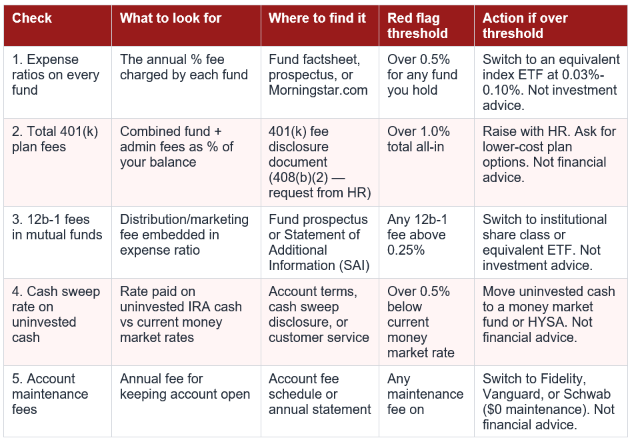
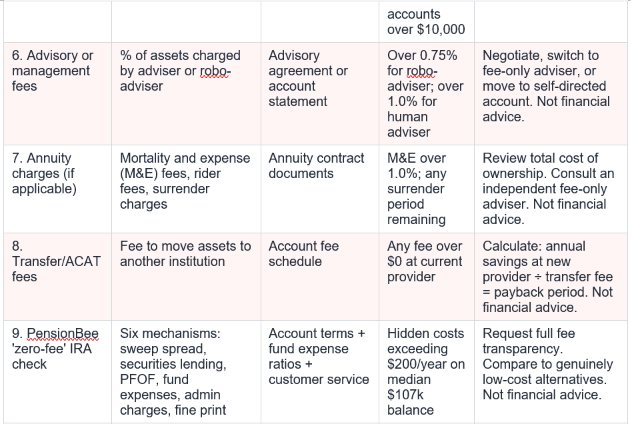
The Complete Retirement Fee Audit: A 10-Point Checklist
Use this checklist once per year to review your retirement accounts for hidden fees. Not financial advice. Consult a qualified adviser for personalised guidance.
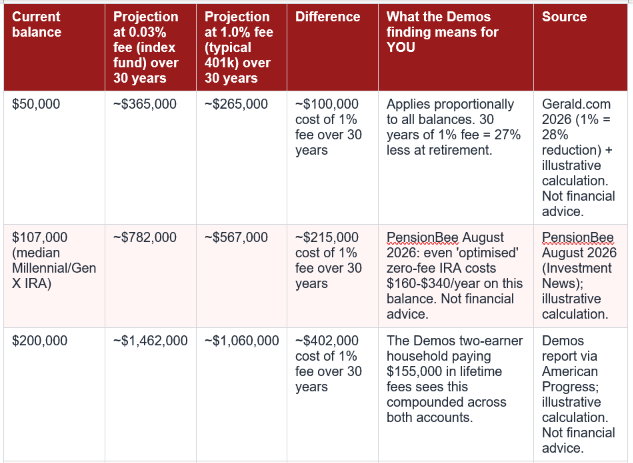
What the Maths Looks Like: Fee Impact at Different Balances
All figures are illustrative, using simplified compound growth calculations assuming a 7% annual return before fees. Not financial projections or investment advice. Past performance does not guarantee future results.
UK Readers: The Same Problem Under Different Names
UK pension savers face the same structural fee problem under slightly different terminology. The Annual Management Charge (AMC) or Total Expense Ratio (TER) on workplace pension and SIPP funds covers the same ground as the US expense ratio. Platform charges on SIPPs (typically 0.15%-0.45% per year at competitive providers) are the UK equivalent of 401(k) administrative fees. The UK Pension Act 2014 introduced a charge cap of 0.75% on default funds in workplace auto-enrolment pensions — providing a baseline protection that has no direct US equivalent for 401(k) participants. However, the cap applies only to the default fund. Non-default fund options within a workplace pension, and all SIPP investments, can carry charges well above this level. The FCA’s retirement outcomes review found that consumers often lack transparency on pension charges — the same finding as the US research. For UK readers: check your pension annual statement for the Total Annual Charge (TAC) or Total Expense Ratio. Compare it against the low-cost benchmark: a SIPP invested in a global index tracker ETF at a competitive platform carries total annual costs of approximately 0.20%-0.35%. Anything above 1.0% total deserves scrutiny. Consult a regulated financial adviser.Conclusion
PensionBee’s August 2026 finding captures the essential injustice of retirement account fees: the saver least equipped to catch them pays the most. The six hidden mechanisms in a ‘zero-fee’ IRA, the 1% administrative overhead on a 401(k) that no one disclosed at sign-up, the 12b-1 marketing fee embedded in a mutual fund’s expense ratio, the cash sweep spread that quietly transfers your uninvested cash return to the brokerage — none of these appear as a line item on a statement. The Demos research put a number on the lifetime cost: $155,000 for the median two-income household. Gerald.com quantified the mechanical effect: a 1% fee difference reduces the final retirement balance by 28%. The PensionBee study projected the thirty-year impact of actively managed funds versus index alternatives at $170,000 in lost returns. These are not edge cases. They are the typical experience of most retirement savers in the United States and the UK, right now, unless they have specifically identified and addressed each fee category. The ten-point checklist in Section 7 is the audit. The fund switches, the plan comparison, the fee transparency request — these are the actions. None of them require financial expertise to complete. They require only the knowledge that the fees exist. This is a general information and educational material and not financial, investment, tax, or retirement advice. Always consult a qualified, regulated financial adviser.Frequently Asked Questions
What are the biggest hidden fees in a 401(k)?The Demos research cited by American Progress identified two primary cost layers: fund expense ratios (averaging approximately 1% of assets in many plans, per American Progress's analysis) and administrative/recordkeeping fees that the employer passes to employees (91% of plan costs, per Demos). Gerald.com's 2026 guide adds that many 401(k) plans carry expense ratios between 0.5% and 2% annually plus these administrative fees. The total 401(k) fee picture is visible in the plan's 408(b)(2) fee disclosure document — request this from your HR department. It is a DOL-mandated document. 65% of retirement savers have no idea they are paying off-the-top fees (Demos report).
Can a 'zero-fee' IRA really cost $1,400 per year?
Yes — according to PensionBee's research published in August 2026 and covered by Investment News. The study identified six hidden revenue mechanisms: cash sweep spreads, securities lending, payment for order flow, high fund expense ratios, administrative charges, and misleading fine print. Under optimal conditions on a median $107,000 IRA balance, these mechanisms generate hidden annual costs of $160-$340. With common saver behaviour (not fully optimised fund selection), costs can reach approximately $1,400/year. Over 30 years, using actively managed funds inside a 'zero-fee' IRA rather than low-cost index alternatives could cost over $170,000 in lost returns. 66% of Americans lack confidence in IRA knowledge. The research was framed by PensionBee CEO Romi Savova as rewarding financial expertise and penalising its absence.
What is an expense ratio and how much should I be paying?
An expense ratio is the annual percentage fee charged by a fund to cover its operating costs, deducted from the fund's assets before calculating its daily price. Gerald.com's 2026 guide identifies the spectrum: many 401(k) actively managed funds carry expense ratios between 0.5% and 2% annually. Index funds are available at expense ratios as low as 0.03% at major brokerages. DWealth News (March 2026) identifies expense ratios as the 'silent killer' of retirement savings. Gerald.com confirms: a 1% difference in fees reduces the final retirement balance by 28% (citing DOL research). For most investors, expense ratios under 0.10% on a diversified index fund represent an achievable benchmark. Anything above 0.50% deserves a specific justification.
What is a 12b-1 fee and do I have to pay it?
A 12b-1 fee is a mutual fund fee, permitted under SEC Rule 12b-1, that covers the fund's distribution and marketing costs. It is embedded within the fund's expense ratio rather than charged separately — making it invisible without reading the fund's prospectus. DWealth News's March 2026 hidden fee guide includes it in the eight categories. Typical 12b-1 fees range from 0.25% to 1.0% of assets annually. ETFs do not charge 12b-1 fees by structure. Institutional share classes of mutual funds often have lower or no 12b-1 fees. You can check whether a specific fund charges a 12b-1 fee by reviewing its prospectus or Statement of Additional Information (SAI) — look under 'Distribution and/or Service (12b-1) Fees'.
How do I find out what fees I am actually paying on my retirement accounts?
For a 401(k): Request the 408(b)(2) fee disclosure document from your HR department. This is legally required to be provided and contains all plan-level fees. Check each fund's expense ratio in the fund lineup. For an IRA: Review the account's fee schedule on the provider's website. Check each fund's expense ratio at Morningstar.com or the fund's own fact sheet. Search account terms for 'cash sweep rate', 'securities lending', 'payment for order flow'. For any account with an adviser: review the advisory agreement for the management fee percentage and any additional fund-level costs. PensionBee's August 2026 research identified that the fee transparency issue is significant: 66% of Americans lack confidence in IRA knowledge.
0 Comments
Be the first to share your thoughts on this article.