

Spending
What Is a Rip-Off Subscription? UK Complete Guide

Key Statistics: UK has approximately 155 million active subscriptions. Consumers spend £1.6 billion per year on subscriptions they do not want (UK government, 2026). Average cost of each unwanted subscription: £14 per month. New DMCC rules expected to save consumers £400 million per year and an average of £170 per person. Americans spent average $205/year on unused subscriptions (CNET/YouGov, April 2025). 90% of US and UK consumers reported higher subscription costs; only 58% felt justified (Chargebee, 2025). 82% said they were more likely to subscribe when cancellation was easy. CMA can fine businesses up to 10% of global turnover or £300,000 for DMCC violations. Andy Burnham announced crackdown on 9 August 2026; new rules effective January 2027. 14-day cooling-off period after trial or long-term contract renewal. 44% of those with digital subscriptions said they take a moderate or significant share of their budget.
At some point in the past year, most people have paid for something they did not want. Not because they chose to, but because a subscription renewed automatically, a free trial silently became a paid contract, or cancellation required navigating a deliberately complex process designed to outlast their patience. This is what UK government, consumer advocates, and now Prime Minister Andy Burnham call a subscription trap — and it is a problem operating at industrial scale.
According to UK government figures published alongside the August 2026 policy announcement, there are approximately 155 million active subscriptions in the UK. Of these, consumers are spending £1.6 billion per year on subscriptions they do not want. The average cost of each unwanted subscription is £14 per month, meaning a household with just two or three forgotten or trapped subscriptions is losing between £336 and £504 per year without realising it.
On 9 August 2026, Andy Burnham — who became Prime Minister on 20 July 2026 after the resignation of Sir Keir Starmer — announced a package of consumer protection measures targeting subscription traps and misleading pricing. New rules under the Digital Markets, Competition and Consumers Act 2024 (DMCC Act) will take effect from January 2027. This article explains what a rip-off subscription is, how the traps work, what rights you already have, and what the new rules will change.
Breaking: Prime Minister Andy Burnham announced a crackdown on subscription traps on 9 August 2026. New rules under the Digital Markets, Competition and Consumers Act 2024 (DMCC Act) will take effect from January 2027. This article incorporates the latest announcements.
The UK government’s Browne Jacobson analysis, published on 29 April 2026, describes the core problem as consumers drifting into paying for contracts they did not mean to keep, particularly where free or discounted trials roll into paid terms and exit routes are unnecessarily difficult.
A rip-off subscription is not the same as a subscription you freely chose and continue to enjoy. Netflix, Spotify, a gym membership, a magazine you read — these are legitimate subscription services. The rip-off version is the antivirus software that rolls over at £69.99 after a £1 trial without adequate warning, the streaming service that requires a phone call and a 20-minute process to cancel, the box subscription that sends products you never asked for and charges your card automatically, or the membership that changes its terms on renewal without adequate notice.
UK Government, August 2026: Consumers spend £1.6 billion a year on subscriptions they do not want. The average cost of each unwanted subscription is £14 per month. New rules from January 2027 are expected to deliver £400 million of consumer benefit per year and save the average person around £170 annually.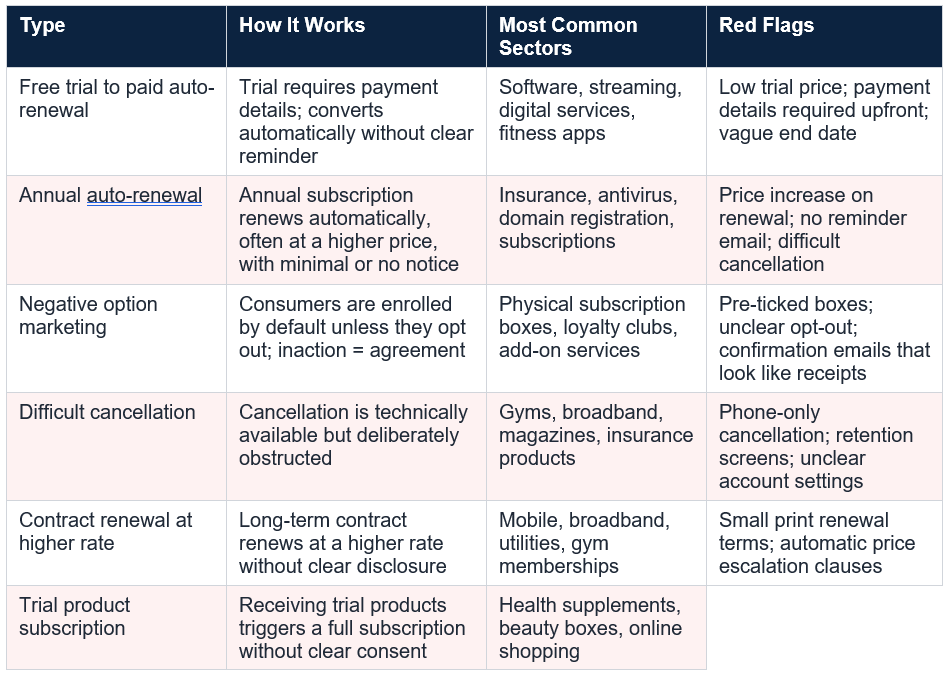

US data from CNET’s April 2025 YouGov survey provides a comparable picture: Americans spent an average of $205 annually on unused subscriptions in the year to April 2025. The Chargebee 2025 report of US and UK consumers found that 90 percent of consumers reported higher subscription costs over the previous year, but only 58 percent felt the higher prices were justified. Forty-four percent of those paying for digital subscriptions said these services take a moderate or significant amount out of their budgets.
The aggregate economic cost has grown in proportion to the subscription economy’s expansion. The C+R Research 2024 study found US households underestimate their monthly subscription spending by an average of 2.5 times — they believe they spend about $86 per month on subscriptions but actually spend approximately $219. The same pattern applies in the UK, where the proliferation of small monthly charges across streaming, software, fitness, news, and services has made it genuinely difficult to track total subscription expenditure without a deliberate audit.
The DMCC subscription regime targets what the Department for Business and Trade calls subscription traps: contracts that renew automatically at a higher price, are significantly harder to cancel than to start, or that provide insufficient information and reminders to consumers. The CMA will be the enforcement authority.
Katrina Anderson, partner at Mills and Reeve, flagged the significance of the January 2027 date for businesses: the date for introducing new protections against subscription traps has already moved three times. This is the first time it has moved in the other direction, and businesses planning around spring 2027 will now need to fast-track their compliance activities.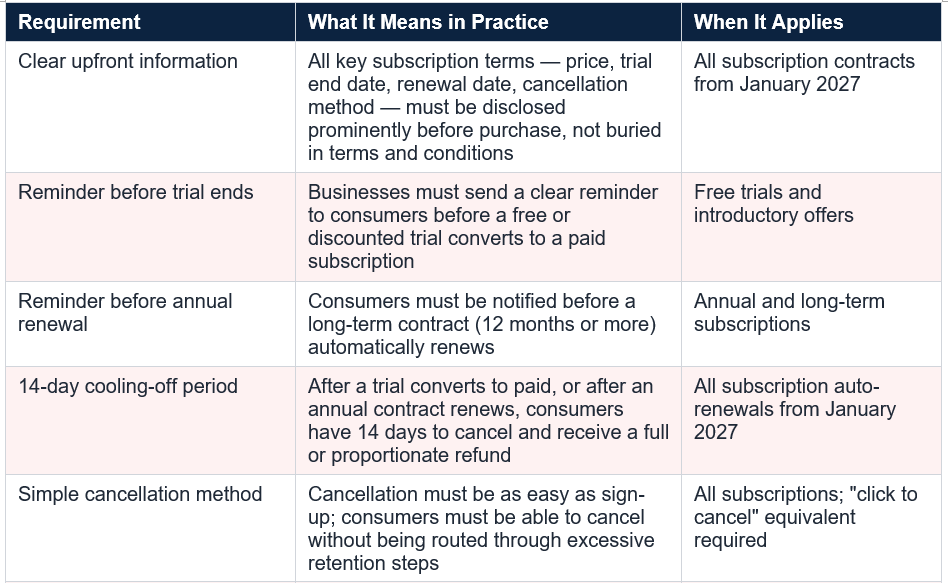
The cultural and heritage charity sector is specifically excluded from the DMCC subscription regime — a concession to organisations such as the National Trust, English Heritage, and similar membership bodies where annual renewal is embedded in the membership model. All commercial subscription services will be in scope.
The government announced a consultation to launch in autumn 2026 on whether to prohibit specific tactics including: fake ‘was’ prices where the reference price was never genuinely charged for a meaningful period; invented discounts that have no basis in a real previous selling price; and misleading Recommended Retail Prices (RRPs) used to create the impression of a significant price reduction that does not reflect actual market prices.
Which? — the UK’s primary consumer organisation — welcomed the announcements but called for the new rules to be introduced swiftly. Which?’s head of consumer rights policy, Sue Davies, noted that Which? had repeatedly exposed businesses including well-known household brands over deals it said were misleading. The Burnham government’s position is that the subscription trap and misleading pricing announcements are the start of a broader cost-of-living agenda: Today is just the start, said Burnham.
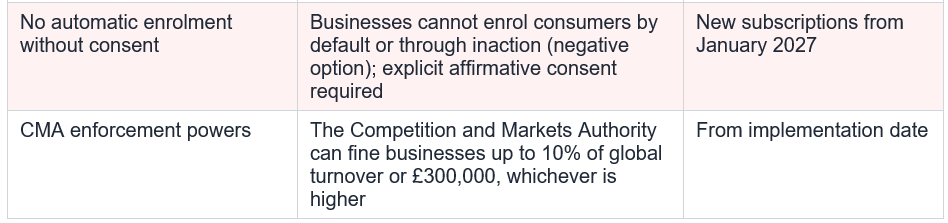
The DMCC Act’s subscription rules, taking effect in January 2027, represent the most comprehensive legislative overhaul of subscription contract regulation in UK history. The requirement for clear upfront information, proactive reminders, 14-day cooling-off periods after auto-renewals, and simple cancellation as easy as sign-up addresses each of the core mechanics of the subscription trap systematically. The CMA’s enforcement powers — fines up to 10% of global turnover — mean the consequences for non-compliance will be severe.
Until January 2027, UK consumers are not without rights. The Consumer Contracts Regulations 2013 provide a 14-day cooling-off period from sign-up for most online subscriptions. The Consumer Protection from Unfair Trading Regulations prohibit misleading omissions. Section 75 and chargeback protect credit and debit card payments. And the direct debit guarantee allows you to reclaim any unauthorised charge from your bank immediately. The £1.6 billion that UK consumers are spending on subscriptions they do not want is not all legally irrecoverable. It is often avoidable with awareness and recoverable with action.
A subscription trap is a recurring payment arrangement designed to be easy to join and difficult to leave. Common forms include free trials that silently convert to full-price subscriptions without adequate notice, annual contracts that auto-renew at higher prices without reminders, and services that require complex or time-consuming processes to cancel. The UK government estimates consumers spend £1.6 billion annually on subscriptions they do not want, at an average cost of £14 per month per unwanted subscription.
What new subscription laws are coming in 2026/2027?
Under the Digital Markets, Competition and Consumers Act 2024 (DMCC Act), new subscription rules will take effect from January 2027. Requirements include: clear upfront information about all key subscription terms; reminders before free trials convert to paid subscriptions; reminders before annual contracts auto-renew; a 14-day cooling-off period after any auto-renewal; simple cancellation as easy as sign-up; and prohibition on automatic enrolment without explicit consent. The CMA will enforce these rules and can fine businesses up to 10% of global turnover.
Can I get a refund on an unwanted auto-renewal?
Yes, in many cases. Under the Consumer Contracts Regulations 2013, you have a 14-day cooling-off period from the date of an online subscription contract. If you signed up online and are within 14 days, you are entitled to a full refund. If the trial or renewal was not clearly communicated, the Consumer Protection from Unfair Trading Regulations may also support a refund claim on the basis of misleading omission. From January 2027, the DMCC Act will provide a specific 14-day cooling-off period after any trial-to-paid conversion or annual auto-renewal.
How do I cancel a direct debit for an unwanted subscription?
You can cancel a direct debit at any time by contacting your bank, either online, by phone, or in branch. Your bank cannot refuse to cancel a direct debit. You should also notify the subscription company in writing that you are cancelling, to prevent them claiming you owe money under the contract. If any payment was taken after you cancelled the direct debit, use the Direct Debit Guarantee to reclaim it from your bank immediately.
What is Section 75 and how does it help with subscription disputes?
Section 75 of the Consumer Credit Act 1974 makes your credit card provider jointly liable with a retailer or service provider for breach of contract or misrepresentation for purchases of £100 to £30,000 made by credit card. If a subscription company has misled you, not delivered what was promised, or refuses to refund money you are entitled to, you can make a Section 75 claim to your credit card provider. This is particularly useful where the company is unresponsive or based abroad. It does not apply to debit cards, but debit card chargeback is an equivalent (though less legally guaranteed) route.
Which organisations will be exempt from the new DMCC subscription rules?
Cultural and heritage charities are specifically excluded from the new DMCC subscription regime. This covers organisations such as the National Trust, English Heritage, Historic Scotland, and similar membership bodies. All commercial subscription services are in scope, regardless of size or sector.
How do I report a company that is breaking subscription rules?
Currently: report to Citizens Advice (0800 144 8848 or citizensadvice.org.uk), which can refer cases to Trading Standards. You can also report directly to the CMA at report.cma.gov.uk. From January 2027: the CMA will have direct enforcement powers under the DMCC Act to investigate subscription contract complaints and impose fines directly. Which? also runs campaigns tracking misleading subscription practices and accepts consumer reports at which.co.uk.
Table of Contents
- 1. Introduction: The £1.6 Billion Problem
- 2. What Is a Rip-Off Subscription? A Definition
- 3. The Anatomy of a Subscription Trap: How They Work
- 4. The Most Common Types of Subscription Trap
- 5. The Real Cost: What Unwanted Subscriptions Are Costing UK Consumers
- 6. Your Rights Today: What UK Consumer Law Already Protects
- 7. The DMCC Act: The New Rules Coming in January 2027
- 8. What the New Rules Will Require Businesses to Do
- 9. Fake Discounts and Pretend Prices: The Related Crackdown
- 10. How to Spot a Subscription Trap Before You Sign Up
- 11. How to Cancel a Subscription and Get a Refund
- 12. What to Do If a Company Refuses to Cancel or Refund
- 13. Conclusion: The Law Is Catching Up With the Trap
- 14. Frequently Asked Questions
- 15. External References and Further Reading
The £1.6 Billion Problem
At some point in the past year, most people have paid for something they did not want. Not because they chose to, but because a subscription renewed automatically, a free trial silently became a paid contract, or cancellation required navigating a deliberately complex process designed to outlast their patience. This is what UK government, consumer advocates, and now Prime Minister Andy Burnham call a subscription trap — and it is a problem operating at industrial scale.According to UK government figures published alongside the August 2026 policy announcement, there are approximately 155 million active subscriptions in the UK. Of these, consumers are spending £1.6 billion per year on subscriptions they do not want. The average cost of each unwanted subscription is £14 per month, meaning a household with just two or three forgotten or trapped subscriptions is losing between £336 and £504 per year without realising it.
On 9 August 2026, Andy Burnham — who became Prime Minister on 20 July 2026 after the resignation of Sir Keir Starmer — announced a package of consumer protection measures targeting subscription traps and misleading pricing. New rules under the Digital Markets, Competition and Consumers Act 2024 (DMCC Act) will take effect from January 2027. This article explains what a rip-off subscription is, how the traps work, what rights you already have, and what the new rules will change.
Breaking: Prime Minister Andy Burnham announced a crackdown on subscription traps on 9 August 2026. New rules under the Digital Markets, Competition and Consumers Act 2024 (DMCC Act) will take effect from January 2027. This article incorporates the latest announcements.
What Is a Rip-Off Subscription? A Definition
A rip-off subscription — or subscription trap — is a recurring payment arrangement that exploits the asymmetry between how easy it is to join and how difficult it is to leave. The term covers a range of practices, all of which share the same fundamental characteristic: the consumer is paying for something they either did not intend to buy in the first place, no longer want but cannot easily stop, or did not know they were buying.The UK government’s Browne Jacobson analysis, published on 29 April 2026, describes the core problem as consumers drifting into paying for contracts they did not mean to keep, particularly where free or discounted trials roll into paid terms and exit routes are unnecessarily difficult.
A rip-off subscription is not the same as a subscription you freely chose and continue to enjoy. Netflix, Spotify, a gym membership, a magazine you read — these are legitimate subscription services. The rip-off version is the antivirus software that rolls over at £69.99 after a £1 trial without adequate warning, the streaming service that requires a phone call and a 20-minute process to cancel, the box subscription that sends products you never asked for and charges your card automatically, or the membership that changes its terms on renewal without adequate notice.
UK Government, August 2026: Consumers spend £1.6 billion a year on subscriptions they do not want. The average cost of each unwanted subscription is £14 per month. New rules from January 2027 are expected to deliver £400 million of consumer benefit per year and save the average person around £170 annually.
The Anatomy of a Subscription Trap: How They Work
Subscription traps are engineered, not accidental. Understanding the mechanics helps you identify them before you are in one:Step 1: The Attractive Entry
The subscription is advertised with a low or zero entry price. A free trial, a £0.99 first month, or a heavily discounted introductory offer. Payment details are collected at sign-up, sometimes with very small-print disclosure that the trial converts to a full-priced subscription after a specific date.Step 2: The Silent Conversion
When the trial or introductory period ends, the subscription automatically converts to the full-price recurring charge. No notification is sent, or a notification is buried in email that is easy to miss. The consumer does not receive a clear, prominent reminder that money is about to be taken.Step 3: The Friction Exit
When the consumer tries to cancel, the process is deliberately difficult. Common friction tactics include: requiring a phone call (during limited hours); routing through multiple retention screens that offer alternative deals before reaching the cancellation option; requiring a written letter or formal notice period; hiding the cancellation function in a counter-intuitive location in the account settings; or offering only account ‘pause’ rather than genuine cancellation. Kim Biggs from Lincolnshire described this to the BBC: trying to cancel the subscription was exasperating. It took quite a lot of time to wade through all the pages, all the information that was presented.Step 4: The Continued Charge
Even after the consumer has attempted to cancel, charges continue because the cancellation process was not completed correctly, or the company disputes the cancellation request. The consumer must escalate to a complaint or chargeback to recover the money.The Most Common Types of Subscription Trap
The Real Cost: What Unwanted Subscriptions Are Costing UK Consumers
The scale of the subscription trap problem in the UK is documented in government data. Of the 155 million active subscriptions, £1.6 billion per year is spent on unwanted ones. The average cost per unwanted subscription is £14 per month, or £168 per year. For a household with multiple unwanted subscriptions — which is common, given how invisible monthly charges become once established in a direct debit — the annual cost is significant.US data from CNET’s April 2025 YouGov survey provides a comparable picture: Americans spent an average of $205 annually on unused subscriptions in the year to April 2025. The Chargebee 2025 report of US and UK consumers found that 90 percent of consumers reported higher subscription costs over the previous year, but only 58 percent felt the higher prices were justified. Forty-four percent of those paying for digital subscriptions said these services take a moderate or significant amount out of their budgets.
The aggregate economic cost has grown in proportion to the subscription economy’s expansion. The C+R Research 2024 study found US households underestimate their monthly subscription spending by an average of 2.5 times — they believe they spend about $86 per month on subscriptions but actually spend approximately $219. The same pattern applies in the UK, where the proliferation of small monthly charges across streaming, software, fitness, news, and services has made it genuinely difficult to track total subscription expenditure without a deliberate audit.
Your Rights Today: What UK Consumer Law Already Protects
Before the DMCC Act’s subscription rules take effect in January 2027, the existing legal framework provides meaningful but imperfect protections:- Consumer Contracts (Information, Cancellation and Additional Charges) Regulations 2013 (CCR): for contracts entered into off-premises (including online), you have a 14-day cooling-off period from the date of the contract — not from the start of a trial. This means you can cancel an online subscription within 14 days and receive a full refund, even if you have used the service. The right applies to most services and goods bought online.
- Consumer Rights Act 2015: requires that services are carried out with reasonable care and skill. If a subscription service is fundamentally not what was described, you may have grounds for a refund.
- The Consumer Protection from Unfair Trading Regulations 2008: prohibits unfair commercial practices, including misleading omissions — failing to tell you important information that affects your decision to buy. Hiding key terms (such as trial-to-paid conversion) in small print may breach this regulation.
- Direct debit guarantee: if a company takes a payment from you by direct debit that you did not authorise or that differs from what was notified, you can claim an immediate full refund from your bank.
- Section 75 Consumer Credit Act 1974: if you paid by credit card for a subscription of more than £100 and the company has failed to deliver what was agreed, your credit card company is jointly liable and you can claim from them.
The DMCC Act: The New Rules Coming in January 2027
The Digital Markets, Competition and Consumers Act 2024 received Royal Assent in May 2024. It creates a comprehensive new framework for subscription contracts that goes significantly beyond existing consumer protections. The subscription-specific provisions are being brought into force in January 2027 — a date that has been announced, delayed, and re-confirmed multiple times before Prime Minister Burnham accelerated it on 9 August 2026 from its previous Spring 2027 target.The DMCC subscription regime targets what the Department for Business and Trade calls subscription traps: contracts that renew automatically at a higher price, are significantly harder to cancel than to start, or that provide insufficient information and reminders to consumers. The CMA will be the enforcement authority.
Katrina Anderson, partner at Mills and Reeve, flagged the significance of the January 2027 date for businesses: the date for introducing new protections against subscription traps has already moved three times. This is the first time it has moved in the other direction, and businesses planning around spring 2027 will now need to fast-track their compliance activities.
What the New Rules Will Require Businesses to Do
The cultural and heritage charity sector is specifically excluded from the DMCC subscription regime — a concession to organisations such as the National Trust, English Heritage, and similar membership bodies where annual renewal is embedded in the membership model. All commercial subscription services will be in scope.
Fake Discounts and Pretend Prices: The Related Crackdown
Alongside the subscription trap announcement, Prime Minister Burnham also targeted what he called pretend prices — misleading discount tactics that present artificially inflated ‘was’ prices to make offers appear more valuable than they are.The government announced a consultation to launch in autumn 2026 on whether to prohibit specific tactics including: fake ‘was’ prices where the reference price was never genuinely charged for a meaningful period; invented discounts that have no basis in a real previous selling price; and misleading Recommended Retail Prices (RRPs) used to create the impression of a significant price reduction that does not reflect actual market prices.
Which? — the UK’s primary consumer organisation — welcomed the announcements but called for the new rules to be introduced swiftly. Which?’s head of consumer rights policy, Sue Davies, noted that Which? had repeatedly exposed businesses including well-known household brands over deals it said were misleading. The Burnham government’s position is that the subscription trap and misleading pricing announcements are the start of a broader cost-of-living agenda: Today is just the start, said Burnham.
How to Spot a Subscription Trap Before You Sign Up
The best protection against a subscription trap is identifying it before you provide payment details. These are the specific warning signs to look for:- Payment details required for a ‘free’ trial: any trial that requires a credit or debit card will auto-charge at the end of the trial period unless you cancel. This is not inherently a trap, but it requires active action by a specific date.
- Vague or hidden trial end dates: if the trial period is not clearly stated in plain, prominent text at the point of sign-up, be suspicious. Legitimate services make the trial duration easy to find.
- Opt-out rather than opt-in for continuation: if you are automatically enrolled in the paid tier unless you take action to opt out, this is a negative option arrangement — the most problematic form of subscription trap under the new DMCC rules.
- Complex cancellation described during sign-up: if the cancellation process requires contacting a phone number, writing a letter, or providing notice in advance, the exit is deliberately designed to be harder than the entry. This is a red flag.
- No reminder email commitment: legitimate subscription services that charge annually or that convert from trials should offer clear reminder emails. If there is no mention of reminders in the sign-up flow, you should calendar the renewal date yourself or avoid the subscription.
- Very small print trial-to-paid conversion terms: if the key terms about what happens after the trial require scrolling to the bottom of a long terms-and-conditions page, the design is intentional.
11. How to Cancel a Subscription and Get a Refund
If you are already in an unwanted subscription, these are your practical steps:- Step 1: Check the company’s website for an account settings or subscription management page. Most companies have a cancellation option there, even if it is not prominently displayed. Log in and navigate to Account or Settings, then Subscription or Billing.
- Step 2: Cancel the direct debit or card recurring payment with your bank as a parallel step. This prevents further charges while you resolve the matter with the company. You can cancel a direct debit at any time by instructing your bank, and the bank cannot refuse. For card recurring payments, instruct your bank to block future charges from the merchant.
- Step 3: Write to the company (email is acceptable) stating clearly that you are cancelling, citing the date, and requesting confirmation. Keep a copy. If the company did not give you adequate information at sign-up, mention this: under current consumer protection law, misleading omissions about key contract terms may entitle you to a full refund.
- Step 4: If you are within 14 days of signing up or within 14 days of a renewal (once the new DMCC rules apply from January 2027), you are entitled to a full or proportionate refund. Cite the Consumer Contracts Regulations 2013 (current) or the DMCC Act subscription provisions (from January 2027) as applicable.
- Step 5: If the company refuses to cancel or refund and you paid by credit card (over £100 total), make a Section 75 claim to your credit card provider. If you paid by debit card, try a chargeback claim through your bank. For direct debit, use the Direct Debit Guarantee for any unauthorised or incorrect charges.
- Step 6: If the company remains uncooperative, report the matter to the Competition and Markets Authority (report.cma.gov.uk) or Citizens Advice (0800 144 8848). From January 2027, the CMA will have direct enforcement powers under the DMCC Act to act against businesses breaching subscription rules, including fines up to 10% of global turnover.
What to Do If a Company Refuses to Cancel or Refund
If a company refuses to cancel your subscription or refund a charge you believe is unjustified:- Escalate formally in writing: send a letter or email headed ‘Formal Complaint’ to the company’s customer service address. State the specific legal basis for your claim — the Consumer Contracts Regulations 2013, the Consumer Protection from Unfair Trading Regulations 2008, or (from January 2027) the DMCC Act subscription provisions.
- Use Alternative Dispute Resolution (ADR): many subscription services are members of ADR schemes. If the company has an ADR scheme listed in its terms, you can refer the dispute to the scheme for a binding or non-binding determination.
- Report to the CMA: from January 2027, the CMA has direct enforcement powers under the DMCC Act. Reports can be made at report.cma.gov.uk. The CMA can investigate individual cases and impose substantial penalties on non-compliant businesses.
- Contact your bank for chargeback: a chargeback is a dispute raised through your card provider where the card scheme (Visa, Mastercard) may reverse the transaction on your behalf. It is not guaranteed but is particularly effective where the goods or services were materially different from what was described.
- Small Claims Court: for amounts under £10,000, the small claims process in England and Wales is accessible without a solicitor. HM Courts and Tribunals Service provides guidance at gov.uk. Many companies settle when they receive a formal letter before action.
Conclusion
The subscription trap is not a new invention. Companies have been using friction exits, silent auto-renewals, and deliberate complexity to retain revenue from customers who would otherwise leave for decades. What is new in 2026 is that government — at the highest level, with Prime Minister Andy Burnham making it a flagship consumer policy within three weeks of taking office — has made tackling these practices a legislative priority.The DMCC Act’s subscription rules, taking effect in January 2027, represent the most comprehensive legislative overhaul of subscription contract regulation in UK history. The requirement for clear upfront information, proactive reminders, 14-day cooling-off periods after auto-renewals, and simple cancellation as easy as sign-up addresses each of the core mechanics of the subscription trap systematically. The CMA’s enforcement powers — fines up to 10% of global turnover — mean the consequences for non-compliance will be severe.
Until January 2027, UK consumers are not without rights. The Consumer Contracts Regulations 2013 provide a 14-day cooling-off period from sign-up for most online subscriptions. The Consumer Protection from Unfair Trading Regulations prohibit misleading omissions. Section 75 and chargeback protect credit and debit card payments. And the direct debit guarantee allows you to reclaim any unauthorised charge from your bank immediately. The £1.6 billion that UK consumers are spending on subscriptions they do not want is not all legally irrecoverable. It is often avoidable with awareness and recoverable with action.
Frequently Asked Questions
What is a subscription trap?A subscription trap is a recurring payment arrangement designed to be easy to join and difficult to leave. Common forms include free trials that silently convert to full-price subscriptions without adequate notice, annual contracts that auto-renew at higher prices without reminders, and services that require complex or time-consuming processes to cancel. The UK government estimates consumers spend £1.6 billion annually on subscriptions they do not want, at an average cost of £14 per month per unwanted subscription.
What new subscription laws are coming in 2026/2027?
Under the Digital Markets, Competition and Consumers Act 2024 (DMCC Act), new subscription rules will take effect from January 2027. Requirements include: clear upfront information about all key subscription terms; reminders before free trials convert to paid subscriptions; reminders before annual contracts auto-renew; a 14-day cooling-off period after any auto-renewal; simple cancellation as easy as sign-up; and prohibition on automatic enrolment without explicit consent. The CMA will enforce these rules and can fine businesses up to 10% of global turnover.
Can I get a refund on an unwanted auto-renewal?
Yes, in many cases. Under the Consumer Contracts Regulations 2013, you have a 14-day cooling-off period from the date of an online subscription contract. If you signed up online and are within 14 days, you are entitled to a full refund. If the trial or renewal was not clearly communicated, the Consumer Protection from Unfair Trading Regulations may also support a refund claim on the basis of misleading omission. From January 2027, the DMCC Act will provide a specific 14-day cooling-off period after any trial-to-paid conversion or annual auto-renewal.
How do I cancel a direct debit for an unwanted subscription?
You can cancel a direct debit at any time by contacting your bank, either online, by phone, or in branch. Your bank cannot refuse to cancel a direct debit. You should also notify the subscription company in writing that you are cancelling, to prevent them claiming you owe money under the contract. If any payment was taken after you cancelled the direct debit, use the Direct Debit Guarantee to reclaim it from your bank immediately.
What is Section 75 and how does it help with subscription disputes?
Section 75 of the Consumer Credit Act 1974 makes your credit card provider jointly liable with a retailer or service provider for breach of contract or misrepresentation for purchases of £100 to £30,000 made by credit card. If a subscription company has misled you, not delivered what was promised, or refuses to refund money you are entitled to, you can make a Section 75 claim to your credit card provider. This is particularly useful where the company is unresponsive or based abroad. It does not apply to debit cards, but debit card chargeback is an equivalent (though less legally guaranteed) route.
Which organisations will be exempt from the new DMCC subscription rules?
Cultural and heritage charities are specifically excluded from the new DMCC subscription regime. This covers organisations such as the National Trust, English Heritage, Historic Scotland, and similar membership bodies. All commercial subscription services are in scope, regardless of size or sector.
How do I report a company that is breaking subscription rules?
Currently: report to Citizens Advice (0800 144 8848 or citizensadvice.org.uk), which can refer cases to Trading Standards. You can also report directly to the CMA at report.cma.gov.uk. From January 2027: the CMA will have direct enforcement powers under the DMCC Act to investigate subscription contract complaints and impose fines directly. Which? also runs campaigns tracking misleading subscription practices and accepts consumer reports at which.co.uk.
0 Comments
Be the first to share your thoughts on this article.