

Taxes
What Is a Tax Year? UK & US Dates & Deadlines

Table of Contents
- The Foundation of the Tax System
- What Is a Tax Year? The Core Definition
- Why Does the UK Tax Year Start on 6 April? The Historical Explanation
- UK Tax Year Key Dates: 2025/26 and 2026/27 Complete Calendar
- The UK Tax Year in Practice: Who Needs to File and What For
- PAYE: When You Do Not Need to File
- Self Assessment: When You Do Need to File
- Payments on Account: The Advance Payment System
- Making Tax Digital: The 2026 Change
- The US Tax Year Explained: Calendar Year, Key Dates, and Deadlines
- US Tax Year: 1 January to 31 December
- US Tax Year Key Dates for 2025 and 2026
- UK vs US Tax Year: Side-by-Side Comparison
- What Happens If You Miss a Tax Deadline? Penalties Explained
- UK Penalties for Late Filing and Late Payment
- US Penalties for Late Filing and Late Payment
- Tax Year-End Planning: How to Use the Tax Year Boundary Effectively
- Conclusion
- Frequently Asked Questions (FAQ)
The Foundation of the Tax System
A tax year is the defined 12-month period over which an individual's or business's income, gains, and expenses are calculated for tax purposes. It determines which income is included in which tax return, which allowances and rates apply, and when the filing and payment deadlines fall. Without a tax year, there is no meaningful basis for calculating what is owed, what reliefs are available, or when obligations must be met. The tax year is, in practical terms, the frame around which the entire tax system is organised.The curious thing about tax years is how differently they are defined around the world. In the United States, the individual tax year runs from 1 January to 31 December -- aligned with the calendar year and immediately intuitive to anyone accustomed to thinking in calendar terms. In the United Kingdom, the personal tax year runs from 6 April to 5 April the following year -- a start date that appears arbitrary but has a fascinating historical explanation rooted in an 18th-century calendar reform. YourCompanyFormations (updated 2 days ago): 'The UK personal tax year starts on 6 April and ends on 5 April the following year. The current tax year is 2026/27, running from 6 April 2026 to 5 April 2027.'
This difference has significant practical implications for taxpayers with income or assets in both countries, for international workers, and for anyone who needs to understand why their UK and US tax obligations cover different periods and have different filing deadlines. This guide explains everything about tax years in both countries: the exact dates, the filing deadlines, the penalty structures, the allowances, the payments on account system, the Making Tax Digital changes taking effect from April 2026, and the historical origin of the UK's unusual April tax year -- all grounded in current July 2026 sources.
What Is a Tax Year? The Core Definition
A tax year is the 12-month accounting period used by tax authorities to determine an individual's total income, allowances, deductions, and resulting tax liability. Sage UK (March 11, 2026): 'The personal tax year runs from 6 April to 5 April the following year. Also known as the fiscal year, this is the period during which any calculations, assessments and financial reporting will be based for individuals and sole traders. By the end of the period, you will need to have your income and expenses in order, ready to submit to HMRC.'All income received, all allowable expenses incurred, all capital gains realised, and all tax reliefs and allowances used are assessed against the tax year in which they occur. This means: income earned in the 2025/26 tax year (6 April 2025 to 5 April 2026) is reported on the 2025/26 tax return, uses the 2025/26 personal allowance (£12,570), and is taxed at 2025/26 rates and bands. The same income, if received one day later in 2026/27, would be reported on the next tax return using the 2026/27 allowances and rates (which may differ). The assignment of income to a specific tax year is therefore not an administrative technicality -- it is a decision with direct financial consequences.
Tax years are distinct from companies' accounting periods. A UK limited company normally has its own financial year-end, which can fall on any date of the year -- it does not need to align with the 5 April personal tax year. Similarly, US corporations can elect a fiscal year ending on any month, though individual taxpayers are always assessed on the calendar year. Understanding this distinction -- between the personal tax year used for income tax and the company's own accounting period used for corporation tax -- prevents a common source of confusion for business owners in both countries.
The current tax year in 2026: UK: 2026/27 (6 April 2026 to 5 April 2027). US: 2026 (1 January to 31 December 2026). UK personal allowance: £12,570 (frozen). — YourCompanyFormations (2 days ago): 'The current tax year is 2026/27, running from 6 April 2026 to 5 April 2027. For the 2025/26 tax year, file your Self Assessment return by 31 January 2027 online or 31 October 2026 on paper.' GoSimpleTax (April 8, 2026): 'The personal allowance is £12,570.' USTAXFS (April 28, 2026): 'The 2026 US tax year ends on December 31, 2026.' HS Global (March 19, 2026): 'HMRC charges an automatic £100 penalty the moment you file even one day late.'
Why Does the UK Tax Year Start on 6 April? The Historical Explanation
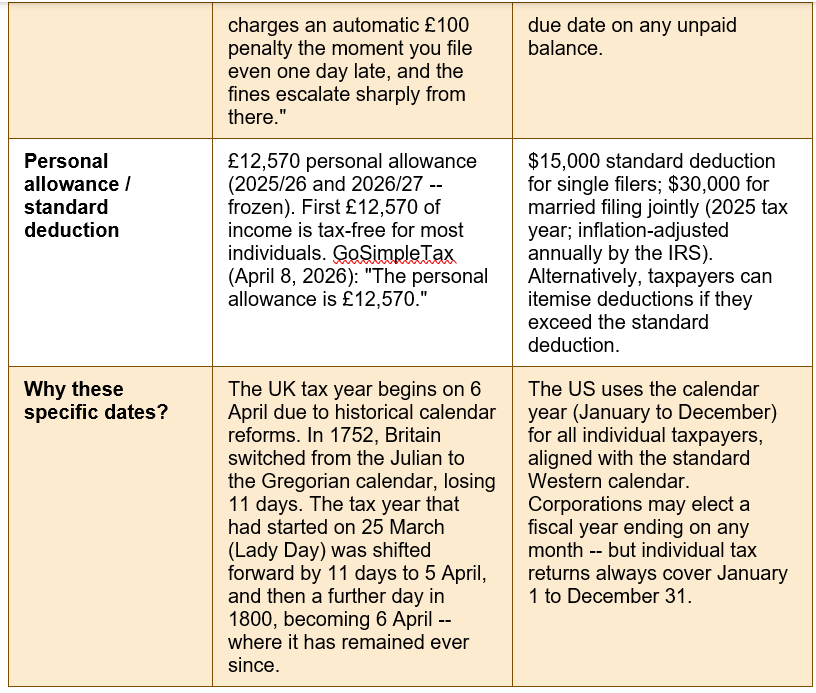
The 6 April start date for the UK tax year is one of the most frequently asked and least intuitively obvious features of the British tax system. Why not 1 January, like the US? Why not 1 April, like many corporate accounting periods? The answer lies in an 18th-century calendar reform and its complex interaction with the tax collection system of the time.Until 1752, Britain used the Julian calendar, which placed the start of the new year (and the tax year, which was then aligned with the ecclesiastical calendar's Lady Day) on 25 March. In 1752, Britain adopted the Gregorian calendar -- the calendar still in use today -- which corrected a cumulative error in the Julian calendar by eliminating 11 days from September 1752.
The calendar skipped directly from 2 September to 14 September. To prevent taxpayers from losing 11 days of the tax year they had been paying taxes on, the UK tax authorities shifted the tax year start forward by 11 days -- from 25 March to 5 April. The following century, the century-year adjustment for 1800 (which the Gregorian calendar required but the Julian calendar would not have) shifted it one more day to 6 April. And there it has remained ever since -- a peculiarity of British fiscal history embedded in the tax year start date that every UK taxpayer lives with today.
The tax year vs the financial year vs the accounting year: Three terms that sound similar but mean different things in UK usage. The tax year (or fiscal year) runs 6 April to 5 April and is used for personal income tax, Self Assessment, National Insurance, and capital gains tax. The financial year -- in UK government and corporate usage -- typically runs 1 April to 31 March (note: not 6 April). The company accounting year is whichever 12-month period a company chooses to end its accounts on (common year-ends include 31 December, 31 March, and 30 September). A sole trader uses the tax year for their tax return; a limited company uses its own accounting year for corporation tax. YourCompanyFormations (2 days ago): 'Limited companies normally follow their own accounting periods for annual accounts and Corporation Tax.'
UK Tax Year Key Dates: 2025/26 and 2026/27 Complete Calendar
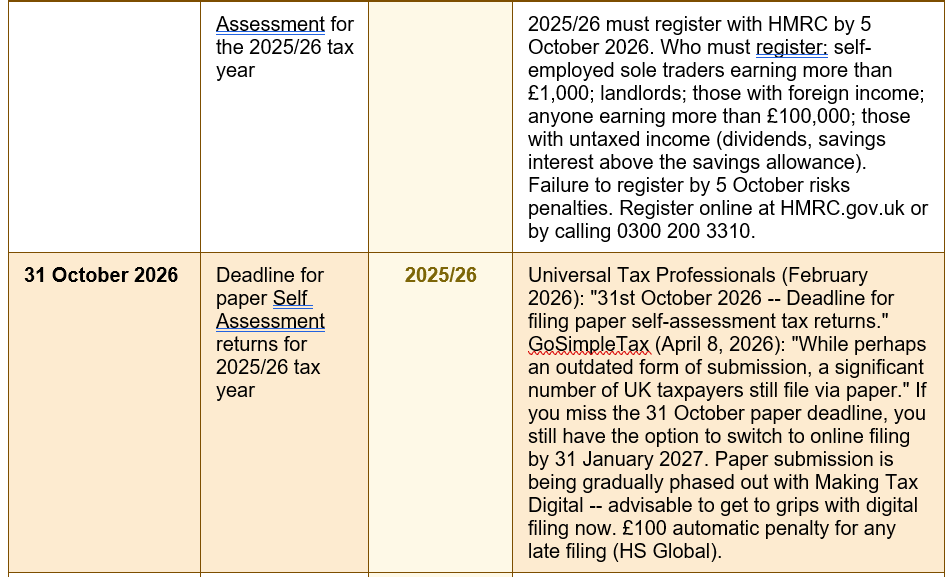
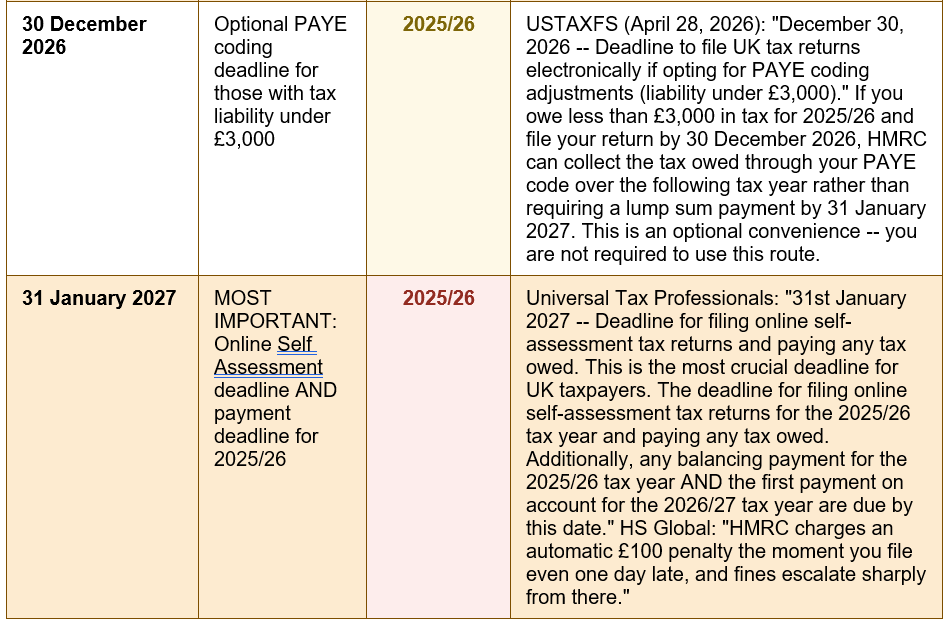
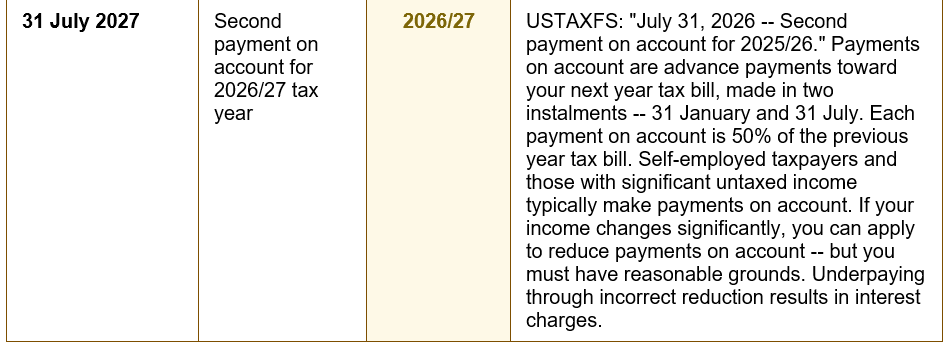
The following table maps every significant UK tax year deadline for the 2025/26 and 2026/27 tax years, with the full details of what each date means, who it affects, and the consequences of missing it: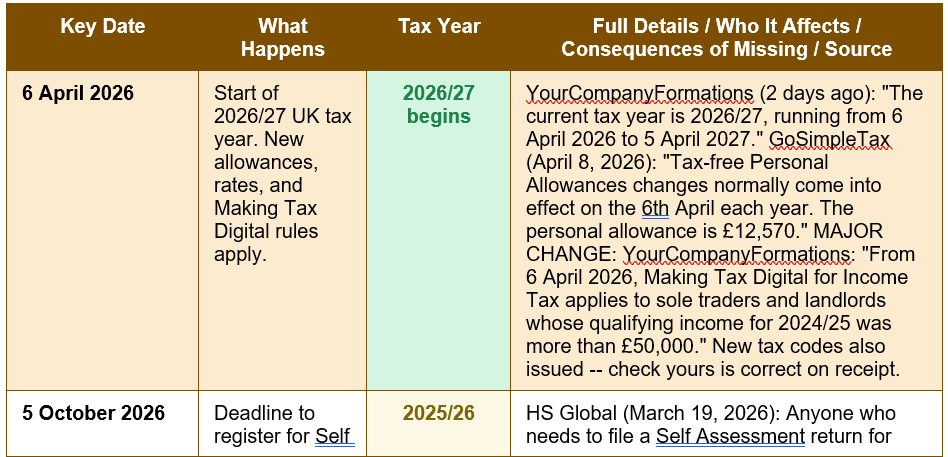
The UK Tax Year in Practice: Who Needs to File and What For
PAYE: When You Do Not Need to File
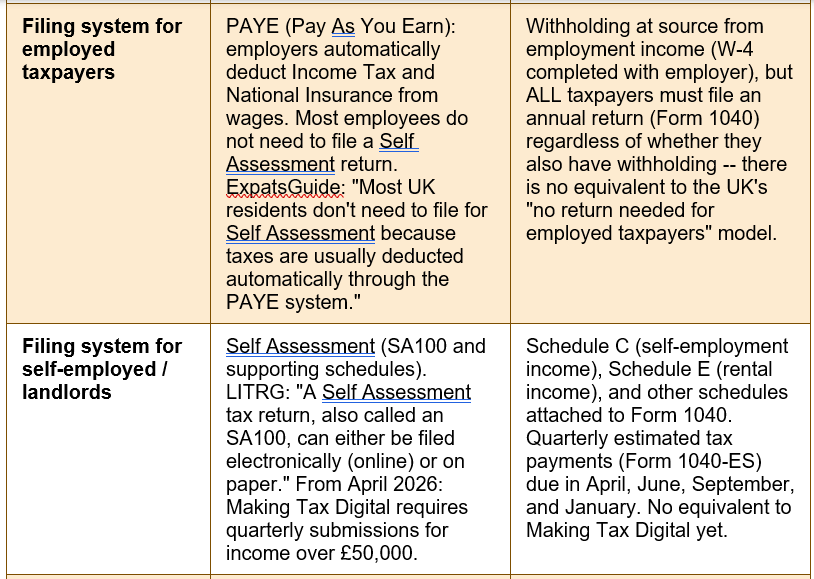
The majority of UK employees have their income tax collected automatically through the PAYE (Pay As You Earn) system. GoSimpleTax (April 8, 2026): 'Personal Allowances changes normally come into effect on the 6th April each year. The personal allowance is £12,570. You may also receive your new tax code for the year. The numbers within your tax code refer to the amount of tax-free income you are entitled to that year -- making it essential that you check they are correct upon receiving them. Otherwise, you run the risk of paying more than you need to or facing an avoidable bill.'Under PAYE, the employer calculates and deducts income tax and National Insurance contributions from each payslip and pays them directly to HMRC on the employee's behalf. For most employees whose only income is employment income within PAYE, no Self Assessment tax return is required. The employer handles the calculation; the employee simply receives their net pay with tax already deducted. However, PAYE does not mean tax cannot be wrong -- incorrect tax codes are a common cause of underpaying or overpaying tax, and employees should review their P60 (issued by employers after the end of each tax year) and their tax code every April to confirm both are correct.
Self Assessment: When You Do Need to File
Self Assessment is the UK system for reporting income that is not or cannot be taxed through PAYE. HS Global (March 19, 2026) lists who must file: 'You must file a Self Assessment tax return if any of the following apply to you: you are self-employed as a sole trader and earned more than £1,000; you are a partner in a business partnership; you are a landlord with rental income above £1,000; you have foreign income; you earn more than £100,000; you received untaxed income from dividends, savings interest above your savings allowance, or other sources; or you need to claim certain reliefs or tax credits.' LITRG adds: 'A Self Assessment tax return, also called an SA100, can either be filed electronically (online) or on paper.'Payments on Account: The Advance Payment System
Self-employed taxpayers and those with significant untaxed income typically pay their tax bill in advance through a system called Payments on Account. Sage (March 11, 2026): 'Usually, there is a deadline to file and then the payment deadline will be on a different date. Self-assessment is paid in advance.' Two Payments on Account are made each tax year: the first on 31 January (coinciding with the filing deadline for the previous year's return) and the second on 31 July. Each payment is 50% of the previous year's total tax bill -- an estimate of the current year's liability. If the actual liability differs significantly from the estimate, a balancing payment (or refund) is made at the following January deadline. Sage: 'If you cannot pay on time, for whatever reason, the first step is to contact HMRC to arrange a payment plan. If you are self-employed and do not already have an existing payment plan or debts with HMRC, you can do this online, but only if you owe less than £30,000.'Making Tax Digital: The 2026 Change
From 6 April 2026, a major change to the UK tax system takes effect. YourCompanyFormations (2 days ago): 'From 6 April 2026, Making Tax Digital for Income Tax applies to sole traders and landlords whose qualifying income for 2024/25 was more than £50,000.' Making Tax Digital (MTD) for Income Tax Self Assessment requires affected taxpayers to keep digital records and submit quarterly updates to HMRC throughout the tax year, rather than a single annual return. Sterling and Wells: 'From April 2026, MTD for Income Tax Self Assessment will start for those earning over £50,000. This means quarterly reporting will become mandatory for many individuals.' MTD will extend to those earning over £30,000 from April 2027, and eventually to the majority of self-employed taxpayers and landlords. For those affected, the transition from a single annual return to quarterly digital submissions is the most significant change to UK tax administration in decades.The US Tax Year Explained: Calendar Year, Key Dates, and Deadlines
US Tax Year: 1 January to 31 December
For individual taxpayers in the United States, the tax year runs from 1 January to 31 December -- the standard calendar year. USTAXFS (April 28, 2026): 'The 2026 US tax year ends on December 31, 2026. Taxpayers should consider year-end planning strategies, including charitable contributions, retirement contributions, and estimated state tax payments.' Unlike the UK, where most employees do not need to file a return (PAYE handles their tax), every US taxpayer is generally required to file an annual tax return regardless of whether they have withholding from employment income. The return summarises all income for the calendar year and reconciles it against taxes already paid through withholding or estimated payments.US Tax Year Key Dates for 2025 and 2026
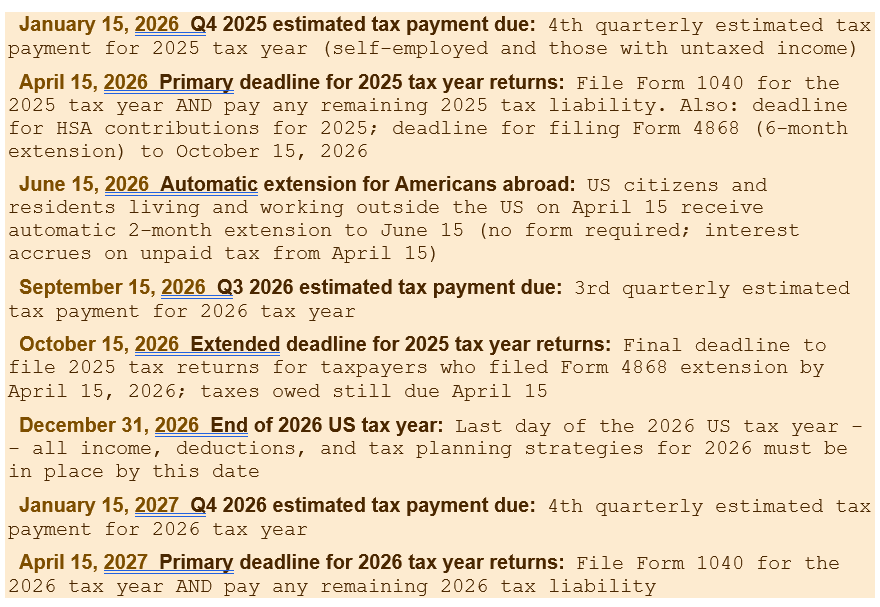
Unlike the UK's PAYE system where most employees settle their tax through employer deductions alone, US taxpayers with income beyond simple employment earnings typically make quarterly estimated tax payments (Form 1040-ES) throughout the year. Self-employed individuals, landlords, investors, and freelancers must estimate their annual tax liability and pay 25% of it each quarter (January, April, June, and September). Underpaying estimated taxes results in an underpayment penalty, calculated at the applicable IRS interest rate on the shortfall.
UK vs US Tax Year: Side-by-Side Comparison
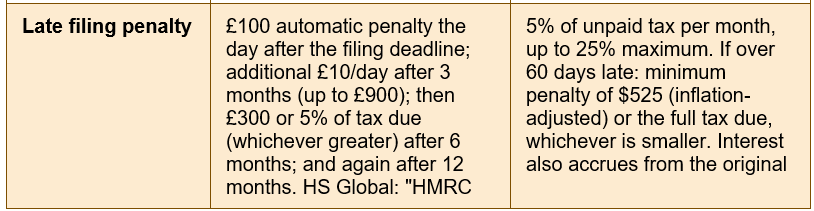
The structural differences between the UK and US tax year systems have significant practical implications for anyone operating in both countries -- expats, dual citizens, international workers, and cross-border investors. The following table maps every key dimension: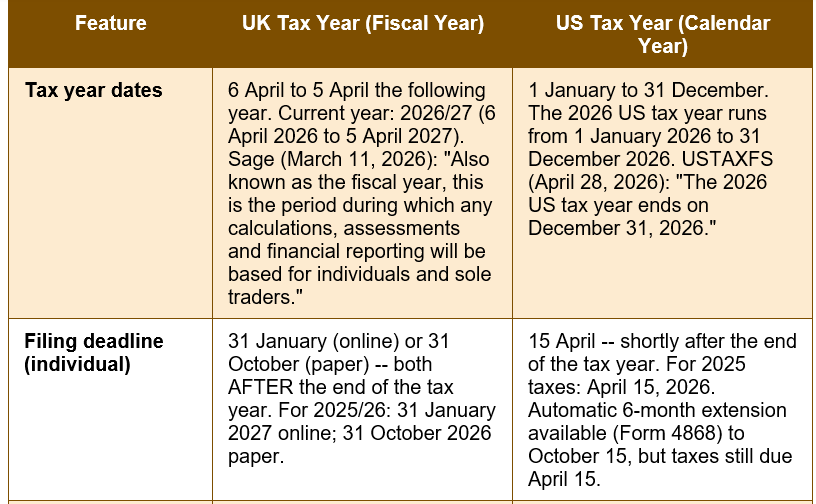
What Happens If You Miss a Tax Deadline? Penalties Explained
UK Penalties for Late Filing and Late Payment
HS Global (March 19, 2026): 'Missing a Self Assessment deadline can be expensive. HMRC charges an automatic £100 penalty the moment you file even one day late, and the fines escalate sharply from there.' The full UK penalty structure for Self Assessment:1. Day 1 after deadline: Automatic £100 penalty, regardless of how small the tax due is or whether any tax is even owed. Filing one day late with zero tax owed still triggers the £100 penalty.
2. 3 months late: £10 per day additional penalty, up to 90 days (maximum additional £900), bringing the potential total to £1,000.
3. 6 months late: An additional penalty of £300 or 5% of the tax due, whichever is the greater amount.
4. 12 months late: A further £300 or 5% of the tax due -- plus HMRC can charge an additional 100% of the tax due in cases of deliberate withholding of information.
5. Late payment: Sage: 'If you cannot pay on time, the first step is to contact HMRC to arrange a payment plan. If you owe less than £30,000, you can do this online.' HMRC charges interest on late payments at the Bank of England base rate plus 2.5%. Late payment penalties (separate from late filing penalties) begin at 5% of unpaid tax and escalate similarly to late filing penalties.
US Penalties for Late Filing and Late Payment
For US taxpayers who miss the April 15 deadline without filing a valid extension (Form 4868): the failure-to-file penalty is 5% of unpaid tax per month, up to a maximum of 25%. If more than 60 days late, the minimum penalty is $525 (inflation-adjusted) or the full tax due, whichever is smaller. The failure-to-pay penalty is 0.5% of unpaid tax per month, up to 25%, running from April 15 on any balance not paid. Interest also accrues from the original due date at the IRS underpayment rate. The critical planning tool available to US taxpayers is Form 4868 -- filing this extension by April 15 eliminates the failure-to-file penalty entirely, while only the smaller failure-to-pay penalty and interest run on any unpaid balance.Tax Year-End Planning: How to Use the Tax Year Boundary Effectively
The end of the tax year is not merely an administrative deadline -- it is a planning boundary with real financial significance. Actions taken before the end of the tax year can reduce the tax bill; the same actions taken one day later fall in the next tax year and produce no immediate benefit. Key year-end planning opportunities:- 6. UK: Use your annual allowances before 5 April: Several UK allowances reset to zero on 5 April and cannot be carried forward. The ISA allowance (£20,000 per person per year) and the Capital Gains Tax Annual Exempt Amount (£3,000 per person per year) both expire at tax year-end. YourCompanyFormations: 'Assess your tax planning opportunities to reduce your tax bill. Make sure to put money into a pension scheme to get tax benefits.' Unused allowances are permanently lost.
- 7. UK: Make pension contributions before 5 April: Pension contributions attract tax relief at the individual's marginal rate. Higher-rate taxpayers receive 40% relief; additional-rate taxpayers 45%. Contributions must be paid within the tax year to generate relief in that year's return. The annual pension contribution allowance is £60,000 per year (subject to earnings), with carry-forward of unused allowance from the previous three years available.
- 8. US: Accelerate deductions and defer income before 31 December: US taxpayers with control over the timing of income and expenses can accelerate deductible expenses into the current tax year (pay them before 31 December) and defer income into the next year (delay billing for services until January) to manage their taxable income. Year-end charitable contributions, retirement account contributions (401(k) employee contributions by 31 December; IRA contributions by April 15 of the following year), and capital loss harvesting are all time-sensitive to the tax year end.
- 9. UK: Review your tax code every April: GoSimpleTax (April 8, 2026): 'Tax-free Personal Allowances changes normally come into effect on the 6th April each year. You may also receive your new tax code for the year. The numbers within your tax code refer to the amount of tax-free income you are entitled to that year. Making it essential that you check they are correct upon receiving them. Otherwise, you run the risk of paying more than you need to or facing an avoidable bill.' An incorrect tax code is a very common cause of over or underpayment.
- 10. Both: Keep records throughout the year, not just at year-end: USTAXFS: 'Taxpayers should consider year-end planning strategies.' The most effective tax planning is done continuously throughout the year, not in a last-minute scramble. YourCompanyFormations: 'Setting aside some money throughout the year to cover your tax bill to avoid last-minute scrambles and financial strain when your payments are due is advisable. File your returns on time: preparing early helps you meet deadlines and avoid penalties, interest charges, underpaying or overpaying tax.'
COMPLETE TAX YEAR DATE GUIDE -- UK 2025/26 AND US 2025/2026: UK 2025/26 TAX YEAR (6 April 2025 to 5 April 2026): 5 April 2026: End of 2025/26 tax year -- final day to use ISA allowance, CGT exemption, and pension contributions for 2025/26. 5 October 2026: Deadline to register for Self Assessment for 2025/26. 31 October 2026: Paper Self Assessment return deadline for 2025/26. 30 December 2026: Optional PAYE coding deadline for liability under £3,000. 31 January 2027: Online Self Assessment deadline AND balancing payment AND first payment on account for 2026/27. 31 July 2027: Second payment on account for 2026/27. UK 2026/27 TAX YEAR: Starts 6 April 2026. From this date: MTD for Income Tax applies for those with qualifying income over £50,000 for 2024/25. US 2025 TAX YEAR (1 Jan to 31 Dec 2025): April 15, 2026: File Form 1040 and pay 2025 taxes. Form 4868 extension also due by April 15 to extend filing to October 15 (does NOT extend payment). US 2026 TAX YEAR (1 Jan to 31 Dec 2026): Quarterly estimated payments: Jan 15, Apr 15, Sep 15, Jan 15 2027. December 31, 2026: End of 2026 US tax year -- final day for all 2026 planning strategies.
FIVE TAX YEAR MISTAKES THAT COST UK AND US TAXPAYERS MONEY: (1) UK: NOT CHECKING YOUR TAX CODE EVERY APRIL. GoSimpleTax (April 8, 2026): tax codes change annually and incorrect codes cause underpayments or overpayments. Check your code when it arrives -- if it looks wrong, contact HMRC before the error compounds over the year. (2) UK: MISSING THE 31 JANUARY ONLINE FILING DEADLINE BY EVEN ONE DAY. HS Global (March 19, 2026): 'HMRC charges an automatic £100 penalty the moment you file even one day late.' A return filed on 1 February faces exactly the same penalty as one filed in March. There is no grace period. (3) UK: LETTING ISA ALLOWANCE AND CGT EXEMPTION EXPIRE UNUSED ON 5 APRIL. Both the £20,000 ISA allowance and the £3,000 CGT Annual Exempt Amount reset to zero on 5 April and cannot be carried forward. Unused allowances are permanently lost -- a cost measured in real money for investors and savers. (4) US: PAYING TAXES ON THE EXTENDED DEADLINE (OCTOBER 15) INSTEAD OF APRIL 15. Form 4868 extends the FILING deadline -- not the payment deadline. Interest and failure-to-pay penalties run from April 15 on any unpaid balance, regardless of the extension. (5) BOTH: CONFLATING THE PERSONAL TAX YEAR WITH THE COMPANY ACCOUNTING YEAR. UK limited companies use their own accounting year-end (not 5 April) for corporation tax. US corporations can elect any fiscal year-end. Confusing which period applies to which return leads to errors in calculating and reporting business income.
Conclusion
The tax year is the 12-month accounting period that determines which income is assessed, which allowances apply, and when the filing and payment deadlines fall. In the UK, the personal tax year runs from 6 April to 5 April the following year -- a date rooted in the 1752 calendar reform -- with the current year being 2026/27 (6 April 2026 to 5 April 2027). In the US, the individual tax year follows the calendar year from 1 January to 31 December, with all tax planning strategies for 2026 required to be in place by 31 December 2026.For the 2025/26 UK tax year, the critical deadlines are: paper Self Assessment by 31 October 2026; online Self Assessment and payment by 31 January 2027; with an automatic £100 penalty for any filing one day late. From 6 April 2026, Making Tax Digital for Income Tax has taken effect for sole traders and landlords with qualifying income over £50,000 for 2024/25 -- the most significant change to UK tax administration in decades. For the 2025 US tax year, the primary deadline was April 15, 2026, with a 6-month extension (not payment extension) available to October 15, 2026 via Form 4868.
Understanding the tax year -- its boundaries, its deadlines, its allowances, and its penalty structure -- is the single most important piece of administrative tax knowledge available to any individual taxpayer. Missing a deadline by one day in the UK costs £100 with no grace period. Failing to use allowances before year-end wastes money permanently. Acting in the final weeks of the tax year rather than throughout it forces rushed decisions and missed opportunities. The investment in understanding these dates and building them into a financial calendar repays itself every year.
Frequently Asked Questions (FAQ)
What is a tax year and when does it start and end in the UK?A tax year is the 12-month period used to calculate an individual's income, allowances, and tax liability for the purposes of income tax and Self Assessment. Sage (March 11, 2026): 'The personal tax year runs from 6 April to 5 April the following year. Also known as the fiscal year, this is the period during which any calculations, assessments, and financial reporting will be based for individuals and sole traders.' YourCompanyFormations (2 days ago): 'The UK personal tax year starts on 6 April and ends on 5 April the following year. The current tax year is 2026/27, running from 6 April 2026 to 5 April 2027.' The 6 April start date originates from the 1752 Gregorian calendar reform, which shifted Britain's tax year start from 25 March (Lady Day) forward by 11 days to account for the calendar adjustment, arriving at 5 April, and then shifted one further day to 6 April in 1800. This unusual date has remained unchanged ever since. Each UK tax year is referred to by the two calendar years it spans -- the 2025/26 tax year covers 6 April 2025 to 5 April 2026; the 2026/27 tax year covers 6 April 2026 to 5 April 2027.
When is the UK Self Assessment tax return deadline for 2025/26?
For the 2025/26 UK tax year (6 April 2025 to 5 April 2026), there are two filing deadlines depending on your submission method. YourCompanyFormations (2 days ago): 'For the 2025/26 tax year, file your Self Assessment return by 31 January 2027 online or 31 October 2026 on paper.' HS Global (March 19, 2026): 'Your Self Assessment return for this period is due by 31 January 2027 if you file online, or 31 October 2026 if you file on paper.' The 31 January 2027 deadline is also the payment deadline -- any balancing payment for 2025/26 tax owed and the first payment on account toward 2026/27 are both due on 31 January 2027. Universal Tax Professionals (February 2026): 'This is the most crucial deadline for UK taxpayers.' Additionally, anyone who needs to file a Self Assessment return for 2025/26 but has not done so before must register with HMRC by 5 October 2026 (the registration deadline). Penalty for missing the filing deadline: HS Global: 'HMRC charges an automatic £100 penalty the moment you file even one day late, and the fines escalate sharply from there.'
What is the difference between the UK and US tax year?
The UK and US tax years differ in both their dates and their filing systems. Date difference: the UK tax year runs from 6 April to 5 April the following year; the US tax year for individuals runs from 1 January to 31 December (the calendar year). USTAXFS (April 28, 2026): 'The 2026 US tax year ends on December 31, 2026.' Filing system difference: in the UK, the majority of employed taxpayers have their income tax collected automatically through PAYE (Pay As You Earn) and do not need to file a return. GoSimpleTax (April 2026): 'Most UK residents do not need to file for Self Assessment because taxes are usually deducted automatically through the PAYE system.' In the US, virtually all taxpayers must file an annual return (Form 1040) regardless of whether they have withholding. Filing deadline difference: the UK online Self Assessment deadline is 31 January after the end of the tax year; the US Form 1040 deadline is April 15 (shortly after year-end), with a 6-month extension available. For taxpayers with income or assets in both countries, these differences require careful coordination -- income earned in the UK tax year does not always align with the US calendar year, and IRS Form 1116 (Foreign Tax Credit) must be used carefully to allocate UK taxes paid against the correct US tax year.
What is Making Tax Digital and does it affect me?
Making Tax Digital (MTD) for Income Tax Self Assessment is a major HMRC initiative to move tax record-keeping and reporting to digital platforms. YourCompanyFormations (2 days ago): 'From 6 April 2026, Making Tax Digital for Income Tax applies to sole traders and landlords whose qualifying income for 2024/25 was more than £50,000.' Sterling and Wells: 'From April 2026, Making Tax Digital for Income Tax Self Assessment will start for those earning over £50,000. This means quarterly reporting will become mandatory for many individuals.' Under MTD, affected taxpayers must: keep digital financial records using MTD-compatible software (such as Xero, QuickBooks, FreeAgent, or Sage); submit quarterly digital updates to HMRC during the tax year (four times per year rather than once); and complete a final declaration after the end of the tax year. MTD will extend to those earning over £30,000 from April 2027, and is expected to cover the majority of self-employed individuals and landlords in subsequent years. If your qualifying income for 2024/25 exceeded £50,000, you are required to comply with MTD from 6 April 2026. The quarterly reporting replaces the single annual Self Assessment return for affected taxpayers. Non-compliance with MTD requirements triggers separate penalty points and financial penalties under HMRC's points-based system.
Do I need to file a tax return in the UK?
Whether you need to file a UK Self Assessment tax return depends on your income sources. Most employees with only employment income taxed through PAYE do not need to file a return -- their employer handles it. However, you must file a Self Assessment return if any of the following applied in the 2025/26 tax year: you were self-employed as a sole trader and earned more than £1,000; you earned rental income above £1,000; you had foreign income; you earned more than £100,000; you had untaxed income (dividends above the dividend allowance, savings interest above your savings allowance); you are a partner in a business partnership; or you need to claim certain tax reliefs or credits. HS Global (March 19, 2026): 'You must file a Self Assessment tax return if: you are self-employed as a sole trader and earned more than £1,000.' If you are in any doubt whether you need to file, use HMRC's online check tool at gov.uk/check-if-you-need-to-send-a-self-assessment-tax-return, or contact HMRC directly on 0300 200 3310. Failure to register for Self Assessment when required (by 5 October following the end of the relevant tax year) and failure to file by the January deadline both carry automatic financial penalties.

0 Comments Comments