

Savings
What Subscription Did You Cancel and Not Miss?

Americans spend $219/month on subscriptions but think they spend $86. 89% underestimate. 42% are paying for something they’ve completely forgotten. The most honest personal finance conversation happening right now — and the data behind it.

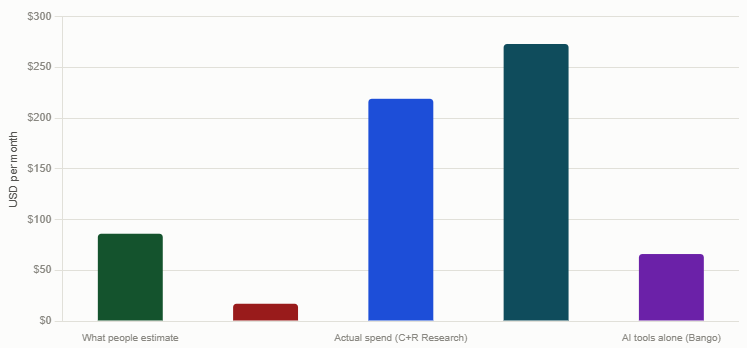
The data on what is happening inside American households’ subscription budgets in 2026 is striking. Americans spend an average of $219 per month on subscriptions but estimate their spending at $86 — a 2.5-times perception gap, identified by C+R Research and cited by LowerMySubs in February 2026. West Monroe’s survey found that 89 percent of consumers underestimate their actual monthly subscription spending, with 66 percent off by more than $200 per month and 13 percent off by more than $400 per month. The average person is paying $17 per month — $204 per year — for subscriptions they have completely forgotten about, according to a 2025 CNET survey.
This is the most honest question in personal finance right now: what subscription did you cancel and not miss? It is also the most revealing. Because the answer, multiplied across millions of households, exposes the mechanism by which subscription creep silently drains budgets — and points directly to where the money can be recovered.
The Data: Americans spend $219/month on subscriptions but estimate $86 (C+R Research; 2.5× perception gap). 89% underestimate (West Monroe). Average person pays $204/year for completely forgotten subscriptions (CNET 2025). 55% of Americans plan to significantly cut subscriptions in 2026 (NerdWallet, April 2026).
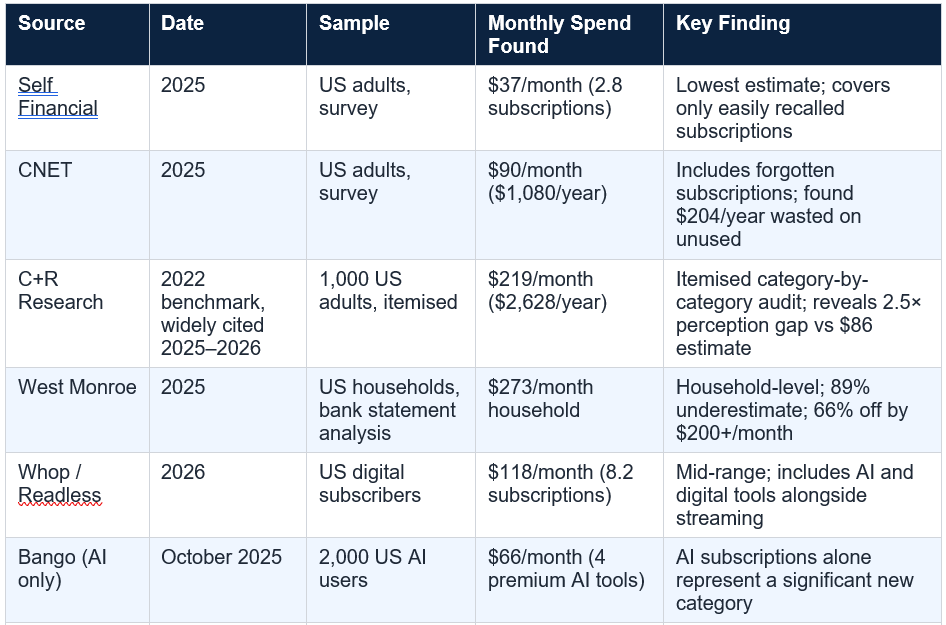
The variation comes from methodology: some studies count only the subscriptions people can name; others count every recurring charge that appears on actual bank and card statements across all payment methods. The gap between the two is the subscription spending problem in a single data point. When people name their subscriptions from memory, they produce a low number. When researchers examine actual statements, the number is dramatically higher.

The most accurate representation of the typical American’s subscription spending is probably somewhere between $90 and $219 per month, depending on how many digital tools and services they use professionally and personally. What all studies agree on: the number the person themselves estimates is substantially lower than the number they actually pay.
The Data: The perception gap is universal across demographics. West Monroe found 66% of consumers were off by more than $200/month on their subscription spending estimate. The gap persists across income levels, age groups, and subscription types. The subscription economy is engineered for invisibility.
The drivers are a combination of factors: price increases that crossed a threshold, the arrival of AI subscription costs as a new category layered on top of existing entertainment and productivity subscriptions, and a broader financial stress environment in which 55 percent of Americans are living paycheck to paycheck (SpendMeNot). The specific trigger described most often in consumer research is a price increase notification. Education-related subscriptions (language learning apps) show the highest cancellation rate following a price hike, with sports streaming subscriptions showing the lowest.
Kim Palmer, Personal Finance Expert, NerdWallet (April 2026): Sometimes it can help to do an overall subscription freeze to just stop all of your subscriptions at once to see what you might miss. Because sometimes we just get into the habit of paying for subscriptions but we’re not actually enjoying the product or services anymore. So it can help to go cold turkey and try to get rid of all of them at once.
Deloitte’s 2025 Digital Media Trends Survey of 3,595 US consumers found that 41 percent said content on streaming video services is not worth the price — up 5 percentage points from 2024. Forty-seven percent of streamers say they already pay too much. Yet subscription inertia means they are slow to cancel.
The pattern most commonly described by households that successfully cut streaming costs without meaningfully reducing their watching:
The subscribers who cancelled music streaming and did not miss it most commonly fell into one of three groups: those who discovered they already had access through a bundle they were paying for separately; those who returned to YouTube (which provides substantial free music access); and those who found that the loss of on-demand music was quickly replaced by radio, podcast listening, or the free tier of Spotify.
Spotify’s free tier — ad-supported, shuffle-only for mobile but fully featured on desktop — is the most common destination for those who cancel Spotify Premium. The difference in experience between free and paid is meaningful for some users and immaterial for others. Those who primarily use music as background while working often find the free tier entirely adequate. Those who commute with specific playlists typically miss the paid version.
The subscriptions that survive cancellation reckoning tend to be those that produce genuinely original, investigative journalism with no free equivalent — local newspapers, specialist trade publications, and long-form outlets whose content cannot be accessed through social sharing. The major national newspapers’ full-price subscriptions are most commonly the ones that feel like candidates for cancellation; their introductory offers were accepted and then their renewals at $20 to $40 per month were not closely examined.
The most impactful free alternative for news subscriptions is often the public library’s digital card, which in most US cities provides free access to major newspaper archives, magazine subscriptions through apps like Libby and PressReader, and ebook borrowing. The service is paid for by property taxes; using it costs nothing additional.
Action: Check your local library’s digital offers at your city or county library’s website. Most provide free access to Libby (ebook and magazine borrowing), PressReader (800+ newspapers and magazines), and Kanopy (film streaming). These replace significant paid subscription costs at zero additional expense.
The consumers who cancelled these apps and did not miss them most commonly found that:
The AI subscription landscape in 2026 is characterised by rapid capability improvements that continuously change the best-value calculus. A tool purchased for a specific capability in early 2025 may have been superseded by a competing tool offering the same capability at lower cost or within a general-purpose AI subscription that has expanded its features. Maintaining subscriptions to three separate AI tools when one general-purpose tool now covers all three use cases is a common source of unnecessary spending.
The cancel-and-not-miss pattern with AI tools is the most project-specific of all categories: users who cancelled a specialised AI tool between active projects genuinely did not miss it for months, then resubscribed when a new project required it. This on-demand pattern, described by 53 percent of AI subscribers, suggests that treating AI tools more like pay-as-you-go utilities than fixed monthly subscriptions matches their actual usage patterns better.
Key Insight: The AI subscription stack is duplicating itself in real-time. Many users who pay for Claude, ChatGPT, Gemini, and Perplexity simultaneously are often using one primarily and accessing the others rarely. The cancel-and-restart pattern (53% of AI subscribers) is the rational response: subscribe when you need it, cancel when the project ends.
The cancel-and-not-miss patterns in cloud storage:
The calculation is simple: if the membership costs $10 per month and the average delivery fee it waives is $5, the break-even is two orders per month. Households that order three to four times per week have a clear financial case for the membership. Households that order twice per month are paying for something that costs more than it saves.
The most common cancel-and-not-miss story with food delivery memberships is not that people stopped ordering food delivery. It is that they started making a more deliberate cost calculation for each order rather than defaulting to delivery because the fee felt ‘included.’ Without the membership, the visible $5 to $8 delivery fee becomes a real-time check on whether the convenience is worth the cost, which often produces a cooking decision instead.
The freeze approach works differently for different types of subscriptions:
The data behind the question is sobering: Americans spend $219 per month on subscriptions and think they spend $86. Eighty-nine percent underestimate. The average person wastes $204 per year on completely forgotten charges. And 55 percent of Americans plan to cut back in 2026 — not because subscription services have stopped offering value, but because the aggregate cost of subscribing to everything has crossed a threshold that no longer feels justified.
The answers people give when asked what they cancelled and did not miss reveal the same few categories repeatedly: the second and third streaming services, the fitness app that was replaced by a walk outside, the news subscription whose articles were available for free through the library, the AI tool made redundant by a general-purpose subscription that has expanded its features. None of these cancellations produced lasting regret. Most produced mild surprise at how quickly the absence became unremarkable.
The subscriptions worth keeping are the ones you would notice within a week. The ones worth cancelling are the ones you needed to be told were gone. The 15-minute audit, done once a quarter, is the most efficient per-hour personal finance intervention available in 2026. Most people find $50 to $100 per month on their first one. That is $600 to $1,200 per year for fifteen minutes of attention.
The honest answer is: more than they think. C+R Research found the average American spends $219 per month on subscriptions across all categories, but estimates only $86 when asked — a 2.5x perception gap (cited by LowerMySubs, February 2026 and extensively cited in 2025–2026 industry analysis). West Monroe's household-level analysis puts the average at $273 per month. CNET's 2025 survey found $90 per month. The variation comes from what each study counts as a 'subscription' and, more importantly, what respondents can actually recall when asked. The consistent finding across all studies: people underestimate their own subscription spending significantly, with 89% of consumers underestimating according to West Monroe.
What are the most commonly cancelled subscriptions that people don't miss?
Based on International Finance's analysis (November 2025) and Deloitte's 2025 Digital Media Trends Survey: (1) Video streaming services — 54.5% of subscription cancellations; most commonly the second or third streaming service in a household's stack. (2) Music streaming — 22.9% of cancellations; most often replaced by a bundle already paid for or the free tier. (3) News and magazine subscriptions — high churn; free library digital access through Libby and PressReader replaces much of the content. (4) Fitness and wellness apps — high non-regret rate; YouTube fitness content, outdoor exercise, and Silver Sneakers (for Medicare enrollees) are the most common free replacements. (5) AI productivity tools — 53% of AI subscribers cancel and restart as needed between projects.
How many subscriptions does the average American have?
Estimates vary widely depending on methodology: Self Financial's 2025 survey found 2.8 subscriptions per person; CNET and others estimate 5–8; C+R Research's itemised methodology found 12+ active subscriptions per person; Whop's 2026 analysis found 8.2 subscriptions per person. The variation comes from whether the study counts only subscriptions the person can name (lower number) or all recurring charges on actual bank and card statements (higher number). The most important number is not the count but the waste figure: the average person pays for at least 1 to 2 subscriptions they have completely forgotten about, costing approximately $17 per month ($204 per year) according to CNET's 2025 survey.
What is the subscription freeze strategy?
The subscription freeze is a strategy recommended by NerdWallet's personal finance expert Kim Palmer in April 2026: cancel all or most subscriptions at once, then add back only the ones you actively miss. Rather than trying to decide in advance which subscriptions are worth keeping, the freeze lets the experience of not having access answer the question. Subscriptions you seek to access within 30 days of cancellation are worth resubscribing to. Subscriptions you don't think about are confirmed as non-essential. Kim Palmer described it: 'Sometimes it can help to do an overall subscription freeze to just stop all of your subscriptions at once to see what you might miss, because sometimes we just get into the habit of paying for subscriptions but we're not actually enjoying the product or services anymore.'
How do I do a quick subscription audit?
The 15-minute audit process recommended by Resubs (January 2026) and other subscription tracking services: (1) Review 90 days of bank and credit card statements and highlight every recurring charge. (2) Check Apple ID subscriptions (Settings > [Your Name] > Subscriptions on iPhone) and Google Play subscriptions (play.google.com/store/account/subscriptions). (3) Search your email for 'renewal,' 'receipt,' and 'subscription' to catch annual charges. (4) For each subscription found, ask: When did I last use this? Is it available free or through a bundle I already pay for? Would I pay for this today knowing how much I use it? Cancel any that fail this test. Most people find 2–3 forgotten subscriptions and $50–$100/month in unnecessary spending on their first audit.
Are AI subscriptions worth keeping?
It depends on usage frequency and whether one general-purpose AI subscription covers your needs better than multiple specialised tools. Bango's October 2025 survey of 2,000 US AI users found the average AI subscriber pays for four premium AI tools at $66/month, with 53% cancelling and restarting tools as needed between projects. The cancel-and-restart pattern is the rational response for project-based AI use. For ongoing daily use, a single general-purpose AI subscription ($20/month for most tools) that covers the majority of use cases is more cost-effective than maintaining multiple specialised subscriptions simultaneously. Review your AI tools quarterly: identify which you use weekly, which you use occasionally, and cancel the occasional ones for resubscription when a specific project requires them.
Table of Contents
- The Subscription We Forgot We Were Paying For
- The Real Numbers: How Much Americans Actually Spend on Subscriptions
- Why We Underestimate by 2.5×: The Architecture of Invisible Spending
- The Great Subscription Reckoning of 2026
- What People Actually Cancelled — and Didn’t Miss
- Category Deep Dive: Video Streaming
- Category Deep Dive: Music Streaming
- Category Deep Dive: News and Magazine Subscriptions
- Category Deep Dive: Fitness and Wellness Apps
- Category Deep Dive: AI Tools and Productivity Software
- Category Deep Dive: Cloud Storage and Backup Services
- Category Deep Dive: Food Delivery and Membership Perks
- The Subscriptions People Kept: What Passes the ‘Worth It’ Test
- The 15-Minute Subscription Audit
- The ‘Subscription Freeze’ Strategy
- How to Negotiate, Pause, or Downgrade Instead of Cancel
- Conclusion: The Best Personal Finance Question of 2026
- Frequently Asked Questions
What People Cancelled
The $133 Perception Gap
The Subscription We Forgot We Were Paying For
At some point in the last three years, almost everyone signed up for something they no longer use. A streaming service for a show that is now over. A meditation app that was used for two weeks in January. A news subscription that was offered at a discount for three months and then auto-renewed at full price for the following eighteen. A productivity tool that the free tier turned out to be sufficient for. A gym app that replaced the gym but then itself went unused.The data on what is happening inside American households’ subscription budgets in 2026 is striking. Americans spend an average of $219 per month on subscriptions but estimate their spending at $86 — a 2.5-times perception gap, identified by C+R Research and cited by LowerMySubs in February 2026. West Monroe’s survey found that 89 percent of consumers underestimate their actual monthly subscription spending, with 66 percent off by more than $200 per month and 13 percent off by more than $400 per month. The average person is paying $17 per month — $204 per year — for subscriptions they have completely forgotten about, according to a 2025 CNET survey.
This is the most honest question in personal finance right now: what subscription did you cancel and not miss? It is also the most revealing. Because the answer, multiplied across millions of households, exposes the mechanism by which subscription creep silently drains budgets — and points directly to where the money can be recovered.
The Data: Americans spend $219/month on subscriptions but estimate $86 (C+R Research; 2.5× perception gap). 89% underestimate (West Monroe). Average person pays $204/year for completely forgotten subscriptions (CNET 2025). 55% of Americans plan to significantly cut subscriptions in 2026 (NerdWallet, April 2026).
The Real Numbers: How Much Americans Actually Spend on Subscriptions
The difficulty with measuring subscription spending is that different studies count different things, which explains the wide range in reported figures. Self Financial’s 2025 survey found Americans have 2.8 active subscriptions spending $37 per month. Whop’s 2026 analysis found 8.2 subscriptions per person at $118 per month. CNET landed at $90 per month. C+R Research’s detailed itemised category-by-category methodology produced $219 per month. West Monroe’s household figure is $273 per month.The variation comes from methodology: some studies count only the subscriptions people can name; others count every recurring charge that appears on actual bank and card statements across all payment methods. The gap between the two is the subscription spending problem in a single data point. When people name their subscriptions from memory, they produce a low number. When researchers examine actual statements, the number is dramatically higher.
The most accurate representation of the typical American’s subscription spending is probably somewhere between $90 and $219 per month, depending on how many digital tools and services they use professionally and personally. What all studies agree on: the number the person themselves estimates is substantially lower than the number they actually pay.
The Data: The perception gap is universal across demographics. West Monroe found 66% of consumers were off by more than $200/month on their subscription spending estimate. The gap persists across income levels, age groups, and subscription types. The subscription economy is engineered for invisibility.
Why We Underestimate by 2.5×: The Architecture of Invisible Spending
The 2.5-times gap between what Americans think they spend on subscriptions and what they actually spend is not carelessness. It is the predictable outcome of a payment architecture specifically designed to minimise the salience of recurring charges. OsakaWire’s April 2026 analysis of subscription creep describes this precisely: when a charge is $6.99 here, $14.99 there, $4.99 elsewhere, each individually too small to warrant scrutiny, the aggregate becomes invisible. Four structural features of subscription billing create and sustain this invisibility:- • Annual billing amnesia: a $119/year subscription appears once a year and is processed as a single, annual event. People remember the monthly equivalent as zero because there was no charge last month. Annual billing is designed to reduce cancellation rates — and it works, partly because it also reduces spending awareness.
- • Accumulated micro-price increases: Netflix raised each of its three tiers by 14 to 16 percent in January 2025 alone — Standard with Ads to $7.99, Standard to $17.99, and Premium to $24.99 — and made a second major increase in March 2026. Disney+ raised its ad-supported tier from $9.99 to $11.99 and its premium tier from $15.99 to $18.99 in October 2025. TrackAllSubs’ August 2026 analysis notes that across eight subscriptions that raised prices in 2025–2026, the total increase can reach $30 to $60 per month — invisible if no one is tracking.
- • Payment method fragmentation: 72 percent of consumers have all subscriptions set to auto-pay, spread across personal credit cards, business cards, PayPal, Apple’s App Store, Google Play, and PayPal. A subscription charged to a secondary card used for nothing else is effectively invisible until the annual statement arrives.
- • The forgotten subscription: 42 percent of consumers admit they are paying for at least one subscription they have entirely forgotten about (C+R Research, OsakaWire April 2026). The average forgotten subscription has been running for 14 months before it is discovered.
The Great Subscription Reckoning of 2026
Something changed in 2026. After years of steady subscription accumulation — each new service added one at a time in moments of enthusiasm, each price increase accepted passively through inaction — a significant proportion of Americans began actively cutting back. NerdWallet’s April 2026 survey found 55 percent of Americans plan to significantly cut back on subscriptions to save money. Sixty-three percent of parents said they wanted to cancel subscriptions right now. Zuora’s 2026 Subscription Economy Index found that 47 percent of consumers actively cancelled at least one subscription service in 2026, up from 31 percent in 2024.The drivers are a combination of factors: price increases that crossed a threshold, the arrival of AI subscription costs as a new category layered on top of existing entertainment and productivity subscriptions, and a broader financial stress environment in which 55 percent of Americans are living paycheck to paycheck (SpendMeNot). The specific trigger described most often in consumer research is a price increase notification. Education-related subscriptions (language learning apps) show the highest cancellation rate following a price hike, with sports streaming subscriptions showing the lowest.
Kim Palmer, Personal Finance Expert, NerdWallet (April 2026): Sometimes it can help to do an overall subscription freeze to just stop all of your subscriptions at once to see what you might miss. Because sometimes we just get into the habit of paying for subscriptions but we’re not actually enjoying the product or services anymore. So it can help to go cold turkey and try to get rid of all of them at once.
What People Actually Cancelled — and Didn’t Miss
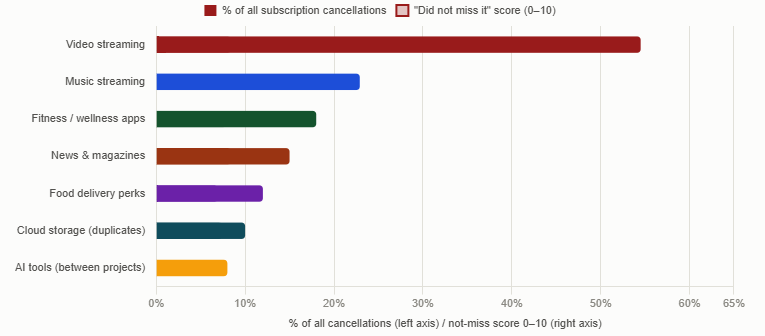
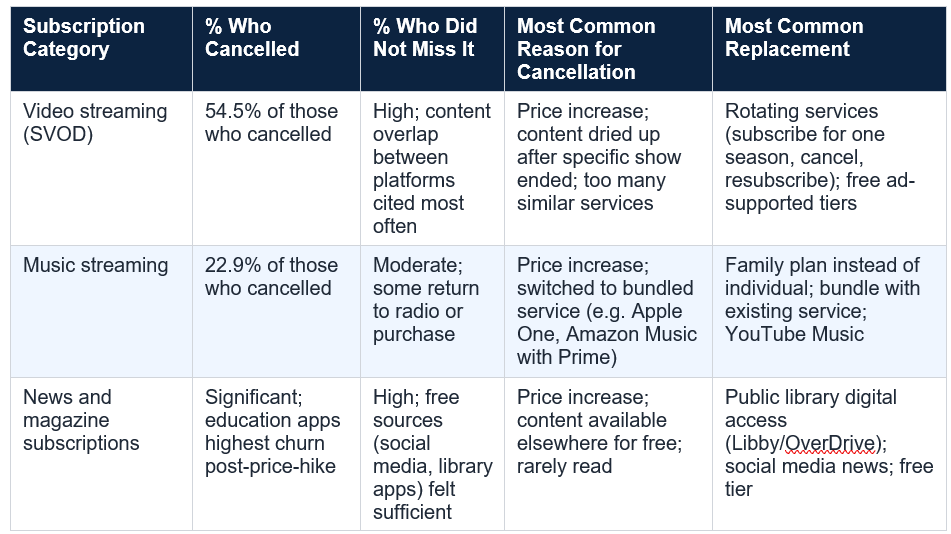
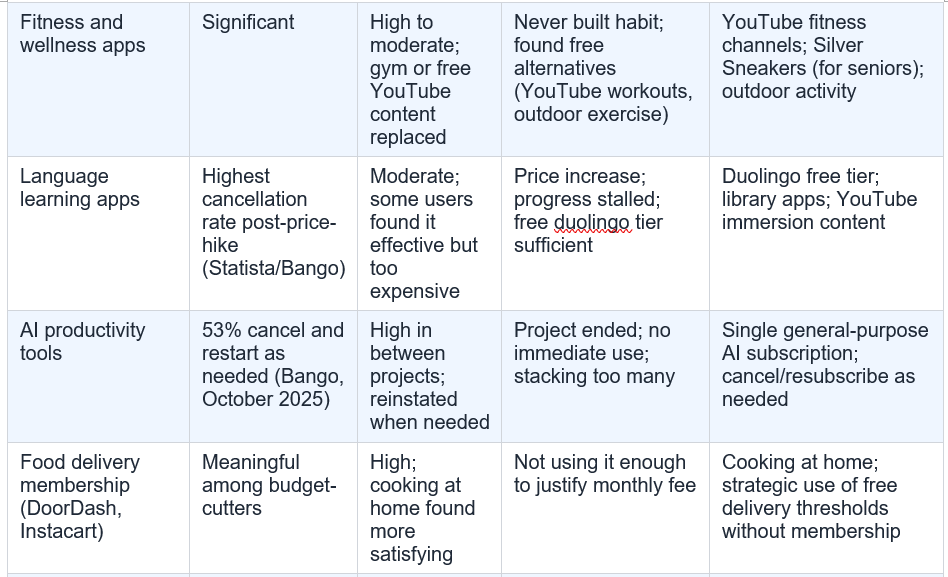
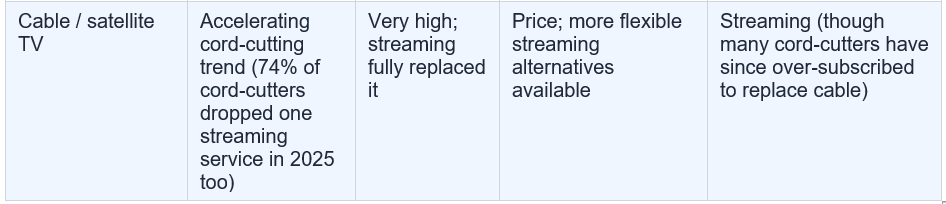
The most commonly cancelled subscription categories, based on survey data from International Finance (November 2025), Deloitte’s 2025 Digital Media Trends Survey, and CivicScience research via TechRT (May 2026):
6. Category Deep Dive: Video Streaming
Video streaming is the subscription people cancel most and, often, miss the least in the short term. The 54.5 percent of cancellations attributable to video streaming reflects a structural reality: the streaming market has fragmented to the point where no single service contains all the content any individual household wants, and maintaining all of them simultaneously means paying five or six subscriptions for a combined $75 to $100+ per month — comparable to the cable bills the services originally promised to replace.Deloitte’s 2025 Digital Media Trends Survey of 3,595 US consumers found that 41 percent said content on streaming video services is not worth the price — up 5 percentage points from 2024. Forty-seven percent of streamers say they already pay too much. Yet subscription inertia means they are slow to cancel.
The pattern most commonly described by households that successfully cut streaming costs without meaningfully reducing their watching:
- Rotate rather than stack: subscribe to Service A for three months while a specific show airs, cancel, subscribe to Service B for the next compelling season, cancel. The rotating approach eliminates the ‘paying for three services at once when you can only watch one at a time’ problem.
- Switch to ad-supported tiers: 36 percent of streaming users said they would accept twice as many ads to lower subscription fees, and 49 percent of Gen Z would accept more ads for cheaper plans (TechRT, May 2026). Most major services now offer ad-supported tiers at $4 to $8 per month, compared to $18 to $25 for ad-free premium.
- Share a family plan: splitting one family plan among eligible members produces per-person costs below any individual subscription.
Category Deep Dive: Music Streaming
Music streaming is the second most commonly cancelled subscription category at 22.9 percent of cancellations. The most common trigger is a price increase, followed by realisation that the service is bundled with something already paid for. Spotify’s individual plan rose to $11.99 per month in 2024 and has maintained that rate. Apple Music costs $10.99 for individuals. Amazon Music Unlimited is often already included in Amazon Prime. Apple Music is bundled with Apple One.The subscribers who cancelled music streaming and did not miss it most commonly fell into one of three groups: those who discovered they already had access through a bundle they were paying for separately; those who returned to YouTube (which provides substantial free music access); and those who found that the loss of on-demand music was quickly replaced by radio, podcast listening, or the free tier of Spotify.
Spotify’s free tier — ad-supported, shuffle-only for mobile but fully featured on desktop — is the most common destination for those who cancel Spotify Premium. The difference in experience between free and paid is meaningful for some users and immaterial for others. Those who primarily use music as background while working often find the free tier entirely adequate. Those who commute with specific playlists typically miss the paid version.
Category Deep Dive: News and Magazine Subscriptions
News subscriptions have some of the highest ‘cancel and not miss’ rates in consumer surveys. The reason is structural: most of the content consumers actually consume comes through social media shares, which provide access to individual articles without requiring a subscription. The user who cancels a news paywall subscription and discovers they can access most articles they encounter through social links without one has effectively found a free replacement.The subscriptions that survive cancellation reckoning tend to be those that produce genuinely original, investigative journalism with no free equivalent — local newspapers, specialist trade publications, and long-form outlets whose content cannot be accessed through social sharing. The major national newspapers’ full-price subscriptions are most commonly the ones that feel like candidates for cancellation; their introductory offers were accepted and then their renewals at $20 to $40 per month were not closely examined.
The most impactful free alternative for news subscriptions is often the public library’s digital card, which in most US cities provides free access to major newspaper archives, magazine subscriptions through apps like Libby and PressReader, and ebook borrowing. The service is paid for by property taxes; using it costs nothing additional.
Action: Check your local library’s digital offers at your city or county library’s website. Most provide free access to Libby (ebook and magazine borrowing), PressReader (800+ newspapers and magazines), and Kanopy (film streaming). These replace significant paid subscription costs at zero additional expense.
Category Deep Dive: Fitness and Wellness Apps
Fitness and wellness apps have among the highest churn rates of any subscription category, driven by the well-documented gap between January enthusiasm and February reality. Apps like Peloton, Calm, Headspace, Noom, MyFitnessPal Premium, and assorted workout platforms command $10 to $40 per month for services that require consistent engagement to justify their cost.The consumers who cancelled these apps and did not miss them most commonly found that:
- Free alternatives were sufficient: YouTube’s fitness content (yoga channels, HIIT workout programs, running plans) is extensive, professionally produced, and free. The gap in functionality between a premium fitness app and a well-curated YouTube playlist is smaller than the $15 to $30 per month suggests.
- Outdoor and community alternatives replaced app-guided workouts: running outside costs nothing. Community-based fitness (local running groups, recreational sports leagues) costs significantly less than a monthly app subscription and provides the social accountability that apps attempt to replicate through notifications.
- The app became redundant after goal achievement: someone who used a meditation app intensively for three months and developed a meditation habit may find the app no longer necessary once the habit is established.
10. Category Deep Dive: AI Tools and Productivity Software
AI subscriptions are the fastest-growing new category of subscription fatigue in 2026. Bango’s ‘Rise of the AI Subscriber’ survey of 2,000 US AI users in October 2025 found that the average American AI subscriber pays for four premium AI tools at approximately $66 per month. Fourteen percent pay for eight or more AI services. The most striking behavioural finding: 53 percent say they cancel and restart AI tools as needed — making churn the default management strategy rather than an exception.The AI subscription landscape in 2026 is characterised by rapid capability improvements that continuously change the best-value calculus. A tool purchased for a specific capability in early 2025 may have been superseded by a competing tool offering the same capability at lower cost or within a general-purpose AI subscription that has expanded its features. Maintaining subscriptions to three separate AI tools when one general-purpose tool now covers all three use cases is a common source of unnecessary spending.
The cancel-and-not-miss pattern with AI tools is the most project-specific of all categories: users who cancelled a specialised AI tool between active projects genuinely did not miss it for months, then resubscribed when a new project required it. This on-demand pattern, described by 53 percent of AI subscribers, suggests that treating AI tools more like pay-as-you-go utilities than fixed monthly subscriptions matches their actual usage patterns better.
Key Insight: The AI subscription stack is duplicating itself in real-time. Many users who pay for Claude, ChatGPT, Gemini, and Perplexity simultaneously are often using one primarily and accessing the others rarely. The cancel-and-restart pattern (53% of AI subscribers) is the rational response: subscribe when you need it, cancel when the project ends.
Category Deep Dive: Cloud Storage and Backup Services
Cloud storage subscriptions are among the most innocuously expensive in the subscription stack. iCloud+, Google One, Dropbox, OneDrive, and Backblaze each charge $3 to $12 per month for plans that users typically acquire because their device ran out of free storage — and then forget about permanently.The cancel-and-not-miss patterns in cloud storage:
- Duplicate services: many users pay for both iCloud+ and Google One without realising that their smartphone’s automatic backup is going to one, making the other redundant. Identifying the primary backup service and cancelling the secondary is pure saving.
- Storage not actually needed: a 2TB plan purchased after a photo dump is not necessarily permanently needed at that level. Reviewing what is actually stored — and deleting duplicates, old screenshots, and redundant files — may bring usage back within the free tier.
- Bundle overlap: Microsoft 365 includes 1TB of OneDrive storage per subscriber. Users who pay separately for OneDrive storage on top of a Microsoft 365 subscription are paying twice for the same storage.
12. Category Deep Dive: Food Delivery and Membership Perks
Food delivery memberships (DoorDash DashPass, Instacart+, Uber One) promise free delivery and reduced service fees for a monthly or annual subscription cost of $9 to $15 per month. These subscriptions deliver excellent value for heavy food delivery users and negative value for households that order less than two to three times per month.The calculation is simple: if the membership costs $10 per month and the average delivery fee it waives is $5, the break-even is two orders per month. Households that order three to four times per week have a clear financial case for the membership. Households that order twice per month are paying for something that costs more than it saves.
The most common cancel-and-not-miss story with food delivery memberships is not that people stopped ordering food delivery. It is that they started making a more deliberate cost calculation for each order rather than defaulting to delivery because the fee felt ‘included.’ Without the membership, the visible $5 to $8 delivery fee becomes a real-time check on whether the convenience is worth the cost, which often produces a cooking decision instead.
13. The Subscriptions People Kept: What Passes the ‘Worth It’ Test
In every subscription audit conversation — in personal finance communities, in NerdWallet’s research, in the Bogleheads forum, across Reddit’s personal finance boards — certain categories consistently survive the cull. Understanding what survives is as informative as understanding what does not:- • A single, actively used streaming service: the households that were happiest with their streaming decisions maintained one or two services they watched weekly and cancelled the rest. The specific service varied; what mattered was that it was genuinely used regularly.
- • Password management: LastPass, 1Password, and similar tools ($3 to $5 per month) are uniformly reported as worth keeping. The security value and the time saved across hundreds of logins justify the cost for almost all users.
- • Cloud backup for photos and documents: one comprehensive backup service — not three overlapping ones — is consistently kept.
- • Active professional tools: software directly tied to income generation (Adobe Creative Cloud for a designer, GitHub Copilot for a developer, Canva Pro for a marketing professional) survives cancellation reviews because the ROI is direct and measurable.
- • Services used multiple times per week: the consistent predictor of a subscription surviving an audit is weekly usage frequency. If you use something twice a week, you will miss it. If you use it twice per year, you will not.
The 15-Minute Subscription Audit
Resubs’ January 2026 guide identifies a 15-minute subscription audit as the standard recommendation across personal finance researchers. The average person finds two to three subscriptions they had completely forgotten about. The process:- Step 1 (5 minutes): open your primary bank and credit card statements for the past 90 days. Export or screenshot them. Every recurring charge — any charge appearing in the same or similar amount on a monthly or annual basis — gets highlighted.
- Step 2 (3 minutes): check your Apple ID subscriptions (Settings → [Your Name] → Subscriptions on iPhone; appleid.apple.com on web). Check Google Play subscriptions (play.google.com/store/account/subscriptions). These surfaces reveal the most commonly forgotten recurring charges.
- Step 3 (3 minutes): search your email inbox for the words ‘renewal,’ ‘receipt,’ and ‘subscription’ filtered to the past 12 months. Many annual subscriptions arrive as a single email before the charge appears on the statement.
- Step 4 (4 minutes): for each subscription identified, answer three questions: When did I last use this? Could I get this free or through a bundle I already pay for? Would I pay for this again today, knowing what I know about how much I actually use it? Cancel any that fail the three-question test.
The ‘Subscription Freeze’ Strategy
NerdWallet’s Kim Palmer, in her April 2026 InvestigateTV interview, recommended what she called the ‘subscription freeze’: cancel everything at once, then add back only the subscriptions you actively miss. This cold-turkey approach is psychologically more effective than the incremental audit for many people because it forces the ‘do I actually miss this?’ question to be answered by experience rather than speculation.The freeze approach works differently for different types of subscriptions:
- Most effective for: streaming services, fitness apps, productivity tools with free alternatives, news subscriptions with library-accessible content.
- Not appropriate for: annual subscriptions where cancelling mid-term forfeits paid months; cloud backups with active data; services with early-cancellation fees; any service tied to active professional obligations.
- The resubscription test: after cancelling, wait 30 days. If you have actively sought to access the service’s content or features at least once in those 30 days, resubscribe. If you have not thought about it, you have your answer.
How to Negotiate, Pause, or Downgrade Instead of Cancel
For subscriptions where there is genuine value but the price has risen to an uncomfortable level, outright cancellation is not always the only option:- Negotiate a loyalty discount: many subscription services, particularly streaming and software, have retention offers that are not advertised but are offered when a cancellation is initiated. Clicking ‘cancel’ and then responding to the retention pop-up with ‘offer’ rather than ‘confirm cancellation’ frequently produces a discount of 20 to 50 percent for three to six months.
- Pause instead of cancel: several subscription services — Amazon Prime, Hulu, Headspace, and others — offer a pause option that suspends billing for one to three months without cancelling membership. This is ideal for the subscription that is genuinely useful but not currently needed.
- Downgrade to a lower tier: if the premium tier’s additional features are not actually used, downgrading to a mid-tier or ad-supported tier can reduce cost by 30 to 60 percent without losing access to the core content.
- Share a family plan: many services allow family plans at a per-person cost well below individual subscriptions. Coordinating with family members who use the same services can cut per-person cost significantly.
- Check for employer or bank benefits: some employers offer subscription discounts as part of their benefits package. Many premium credit cards include streaming credits, food delivery credits, or other subscription offsets that are frequently left unclaimed.
Conclusion
The question ‘what subscription did you cancel and not miss?’ is doing something that most personal finance questions do not: it asks about lived experience rather than theory. Most financial advice tells people what they should value. This question asks what they actually value, revealed by the evidence of what they chose not to pay for again.The data behind the question is sobering: Americans spend $219 per month on subscriptions and think they spend $86. Eighty-nine percent underestimate. The average person wastes $204 per year on completely forgotten charges. And 55 percent of Americans plan to cut back in 2026 — not because subscription services have stopped offering value, but because the aggregate cost of subscribing to everything has crossed a threshold that no longer feels justified.
The answers people give when asked what they cancelled and did not miss reveal the same few categories repeatedly: the second and third streaming services, the fitness app that was replaced by a walk outside, the news subscription whose articles were available for free through the library, the AI tool made redundant by a general-purpose subscription that has expanded its features. None of these cancellations produced lasting regret. Most produced mild surprise at how quickly the absence became unremarkable.
The subscriptions worth keeping are the ones you would notice within a week. The ones worth cancelling are the ones you needed to be told were gone. The 15-minute audit, done once a quarter, is the most efficient per-hour personal finance intervention available in 2026. Most people find $50 to $100 per month on their first one. That is $600 to $1,200 per year for fifteen minutes of attention.
Frequently Asked Questions
How much do Americans really spend on subscriptions in 2026?The honest answer is: more than they think. C+R Research found the average American spends $219 per month on subscriptions across all categories, but estimates only $86 when asked — a 2.5x perception gap (cited by LowerMySubs, February 2026 and extensively cited in 2025–2026 industry analysis). West Monroe's household-level analysis puts the average at $273 per month. CNET's 2025 survey found $90 per month. The variation comes from what each study counts as a 'subscription' and, more importantly, what respondents can actually recall when asked. The consistent finding across all studies: people underestimate their own subscription spending significantly, with 89% of consumers underestimating according to West Monroe.
What are the most commonly cancelled subscriptions that people don't miss?
Based on International Finance's analysis (November 2025) and Deloitte's 2025 Digital Media Trends Survey: (1) Video streaming services — 54.5% of subscription cancellations; most commonly the second or third streaming service in a household's stack. (2) Music streaming — 22.9% of cancellations; most often replaced by a bundle already paid for or the free tier. (3) News and magazine subscriptions — high churn; free library digital access through Libby and PressReader replaces much of the content. (4) Fitness and wellness apps — high non-regret rate; YouTube fitness content, outdoor exercise, and Silver Sneakers (for Medicare enrollees) are the most common free replacements. (5) AI productivity tools — 53% of AI subscribers cancel and restart as needed between projects.
How many subscriptions does the average American have?
Estimates vary widely depending on methodology: Self Financial's 2025 survey found 2.8 subscriptions per person; CNET and others estimate 5–8; C+R Research's itemised methodology found 12+ active subscriptions per person; Whop's 2026 analysis found 8.2 subscriptions per person. The variation comes from whether the study counts only subscriptions the person can name (lower number) or all recurring charges on actual bank and card statements (higher number). The most important number is not the count but the waste figure: the average person pays for at least 1 to 2 subscriptions they have completely forgotten about, costing approximately $17 per month ($204 per year) according to CNET's 2025 survey.
What is the subscription freeze strategy?
The subscription freeze is a strategy recommended by NerdWallet's personal finance expert Kim Palmer in April 2026: cancel all or most subscriptions at once, then add back only the ones you actively miss. Rather than trying to decide in advance which subscriptions are worth keeping, the freeze lets the experience of not having access answer the question. Subscriptions you seek to access within 30 days of cancellation are worth resubscribing to. Subscriptions you don't think about are confirmed as non-essential. Kim Palmer described it: 'Sometimes it can help to do an overall subscription freeze to just stop all of your subscriptions at once to see what you might miss, because sometimes we just get into the habit of paying for subscriptions but we're not actually enjoying the product or services anymore.'
How do I do a quick subscription audit?
The 15-minute audit process recommended by Resubs (January 2026) and other subscription tracking services: (1) Review 90 days of bank and credit card statements and highlight every recurring charge. (2) Check Apple ID subscriptions (Settings > [Your Name] > Subscriptions on iPhone) and Google Play subscriptions (play.google.com/store/account/subscriptions). (3) Search your email for 'renewal,' 'receipt,' and 'subscription' to catch annual charges. (4) For each subscription found, ask: When did I last use this? Is it available free or through a bundle I already pay for? Would I pay for this today knowing how much I use it? Cancel any that fail this test. Most people find 2–3 forgotten subscriptions and $50–$100/month in unnecessary spending on their first audit.
Are AI subscriptions worth keeping?
It depends on usage frequency and whether one general-purpose AI subscription covers your needs better than multiple specialised tools. Bango's October 2025 survey of 2,000 US AI users found the average AI subscriber pays for four premium AI tools at $66/month, with 53% cancelling and restarting tools as needed between projects. The cancel-and-restart pattern is the rational response for project-based AI use. For ongoing daily use, a single general-purpose AI subscription ($20/month for most tools) that covers the majority of use cases is more cost-effective than maintaining multiple specialised subscriptions simultaneously. Review your AI tools quarterly: identify which you use weekly, which you use occasionally, and cancel the occasional ones for resubscription when a specific project requires them.
0 Comments
Be the first to share your thoughts on this article.