

Financial Literacy
What Wealthy People Do Before 9 AM That Broke People Don't

Tom Corley spent five years studying 233 millionaires and 128 people living in poverty. The gaps in their morning habits are not small: 44-55% of the wealthy wake up 3+ hours early vs 3% of the nonwealthy. 76% exercise vs 23%. 88% read vs 26%. The mornings are different. Here is how.
The gap between wealth and financial struggle is often attributed to income, opportunity, education, and circumstance — and those things are real and important. But there is another gap that the research documents in fine detail, and it runs through the first few hours of every single morning. Tom Corley spent five years studying the daily habits of 233 wealthy individuals and 128 people living in poverty, published in ‘Rich Habits: The Daily Success Habits of Wealthy Individuals.’ The data that emerged was not about intelligence, talent, or luck. It was about the specific, repeatable, intentional things that wealthy people do before 9 AM that most financially struggling people simply do not. The Sleep Judge’s survey of over 1,000 people found that those who reported a consistent morning routine earned an average of $12,500 more per year than those who did not. Laura Vanderkam’s research on what the most successful people do before breakfast found that they treat morning as protected time — the window that belongs to their own priorities before the world’s demands arrive. This article covers seven of those morning habits, what the research behind each one says, and the precise gap between wealthy and nonwealthy people on each metric.
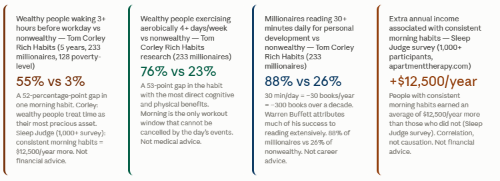
Tom Corley, Rich Habits (5 years, 233 millionaires, 128 poverty-level individuals): 44-55% of wealthy wake 3+ hours before workday; 3% of nonwealthy. Sleep Judge (1,000+ survey): consistent morning habits = $12,500/year more.
The key morning habit statistics from Corley’s research: 44-55% of wealthy people wake at least three hours before their formal workday begins, against 3% of those who are not wealthy. 76% of wealthy people engage in aerobic exercise at least four days per week, versus 23% of the nonwealthy. 88% of millionaires read for at least 30 minutes daily, against 26% of the nonwealthy who report loving to read. 62% of rich people maintain daily focus on their goals, versus 6% of those who are not wealthy. 81% of wealthy people maintain a daily to-do list, against 19% of the nonwealthy. 57% make deliberate daily food choices, versus 5%. These are not personality differences. They are habit differences — differences in what is done, repeatedly, in the hours before 9 AM, over years.
The gap: Wealthy: 44-55% wake 3+ hours before workday. Non-wealthy: 3%. The gap is not about sleeping less — it is about who controls the first hours of the day. Not career advice.
Wealthy: phone is off or away for the first hour. Most: the phone is the first thing checked. Starting with others' inputs before your own thinking is the difference between a proactive day and a reactive one. Not career advice.
Put your phone in another room tonight. For the first thirty minutes of tomorrow morning, do anything that does not involve a screen. Notice the quality of your thinking.
The gap: 76% of wealthy exercise aerobically 4 days/week vs 23% of nonwealthy (Corley). A 53-percentage-point gap in one of the most cognitively beneficial habits available.
Start with twenty minutes of walking three mornings this week. Aerobic exercise does not require a gym. Walking at a brisk pace produces the same cognitive benefits at a fraction of the barrier to entry.
The gap: 88% of millionaires read 30+ minutes daily; 26% of nonwealthy report loving to read (Corley). The gap is not about access to books. It is about whether reading is treated as an essential daily investment or an optional leisure activity.
Place a book (physical or digital) beside your bed tonight. Tomorrow morning, before the phone, read one page. One page. The habit is the thing — the length will grow naturally.
The gap: 62% of wealthy focus on goals daily vs 6% nonwealthy. 81% maintain a daily to-do list vs 19% nonwealthy (Corley). The gap between a directed day and a reactive day often comes down to a single five-minute planning session.
Tonight, write down your top three priorities for tomorrow before you go to sleep. Not a full to-do list — just three things. Review them when you wake up. That is the practice.
The gap: 57% of wealthy make deliberate daily food choices vs 5% of nonwealthy — a 52-point gap (Corley). Cognitive performance is affected by what is eaten before 9 AM.
Prepare breakfast the night before once this week. Something with protein: eggs, yoghurt, nuts. Notice whether the morning feels different when food is not a decision to be made under time pressure.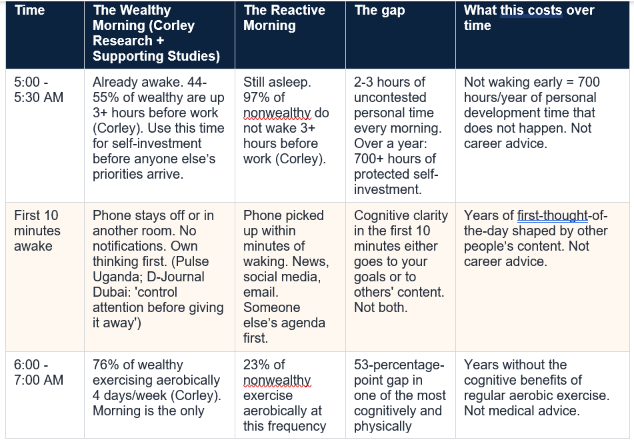
Corley’s research focused specifically on self-made wealthy individuals — people who built wealth through their own efforts rather than inheritance. The habits he identified are correlated with wealth accumulation in that specific context, over the five years of his observation. They are not universal guarantees. What the research does support is that consistently applied morning habits — early rising, physical exercise, deliberate reading, goal focus, intentional food choices, protection of attention — improve the daily conditions for cognitive performance, decision quality, and long-term behaviour alignment with stated goals. These improvements compound. Over years, they change what is possible. They are not the whole story. They are a meaningful part of it.
The honest truth: D-Journal Dubai: 'Morning habits complement these factors — they are not substitutes for them.' Wealth is affected by systemic factors beyond individual habits. The research describes correlations in self-made wealthy individuals — not guarantees. Habits improve conditions for success; they do not create it alone.
Every one of those defaults is changeable. Not all at once, and not without effort, but one habit at a time, starting with the smallest version of it. The Sleep Judge survey found that a consistent morning routine was worth an average of $12,500 more per year across their survey population. Laura Vanderkam found that highly successful people use the morning as protected time for what matters to them before the world’s demands arrive. The morning is the one period of the day that is most fully yours. What you do with it, consistently, over years, is a compound interest calculation. The question is what you are investing in.
Tom Corley's Rich Habits research (233 millionaires, 128 poverty-level individuals, 5 years) found that 44-55% of wealthy people wake up at least three hours before their formal workday begins. A separate compilation at lollydaskal.com puts the figure at 44% waking three or more hours before going to work. Against 3% of those who are not wealthy. In practice, this often means a 5 AM wake-up for someone starting work at 8 AM, or a 4 AM wake-up for an earlier start. The specific time matters less than the principle: wealthy people consistently create a morning buffer of uncontested personal time before anyone else's agenda arrives. The Sleep Judge survey found that rising earlier was linked to greater wealth, especially when those early mornings were productive rather than passive.
Is the reading habit really that important? What do wealthy people read?
Corley's research found that 88% of millionaires read for at least 30 minutes daily, almost exclusively for personal development, education, or professional knowledge. 86% of wealthy people report loving to read, against 26% of the nonwealthy (lollydaskal.com). The content matters: Corley's research specifies personal development, biography, history, self-improvement, and industry-specific knowledge rather than entertainment. Warren Buffett is the most cited example — he attributes much of his success to reading extensively. The mechanism is compound knowledge accumulation: 30 minutes per day produces approximately 30 books per year. Over ten years: 300 books of compounding expertise. The morning is specifically valuable for reading because it is the sharpest cognitive window of the day, before decision fatigue accumulates.
What if I can't wake up early due to work schedule or family responsibilities?
The research describes correlations in the specific group Corley studied — self-made wealthy individuals with the structural ability to control their morning schedules. D-Journal Dubai's analysis of morning habits acknowledges directly: 'Morning habits do not create wealth by themselves. Morning routines complement these factors — they are not substitutes for them.' For parents of young children, shift workers, carers, and others whose mornings are not theirs to control, the principle of the wealthy morning — protecting some time for intentional self-investment before others' demands dominate — applies whenever that window exists, not necessarily before 9 AM. The Sleep Judge survey found that consistency of morning habits mattered more than any specific activity.
How much of a difference does a morning routine actually make financially?
The Sleep Judge survey of over 1,000 people found that those who reported a consistent set of morning habits earned an average of $12,500 per year more than those who did not. This is a correlation from survey data, not a controlled experiment — and income differences reflect many variables beyond morning habits. Corley's research found 62% of wealthy people maintain daily goal focus versus 6% of the nonwealthy, and 81% maintain a daily to-do list versus 19% — suggesting that the planning habits of wealthy mornings are among the most significant separators. D-Journal Dubai's caveat applies: morning habits complement other factors, they do not substitute for them.
Where do I start if I want to build a wealthy morning routine?
The research suggests starting with one habit at a time rather than attempting a complete morning overhaul. D-Journal Dubai's analysis notes that 'successful people frequently begin working before inspiration arrives' — the same principle applies to building the routine. The sequence that Corley's research most strongly supports, in order of impact-per-effort: (1) Wake up thirty minutes earlier than usual — not three hours, just thirty minutes; (2) Do not check the phone for the first fifteen minutes; (3) Read for fifteen minutes of that morning window; (4) Write down your three priorities for the day before starting work. These four changes require no equipment, no expense, and no dramatic lifestyle shift. They do require consistency. The Sleep Judge survey finding — $12,500/year income difference for those with consistent morning habits — is a correlation, not a guarantee. But the cognitive and behavioural mechanisms that morning habits engage are real and well-documented.
The gap between wealth and financial struggle is often attributed to income, opportunity, education, and circumstance — and those things are real and important. But there is another gap that the research documents in fine detail, and it runs through the first few hours of every single morning. Tom Corley spent five years studying the daily habits of 233 wealthy individuals and 128 people living in poverty, published in ‘Rich Habits: The Daily Success Habits of Wealthy Individuals.’ The data that emerged was not about intelligence, talent, or luck. It was about the specific, repeatable, intentional things that wealthy people do before 9 AM that most financially struggling people simply do not. The Sleep Judge’s survey of over 1,000 people found that those who reported a consistent morning routine earned an average of $12,500 more per year than those who did not. Laura Vanderkam’s research on what the most successful people do before breakfast found that they treat morning as protected time — the window that belongs to their own priorities before the world’s demands arrive. This article covers seven of those morning habits, what the research behind each one says, and the precise gap between wealthy and nonwealthy people on each metric.
Table of Contents
- Why Mornings Are Where the Gap Begins
- The Research: What Tom Corley Found in 5 Years Studying 233 Millionaires
- Habit 1 They Wake Up Before the World Wants Something From Them
- Habit 2 They Don’t Check Their Phone First
- Habit 3 They Exercise — Specifically, Aerobic Exercise
- Habit 4 They Read — Every Morning, Without Exception
- Habit 5 They Review Their Goals and Plan Their Day With Purpose
- Habit 6 They Make Intentional Choices About Food
- Habit 7 They Protect a Moment of Stillness
- The Wealthy Morning vs The Reactive Morning: A Side-by-Side
- The Honest Truth: Habits Are Necessary But Not Sufficient
- Conclusion: The Morning Is a Choice That Compounds
- Frequently Asked Questions
Why Mornings Are Where the Gap Begins
The morning is the most leveraged period of the day. It is the window before the world has made demands, before your email has told you what is urgent, before other people’s priorities have colonised your attention. What you do in that window — or what you allow to happen to you in it — sets a tone that is remarkably difficult to reverse once the day’s momentum is established. D-Journal Dubai’s analysis of high achiever morning habits makes this case plainly: ‘Morning habits create momentum, shape decision-making, improve focus, and set the tone for everything that follows.’ This is not motivational rhetoric. The cognitive science behind it is specific. The prefrontal cortex — the brain region responsible for decision-making, goal-directed behaviour, and executive function — is freshest in the morning. Decision fatigue accumulates across the day. The person who exercises, reads, and plans in the morning is deploying their sharpest cognitive resources for their own benefit. The person who opens their phone and reacts to whatever is in it is deploying those same resources for everyone else’s benefit first. Tom Corley’s five-year research project with 233 millionaires and 128 people living in poverty found that this morning gap is measurable, specific, and reproducible.Tom Corley, Rich Habits (5 years, 233 millionaires, 128 poverty-level individuals): 44-55% of wealthy wake 3+ hours before workday; 3% of nonwealthy. Sleep Judge (1,000+ survey): consistent morning habits = $12,500/year more.
The Research: What Tom Corley Found in 5 Years Studying 233 Millionaires
Tom Corley is a certified public accountant and financial planner who spent five years observing and documenting the daily activities of wealthy people and people living in poverty. His research, published in ‘Rich Habits: The Daily Success Habits of Wealthy Individuals,’ identified over 200 daily activities that separated those who had accumulated significant wealth from those who had not. The methodology was direct: observation and documentation, not surveys alone, over five years, with specific groups. The results were not primarily about talent, intelligence, or luck. They were about repeatable daily habits, a disproportionate number of which clustered in the morning hours.The key morning habit statistics from Corley’s research: 44-55% of wealthy people wake at least three hours before their formal workday begins, against 3% of those who are not wealthy. 76% of wealthy people engage in aerobic exercise at least four days per week, versus 23% of the nonwealthy. 88% of millionaires read for at least 30 minutes daily, against 26% of the nonwealthy who report loving to read. 62% of rich people maintain daily focus on their goals, versus 6% of those who are not wealthy. 81% of wealthy people maintain a daily to-do list, against 19% of the nonwealthy. 57% make deliberate daily food choices, versus 5%. These are not personality differences. They are habit differences — differences in what is done, repeatedly, in the hours before 9 AM, over years.
Habit 1 They Wake Up Before the World Wants Something From Them
The research: 44-55% of wealthy people wake up at least three hours before their formal workday begins. Just 3% of financially struggling people do the same.
This is the foundational habit — not because early rising is inherently virtuous, but because of what it purchases: time that belongs entirely to you, before anyone else’s demands, notifications, or urgencies have arrived to claim it. Tom Corley’s Rich Habits research, conducted over five years with 233 millionaires and 128 individuals living in poverty, found that 44% of wealthy people wake up at least three hours before their workday begins. A separate citation from propertyupdate.com.au places it at 55%. Either figure is striking. Against just 3% of those who are not wealthy. The gap is not about sleeping less. It is about intention. The wealthy person who wakes at 5 AM for an 8 AM start has three hours of uncontested time to exercise, read, plan, and prepare. The person who wakes at 7:50 for an 8 AM start is immediately in reactive mode — behind from the first moment, decisions made under pressure, priorities set by whoever emailed most recently. Laura Vanderkam, who researched what the most successful people do before breakfast, found that highly successful people use morning time as protected space for the activities most important to them, before the demands of others encroach. Sleep Judge’s survey of over 1,000 people found that those who reported a consistent morning routine earned an average of $12,500 more per year than those who did not.The gap: Wealthy: 44-55% wake 3+ hours before workday. Non-wealthy: 3%. The gap is not about sleeping less — it is about who controls the first hours of the day. Not career advice.
Habit 2 They Don’t Check Their Phone First
The research: Wealthy people control their mornings — they don't let their phones control them. Checking the phone first thing fragments attention before the day has even started.
The phone is a portal into everyone else’s priorities. The moment you open it, you have handed over the first minutes of your mental day — your sharpest attention, your clearest thinking, your most undistracted cognition — to whoever last sent you a message, whatever news broke overnight, whatever social feed is designed to hold you for as long as possible. Pulse Uganda’s analysis of wealthy morning habits identifies phone avoidance as one of the five core differentiating practices: ‘Rich people control their mornings, they don’t let their phones control them. Before you know it, you’ve wasted an hour looking at other people’s lives instead of building your own.’ D-Journal Dubai’s analysis of the morning habits of high achievers frames the same practice in attention terms: successful people ‘choose to control their attention before giving it away.’ There is a compounding quality to this that is easy to underestimate. The first thing you do in the morning sets a cognitive tone. Starting with your own intentions, your own goals, your own thinking — even for thirty minutes before picking up the phone — produces a different kind of day from starting with the notifications of others.Wealthy: phone is off or away for the first hour. Most: the phone is the first thing checked. Starting with others' inputs before your own thinking is the difference between a proactive day and a reactive one. Not career advice.
Put your phone in another room tonight. For the first thirty minutes of tomorrow morning, do anything that does not involve a screen. Notice the quality of your thinking.
Habit 3 They Exercise — Specifically, Aerobic Exercise
The research: 76% of wealthy people engage in aerobic exercise at least four days per week, vs 23% of the nonwealthy (Tom Corley, Rich Habits research, 233 millionaires).
The exercise habit in the wealthy morning is not aspirational vanity. It is cognitive infrastructure. Tom Corley’s five-year Rich Habits study found that 76% of wealthy people engage in aerobic exercise at least four days per week, compared to 23% of those who are not wealthy — a 53-percentage-point gap. The mechanism is well-established: aerobic exercise increases blood flow to the prefrontal cortex, enhances cognitive function, improves mood regulation through endorphin release, and reduces the cortisol response to stress. These are all competitive advantages for a day that requires sharp thinking, sound decisions, and resilience under pressure. GoBankingRates’ synthesis of Corley’s research notes that the Harvard Business Review identified food and exercise as factors in daily productivity outcomes. The morning is when most wealthy people exercise for a structural reason: the morning window is the most controllable part of the day. Meetings, emergencies, and obligations accumulate as the day progresses. The person who exercises at 6 AM never gets their workout cancelled by an unexpected meeting. The person who plans to exercise at 6 PM often does not make it.The gap: 76% of wealthy exercise aerobically 4 days/week vs 23% of nonwealthy (Corley). A 53-percentage-point gap in one of the most cognitively beneficial habits available.
Start with twenty minutes of walking three mornings this week. Aerobic exercise does not require a gym. Walking at a brisk pace produces the same cognitive benefits at a fraction of the barrier to entry.
Habit 4 They Read — Every Morning, Without Exception
The research: 88% of millionaires read at least 30 minutes daily, focusing on personal development (Tom Corley, Rich Habits, 233 millionaires). 86% of wealthy love to read vs 26% of nonwealthy.
Tom Corley’s research found that 88% of millionaires read for at least 30 minutes daily, almost always focused on personal development, education, or their field of expertise. Not novels for entertainment (though that has value too) but books, industry content, and research that compound their knowledge base. Against 26% of the nonwealthy who report loving to read. Warren Buffett is the most famous example of the reading habit taken to its logical conclusion: he famously attributes much of his success to reading extensively, often spending most of a working day on reading, prioritising deep knowledge over scattered busyness. But the habit does not require Buffett’s intensity. Thirty minutes each morning, consistently applied, compounds substantially. At thirty minutes a day, you can read approximately thirty books per year — a figure that, over a decade, represents 300 books of compounding knowledge that a non-reader does not have. Pulse Uganda’s analysis of wealthy morning habits puts it practically: ‘You can read for just 15 minutes every morning — books, articles, or industry news. Success isn’t just about working hard, it’s about thinking smart.’ Morning reading is morning thinking. It is using the sharpest window of cognitive availability to put new ideas into a mind that has not yet been scattered by the demands of the day.The gap: 88% of millionaires read 30+ minutes daily; 26% of nonwealthy report loving to read (Corley). The gap is not about access to books. It is about whether reading is treated as an essential daily investment or an optional leisure activity.
Place a book (physical or digital) beside your bed tonight. Tomorrow morning, before the phone, read one page. One page. The habit is the thing — the length will grow naturally.
Habit 5 They Review Their Goals and Plan Their Day With Purpose
The research: 62% of wealthy people maintain daily focus on their goals vs just 6% of the nonwealthy. 81% maintain a daily to-do list vs 19% of the nonwealthy (Tom Corley).
Corley’s research found one of the most striking gaps in the data: 62% of rich people maintained daily focus on their goals, against just 6% of the nonwealthy. Daily focus on goals. Not weekly, not when they happen to think about it — daily. The same research found that 81% of wealthy people maintain a daily to-do list, against just 19% of those who are not wealthy. These habits are not glamorous. They are a piece of paper (or a digital note) with priorities on it, reviewed and updated before the day begins. But their function is foundational: a person who has written down their top three priorities for the day and reviewed their goals before the first meeting begins is operating from an internal agenda. A person who has not is operating from someone else’s. GoBankingRates cites the Corley finding in the context of Vanderkam’s research: the wealthiest and most productive people understand the value of their time in a way that shapes how they allocate their mornings. The morning planning session is not about cramming more into the day. It is about choosing which things matter so that the scarce resource of a day is directed toward them, rather than dispersed across whatever arrives. Pulse Uganda’s analysis states the principle simply: ‘Rich people don’t waste mornings thinking “What should I do today?” They already have a plan.The gap: 62% of wealthy focus on goals daily vs 6% nonwealthy. 81% maintain a daily to-do list vs 19% nonwealthy (Corley). The gap between a directed day and a reactive day often comes down to a single five-minute planning session.
Tonight, write down your top three priorities for tomorrow before you go to sleep. Not a full to-do list — just three things. Review them when you wake up. That is the practice.
Habit 6 They Make Intentional Choices About Food
The research: 57% of wealthy people count calories or make deliberate food choices daily, vs just 5% of the nonwealthy (Tom Corley, Rich Habits research).
The food gap in Corley’s data is the most extreme in the entire research: 57% of wealthy people make deliberate food choices each day (counting calories, planning meals, making intentional nutrition decisions) versus just 5% of the nonwealthy. A 52-percentage-point gap. The GoBankingRates analysis of Corley’s research notes that the Harvard Business Review has identified food as a significant factor in daily productivity. The mechanism is straightforward: blood glucose stability affects cognitive performance, concentration, and decision quality throughout the day. A morning that includes a protein-and-fibre-balanced meal provides more stable energy through a morning meeting than one that includes a high-sugar spike and subsequent crash. The morning food habit extends to what wealthy people do not eat: skipping breakfast, sugary morning foods, and unplanned eating are less common among the wealthy not because they are following a specific dietary philosophy but because they are applying the same intentionality to nutrition that they apply to everything else. Pulse Uganda’s morning habits analysis notes that meal prep in the morning ‘sets the tone for productivity throughout the day’ and helps prevent mindless eating habits with downstream effects on energy and focus.The gap: 57% of wealthy make deliberate daily food choices vs 5% of nonwealthy — a 52-point gap (Corley). Cognitive performance is affected by what is eaten before 9 AM.
Prepare breakfast the night before once this week. Something with protein: eggs, yoghurt, nuts. Notice whether the morning feels different when food is not a decision to be made under time pressure.
Habit 7 They Protect a Moment of Stillness
The research: Many of the world's most successful leaders and entrepreneurs include a period of mindfulness, journalling, or intentional reflection in their morning routines — protecting their attention before giving it away.
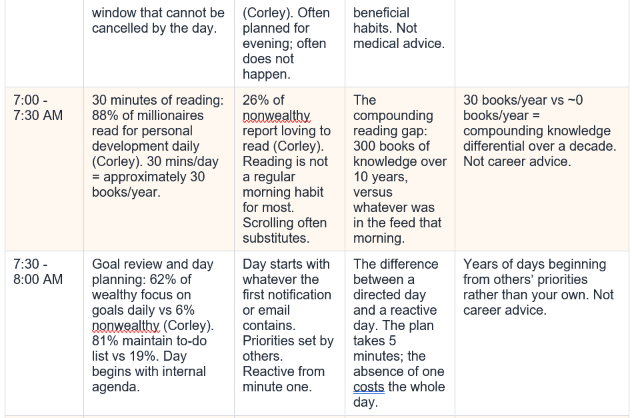
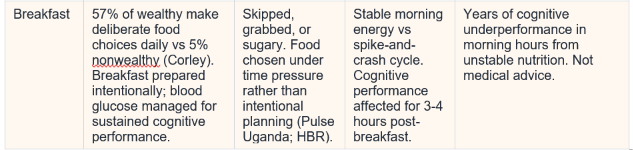
The seventh habit is less data-saturated than the others but consistently present in descriptions of wealthy and successful people’s mornings: a period of deliberate stillness. Not meditation in any particular formal sense, though that is one version of it. More broadly: a few minutes without input, without task, without performance. A moment of deliberate quiet before the day’s busyness begins. D-Journal Dubai’s analysis of high achiever morning habits describes successful people as choosing ‘to control their attention before giving it away’ and notes that this includes time for reflection. The Sleep Judge survey found that mindfulness and intentional morning practices were among the habits associated with higher earners in their survey data. The underlying mechanism connects to what Corley’s research identifies as the wealthy person’s relationship to time: treating it as ‘the most precious asset.’ A morning that includes a moment of stillness is a morning that begins from a chosen place rather than an imposed one. The day’s first tone is quiet, intentional, and self-directed rather than reactive. That tone, small as it seems, compounds across a working life. Pulse Uganda’s analysis includes journalling as a replacement for morning social media scrolling: ‘Replace scrolling with journalling, meditating, or learning something useful.The Wealthy Morning vs The Reactive Morning: A Side-by-Side
The Honest Truth: Habits Are Necessary But Not Sufficient
This article would be incomplete without naming what it does not claim. Morning habits are not a universal wealth-creation formula. D-Journal Dubai’s analysis of successful people’s morning routines acknowledges this directly: ‘Morning habits complement these factors — they are not substitutes for them.’ The factors that morning habits complement include: the structural and systemic conditions of wealth and poverty; access to education and capital; the geographical, social, and economic circumstances of birth; health conditions and disabilities; caregiving responsibilities that make 5 AM starts impossible for many parents; and the simple reality that some wealthy people have poor morning habits while some financially struggling people have excellent ones.Corley’s research focused specifically on self-made wealthy individuals — people who built wealth through their own efforts rather than inheritance. The habits he identified are correlated with wealth accumulation in that specific context, over the five years of his observation. They are not universal guarantees. What the research does support is that consistently applied morning habits — early rising, physical exercise, deliberate reading, goal focus, intentional food choices, protection of attention — improve the daily conditions for cognitive performance, decision quality, and long-term behaviour alignment with stated goals. These improvements compound. Over years, they change what is possible. They are not the whole story. They are a meaningful part of it.
The honest truth: D-Journal Dubai: 'Morning habits complement these factors — they are not substitutes for them.' Wealth is affected by systemic factors beyond individual habits. The research describes correlations in self-made wealthy individuals — not guarantees. Habits improve conditions for success; they do not create it alone.
Conclusion
Tom Corley’s five years with 233 millionaires produced one overriding observation: the self-made wealthy treat time as their most precious asset, and the morning hours are where that treatment is most visible. The gaps in the data — 44-55% vs 3% on early rising; 76% vs 23% on exercise; 88% vs 26% on reading; 62% vs 6% on daily goal focus — are not describing people of different talent or different luck. They are describing people with different morning defaults.Every one of those defaults is changeable. Not all at once, and not without effort, but one habit at a time, starting with the smallest version of it. The Sleep Judge survey found that a consistent morning routine was worth an average of $12,500 more per year across their survey population. Laura Vanderkam found that highly successful people use the morning as protected time for what matters to them before the world’s demands arrive. The morning is the one period of the day that is most fully yours. What you do with it, consistently, over years, is a compound interest calculation. The question is what you are investing in.
Frequently Asked Questions
How early do wealthy people actually wake up?Tom Corley's Rich Habits research (233 millionaires, 128 poverty-level individuals, 5 years) found that 44-55% of wealthy people wake up at least three hours before their formal workday begins. A separate compilation at lollydaskal.com puts the figure at 44% waking three or more hours before going to work. Against 3% of those who are not wealthy. In practice, this often means a 5 AM wake-up for someone starting work at 8 AM, or a 4 AM wake-up for an earlier start. The specific time matters less than the principle: wealthy people consistently create a morning buffer of uncontested personal time before anyone else's agenda arrives. The Sleep Judge survey found that rising earlier was linked to greater wealth, especially when those early mornings were productive rather than passive.
Is the reading habit really that important? What do wealthy people read?
Corley's research found that 88% of millionaires read for at least 30 minutes daily, almost exclusively for personal development, education, or professional knowledge. 86% of wealthy people report loving to read, against 26% of the nonwealthy (lollydaskal.com). The content matters: Corley's research specifies personal development, biography, history, self-improvement, and industry-specific knowledge rather than entertainment. Warren Buffett is the most cited example — he attributes much of his success to reading extensively. The mechanism is compound knowledge accumulation: 30 minutes per day produces approximately 30 books per year. Over ten years: 300 books of compounding expertise. The morning is specifically valuable for reading because it is the sharpest cognitive window of the day, before decision fatigue accumulates.
What if I can't wake up early due to work schedule or family responsibilities?
The research describes correlations in the specific group Corley studied — self-made wealthy individuals with the structural ability to control their morning schedules. D-Journal Dubai's analysis of morning habits acknowledges directly: 'Morning habits do not create wealth by themselves. Morning routines complement these factors — they are not substitutes for them.' For parents of young children, shift workers, carers, and others whose mornings are not theirs to control, the principle of the wealthy morning — protecting some time for intentional self-investment before others' demands dominate — applies whenever that window exists, not necessarily before 9 AM. The Sleep Judge survey found that consistency of morning habits mattered more than any specific activity.
How much of a difference does a morning routine actually make financially?
The Sleep Judge survey of over 1,000 people found that those who reported a consistent set of morning habits earned an average of $12,500 per year more than those who did not. This is a correlation from survey data, not a controlled experiment — and income differences reflect many variables beyond morning habits. Corley's research found 62% of wealthy people maintain daily goal focus versus 6% of the nonwealthy, and 81% maintain a daily to-do list versus 19% — suggesting that the planning habits of wealthy mornings are among the most significant separators. D-Journal Dubai's caveat applies: morning habits complement other factors, they do not substitute for them.
Where do I start if I want to build a wealthy morning routine?
The research suggests starting with one habit at a time rather than attempting a complete morning overhaul. D-Journal Dubai's analysis notes that 'successful people frequently begin working before inspiration arrives' — the same principle applies to building the routine. The sequence that Corley's research most strongly supports, in order of impact-per-effort: (1) Wake up thirty minutes earlier than usual — not three hours, just thirty minutes; (2) Do not check the phone for the first fifteen minutes; (3) Read for fifteen minutes of that morning window; (4) Write down your three priorities for the day before starting work. These four changes require no equipment, no expense, and no dramatic lifestyle shift. They do require consistency. The Sleep Judge survey finding — $12,500/year income difference for those with consistent morning habits — is a correlation, not a guarantee. But the cognitive and behavioural mechanisms that morning habits engage are real and well-documented.
0 Comments
Be the first to share your thoughts on this article.