

Taxes
When the IHT 7-Year Rule Becomes a 14-Year Rule

Key Statistics and Facts: IHT nil rate band: £325,000 (frozen until April 2030). Residence nil rate band: £175,000. Combined for couples: up to £1 million. Taper relief: 0-3 years: 40% (full rate); 3-4 years: 32%; 4-5 years: 24%; 5-6 years: 16%; 6-7 years: 8%; 7+ years: 0%. CLT lifetime rate: 20% (half the death rate of 40%). 14-year lookback triggered only where both CLTs and failed PETs exist. IHT revenues: £7.6 billion in 2023-24 (HMRC). Gifts into most trusts are CLTs; gifts to individuals are PETs. GWROB (gift with reservation of benefit) can mean even 7-year clock never starts.
Most people who have done any reading on Inheritance Tax in the UK know about the 7-year rule: make a gift to an individual, survive seven years, and the gift falls outside your estate for IHT purposes. It is one of the most commonly cited estate planning strategies and, for many families, it works exactly as expected.
What far fewer people know is that the 7-year rule can, in certain circumstances, silently extend to 14 years. This is not a different rule in the sense of a separate piece of legislation. It is a consequence of how HMRC's cumulation rules work when a person has made both gifts to individuals (known as Potentially Exempt Transfers, or PETs) and gifts into trusts (known as Chargeable Lifetime Transfers, or CLTs). When a PET fails — because the donor dies within seven years of making it — HMRC must work out the tax position. And to do that, they look back at all CLTs made in the seven years before the PET. If those CLTs themselves were made up to seven years before the PET, HMRC is effectively looking back up to 14 years in total.
This is what Canada Life's technical team calls the 14-year shadow, and what THP Accountants describes as the moment when the 7-year rule becomes the 14-year rule. It is one of the most widely misunderstood aspects of UK IHT planning, and the consequences of not understanding it can be a significantly larger tax bill for beneficiaries. This article explains it from first principles.
Disclaimer: This article is for general informational and educational purposes only. It is not legal, tax, or financial advice. Inheritance Tax rules are complex and depend on individual circumstances. Always consult a qualified solicitor or tax adviser for advice specific to your estate planning situation.
If the donor dies within seven years of making the gift, the gift is brought back into the taxable estate for IHT calculation purposes. The gift is then set against the available nil-rate band (currently £325,000 per individual, frozen until April 2030). If it exhausts the nil-rate band, the excess is charged to IHT at 40 percent — or a reduced rate via taper relief if the death occurred between three and seven years after the gift.
The crucial point is how the nil-rate band is used. Gifts are applied against the nil-rate band in chronological order — oldest first. So if a person made a gift of £200,000 five years ago and a gift of £200,000 two years ago, the older gift is counted first. The first £200,000 uses £200,000 of the nil-rate band; the second £200,000 uses the remaining £125,000 of the nil-rate band and then £75,000 is left exposed to IHT at 40 percent (or a tapered rate depending on the timing).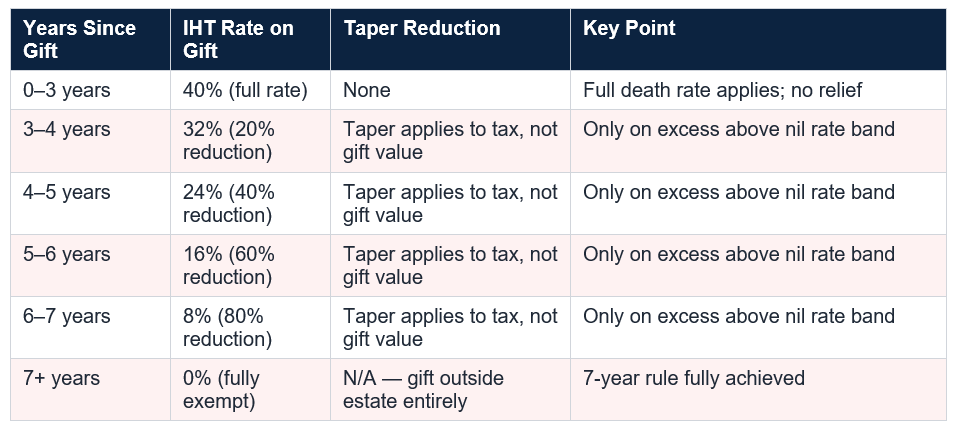
Taper relief is one of the most commonly misunderstood elements of the 7-year rule. Several critical points deserve emphasis:
CLTs are cumulative over a rolling seven-year period. If you made a CLT of £175,000 into a trust in year one, and another CLT of £175,000 into a trust in year four, the second CLT is assessed against the available nil-rate band after accounting for the first CLT made in the previous seven years. The combined £350,000 exceeds the £325,000 nil-rate band by £25,000, and a lifetime charge of 20 percent on £25,000 (£5,000) would be payable on the second CLT.
The key point: unlike PETs, CLTs do not simply disappear after seven years for the purpose of assessing a subsequent failed PET. They continue to affect the nil-rate band available to offset that PET — which is where the 14-year rule comes in.
Here is the mechanism, as described by Canada Life's technical guidance:
M&G Technical Guidance: The 14 year rule applies where there are CLTs in the 7 years before a PET which has failed. This rule is there to ensure that gifts which become chargeable are taxed appropriately. The order in which gifts are made therefore matters significantly.
As Aberdeen Adviser's TechZone analysis notes, when calculating the IHT payable by the estate, failed PETs and CLTs made in the seven years before death are included in the calculation. The 14-year rule applies where CLTs in the seven years before the PET reduce the nil-rate band available to offset that PET.
The 2020 PET to his daughter has failed: only three years before death. This PET must now be assessed against the available nil-rate band. HMRC looks back seven years from 2020 to identify prior CLTs. The 2012 CLT falls within that window. It consumed the entire £325,000 nil-rate band. Therefore, the 2020 PET of £125,000 has no nil-rate band available to offset it. The full £125,000 is subject to IHT at 40 percent (no taper relief, as death was within three years of the PET): a tax bill of £50,000.
As THP Accountants observe: if John had waited the full seven years after making the CLT before making the PET, the nil-rate band would have reset. The full £325,000 would have been available for the PET, significantly reducing the IHT on John's death.
This is what THP means when they say no-one wants to pay more tax than they need, but that is exactly what happens when the 7-year rule becomes the 14-year rule.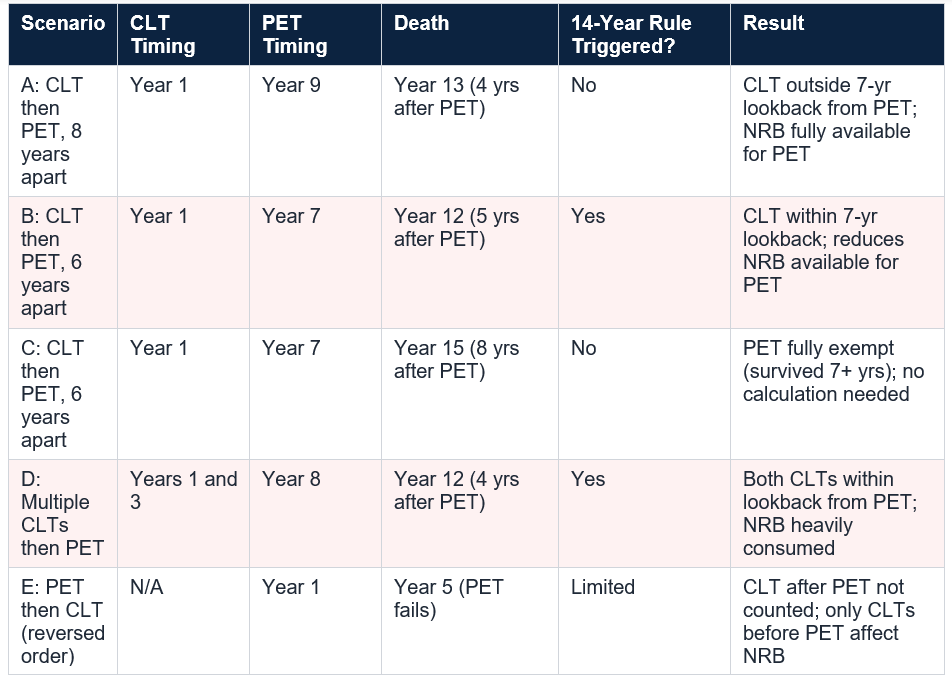
The pattern is clear: the 14-year shadow only arises when CLTs precede PETs, and the PET subsequently fails. When the PET is made first, only CLTs made after the PET (which do not exist yet at the time of the PET) can affect it. The order of gifts matters more than almost any other factor in IHT planning involving both trusts and direct gifts.
A GWROB occurs when you make a gift but continue to benefit from the asset. The most common example is a parent who transfers their home to their children but continues to live in it rent-free. In 2025, the Chugtai v HMRC tribunal case affirmed the risk: Mohammed Chugtai transferred a property into trusts more than seven years before his death, but later returned to live in the property while caring for his daughter. Despite the transfers being made over seven years prior, HMRC ruled the gifts were GWROBs and the estate faced a £176,000 IHT bill. The tribunal upheld HMRC's decision.
With a GWROB, the seven-year clock never starts running. The asset remains in the estate for IHT purposes until the donor genuinely gives up all benefit from it. A donor who transfers their home, continues living in it, and then stops benefiting from it only starts the seven-year clock from the date they stopped benefiting — not from the date of the original transfer. If they then also have CLTs in the preceding seven years, the 14-year shadow can apply on top of the GWROB problem.
But the 14-year shadow is a real and serious risk for anyone who has made or is planning to make both trust gifts (CLTs) and direct individual gifts (PETs). The rule does not require any unusual or aggressive tax planning to trigger: it can arise from straightforward estate planning decisions made years apart, without anyone intending to create an extended look-back period. The consequence is that nil-rate band consumed by a CLT made up to seven years before a later PET continues to affect the tax position of that PET, even after the CLT itself would otherwise be considered historic.
The solution is not to avoid CLTs or PETs. Both have legitimate and valuable roles in estate planning. The solution is to understand the order in which gifts are made and the timing between them. Plan the sequence carefully. Allow CLTs to age out of the lookback window before making significant PETs. Use annual and other exempt gifts to build a pattern of giving that reduces taxable estate value without IHT exposure. And, given the complexity, take professional advice before implementing any significant lifetime gifting strategy. The difference between getting the timing right and getting it wrong can be measured in tens of thousands of pounds of unnecessary IHT.
The 14-year rule is the name given to the effect that occurs when a person has made gifts into trusts (CLTs) and later makes gifts to individuals (PETs), and the PET subsequently fails because the donor dies within seven years. To calculate the tax on the failed PET, HMRC looks back at CLTs made in the seven years before the PET. If those CLTs were themselves made up to seven years earlier, HMRC's effective lookback period extends to 14 years. The 14-year rule is not a separate piece of legislation; it is a consequence of how IHT cumulation rules work.
What is the difference between a PET and a CLT?
A Potentially Exempt Transfer (PET) is a gift from one individual to another individual. It has no immediate IHT consequence. If the donor survives seven years, it becomes fully exempt. If the donor dies within seven years, it becomes chargeable. A Chargeable Lifetime Transfer (CLT) is a gift made during lifetime that is immediately chargeable to IHT — the most common example is a transfer into a discretionary trust. CLTs attract a lifetime rate of 20% on any amount exceeding the nil-rate band, and are cumulated over a rolling seven-year period.
When does the 14-year rule apply?
The 14-year rule applies specifically when: (a) the donor made one or more CLTs, and (b) they subsequently made a PET which fails because they died within seven years of the PET, and (c) the CLTs were made in the seven years before the PET. In this situation, HMRC uses the CLTs to reduce the nil-rate band available to offset the failed PET, even though the CLTs themselves may be more than seven years before the date of death.
Does taper relief help with the 14-year rule?
Taper relief can help reduce the tax on a failed PET, but only in specific circumstances. Taper relief: (1) only applies where the total gifts in the seven years before death exceed the £325,000 nil-rate band; (2) reduces the rate of tax charged, not the value of the gift; and (3) applies based on how long the donor survived after making the PET. The key point is that the earlier CLTs reducing the available nil-rate band may mean more of the PET falls above the threshold, even if taper relief then reduces the rate on that excess.
What is a gift with reservation of benefit?
A gift with reservation of benefit (GWROB) is a gift where the donor retains some benefit from the asset given away. The most common example is a parent who transfers their home to their children but continues to live in it rent-free. A GWROB does not start the seven-year clock because the asset has not genuinely left the estate. In the Chugtai v HMRC case (2025), property transferred into trust more than seven years before the donor's death was still subject to IHT because the donor had returned to live in the property.
How can I avoid the 14-year shadow?
The main strategies are: (1) allow any CLTs to fall outside the seven-year lookback window before making significant PETs — wait at least seven years from a CLT before making a large direct gift; (2) make PETs before CLTs rather than after, so the PETs do not sit within the seven-year lookback from the CLT; (3) keep the rolling seven-year value of CLTs within the nil-rate band so no nil-rate band is consumed that would otherwise be available for PETs; (4) use annual exempt gifts and gifts from surplus income to build a pattern of giving that falls entirely outside IHT; and (5) take professional advice before implementing any lifetime gifting strategy.
What is the UK IHT nil-rate band in 2026/27?
The standard nil-rate band is £325,000 per individual, frozen until at least April 2030. The residence nil-rate band provides an additional £175,000 where a main residence is passed to direct descendants (subject to eligibility criteria, including an estate value below £2 million for the full amount). A married couple or civil partnership can transfer unused nil-rate band to the surviving partner, meaning the combined nil-rate band can be up to £1 million (including both residence nil-rate bands). The standard IHT rate is 40% on the estate above the nil-rate band.
Do gifts made from income count towards the 7- or 14-year rule?
No. Regular gifts made out of surplus income — not capital — are exempt from IHT immediately under the gifts out of income exemption. They do not start the seven-year clock, do not count as PETs or CLTs, and do not affect the nil-rate band. To qualify, the gifts must: be made regularly and as part of a pattern; be made from income (not capital); and not affect the donor's normal standard of living. This is one of the most valuable and underused IHT exemptions available.
Table of Contents
- The Rule Most Estate Planners Underestimate
- The Standard 7-Year Rule: A Quick Recap
- Taper Relief: What It Actually Does (and What It Doesn’t)
- PETs vs CLTs: The Critical Distinction
- How Chargeable Lifetime Transfers Work
- The 14-Year Rule: Why and When It Applies
- The Mechanics: How HMRC Calculates Tax Across 14 Years
- A Worked Example: John’s Costly Gift Timing
- The 14-Year Rule in Practice: Key Scenarios
- Gifts With Reservation of Benefit: When the Clock Never Starts
- How to Plan Around the 14-Year Shadow
- Conclusion: Timing Is Everything
- Frequently Asked Questions
- External References and Further Reading
The Rule Most Estate Planners Underestimate
Most people who have done any reading on Inheritance Tax in the UK know about the 7-year rule: make a gift to an individual, survive seven years, and the gift falls outside your estate for IHT purposes. It is one of the most commonly cited estate planning strategies and, for many families, it works exactly as expected.What far fewer people know is that the 7-year rule can, in certain circumstances, silently extend to 14 years. This is not a different rule in the sense of a separate piece of legislation. It is a consequence of how HMRC's cumulation rules work when a person has made both gifts to individuals (known as Potentially Exempt Transfers, or PETs) and gifts into trusts (known as Chargeable Lifetime Transfers, or CLTs). When a PET fails — because the donor dies within seven years of making it — HMRC must work out the tax position. And to do that, they look back at all CLTs made in the seven years before the PET. If those CLTs themselves were made up to seven years before the PET, HMRC is effectively looking back up to 14 years in total.
This is what Canada Life's technical team calls the 14-year shadow, and what THP Accountants describes as the moment when the 7-year rule becomes the 14-year rule. It is one of the most widely misunderstood aspects of UK IHT planning, and the consequences of not understanding it can be a significantly larger tax bill for beneficiaries. This article explains it from first principles.
Disclaimer: This article is for general informational and educational purposes only. It is not legal, tax, or financial advice. Inheritance Tax rules are complex and depend on individual circumstances. Always consult a qualified solicitor or tax adviser for advice specific to your estate planning situation.
The Standard 7-Year Rule: A Quick Recap
The 7-year rule applies to Potentially Exempt Transfers: gifts made to individuals during the donor's lifetime. Under the rule, if the donor survives for seven complete years after making a gift, that gift becomes fully exempt from IHT — it falls entirely outside the estate. HMRC uses this rule to distinguish genuine lifetime giving from last-minute attempts to reduce an estate before death.If the donor dies within seven years of making the gift, the gift is brought back into the taxable estate for IHT calculation purposes. The gift is then set against the available nil-rate band (currently £325,000 per individual, frozen until April 2030). If it exhausts the nil-rate band, the excess is charged to IHT at 40 percent — or a reduced rate via taper relief if the death occurred between three and seven years after the gift.
The crucial point is how the nil-rate band is used. Gifts are applied against the nil-rate band in chronological order — oldest first. So if a person made a gift of £200,000 five years ago and a gift of £200,000 two years ago, the older gift is counted first. The first £200,000 uses £200,000 of the nil-rate band; the second £200,000 uses the remaining £125,000 of the nil-rate band and then £75,000 is left exposed to IHT at 40 percent (or a tapered rate depending on the timing).
Taper Relief: What It Actually Does (and What It Doesn’t)
Taper relief is one of the most commonly misunderstood elements of the 7-year rule. Several critical points deserve emphasis:
- Taper relief reduces the rate of tax on the taxable part of a gift. It does not reduce the value of the gift itself. A gift of £400,000 made five years before death is still counted as £400,000 when calculating its impact on the nil-rate band.
- Taper relief only applies where the total value of gifts in the seven years before death exceeds the nil-rate band of £325,000. If the gifts are within the nil-rate band, there is no tax on them regardless of when they were made, and taper relief is therefore irrelevant.
- The confusion in the Vision Consulting July 2026 analysis puts it bluntly: people assume a gift made 5 years before death attracts a much lower rate of tax. It does — but only on the portion of the gift that exceeds the available nil-rate band.
PETs vs CLTs: The Critical Distinction
To understand the 14-year rule, the distinction between PETs and CLTs is essential. These are the two main categories of lifetime gift for IHT purposes, and they operate very differently.Potentially Exempt Transfers (PETs)
A PET is a gift from one individual to another individual. The most common examples are cash gifts to children or grandchildren, gifts of property between family members (other than into trust), and transfers into bare trusts or trusts for disabled persons. PETs have no immediate IHT consequence. They only become taxable if the donor dies within seven years. If the donor survives seven years, they disappear from IHT calculations entirely.Chargeable Lifetime Transfers (CLTs)
A CLT is a gift made during lifetime that is immediately chargeable to IHT. The most common example is a transfer of assets into a discretionary trust. Unlike PETs, CLTs may trigger a tax charge immediately at the time of the gift: a lifetime rate of 20 percent (exactly half the death rate of 40 percent) on any amount exceeding the available nil-rate band.CLTs are cumulative over a rolling seven-year period. If you made a CLT of £175,000 into a trust in year one, and another CLT of £175,000 into a trust in year four, the second CLT is assessed against the available nil-rate band after accounting for the first CLT made in the previous seven years. The combined £350,000 exceeds the £325,000 nil-rate band by £25,000, and a lifetime charge of 20 percent on £25,000 (£5,000) would be payable on the second CLT.
The key point: unlike PETs, CLTs do not simply disappear after seven years for the purpose of assessing a subsequent failed PET. They continue to affect the nil-rate band available to offset that PET — which is where the 14-year rule comes in.
How Chargeable Lifetime Transfers Work
When you make a CLT (typically by putting assets into a discretionary trust), several things happen:- Immediately: a lifetime charge of 20 percent applies to any amount exceeding the available nil-rate band. This tax is payable immediately, either by the trustees from the trust assets or by the donor personally. If the donor pays the tax personally, the effective rate on the gross transfer is 25 percent.
- After 7 years: if the donor survives seven years from the CLT, the entry charge paid is the final tax settlement. The CLT falls out of the rolling seven-year cumulation for the purpose of subsequent CLTs.
- If death within 7 years: HMRC recalculates the tax at the full 40 percent death rate. The 20 percent entry charge paid is credited against the higher death rate, meaning only the difference (at most another 20 percent) is payable as a top-up. Taper relief applies between years three and seven to reduce the top-up.
The 14-Year Rule: Why and When It Applies
The 14-year rule — or, more precisely, the 14-year shadow — arises specifically when a person has made a CLT and then subsequently makes a PET that fails (because they die within seven years of the PET).Here is the mechanism, as described by Canada Life's technical guidance:
- The failed PET becomes chargeable on death. HMRC must calculate the tax on this failed PET.
- To do so, HMRC looks back at all CLTs made in the seven years before the PET was made, because those CLTs have used up nil-rate band that would otherwise be available to offset the PET.
- The look-back period for the PET is seven years. The look-back period for the CLTs that preceded it is also seven years. Total potential look-back: up to 14 years.
M&G Technical Guidance: The 14 year rule applies where there are CLTs in the 7 years before a PET which has failed. This rule is there to ensure that gifts which become chargeable are taxed appropriately. The order in which gifts are made therefore matters significantly.
The Mechanics: How HMRC Calculates Tax Across 14 Years
When a failed PET sits alongside earlier CLTs, HMRC's calculation works as follows:- Step 1: Identify the failed PET and its value.
- Step 2: Look back seven years from the date of the PET. Identify all CLTs made in that window.
- Step 3: Calculate how much nil-rate band those CLTs consumed at the time of the PET.
- Step 4: Apply whatever nil-rate band remains after those CLTs to offset the failed PET.
- Step 5: If the failed PET exceeds the remaining nil-rate band, the excess is taxed at 40 percent (reduced by taper relief where applicable, based on how many years elapsed between the PET and the date of death).
As Aberdeen Adviser's TechZone analysis notes, when calculating the IHT payable by the estate, failed PETs and CLTs made in the seven years before death are included in the calculation. The 14-year rule applies where CLTs in the seven years before the PET reduce the nil-rate band available to offset that PET.
A Worked Example: John’s Costly Gift Timing
John makes the following lifetime gifts:- Year 1 (2012): transfers £325,000 into a discretionary trust (a CLT). This exactly matches the nil-rate band, so no immediate lifetime charge arises. John pays no tax.
- Year 2 (2013): gives his son £125,000 as cash (a PET). No immediate tax; becomes exempt if John survives to 2020.
- Year 9 (2020): gives his daughter £125,000 as cash (another PET). No immediate tax; becomes exempt if John survives to 2027.
- Year 12 (2023): John dies.
The 2020 PET to his daughter has failed: only three years before death. This PET must now be assessed against the available nil-rate band. HMRC looks back seven years from 2020 to identify prior CLTs. The 2012 CLT falls within that window. It consumed the entire £325,000 nil-rate band. Therefore, the 2020 PET of £125,000 has no nil-rate band available to offset it. The full £125,000 is subject to IHT at 40 percent (no taper relief, as death was within three years of the PET): a tax bill of £50,000.
As THP Accountants observe: if John had waited the full seven years after making the CLT before making the PET, the nil-rate band would have reset. The full £325,000 would have been available for the PET, significantly reducing the IHT on John's death.
This is what THP means when they say no-one wants to pay more tax than they need, but that is exactly what happens when the 7-year rule becomes the 14-year rule.
9. The 14-Year Rule in Practice: Key Scenarios
The pattern is clear: the 14-year shadow only arises when CLTs precede PETs, and the PET subsequently fails. When the PET is made first, only CLTs made after the PET (which do not exist yet at the time of the PET) can affect it. The order of gifts matters more than almost any other factor in IHT planning involving both trusts and direct gifts.
Gifts With Reservation of Benefit: When the Clock Never Starts
Before turning to planning strategies, it is important to flag a related concept that can compound the 14-year rule problem: gifts with reservation of benefit (GWROBs).A GWROB occurs when you make a gift but continue to benefit from the asset. The most common example is a parent who transfers their home to their children but continues to live in it rent-free. In 2025, the Chugtai v HMRC tribunal case affirmed the risk: Mohammed Chugtai transferred a property into trusts more than seven years before his death, but later returned to live in the property while caring for his daughter. Despite the transfers being made over seven years prior, HMRC ruled the gifts were GWROBs and the estate faced a £176,000 IHT bill. The tribunal upheld HMRC's decision.
With a GWROB, the seven-year clock never starts running. The asset remains in the estate for IHT purposes until the donor genuinely gives up all benefit from it. A donor who transfers their home, continues living in it, and then stops benefiting from it only starts the seven-year clock from the date they stopped benefiting — not from the date of the original transfer. If they then also have CLTs in the preceding seven years, the 14-year shadow can apply on top of the GWROB problem.
How to Plan Around the 14-Year Shadow
The 14-year rule is a consequence of the order and timing of gifts, not of the amount. Effective planning to avoid or minimise it focuses on those two variables:- Allow CLTs to fall outside the seven-year lookback before making significant PETs: if you make a CLT today and then want to make a large PET, waiting at least seven years from the CLT date ensures the CLT has fallen outside the lookback window by the time the PET is made. The nil-rate band is then fully available for the PET.
- Consider PETs before CLTs: making direct gifts to individuals (PETs) before putting money into trusts (CLTs) means the earlier PETs are not counted against the nil-rate band available for the CLT. The order reversal can significantly change the tax outcome.
- Use annual exemptions and other exempt gifts to reduce the taxable value: the annual gift exemption of £3,000 per tax year, small gifts of up to £250 per person, and gifts made out of surplus income are all immediately exempt and do not start the seven-year clock or count against the nil-rate band. Building a pattern of regular exempt giving reduces the overall taxable estate without any seven- or 14-year exposure.
- Keep the seven-year cumulative value of CLTs within the nil-rate band: if CLTs over any rolling seven-year period stay below £325,000, no immediate lifetime charge arises and, critically, no nil-rate band is consumed that would otherwise be available for subsequent PETs. This is the strategy that avoids the 14-year shadow arising at all.
- Work with a qualified solicitor or tax adviser: the interaction between CLTs, PETs, the nil-rate band, and the 14-year shadow is sufficiently complex that errors are common and costly. As THP Accountants note, no-one wants to pay more tax than they need, but that is exactly what happens when planning is done without professional advice in this area.
Conclusion
The 7-year rule is genuinely one of the most powerful IHT planning tools available to UK residents. A gift made to an individual that becomes fully exempt after seven years removes it entirely from the IHT calculation, with no conditions or caveats beyond surviving the seven years.But the 14-year shadow is a real and serious risk for anyone who has made or is planning to make both trust gifts (CLTs) and direct individual gifts (PETs). The rule does not require any unusual or aggressive tax planning to trigger: it can arise from straightforward estate planning decisions made years apart, without anyone intending to create an extended look-back period. The consequence is that nil-rate band consumed by a CLT made up to seven years before a later PET continues to affect the tax position of that PET, even after the CLT itself would otherwise be considered historic.
The solution is not to avoid CLTs or PETs. Both have legitimate and valuable roles in estate planning. The solution is to understand the order in which gifts are made and the timing between them. Plan the sequence carefully. Allow CLTs to age out of the lookback window before making significant PETs. Use annual and other exempt gifts to build a pattern of giving that reduces taxable estate value without IHT exposure. And, given the complexity, take professional advice before implementing any significant lifetime gifting strategy. The difference between getting the timing right and getting it wrong can be measured in tens of thousands of pounds of unnecessary IHT.
Frequently Asked Questions
What is the IHT 14-year rule?The 14-year rule is the name given to the effect that occurs when a person has made gifts into trusts (CLTs) and later makes gifts to individuals (PETs), and the PET subsequently fails because the donor dies within seven years. To calculate the tax on the failed PET, HMRC looks back at CLTs made in the seven years before the PET. If those CLTs were themselves made up to seven years earlier, HMRC's effective lookback period extends to 14 years. The 14-year rule is not a separate piece of legislation; it is a consequence of how IHT cumulation rules work.
What is the difference between a PET and a CLT?
A Potentially Exempt Transfer (PET) is a gift from one individual to another individual. It has no immediate IHT consequence. If the donor survives seven years, it becomes fully exempt. If the donor dies within seven years, it becomes chargeable. A Chargeable Lifetime Transfer (CLT) is a gift made during lifetime that is immediately chargeable to IHT — the most common example is a transfer into a discretionary trust. CLTs attract a lifetime rate of 20% on any amount exceeding the nil-rate band, and are cumulated over a rolling seven-year period.
When does the 14-year rule apply?
The 14-year rule applies specifically when: (a) the donor made one or more CLTs, and (b) they subsequently made a PET which fails because they died within seven years of the PET, and (c) the CLTs were made in the seven years before the PET. In this situation, HMRC uses the CLTs to reduce the nil-rate band available to offset the failed PET, even though the CLTs themselves may be more than seven years before the date of death.
Does taper relief help with the 14-year rule?
Taper relief can help reduce the tax on a failed PET, but only in specific circumstances. Taper relief: (1) only applies where the total gifts in the seven years before death exceed the £325,000 nil-rate band; (2) reduces the rate of tax charged, not the value of the gift; and (3) applies based on how long the donor survived after making the PET. The key point is that the earlier CLTs reducing the available nil-rate band may mean more of the PET falls above the threshold, even if taper relief then reduces the rate on that excess.
What is a gift with reservation of benefit?
A gift with reservation of benefit (GWROB) is a gift where the donor retains some benefit from the asset given away. The most common example is a parent who transfers their home to their children but continues to live in it rent-free. A GWROB does not start the seven-year clock because the asset has not genuinely left the estate. In the Chugtai v HMRC case (2025), property transferred into trust more than seven years before the donor's death was still subject to IHT because the donor had returned to live in the property.
How can I avoid the 14-year shadow?
The main strategies are: (1) allow any CLTs to fall outside the seven-year lookback window before making significant PETs — wait at least seven years from a CLT before making a large direct gift; (2) make PETs before CLTs rather than after, so the PETs do not sit within the seven-year lookback from the CLT; (3) keep the rolling seven-year value of CLTs within the nil-rate band so no nil-rate band is consumed that would otherwise be available for PETs; (4) use annual exempt gifts and gifts from surplus income to build a pattern of giving that falls entirely outside IHT; and (5) take professional advice before implementing any lifetime gifting strategy.
What is the UK IHT nil-rate band in 2026/27?
The standard nil-rate band is £325,000 per individual, frozen until at least April 2030. The residence nil-rate band provides an additional £175,000 where a main residence is passed to direct descendants (subject to eligibility criteria, including an estate value below £2 million for the full amount). A married couple or civil partnership can transfer unused nil-rate band to the surviving partner, meaning the combined nil-rate band can be up to £1 million (including both residence nil-rate bands). The standard IHT rate is 40% on the estate above the nil-rate band.
Do gifts made from income count towards the 7- or 14-year rule?
No. Regular gifts made out of surplus income — not capital — are exempt from IHT immediately under the gifts out of income exemption. They do not start the seven-year clock, do not count as PETs or CLTs, and do not affect the nil-rate band. To qualify, the gifts must: be made regularly and as part of a pattern; be made from income (not capital); and not affect the donor's normal standard of living. This is one of the most valuable and underused IHT exemptions available.
0 Comments
Be the first to share your thoughts on this article.