

Professional & Career Development
Why Americans Take Second Jobs Even After Raises

Key Statistics (2026): 8.9 million Americans are working multiple jobs — 5.4% of employed workers, the highest rate since the Great Recession in 2009 (BLS). 8.8 million held multiple jobs as of September 2025, up from 8.4 million in 2024 (BLS via Embrace Change, January 2026). 473,000 hold two full-time jobs as of July 2026 (BLS via Careerminds, August 2026). 72% of workers now rely on at least one secondary income source (MyPerfectResume 2026 State of Secondary Income Report, February 2026). 40% of side hustlers would NOT quit even if their primary employer gave them a 20% raise (The Penny Hoarder 2026 Survey). 75%+ say rising costs have increased their reliance on side hustle income (The Penny Hoarder 2026). 95% of workers say income hasn’t kept pace with cost of living increases (Monster May 2025 poll, 1,200+ US workers). 64% of employed US adults plan to get a second job or start a side hustle within the next year (American Staffing Association / Harris Poll, April 2025). 65% of Americans who live paycheck to paycheck have multiple jobs (ADP Research People at Work 2025). 38% of MyPerfectResume respondents say inflation has ‘significantly’ increased their need for additional income; 72% say rising costs have made side work more necessary overall. 26% believe secondary income could eventually replace traditional raises (MyPerfectResume 2026). Side hustlers average: Millennials $1,129/month; Gen Z $958/month; Gen X $751/month; Boomers $561/month (Bankrate). 54.9% say extra work contributes to moderate or severe burnout; 87.4% report at least some increase in stress (Careerminds 2026). Multiple job holders earn average $57,865/year vs $56,965 for single-job workers (St. Louis Fed). 50.2% of multiple job holders now have college degrees, up from 45.1% in 2019 (St. Louis Fed).
The numbers behind this reality are striking. As of the most recent Bureau of Labor Statistics data, 8.9 million Americans are working multiple jobs — 5.4 percent of all employed workers, the highest rate since the Great Recession in April 2009. The MyPerfectResume 2026 State of Secondary Income Report, published in February, found that nearly three in four workers (72 percent) now rely on at least one secondary income source. What was once a stopgap during high inflation has become, in the report’s own framing, a long-term necessity.
The Penny Hoarder’s 2026 Side Hustle Survey of 1,000 US adults with side hustles found that more than 75 percent said rising costs have increased their reliance on side hustle income. The same survey found that 40 percent would not quit even after a 20 percent raise. The gap between what wages provide and what life costs has become too wide for a paycheck-sized solution to close.
This article examines the specific forces that have made second jobs a permanent feature of American working life in 2026, why raises have not solved the problem, who is most affected, and what a genuine solution would actually require.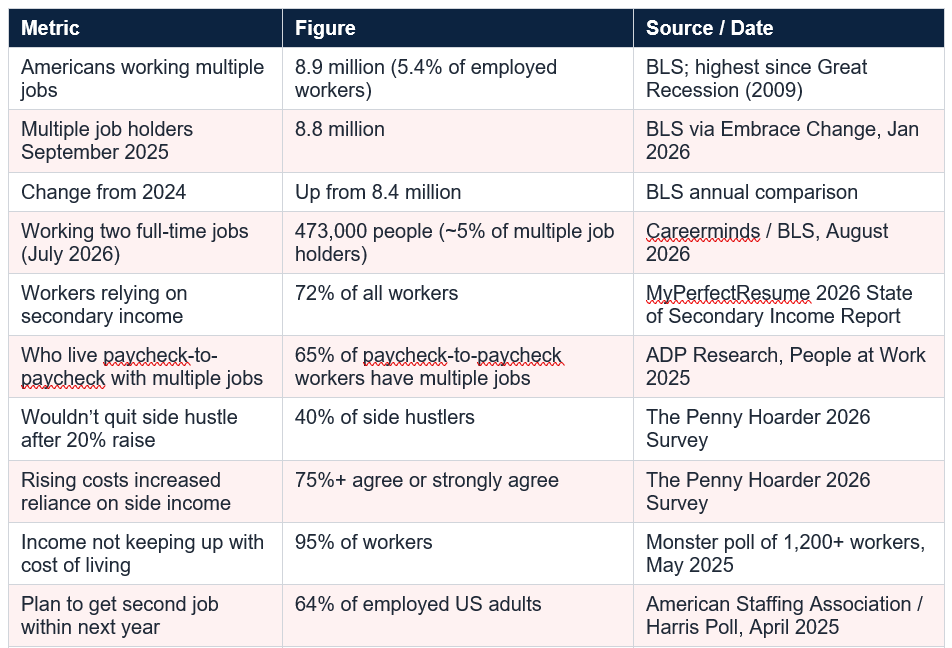
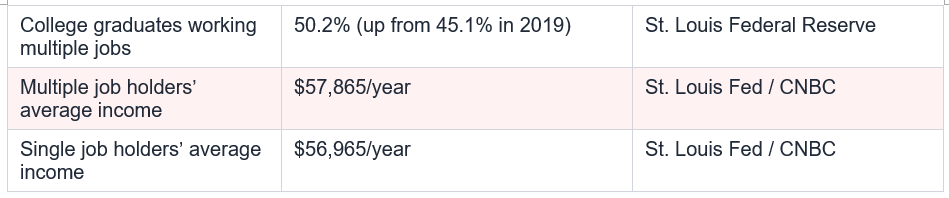
The numbers tell a story that goes beyond simple financial struggle. The income differential between single and multiple job holders is barely $900 per year — meaning the second job is not propelling workers into a dramatically higher income bracket. For most, it is covering the gap that their primary salary cannot close: the monthly shortfall between what they earn and what their life actually costs.
Consider what a 20 percent raise actually delivers. For a worker earning the median US household income of approximately $56,000 per year, a 20 percent raise generates approximately $11,200 more annually before taxes, or roughly $8,000 to $9,000 after federal income tax and FICA. This is a meaningful improvement. But the Penny Hoarder data suggests that for 40 percent of current second-job workers, this amount would still not close the gap between their expenses and their income.
This is partly because 20 percent raises are themselves rarely adequate for the pace at which costs have risen. The MyPerfectResume 2026 report found that 26 percent of respondents believe secondary income could eventually replace traditional raises entirely — a sign that workers are beginning to see wage increases from employers as an insufficient mechanism for keeping up with the actual cost trajectory of American life. The Monster May 2025 poll of more than 1,200 US workers found 95 percent saying their income has not kept pace with cost of living increases — not in a single bad year, but as a sustained, multi-year pattern.
The Number: 40% of side hustlers would not quit even if their primary employer gave them a 20% raise. For 95% of workers, income has not kept pace with cost of living increases over the past year.
When inflation peaked at 9.1 percent in June 2022, nominal wages were also rising — but they were rising at 5 to 6 percent, producing real wage losses of 3 to 4 percent annually. As inflation subsequently cooled to 2 to 3 percent and wage growth also moderated, many workers never recovered the purchasing power they lost during the peak inflation years. Their wages are nominally higher than in 2021. In real terms, adjusted for what their dollars can actually buy, many workers are still behind where they were before the inflationary episode began.
The specific categories of cost that have not reverted to pre-2021 levels compound this problem:
The mathematics in major metropolitan areas are particularly stark. A worker earning $60,000 per year in a city like Chicago, Denver, Austin, or Seattle has a monthly take-home pay of approximately $3,800 to $4,000 after taxes. A one-bedroom apartment in any of these cities now costs $1,800 to $2,500 per month. At the upper end of this range, housing alone consumes more than 60 percent of take-home pay — more than double the 30 percent threshold that financial advisers have traditionally recommended for housing as a proportion of income.
A 20 percent raise in this scenario brings monthly take-home pay to approximately $4,600 to $4,800. Housing as a proportion of income improves from 60 to 65 percent to 45 to 55 percent. This is still far above the 30 percent recommendation and still leaves the worker economically stretched. The second job is not a response to financial mismanagement. It is a response to a housing market whose cost structure has outpaced the wage structure of most of the workforce.
Key Insight: A third of US side hustlers cite housing costs as the primary driver of their decision to take on additional income. In cities where rents have risen 40 to 60% since 2019, a standard 3 to 5% annual raise closes a fraction of the housing affordability gap. The second job is not supplementary income in these markets. It is load-bearing income.
Three financial goals that have become structurally difficult to achieve on a single median income:
The remote work revolution has amplified this further. As Julia Pollak, chief economist at ZipRecruiter, has noted, flexible, remote work creates side hustle opportunities that simply did not exist for workers who had to be physically present at a fixed location for 8 or more hours per day. A knowledge worker who logs off their primary job at 5 pm can immediately pick up freelance work on Fiverr or Upwork using the same skills that make them valuable at their primary employer.
The American Staffing Association’s April 2025 survey (conducted with the Harris Poll) found that 64 percent of employed US adults plan to get a second job or start a side hustle within the next year. This is not an indicator that 64 percent of Americans are financially desperate; some genuinely are, many are building savings or pursuing entrepreneurial interests. But the accessibility of the gig economy means that the decision to pursue additional income has been decoupled from the traditionally high barrier of finding an additional employer, signing another employment contract, and coordinating schedules across two physical workplaces.
The US economy shed 92,000 jobs in February 2026, according to the Bureau of Labor Statistics. January 2026 marked the 32nd consecutive month of manufacturing decline — the longest losing streak since data tracking began in 2010. The WhatJobs February 2026 analysis noted that the headline unemployment rate of 4.3 percent understates the financial strain many workers feel, because underlying indicators — rising multi-job holders, involuntary part-time work, and persistent sectoral contractions — paint a more complex picture than the unemployment number alone captures.
Careerminds’ job security research found that 36 percent of young workers believe they will very likely need a second job in 2026 — not as a wish but as an expectation. And 64.1 percent of side hustlers in the same research said they feel pressured to earn extra income because their primary job feels insecure. The second job, in this reading, is not just an income supplement. It is an insurance policy.
The Number: 64.1% of side hustlers say they feel pressured to earn extra income because their primary job feels insecure. 32nd consecutive month of manufacturing decline in January 2026 (BLS). Economy shed 92,000 jobs in February 2026.
The college premium — the income advantage that a college degree historically provided over a high school diploma — has been a foundational assumption of American workforce policy for decades. If college graduates are increasingly found among multiple-job holders at rates similar to the overall working population, this assumption requires revisiting. Several specific factors explain the convergence:
The workers who have taken on two full-time jobs face a particularly compressed version of these pressures. Careerminds’ analysis notes that the first thing to break is not performance but recovery time: two full-time jobs leave no slack for illness, overtime at either employer, or a meeting that runs late at one job that creates a conflict with the other. A single disruption cascades across both schedules. The 473,000 Americans currently working two full-time jobs (BLS, July 2026) are typically working more than 70 hours per week — and the stress of doing so falls disproportionately on the individuals who most needed the additional income.
Laura Norman, a Baltimore County teacher earning just above $60,000 per year who works 60 additional hours per month as a theater house manager, described the emotional calculus directly: ‘No one wants to feel like they are living paycheck to paycheck or that they have to constantly be checking how much money they have in their account to do the things they need to do.’ The second job solves the financial arithmetic. It does not solve the human cost of maintaining it.
Key Insight: The data consistently shows that multiple-job holders earn only about $1,000 more per year on average than single-job holders (St. Louis Fed). This is not a return worth the 13.5 additional hours per week the average second job requires. For financial necessity workers, improving primary job wages or reducing fixed costs is more economically rational than maintaining a second job indefinitely.
At the upper leg of the K: workers in high-demand fields (technology, finance, healthcare specialties) have received raises that have outpaced inflation, seen equity and investment portfolios appreciate, and in some cases accumulated enough financial margin that a cost-of-living increase simply changes their savings rate rather than requiring a second job.
At the lower leg: workers in middle-income and lower-middle-income ranges who have received nominal raises that have not kept pace with cumulative cost increases. For this group, the K-shape means that the recovery has happened — the headline numbers look reasonable — but the recovery has not reached their household. The 20 percent raise that sounds transformative produces a monthly take-home increase of $350 to $600 in most cases — real money, but not enough to close a housing gap that may exceed $600 per month in cities where rents have risen 40 percent since 2019.
The MyPerfectResume 2026 report noted that 54 percent of respondents expect to maintain the same level of secondary income in 2026, and 32 percent plan to increase it. Only 14 percent foresee scaling back. This is not a workforce waiting for a raise. This is a workforce that has recalibrated its relationship with employment to include secondary income as a permanent structural feature — not as a response to inadequate pay, but as a response to a cost-of-living environment that makes single-income dependency feel risky regardless of how generous that single income is.
The employers who are most successful at retaining talent in this environment are not necessarily those who pay the most. They are those who offer the scheduling flexibility that allows workers to maintain a second income without sacrificing their primary job — effectively acknowledging, rather than resisting, the economic reality that has made secondary income permanent for most of their workforce.
The MyPerfectResume report’s conclusion is the most accurate framing available in the current data: what began as a short-term response to rising prices has evolved into a lifestyle. The second job is not a sign of failure. For most of the Americans who hold one, it is a sign of rational adaptation to an economic environment in which the traditional compact — work hard, receive regular raises, achieve financial stability — has not delivered the outcome it promised.
The solution is not a larger raise. It is a housing market that actually houses people at prices that a working income can sustain, a cost-of-living environment in which a single salary can cover a family’s needs, and an economy whose growth is shared broadly enough that the K-shape straightens out over time. Until then, 8.9 million — and rising — will keep their second jobs.
Bureau of Labor Statistics data shows 8.9 million Americans are working multiple jobs — 5.4 percent of all employed workers. This is the highest rate since the Great Recession in April 2009, and up from 8.4 million in 2024. Careerminds’ August 2026 analysis found that 473,000 Americans specifically hold two full-time jobs (roughly 5 percent of all multiple job holders). A broader measure from MyPerfectResume’s 2026 State of Secondary Income Report found that 72 percent of workers rely on at least one secondary income source when gig work, freelancing, and platform work are included.
Why won’t workers quit their side hustle even after getting a raise?
The Penny Hoarder’s 2026 Side Hustle Survey found that 40 percent of side hustlers would not quit even if their primary employer gave them a 20 percent raise. This reflects the structural gap between wage growth and cost growth: for workers facing housing costs that have risen 30 to 50 percent since 2020 and cumulative grocery inflation of approximately 25 percent, a 20 percent raise on a salary that was already failing to cover expenses produces a salary that still fails to cover expenses. The second job is not supplementing a comfortable income — it is covering a structural shortfall.
Are college graduates also taking second jobs?
Yes. St. Louis Federal Reserve data shows that 50.2 percent of multiple job holders have college degrees — up from 45.1 percent in 2019. This reflects the declining protective power of the college premium in high-cost markets, the burden of average student loan debt of approximately $37,000, and the wage divergence between college graduates in high-demand fields (where salaries absorb cost pressures) and those in lower-demand fields like education and social work (where they may not).
What are the most common reasons Americans take second jobs?
The Penny Hoarder’s 2026 survey found that over 75 percent of side hustlers cite rising costs as the primary driver of their reliance on secondary income. LendingTree’s data found that approximately one-third specifically cite cost-of-living expenses; 29 percent say they need the money for bills; and 28 percent use it for discretionary income. Careerminds’ research also found that 64.1 percent of side hustlers feel pressured to earn extra income because their primary job feels insecure — suggesting job security anxiety is as important a driver as cost pressure.
What is the burnout risk of working two jobs?
Significant. Careerminds’ August 2026 research found that 54.9 percent of side hustlers say their extra work contributes to moderate or severe burnout, and 87.4 percent report at least some increase in stress. SurveyMonkey’s January 2026 side hustle statistics found that 67 percent of side hustlers say additional work leads to burnout, and 52 percent believe the burnout is only worth it if the second job earns over $500 per week. Workers holding two full-time jobs face the most severe pressure: Careerminds notes that ‘the first thing to break is recovery time, not performance,’ as two full-time roles leave no slack for illness, overtime, or scheduling disruptions at either employer.
Do second jobs actually solve financial problems?
For most workers, only partially. St. Louis Federal Reserve data shows that multiple job holders earn only about $900 more per year on average than single job holders — a return that barely compensates for the average 13.5 additional hours per week a second job requires. ADP Research’s People at Work 2025 report found that 65 percent of Americans living paycheck to paycheck have multiple jobs — suggesting that the second job is keeping many workers from falling further behind rather than producing genuine financial advancement.
Is the second-job trend expected to continue?
Yes. MyPerfectResume’s 2026 State of Secondary Income Report found that 54 percent of workers expect to maintain the same level of secondary income in 2026, and 32 percent plan to increase it. Only 14 percent foresee scaling back. The Embrace Change Consulting January 2026 analysis described 2026 as the year when side hustles become a mainstream career strategy rather than a temporary response to economic conditions. Unless housing affordability, wage growth, and cost-of-living pressures change structurally, the trend line is upward.
Table of Contents
- The Raise That Was Never Enough
- The Scale of the Problem: By the Numbers
- The 20% Raise Test — and Why 40% Still Won’t Quit
- Reason 1: Wages Have Not Kept Up With Real Costs
- Reason 2: The Housing Gap That No Raise Can Fix
- Reason 3: Financial Goals Have Become Unachievable on One Salary
- Reason 4: The Gig Economy Made It Easier Than Ever
- Reason 5: Job Insecurity and the Diversification Instinct
- Who Is Working Multiple Jobs? The Profile Has Changed
- The College Graduate Who Still Needs a Side Hustle
- The Burnout Reality: What the Second Job Actually Costs
- The Two Types of Second-Job Workers
- The K-Shaped Economy: Why Raises Feel Different Depending on Where You Start
- What Employers Are Getting Wrong About Raises
- What Could Actually Change This
- Conclusion: The Second Job Is Not Going Away
- Frequently Asked Questions
The Raise That Was Never Enough
Something structurally important is happening in the American workforce, and a single statistic captures it more clearly than most economic analyses manage to: 40 percent of workers with side hustles say they would not quit their second income even if their primary employer gave them a 20 percent raise. This is not a statement about ingratitude or ambition. It is a statement about arithmetic. For tens of millions of American workers, a 20 percent raise on a salary that was already failing to cover their expenses would produce a salary that still fails to cover their expenses.The numbers behind this reality are striking. As of the most recent Bureau of Labor Statistics data, 8.9 million Americans are working multiple jobs — 5.4 percent of all employed workers, the highest rate since the Great Recession in April 2009. The MyPerfectResume 2026 State of Secondary Income Report, published in February, found that nearly three in four workers (72 percent) now rely on at least one secondary income source. What was once a stopgap during high inflation has become, in the report’s own framing, a long-term necessity.
The Penny Hoarder’s 2026 Side Hustle Survey of 1,000 US adults with side hustles found that more than 75 percent said rising costs have increased their reliance on side hustle income. The same survey found that 40 percent would not quit even after a 20 percent raise. The gap between what wages provide and what life costs has become too wide for a paycheck-sized solution to close.
This article examines the specific forces that have made second jobs a permanent feature of American working life in 2026, why raises have not solved the problem, who is most affected, and what a genuine solution would actually require.
The Scale of the Problem: By the Numbers
The numbers tell a story that goes beyond simple financial struggle. The income differential between single and multiple job holders is barely $900 per year — meaning the second job is not propelling workers into a dramatically higher income bracket. For most, it is covering the gap that their primary salary cannot close: the monthly shortfall between what they earn and what their life actually costs.
The 20% Raise Test — and Why 40% Still Won’t Quit
The Penny Hoarder’s finding that 40 percent of side hustlers would not quit even after a 20 percent raise is the most diagnostically important number in the 2026 second-job data. It deserves careful unpacking because it reveals that the relationship between wages and second jobs has shifted from a simple financial gap to something more structural.Consider what a 20 percent raise actually delivers. For a worker earning the median US household income of approximately $56,000 per year, a 20 percent raise generates approximately $11,200 more annually before taxes, or roughly $8,000 to $9,000 after federal income tax and FICA. This is a meaningful improvement. But the Penny Hoarder data suggests that for 40 percent of current second-job workers, this amount would still not close the gap between their expenses and their income.
This is partly because 20 percent raises are themselves rarely adequate for the pace at which costs have risen. The MyPerfectResume 2026 report found that 26 percent of respondents believe secondary income could eventually replace traditional raises entirely — a sign that workers are beginning to see wage increases from employers as an insufficient mechanism for keeping up with the actual cost trajectory of American life. The Monster May 2025 poll of more than 1,200 US workers found 95 percent saying their income has not kept pace with cost of living increases — not in a single bad year, but as a sustained, multi-year pattern.
The Number: 40% of side hustlers would not quit even if their primary employer gave them a 20% raise. For 95% of workers, income has not kept pace with cost of living increases over the past year.
Reason 1: Wages Have Not Kept Up With Real Costs
The foundational cause of the second-job phenomenon is the structural divergence between wage growth and cost growth that has accumulated over the past four years. This is not simply an inflation story, though inflation is the precipitating event. It is a story about how wages respond to inflation — and how they consistently undershoot.When inflation peaked at 9.1 percent in June 2022, nominal wages were also rising — but they were rising at 5 to 6 percent, producing real wage losses of 3 to 4 percent annually. As inflation subsequently cooled to 2 to 3 percent and wage growth also moderated, many workers never recovered the purchasing power they lost during the peak inflation years. Their wages are nominally higher than in 2021. In real terms, adjusted for what their dollars can actually buy, many workers are still behind where they were before the inflationary episode began.
The specific categories of cost that have not reverted to pre-2021 levels compound this problem:
- Housing: both rents and mortgage costs remain at historically elevated levels in 2026. The combination of higher interest rates (even after several Fed cuts) and low housing supply has kept monthly housing costs 30 to 50 percent above 2020 levels in many markets. A raise that increases monthly take-home pay by $300 is absorbed entirely by a rent increase of the same amount — with no improvement in the worker’s net financial position.
- Car insurance: average car insurance premiums rose 25 to 30 percent nationally between 2022 and 2024, driven by repair cost inflation and higher replacement values. A worker who has received a 5 percent annual raise for three years has had most of that raise consumed by a single insurance category.
- Groceries: food prices rose approximately 25 percent cumulatively between 2020 and 2025. These prices have not declined significantly in 2026; they have merely stopped rising as fast. The grocery basket that cost $200 per week in 2019 costs approximately $250 to $260 in 2026.
Reason 2: The Housing Gap That No Raise Can Fix
Housing deserves its own section because it is the single largest driver of the second-job phenomenon. Housing costs have reached levels in 2026 that create a permanent, structural gap between what a single income provides and what the housing market requires.The mathematics in major metropolitan areas are particularly stark. A worker earning $60,000 per year in a city like Chicago, Denver, Austin, or Seattle has a monthly take-home pay of approximately $3,800 to $4,000 after taxes. A one-bedroom apartment in any of these cities now costs $1,800 to $2,500 per month. At the upper end of this range, housing alone consumes more than 60 percent of take-home pay — more than double the 30 percent threshold that financial advisers have traditionally recommended for housing as a proportion of income.
A 20 percent raise in this scenario brings monthly take-home pay to approximately $4,600 to $4,800. Housing as a proportion of income improves from 60 to 65 percent to 45 to 55 percent. This is still far above the 30 percent recommendation and still leaves the worker economically stretched. The second job is not a response to financial mismanagement. It is a response to a housing market whose cost structure has outpaced the wage structure of most of the workforce.
Key Insight: A third of US side hustlers cite housing costs as the primary driver of their decision to take on additional income. In cities where rents have risen 40 to 60% since 2019, a standard 3 to 5% annual raise closes a fraction of the housing affordability gap. The second job is not supplementary income in these markets. It is load-bearing income.
Reason 3: Financial Goals Have Become Unachievable on One Salary
Beyond covering immediate expenses, the second job has become the primary mechanism through which many Americans pursue financial goals that a single salary no longer supports. The Penny Hoarder’s 2026 survey found that 58 percent of tax filers said their financial situation has not improved since the previous tax season. The ADP Research People at Work 2025 report found that 65 percent of paycheck-to-paycheck workers have multiple jobs — a figure that reveals the second job is not keeping these workers ahead; it is keeping them from falling further behind.Three financial goals that have become structurally difficult to achieve on a single median income:
- Emergency fund: the standard advice to maintain 3 to 6 months of expenses in liquid savings requires approximately $15,000 to $30,000 for a household spending $5,000 per month. For a worker whose take-home pay is $3,800 to $4,200 per month and whose fixed costs consume 85 to 90 percent of that, building this reserve on a single income requires years of extreme discipline. The second job compresses the timeline.
- Retirement savings: contributing 15 percent of income to retirement accounts — the amount most financial advisers recommend — on a $56,000 salary requires $8,400 per year before taxes. For workers whose primary salary barely covers monthly expenses, this rate of saving is effectively inaccessible without additional income.
- Homeownership: the down payment on a median-priced US home in 2026 requires $50,000 to $100,000 at standard mortgage origination requirements. On a single income of $56,000 per year, saving this amount while also paying rent and living expenses would take a decade of very aggressive saving. The second job is for many workers the only realistic path to the home purchase that was a standard middle-class expectation for previous generations.
Reason 4: The Gig Economy Made It Easier Than Ever
The supply-side explanation for the second-job surge is as important as the demand-side one. The gig economy and digital platform economy have dramatically lowered the barriers to working multiple jobs in ways that would not have been possible before 2015. The Careerminds August 2026 analysis and the Forbes March 2025 report both identify this as a structural enabler: platforms like Uber, Fiverr, Airbnb, DoorDash, Etsy, and TaskRabbit have made it possible to begin earning a second income within 24 to 72 hours of a decision to do so.The remote work revolution has amplified this further. As Julia Pollak, chief economist at ZipRecruiter, has noted, flexible, remote work creates side hustle opportunities that simply did not exist for workers who had to be physically present at a fixed location for 8 or more hours per day. A knowledge worker who logs off their primary job at 5 pm can immediately pick up freelance work on Fiverr or Upwork using the same skills that make them valuable at their primary employer.
The American Staffing Association’s April 2025 survey (conducted with the Harris Poll) found that 64 percent of employed US adults plan to get a second job or start a side hustle within the next year. This is not an indicator that 64 percent of Americans are financially desperate; some genuinely are, many are building savings or pursuing entrepreneurial interests. But the accessibility of the gig economy means that the decision to pursue additional income has been decoupled from the traditionally high barrier of finding an additional employer, signing another employment contract, and coordinating schedules across two physical workplaces.
Reason 5: Job Insecurity and the Diversification Instinct
A fifth driver of the second-job phenomenon is psychological rather than purely financial: the growing perception that a single employer is not a sufficient foundation for financial security. Embrace Change Consulting’s January 2026 analysis describes this as the emergence of the ‘multi-career professional’ — a worker who deliberately cultivates income streams across multiple employers or platforms not because any one of them is inadequate but because the experience of layoffs, AI-driven restructuring, and company instability over the past six years has taught a generation of workers that single-employer dependency is itself a risk.The US economy shed 92,000 jobs in February 2026, according to the Bureau of Labor Statistics. January 2026 marked the 32nd consecutive month of manufacturing decline — the longest losing streak since data tracking began in 2010. The WhatJobs February 2026 analysis noted that the headline unemployment rate of 4.3 percent understates the financial strain many workers feel, because underlying indicators — rising multi-job holders, involuntary part-time work, and persistent sectoral contractions — paint a more complex picture than the unemployment number alone captures.
Careerminds’ job security research found that 36 percent of young workers believe they will very likely need a second job in 2026 — not as a wish but as an expectation. And 64.1 percent of side hustlers in the same research said they feel pressured to earn extra income because their primary job feels insecure. The second job, in this reading, is not just an income supplement. It is an insurance policy.
The Number: 64.1% of side hustlers say they feel pressured to earn extra income because their primary job feels insecure. 32nd consecutive month of manufacturing decline in January 2026 (BLS). Economy shed 92,000 jobs in February 2026.
Who Is Working Multiple Jobs? The Profile Has Changed
The traditional image of the multiple-job worker as a lower-income service sector employee working a second shift has become outdated. The profile of the 2026 multiple-job holder is more diverse, more educated, and spans a broader income range than at any previous point in the data:- Age: BLS data via the St. Louis Fed shows multiple job holders average 42.5 years old — not young workers in early career instability but mid-career workers with established lives and substantial financial obligations.
- Education: 50.2 percent of multiple job holders now have college degrees, up from 45.1 percent in 2019 (St. Louis Fed). The college degree no longer provides the income buffer it once did against the cost-of-living pressures driving the second-job phenomenon.
- Generation: among workers who earn side income, Millennials average $1,129 per month from secondary work; Gen Z averages $958; Gen X averages $751; and Boomers average $561 (Bankrate data). Millennials lead in side hustle earnings, reflecting both their digital native ability to monetise skills online and their position in the most financially stretched phase of life — children, mortgages, student loans, and peak housing costs.
- Sector: the multiple-job phenomenon is no longer confined to hospitality and retail. Real estate professionals, technology workers, educators, and healthcare workers all appear in significant numbers in 2026 side hustle data. The designer who freelances after hours, the teacher who works theater management on weekends, the tech worker who consults for smaller firms alongside their primary employment — these are now representative examples, not exceptions.
The College Graduate Who Still Needs a Side Hustle
The most diagnostically important data point in the 2026 second-job landscape is the rising proportion of college-educated workers in the multiple-job category. The St. Louis Federal Reserve’s analysis shows this figure rising from 45.1 percent of multiple job holders in 2019 to 50.2 percent in 2024.The college premium — the income advantage that a college degree historically provided over a high school diploma — has been a foundational assumption of American workforce policy for decades. If college graduates are increasingly found among multiple-job holders at rates similar to the overall working population, this assumption requires revisiting. Several specific factors explain the convergence:
- Student loan debt: the average federal student loan borrower carries approximately $37,000 in outstanding debt. Monthly loan payments of $300 to $600 on a standard repayment plan represent a fixed cost that effectively reduces take-home pay by the same amount, pushing even college-graduate salaries below the threshold where a single income covers monthly obligations.
- Sector wage divergence: college graduates in high-demand fields (software engineering, finance, medicine, law) command salaries that absorb cost pressures. College graduates in lower-demand fields (education, social work, arts, humanities) may earn salaries that are only modestly above the high school graduate median. A teacher with a bachelor’s degree earning $52,000 faces the same housing market as an engineer earning $140,000.
- Urban concentration: college graduates tend to live in higher-cost urban markets where the premium their degree commands does not compensate for the premium their city charges on rent, food, and services.
The Burnout Reality: What the Second Job Actually Costs
The 2026 data on burnout is as striking as the data on financial necessity. Careerminds’ August 2026 research found that 54.9 percent of side hustlers say their extra work has contributed to moderate or severe burnout, and 87.4 percent report at least some increase in stress. From the SurveyMonkey side hustle statistics (January 2026): 67 percent of side hustlers say their additional work leads to burnout, and more than half (52 percent) believe burnout is only worth it if they earn over $500 per week from the second job.The workers who have taken on two full-time jobs face a particularly compressed version of these pressures. Careerminds’ analysis notes that the first thing to break is not performance but recovery time: two full-time jobs leave no slack for illness, overtime at either employer, or a meeting that runs late at one job that creates a conflict with the other. A single disruption cascades across both schedules. The 473,000 Americans currently working two full-time jobs (BLS, July 2026) are typically working more than 70 hours per week — and the stress of doing so falls disproportionately on the individuals who most needed the additional income.
Laura Norman, a Baltimore County teacher earning just above $60,000 per year who works 60 additional hours per month as a theater house manager, described the emotional calculus directly: ‘No one wants to feel like they are living paycheck to paycheck or that they have to constantly be checking how much money they have in their account to do the things they need to do.’ The second job solves the financial arithmetic. It does not solve the human cost of maintaining it.
The Two Types of Second-Job Workers
The second-job population is not monolithic. Forbes’ March 2025 analysis identified two distinct motivational groups within the multiple-job data, and understanding the distinction matters for policy, employer response, and individual decision-making:Group 1: The Financial Necessity Worker
The majority of multiple-job holders are in the financial necessity category. They have a primary job that does not cover their expenses, and they have taken a second job not from entrepreneurial ambition but from arithmetic necessity. LendingTree’s survey found that 61 percent of side hustlers say their life would be unaffordable without their additional income. A third of side hustlers cite cost-of-living expenses as the primary driver; 29 percent say they need the money for bills. For this group, the second job is a survival mechanism. The burnout risk is highest here, and the exit from the second job is hardest to achieve because it requires either a structural reduction in costs (unlikely in the near term) or a wage increase large enough to cover the gap the second job is plugging.Group 2: The Goal Accelerator
A significant minority of multiple-job holders are pursuing financial goals that a single income can meet in theory but will take too long to achieve in practice: a house down payment, an emergency fund, an early retirement date, or the capital needed to start a business. For this group, the second job is a time-compression tool rather than a survival necessity. They are more likely to have set a specific timeline for the second job (‘two more years until we have the down payment’), and they are more likely to exit the second job voluntarily when the goal is achieved. The burnout risk is present but lower, because the endpoint is defined.Key Insight: The data consistently shows that multiple-job holders earn only about $1,000 more per year on average than single-job holders (St. Louis Fed). This is not a return worth the 13.5 additional hours per week the average second job requires. For financial necessity workers, improving primary job wages or reducing fixed costs is more economically rational than maintaining a second job indefinitely.
The K-Shaped Economy: Why Raises Feel Different Depending on Where You Start
Economists describe the post-pandemic recovery as ‘K-shaped’ — a bifurcated pattern in which some workers and households have seen genuinely improved financial conditions while others have fallen further behind. The second-job data is the labour market’s most visible manifestation of this K-shape.At the upper leg of the K: workers in high-demand fields (technology, finance, healthcare specialties) have received raises that have outpaced inflation, seen equity and investment portfolios appreciate, and in some cases accumulated enough financial margin that a cost-of-living increase simply changes their savings rate rather than requiring a second job.
At the lower leg: workers in middle-income and lower-middle-income ranges who have received nominal raises that have not kept pace with cumulative cost increases. For this group, the K-shape means that the recovery has happened — the headline numbers look reasonable — but the recovery has not reached their household. The 20 percent raise that sounds transformative produces a monthly take-home increase of $350 to $600 in most cases — real money, but not enough to close a housing gap that may exceed $600 per month in cities where rents have risen 40 percent since 2019.
What Employers Are Getting Wrong About Raises
The data on second jobs contains an implicit critique of how employers think about compensation. The standard employer model treats a raise as a complete solution to a worker’s financial concerns: if we pay you more, you are better off, and the problem is solved. The 40 percent figure from the Penny Hoarder’s survey — workers who would not quit even after a 20 percent raise — is the data equivalent of an employee responding to this logic by saying: ‘You’re not wrong, but you’re not solving the problem either.’The MyPerfectResume 2026 report noted that 54 percent of respondents expect to maintain the same level of secondary income in 2026, and 32 percent plan to increase it. Only 14 percent foresee scaling back. This is not a workforce waiting for a raise. This is a workforce that has recalibrated its relationship with employment to include secondary income as a permanent structural feature — not as a response to inadequate pay, but as a response to a cost-of-living environment that makes single-income dependency feel risky regardless of how generous that single income is.
The employers who are most successful at retaining talent in this environment are not necessarily those who pay the most. They are those who offer the scheduling flexibility that allows workers to maintain a second income without sacrificing their primary job — effectively acknowledging, rather than resisting, the economic reality that has made secondary income permanent for most of their workforce.
What Could Actually Change This
The second-job phenomenon at its current scale requires structural solutions rather than incremental ones. The data points to several specific interventions that would address the gap:- Housing supply: the most direct intervention for the workers who cite housing as their primary driver would be meaningful increases in housing supply — zoning reform, investment in affordable housing construction, and policies that reduce the barriers to building in high-demand markets. This is a long-term structural change, not a near-term fix.
- Wage indexation: some economists and policy advocates have proposed linking minimum wage increases to regional cost-of-living indices rather than to national averages or political timetables. A worker in Manhattan whose rent has risen 40 percent should receive a different minimum wage floor than a worker in rural Iowa whose costs have risen 15 percent.
- Benefits portability: many secondary income workers lack access to employer-sponsored health insurance, retirement matching, or paid leave through their second job. Portable benefits — benefits tied to the worker rather than the employer — would reduce the hidden cost of multiple-job holding by ensuring that gig and platform workers do not sacrifice benefits protection for the flexibility of secondary income.
- Employer flexibility policies: for goal-accelerator workers whose second job is a defined-term strategy, employers who offer flexible scheduling and predictable hours make the dual-income arrangement sustainable. Unpredictable scheduling — which is common in service industries — makes holding a second job extremely difficult and forces workers to choose between financial goals and employment stability.
Conclusion
The 8.9 million Americans working multiple jobs are not a data anomaly or a temporary response to a passing economic episode. They are the arithmetic consequence of a sustained structural gap between what wages provide and what life in the United States costs. The Penny Hoarder’s 40 percent figure — workers who would not quit even after a 20 percent raise — is the most honest summary of this gap. For tens of millions of workers, the gap has become too wide for any wage increase calibrated to the norms of annual salary negotiation to close.The MyPerfectResume report’s conclusion is the most accurate framing available in the current data: what began as a short-term response to rising prices has evolved into a lifestyle. The second job is not a sign of failure. For most of the Americans who hold one, it is a sign of rational adaptation to an economic environment in which the traditional compact — work hard, receive regular raises, achieve financial stability — has not delivered the outcome it promised.
The solution is not a larger raise. It is a housing market that actually houses people at prices that a working income can sustain, a cost-of-living environment in which a single salary can cover a family’s needs, and an economy whose growth is shared broadly enough that the K-shape straightens out over time. Until then, 8.9 million — and rising — will keep their second jobs.
Frequently Asked Questions
How many Americans are working multiple jobs in 2026?Bureau of Labor Statistics data shows 8.9 million Americans are working multiple jobs — 5.4 percent of all employed workers. This is the highest rate since the Great Recession in April 2009, and up from 8.4 million in 2024. Careerminds’ August 2026 analysis found that 473,000 Americans specifically hold two full-time jobs (roughly 5 percent of all multiple job holders). A broader measure from MyPerfectResume’s 2026 State of Secondary Income Report found that 72 percent of workers rely on at least one secondary income source when gig work, freelancing, and platform work are included.
Why won’t workers quit their side hustle even after getting a raise?
The Penny Hoarder’s 2026 Side Hustle Survey found that 40 percent of side hustlers would not quit even if their primary employer gave them a 20 percent raise. This reflects the structural gap between wage growth and cost growth: for workers facing housing costs that have risen 30 to 50 percent since 2020 and cumulative grocery inflation of approximately 25 percent, a 20 percent raise on a salary that was already failing to cover expenses produces a salary that still fails to cover expenses. The second job is not supplementing a comfortable income — it is covering a structural shortfall.
Are college graduates also taking second jobs?
Yes. St. Louis Federal Reserve data shows that 50.2 percent of multiple job holders have college degrees — up from 45.1 percent in 2019. This reflects the declining protective power of the college premium in high-cost markets, the burden of average student loan debt of approximately $37,000, and the wage divergence between college graduates in high-demand fields (where salaries absorb cost pressures) and those in lower-demand fields like education and social work (where they may not).
What are the most common reasons Americans take second jobs?
The Penny Hoarder’s 2026 survey found that over 75 percent of side hustlers cite rising costs as the primary driver of their reliance on secondary income. LendingTree’s data found that approximately one-third specifically cite cost-of-living expenses; 29 percent say they need the money for bills; and 28 percent use it for discretionary income. Careerminds’ research also found that 64.1 percent of side hustlers feel pressured to earn extra income because their primary job feels insecure — suggesting job security anxiety is as important a driver as cost pressure.
What is the burnout risk of working two jobs?
Significant. Careerminds’ August 2026 research found that 54.9 percent of side hustlers say their extra work contributes to moderate or severe burnout, and 87.4 percent report at least some increase in stress. SurveyMonkey’s January 2026 side hustle statistics found that 67 percent of side hustlers say additional work leads to burnout, and 52 percent believe the burnout is only worth it if the second job earns over $500 per week. Workers holding two full-time jobs face the most severe pressure: Careerminds notes that ‘the first thing to break is recovery time, not performance,’ as two full-time roles leave no slack for illness, overtime, or scheduling disruptions at either employer.
Do second jobs actually solve financial problems?
For most workers, only partially. St. Louis Federal Reserve data shows that multiple job holders earn only about $900 more per year on average than single job holders — a return that barely compensates for the average 13.5 additional hours per week a second job requires. ADP Research’s People at Work 2025 report found that 65 percent of Americans living paycheck to paycheck have multiple jobs — suggesting that the second job is keeping many workers from falling further behind rather than producing genuine financial advancement.
Is the second-job trend expected to continue?
Yes. MyPerfectResume’s 2026 State of Secondary Income Report found that 54 percent of workers expect to maintain the same level of secondary income in 2026, and 32 percent plan to increase it. Only 14 percent foresee scaling back. The Embrace Change Consulting January 2026 analysis described 2026 as the year when side hustles become a mainstream career strategy rather than a temporary response to economic conditions. Unless housing affordability, wage growth, and cost-of-living pressures change structurally, the trend line is upward.
0 Comments
Be the first to share your thoughts on this article.