

Financial Literacy
Why Getting Rich Isn’t Complicated (And What Is)

Key Statistics: 40–45% of American millionaires built wealth through career + consistent investing — no inheritance, no business exit (Wealthvieu, April 2026). Only 11% of Americans consider themselves wealthy (Fidelity 2024). 80% of millionaires aggressively invested in 401(k) plans (The World Data, Feb 2026). 80% of Americans say they wish they started investing earlier (IPX1031 survey, 2025). Average first investment age: 27; Gen Z average: 20. $1,000 at 10% for 40 years = $45,259. $100/month at 10% for 40 years = $584,222. 78% of Americans live paycheck to paycheck at some point (LendingTree, 2025). S&P 500 historical average: ~10% annually. Missing the 10 best market days in a decade eliminates ~80% of total returns (JPMorgan). 34% of Americans have no emergency savings (Bankrate 2026). Only 33% of US high school students receive personal finance education (NGPF, 2025). The ‘typical millionaire’ drives a used car, lives in a modest house, and has never owned a yacht (The Millionaire Next Door, Thomas Stanley).
Wealthvieu’s April 2026 analysis of US millionaire data found that 40 to 45 percent of American millionaires built their net worth through career earnings combined with consistent, disciplined investing — not business ownership, not inheritance, and not a single transformative event. The World Data’s February 2026 research found 80 percent of millionaires aggressively invested in employer-sponsored 401(k) plans. These are not extraordinary people doing extraordinary things. They are ordinary people doing ordinary things — consistently, over a long time.
So why do only 11 percent of Americans currently consider themselves wealthy, according to Fidelity’s 2024 State of Wealth Mobility Study? Why do 78 percent of Americans live paycheck to paycheck at some point in their lives, per LendingTree’s 2025 data? Why do 34 percent have no emergency savings at all? If the formula is simple, why do so few people follow it? That is the question this article answers. And the answer, as it turns out, is more psychological than mathematical.
Thomas J. Stanley’s landmark research, The Millionaire Next Door, found that the typical American millionaire drives a used or moderately priced car, lives in a home they have owned for many years in an ordinary neighbourhood, shops at regular supermarkets, and avoids ostentatious displays of wealth. The stereotype of the millionaire as a luxury consumer is a media construction. The reality is usually a person who spent decades not spending money they could have spent.
For the purposes of this article, ‘rich’ means financially independent: having sufficient invested assets that your passive income from investments covers your living expenses, eliminating your dependency on a salary. This is also called financial freedom or financial independence. It does not require a yacht. It requires a portfolio large enough to generate the income you need to live the life you want. For most Americans, this number is between $1 million and $3 million, depending on lifestyle and location.
The Simple Truth: Rich is not a lifestyle. Rich is a balance sheet. A person with $2 million in index funds and a modest lifestyle is richer — in every meaningful sense — than a person with $500,000 in debt and a rented penthouse.
Earn more than you spend. Save the difference consistently. Invest those savings in diversified, low-cost index funds inside tax-advantaged accounts. Do not sell when markets fall. Give it time. Repeat for twenty to forty years.
That’s it. That is the complete formula that 40 to 45 percent of American millionaires followed. It has no prerequisites about your starting income, your educational background, your city, your race, or your family history. It does not require you to identify the next Apple before anyone else does. It does not require you to time the market, pick winning stocks, or navigate complex financial instruments. It requires a positive income-expense gap, consistency, and patience.
The Simple Truth: The formula for building wealth is simple enough to write in one sentence. The reason more people do not follow it is not that they cannot understand it. It is that simple is not the same as easy.
This is the central insight of this article. The intellectual challenge of getting rich is trivial. The behavioural challenge of getting rich is genuinely hard. And understanding the difference between those two challenges is the first step toward overcoming the second one.
S&P’s SPIVA Report consistently finds that approximately 85 to 90 percent of actively managed funds underperform their benchmark index over 15-year periods. The portfolio of a professional stock-picker with an MBA from a prestigious business school, a team of analysts, and access to proprietary data typically does worse than a simple S&P 500 index fund over any sufficiently long time period. Not occasionally. Consistently. Persistently. Year after year.
The reason: the index fund does not try to be clever. It simply buys all the stocks in the index, in proportion to their market capitalisation, and holds them. It charges 0.03 to 0.10 percent per year in fees. It never panics. It never sells on bad news. It captures the collective productivity of the American (or global) economy and passes that return through to investors, minus a tiny cost. This is not a compromise strategy. It is the most evidence-supported investment approach available to any individual investor.
Warren Buffett’s Bet: In 2007, Warren Buffett bet $1 million that a simple S&P 500 index fund would outperform a curated basket of hedge funds over ten years. He won decisively. The index fund returned approximately 7.1% annually; the hedge funds averaged 2.2%. Complexity lost. Simplicity won. The lesson was not subtle.
Highland Financial Advisors’ January 2026 analysis demonstrates this clearly: a household earning $150,000 that saves 20 percent ($30,000 per year) will accumulate far more long-term wealth than a household earning $250,000 that saves only 5 percent ($12,500 per year). The higher-earning household puts $17,500 more per year into their wallet. The lower-earning household puts $17,500 more per year into their investment account. Over 30 years at 7 percent compound annual growth, that difference is the difference between approximately $2.8 million and $1.4 million.
The specific dollar number that goes into investments matters less than the consistency and the time. A person who invests $100 per month starting at age 22 will, at 10 percent average annual return, have approximately $584,000 at age 62. They will have contributed only $48,000 of their own money. The other $536,000 is compounding — money that was never their paycheck, created by time and consistency rather than a high salary.
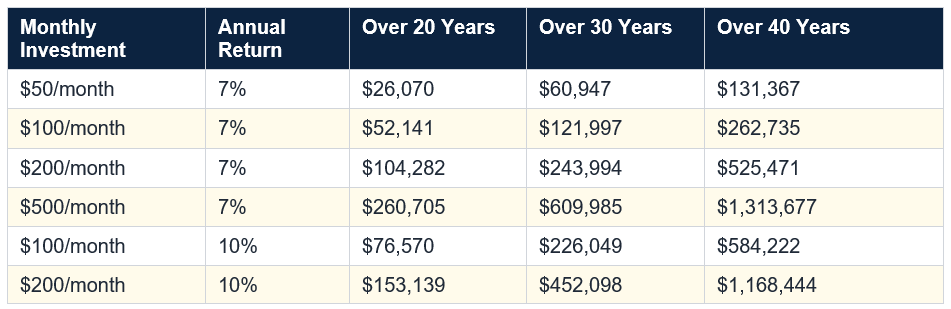
The table makes the point without needing any additional argument. $100 per month at 10 percent for 40 years: $584,000. Not because of a high income. Because of a long time horizon and the discipline to start and stay consistent.
Individual investors who pick stocks face a fundamental disadvantage: they are competing against professional investors with teams of analysts, proprietary information systems, and years of specialised training, who are themselves mostly losing to index funds. The retail investor trying to pick the next Amazon in 2026 is competing with organisations that have spent hundreds of millions of dollars building analytical capabilities. The odds are not favourable.
The evidence from decades of market data: the best-performing portfolio in any given year almost never remains the best-performing portfolio in the following year. Chasing last year’s winners is one of the most reliably documented ways to produce below-average returns. Owning everything — through a total market index fund — guarantees you own the winners, whatever they turn out to be, without requiring you to predict in advance which they will be.
The Simple Truth: You do not need to know which stocks will go up. You just need to own all of them, cheaply, for a very long time. That is what a total market index fund does.
Wealthvieu’s April 2026 data is unambiguous: 40 to 45 percent of American millionaires got there through career earnings and consistent investing. No single big moment. No lottery. No startup exit. Just a salary, a savings habit, a 401(k), and thirty years. The average millionaire did not have a defining financial event. They had ten thousand defining financial decisions: the Friday night they cooked at home instead of eating out; the bonus they put into their Roth IRA instead of upgrading their car; the market crash they ignored while everyone around them panicked and sold.
The wealth-building equivalent of fitness is instructive here. Getting fit does not require one transformative day at the gym. It requires showing up most days for years, making reasonable food choices most of the time, and not abandoning the habit when you miss a week. The result is not dramatic in any single month. Over a decade, it is transformative. Wealth works identically. The habit matters more than any individual decision within it.
Nick Maggiulli, Just Keep Buying (2022): The data is clear: the single most powerful thing most investors can do is to keep buying. Not brilliantly. Not at the perfect moment. Just consistently. The ‘just keep buying’ strategy, applied to a low-cost index fund over a full career, outperforms most active strategies and virtually all timing strategies in the historical data.
This conclusion is false. At 45, a person has approximately 20 years to retirement at age 65. Twenty years at 7 percent compound growth turns $50,000 into $193,000. It turns $200 per month of new contributions into $104,000. A person who starts at 45 and maximises their 401(k) at $23,500 per year for 20 years — at 7 percent average return — would accumulate approximately $1,024,000 by age 65.
The person who starts at 50 has even fewer compounding years, but still meaningfully more than zero. Workers 50 and older can contribute $31,000 per year to a 401(k) with catch-up provisions. Fifteen years of $31,000 annual contributions at 7 percent compound annual growth produces approximately $774,000. Not the multi-million-dollar outcome of someone who started at 22, but a million dollar difference versus the person who continued to believe it was too late and invested nothing.
Every year of waiting is a year of compounding that cannot be recovered. The tree you should have planted twenty years ago is gone. The second-best time to plant it is today.
Consider two investors. Investor A starts at 22, invests $300 per month until age 32, then stops and never adds another dollar. Investor B starts at 32, invests $300 per month until age 62, thirty years of consistent contributions. At 7 percent average annual return, Investor A has contributed $36,000 and by age 62 has approximately $338,000. Investor B has contributed $108,000 over thirty years and at 62 has approximately $340,000. Both end at approximately the same place. But Investor A contributed a third of the money and stopped investing three decades before retirement.
This mathematical reality — sometimes called the miracle of the early investor — is the most powerful argument for the urgency of starting. The 80 percent of Americans who said they wish they had started investing earlier understood this truth, but after the fact. The person who acts on it in their 20s will look back at 60 with an asset base that their income alone cannot explain. Compounding will have explained the rest.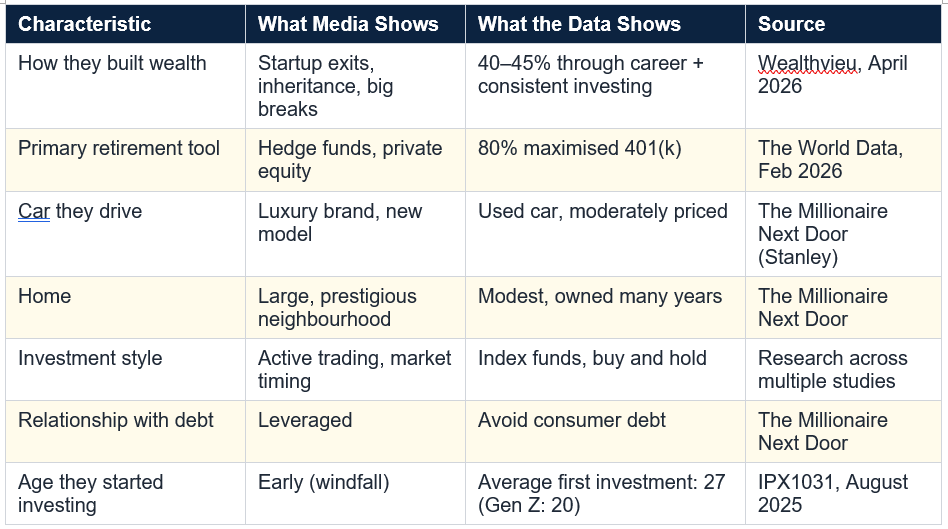
The gap between the media’s image of wealth and what the data actually shows is almost total. The typical American millionaire is not the person in the television commercial. They are the person sitting next to you at a modest restaurant, paying cash, who has been putting $500 per month into index funds since 1997.
This is what Carl Richards called the behaviour gap: the gap between the investment return that was available and the return the investor actually received, shrunk by the cost of emotional decision-making. The solution to the behaviour gap is not more information. It is automation, simplicity, and psychological distance from your own portfolio.
Reading about wealth building and starting wealth building are separated by a gap that most people never cross. Here is the specific action plan for the first week:
The reason more people do not follow this formula is not that it is intellectually beyond them. It is that it requires sustained behavioural discipline in the face of present bias, social comparison pressure, market volatility, and the daily temptation to consume rather than invest. These are real challenges. But they are psychological challenges, not financial ones. And psychological challenges can be addressed through systems: automation, simplicity, written policies, and the removal of frictions that enable poor decisions.
The 11 percent of Americans who consider themselves wealthy are not fundamentally different from the 89 percent who do not. They are people who understood the formula, took it seriously, and applied it consistently for long enough for compounding to produce a result that seems, from the outside, remarkable. From the inside, it was just a direct debit that ran every month for thirty years.
The best time to start was the day you got your first paycheck. The second-best time is today. The formula does not change. The markets do not care when you start. The compounding table does not have a waiting list. It is open right now. All you have to do is begin.
Yes. The data consistently shows that the savings rate — the percentage of income that goes to investment — matters more than the income level itself. Highland Financial Advisors’ 2026 analysis shows that a $150,000 household saving 20% accumulates far more wealth than a $250,000 household saving 5%. $100 per month at 10% annual return for 40 years grows to $584,222. Most of that sum was never in anyone’s paycheck. It was created by compounding over time.
How much do I need to start investing?
Nothing. Most major brokerages — Fidelity, Schwab, Vanguard — have $0 account minimums and offer fractional shares from $1. Many 401(k) plans accept contributions from the first dollar of paycheck. The minimum is not a financial barrier. It is a psychological one. The decision to start with $25 per month creates the habit that the subsequent pay rise will scale. Starting with nothing is better than continuing to wait for the right moment to start with more.
Why do most people not build wealth even though the formula is simple?
The primary barriers are behavioural, not intellectual. Present bias (the preference for immediate gratification over future reward), social comparison pressure (spending to match visible neighbour or colleague consumption), the behaviour gap (selling during market crashes and buying after rallies), and financial illiteracy (not understanding the formula at all). Only 33% of US high school students receive personal finance education. The formula is simple. The sustained behavioural discipline it requires is genuinely hard.
Do I need a financial adviser to build wealth?
Not necessarily. For a straightforward wealth-building strategy — contribute to a 401(k), invest in a total market index fund, maintain an emergency fund, and avoid high-interest debt — a financial adviser is not required. Where advisers add significant value: complex tax planning, estate planning, business succession, managing a large and complex portfolio, and providing the behavioural coaching that prevents panic-selling during market declines. For most people starting out, a Roth IRA with a target-date fund is sufficient without professional help.
What is the single most important wealth-building decision?
Starting. Eighty percent of Americans say they wish they had started investing earlier (IPX1031, 2025). The average American makes their first investment at age 27. Gen Z is already doing better, averaging their first investment at 20. The mathematical evidence is unambiguous: an investor who starts at 22 and contributes consistently for 10 years, then stops, can end up with the same wealth at 62 as an investor who starts at 32 and contributes for 30 years. Every year of waiting is a year of compounding that cannot be recovered.
Is the stock market too risky for wealth building?
The stock market carries short-term volatility — it will decline in any given year some of the time. But for investors with a time horizon of 10 or more years, the risk of a permanently bad outcome from a diversified index fund portfolio is historically extremely low. The S&P 500 has never produced a negative return over any rolling 20-year period in its history. The greater risk, for long-term investors, is not that the stock market will decline. It is that they will sell during the decline and miss the recovery, which is what most investors who ‘play it safe’ in cash actually experience.
How do I stop myself from panic-selling during a market crash?
The most effective strategies: automate contributions so investing happens without active decision-making; simplify your portfolio to reduce the number of decisions required; do not check your portfolio more than quarterly; write an investment policy before the crash that commits your future self to staying invested; and reframe declines as discounts — an opportunity to buy more of the same asset at a lower price. If your panic is severe enough that staying invested feels genuinely impossible, the portfolio may carry more risk than your actual tolerance allows, and reducing the stock allocation to a level you can maintain through a 30% decline is better than abandoning the strategy entirely.
Table of Contents
- The Formula Exists. The Problem Is Elsewhere.
- What ‘Rich’ Actually Means (It’s Not What Most People Picture)
- The Simple Formula — Written Out in One Paragraph
- Why Complexity Is a Distraction, Not a Requirement
- Myth 1: You Need a High Income to Build Wealth
- Myth 2: You Need to Pick the Right Stocks
- Myth 3: Wealth Is Built Through Big Moments, Not Small Habits
- Myth 4: It’s Too Late to Start
- The Real Barriers: What Actually Stops People
- The Compounding Math: Why Time Is the Only Scarce Resource
- What Millionaires Actually Look Like
- The Behaviour Gap: Why Knowing Isn’t Enough
- The Week-One Action Plan: Starting Today
- Conclusion: Simple Is Not Easy. But It’s Enough.
- Frequently Asked Questions
The Formula Exists. The Problem Is Elsewhere.
If getting rich required a PhD in economics, most millionaires would have one. They do not. If it required stock-picking genius, most wealthy people would be former traders at Goldman Sachs. They are not. If it required inheritance, extraordinary luck, or a single brilliant business idea, the majority of high-net-worth Americans would trace their wealth to one of those sources. They cannot.Wealthvieu’s April 2026 analysis of US millionaire data found that 40 to 45 percent of American millionaires built their net worth through career earnings combined with consistent, disciplined investing — not business ownership, not inheritance, and not a single transformative event. The World Data’s February 2026 research found 80 percent of millionaires aggressively invested in employer-sponsored 401(k) plans. These are not extraordinary people doing extraordinary things. They are ordinary people doing ordinary things — consistently, over a long time.
So why do only 11 percent of Americans currently consider themselves wealthy, according to Fidelity’s 2024 State of Wealth Mobility Study? Why do 78 percent of Americans live paycheck to paycheck at some point in their lives, per LendingTree’s 2025 data? Why do 34 percent have no emergency savings at all? If the formula is simple, why do so few people follow it? That is the question this article answers. And the answer, as it turns out, is more psychological than mathematical.
What ‘Rich’ Actually Means (It’s Not What Most People Picture)
Before examining why getting rich is not complicated, it is worth defining what we mean by the word. Most people picture wealth as a specific lifestyle: a large house, expensive cars, designer clothing, exotic holidays, and the kind of conspicuous consumption that appears on social media. This picture is mostly wrong, and mistaking it for the definition of wealth is itself one of the barriers to building it.Thomas J. Stanley’s landmark research, The Millionaire Next Door, found that the typical American millionaire drives a used or moderately priced car, lives in a home they have owned for many years in an ordinary neighbourhood, shops at regular supermarkets, and avoids ostentatious displays of wealth. The stereotype of the millionaire as a luxury consumer is a media construction. The reality is usually a person who spent decades not spending money they could have spent.
For the purposes of this article, ‘rich’ means financially independent: having sufficient invested assets that your passive income from investments covers your living expenses, eliminating your dependency on a salary. This is also called financial freedom or financial independence. It does not require a yacht. It requires a portfolio large enough to generate the income you need to live the life you want. For most Americans, this number is between $1 million and $3 million, depending on lifestyle and location.
The Simple Truth: Rich is not a lifestyle. Rich is a balance sheet. A person with $2 million in index funds and a modest lifestyle is richer — in every meaningful sense — than a person with $500,000 in debt and a rented penthouse.
The Simple Formula — Written Out in One Paragraph
Here is the entire wealth-building formula, stated completely:Earn more than you spend. Save the difference consistently. Invest those savings in diversified, low-cost index funds inside tax-advantaged accounts. Do not sell when markets fall. Give it time. Repeat for twenty to forty years.
That’s it. That is the complete formula that 40 to 45 percent of American millionaires followed. It has no prerequisites about your starting income, your educational background, your city, your race, or your family history. It does not require you to identify the next Apple before anyone else does. It does not require you to time the market, pick winning stocks, or navigate complex financial instruments. It requires a positive income-expense gap, consistency, and patience.
The Simple Truth: The formula for building wealth is simple enough to write in one sentence. The reason more people do not follow it is not that they cannot understand it. It is that simple is not the same as easy.
This is the central insight of this article. The intellectual challenge of getting rich is trivial. The behavioural challenge of getting rich is genuinely hard. And understanding the difference between those two challenges is the first step toward overcoming the second one.
Why Complexity Is a Distraction, Not a Requirement
The financial services industry has a structural incentive to make investing seem complicated. Complexity justifies advisory fees, active management charges, complex financial products, and the general impression that managing money is a specialised skill that most people need to pay others to perform on their behalf. This impression is not entirely inaccurate for very large and complex estates. But for the vast majority of individual investors, complexity is not a value-add. It is a cost.S&P’s SPIVA Report consistently finds that approximately 85 to 90 percent of actively managed funds underperform their benchmark index over 15-year periods. The portfolio of a professional stock-picker with an MBA from a prestigious business school, a team of analysts, and access to proprietary data typically does worse than a simple S&P 500 index fund over any sufficiently long time period. Not occasionally. Consistently. Persistently. Year after year.
The reason: the index fund does not try to be clever. It simply buys all the stocks in the index, in proportion to their market capitalisation, and holds them. It charges 0.03 to 0.10 percent per year in fees. It never panics. It never sells on bad news. It captures the collective productivity of the American (or global) economy and passes that return through to investors, minus a tiny cost. This is not a compromise strategy. It is the most evidence-supported investment approach available to any individual investor.
Warren Buffett’s Bet: In 2007, Warren Buffett bet $1 million that a simple S&P 500 index fund would outperform a curated basket of hedge funds over ten years. He won decisively. The index fund returned approximately 7.1% annually; the hedge funds averaged 2.2%. Complexity lost. Simplicity won. The lesson was not subtle.
Myth 1: You Need a High Income to Build Wealth
This is the most persistent and most damaging myth about wealth building. It is wrong, and it is provably wrong — though not in the direction that implies low income creates no challenges. Income absolutely matters. Higher income gives you more material to work with. But the relationship between income and wealth accumulation is far weaker than most people assume.Highland Financial Advisors’ January 2026 analysis demonstrates this clearly: a household earning $150,000 that saves 20 percent ($30,000 per year) will accumulate far more long-term wealth than a household earning $250,000 that saves only 5 percent ($12,500 per year). The higher-earning household puts $17,500 more per year into their wallet. The lower-earning household puts $17,500 more per year into their investment account. Over 30 years at 7 percent compound annual growth, that difference is the difference between approximately $2.8 million and $1.4 million.
The specific dollar number that goes into investments matters less than the consistency and the time. A person who invests $100 per month starting at age 22 will, at 10 percent average annual return, have approximately $584,000 at age 62. They will have contributed only $48,000 of their own money. The other $536,000 is compounding — money that was never their paycheck, created by time and consistency rather than a high salary.
The table makes the point without needing any additional argument. $100 per month at 10 percent for 40 years: $584,000. Not because of a high income. Because of a long time horizon and the discipline to start and stay consistent.
Myth 2: You Need to Pick the Right Stocks
Stock-picking is exciting. It is the subject of financial media, investment conferences, and countless books. It is also, for the vast majority of investors, a reliable way to underperform a simple index fund while spending significantly more time and emotional energy than buy-and-hold passive investing requires.Individual investors who pick stocks face a fundamental disadvantage: they are competing against professional investors with teams of analysts, proprietary information systems, and years of specialised training, who are themselves mostly losing to index funds. The retail investor trying to pick the next Amazon in 2026 is competing with organisations that have spent hundreds of millions of dollars building analytical capabilities. The odds are not favourable.
The evidence from decades of market data: the best-performing portfolio in any given year almost never remains the best-performing portfolio in the following year. Chasing last year’s winners is one of the most reliably documented ways to produce below-average returns. Owning everything — through a total market index fund — guarantees you own the winners, whatever they turn out to be, without requiring you to predict in advance which they will be.
The Simple Truth: You do not need to know which stocks will go up. You just need to own all of them, cheaply, for a very long time. That is what a total market index fund does.
Myth 3: Wealth Is Built Through Big Moments, Not Small Habits
The financial media is built on compelling stories. The early Facebook employee. The Bitcoin buyer who held for ten years. The entrepreneur who sold their startup for $50 million. These stories are real. They are also profoundly unrepresentative of how most wealth is built.Wealthvieu’s April 2026 data is unambiguous: 40 to 45 percent of American millionaires got there through career earnings and consistent investing. No single big moment. No lottery. No startup exit. Just a salary, a savings habit, a 401(k), and thirty years. The average millionaire did not have a defining financial event. They had ten thousand defining financial decisions: the Friday night they cooked at home instead of eating out; the bonus they put into their Roth IRA instead of upgrading their car; the market crash they ignored while everyone around them panicked and sold.
The wealth-building equivalent of fitness is instructive here. Getting fit does not require one transformative day at the gym. It requires showing up most days for years, making reasonable food choices most of the time, and not abandoning the habit when you miss a week. The result is not dramatic in any single month. Over a decade, it is transformative. Wealth works identically. The habit matters more than any individual decision within it.
Nick Maggiulli, Just Keep Buying (2022): The data is clear: the single most powerful thing most investors can do is to keep buying. Not brilliantly. Not at the perfect moment. Just consistently. The ‘just keep buying’ strategy, applied to a low-cost index fund over a full career, outperforms most active strategies and virtually all timing strategies in the historical data.
Myth 4: It’s Too Late to Start
This myth is particularly destructive because it is most believed by the people who most need to reject it. The person who is 40, 45, or 50 and has saved little often concludes that the window has closed — that the compounding advantage available to a 22-year-old is gone, and with it, the possibility of meaningful wealth accumulation.This conclusion is false. At 45, a person has approximately 20 years to retirement at age 65. Twenty years at 7 percent compound growth turns $50,000 into $193,000. It turns $200 per month of new contributions into $104,000. A person who starts at 45 and maximises their 401(k) at $23,500 per year for 20 years — at 7 percent average return — would accumulate approximately $1,024,000 by age 65.
The person who starts at 50 has even fewer compounding years, but still meaningfully more than zero. Workers 50 and older can contribute $31,000 per year to a 401(k) with catch-up provisions. Fifteen years of $31,000 annual contributions at 7 percent compound annual growth produces approximately $774,000. Not the multi-million-dollar outcome of someone who started at 22, but a million dollar difference versus the person who continued to believe it was too late and invested nothing.
Every year of waiting is a year of compounding that cannot be recovered. The tree you should have planted twenty years ago is gone. The second-best time to plant it is today.
The Real Barriers: What Actually Stops People
The formula is simple. The myths are addressable. So what actually stops people? The barriers are real, but they are mostly behavioural and systemic, not intellectual:The Behaviour Gap
Psychologist and financial researcher Carl Richards coined the phrase the behaviour gap to describe the difference between what investors should do (stay invested, contribute consistently, ignore short-term noise) and what they actually do (sell during crashes, buy after rallies, check portfolios obsessively and react to what they see). The behaviour gap destroys returns that would otherwise be captured by simply staying the course.Present Bias
Humans are evolutionarily wired to prioritise present gratification over future reward. Spending $200 on a meal tonight feels immediate and real. Investing $200 for a retirement that is thirty years away feels abstract and optional. The wealth-building formula requires repeatedly making the less emotionally satisfying choice — not once, but consistently, for decades.Social Comparison
Consumer culture is built on social comparison. The visible wealth signals of neighbours, colleagues, and social media connections create constant pressure to spend at or above one’s income level. As Thomas Stanley’s research found, many of the people who look richest — driving expensive cars, living in large homes, wearing designer brands — are deeply in debt. Many of the people building genuine wealth are indistinguishable from the crowd.Financial Illiteracy
Only 33 percent of US high school students receive any personal finance education, according to NGPF’s 2025 data. Only 57 percent of US adults are financially literate. When the foundational concepts of compound interest, tax-advantaged investing, and index fund performance are never taught, they cannot be applied. Ignorance of the formula is a genuine barrier for a significant proportion of the population.Structural Barriers
For people living at or near subsistence level, the gap between income and expenses may genuinely not exist. This article is not addressed to people for whom survival is the immediate challenge. But the research consistently shows that the majority of people who believe they cannot afford to invest could, with discipline and prioritisation, find some amount — even $25 or $50 per month — to begin. The story of ‘I cannot afford to invest’ is true for some people and a choice for many others.The Compounding Math: Why Time Is the Only Scarce Resource
Of all the inputs to wealth building — income, savings rate, investment return, time — time is the only one you cannot get more of. You can earn a higher income. You can increase your savings rate. You can optimise your investment allocation. You cannot recover years of compounding that were not started.Consider two investors. Investor A starts at 22, invests $300 per month until age 32, then stops and never adds another dollar. Investor B starts at 32, invests $300 per month until age 62, thirty years of consistent contributions. At 7 percent average annual return, Investor A has contributed $36,000 and by age 62 has approximately $338,000. Investor B has contributed $108,000 over thirty years and at 62 has approximately $340,000. Both end at approximately the same place. But Investor A contributed a third of the money and stopped investing three decades before retirement.
This mathematical reality — sometimes called the miracle of the early investor — is the most powerful argument for the urgency of starting. The 80 percent of Americans who said they wish they had started investing earlier understood this truth, but after the fact. The person who acts on it in their 20s will look back at 60 with an asset base that their income alone cannot explain. Compounding will have explained the rest.
What Millionaires Actually Look Like
The gap between the media’s image of wealth and what the data actually shows is almost total. The typical American millionaire is not the person in the television commercial. They are the person sitting next to you at a modest restaurant, paying cash, who has been putting $500 per month into index funds since 1997.
The Behaviour Gap: Why Knowing Isn’t Enough
If knowledge were sufficient, financial literacy education alone would produce dramatically better wealth outcomes across the population. It does not. A study by Morningstar found that investors in funds that performed well actually earned significantly lower returns than the fund’s published performance because they invested after the fund had already risen and sold after it had fallen — the classic buy-high, sell-low behaviour driven by emotion rather than strategy.This is what Carl Richards called the behaviour gap: the gap between the investment return that was available and the return the investor actually received, shrunk by the cost of emotional decision-making. The solution to the behaviour gap is not more information. It is automation, simplicity, and psychological distance from your own portfolio.
- Automate contributions: direct debit from paycheck to 401(k) and brokerage account on payday. Money that is never in your checking account cannot be spent.
- Simplify your portfolio: the more complex your portfolio, the more decisions you need to make and the more opportunities for emotional interference. One or two index funds is sufficient for most investors and eliminates most of the decision points that create behavioural errors.
- Stop checking: checking your portfolio weekly or daily causes the emotional response that drives poor decisions. Quarterly reviews are sufficient for most long-term investors. Monthly at most.
- Have a written investment policy: decide in advance what you will do in a market crash (stay invested, rebalance, add more if able), and write it down. Reading a pre-committed rational plan during a market panic is more effective than trying to reason clearly under emotional pressure.
Reading about wealth building and starting wealth building are separated by a gap that most people never cross. Here is the specific action plan for the first week:
- Day 1: calculate your income-expense gap. Add up last month’s income and last month’s spending. If the gap is positive, that is your current investment capacity. If it is negative, identify one to three spending categories to reduce first.
- Day 2: set up your employer’s 401(k) if not already enrolled. Contribute at least enough to capture the full employer match. If your employer offers no 401(k), open a Roth IRA at Fidelity, Vanguard, or Schwab.
- Day 3: open a high-yield savings account at an online bank if you do not already have one. Move one month of essential expenses into it as the start of your emergency fund.
- Day 4: choose your investment. For most people starting out, a single total market index fund (such as Vanguard’s VTSAX or its ETF equivalent VTI) or a target-date fund set to your expected retirement year is sufficient. The decision that must be made is not which fund is best. It is which fund you will stick with for the next thirty years.
- Day 5: set up automatic recurring contributions. Monthly, on payday, to your 401(k) (via payroll) and your IRA or taxable brokerage (via automatic bank transfer). Make it automatic so it happens by default rather than by decision.
- Day 6: delete the trading apps from your phone. Unsubscribe from daily financial newsletters. Financial entertainment is not the same as financial education, and most of it creates the emotional churn that drives poor investment decisions.
- Day 7: write your investment policy in one paragraph: what you invest in, how often you contribute, what you will do if markets fall 20 percent (answer: keep contributing), and when you will review (quarterly). File it somewhere you can find it during the next market panic.
Conclusion
Getting rich is not complicated. The formula is earn, save, invest consistently, stay invested, and give it time. Forty to forty-five percent of American millionaires built their wealth exactly this way: no inheritance, no business exit, no stock-picking genius. Just a salary, a savings habit, and three to four decades of compounding.The reason more people do not follow this formula is not that it is intellectually beyond them. It is that it requires sustained behavioural discipline in the face of present bias, social comparison pressure, market volatility, and the daily temptation to consume rather than invest. These are real challenges. But they are psychological challenges, not financial ones. And psychological challenges can be addressed through systems: automation, simplicity, written policies, and the removal of frictions that enable poor decisions.
The 11 percent of Americans who consider themselves wealthy are not fundamentally different from the 89 percent who do not. They are people who understood the formula, took it seriously, and applied it consistently for long enough for compounding to produce a result that seems, from the outside, remarkable. From the inside, it was just a direct debit that ran every month for thirty years.
The best time to start was the day you got your first paycheck. The second-best time is today. The formula does not change. The markets do not care when you start. The compounding table does not have a waiting list. It is open right now. All you have to do is begin.
Frequently Asked Questions
Is it really possible to build wealth on an average income?Yes. The data consistently shows that the savings rate — the percentage of income that goes to investment — matters more than the income level itself. Highland Financial Advisors’ 2026 analysis shows that a $150,000 household saving 20% accumulates far more wealth than a $250,000 household saving 5%. $100 per month at 10% annual return for 40 years grows to $584,222. Most of that sum was never in anyone’s paycheck. It was created by compounding over time.
How much do I need to start investing?
Nothing. Most major brokerages — Fidelity, Schwab, Vanguard — have $0 account minimums and offer fractional shares from $1. Many 401(k) plans accept contributions from the first dollar of paycheck. The minimum is not a financial barrier. It is a psychological one. The decision to start with $25 per month creates the habit that the subsequent pay rise will scale. Starting with nothing is better than continuing to wait for the right moment to start with more.
Why do most people not build wealth even though the formula is simple?
The primary barriers are behavioural, not intellectual. Present bias (the preference for immediate gratification over future reward), social comparison pressure (spending to match visible neighbour or colleague consumption), the behaviour gap (selling during market crashes and buying after rallies), and financial illiteracy (not understanding the formula at all). Only 33% of US high school students receive personal finance education. The formula is simple. The sustained behavioural discipline it requires is genuinely hard.
Do I need a financial adviser to build wealth?
Not necessarily. For a straightforward wealth-building strategy — contribute to a 401(k), invest in a total market index fund, maintain an emergency fund, and avoid high-interest debt — a financial adviser is not required. Where advisers add significant value: complex tax planning, estate planning, business succession, managing a large and complex portfolio, and providing the behavioural coaching that prevents panic-selling during market declines. For most people starting out, a Roth IRA with a target-date fund is sufficient without professional help.
What is the single most important wealth-building decision?
Starting. Eighty percent of Americans say they wish they had started investing earlier (IPX1031, 2025). The average American makes their first investment at age 27. Gen Z is already doing better, averaging their first investment at 20. The mathematical evidence is unambiguous: an investor who starts at 22 and contributes consistently for 10 years, then stops, can end up with the same wealth at 62 as an investor who starts at 32 and contributes for 30 years. Every year of waiting is a year of compounding that cannot be recovered.
Is the stock market too risky for wealth building?
The stock market carries short-term volatility — it will decline in any given year some of the time. But for investors with a time horizon of 10 or more years, the risk of a permanently bad outcome from a diversified index fund portfolio is historically extremely low. The S&P 500 has never produced a negative return over any rolling 20-year period in its history. The greater risk, for long-term investors, is not that the stock market will decline. It is that they will sell during the decline and miss the recovery, which is what most investors who ‘play it safe’ in cash actually experience.
How do I stop myself from panic-selling during a market crash?
The most effective strategies: automate contributions so investing happens without active decision-making; simplify your portfolio to reduce the number of decisions required; do not check your portfolio more than quarterly; write an investment policy before the crash that commits your future self to staying invested; and reframe declines as discounts — an opportunity to buy more of the same asset at a lower price. If your panic is severe enough that staying invested feels genuinely impossible, the portfolio may carry more risk than your actual tolerance allows, and reducing the stock allocation to a level you can maintain through a 30% decline is better than abandoning the strategy entirely.
0 Comments
Be the first to share your thoughts on this article.