

Financial Literacy
10 Money Behaviors Holding Back Your Financial Success

83% of Americans failed their 2025 financial goals. It’s 80% behavior, 20% knowledge. These are the ten patterns that do the most damage — and what to do instead.
Money is not mostly a maths problem. Dave Ramsey’s famous line, quoted extensively in Yahoo Finance’s 2026 coverage, puts a number on it: ‘Personal finance is only 20% head knowledge. It’s 80% behavior.’ The evidence supports this. Beyond Finance’s 2026 survey found that 83% of Americans failed some or all of their financial goals in 2025. Credit Karma’s year-end survey found that 49% of Americans say their financial situation got worse. The Wells Fargo Money Study 2025 found that 83% of Americans want to learn new ways of thinking about their money. The knowledge gap is real — but it is not the primary obstacle. The primary obstacle is the gap between understanding what to do and consistently doing it, across the daily decisions that compound over years into financial outcomes. This article identifies the ten money behaviors that the research consistently shows hold people back, and pairs each with the specific shift that converts the behavior from a headwind into a habit.
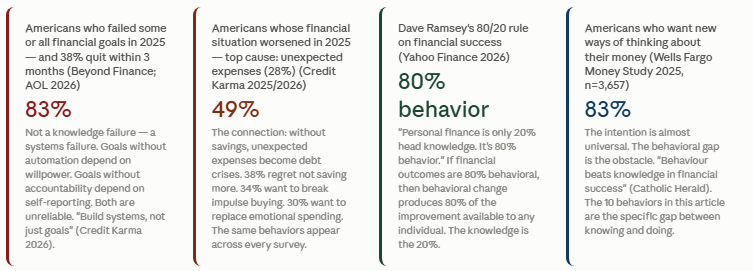
The statistics on financial goal failure confirm this analysis. Beyond Finance’s 2026 survey found that 83% of Americans failed some or all of their financial goals in 2025 — not because they did not know what good financial goals look like, but because the behavioral systems to sustain them were not in place. Credit Karma’s 2026 survey found that 49% of Americans say their financial situation worsened in 2025. The Wells Fargo Money Study 2025 found that 83% want new ways of thinking about their money. The Catholic Herald’s psychology-of-money analysis put it directly: ‘Behaviour beats knowledge in financial success.’ The ten behaviors in this article are the specific patterns that the research identifies as the most damaging — not because they are unusual, but because they are common, and because the fix for each is specific and actionable.
Personal finance is only 20% head knowledge. It's 80% behavior.' — Dave Ramsey (Yahoo Finance 2026). 83% of Americans failed some or all financial goals in 2025 (Beyond Finance/AOL). 49% say finances worsened (Credit Karma). 83% want new ways of thinking about money (Wells Fargo Money Study 2025, n=3,657). Sources cited.
Without a budget, spending is managed by feeling rather than fact. 'I feel like I have enough left this month' is not a financial system. Nearly half of US households spend more than they earn (NAIFA 2026).
Impulse buying is the #1 habit Americans want to break in 2026 (34%, Credit Karma). Emotional spending uses the debit card as a coping mechanism — a role money cannot sustainably fill.
38% of Americans regret not saving more in 2025 — the #1 financial regret (Credit Karma; Yahoo Finance). Inconsistent saving means irregular financial breathing room — every unexpected expense risks cascading into debt.
83% failed some or all financial goals in 2025. 64% quit by end of January. Goal-setting is not the problem — follow-through is. Sources: Beyond Finance/AOL 2026; NAIFA 2026.
Lifestyle inflation means a pay rise produces no improvement in financial resilience — the spending floor simply rises to absorb the increase. Income grows; net worth stays flat.
Using high-interest credit cards as income supplements means paying 20-25% APR to fund a lifestyle the income doesn't support. Every month of carried balance is a guaranteed financial loss. Sources: Credit Karma 2025; NAIFA 2026.
56% of Americans keep their finances secret (Wells Fargo Money Study 2025). Financial avoidance converts manageable problems into unmanageable ones through inaction. What you don't look at, you can't fix.
Delay is the most expensive decision in investing. A 10-year delay typically requires saving twice as much per year to reach the same retirement outcome. 64% plan to invest — but intention and action are different things (YouGov 2025; WSBTV).
83% of Americans want to learn new ways of thinking about money — but want and do are different (Wells Fargo Money Study 2025). 'Knowledge costs nothing; financial mistakes cost everything' (Daily Maverick 2026).
83% of Americans fail on financial goals. The failure mechanism is usually accountability — pursuing goals in isolation, without tracking or external commitment. Sources: Beyond Finance/AOL 2026; Credit Karma 2026.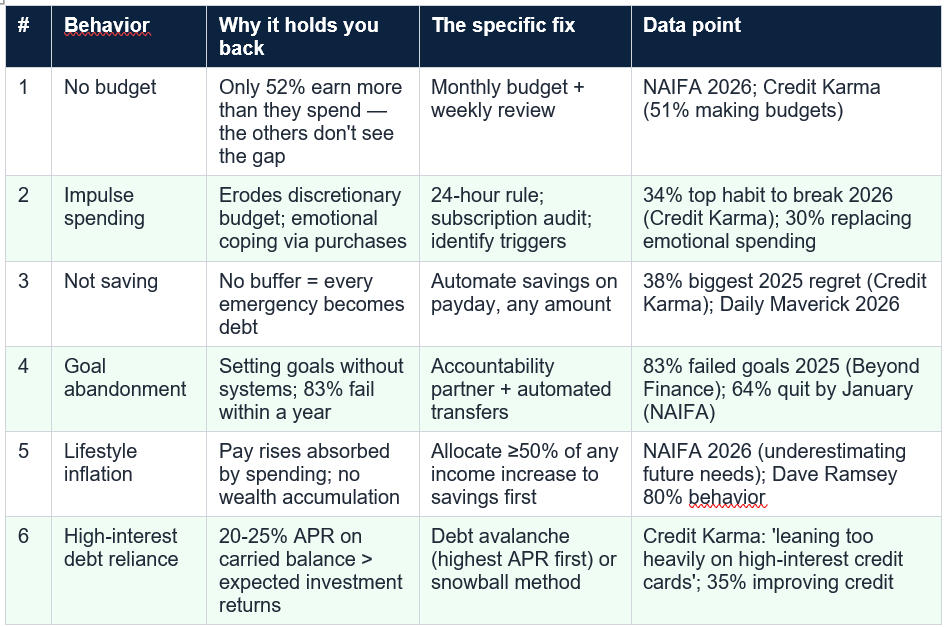
The behaviors are the levers because they are the variables that compound. A saving behavior compounded over 20 years produces financial security. An impulse spending behavior compounded over the same period produces debt and regret. The financial outcome is not primarily the product of income — it is the product of what is done with the income, repeatedly, over time. Dave Ramsey’s 80/20 observation is not a reassurance; it is an empowerment. If financial outcomes are 80% behavioral, then behavioral change produces 80% of the improvement available to any individual. The knowledge in this article is the 20%. The actions — the budget built this weekend, the savings transfer automated on the next payday, the subscription audit done before next month — are the 80%. Not financial advice. Consult a qualified financial adviser for guidance specific to your situation.
Dave Ramsey (Yahoo Finance 2026): 'Personal finance is only 20% head knowledge. It's 80% behavior. It's our behaviors with money that can get us into the biggest trouble or lead us into the biggest successes.' Credit Karma 2026: 'The key to success and sticking to better financial habits is to not just set goals, but to build systems of accountability.' Daily Maverick April 2026: 'You cannot control inflation, interest rates or global shocks, but you can control your habits.' Sources cited.
Beyond Finance's 2026 survey, reported by AOL, found that 83% of Americans failed some or all of their financial goals in 2025, with 38% abandoning within three months. NAIFA's financial resolutions analysis found that 64% gave up by the end of January. The primary mechanisms are not motivation failures — they are systems failures. Goals set without automated actions depend on willpower, which depletes. Goals set without accountability depend on self-reporting, which is unreliable. Credit Karma's 2026 survey identified the most actionable insight: 'The key to success and sticking to better financial habits in the new year is to not just set goals, but to build systems of accountability — whether that's with a partner, family member, or using a financial app.' Beyond Finance also noted that early financial habits formed in childhood have profound long-term consequences, suggesting for some that the goal abandonment pattern is deeply rooted. Sources: Beyond Finance/AOL 2026; NAIFA 2026; Credit Karma 2026.
Is financial success more about income or behavior?
The research and expert commentary consistently points to behavior as the dominant factor. Dave Ramsey, quoted in Yahoo Finance's 2026 coverage, stated: 'Personal finance is only 20% head knowledge. It's 80% behavior.' The Daily Maverick's April 2026 financial wellbeing analysis reached the same conclusion from different data: 'While incomes matter, habits may matter more.' The specific finding cited was from TransUnion research: 'The moment you're able to put in place the habits — saving regularly, tracking expenses, keeping debt manageable, developing a financial plan — you see a disproportional improvement in financial wellbeing.' This does not mean income is irrelevant — there are levels of income below which no amount of behavioral improvement can produce meaningful wealth accumulation. But above that level, the research consistently shows that behavioral differences account for most of the variation in financial outcomes between people with similar incomes. Sources: Yahoo Finance/Dave Ramsey 2026; Daily Maverick April 2026.
What is the most common financial regret Americans have?
Not saving enough money was the top financial regret among Americans in 2025, cited by 38% of respondents in Credit Karma's year-end survey reported by Yahoo Finance. The second context is impulse buying, which 34% of Americans identified as the top habit they want to break in 2026 (Credit Karma 2025). More broadly, 49% of Americans said their financial situation worsened in 2025, with the most common setback being unexpected expenses (28%) — which connects directly to the savings regret: without an emergency fund, unexpected expenses become financial crises. Credit Karma's survey also found that two-thirds (67%) said economic factors such as tariffs, cost of living, and inflation affected their spending habits in 2025 — but the top responses to these pressures (impulse spending, reduced savings, over-reliance on credit cards) were behavioral, not structural. Sources: Credit Karma survey 2025/2026; Yahoo Finance.
How does emotional spending affect financial outcomes?
Emotional spending — using purchases as a coping mechanism for stress, boredom, anxiety, or social pressure — is one of the most commonly identified drivers of financial difficulty. Credit Karma's 2026 survey found that 30% of Americans want to replace emotional spending with healthier coping strategies, and 34% identified impulse buying (which heavily overlaps with emotional spending) as the top habit they want to break. Rachel Cruze, quoted in Yahoo Finance's 2026 coverage, explains the psychological root: 'If you want to get to the root of why you behave the way you do — why you spend, save, use debt, put off investing and more — you've got to learn about how the psychology of money affects you.' The Wells Fargo Money Study 2025 found that money is deeply emotional for most Americans — 57% sometimes judge themselves based on their money, and 83% want new ways of thinking about it. Emotional spending typically produces short-term relief and long-term financial regret — one of the most consistent findings in behavioral finance. Sources: Credit Karma 2026; Wells Fargo Money Study 2025; Yahoo Finance/Rachel Cruze 2026.
What one financial behavior change has the biggest impact?
The research consistently points to consistent saving — specifically automating a savings transfer on payday — as the single behavioral change with the broadest positive impact. The Daily Maverick's April 2026 analysis cited this specifically: 'Saving regularly' was the first habit listed in the constellation that produces disproportional improvement in financial wellbeing. Not saving enough was the #1 financial regret among Americans in 2025 (38%, Credit Karma). The mechanism is clear: automatic savings on payday builds the emergency fund that prevents unexpected expenses from becoming debt crises; it builds the investment account that creates long-term wealth; and it builds the behavioral habit of living within income minus savings rather than on all available income. Credit Karma's 2026 framework specifically identifies automation as the key: 'Build a budget that lays out your expenses, and see how much room is available to set aside a certain amount of money for savings.' The amount is less important than the automation and the consistency. Sources: Credit Karma 2026; Daily Maverick April 2026; Yahoo Finance.
Money is not mostly a maths problem. Dave Ramsey’s famous line, quoted extensively in Yahoo Finance’s 2026 coverage, puts a number on it: ‘Personal finance is only 20% head knowledge. It’s 80% behavior.’ The evidence supports this. Beyond Finance’s 2026 survey found that 83% of Americans failed some or all of their financial goals in 2025. Credit Karma’s year-end survey found that 49% of Americans say their financial situation got worse. The Wells Fargo Money Study 2025 found that 83% of Americans want to learn new ways of thinking about their money. The knowledge gap is real — but it is not the primary obstacle. The primary obstacle is the gap between understanding what to do and consistently doing it, across the daily decisions that compound over years into financial outcomes. This article identifies the ten money behaviors that the research consistently shows hold people back, and pairs each with the specific shift that converts the behavior from a headwind into a habit.
Table of Contents
- Why It’s 80% Behavior and Only 20% Knowledge
- Behavior #1 [AVOIDANCE]: Not Having a Budget — or Having One You Never Use
- Behavior #2 [IMPULSE SPENDING]: Impulse Buying and Emotional Spending
- Behavior #3 [SAVINGS NEGLECT]: Not Saving Consistently — The Number One Regret
- Behavior #4 [GOAL ABANDONMENT]: Setting Financial Goals Without Systems to Keep Them
- Behavior #5 [LIFESTYLE INFLATION]: Letting Spending Grow With Every Pay Rise
- Behavior #6 [DEBT MISMANAGEMENT]: Using High-Interest Debt as an Income Supplement
- Behavior #7 [FINANCIAL AVOIDANCE]: Avoiding Financial Conversations and Statements
- Behavior #8 [UNDERINVESTING]: Delaying Investing Because It Feels Too Complicated
- Behavior #9 [FINANCIAL LITERACY]: Underinvesting in Your Own Financial Education
- Behavior #10 [ISOLATION]: Trying to Fix Your Finances Alone, Without Accountability
- The 10 Behaviors and Their Fixes: Summary Table
- Conclusion: The Behaviors Are the Levers
- Frequently Asked Questions
Why It’s 80% Behavior and Only 20% Knowledge
Most people know they should save more. Most people know that high-interest debt is expensive. Most people know that a budget is useful and that investing early produces compound growth. This knowledge is not rare. It is freely available and widely understood. What is not widely done is consistently applying it — and the gap between knowing and doing is precisely where financial outcomes are determined. Dave Ramsey, quoted in Yahoo Finance’s 2026 coverage, articulated this with precision: ‘Personal finance is only 20% head knowledge. It’s 80% behavior.’ His daughter Rachel Cruze extended the framework: ‘If you want to get to the root of why you behave the way you do — why you spend, save, use debt, put off investing and more — you’ve got to learn about how the psychology of money affects you.’The statistics on financial goal failure confirm this analysis. Beyond Finance’s 2026 survey found that 83% of Americans failed some or all of their financial goals in 2025 — not because they did not know what good financial goals look like, but because the behavioral systems to sustain them were not in place. Credit Karma’s 2026 survey found that 49% of Americans say their financial situation worsened in 2025. The Wells Fargo Money Study 2025 found that 83% want new ways of thinking about their money. The Catholic Herald’s psychology-of-money analysis put it directly: ‘Behaviour beats knowledge in financial success.’ The ten behaviors in this article are the specific patterns that the research identifies as the most damaging — not because they are unusual, but because they are common, and because the fix for each is specific and actionable.
Personal finance is only 20% head knowledge. It's 80% behavior.' — Dave Ramsey (Yahoo Finance 2026). 83% of Americans failed some or all financial goals in 2025 (Beyond Finance/AOL). 49% say finances worsened (Credit Karma). 83% want new ways of thinking about money (Wells Fargo Money Study 2025, n=3,657). Sources cited.
Behavior #1 [AVOIDANCE]: Not Having a Budget — or Having One You Never Use
The number that should stop most people in their tracks: just 52% of American households earn more money than they spend each year, according to a NAIFA consumer finance report cited in 2026. That means nearly half of households are spending more than they earn — and doing so, in many cases, without a clear picture of where the money is going. A budget is not a restriction. It is a description of the choices you have already made, made visible. Yet NAIFA’s financial resolutions report notes a consistent pattern: ‘People often feel they make enough money that they don’t feel it important to budget.’ Credit Karma’s 2026 survey found that 51% of Americans are specifically aiming to make a budget and stick to it — which, given the stated intention, implies a majority are currently operating without one. The Catholic Herald’s psychology-of-money analysis is blunt: ‘While financial literacy is valuable, the consistent application of good financial habits genuinely drives success.’ The budget is the foundational habit. Not financial advice.Without a budget, spending is managed by feeling rather than fact. 'I feel like I have enough left this month' is not a financial system. Nearly half of US households spend more than they earn (NAIFA 2026).
Behavior #2 [IMPULSE SPENDING]: Impulse Buying and Emotional Spending
Impulse buying was identified as the number one habit that Americans want to break in 2026 — cited by 34% of respondents in the Credit Karma 2025 survey reported by Yahoo Finance. A separate 30% specifically named replacing emotional spending with healthier coping strategies as a priority (Credit Karma 2026). The Yahoo Finance reporting on Dave Ramsey’s financial philosophy makes the mechanism clear: ‘Resisting impulse buys and getting rid of any unused streaming platforms and meal delivery services will leave you with more money to save, pay off debt and invest.’ Emotional spending is a specific subset of impulse buying: using purchases as a coping mechanism for stress, boredom, anxiety, or social pressure. Rachel Cruze, citing the psychology of money, noted: ‘If you want to get to the root of why you behave the way you do — why you spend, save, use debt, put off investing and more — you’ve got to learn about how the psychology of money affects you.’ The solution is not willpower alone. It is structure: the 24-hour rule before non-essential purchases, the subscription audit, the habit of identifying what triggered the spending urge before acting on it. Not financial advice.Impulse buying is the #1 habit Americans want to break in 2026 (34%, Credit Karma). Emotional spending uses the debit card as a coping mechanism — a role money cannot sustainably fill.
Behavior #3 [SAVINGS NEGLECT]: Not Saving Consistently — The Number One Regret
Not saving enough money was the top financial regret among Americans in 2025 — cited by 38% of respondents in Credit Karma’s year-end survey, reported by Yahoo Finance. The context makes this figure particularly striking: this regret persisted despite two-thirds of survey respondents saying economic factors affected their spending habits in 2025. The Daily Maverick’s April 2026 analysis of financial wellbeing research, citing TransUnion South Africa, arrived at the same conclusion from a different geography: ‘The moment you’re able to put in place the habits — saving regularly, tracking expenses, keeping debt manageable, developing a financial plan — you see a disproportional improvement in financial wellbeing.’ Consistent saving produces disproportionate wellbeing improvement relative to the effort because it addresses both the practical problem (insufficient buffer for unexpected expenses) and the psychological one (the anxiety of financial precariousness). The Credit Karma 2026 survey found that 45% of Americans feel confident they can reach their 2026 financial goals. The most direct path to that confidence is the automation of a savings transfer on payday.38% of Americans regret not saving more in 2025 — the #1 financial regret (Credit Karma; Yahoo Finance). Inconsistent saving means irregular financial breathing room — every unexpected expense risks cascading into debt.
Behavior #4 [GOAL ABANDONMENT]: Setting Financial Goals Without Systems to Keep Them
The statistics on financial resolution failure are some of the most consistent in personal finance research. Beyond Finance’s survey, reported by AOL in 2026, found that 83% of people failed some or all of their financial-related goals in 2025, with 38% abandoning their resolutions within just three months. NAIFA’s financial resolutions analysis put the early failure rate even higher: 64% of those who set financial resolutions had already given up by the end of January. The Credit Karma 2026 survey found that 63% of Americans have clearly defined personal finance goals for 2026 — which, read alongside the 83% failure rate, suggests that goal-setting is not the bottleneck. The bottleneck is follow-through. Credit Karma’s framework specifically identifies the solution: ‘The key to success and sticking to better financial habits in the new year is to not just set goals, but to build systems of accountability — whether that’s with a partner, family member, or using a financial app.’ Beyond Finance adds that early financial habits formed in childhood have profound long-term consequences — suggesting that for some, goal abandonment traces back to foundational patterns established before adulthood.83% failed some or all financial goals in 2025. 64% quit by end of January. Goal-setting is not the problem — follow-through is. Sources: Beyond Finance/AOL 2026; NAIFA 2026.
Behavior #5 [LIFESTYLE INFLATION]: Letting Spending Grow With Every Pay Rise
Lifestyle inflation — the tendency to increase spending proportionally or more as income rises — is one of the most insidious money behaviors because it feels entirely rational in the moment. You earn more; you spend more. The difficulty is invisible: net worth does not grow, financial resilience does not improve, and the gap between income and savings never closes because the spending floor rises with every raise. The NAIFA 2026 financial resolutions report notes the related pattern: a common tendency to ‘vastly underestimate the amount of money needed in the future,’ which is partly a consequence of lifestyle inflation — if spending grows with income, the future fund required grows too, but the savings rate stays flat. Dave Ramsey’s philosophy, quoted extensively in Yahoo Finance’s 2026 coverage, directly addresses the behavioral dimension: ‘Personal finance is only 20% head knowledge. It’s 80% behavior.’ The 20% of people who intellectually understand compound growth still fail to avoid lifestyle inflation if the behavioral system does not capture income increases in saving before they reach the spending account. The practical protection: when income rises, allocate at least half the increase to savings or debt repayment before adjusting any spending category upward.Lifestyle inflation means a pay rise produces no improvement in financial resilience — the spending floor simply rises to absorb the increase. Income grows; net worth stays flat.
Behavior #6 [DEBT MISMANAGEMENT]: Using High-Interest Debt as an Income Supplement
Credit Karma’s 2025 year-end survey, reported by Yahoo Finance, noted that economic pressures ‘led Americans to save less, spend impulsively and lean too heavily on high-interest credit cards.’ NAIFA’s financial resolutions analysis describes the structural damage directly: ‘A debt that will inevitably eat through the financial intestines of our country if left alone.’ The Catholic Herald’s psychology-of-money analysis makes the arithmetic case: high-interest debt at 20-25% APR almost certainly exceeds expected returns from any standard investment. Paying off credit card debt is therefore a guaranteed, risk-free return at the debt’s interest rate — a return that no savings account or conventional investment reliably matches. The behavior that exacerbates debt is the use of credit cards to bridge the gap between income and a lifestyle the income does not actually support. When the card balance is carried month-to-month, the household is effectively borrowing to fund a lifestyle, paying 20-25% annual interest on the borrowed portion, and making wealth accumulation mathematically much harder. Credit Karma’s 2026 survey found that 35% of Americans are specifically prioritising improving their credit — reflecting awareness of this problem even if the structural solution is not yet in place.Using high-interest credit cards as income supplements means paying 20-25% APR to fund a lifestyle the income doesn't support. Every month of carried balance is a guaranteed financial loss. Sources: Credit Karma 2025; NAIFA 2026.
Behavior #7 [FINANCIAL AVOIDANCE]: Avoiding Financial Conversations and Statements
The Wells Fargo Money Study 2025, one of the most comprehensive surveys of American financial psychology (n=3,657 US adults), found that 56% of Americans keep their finances secret — from partners, family, and friends. A separate 57% say they sometimes judge themselves based on their money. These two findings are connected: financial secrecy is often a consequence of financial shame, and both impede the conversations and professional relationships that enable better financial decisions. The Credit Karma 2026 survey found that 21% of Americans are planning to use personal finance apps and AI to better manage their money — a signal that many are ready to engage more actively with their finances but are still looking for an accessible on-ramp. The Daily Maverick’s April 2026 financial wellbeing analysis quoted: ‘Knowledge costs nothing; financial mistakes cost everything.’ Avoiding financial statements, banking apps, and credit reports does not make the underlying situation better; it makes it more opaque, and financial problems that are not visible cannot be addressed. Avoidance is the behavior that converts a manageable financial problem into an unmanageable one, simply through the passage of time.56% of Americans keep their finances secret (Wells Fargo Money Study 2025). Financial avoidance converts manageable problems into unmanageable ones through inaction. What you don't look at, you can't fix.
Behavior #8 [UNDERINVESTING]: Delaying Investing Because It Feels Too Complicated
WSBTV’s 2025 personal finance trends report, citing YouGov data, found that 64% of US adults plan to invest — a figure that reflects widespread intention without necessarily reflecting action. The perception that investing is complex is one of the most consistent reasons cited for delay, and it is compounded by a fear of loss that the Catholic Herald’s psychology-of-money analysis traces to a well-documented cognitive phenomenon: loss aversion. People feel the pain of financial losses approximately twice as intensely as they feel equivalent gains. This makes the prospect of investing feel riskier than the arithmetic justifies, because the emotional weight of a 10% loss exceeds the emotional reward of a 10% gain. The financial wellbeing consequences of delay are concrete: the power of compound growth means that a 10-year delay in starting to invest typically requires saving approximately twice as much per year to reach the same retirement outcome. Dave Ramsey’s philosophy, quoted in Yahoo Finance 2026, makes the behavioral dimension explicit: ‘It’s our behaviors with money that can get us into the biggest trouble or lead us into the biggest successes.’ The behavior that produces the biggest success in investing is starting, consistently, in a low-cost diversified index fund, within a tax-efficient wrapper.Delay is the most expensive decision in investing. A 10-year delay typically requires saving twice as much per year to reach the same retirement outcome. 64% plan to invest — but intention and action are different things (YouGov 2025; WSBTV).
Behavior #9 [FINANCIAL LITERACY]: Underinvesting in Your Own Financial Education
The Wells Fargo Money Study 2025 found that 83% of Americans want to learn new ways of thinking about and dealing with their money. NAIFA’s financial resolutions analysis identified inadequate financial literacy as one of the most common financial bad habits — and noted with characteristic directness: ‘Is the financial world boring? Many find it that way.’ The Catholic Herald’s psychology-of-money review cited the research directly: ‘Financial literacy is valuable.’ Beyond Finance’s 2026 survey found that early financial habits formed at home have profound long-term consequences: ‘What consumers learn about money as children has profound long-term consequences.’ Financial literacy does not require reading academic textbooks. It requires, at minimum, understanding the difference between a stock and a bond, how compound interest works in both directions (savings and debt), what an ISA or 401k does, and how your credit score is calculated. Dave Ramsey’s philosophy quotes suggest the behavioral barrier is the bigger issue: people with financial knowledge who do not apply it consistently still underperform people with moderate knowledge who do. But building knowledge creates the options. Acting without knowledge creates the conditions for expensive mistakes.83% of Americans want to learn new ways of thinking about money — but want and do are different (Wells Fargo Money Study 2025). 'Knowledge costs nothing; financial mistakes cost everything' (Daily Maverick 2026).
Behavior #10 [ISOLATION]: Trying to Fix Your Finances Alone, Without Accountability
Credit Karma’s 2026 survey identified one of the most practically actionable insights in the financial behavior research: the key to sticking to better financial habits is building systems of accountability. Whether with a partner, a family member, or a financial app, external accountability converts private intention into expressed commitment. NAIFA’s financial resolutions analysis frames the general problem: 83% of Americans who set financial goals fail at some point. Beyond Finance found that 38% abandon within three months. The failure rate is not primarily a knowledge problem or a motivation problem — it is an accountability problem. Financial goals pursued in isolation, with no visible tracking system and no external check-in, are subject to the full force of inertia and the gradual fading of initial motivation. The financial behavior that holds people back is not always a specific bad habit — it is sometimes the absence of a structure that catches the drift before it becomes a reversal. The Wells Fargo Money Study 2025 found that 56% keep their finances secret, which means the majority of people do not have the accountability partnership that Credit Karma identifies as the key to success.83% of Americans fail on financial goals. The failure mechanism is usually accountability — pursuing goals in isolation, without tracking or external commitment. Sources: Beyond Finance/AOL 2026; Credit Karma 2026.
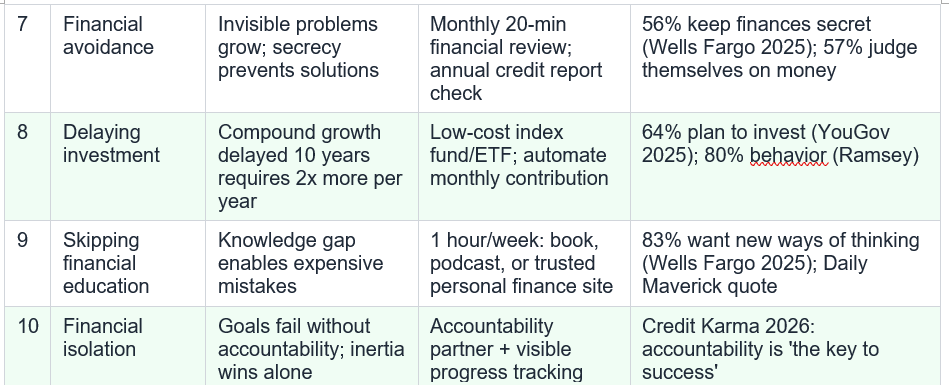
The 10 Behaviors and Their Fixes: Summary Table
Conclusion
None of the ten behaviors in this article require more income to address. They require different patterns — a budget instead of a feeling, an automated savings transfer instead of a manual intention, a 24-hour pause before an impulse purchase, a monthly statement review instead of a closed laptop. The Daily Maverick’s April 2026 financial wellbeing analysis put the principle most clearly: ‘You cannot control inflation, interest rates or global shocks, but you can control your habits.’The behaviors are the levers because they are the variables that compound. A saving behavior compounded over 20 years produces financial security. An impulse spending behavior compounded over the same period produces debt and regret. The financial outcome is not primarily the product of income — it is the product of what is done with the income, repeatedly, over time. Dave Ramsey’s 80/20 observation is not a reassurance; it is an empowerment. If financial outcomes are 80% behavioral, then behavioral change produces 80% of the improvement available to any individual. The knowledge in this article is the 20%. The actions — the budget built this weekend, the savings transfer automated on the next payday, the subscription audit done before next month — are the 80%. Not financial advice. Consult a qualified financial adviser for guidance specific to your situation.
Dave Ramsey (Yahoo Finance 2026): 'Personal finance is only 20% head knowledge. It's 80% behavior. It's our behaviors with money that can get us into the biggest trouble or lead us into the biggest successes.' Credit Karma 2026: 'The key to success and sticking to better financial habits is to not just set goals, but to build systems of accountability.' Daily Maverick April 2026: 'You cannot control inflation, interest rates or global shocks, but you can control your habits.' Sources cited.
Frequently Asked Questions
Why do so many people fail their financial goals every year?Beyond Finance's 2026 survey, reported by AOL, found that 83% of Americans failed some or all of their financial goals in 2025, with 38% abandoning within three months. NAIFA's financial resolutions analysis found that 64% gave up by the end of January. The primary mechanisms are not motivation failures — they are systems failures. Goals set without automated actions depend on willpower, which depletes. Goals set without accountability depend on self-reporting, which is unreliable. Credit Karma's 2026 survey identified the most actionable insight: 'The key to success and sticking to better financial habits in the new year is to not just set goals, but to build systems of accountability — whether that's with a partner, family member, or using a financial app.' Beyond Finance also noted that early financial habits formed in childhood have profound long-term consequences, suggesting for some that the goal abandonment pattern is deeply rooted. Sources: Beyond Finance/AOL 2026; NAIFA 2026; Credit Karma 2026.
Is financial success more about income or behavior?
The research and expert commentary consistently points to behavior as the dominant factor. Dave Ramsey, quoted in Yahoo Finance's 2026 coverage, stated: 'Personal finance is only 20% head knowledge. It's 80% behavior.' The Daily Maverick's April 2026 financial wellbeing analysis reached the same conclusion from different data: 'While incomes matter, habits may matter more.' The specific finding cited was from TransUnion research: 'The moment you're able to put in place the habits — saving regularly, tracking expenses, keeping debt manageable, developing a financial plan — you see a disproportional improvement in financial wellbeing.' This does not mean income is irrelevant — there are levels of income below which no amount of behavioral improvement can produce meaningful wealth accumulation. But above that level, the research consistently shows that behavioral differences account for most of the variation in financial outcomes between people with similar incomes. Sources: Yahoo Finance/Dave Ramsey 2026; Daily Maverick April 2026.
What is the most common financial regret Americans have?
Not saving enough money was the top financial regret among Americans in 2025, cited by 38% of respondents in Credit Karma's year-end survey reported by Yahoo Finance. The second context is impulse buying, which 34% of Americans identified as the top habit they want to break in 2026 (Credit Karma 2025). More broadly, 49% of Americans said their financial situation worsened in 2025, with the most common setback being unexpected expenses (28%) — which connects directly to the savings regret: without an emergency fund, unexpected expenses become financial crises. Credit Karma's survey also found that two-thirds (67%) said economic factors such as tariffs, cost of living, and inflation affected their spending habits in 2025 — but the top responses to these pressures (impulse spending, reduced savings, over-reliance on credit cards) were behavioral, not structural. Sources: Credit Karma survey 2025/2026; Yahoo Finance.
How does emotional spending affect financial outcomes?
Emotional spending — using purchases as a coping mechanism for stress, boredom, anxiety, or social pressure — is one of the most commonly identified drivers of financial difficulty. Credit Karma's 2026 survey found that 30% of Americans want to replace emotional spending with healthier coping strategies, and 34% identified impulse buying (which heavily overlaps with emotional spending) as the top habit they want to break. Rachel Cruze, quoted in Yahoo Finance's 2026 coverage, explains the psychological root: 'If you want to get to the root of why you behave the way you do — why you spend, save, use debt, put off investing and more — you've got to learn about how the psychology of money affects you.' The Wells Fargo Money Study 2025 found that money is deeply emotional for most Americans — 57% sometimes judge themselves based on their money, and 83% want new ways of thinking about it. Emotional spending typically produces short-term relief and long-term financial regret — one of the most consistent findings in behavioral finance. Sources: Credit Karma 2026; Wells Fargo Money Study 2025; Yahoo Finance/Rachel Cruze 2026.
What one financial behavior change has the biggest impact?
The research consistently points to consistent saving — specifically automating a savings transfer on payday — as the single behavioral change with the broadest positive impact. The Daily Maverick's April 2026 analysis cited this specifically: 'Saving regularly' was the first habit listed in the constellation that produces disproportional improvement in financial wellbeing. Not saving enough was the #1 financial regret among Americans in 2025 (38%, Credit Karma). The mechanism is clear: automatic savings on payday builds the emergency fund that prevents unexpected expenses from becoming debt crises; it builds the investment account that creates long-term wealth; and it builds the behavioral habit of living within income minus savings rather than on all available income. Credit Karma's 2026 framework specifically identifies automation as the key: 'Build a budget that lays out your expenses, and see how much room is available to set aside a certain amount of money for savings.' The amount is less important than the automation and the consistency. Sources: Credit Karma 2026; Daily Maverick April 2026; Yahoo Finance.
0 Comments
Be the first to share your thoughts on this article.