

Vehicles & Cars
5 Biggest Car Buying Mistakes to Avoid in UK & US

Table of Contents
- Why Car Buying Mistakes Are More Expensive Than Ever in 2026
- Why Car Buying Decisions Have Such Lasting Financial Consequences
- The True Cost of Car Ownership: What Buyers Miss Before Signing
- The 5 Biggest Car Buying Mistakes to Avoid in 2026
- UK Car Finance Types Explained: PCP vs HP vs Personal Loan vs Extended Term
- UK-Specific Car Buying Mistakes to Watch in 2026
- The Car Buying Checklist: What to Do Before, During, and After
- Before Visiting Any Dealership
- At the Dealership
- After Signing
- Conclusion
- Frequently Asked Questions (FAQ)
Why Car Buying Mistakes Are More Expensive Than Ever in 2026
Buying a car is, for most people, the second largest financial commitment they will make after purchasing a home. And yet the average car buyer spends less time researching the financial implications of a car purchase than they spend choosing a holiday. The result, in 2026, is a market in which the statistics are alarming: a record 19.3% of consumers who financed a new vehicle in Q2 2025 committed to a monthly payment of $1,000 or more -- nearly one in five buyers taking on what was once considered an extreme car payment, driven by high interest rates and rising vehicle prices (CBS News, citing Edmunds, August 2025).The average new vehicle transaction price in the US has reached approximately $49,000. In the UK, the average new car price exceeded £40,000 in 2025. Car finance is now the most common way to buy a car in the UK -- and one of the areas where mistakes are easiest to make and most expensive to live with. eLending Services (April 22, 2026): 'Dealership car financing mistakes cost American consumers billions of dollars every year.' The five mistakes in this guide are not obscure edge cases. They are the specific errors that car buyers make most frequently -- and that cost the most, both immediately and over the years of ownership that follow.
Mysafestcar.com (June 11, 2026): 'The most expensive car buying mistakes usually aren't dramatic -- they're small decisions that compound over time. Car buying mistakes start long before you sign the paperwork. They begin with small decisions that seem harmless in the showroom but quietly drain your wallet for years afterward.' This guide addresses each of the five most costly mistakes, explains exactly why they are so common, provides the 2026 UK and US data that quantifies their cost, and gives the specific actions that prevent each one.
Why Car Buying Decisions Have Such Lasting Financial Consequences
The financial consequences of car buying decisions are unusually persistent because of three structural features of the transaction that work against the buyer. The first is the duration of the commitment: a 48-month or 60-month finance agreement commits the buyer to a payment schedule that runs almost as long as a standard undergraduate degree. The second is the combination of multiple financial decisions that are presented simultaneously in the dealership environment -- vehicle price, trade-in value, finance product, interest rate, add-on products -- each of which represents an independent negotiation in which the dealer has significant information and experience advantages. The third is depreciation: unlike property, a car's value decreases from the moment of purchase, creating the possibility of negative equity -- owing more on the vehicle than it is worth -- that then constrains subsequent financial decisions.CBS News (citing Edmunds, August 2025): '28.2% of trade-ins in July 2025 involved negative equity, and the average amount buyers owed above the vehicle's value was $6,902. That sets the stage for a vicious cycle, especially if buyers trade cars frequently or face unexpected job loss or repair costs.' This figure -- nearly three in ten trade-ins being underwater -- is a direct consequence of the financial mistakes described in this guide: buying more car than the budget can support; focusing on monthly payment rather than total cost; and taking too-long finance terms that guarantee the debt exceeds the value for much of the loan period. The guide below addresses the most common and most costly of these decisions.
Car buying in 2026 -- the cost of common mistakes: 19.3% of new US car buyers paying $1,000+/month. 28.2% of trade-ins in negative equity. Average amount owed above vehicle value: $6,902. — CBS News/Edmunds (August 28, 2025): 'A record 19.3% of consumers who financed a new vehicle in Q2 2025 committed to a monthly payment of $1,000 or more. Average new vehicle transaction price approximately $49,000.' Edmunds: '28.2% of trade-ins in July 2025 involved negative equity; average amount owed above vehicle value = $6,902.' eLending Services (April 22, 2026 -- most current): 'Dealer interest rates average 1-2 percentage points higher than bank or credit union offers. Buyers who negotiate only on monthly payment can overpay by $3,000 or more.' AAA/Mysafestcar.com (June 11, 2026): 'Average annual cost of owning and operating a new vehicle exceeds $12,000.'
The True Cost of Car Ownership: What Buyers Miss Before Signing
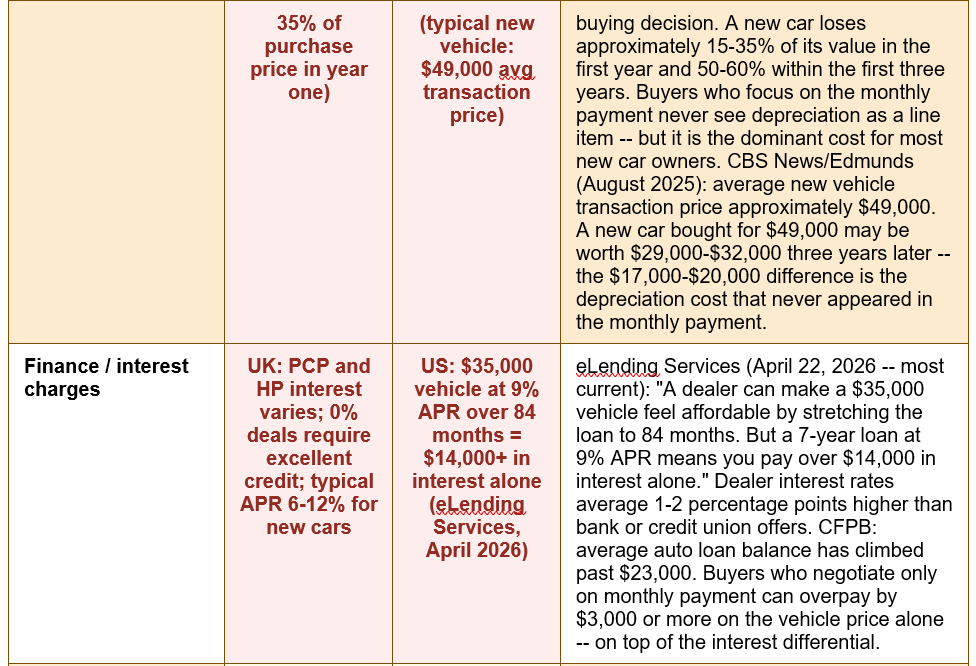
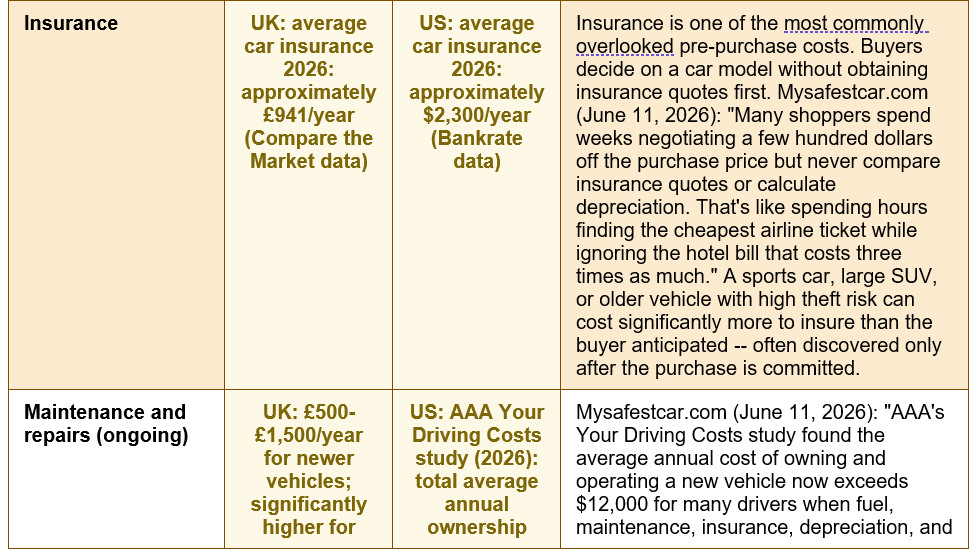
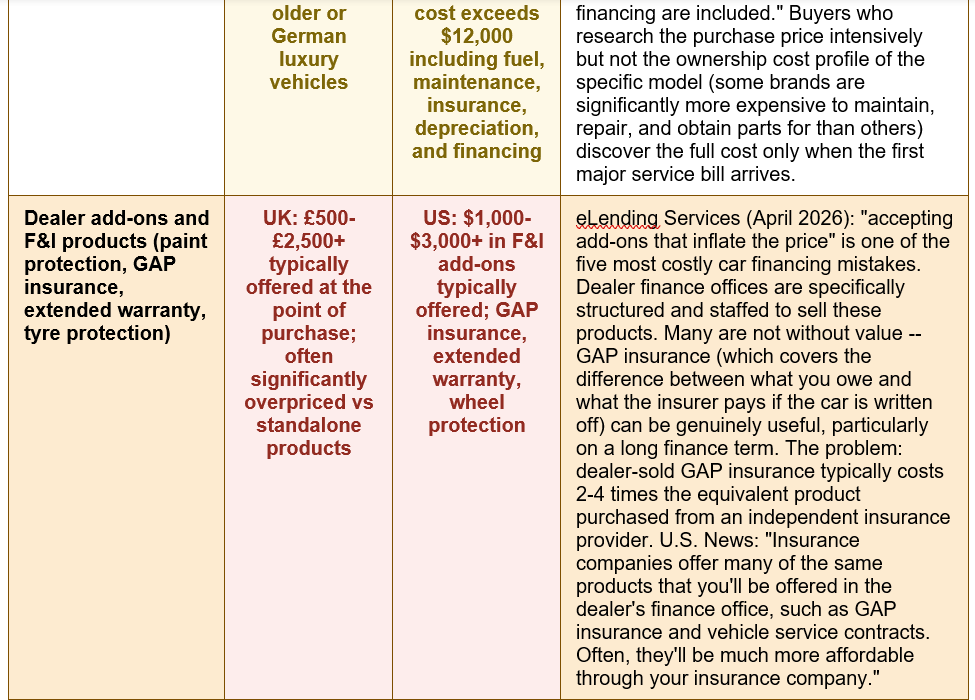
Before examining the five specific mistakes, it is important to establish what a car actually costs beyond the purchase price or monthly payment. Most buyers research the sticker price exhaustively but ignore the costs that will accumulate over the years of ownership:
The 5 Biggest Car Buying Mistakes to Avoid in 2026
MISTAKE #1: Negotiating on Monthly Payment Instead of Total Price | The single most exploited car buying mistake
This is the most consistently documented and most exploited car buying error in both the UK and the US -- and it operates on a simple psychological mechanism: a large total cost feels smaller when divided into monthly payments. eLending Services (April 22, 2026): 'Fixating on the monthly payment is the single most exploited dealership car financing mistake. It allows dealers to extend loan terms, raise interest rates, or roll in extras -- all while keeping the monthly number low and your total cost sky-high. A dealer can make a $35,000 vehicle feel affordable by stretching the loan to 84 months. But a 7-year loan at 9% APR means you pay over $14,000 in interest alone.' Here is precisely how the monthly payment trap works in practice: the buyer tells the salesperson their target monthly payment. The salesperson now has a target they can work with -- and the entire deal is structured around keeping that monthly number within range while maximising profit through vehicle price, interest rate, loan term, and add-ons. Each of these levers can be adjusted to produce the target monthly figure while increasing total cost significantly. The buyer, focused on the monthly number, never sees the full picture. The correct approach: CBS News/Edmunds (August 2025): 'Agree on the vehicle price first, then discuss financing separately. Never reveal your target monthly payment to a sales manager. Once they know that number, the entire deal is structured around it -- not around your best interest.' The negotiation sequence matters: agree on the OTR (on-the-road price UK) or out-the-door price (US) first, with no mention of monthly payment or financing. Once the vehicle price is agreed, separately negotiate the financing. Compare the dealer's financing offer against your pre-approved bank or credit union rate. The monthly payment that results from a properly negotiated deal is the right monthly payment -- not the starting point for the negotiation. UK specific: the same principle applies to PCP deals, where the monthly payment is the headline figure and the balloon payment, total amount payable, and mileage restrictions are buried in the small print. The monthly payment is the least important number in a PCP agreement.MISTAKE #2: Skipping Finance Pre-Approval Before Visiting the Dealership | Arriving without a competing offer is the most avoidable negotiating disadvantage
Walking into a dealership without a pre-approved finance offer from a bank, credit union, or online lender is the equivalent of going to a salary negotiation without knowing your market rate. You have no benchmark against which to evaluate the dealer's offer, no alternative to compare it to, and no credible ability to walk away from a bad rate. CBS News/Edmunds (August 2025): 'One of the most costly and common mistakes car buyers make is waiting until they're sitting in the dealership finance office to think about a loan. Dealerships may offer convenience, but their financing may include marked-up interest rates or hidden fees. Instead, walk into the dealership with a preapproved loan offer from your bank, credit union or an online lender. According to the Consumer Financial Protection Bureau, this move can save buyers hundreds to thousands of dollars over the life of the loan. When you do this, the dealer can still try to beat the rate -- and sometimes will. But now you're negotiating from a position of strength, not desperation.' eLending Services (April 2026): dealer interest rates average 1-2 percentage points higher than bank or credit union offers. On a $25,000 loan over 60 months, a 2-percentage-point rate difference costs approximately $1,400 in additional interest. On a $40,000 loan over 72 months, the same differential costs over $2,800. The pre-approval process is straightforward: check your credit score before applying; apply for pre-approval from your bank, a credit union, and at least one online lender; compare the rates offered; take the best pre-approval letter to the dealership. The dealer then has the opportunity to beat the rate -- if they can, excellent. If they cannot, you use your pre-approved loan. UK specific: the FCA regulated hire purchase and PCP market means dealers must conduct creditworthiness assessments, but this does not prevent them from offering higher rates than those available elsewhere. Comparison sites (MoneySupermarket, Confused.com) and direct applications to banks and credit unions allow UK buyers to obtain comparison rates before visiting any dealership.MISTAKE #3: Ignoring the Total Cost of Ownership -- Buying the Car, Not the Cost | The mistake that makes the monthly payment feel manageable until the first insurance or repair bill
Most buyers calculate whether they can afford the monthly payment. Very few calculate whether they can afford the car. These are not the same question. Mysafestcar.com (June 11, 2026): 'According to AAA's Your Driving Costs study, the average annual cost of owning and operating a new vehicle now exceeds $12,000 for many drivers when fuel, maintenance, insurance, depreciation, and financing are included.' The monthly payment covers only the finance element. The annual ownership cost covers fuel, insurance, servicing, MOT (UK), tyres, road tax (UK VED), parking, and depreciation -- none of which appear on the monthly payment schedule. Buyers who focus exclusively on the monthly payment regularly discover that the total cost of ownership is significantly beyond what their budget can support. The specific ownership costs most commonly underestimated or ignored entirely: insurance is routinely underestimated. A sports car, large SUV, high-performance model, or vehicle in a high-theft category can cost dramatically more to insure than a standard hatchback or saloon. The time to discover this is before purchasing, not after. Running costs vary significantly by fuel type and engine specification. A petrol SUV with a large engine will cost significantly more to fuel than an equivalent electric or hybrid model over a 3-year ownership period. Maintenance and repair costs vary enormously by manufacturer. German luxury brands typically cost significantly more to service and repair than equivalent Japanese or Korean vehicles. Parts availability, labour rates, and service interval costs all differ. The UK MOT, vehicle excise duty, and annual service costs should all be factored into total cost of ownership before purchase. CBS News: 'There is a difference between being able to buy something and being able to afford it wisely.' The practical calculation before any car purchase: total monthly finance payment + insurance / 12 + fuel / 12 + servicing / 12 + depreciation / 12 = true monthly cost of the car. If this total exceeds 20% of monthly net income, the car is not within budget regardless of what the monthly finance payment alone suggests.MISTAKE #4: Not Checking the Car's History Before Purchase | The mistake that turns a bargain into an expensive problem
Used car purchases carry financial risks that new car purchases do not -- specifically, the risk that the vehicle's history conceals problems the seller has not disclosed: outstanding finance (meaning the car legally belongs to the finance company, not the seller, and can be repossessed even after you buy it); previous write-off or accident damage; mileage discrepancies (clocked mileage); or stolen vehicle history. TopCarCheck UK (November 2025): 'Several buyers discovered they had financed vehicles with write-off markers, mileage discrepancies, or outstanding finance. A simple history check would have revealed these issues instantly.' In the UK, a comprehensive vehicle history check (HPI, Carfax equivalent, or equivalent provider) costs approximately £10-£25 and provides data from the DVLA, finance houses, police stolen vehicle registers, and insurance write-off databases. The check is not optional for any used car purchase -- it is the minimum due diligence that protects against potentially costly legal and mechanical problems. US equivalent: a Carfax or AutoCheck report (typically $25-$40) provides similar vehicle history data from state DMV records, insurance company data, and reported accident history. Online-only purchases and private sales present the highest risk of undisclosed history issues. Buyers who purchase a car with outstanding finance may find the finance company has the right to repossess the vehicle regardless of what the buyer paid the seller -- this risk is entirely preventable by completing a history check before purchase. Additional checks worth making before any used car purchase: independent pre-purchase inspection (a mechanic checks the vehicle for mechanical issues the visual inspection and test drive may not reveal; typically costs £50-£150 UK / $100-$200 US); test drive in various conditions; visual inspection for accident damage repair (inconsistent panel gaps, overspray on seals, mismatched paint sheen); and service history documentation (full manufacturer service history significantly affects residual value and provides evidence of maintenance).MISTAKE #5: Accepting Dealer Add-Ons Without Independent Comparison | Where hundreds to thousands are added at the point of maximum emotional commitment
The finance office is the final stage of the dealership sales process -- and it is the stage specifically designed to extract additional profit through add-on products presented at the moment of highest emotional commitment (the deal is almost done, the car is almost yours). eLending Services (April 22, 2026): 'Accepting add-ons that inflate the price' is one of the five most costly financing mistakes. The add-on products most commonly offered in UK and US dealerships: GAP insurance (Guaranteed Asset Protection) -- covers the difference between what your insurer pays on a total loss claim and what you still owe on your finance agreement. Genuinely useful, particularly on long-term PCP or finance agreements where negative equity is likely. The mistake: paying £200-£400 (UK) or $400-$800 (US) for dealer-sold GAP insurance when the same product is available from standalone insurers or your existing insurer for £50-£150 (UK) or $100-$250 (US). Paint and fabric protection -- a chemical treatment applied to the car's paint and interior surfaces. Typically costs £200-£500 at the dealer; available as a DIY product or professional treatment from a detailing company for a fraction of the price. Extended warranty -- covers repairs beyond the manufacturer's warranty period. Not without value, but the dealer's extended warranty is rarely the best-priced option. Standalone vehicle warranty providers (Warrantywise, Autoprotect UK; third-party warranty providers US) and manufacturer-backed extended warranties (applied before the standard warranty expires) typically offer better value. Tyre and alloy wheel protection -- covers damage to tyres and alloys. Review carefully: many policies have exclusions that limit their usefulness. The correct approach: note every add-on offered and its price. Do not agree or decline in the dealership. Research each product independently and compare prices before the next visit or before completing the online signing process. U.S. News (August 2025): 'Insurance companies offer many of the same products that you'll be offered in the dealer's finance office, such as GAP insurance and vehicle service contracts. Often, they'll be much more affordable through your insurance company's products, but you should always compare the specifics of each product to ensure its value.'UK Car Finance Types Explained: PCP vs HP vs Personal Loan vs Extended Term
The following table maps the four most common car finance structures, their key risks, and when each is and is not appropriate -- including the 2026 context from UK and US sources: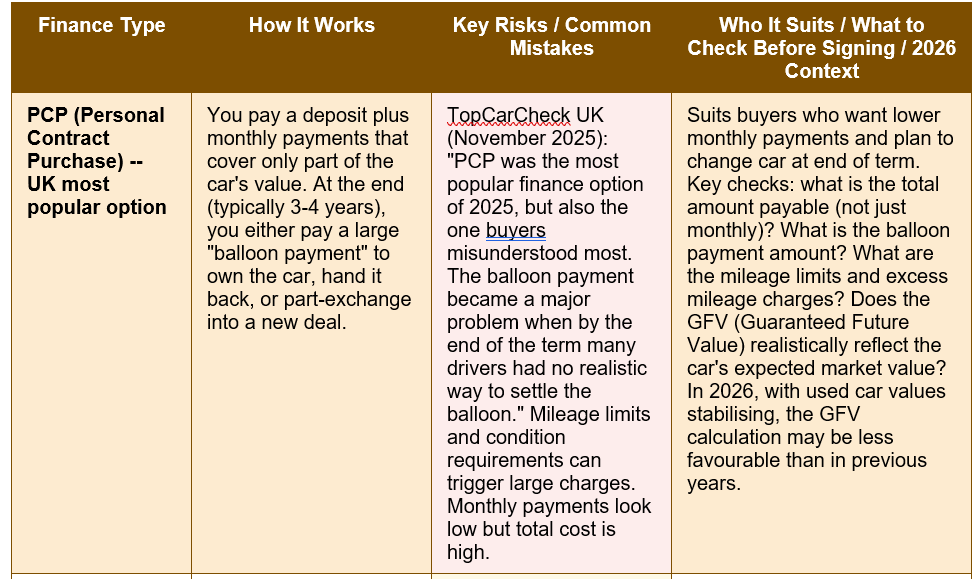
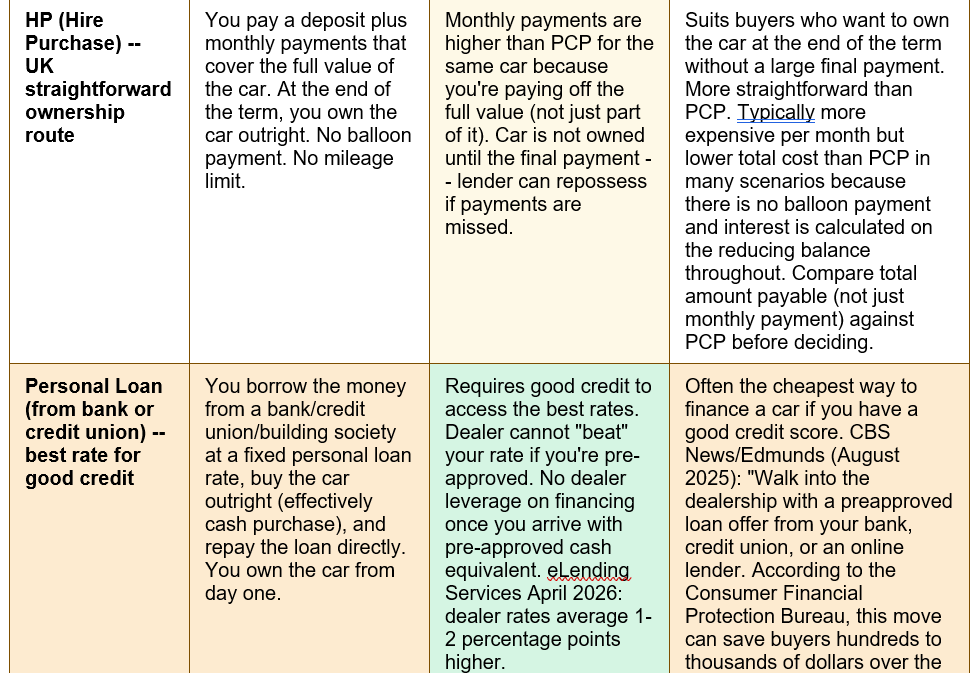
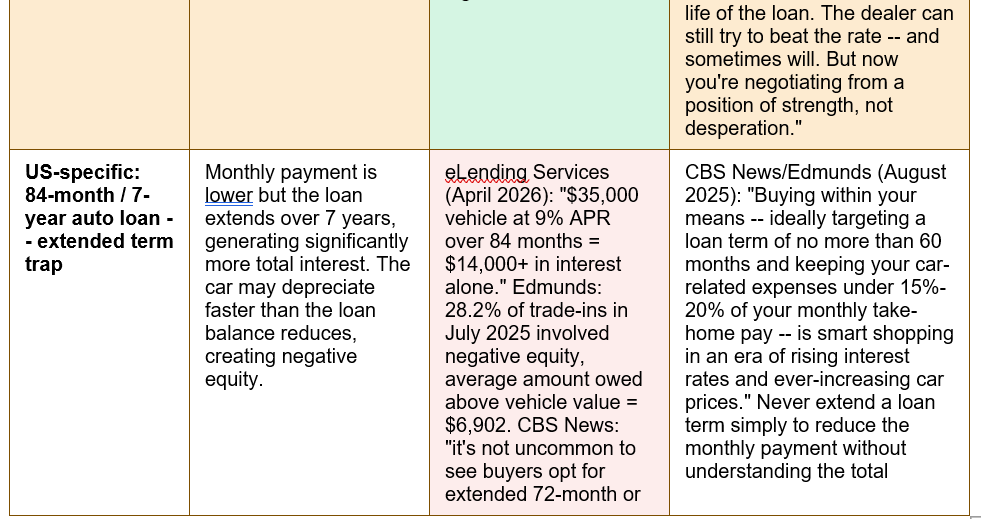

UK-Specific Car Buying Mistakes to Watch in 2026
Several car buying mistakes are particularly prevalent in the UK market in 2026, reflecting specific features of the UK consumer car finance landscape:- 1. Not understanding the PCP balloon payment before signing: TopCarCheck UK (November 2025): 'PCP was the most popular finance option of 2025, but also the one buyers misunderstood most. The balloon payment became a major problem when, by the end of the term, many drivers had no realistic way to settle the balloon.' The Guaranteed Future Value (GFV) -- the lump sum due at the end of the PCP term if you want to keep the car -- is not always prominently presented at the point of signing. Buyers who focus on the monthly payment without understanding the GFV may find themselves committed to a large lump sum that is not budgeted for. Always identify the GFV as a specific pound amount before signing any PCP agreement, and plan specifically for one of the three exit options: pay the GFV, hand the car back, or part-exchange into a new deal.
- 2. Exceeding PCP mileage allowances and condition requirements: PCP agreements typically include an annual mileage limit (commonly 8,000, 10,000, or 12,000 miles per year). Exceeding this limit triggers excess mileage charges (typically 6p-15p per excess mile). A buyer who underestimates their annual mileage by 5,000 miles per year on a 3-year PCP pays up to £2,250 in excess mileage charges at the end of the agreement. Condition standards (fair wear and tear vs damage that attracts charges) are another area where buyers are surprised at handback. Understand these requirements before signing, not when handing the car back.
- 3. Not shopping for car insurance before completing the purchase: Insurance costs vary dramatically between models and can make an otherwise affordable car unaffordable to run. Always obtain insurance quotes (including fully comprehensive cover) for the specific vehicle you intend to purchase before completing the deal. Insurance costs also vary by postcode, age, occupation, and claims history in ways that are impossible to predict without a specific quote.
- 4. Ignoring the FCA's Consumer Duty and your rights on car finance: Since July 2023, the FCA's Consumer Duty requires car finance providers to ensure products offer fair value to consumers. The Supreme Court ruling on discretionary commission arrangements (DCAs) in late 2024 opened a significant mis-selling window for consumers who took out car finance agreements where the lender paid the dealer a commission without disclosure. Buyers who took out PCP or HP agreements before January 2021 may be entitled to redress. Citizens Advice (0800 144 8848) or the Financial Ombudsman Service can provide guidance on whether a complaint is appropriate.
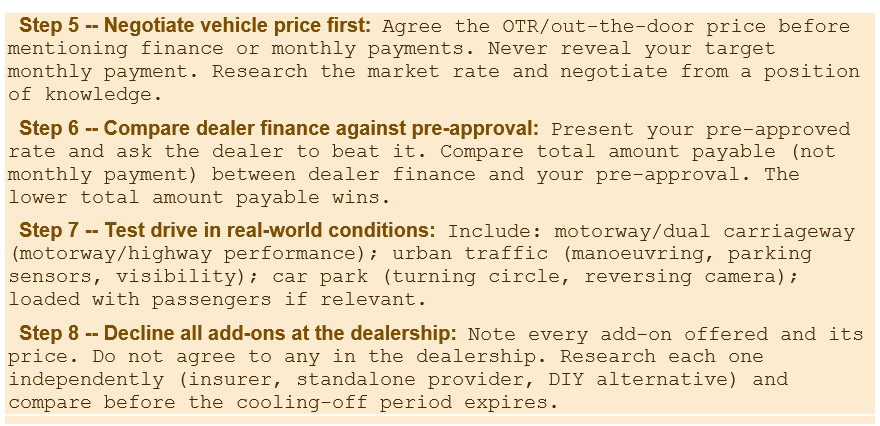
The negotiation sequence every car buyer should follow: before entering any dealership. (1) Set your total budget including all ownership costs (finance + insurance + fuel + servicing + depreciation/year), not just the monthly payment. (2) Obtain a pre-approved finance offer from your bank or credit union before visiting any dealership. This is your benchmark rate. (3) Research the car's market value (AutoTrader UK; Cars.com/Edmunds US) so you know whether the asking price is fair. (4) Obtain a vehicle history check for any used car before negotiating seriously. (5) In the dealership: agree on the vehicle price first, without mentioning monthly payment targets or finance plans. Only after the vehicle price is agreed should financing be discussed. (6) In the finance office: note every add-on product and its price. Research each independently before agreeing. Decline all add-ons at the point of signing and follow up within the cooling-off period (UK: 14 days on distance finance) if any prove good value after comparison. (7) Never be pressured by time-limited offers, 'the car has another buyer interested', or 'this rate is only available today.' Genuine deals do not disappear overnight. Walk away from any dealership that applies high-pressure tactics.
The Car Buying Checklist: What to Do Before, During, and After
Before Visiting Any Dealership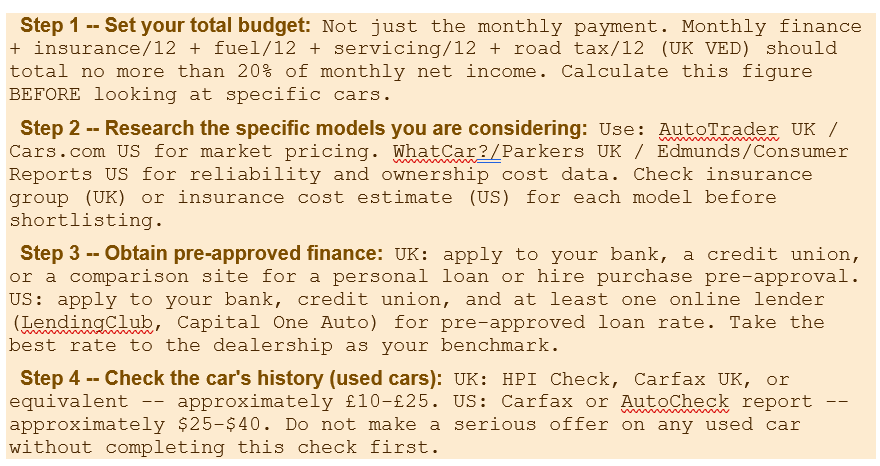
At the Dealership
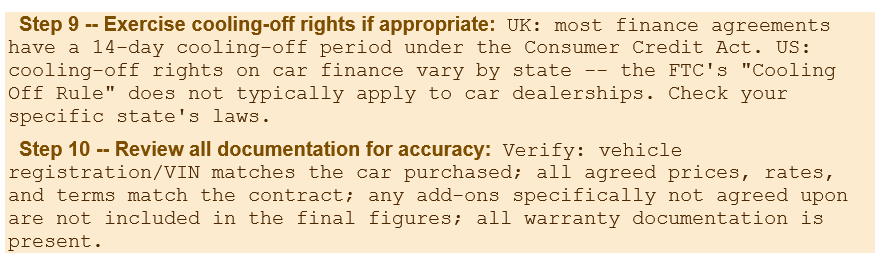
THE FIVE NUMBERS EVERY CAR BUYER MUST KNOW BEFORE SIGNING: (1) THE TOTAL AMOUNT PAYABLE (not the monthly payment): every penny you will pay for the car including all interest and fees. This is the real price of the car. (2) THE ANNUAL PERCENTAGE RATE (APR): the true annual cost of the finance expressed as a percentage. Lower is better. Compare this against your pre-approved rate from a bank or credit union. (3) THE GUARANTEED FUTURE VALUE (UK PCP): the balloon payment due at the end of the PCP term if you want to keep the car. This is not optional -- you need a specific plan for how to handle it before signing. (4) THE TOTAL COST OF OWNERSHIP: monthly finance + insurance + fuel + servicing + depreciation / month. This is the true monthly cost. Keep it under 20% of net monthly income. (5) THE VEHICLE HISTORY CHECK RESULT: for any used car, never sign without a completed history check confirming no outstanding finance, no write-off markers, and no mileage discrepancies.
FIVE THINGS DEALERS WILL SAY AND WHAT THEY ACTUALLY MEAN: (1) 'WHAT MONTHLY PAYMENT ARE YOU LOOKING TO HIT?' This question is not asked to be helpful. It is asked to anchor the entire deal to a monthly figure that the dealer will then structure to maximise profit. The correct response: 'I'm not focused on the monthly payment -- I want to agree the vehicle price first.' Never answer this question with a specific number. (2) 'THIS RATE IS ONLY AVAILABLE TODAY / WE HAVE ANOTHER BUYER INTERESTED.' Time pressure and scarcity tactics are the two most commonly used pressure techniques in car sales. Genuine deals do not disappear overnight. Walk away from any offer presented with artificial urgency. (3) 'THE PAINT PROTECTION/GAP INSURANCE IS ALREADY INSTALLED/INCLUDED IN THE PRICE.' Add-ons described as already applied or automatically included are still negotiable. Nothing in a car deal is fixed until the contract is signed. (4) 'WE COULD ONLY GET YOU APPROVED AT THIS RATE.' Dealers earn finance commission from lenders. The rate they present may not be the best rate for which you qualify. This is precisely why you need a pre-approved rate from a bank or credit union before entering the dealership. eLending Services (April 2026): dealer rates average 1-2 percentage points higher than bank or credit union offers. (5) 'YOUR TRADE-IN IS WORTH £/$ X -- BUT WE'LL GIVE YOU THAT TOWARDS THE NEW CAR.' Trade-in value and new car price are two separate negotiations and should be treated as such. Get your trade-in valued by multiple sources (WeBuyAnyCar UK; CarGurus US; AutoTrader UK; private sale estimate) before entering any conversation about a trade-in. Dealers frequently offer above-market trade-in values while increasing the new car price to compensate.
Conclusion
Car buying mistakes are expensive, persistent, and -- with the right preparation -- entirely avoidable. The five mistakes in this guide are not rare or complex errors. They are the specific decisions that car buyers make most frequently, often without realising the financial implications until years into a finance agreement. Negotiating on monthly payment rather than total price; arriving at the dealership without pre-approved finance; ignoring the true total cost of ownership; failing to check a used car's history before purchase; and accepting dealer add-ons without independent comparison: each of these individually costs hundreds to thousands. Together, they can define the financial experience of car ownership for three, five, or even seven years.eLending Services (April 22, 2026): 'Dealership car financing mistakes cost American consumers billions of dollars every year.' CBS News/Edmunds (August 2025): 'A record 19.3% of consumers who financed a new vehicle in Q2 2025 committed to a monthly payment of $1,000 or more.' Edmunds: '28.2% of trade-ins in July 2025 involved negative equity.' These statistics are not the product of complex financial mismanagement. They are the result of specific, preventable decisions made at the dealership. The checklist in this guide -- total budget calculation, finance pre-approval, market price research, history check, vehicle price negotiation first, add-on research independently -- takes hours before the dealership visit and saves thousands over the finance term.
Mysafestcar.com (June 11, 2026): 'Spending just a few extra hours comparing prices, financing, and vehicle history can save thousands of dollars over five years. The smartest purchase decisions usually happen before the keys ever change hands.' The car you buy in 2026 will define your transport costs for years. The preparation you complete before you buy it defines how much that costs.
Frequently Asked Questions (FAQ)
What is the biggest mistake people make when buying a car?The single most consistently documented car buying mistake is negotiating on monthly payment rather than on total vehicle price and total finance cost. eLending Services (April 22, 2026): 'Fixating on the monthly payment is the single most exploited dealership car financing mistake. It allows dealers to extend loan terms, raise interest rates, or roll in extras -- all while keeping the monthly number low and your total cost sky-high.' The mechanism: when a buyer reveals their target monthly payment, the dealer structures the entire deal -- vehicle price, finance term, interest rate, and add-ons -- around producing that monthly number while maximising profit. A $35,000 vehicle financed over 84 months at 9% APR produces a lower monthly payment than the same vehicle over 60 months, but costs over $14,000 in interest over the loan term (eLending Services, April 2026). Buyers who focus on the monthly payment never see the full interest cost. The correct approach: agree on the out-the-door price (US) or OTR price (UK) first, then discuss financing separately, with a pre-approved rate from a bank or credit union as the benchmark against which the dealer's rate is compared. This transforms the financing from a separate profit centre into a competitive benchmark that may actually benefit the buyer.
How can I avoid paying too much interest on a car loan?
The most effective single action for avoiding overpayment on car finance interest is obtaining a pre-approved loan from a bank, credit union, or online lender before visiting any dealership. CBS News/Edmunds (August 2025): 'According to the Consumer Financial Protection Bureau, this move can save buyers hundreds to thousands of dollars over the life of the loan.' eLending Services (April 22, 2026): 'Dealer interest rates average 1-2 percentage points higher than bank or credit union offers.' On a typical car loan of $20,000-$30,000 over 48-60 months, a 2-percentage-point rate difference represents $800-$2,000 in additional interest cost. Additional steps to minimise interest: check and if possible improve your credit score before applying for finance (a higher credit score qualifies for lower interest rates); compare rates from multiple lenders before taking the best rate to the dealership; minimise the loan term to the shortest period your budget allows (shorter terms mean less total interest even if the monthly payment is higher); and make a larger deposit where possible, as this reduces the borrowed amount and therefore the total interest charged. UK specific: for PCP and HP finance, compare the flat rate (used to calculate monthly payments) and the APR (which reflects the true annual cost including compound interest) across multiple finance providers. The APR is the number to compare, not the flat rate.
What should I check when buying a used car?
Buying a used car requires a systematic series of checks that protect against both financial and mechanical risk. The essential checks before any used car purchase: (1) Vehicle history check: UK: HPI Check, Carfax UK, or equivalent (approximately £10-£25); confirms no outstanding finance (critical: if the previous owner has an outstanding finance agreement, the finance company may have the right to repossess the vehicle even after you have bought it), no recorded write-off markers, no mileage discrepancy, and no stolen vehicle marker. US: Carfax or AutoCheck (approximately $25-$40); provides similar protection. TopCarCheck UK (November 2025): 'Several buyers discovered they had financed vehicles with write-off markers, mileage discrepancies, or outstanding finance. A simple history check would have revealed these issues instantly.' (2) Pre-purchase independent inspection: a mechanic inspects the vehicle for mechanical issues that are not visible to the untrained eye. Typically costs £50-£150 UK / $100-$200 US and can reveal issues worth far more than the inspection cost. (3) Service history verification: full manufacturer service history (stamps in the service book and corresponding receipts) significantly affects residual value and provides evidence of proper maintenance. (4) Visual inspection: check for inconsistent panel gaps, overspray (paint on rubber seals or trim, indicating accident repair), mismatched paint sheen between panels, and any evidence of structural repair. (5) Test drive: include manoeuvring at low speed, higher-speed driving, and hard braking. Listen for unusual noises. Check all electronics, heating, air conditioning, and driver assistance systems.
Is PCP a good idea for buying a car in the UK in 2026?
PCP (Personal Contract Purchase) can be a financially sound product for the right buyer in the right circumstances, but it is also the most commonly misunderstood car finance product in the UK market. TopCarCheck UK (November 2025): 'PCP was the most popular finance option of 2025, but also the one buyers misunderstood most. The balloon payment became a major problem when, by the end of the term, many drivers had no realistic way to settle the balloon.' PCP is potentially appropriate if: you want lower monthly payments than HP on the same car; you genuinely intend to change the car at the end of the term (making the balloon payment irrelevant as you hand the car back or part-exchange); your planned annual mileage fits within the PCP mileage allowance (exceeding it incurs charges); and you want to benefit from the Guaranteed Future Value protection (if the car is worth less than the GFV at the end of the term, the finance company absorbs the difference). PCP is not appropriate if: you want to own the car at the end and do not have a plan for the balloon payment; you consistently drive more than the mileage allowance; the total amount payable (not the monthly payment) is significantly higher than the equivalent HP or personal loan total cost; or you are likely to need to exit the finance agreement early (ending a PCP early typically involves significant early settlement charges). Before signing any PCP agreement: know the exact GFV amount; know the annual mileage limit and excess mileage charge per mile; compare the total amount payable against HP and personal loan alternatives; and have a specific plan for what you will do at the end of the term.
What dealer add-ons should I avoid when buying a car?
Dealer add-ons are not inherently bad products -- some provide genuine value. The problem is the price at which they are offered in the dealer's finance office, which is typically significantly above the equivalent product available independently. The products to research independently before agreeing in the dealership: GAP insurance: covers the difference between the insurer's total loss payment and the outstanding finance balance. Genuinely useful on a PCP or HP agreement, particularly in the early years when the outstanding balance typically exceeds the vehicle's market value. However, dealer-sold GAP insurance typically costs 2-4 times the equivalent product from a standalone GAP insurer (e.g. GAPinsPurchase, Nationwide Vehicle Contracts UK). U.S. News: 'Insurance companies offer many of the same products that you'll be offered in the dealer's finance office. Often, they'll be much more affordable through your insurance company's products.' Paint and fabric protection: professional paint protection and fabric treatment is available from detailing companies and as DIY products at a fraction of the dealer price. The dealer margin on this product is typically very high. Extended warranty: dealer-sold extended warranties can be overpriced relative to standalone extended warranty providers (Warrantywise, Autoprotect UK; third-party US providers). Compare the specific coverage, exclusions, and claim process before comparing price. Tyre and alloy wheel protection: check the specific exclusions carefully (many policies exclude kerb damage, which is the most common cause of alloy wheel damage). The correct approach: note every add-on and its price during the dealership visit. Decline all add-ons at signing. Research each one independently and take advantage of any cooling-off period on the finance agreement to add any that prove genuinely good value after comparison.

0 Comments Comments