

Investing
5 Wealth-Building Stocks to Buy With an Inheritance

In this article, I examine how baby boomers are set to pass $124 trillion to their children over the next two decades. When that money lands, 60% of recipients plan to invest at least part of it. But which stocks are actually built for generational wealth — the kind that doesn’t just grow your own retirement, but leaves something substantial for the generation that comes after? A 2026 study by Arizona State University professor Hendrik Bessembinder tracked nearly 30,000 stocks over 100 years and found that just 46 companies account for half of all US stock market wealth creation since 1926. From that list, Kiplinger (September 17, 2026) identified five that have both the history and the structural advantages to keep creating wealth for decades to come, the greatest wealth wealth transfer in humab race. This article examines all five. This isn't a financial advice, please consult with your financial advisor for any investment decision.
The data on what inheritors actually do is illuminating. A Citizens Bank survey of 1,500 US adults found that 60% would invest at least part of an inheritance. In a Morning Consult survey commissioned by Kiplinger for their Trillion Dollar Talk campaign (September 2026), 15% of adult children said they’d use an inheritance specifically to ‘invest and grow wealth’ — the third most popular answer after providing for the family and investing in a home. As one survey respondent told Morning Consult/Kiplinger, they’d put an inheritance from their parents ‘into investments,’ since ‘that’s what pretty much helped them earn it in the first place.’
The stocks in this article are drawn from a specific, rigorous framework: they are among the 46 companies that account for half of all US stock market wealth creation since 1926, identified by Hendrik Bessembinder in a 2026 study for Arizona State University, and selected by Kiplinger’s Kyle Woodley (September 17, 2026) specifically for their potential to continue building generational wealth. Not financial advice.
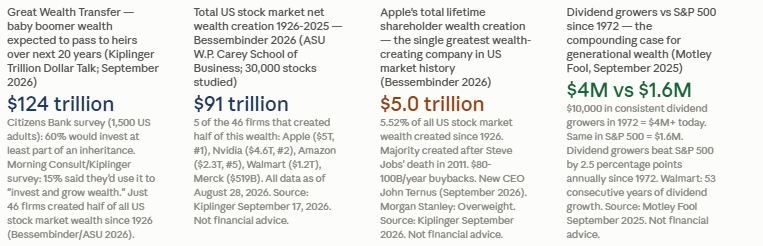
The Great Wealth Transfer: $124 trillion expected to pass from baby boomers and older generations to heirs over the next 20 years (Kiplinger Trillion Dollar Talk; September 2026). Citizens Bank survey (1,500 US adults): 60% would invest at least part of an inheritance. Morning Consult/Kiplinger survey: 15% would 'invest and grow wealth' with an inheritance. Bessembinder 2026 (ASU): just 46 firms account for half of the $91 trillion in US stock market net wealth creation 1926-2025. Source: Kiplinger September 17, 2026.
The central finding is striking: wealth creation within the stock market is massively concentrated. ‘Just 46 firms account for half of the $91 trillion in net wealth creation over the full century,’ Bessembinder found. In Kiplinger’s analysis (via Dan Burrows): ‘T-bills are a kind of stand-in for opportunity cost. And the difference [in performance] over time between the two investment choices, when positive, is wealth creation. It’s the enhancement.’ Wealth creation in this framework is not just total return — it is the excess return over what a completely risk-free asset would have produced.
This framework is particularly powerful for inheritance investing, because it filters away the thousands of stocks that, over a century, either produced less than Treasury bills or simply failed entirely. The five stocks discussed in this article are not just large companies — they are members of the tiny group that has demonstrably created more wealth for shareholders than any other companies in US market history. That does not guarantee future performance, but it provides a more rigorous starting point than most stock selection frameworks. Not financial advice.
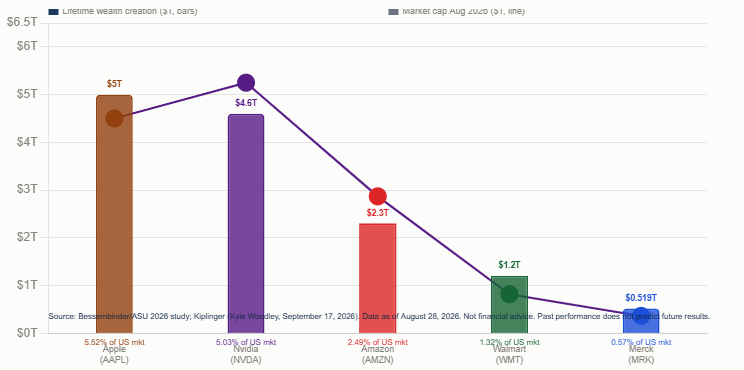
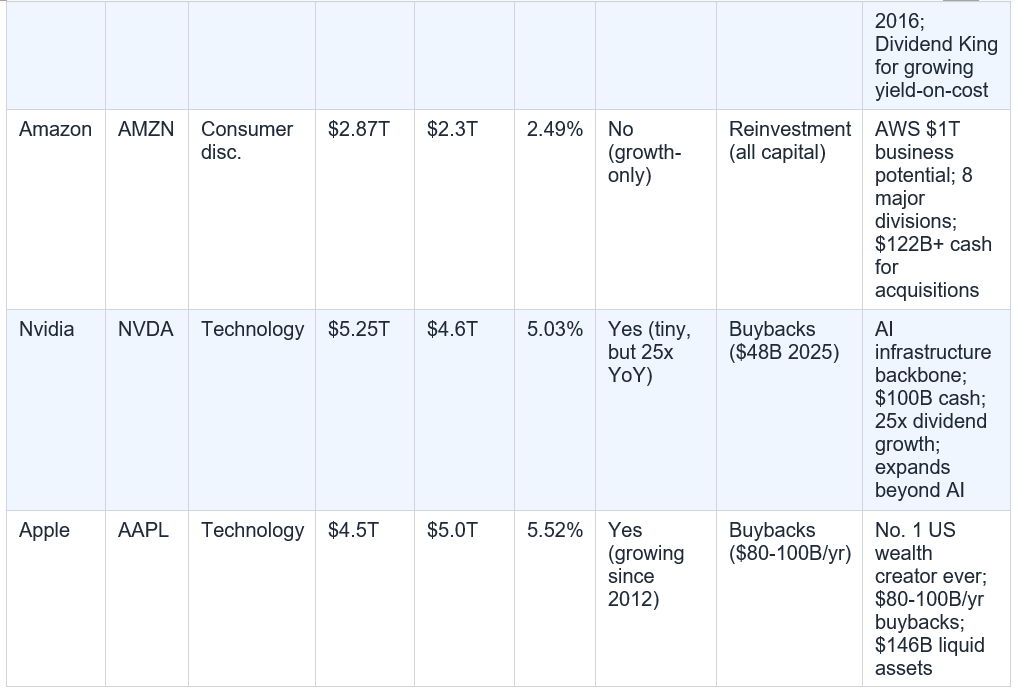
Bessembinder 2026 (ASU W.P. Carey School of Business): studied nearly 30,000 US stocks, 1926-2025, 100 years. Total US stock market net wealth creation: $91 trillion. Concentration: just 46 firms account for half ($45.5 trillion). Wealth creation metric: Shareholder Wealth Creation (SWC) = return vs Treasury bill benchmark (not just total return). The five stocks covered: Apple (No. 1, $5.0T, 5.52% of total); Nvidia (No. 2, $4.6T, 5.03%); Amazon (No. 5, $2.3T, 2.49%); Walmart ($1.2T, 1.32%); Merck ($519.1B, 0.57%). Source: Kiplinger September 17, 2026 citing Bessembinder 2026 / ASU.
The five represent a cross-section of sectors and wealth-creation mechanisms: a healthcare giant (Merck) with a 150-year history and a patent moat; the world’s largest retailer (Walmart) that has survived every retail disruption since 1972; the world’s largest online retailer and cloud provider (Amazon); the backbone of the global AI infrastructure build-out (Nvidia); and the greatest wealth-creating company in the history of the US stock market (Apple). Together they span consumer staples, consumer discretionary, healthcare, and technology.
Companies that consistently raise dividends have crushed the S&P 500 by 2.5 percentage points annually since 1972. $10,000 invested in consistent dividend growers in 1972 would be worth over $4 million today, versus $1.6 million in the S&P 500 (Motley Fool, September 2025). Two of the five (Walmart and Merck) are dividend growers; three (Amazon, Nvidia, Apple) return capital primarily through buybacks. This diversity reflects the multiple paths to generational wealth creation. Not financial advice.
Merck & Co. has roots extending to the founding of Germany’s Merck Group in 1668, making it one of the oldest pharmaceutical enterprises in the world. Its American affiliate was created in 1891, and it has been building shareholder wealth through blockbuster drugs for well over a century. The Bessembinder data reflects $519.1 billion in lifetime wealth creation — 0.57% of all US stock market wealth created over 100 years — from a single company in a single sector.
The modern Merck case is dominated by Keytruda, the cancer-fighting immunotherapy drug that has generated nearly $180 billion in global sales since its 2014 debut. Keytruda has become the world’s best-selling pharmaceutical product, but its core patent expires in 2028 — a risk that would be fatal for most pharmaceutical companies. Merck has responded with one of the most aggressive patent-defence strategies in industry history: an investigation by The Bureau of Investigative Journalism (April 2026) found 211 granted patents extending Keytruda protection to at least 2042, plus more than 337 pending patents and a total of more than 1,200 patents across 53 countries.
Beyond the patent wall, in August 2026 Merck and Moderna announced that their jointly developed experimental mRNA cancer vaccine met the primary goal of a Phase 3 clinical trial in more than 1,000 melanoma patients. The combination of the intismeran vaccine and Keytruda was more effective in preventing the return and spread of melanoma and produced fewer side effects than Keytruda alone. Merck also has a pipeline of next-generation candidates: infinatamab deruxtecan (small-cell lung cancer), opevesostat (prostate cancer), and tulisokibart (ulcerative colitis and Crohn’s disease). Not financial advice.
Merck bull case: (1) $519.1B in proven lifetime wealth creation (Bessembinder 2026). (2) Keytruda patent wall extends to at least 2042 (Bureau of Investigative Journalism April 2026). (3) mRNA cancer vaccine Phase 3 success (August 2026) diversifies the Keytruda franchise. (4) Dividend growing for 16 consecutive years; current yield ~2.3%. (5) Pipeline of three new significant drug candidates. (6) 150+ years of pharmaceutical innovation. Not financial advice. Source: Kiplinger September 2026.
Merck risks: Keytruda core patent expires 2028 -- the patent wall strategy may face legal challenges. Clinical pipeline failures are always possible. Healthcare sector faces drug pricing legislation risk (IRA drug pricing provisions). Keytruda accounts for approximately half of Merck's revenue -- significant concentration risk. Not financial advice.
Walmart’s case for continued wealth creation is the most counterintuitive of the five. It is a brick-and-mortar retailer that went public in 1972 — before the internet existed, before e-commerce was imagined, before Amazon was founded. And yet $1.2 trillion of its $1.2 trillion in lifetime wealth creation has come despite the rise of every form of retail disruption imaginable. Remarkably, as Kiplinger notes: ‘Believe it or not, the sizable majority (62%) of its wealth creation since joining the public markets in 1972 has come since 2016’ — the era in which everyone agreed brick-and-mortar retail was dying.
The reason is structural. Brick-and-mortar retail is not dying — 77% of US retail dollars are still spent in physical stores. Walmart is the world’s largest retailer by revenue and the second-largest US online retailer. E-commerce accounts for approximately 25% of Walmart’s total US sales, and unlike Amazon, Walmart’s online business is supplemented rather than replaced by its 3,335+ physical stores. The combination makes it simultaneously the most accessible retailer in America (almost everyone in the US lives within 10 miles of a Walmart) and a growing digital commerce platform.
As a Dividend King with 53 consecutive years of dividend growth, Walmart is the definition of the compounding machine that builds generational wealth over decades. Shareholders who reinvested dividends through every economic cycle since 1972 have participated in one of the great compounding journeys in US equity history. The buyback programme — $2 billion to nearly $10 billion per year over the past decade — provides additional shareholder capital return. Not financial advice.
Walmart generational case: A Dividend King with 53 consecutive years of annual dividend increases makes Walmart a natural inheritance holding because the dividend income itself grows with every passing year. An investor who received WMT shares in an inheritance and reinvested dividends compounds both share price appreciation AND growing dividend income simultaneously. Walmart's dividend growth streak means an investor who held for 20 years has seen their yield on original cost (yield on cost) grow substantially above the starting yield. This is the essence of generational wealth compounding. Source: Kiplinger September 2026; Motley Fool September 2025. Not financial advice.
Amazon’s place among the five greatest wealth-creating companies of the past century is not primarily about selling books, or even selling everything. It is about Amazon Web Services (AWS), which Kiplinger describes as ‘the straw that stirs the drink’: the cloud computing division that is the engine behind Amazon’s profitability and that Amazon itself believes could become a $1-trillion-a-year business on its own.
But the case for Amazon as a generational wealth builder extends well beyond AWS. The company’s scope has expanded in ways that would have seemed impossible at its 1997 IPO: streaming (Prime Video, Amazon Music), advertising, supply chain services, healthcare (One Medical, Amazon Pharmacy), autonomous vehicles (Zoox), entertainment (MGM Studios), satellite telecommunications (Globalstar), grocery (Whole Foods, Amazon Fresh), and AI infrastructure (one of the biggest spenders on AI capex in the world). Each new business is an additional wealth-creation engine.
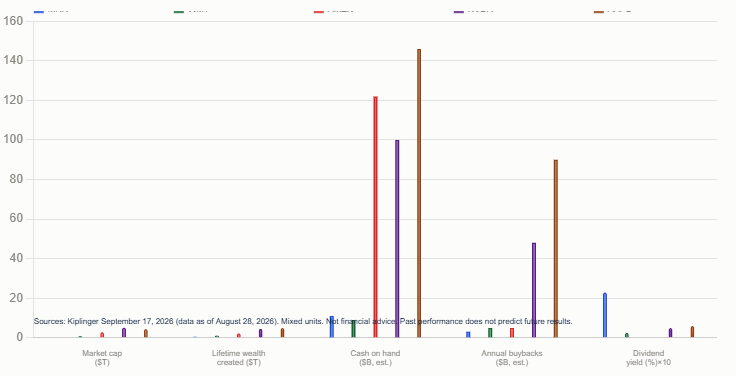
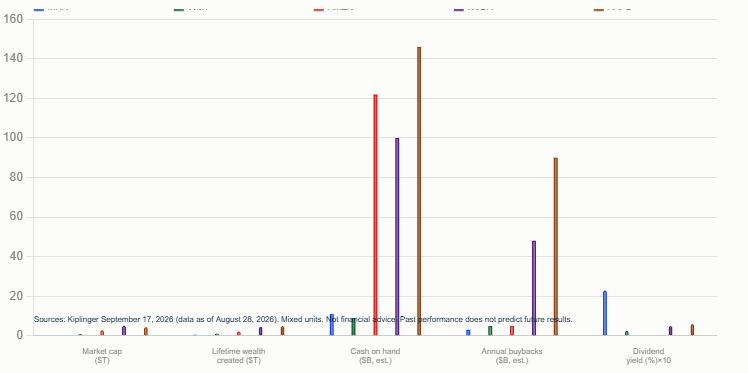
What distinguishes Amazon in the Bessembinder context is its combination of capital deployment and business model diversification. With $122 billion in cash and short-term investments plus a similar amount in long-term investments, Amazon has the balance sheet to continue acquiring and building new businesses for decades. It does not pay a regular dividend — all capital is plowed into growth. For an inheritance investor with a 20–30 year horizon, this reinvestment-over-distribution philosophy may be the most powerful long-term compounding engine on this list. Not financial advice.
Amazon bull case: (1) $2.3 trillion in proven lifetime wealth creation (No. 5 of all US companies, Bessembinder 2026). (2) AWS growing toward what Amazon believes could be a $1 trillion/year business. (3) $122B+ cash for acquisitions and new businesses. (4) Eight distinct major business lines beyond retail (streaming, advertising, healthcare, logistics, autonomous vehicles, satellites, AI, entertainment). (5) No. 1 US online retailer with growing physical presence. (6) AI hyperscaler spending driving AWS demand. Source: Kiplinger September 2026. Not financial advice.
Amazon risks: antitrust scrutiny across multiple divisions globally. No dividend -- pure capital appreciation play (requires selling to realise gains). Heavy capital expenditure ($725B+ combined with Microsoft/Meta/Alphabet on AI capex per earlier data). Valuation high relative to traditional metrics. Labour relations concerns in logistics. Not financial advice.
Nvidia is the second-greatest wealth-creating company in the history of the US stock market, generating $4.6 trillion in excess of a Treasury-bill benchmark since its 1999 IPO — and it has done so almost entirely in the past three years. The AI infrastructure build-out has made Nvidia’s H100, H200, and Blackwell GPU chips not just commercially dominant but structurally indispensable: every major hyperscaler, every enterprise AI deployment, and every AI research institution needs Nvidia’s GPUs. That is the short version of a $5.25-trillion market capitalisation.
But the generational case for Nvidia rests on what it does beyond AI chips. Argus Research analyst Jim Kelleher (Buy rating): ‘We believe the NVDA shares have much further to go and believe that most technology investors should own NVDA in the age of AI and GPU-driven applications acceleration.’ Beyond AI data centers: Nvidia’s chips power gaming, professional graphics, autonomous vehicles, climate forecasting models, and genomic sequencing — making it a horizontal technology company rather than a pure AI play. As long as any advanced computation exists anywhere in the global economy, Nvidia’s products are likely to be in demand.
Nvidia’s capital return programme has accelerated dramatically: buybacks grew from approximately $2 billion in 2021 to $12 billion in 2023 to $48 billion in 2025. The dividend, while small in yield (approximately 0.5%), is 25 times what it was a year ago — signalling a company that is rapidly building its payout. With nearly $100 billion in cash and investments and tens of billions in annual free cash flow, Nvidia has the financial muscle to sustain this capital return programme for decades. Not financial advice.
Nvidia generational case: Nvidia was worth essentially nothing relative to its current value before 2020. An investor who received Nvidia shares in an inheritance in 2020 and held has seen the definition of generational wealth creation in a compressed time period. The question for new inheritance investors is whether the AI investment cycle is in innings 1 or innings 8. Kiplinger's selection of Nvidia specifically because it is among Bessembinder's 46 names suggests the historical track record supports continued above-market returns. But the AI concentration risk is real. Appropriate position sizing and holding alongside the other four stocks reduces single-stock risk. Not financial advice.
Apple is the greatest wealth-creating company in the history of the US stock market. $5.0 trillion in shareholder wealth creation — 5.52% of all the wealth ever created by all US public companies over 100 years — from a single company that did not exist until 1976. Critically, the vast majority of this wealth was created after the 2011 death of Steve Jobs, under Tim Cook’s operational and services-focused leadership. The lesson: Apple’s wealth-creation machinery is institutional, not dependent on a single genius founder.
In September 2026, Tim Cook stepped down as CEO after 15 years (retained as Executive Chairman) and was replaced by John Ternus, a 25-year Apple executive who helped oversee the development of the iPad, AirPods, and Apple Watch. Morgan Stanley analyst Erik Woodring (Overweight/Buy): ‘Mr. Ternus... has been an important part of Apple product launches for over two decades, and promoting him to CEO clearly shows Apple’s emphasis on product at the center of the flywheel will remain.’ This transition — to a career Apple product executive rather than an external hire — suggests strategic continuity.
The financial dimensions are equally exceptional. Apple repurchases $80–$100 billion of its own shares every year since 2021 — the largest consistent buyback programme in corporate history. With $62 billion in cash and short-term investments plus $84 billion in long-term investments ($146 billion total liquid), Apple has the resources for transformational acquisitions. The dividend has grown every year since 2012. Apple Intelligence (its AI platform) is the next category-defining product iteration. And the App Store, Services, and Wearables businesses provide recurring revenue entirely separate from iPhone hardware. Not financial advice.
Apple bull case: (1) $5.0 trillion in proven lifetime wealth creation -- No. 1 in US market history (Bessembinder 2026). (2) $80-100 billion in annual buybacks -- massive sustained capital return. (3) $146 billion in total liquid assets for acquisitions. (4) Dividend growing since 2012. (5) Tim Cook as Executive Chairman provides continuity; CEO John Ternus has 25-year Apple track record. (6) Services and Wearables businesses provide recurring revenue above and beyond iPhone. (7) Apple Intelligence/AI is the next product category. Source: Kiplinger September 2026. Not financial advice.
Apple risks: iPhone hardware revenue (~50% of total) dependent on continued smartphone demand and upgrade cycles. Regulatory risk: EU Digital Markets Act, DOJ antitrust, App Store legislation. China manufacturing and revenue concentration. CEO transition (September 2026). AI competition from Google, Samsung, and Chinese manufacturers. Not financial advice.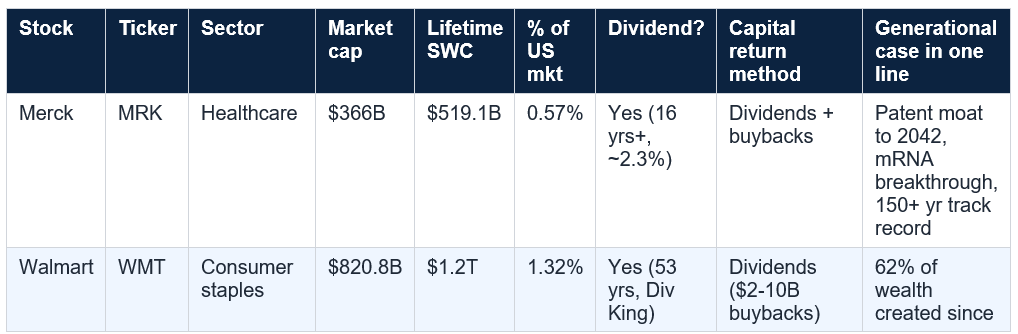
The Motley Fool (September 2025) makes the case for dividend growers: companies that consistently raise dividends have crushed the S&P 500 by 2.5 percentage points annually since 1972. $10,000 invested in dividend growers in 1972 would be worth over $4 million today versus $1.6 million in the S&P 500. The compounding mechanism is particularly powerful when dividends are reinvested: each dividend purchase buys more shares, which generate more dividends, which buy more shares. Walmart’s 53-year dividend growth streak means an investor who held for 30 years has seen their original yield on cost (the dividend relative to the original purchase price) grow from a modest number to a substantial income stream.
But the Bessembinder data tells a more nuanced story. The top two wealth creators (Apple and Nvidia) are not primarily dividend machines — they are capital-appreciation compounders that return capital through buybacks rather than distributions. Amazon created $2.3 trillion without paying a dividend. For a 30-year time horizon, the choice between dividend income and capital reinvestment may matter less than the quality of the underlying business. The ideal generational portfolio includes both mechanisms. Not financial advice.
The second step is tax awareness. Inherited assets have a ‘stepped-up basis’ for most assets: the cost basis is reset to the fair market value at the date of death rather than the original purchase price. This means inherited stock can often be sold without immediate capital gains tax on the appreciation that occurred during the original owner’s lifetime. The stepped-up basis is one of the most financially significant features of inheritance, and it provides an immediate flexibility to restructure the portfolio without the tax friction that would apply to a living investor selling long-held positions. Consult a CPA or tax adviser before taking action.
The third step is allocation. An inheritance invested in five long-horizon wealth creators is fundamentally different from a cash inheritance spent on consumption: it becomes the seed capital for the next generation’s inheritance. Building a position in the stocks discussed in this article — or in a broadly diversified index fund that includes them — can begin the compounding process that makes the next inheritance possible. Not financial or tax advice. Consult a qualified CFP.
The generational dimension of this investment framework is not accidental. An inheritance is not just a financial event — it is a transfer of accumulated human effort, discipline, and sacrifice from one generation to the next. The choice of what to do with that capital is the choice between consuming it, preserving it, or growing it into something larger to pass on again. The survey respondent who told Morning Consult they’d put an inheritance ‘into investments, since that’s what pretty much helped them earn it in the first place’ understood this intuitively.
Five companies. $124 trillion set to transfer. A 100-year study. And a straightforward question: can the wealth that arrived build the wealth that leaves? The Bessembinder data suggests the answer is yes — if the companies chosen have the same characteristics as those 46 firms that created half of all US market wealth. Not financial advice. Consult a qualified financial adviser before investing.
The Bessembinder study is a 2026 academic paper by Hendrik Bessembinder, finance professor at Arizona State University's W.P. Carey School of Business, which tracked investment outcomes from nearly 30,000 US stocks over 100 years (1926-2025). The central finding: just 46 firms account for half of the $91 trillion in net wealth creation generated by all US public companies over that century. Wealth creation is defined as excess return versus a Treasury bill benchmark -- the true 'enhancement' of capital that stocks provide. For inheritance investing, this matters because it identifies the specific companies that have already demonstrated the ability to create outsized, multi-decade wealth -- providing a rigorous evidence base for selecting holdings designed to build the next inheritance, rather than just matching the market. Source: Kiplinger (Kyle Woodley, September 17, 2026) citing Bessembinder/ASU 2026.
Why Apple is the greatest wealth creator in US history?
According to the Bessembinder 2026 study, Apple (AAPL) created $5.0 trillion in shareholder wealth creation from its IPO through December 31, 2025 -- 5.52% of all US stock market net wealth creation over 100 years, the highest of any company. Critically, the vast majority of this was created after Steve Jobs' death in 2011, under Tim Cook's leadership. Key drivers: iPhone ($1T+ annual revenue platform), Services (App Store, iCloud, Apple TV+, Apple Music), buybacks ($80-100B/year), and the company's ability to take emerging technologies and turn them into category-defining products. In September 2026, Cook was replaced as CEO by John Ternus (retained as Executive Chairman), with Morgan Stanley maintaining an Overweight rating. Not financial advice. Source: Kiplinger September 2026.
Is it better to buy individual stocks or an index fund with an inheritance?
Both approaches have merit, and they are not mutually exclusive. The case for individual stocks: the Bessembinder data shows that the market's returns are overwhelmingly driven by a small number of exceptional companies; buying those companies directly concentrates wealth-creation potential. The case for index funds: passive funds (S&P 500 ETFs like VOO or VTI) hold all five of the stocks discussed in this article as major positions, provide instant diversification, and have lower fees than active management. 79% of active funds underperformed the S&P 500 in 2025 (SPIVA). For most inheritance investors, a core position in a low-cost broad index fund combined with individual positions in high-conviction, long-duration wealth creators is the most practically sound approach. Consult a CFP for personalised guidance. Not financial advice.
What is stepped-up basis for inherited stocks?
When you inherit stock, the cost basis is typically 'stepped up' to the fair market value of the shares on the date of the original owner's death. This means that if the original owner bought shares for $10 that were worth $100 at death, your cost basis is $100 -- not $10. If you sell those shares for $105, you only owe capital gains tax on the $5 gain, not the full $95 appreciation that occurred during the original owner's lifetime. This stepped-up basis provision is one of the most significant tax advantages in US inheritance law. However, rules can change and vary by situation (e.g. trust vs direct inheritance, state laws). Consult a CPA or estate planning attorney before selling any inherited securities. Not tax or legal advice.
How much of the $124 trillion Great Wealth Transfer will be invested?
According to a Citizens Bank survey of 1,500 US adults, the majority (60%) said they'd invest at least part of an inheritance. A Morning Consult survey commissioned by Kiplinger for their Trillion Dollar Talk campaign (September 2026) found that 15% of adult children specifically said they'd use an inheritance to 'invest and grow wealth' -- the third most popular response after providing for the family (financial security) and investing in a home. The $124 trillion figure represents the total wealth expected to pass from baby boomers and other older generations to heirs over approximately the next 20 years. Not all of this is in equities; much is in property, pension assets, and cash. But the portion directed into stocks will represent a historically significant flow of capital into the equity markets. Source: Kiplinger September 17, 2026.
Table of Contents
- The $124 Trillion Question: What to Do With an Inheritance
- The Bessembinder Study: 100 Years of US Wealth Creation
- Why These Five Stocks — The Selection Framework
- Stock 1: Merck & Co. (MRK) — Healthcare’s Enduring Compounder
- Stock 2: Walmart (WMT) — The Dividend King That Refused to Die
- Stock 3: Amazon.com (AMZN) — The Everything Company
- Stock 4: Nvidia (NVDA) — The AI Infrastructure Backbone
- Stock 5: Apple (AAPL) — The Greatest Wealth Creator of the Century
- The Five Stocks at a Glance: Comparison Table
- The Dividend vs Growth Question: Which Mix Is Right for Generational Wealth?
- Inheritance Investing: The Practical Steps
- Conclusion: Build the Wealth That Builds the Next Wealth
- Frequently Asked Questions
100-year wealth creation — the Bessembinder top 5
Stock profiles — key metrics and generational case
The compounding engine — dividends vs buybacks vs growth
The $124 Trillion Question: What to Do With an Inheritance
The Great Wealth Transfer is the largest intergenerational movement of assets in human history. Baby boomers and other older generations are expected to pass more than $124 trillion to their children, grandchildren, and other heirs over the next two decades. When that money lands, the question is never just ‘what do I do with it?’ It is also ‘can I use it not just for myself but to leave something behind in turn?’The data on what inheritors actually do is illuminating. A Citizens Bank survey of 1,500 US adults found that 60% would invest at least part of an inheritance. In a Morning Consult survey commissioned by Kiplinger for their Trillion Dollar Talk campaign (September 2026), 15% of adult children said they’d use an inheritance specifically to ‘invest and grow wealth’ — the third most popular answer after providing for the family and investing in a home. As one survey respondent told Morning Consult/Kiplinger, they’d put an inheritance from their parents ‘into investments,’ since ‘that’s what pretty much helped them earn it in the first place.’
The stocks in this article are drawn from a specific, rigorous framework: they are among the 46 companies that account for half of all US stock market wealth creation since 1926, identified by Hendrik Bessembinder in a 2026 study for Arizona State University, and selected by Kiplinger’s Kyle Woodley (September 17, 2026) specifically for their potential to continue building generational wealth. Not financial advice.
The Great Wealth Transfer: $124 trillion expected to pass from baby boomers and older generations to heirs over the next 20 years (Kiplinger Trillion Dollar Talk; September 2026). Citizens Bank survey (1,500 US adults): 60% would invest at least part of an inheritance. Morning Consult/Kiplinger survey: 15% would 'invest and grow wealth' with an inheritance. Bessembinder 2026 (ASU): just 46 firms account for half of the $91 trillion in US stock market net wealth creation 1926-2025. Source: Kiplinger September 17, 2026.
The Bessembinder Study: 100 Years of US Wealth Creation
The intellectual foundation for the five stocks in this article comes from a landmark 2026 academic study by Hendrik Bessembinder, a finance professor at Arizona State University’s W.P. Carey School of Business. Bessembinder researched the investment outcomes from nearly 30,000 stocks over the 100 years between 1926 and 2025 — arguably the most comprehensive long-term study of US equity wealth creation ever conducted.The central finding is striking: wealth creation within the stock market is massively concentrated. ‘Just 46 firms account for half of the $91 trillion in net wealth creation over the full century,’ Bessembinder found. In Kiplinger’s analysis (via Dan Burrows): ‘T-bills are a kind of stand-in for opportunity cost. And the difference [in performance] over time between the two investment choices, when positive, is wealth creation. It’s the enhancement.’ Wealth creation in this framework is not just total return — it is the excess return over what a completely risk-free asset would have produced.
This framework is particularly powerful for inheritance investing, because it filters away the thousands of stocks that, over a century, either produced less than Treasury bills or simply failed entirely. The five stocks discussed in this article are not just large companies — they are members of the tiny group that has demonstrably created more wealth for shareholders than any other companies in US market history. That does not guarantee future performance, but it provides a more rigorous starting point than most stock selection frameworks. Not financial advice.
Bessembinder 2026 (ASU W.P. Carey School of Business): studied nearly 30,000 US stocks, 1926-2025, 100 years. Total US stock market net wealth creation: $91 trillion. Concentration: just 46 firms account for half ($45.5 trillion). Wealth creation metric: Shareholder Wealth Creation (SWC) = return vs Treasury bill benchmark (not just total return). The five stocks covered: Apple (No. 1, $5.0T, 5.52% of total); Nvidia (No. 2, $4.6T, 5.03%); Amazon (No. 5, $2.3T, 2.49%); Walmart ($1.2T, 1.32%); Merck ($519.1B, 0.57%). Source: Kiplinger September 17, 2026 citing Bessembinder 2026 / ASU.
Why These Five Stocks — The Selection Framework
Kiplinger’s Kyle Woodley (September 17, 2026) applied a deliberate filter to select these five from Bessembinder’s list of 46 wealth-creating giants: each company mentioned has both a track record in the Bessembinder data and ‘certain characteristics and advantages that point toward their ability to continue generating returns well in excess of that T-bill benchmark.’ In other words: past wealth creation is the proof of concept; structural competitive advantages are the argument for future performance.The five represent a cross-section of sectors and wealth-creation mechanisms: a healthcare giant (Merck) with a 150-year history and a patent moat; the world’s largest retailer (Walmart) that has survived every retail disruption since 1972; the world’s largest online retailer and cloud provider (Amazon); the backbone of the global AI infrastructure build-out (Nvidia); and the greatest wealth-creating company in the history of the US stock market (Apple). Together they span consumer staples, consumer discretionary, healthcare, and technology.
Companies that consistently raise dividends have crushed the S&P 500 by 2.5 percentage points annually since 1972. $10,000 invested in consistent dividend growers in 1972 would be worth over $4 million today, versus $1.6 million in the S&P 500 (Motley Fool, September 2025). Two of the five (Walmart and Merck) are dividend growers; three (Amazon, Nvidia, Apple) return capital primarily through buybacks. This diversity reflects the multiple paths to generational wealth creation. Not financial advice.
Stock 1: MRK — Merck & Co.
Merck & Co. has roots extending to the founding of Germany’s Merck Group in 1668, making it one of the oldest pharmaceutical enterprises in the world. Its American affiliate was created in 1891, and it has been building shareholder wealth through blockbuster drugs for well over a century. The Bessembinder data reflects $519.1 billion in lifetime wealth creation — 0.57% of all US stock market wealth created over 100 years — from a single company in a single sector.
The modern Merck case is dominated by Keytruda, the cancer-fighting immunotherapy drug that has generated nearly $180 billion in global sales since its 2014 debut. Keytruda has become the world’s best-selling pharmaceutical product, but its core patent expires in 2028 — a risk that would be fatal for most pharmaceutical companies. Merck has responded with one of the most aggressive patent-defence strategies in industry history: an investigation by The Bureau of Investigative Journalism (April 2026) found 211 granted patents extending Keytruda protection to at least 2042, plus more than 337 pending patents and a total of more than 1,200 patents across 53 countries.
Beyond the patent wall, in August 2026 Merck and Moderna announced that their jointly developed experimental mRNA cancer vaccine met the primary goal of a Phase 3 clinical trial in more than 1,000 melanoma patients. The combination of the intismeran vaccine and Keytruda was more effective in preventing the return and spread of melanoma and produced fewer side effects than Keytruda alone. Merck also has a pipeline of next-generation candidates: infinatamab deruxtecan (small-cell lung cancer), opevesostat (prostate cancer), and tulisokibart (ulcerative colitis and Crohn’s disease). Not financial advice.
Merck bull case: (1) $519.1B in proven lifetime wealth creation (Bessembinder 2026). (2) Keytruda patent wall extends to at least 2042 (Bureau of Investigative Journalism April 2026). (3) mRNA cancer vaccine Phase 3 success (August 2026) diversifies the Keytruda franchise. (4) Dividend growing for 16 consecutive years; current yield ~2.3%. (5) Pipeline of three new significant drug candidates. (6) 150+ years of pharmaceutical innovation. Not financial advice. Source: Kiplinger September 2026.
Merck risks: Keytruda core patent expires 2028 -- the patent wall strategy may face legal challenges. Clinical pipeline failures are always possible. Healthcare sector faces drug pricing legislation risk (IRA drug pricing provisions). Keytruda accounts for approximately half of Merck's revenue -- significant concentration risk. Not financial advice.
Stock 2: WMT — Walmart
Walmart’s case for continued wealth creation is the most counterintuitive of the five. It is a brick-and-mortar retailer that went public in 1972 — before the internet existed, before e-commerce was imagined, before Amazon was founded. And yet $1.2 trillion of its $1.2 trillion in lifetime wealth creation has come despite the rise of every form of retail disruption imaginable. Remarkably, as Kiplinger notes: ‘Believe it or not, the sizable majority (62%) of its wealth creation since joining the public markets in 1972 has come since 2016’ — the era in which everyone agreed brick-and-mortar retail was dying.
The reason is structural. Brick-and-mortar retail is not dying — 77% of US retail dollars are still spent in physical stores. Walmart is the world’s largest retailer by revenue and the second-largest US online retailer. E-commerce accounts for approximately 25% of Walmart’s total US sales, and unlike Amazon, Walmart’s online business is supplemented rather than replaced by its 3,335+ physical stores. The combination makes it simultaneously the most accessible retailer in America (almost everyone in the US lives within 10 miles of a Walmart) and a growing digital commerce platform.
As a Dividend King with 53 consecutive years of dividend growth, Walmart is the definition of the compounding machine that builds generational wealth over decades. Shareholders who reinvested dividends through every economic cycle since 1972 have participated in one of the great compounding journeys in US equity history. The buyback programme — $2 billion to nearly $10 billion per year over the past decade — provides additional shareholder capital return. Not financial advice.
Walmart generational case: A Dividend King with 53 consecutive years of annual dividend increases makes Walmart a natural inheritance holding because the dividend income itself grows with every passing year. An investor who received WMT shares in an inheritance and reinvested dividends compounds both share price appreciation AND growing dividend income simultaneously. Walmart's dividend growth streak means an investor who held for 20 years has seen their yield on original cost (yield on cost) grow substantially above the starting yield. This is the essence of generational wealth compounding. Source: Kiplinger September 2026; Motley Fool September 2025. Not financial advice.
Stock 3: AMZN — Amazon.com
Amazon’s place among the five greatest wealth-creating companies of the past century is not primarily about selling books, or even selling everything. It is about Amazon Web Services (AWS), which Kiplinger describes as ‘the straw that stirs the drink’: the cloud computing division that is the engine behind Amazon’s profitability and that Amazon itself believes could become a $1-trillion-a-year business on its own.
But the case for Amazon as a generational wealth builder extends well beyond AWS. The company’s scope has expanded in ways that would have seemed impossible at its 1997 IPO: streaming (Prime Video, Amazon Music), advertising, supply chain services, healthcare (One Medical, Amazon Pharmacy), autonomous vehicles (Zoox), entertainment (MGM Studios), satellite telecommunications (Globalstar), grocery (Whole Foods, Amazon Fresh), and AI infrastructure (one of the biggest spenders on AI capex in the world). Each new business is an additional wealth-creation engine.
What distinguishes Amazon in the Bessembinder context is its combination of capital deployment and business model diversification. With $122 billion in cash and short-term investments plus a similar amount in long-term investments, Amazon has the balance sheet to continue acquiring and building new businesses for decades. It does not pay a regular dividend — all capital is plowed into growth. For an inheritance investor with a 20–30 year horizon, this reinvestment-over-distribution philosophy may be the most powerful long-term compounding engine on this list. Not financial advice.
Amazon bull case: (1) $2.3 trillion in proven lifetime wealth creation (No. 5 of all US companies, Bessembinder 2026). (2) AWS growing toward what Amazon believes could be a $1 trillion/year business. (3) $122B+ cash for acquisitions and new businesses. (4) Eight distinct major business lines beyond retail (streaming, advertising, healthcare, logistics, autonomous vehicles, satellites, AI, entertainment). (5) No. 1 US online retailer with growing physical presence. (6) AI hyperscaler spending driving AWS demand. Source: Kiplinger September 2026. Not financial advice.
Amazon risks: antitrust scrutiny across multiple divisions globally. No dividend -- pure capital appreciation play (requires selling to realise gains). Heavy capital expenditure ($725B+ combined with Microsoft/Meta/Alphabet on AI capex per earlier data). Valuation high relative to traditional metrics. Labour relations concerns in logistics. Not financial advice.
Stock 4: NVDA — Nvidia
Nvidia is the second-greatest wealth-creating company in the history of the US stock market, generating $4.6 trillion in excess of a Treasury-bill benchmark since its 1999 IPO — and it has done so almost entirely in the past three years. The AI infrastructure build-out has made Nvidia’s H100, H200, and Blackwell GPU chips not just commercially dominant but structurally indispensable: every major hyperscaler, every enterprise AI deployment, and every AI research institution needs Nvidia’s GPUs. That is the short version of a $5.25-trillion market capitalisation.
But the generational case for Nvidia rests on what it does beyond AI chips. Argus Research analyst Jim Kelleher (Buy rating): ‘We believe the NVDA shares have much further to go and believe that most technology investors should own NVDA in the age of AI and GPU-driven applications acceleration.’ Beyond AI data centers: Nvidia’s chips power gaming, professional graphics, autonomous vehicles, climate forecasting models, and genomic sequencing — making it a horizontal technology company rather than a pure AI play. As long as any advanced computation exists anywhere in the global economy, Nvidia’s products are likely to be in demand.
Nvidia’s capital return programme has accelerated dramatically: buybacks grew from approximately $2 billion in 2021 to $12 billion in 2023 to $48 billion in 2025. The dividend, while small in yield (approximately 0.5%), is 25 times what it was a year ago — signalling a company that is rapidly building its payout. With nearly $100 billion in cash and investments and tens of billions in annual free cash flow, Nvidia has the financial muscle to sustain this capital return programme for decades. Not financial advice.
Nvidia generational case: Nvidia was worth essentially nothing relative to its current value before 2020. An investor who received Nvidia shares in an inheritance in 2020 and held has seen the definition of generational wealth creation in a compressed time period. The question for new inheritance investors is whether the AI investment cycle is in innings 1 or innings 8. Kiplinger's selection of Nvidia specifically because it is among Bessembinder's 46 names suggests the historical track record supports continued above-market returns. But the AI concentration risk is real. Appropriate position sizing and holding alongside the other four stocks reduces single-stock risk. Not financial advice.
Stock 5: AAPL — Apple Inc.
Apple is the greatest wealth-creating company in the history of the US stock market. $5.0 trillion in shareholder wealth creation — 5.52% of all the wealth ever created by all US public companies over 100 years — from a single company that did not exist until 1976. Critically, the vast majority of this wealth was created after the 2011 death of Steve Jobs, under Tim Cook’s operational and services-focused leadership. The lesson: Apple’s wealth-creation machinery is institutional, not dependent on a single genius founder.
In September 2026, Tim Cook stepped down as CEO after 15 years (retained as Executive Chairman) and was replaced by John Ternus, a 25-year Apple executive who helped oversee the development of the iPad, AirPods, and Apple Watch. Morgan Stanley analyst Erik Woodring (Overweight/Buy): ‘Mr. Ternus... has been an important part of Apple product launches for over two decades, and promoting him to CEO clearly shows Apple’s emphasis on product at the center of the flywheel will remain.’ This transition — to a career Apple product executive rather than an external hire — suggests strategic continuity.
The financial dimensions are equally exceptional. Apple repurchases $80–$100 billion of its own shares every year since 2021 — the largest consistent buyback programme in corporate history. With $62 billion in cash and short-term investments plus $84 billion in long-term investments ($146 billion total liquid), Apple has the resources for transformational acquisitions. The dividend has grown every year since 2012. Apple Intelligence (its AI platform) is the next category-defining product iteration. And the App Store, Services, and Wearables businesses provide recurring revenue entirely separate from iPhone hardware. Not financial advice.
Apple bull case: (1) $5.0 trillion in proven lifetime wealth creation -- No. 1 in US market history (Bessembinder 2026). (2) $80-100 billion in annual buybacks -- massive sustained capital return. (3) $146 billion in total liquid assets for acquisitions. (4) Dividend growing since 2012. (5) Tim Cook as Executive Chairman provides continuity; CEO John Ternus has 25-year Apple track record. (6) Services and Wearables businesses provide recurring revenue above and beyond iPhone. (7) Apple Intelligence/AI is the next product category. Source: Kiplinger September 2026. Not financial advice.
Apple risks: iPhone hardware revenue (~50% of total) dependent on continued smartphone demand and upgrade cycles. Regulatory risk: EU Digital Markets Act, DOJ antitrust, App Store legislation. China manufacturing and revenue concentration. CEO transition (September 2026). AI competition from Google, Samsung, and Chinese manufacturers. Not financial advice.
The Five Stocks at a Glance: Comparison Table
The Dividend vs Growth Question: Which Mix Is Right for Generational Wealth?
Of the five stocks, two (Merck and Walmart) are traditional dividend growers that provide current income alongside capital appreciation. Two (Amazon and Nvidia in its earlier years) return capital primarily through reinvestment and buybacks, with minimal or no dividend income. Apple sits between — a growing dividend alongside a massive buyback programme. For an inheritance investor, this spectrum raises the practical question: which approach is better for building the next inheritance?The Motley Fool (September 2025) makes the case for dividend growers: companies that consistently raise dividends have crushed the S&P 500 by 2.5 percentage points annually since 1972. $10,000 invested in dividend growers in 1972 would be worth over $4 million today versus $1.6 million in the S&P 500. The compounding mechanism is particularly powerful when dividends are reinvested: each dividend purchase buys more shares, which generate more dividends, which buy more shares. Walmart’s 53-year dividend growth streak means an investor who held for 30 years has seen their original yield on cost (the dividend relative to the original purchase price) grow from a modest number to a substantial income stream.
But the Bessembinder data tells a more nuanced story. The top two wealth creators (Apple and Nvidia) are not primarily dividend machines — they are capital-appreciation compounders that return capital through buybacks rather than distributions. Amazon created $2.3 trillion without paying a dividend. For a 30-year time horizon, the choice between dividend income and capital reinvestment may matter less than the quality of the underlying business. The ideal generational portfolio includes both mechanisms. Not financial advice.
Inheritance Investing: The Practical Steps
Receiving an inheritance is a financial and emotional event simultaneously. The first and most important practical step is not to act quickly. Kiplinger’s coverage of the Great Wealth Transfer consistently emphasises that the most common mistake inheritors make is acting under pressure of grief or excitement before they have a clear plan. Parking the inheritance in a money market account or high-yield savings account while formulating a plan is entirely appropriate and costs very little time value when the long-term horizon is decades.The second step is tax awareness. Inherited assets have a ‘stepped-up basis’ for most assets: the cost basis is reset to the fair market value at the date of death rather than the original purchase price. This means inherited stock can often be sold without immediate capital gains tax on the appreciation that occurred during the original owner’s lifetime. The stepped-up basis is one of the most financially significant features of inheritance, and it provides an immediate flexibility to restructure the portfolio without the tax friction that would apply to a living investor selling long-held positions. Consult a CPA or tax adviser before taking action.
The third step is allocation. An inheritance invested in five long-horizon wealth creators is fundamentally different from a cash inheritance spent on consumption: it becomes the seed capital for the next generation’s inheritance. Building a position in the stocks discussed in this article — or in a broadly diversified index fund that includes them — can begin the compounding process that makes the next inheritance possible. Not financial or tax advice. Consult a qualified CFP.
- Practical step 1: Do not rush. Park the inheritance in a money market fund or HYSA while forming a plan. Resist pressure to act immediately.
- Practical step 2: Get tax advice on stepped-up basis before selling any inherited securities. The basis reset may provide tax-free rebalancing flexibility.
- Practical step 3: Consult a CFP to build a long-horizon investment plan. The five-stock framework here is educational, not a personal recommendation.
- Practical step 4: Use tax-advantaged accounts where possible. Roth IRA contributions from earned income, and a taxable brokerage account for the inheritance itself.
- Practical step 5: Consider the family legacy dimension. Document your investment intent so that heirs who receive your eventual inheritance understand why the holdings are there. The financial plan and the family narrative travel together.
Conclusion
Hendrik Bessembinder’s century of data has a simple message: most of the wealth created by US public companies over 100 years came from a tiny handful of businesses that combined durable competitive advantages with decades of operational excellence. The five stocks in this article — Merck, Walmart, Amazon, Nvidia, and Apple — are all members of that exclusive 46-company group, and Kiplinger’s September 2026 analysis argues they have the structural characteristics to continue creating wealth in the decades ahead.The generational dimension of this investment framework is not accidental. An inheritance is not just a financial event — it is a transfer of accumulated human effort, discipline, and sacrifice from one generation to the next. The choice of what to do with that capital is the choice between consuming it, preserving it, or growing it into something larger to pass on again. The survey respondent who told Morning Consult they’d put an inheritance ‘into investments, since that’s what pretty much helped them earn it in the first place’ understood this intuitively.
Five companies. $124 trillion set to transfer. A 100-year study. And a straightforward question: can the wealth that arrived build the wealth that leaves? The Bessembinder data suggests the answer is yes — if the companies chosen have the same characteristics as those 46 firms that created half of all US market wealth. Not financial advice. Consult a qualified financial adviser before investing.
Frequently Asked Questions
What is the Bessembinder study and why does it matter for inheritance investing?The Bessembinder study is a 2026 academic paper by Hendrik Bessembinder, finance professor at Arizona State University's W.P. Carey School of Business, which tracked investment outcomes from nearly 30,000 US stocks over 100 years (1926-2025). The central finding: just 46 firms account for half of the $91 trillion in net wealth creation generated by all US public companies over that century. Wealth creation is defined as excess return versus a Treasury bill benchmark -- the true 'enhancement' of capital that stocks provide. For inheritance investing, this matters because it identifies the specific companies that have already demonstrated the ability to create outsized, multi-decade wealth -- providing a rigorous evidence base for selecting holdings designed to build the next inheritance, rather than just matching the market. Source: Kiplinger (Kyle Woodley, September 17, 2026) citing Bessembinder/ASU 2026.
Why Apple is the greatest wealth creator in US history?
According to the Bessembinder 2026 study, Apple (AAPL) created $5.0 trillion in shareholder wealth creation from its IPO through December 31, 2025 -- 5.52% of all US stock market net wealth creation over 100 years, the highest of any company. Critically, the vast majority of this was created after Steve Jobs' death in 2011, under Tim Cook's leadership. Key drivers: iPhone ($1T+ annual revenue platform), Services (App Store, iCloud, Apple TV+, Apple Music), buybacks ($80-100B/year), and the company's ability to take emerging technologies and turn them into category-defining products. In September 2026, Cook was replaced as CEO by John Ternus (retained as Executive Chairman), with Morgan Stanley maintaining an Overweight rating. Not financial advice. Source: Kiplinger September 2026.
Is it better to buy individual stocks or an index fund with an inheritance?
Both approaches have merit, and they are not mutually exclusive. The case for individual stocks: the Bessembinder data shows that the market's returns are overwhelmingly driven by a small number of exceptional companies; buying those companies directly concentrates wealth-creation potential. The case for index funds: passive funds (S&P 500 ETFs like VOO or VTI) hold all five of the stocks discussed in this article as major positions, provide instant diversification, and have lower fees than active management. 79% of active funds underperformed the S&P 500 in 2025 (SPIVA). For most inheritance investors, a core position in a low-cost broad index fund combined with individual positions in high-conviction, long-duration wealth creators is the most practically sound approach. Consult a CFP for personalised guidance. Not financial advice.
What is stepped-up basis for inherited stocks?
When you inherit stock, the cost basis is typically 'stepped up' to the fair market value of the shares on the date of the original owner's death. This means that if the original owner bought shares for $10 that were worth $100 at death, your cost basis is $100 -- not $10. If you sell those shares for $105, you only owe capital gains tax on the $5 gain, not the full $95 appreciation that occurred during the original owner's lifetime. This stepped-up basis provision is one of the most significant tax advantages in US inheritance law. However, rules can change and vary by situation (e.g. trust vs direct inheritance, state laws). Consult a CPA or estate planning attorney before selling any inherited securities. Not tax or legal advice.
How much of the $124 trillion Great Wealth Transfer will be invested?
According to a Citizens Bank survey of 1,500 US adults, the majority (60%) said they'd invest at least part of an inheritance. A Morning Consult survey commissioned by Kiplinger for their Trillion Dollar Talk campaign (September 2026) found that 15% of adult children specifically said they'd use an inheritance to 'invest and grow wealth' -- the third most popular response after providing for the family (financial security) and investing in a home. The $124 trillion figure represents the total wealth expected to pass from baby boomers and other older generations to heirs over approximately the next 20 years. Not all of this is in equities; much is in property, pension assets, and cash. But the portion directed into stocks will represent a historically significant flow of capital into the equity markets. Source: Kiplinger September 17, 2026.
0 Comments
Be the first to share your thoughts on this article.