
Spending
Amazon vs Walmart: Who Has the Cheapest Price

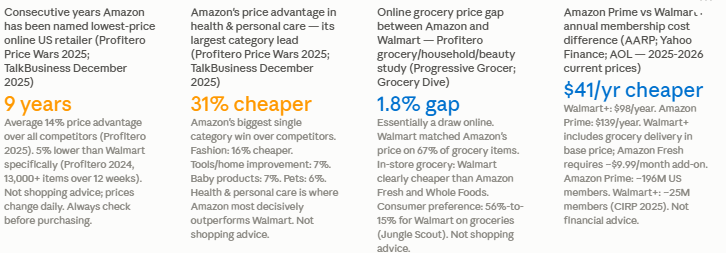
Amazon has been named the lowest-price online retailer in the US for nine consecutive years. But Walmart’s price gap with Amazon on groceries has narrowed to just 1.8%. Health and personal care is 31% cheaper on Amazon. Appliances? That’s Walmart’s battleground. And the membership question — Prime at $139 vs Walmart+ at $98 — can flip the maths entirely. This article breaks down every major product category with the actual data, shows you when each retailer wins, and tells you how to use both strategically to pay the lowest price possible. Not financial or shopping advice; always compare prices before purchasing.
The result is a market that benefits consumers — but navigating it requires knowing which of the two giants wins in each product category, because the answer is not the same everywhere. Amazon has been named the lowest-price online retailer in the US for nine consecutive years by Profitero’s annual Price Wars study. But Doug Herrington’s claim as CEO of Amazon Worldwide Stores in November 2025 — ‘This research shows that Amazon is the lowest-price retailer in the United States’ — is an overstatement that the data does not fully support in every category. Walmart wins on in-store groceries, is Amazon’s closest price competitor online, and is the most aggressive rival specifically in appliances.
This article uses the most rigorous available data — primarily Profitero’s annual Price Wars studies, the most widely cited and methodologically robust price comparison research available in the US retail market — to give a category-by-category answer to the question every bargain-hunting shopper asks: Amazon or Walmart? Not financial or shopping advice; prices change dynamically and must be checked before purchasing.
Amazon: lowest-price online retailer for 9 consecutive years (Profitero Price Wars 2025). Average price advantage: 14% over all competitors (Profitero 2025); 5% over Walmart specifically (Profitero 2024). Doug Herrington (CEO, Amazon Worldwide Stores, November 2025): 'Amazon is the lowest-price retailer in the United States.' Amazon: 37.6% US e-commerce market share (Statista May 2024). Walmart: 6.4% e-commerce share; 3,335+ stores. Amazon Prime: 196M US members; Walmart+: 25M US members (CIRP, 2025 quarterly data). Sources: El Diario NY/Arekore July 2026; TalkBusiness.net December 2025; Yahoo Tech; CIRP May 2025.
The 2024 edition examined more than 13,000 items across 15 product categories over a 12-week period from July to September 2024. The 2025 edition examined more than 10,000 items across 16 product categories. The studies compare ‘everyday low prices’ — not sale or promotional prices — to capture the structural price positioning of each retailer rather than temporary discounting events.
A critical nuance: Profitero’s studies compare online prices only. They do not compare Amazon online prices to Walmart in-store prices, which is a fundamentally different shopping context. Walmart’s in-store prices — particularly for grocery — are generally lower than both Walmart.com and Amazon’s equivalent. The studies also compare list prices, which means a membership like Amazon Prime or Walmart+ can change the effective price paid. This article addresses the membership dimension separately in Section 10. Not financial or shopping advice.
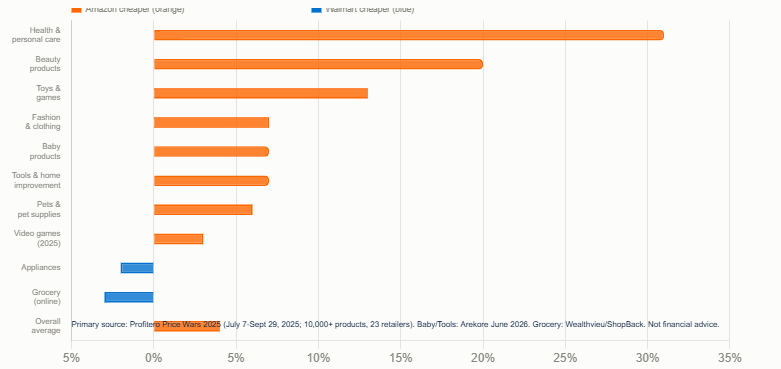
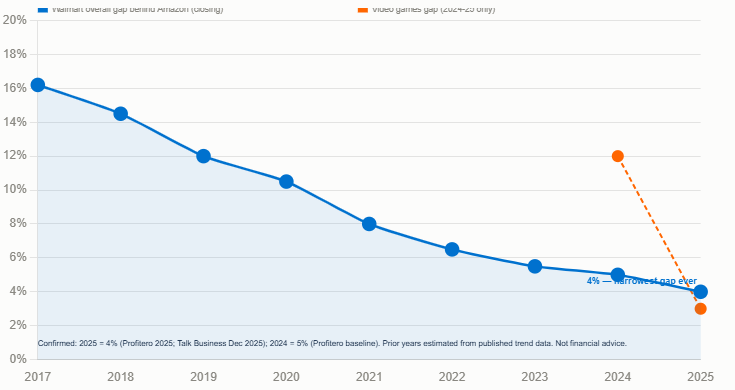
But the ‘average’ obscures the category-level reality that is far more useful to the consumer. Amazon’s 14% average advantage is driven primarily by a small number of categories where the price gap is very large — health and personal care (31% cheaper at Amazon) and fashion (16% cheaper) — which pull the average up significantly. In grocery, the gap has narrowed to just 1.8% between the two retailers online. In appliances, Walmart is described as Amazon’s ‘most aggressive’ competitor. In video games, the gap shrank from 12% to just 3% in 2025.
The practical implication: if you shop primarily for groceries and household essentials, Walmart is competitive and may even be better (particularly in-store). If you shop primarily for health products, fashion, electronics, tools, and baby products, Amazon’s price advantage is significant. The smart shopper uses both, allocating by category. Not financial or shopping advice.
The 31% price gap in health and personal care is not a marginal advantage. On a household that spends $200/month on these items, an Amazon shopper would expect to pay approximately $134 vs the $200 equivalent at higher-priced competitors, a saving of approximately $800 per year in this category alone. Compared specifically to Walmart (rather than the category average across all competitors), Amazon’s advantage may be somewhat smaller, but the directional finding is consistent: Walmart’s health and personal care prices are higher than Amazon’s online.
The reasons relate partly to Amazon’s marketplace structure: third-party sellers on Amazon compete heavily in health and personal care, driving down prices through competition. Amazon also uses health and personal care items as traffic-driving categories where it is willing to maintain lower margins. Not financial or shopping advice.
Amazon Wins: Health and personal care: Amazon wins decisively. Profitero Price Wars 2025: Amazon 31% cheaper on health and personal care than competitors. This is Amazon's largest single price advantage category. Recommendation: buy vitamins, supplements, OTC medications, skincare, and personal care products on Amazon for the significant price advantage. Always compare specific items before purchasing. Source: TalkBusiness.net December 2025 citing Profitero 2025.
However, the meaningful distinction is between online grocery prices and in-store grocery prices. Walmart’s in-store grocery prices are consistently lower than its online prices, lower than Amazon Fresh, and substantially lower than Whole Foods Market (Amazon’s primary physical grocery channel). Consumer research from Jungle Scout found that by a 56%-to-15% margin, US consumers go to Walmart when they need groceries or everyday affordable items — not just because of price but because of proximity, trust, and Walmart’s far larger physical footprint.
A Consumer Reports analysis (cited in El Diario NY, February 2026) found that Costco had actually surpassed Walmart for grocery prices, with prices 21.4% below Walmart on comparable items. For grocery shoppers, the hierarchy from cheapest to most expensive is approximately: Costco (for bulk), Walmart in-store, Walmart online ≈ Amazon Fresh, Whole Foods Market. The 1.8% online grocery gap between Walmart and Amazon is not worth stressing over — but Walmart in-store is meaningfully cheaper than any Amazon option. Not financial or shopping advice.
Walmart Wins: Grocery: Walmart wins on in-store pricing. Online grocery: essentially a draw (1.8% difference per Profitero grocery study). Walmart matched Amazon on 67% of grocery items studied. Consumer preference: 56%-to-15% margin of consumers choose Walmart for grocery/everyday essentials (Jungle Scout). Recommendation: for weekly grocery shopping, Walmart in-store is cheaper than Amazon Fresh or Whole Foods. Online grocery is close enough to choose on delivery convenience and membership benefits. Sources: Progressive Grocer; Jungle Scout; El Diario NY/Consumer Reports February 2026.
In appliances — a sub-category of home improvement — Walmart is specifically called out as Amazon’s ‘most aggressive’ price competitor (Profitero 2024). This suggests that while Amazon wins overall, Walmart competes most intensely in appliances specifically, making it worth checking both sites before purchasing a larger appliance. For tools, hand tools, and home improvement supplies: Amazon’s 7% average advantage is meaningful, particularly on higher-ticket items.
It is worth noting that both retailers carry different assortments of electronics brands and models, which complicates direct comparison. Amazon’s marketplace includes many third-party electronics sellers, which can offer lower prices than retail but also carry greater risk of counterfeit or grey-market products. Walmart’s electronics section typically focuses on major US-market products from established retailers, which provides a different kind of assurance. Not financial or shopping advice.
Amazon Wins: Electronics and tools: Amazon wins. Tools and home improvement: Amazon 7% cheaper than Walmart (Arekore/El Diario NY, citing Profitero 2025). Electronics: Amazon consistently competitive (Profitero 2025). Exception: appliances specifically -- Walmart is Amazon's most aggressive competitor in this sub-category. Recommendation: check both for appliances; for tools, home improvement, and electronics, Amazon's price advantage is generally meaningful. Sources: TalkBusiness.net December 2025; El Diario NY/Arekore July 2026.
In beauty, Walmart has been working hard to close the gap, bringing in more upscale brands to compete with Amazon’s beauty category. But as of Profitero 2025, Amazon still holds the lead. Walmart maintains second-lowest prices in beauty among all tracked retailers, ahead of Target (which was 19% more expensive than Amazon and 15% more expensive than Walmart) and Macy’s (20% more expensive than Amazon, 16% more than Walmart). For a beauty shopper, the hierarchy is Amazon first, Walmart second, other retailers significantly higher.
Baby products are specifically identified by Arekore/El Diario NY (June 2026) as a category where Amazon is 7% cheaper than Walmart. Baby products — including formula, diapers, wipes, bottles, and baby care items — represent a significant ongoing household cost for families with young children, making Amazon’s 7% advantage a meaningful annual saving. Pets show a similar pattern: Amazon 6% cheaper, Walmart only 3% behind. Not financial or shopping advice.
Amazon Wins: Fashion: Amazon 16% cheaper (Profitero 2025; Walmart 7% more expensive than Amazon). Beauty: Amazon wins; Walmart second (ahead of Target at +19% and Macy's at +20% vs Amazon). Baby products: Amazon 7% cheaper (Arekore/El Diario NY). Pets: Amazon 6% cheaper; Walmart only 3% behind (most competitive gap in this grouping). Sources: TalkBusiness.net December 2025; El Diario NY/Arekore July 2026.
Appliances — refrigerators, washing machines, dishwashers, and similar major home purchases — is the category where Walmart competes most intensely with Amazon online. While Amazon generally wins on the majority of appliance comparisons, Walmart’s appliance pricing is described as ‘most aggressive’ in Profitero’s 2024 study. For significant appliance purchases, the difference between checking both sites and buying from the first result could be measured in tens or hundreds of dollars. Both retailers also offer installation services and delivery on major appliances.
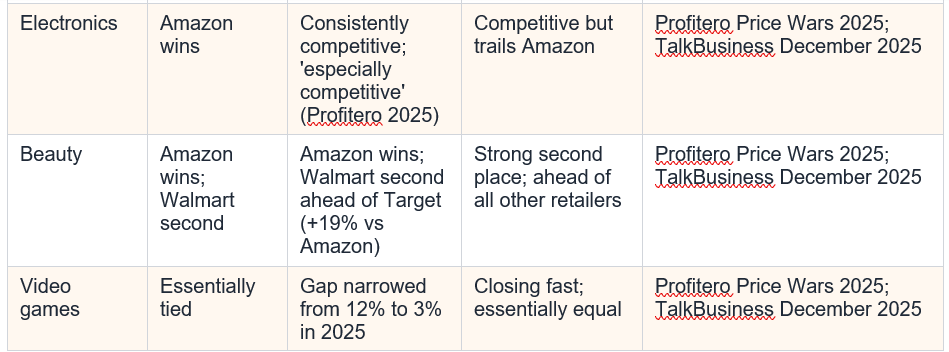
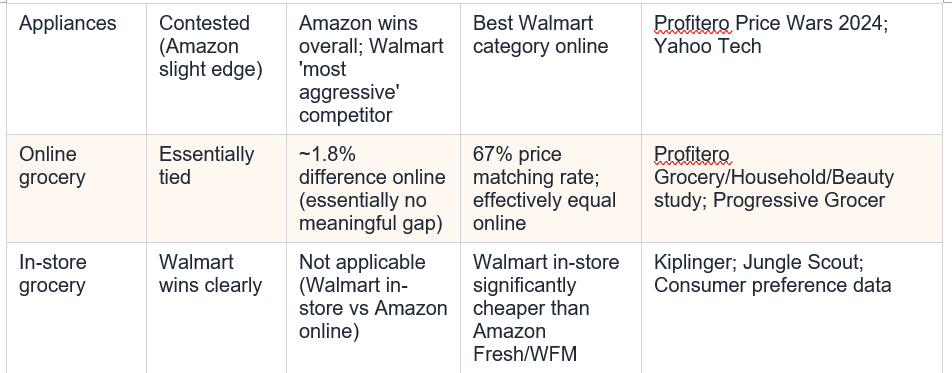
Too Close to Call: Video games: too close to call. Amazon’s advantage narrowed from 12% to just 3% in 2025 (Profitero 2025 cited TalkBusiness December 2025). On a $70 game, a 3% difference is $2.10. Appliances: worth checking both. Walmart is described as Amazon’s 'most aggressive' price competitor in appliances (Profitero 2024). Recommendation: always check both for appliances and video games; the margin of victory is small enough that specific item comparison is essential. Sources: TalkBusiness.net December 2025.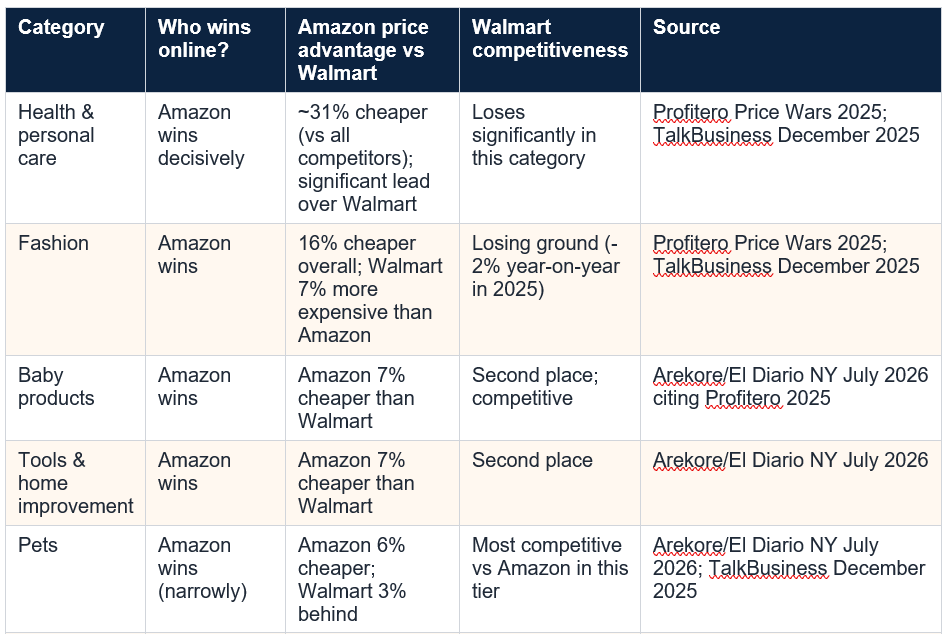
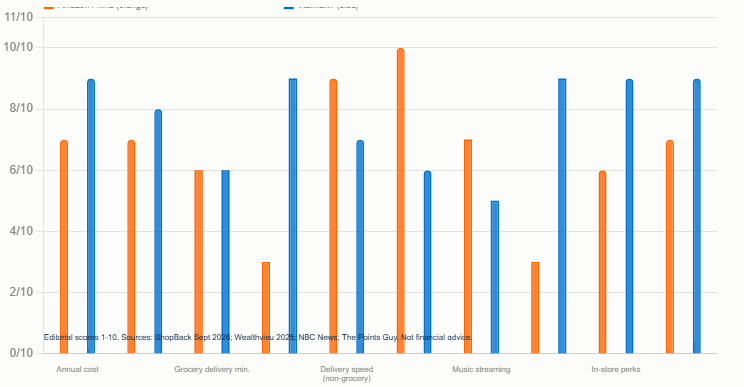
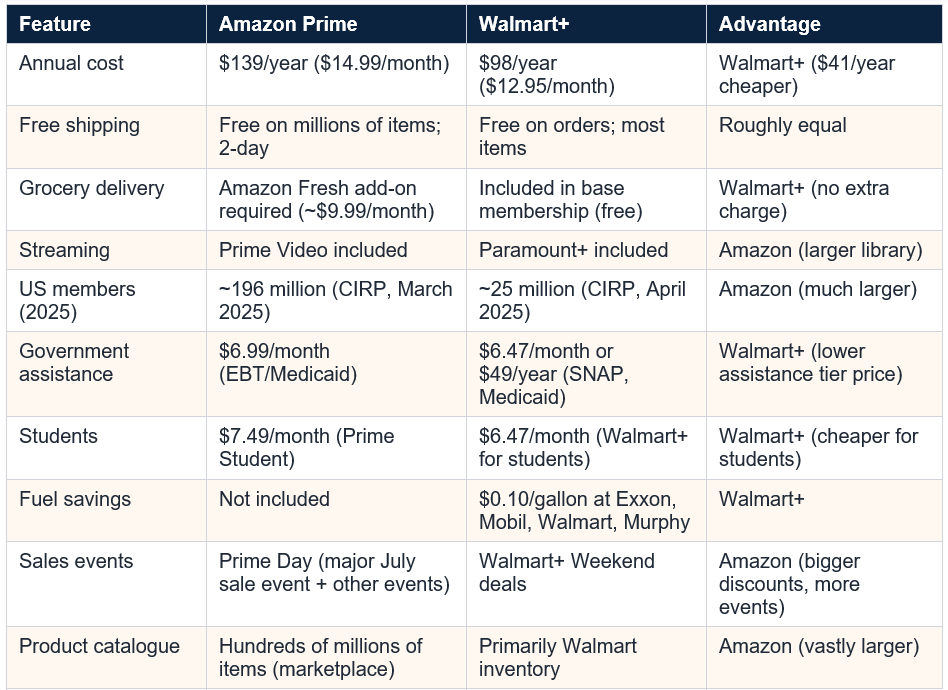
Amazon Prime costs $139 per year ($14.99/month). It includes free two-day shipping on millions of items, access to Prime Video, Prime Music, Prime Reading, exclusive access to Prime Day, and grocery delivery with Amazon Fresh (which requires an additional $9.99/month subscription for orders over $35). As of March 2025, Amazon Prime has approximately 196 million US members (CIRP estimate). Walmart Plus costs $98 per year ($12.95/month). It includes free shipping, free unlimited grocery delivery (included in the base price without a separate add-on), Paramount+ streaming, and fuel savings of up to $0.10 per gallon at Exxon, Mobil, Walmart, and Murphy gas stations. As of April 2025, Walmart Plus has approximately 25 million US members (CIRP estimate).
The membership cost differential is $41 per year — Walmart+ is cheaper (AARP). But Amazon Prime’s additional benefits (Prime Video, the wider product catalogue, Grubhub+ membership included free, Amazon-exclusive sales) may provide value exceeding $41 for heavy users. The decision comes down to the individual consumer’s usage pattern: for primarily grocery-focused households, Walmart+ delivers more grocery value at a lower price. For households that buy heavily across Amazon’s categories and consume streaming content, Prime’s broader benefit suite may justify the premium. Not financial advice.

The Arekore/El Diario NY analysis (July 2026) notes explicitly: ‘The trend for the following year is the impact of the 2025 tariffs, which have already made imported goods more expensive across several categories at all three retailers.’ AOL specifically covers the tariff impact in the context of the Walmart+ vs Amazon Prime comparison: ‘Here’s how much more you’ll pay, thanks to tariffs.’ Both retailers are simultaneously absorbing some tariff costs (reducing margin) and passing others on to consumers (increasing prices), making the price landscape more volatile than the pre-tariff baseline.
The tariff impact is most pronounced in electronics, toys, and clothing — three of Amazon’s strongest categories. If tariff costs push up Amazon’s prices in these categories more than Walmart’s (which has more US domestic manufacturing relationships and more direct negotiating leverage with suppliers due to its in-store footprint), Walmart could gain ground on the price comparison in 2026 beyond what the 2025 Profitero study shows. This is a developing story that will be visible in the 2026 edition of the Profitero Price Wars study when it is published. Not financial or shopping advice.
Tariff navigation tips: (1) For electronics and tech: price checking has become more important than ever in 2026, as tariff pass-through is uneven across categories and retailers. (2) For clothing: both retailers are more exposed; consider discount retailers or buying ahead of seasonal increases. (3) For groceries and household essentials: less tariff exposure than electronics; the Amazon vs Walmart comparison is less affected here. (4) Use browser extensions (Honey, CamelCamelCamel for Amazon history, Keepa for Amazon price tracking) to check whether a current price reflects tariff-related inflation or a genuine deal. Not shopping or financial advice.
Walmart wins on in-store grocery and everyday household essentials — where its physical footprint, scale, and consumer preference data (56% choose Walmart for grocery, only 15% choose Amazon) reflect a genuine structural advantage. Online grocery is essentially a tie at 1.8% difference, and appliances and video games are categories where Walmart has worked hard to close the gap.
The membership comparison further complicates the headline: Walmart+ at $98 is $41/year cheaper than Amazon Prime and includes grocery delivery without an add-on. For grocery-focused households, Walmart+ provides better value at lower cost. For multi-category shoppers who benefit from Amazon’s broader catalogue, Prime Video, and the significant price advantages in health, fashion, and baby products, Amazon Prime’s extra cost may be quickly recovered. The smart approach is to know which retailer wins in the category you’re shopping — and buy accordingly. Not financial or shopping advice.
Amazon is the overall online price leader for nine consecutive years according to Profitero's annual Price Wars studies (most recently Price Wars 2025). In the Profitero 2024 study (13,000+ items across 15 categories), Amazon's prices were 5% lower than Walmart's on average. In 2025, Amazon maintained a 14% overall advantage over all competitors (Profitero 2025). Amazon CEO Doug Herrington stated in November 2025: 'This research shows that Amazon is the lowest-price retailer in the United States.' However, this headline hides significant category variation: Walmart is competitive or wins in grocery (1.8% online gap; in-store clearly cheaper) and appliances. Not shopping advice; prices change dynamically. Check current prices before purchasing.
Is Amazon cheaper than Walmart for groceries?
Online grocery: essentially a tie. Profitero's dedicated grocery, household and beauty study found just a 1.8% average price difference between Walmart and Amazon on online grocery items. Walmart matched Amazon's prices on 67% of grocery items studied. In-store grocery: Walmart clearly wins. Walmart's in-store grocery prices are substantially lower than Amazon Fresh and Whole Foods Market (Amazon's primary grocery channel). Consumer preference data (Jungle Scout, 2022): by a 56%-to-15% margin, US consumers go to Walmart for groceries and everyday essentials. For groceries specifically: Walmart in-store is the cheapest major option; online grocery is essentially a tie between Walmart.com and Amazon Fresh. A February 2026 Consumer Reports analysis found Costco had surpassed Walmart on grocery prices (21.4% cheaper). Not shopping advice.
Is Amazon Prime worth it compared to Walmart+?
It depends on your shopping habits. Amazon Prime costs $139/year; Walmart+ costs $98/year -- a $41 annual difference. Walmart+ includes free grocery delivery in the base price; Amazon Fresh grocery delivery requires an additional ~$9.99/month on Amazon Prime. For primarily grocery-focused households: Walmart+ provides better included value at a lower price. For multi-category shoppers: Amazon Prime's price advantages (31% in health/personal care, 16% in fashion, 7% in tools and baby) can recover the $41 premium quickly. Amazon also has a much larger product catalogue and Prime Video (larger streaming library than Walmart+'s Paramount+). As of early 2025: Amazon Prime has ~196 million US members; Walmart+ has ~25 million. Both offer free 30-day trials. Not financial advice. Prices subject to change.
What is Amazon cheapest at compared to Walmart?
Based on Profitero Price Wars 2025 and Arekore/El Diario NY (July 2026) data: Amazon is most decisively cheaper than Walmart in: (1) Health and personal care: ~31% cheaper. (2) Fashion/clothing: ~16% cheaper. (3) Baby products: ~7% cheaper. (4) Tools and home improvement: ~7% cheaper. (5) Pets: ~6% cheaper. (6) Electronics: consistently competitive (especially Amazon's own brands). (7) Beauty: Amazon wins; Walmart second (both ahead of Target and Macy's). Note: all figures are averages from studies covering specific time periods. Individual item prices vary. Always check both retailers for specific purchases. Sources: TalkBusiness.net December 2025; Arekore/El Diario NY July 2026. Not shopping advice.
Has the tariff situation affected Amazon vs Walmart prices in 2026?
Yes. The Trump administration's 2025 tariffs on Chinese imports increased costs across electronics, toys, clothing, and home goods -- categories heavily reliant on Chinese manufacturing. Both Amazon and Walmart have been absorbing some tariff costs and passing others to consumers. The Arekore/El Diario NY analysis (July 2026) specifically notes that 2025 tariffs 'have already made imported goods more expensive across several categories at all three retailers.' Amazon may be more exposed to tariff pressure in electronics and fashion, where its marketplace relies heavily on imported products. Walmart has more direct relationships with US-based and non-China manufacturing and more negotiating leverage due to its massive physical retail footprint. The 2026 edition of Profitero's Price Wars study will show whether tariffs have shifted the Amazon vs Walmart price gap. Check current prices before purchasing; the tariff environment has made price comparison more important than ever. Not shopping or financial advice.
Table of Contents
- The Price War: Amazon vs Walmart’s Nine-Year Rivalry
- The Methodology: How These Price Studies Work
- The Overall Verdict: Amazon Wins Online — But Not in Every Aisle
- Category Breakdown: Health and Personal Care
- Category Breakdown: Grocery and Everyday Essentials
- Category Breakdown: Electronics, Tools, and Home Improvement
- Category Breakdown: Fashion, Beauty, and Baby
- Category Breakdown: Pets, Video Games, and Appliances
- The Full Category Comparison Table
- Amazon Prime vs Walmart+: The Membership Equation
- The Tariff Effect: How 2025 Trade Policy Changed Both Retailers’ Prices
- How to Use Both Retailers to Pay the Lowest Price
- Conclusion: One Winner per Aisle
- Frequently Asked Questions
Category price gaps — who wins where (Profitero 2025)
Membership comparison — Prime vs Walmart+ full breakdown
The closing gap — Walmart gaining on Amazon year-over-year
The Price War: Amazon vs Walmart’s Nine-Year Rivalry
Few retail battles have been as consequential for the American consumer as the ongoing price war between Amazon and Walmart. These are the two largest retailers in the United States by online and overall sales respectively, and for nearly a decade they have been locked in a dynamic where each side’s pricing on millions of products triggers adjustments from the other, often within the same trading day. Amazon prices items algorithmically, adjusting in real time. Walmart has responded with increasingly sophisticated price-matching infrastructure that monitors Amazon and deploys targeted price cuts to protect its most important categories.The result is a market that benefits consumers — but navigating it requires knowing which of the two giants wins in each product category, because the answer is not the same everywhere. Amazon has been named the lowest-price online retailer in the US for nine consecutive years by Profitero’s annual Price Wars study. But Doug Herrington’s claim as CEO of Amazon Worldwide Stores in November 2025 — ‘This research shows that Amazon is the lowest-price retailer in the United States’ — is an overstatement that the data does not fully support in every category. Walmart wins on in-store groceries, is Amazon’s closest price competitor online, and is the most aggressive rival specifically in appliances.
This article uses the most rigorous available data — primarily Profitero’s annual Price Wars studies, the most widely cited and methodologically robust price comparison research available in the US retail market — to give a category-by-category answer to the question every bargain-hunting shopper asks: Amazon or Walmart? Not financial or shopping advice; prices change dynamically and must be checked before purchasing.
Amazon: lowest-price online retailer for 9 consecutive years (Profitero Price Wars 2025). Average price advantage: 14% over all competitors (Profitero 2025); 5% over Walmart specifically (Profitero 2024). Doug Herrington (CEO, Amazon Worldwide Stores, November 2025): 'Amazon is the lowest-price retailer in the United States.' Amazon: 37.6% US e-commerce market share (Statista May 2024). Walmart: 6.4% e-commerce share; 3,335+ stores. Amazon Prime: 196M US members; Walmart+: 25M US members (CIRP, 2025 quarterly data). Sources: El Diario NY/Arekore July 2026; TalkBusiness.net December 2025; Yahoo Tech; CIRP May 2025.
The Methodology: How These Price Studies Work
The primary data source for Amazon vs Walmart price comparisons in this article is Profitero’s annual Price Wars study — the ninth edition of which was released in 2025. Profitero is a Boston-based e-commerce analytics firm that has been running price comparison research since 2016. The methodology examines like-for-like items — the same product, same size, same quantity — across Amazon and its major online retail competitors, including Walmart, Target, and others.The 2024 edition examined more than 13,000 items across 15 product categories over a 12-week period from July to September 2024. The 2025 edition examined more than 10,000 items across 16 product categories. The studies compare ‘everyday low prices’ — not sale or promotional prices — to capture the structural price positioning of each retailer rather than temporary discounting events.
A critical nuance: Profitero’s studies compare online prices only. They do not compare Amazon online prices to Walmart in-store prices, which is a fundamentally different shopping context. Walmart’s in-store prices — particularly for grocery — are generally lower than both Walmart.com and Amazon’s equivalent. The studies also compare list prices, which means a membership like Amazon Prime or Walmart+ can change the effective price paid. This article addresses the membership dimension separately in Section 10. Not financial or shopping advice.
The Overall Verdict: Amazon Wins Online — But Not in Every Aisle
The headline from Profitero’s 2025 Price Wars study is clear: Amazon maintained a 14% average price advantage over all retailers tracked, and has now held the lowest-price title for nine consecutive years. Compared specifically to Walmart, the average online price gap in 2024 was approximately 5% in Amazon’s favour — meaning Amazon was 5% cheaper on average than Walmart.com across identical items.But the ‘average’ obscures the category-level reality that is far more useful to the consumer. Amazon’s 14% average advantage is driven primarily by a small number of categories where the price gap is very large — health and personal care (31% cheaper at Amazon) and fashion (16% cheaper) — which pull the average up significantly. In grocery, the gap has narrowed to just 1.8% between the two retailers online. In appliances, Walmart is described as Amazon’s ‘most aggressive’ competitor. In video games, the gap shrank from 12% to just 3% in 2025.
The practical implication: if you shop primarily for groceries and household essentials, Walmart is competitive and may even be better (particularly in-store). If you shop primarily for health products, fashion, electronics, tools, and baby products, Amazon’s price advantage is significant. The smart shopper uses both, allocating by category. Not financial or shopping advice.
Category: Health and Personal Care — Amazon’s Biggest Win
Health and personal care is Amazon’s most dominant category in the price wars. Profitero’s 2025 study found Amazon is 31% cheaper than competitors on health and personal care items — the largest single category gap in the entire study. This is a category that covers a vast range of essential spending: vitamins, supplements, over-the-counter medications, skincare products, dental care, hair care, and personal hygiene products.The 31% price gap in health and personal care is not a marginal advantage. On a household that spends $200/month on these items, an Amazon shopper would expect to pay approximately $134 vs the $200 equivalent at higher-priced competitors, a saving of approximately $800 per year in this category alone. Compared specifically to Walmart (rather than the category average across all competitors), Amazon’s advantage may be somewhat smaller, but the directional finding is consistent: Walmart’s health and personal care prices are higher than Amazon’s online.
The reasons relate partly to Amazon’s marketplace structure: third-party sellers on Amazon compete heavily in health and personal care, driving down prices through competition. Amazon also uses health and personal care items as traffic-driving categories where it is willing to maintain lower margins. Not financial or shopping advice.
Amazon Wins: Health and personal care: Amazon wins decisively. Profitero Price Wars 2025: Amazon 31% cheaper on health and personal care than competitors. This is Amazon's largest single price advantage category. Recommendation: buy vitamins, supplements, OTC medications, skincare, and personal care products on Amazon for the significant price advantage. Always compare specific items before purchasing. Source: TalkBusiness.net December 2025 citing Profitero 2025.
Category: Grocery and Everyday Essentials — Walmart’s Battleground
Grocery is the category where Walmart fights hardest — and where the price gap with Amazon is at its narrowest. Profitero’s dedicated grocery, household and beauty study found just a 1.8% average price difference between Walmart and Amazon on online grocery items — essentially a dead heat by any practical measure. Walmart matched Amazon’s grocery prices on 67% of the items compared, the highest price-matching rate of any Walmart category.However, the meaningful distinction is between online grocery prices and in-store grocery prices. Walmart’s in-store grocery prices are consistently lower than its online prices, lower than Amazon Fresh, and substantially lower than Whole Foods Market (Amazon’s primary physical grocery channel). Consumer research from Jungle Scout found that by a 56%-to-15% margin, US consumers go to Walmart when they need groceries or everyday affordable items — not just because of price but because of proximity, trust, and Walmart’s far larger physical footprint.
A Consumer Reports analysis (cited in El Diario NY, February 2026) found that Costco had actually surpassed Walmart for grocery prices, with prices 21.4% below Walmart on comparable items. For grocery shoppers, the hierarchy from cheapest to most expensive is approximately: Costco (for bulk), Walmart in-store, Walmart online ≈ Amazon Fresh, Whole Foods Market. The 1.8% online grocery gap between Walmart and Amazon is not worth stressing over — but Walmart in-store is meaningfully cheaper than any Amazon option. Not financial or shopping advice.
Walmart Wins: Grocery: Walmart wins on in-store pricing. Online grocery: essentially a draw (1.8% difference per Profitero grocery study). Walmart matched Amazon on 67% of grocery items studied. Consumer preference: 56%-to-15% margin of consumers choose Walmart for grocery/everyday essentials (Jungle Scout). Recommendation: for weekly grocery shopping, Walmart in-store is cheaper than Amazon Fresh or Whole Foods. Online grocery is close enough to choose on delivery convenience and membership benefits. Sources: Progressive Grocer; Jungle Scout; El Diario NY/Consumer Reports February 2026.
Category: Electronics, Tools, and Home Improvement
Electronics and technology products are another strong category for Amazon, which Profitero 2025 identifies as ‘especially competitive in electronics, tools and appliances.’ The Arekore/El Diario NY comparative analysis (June 2026) specifically found tools and home improvement products to be 7% cheaper on Amazon than Walmart. For electronics, Amazon’s combination of its own private-label products (Amazon Basics, Amazon Devices), third-party marketplace competition, and price monitoring algorithms keeps prices highly competitive.In appliances — a sub-category of home improvement — Walmart is specifically called out as Amazon’s ‘most aggressive’ price competitor (Profitero 2024). This suggests that while Amazon wins overall, Walmart competes most intensely in appliances specifically, making it worth checking both sites before purchasing a larger appliance. For tools, hand tools, and home improvement supplies: Amazon’s 7% average advantage is meaningful, particularly on higher-ticket items.
It is worth noting that both retailers carry different assortments of electronics brands and models, which complicates direct comparison. Amazon’s marketplace includes many third-party electronics sellers, which can offer lower prices than retail but also carry greater risk of counterfeit or grey-market products. Walmart’s electronics section typically focuses on major US-market products from established retailers, which provides a different kind of assurance. Not financial or shopping advice.
Amazon Wins: Electronics and tools: Amazon wins. Tools and home improvement: Amazon 7% cheaper than Walmart (Arekore/El Diario NY, citing Profitero 2025). Electronics: Amazon consistently competitive (Profitero 2025). Exception: appliances specifically -- Walmart is Amazon's most aggressive competitor in this sub-category. Recommendation: check both for appliances; for tools, home improvement, and electronics, Amazon's price advantage is generally meaningful. Sources: TalkBusiness.net December 2025; El Diario NY/Arekore July 2026.
Category: Fashion, Beauty, and Baby Products
Fashion is Amazon’s second-most dominant category after health and personal care. Profitero’s 2025 study found Amazon held a 16% average price advantage in fashion, with Walmart’s fashion prices 7% more expensive than Amazon’s. Walmart actually lost ground on fashion compared to the previous year, falling 2% further behind Amazon’s price competitiveness. The trend has been consistent: Amazon’s expansion of its own private-label fashion brands and third-party fashion sellers has driven fashion prices down aggressively.In beauty, Walmart has been working hard to close the gap, bringing in more upscale brands to compete with Amazon’s beauty category. But as of Profitero 2025, Amazon still holds the lead. Walmart maintains second-lowest prices in beauty among all tracked retailers, ahead of Target (which was 19% more expensive than Amazon and 15% more expensive than Walmart) and Macy’s (20% more expensive than Amazon, 16% more than Walmart). For a beauty shopper, the hierarchy is Amazon first, Walmart second, other retailers significantly higher.
Baby products are specifically identified by Arekore/El Diario NY (June 2026) as a category where Amazon is 7% cheaper than Walmart. Baby products — including formula, diapers, wipes, bottles, and baby care items — represent a significant ongoing household cost for families with young children, making Amazon’s 7% advantage a meaningful annual saving. Pets show a similar pattern: Amazon 6% cheaper, Walmart only 3% behind. Not financial or shopping advice.
Amazon Wins: Fashion: Amazon 16% cheaper (Profitero 2025; Walmart 7% more expensive than Amazon). Beauty: Amazon wins; Walmart second (ahead of Target at +19% and Macy's at +20% vs Amazon). Baby products: Amazon 7% cheaper (Arekore/El Diario NY). Pets: Amazon 6% cheaper; Walmart only 3% behind (most competitive gap in this grouping). Sources: TalkBusiness.net December 2025; El Diario NY/Arekore July 2026.
Category: Video Games and Appliances — The Closing Gap
Video games are the category that showed the most dramatic shift in 2025. Profitero’s data showed the price gap between Amazon and competitors in video games shrank from 12% in 2024 to just 3% in 2025 — a major erosion of Amazon’s advantage. This likely reflects both increased competition from digital download platforms (Steam, PlayStation Store, Xbox Store) that anchor video game prices, and Walmart’s more aggressive video game pricing strategy. A 3% price gap is barely noticeable on a $59.99 game purchase.Appliances — refrigerators, washing machines, dishwashers, and similar major home purchases — is the category where Walmart competes most intensely with Amazon online. While Amazon generally wins on the majority of appliance comparisons, Walmart’s appliance pricing is described as ‘most aggressive’ in Profitero’s 2024 study. For significant appliance purchases, the difference between checking both sites and buying from the first result could be measured in tens or hundreds of dollars. Both retailers also offer installation services and delivery on major appliances.
Too Close to Call: Video games: too close to call. Amazon’s advantage narrowed from 12% to just 3% in 2025 (Profitero 2025 cited TalkBusiness December 2025). On a $70 game, a 3% difference is $2.10. Appliances: worth checking both. Walmart is described as Amazon’s 'most aggressive' price competitor in appliances (Profitero 2024). Recommendation: always check both for appliances and video games; the margin of victory is small enough that specific item comparison is essential. Sources: TalkBusiness.net December 2025.
The Full Category Comparison Table
Amazon Prime vs Walmart+: The Membership Equation
The product price comparison is only half the story. Both Amazon and Walmart operate subscription membership programmes that provide free shipping, exclusive discounts, and additional benefits — and the cost of membership can change which retailer is actually cheaper when the full picture is considered.Amazon Prime costs $139 per year ($14.99/month). It includes free two-day shipping on millions of items, access to Prime Video, Prime Music, Prime Reading, exclusive access to Prime Day, and grocery delivery with Amazon Fresh (which requires an additional $9.99/month subscription for orders over $35). As of March 2025, Amazon Prime has approximately 196 million US members (CIRP estimate). Walmart Plus costs $98 per year ($12.95/month). It includes free shipping, free unlimited grocery delivery (included in the base price without a separate add-on), Paramount+ streaming, and fuel savings of up to $0.10 per gallon at Exxon, Mobil, Walmart, and Murphy gas stations. As of April 2025, Walmart Plus has approximately 25 million US members (CIRP estimate).
The membership cost differential is $41 per year — Walmart+ is cheaper (AARP). But Amazon Prime’s additional benefits (Prime Video, the wider product catalogue, Grubhub+ membership included free, Amazon-exclusive sales) may provide value exceeding $41 for heavy users. The decision comes down to the individual consumer’s usage pattern: for primarily grocery-focused households, Walmart+ delivers more grocery value at a lower price. For households that buy heavily across Amazon’s categories and consume streaming content, Prime’s broader benefit suite may justify the premium. Not financial advice.
The Tariff Effect: How 2025 Trade Policy Changed Both Retailers’ Prices
The Trump administration’s tariff announcements in April 2025 sent shockwaves through both retailers’ pricing strategies. Tariffs on Chinese imports — which affect electronics, toys, clothing, home goods, and many other Amazon and Walmart product categories — created significant upward cost pressure that both retailers have been managing throughout 2025 and 2026.The Arekore/El Diario NY analysis (July 2026) notes explicitly: ‘The trend for the following year is the impact of the 2025 tariffs, which have already made imported goods more expensive across several categories at all three retailers.’ AOL specifically covers the tariff impact in the context of the Walmart+ vs Amazon Prime comparison: ‘Here’s how much more you’ll pay, thanks to tariffs.’ Both retailers are simultaneously absorbing some tariff costs (reducing margin) and passing others on to consumers (increasing prices), making the price landscape more volatile than the pre-tariff baseline.
The tariff impact is most pronounced in electronics, toys, and clothing — three of Amazon’s strongest categories. If tariff costs push up Amazon’s prices in these categories more than Walmart’s (which has more US domestic manufacturing relationships and more direct negotiating leverage with suppliers due to its in-store footprint), Walmart could gain ground on the price comparison in 2026 beyond what the 2025 Profitero study shows. This is a developing story that will be visible in the 2026 edition of the Profitero Price Wars study when it is published. Not financial or shopping advice.
Tariff navigation tips: (1) For electronics and tech: price checking has become more important than ever in 2026, as tariff pass-through is uneven across categories and retailers. (2) For clothing: both retailers are more exposed; consider discount retailers or buying ahead of seasonal increases. (3) For groceries and household essentials: less tariff exposure than electronics; the Amazon vs Walmart comparison is less affected here. (4) Use browser extensions (Honey, CamelCamelCamel for Amazon history, Keepa for Amazon price tracking) to check whether a current price reflects tariff-related inflation or a genuine deal. Not shopping or financial advice.
How to Use Both Retailers to Pay the Lowest Price
The most financially optimal approach for the American consumer is not to be loyal to Amazon or Walmart — it is to use both strategically, allocating purchases by category according to where the price advantage lies. This is the conclusion supported by all the data in this article, and it is straightforward to implement.- Health, personal care, vitamins, supplements, OTC medications: default to Amazon. 31% average advantage makes this Amazon’s strongest category; the saving on regular purchases is the largest available.
- Grocery and everyday household essentials: Walmart in-store for weekly grocery shopping; online the two are essentially equal. If you have Walmart+, the included grocery delivery makes Walmart the practical choice for online grocery.
- Fashion and clothing: Amazon. 16% average advantage; Walmart is 7% more expensive on comparable items.
- Tools and home improvement: Amazon. 7% average cheaper than Walmart; significant on higher-ticket tool purchases.
- Baby products: Amazon. 7% average price advantage.
- Pet products: Amazon (6% cheaper) but Walmart is competitive (only 3% behind). Compare specific items.
- Electronics: Amazon generally, but always compare specific items. Third-party Amazon marketplace products carry additional counterfeit/grey market risk; check seller ratings carefully.
- Beauty products: Amazon first, Walmart second. Both significantly beat Target and Macy’s.
- Appliances: check both. Walmart is most competitive specifically in this category; the price difference can be meaningful on a $500+ appliance.
- Video games: essentially a tie (3% gap); choose based on delivery, condition preference, and format.
13. Conclusion: One Winner per Aisle
The answer to ‘Amazon vs Walmart: who has the cheapest price?’ is both of them — depending on what you’re buying. Amazon wins the overall online price comparison nine years running, and its category-level advantages are largest in health and personal care (31%), fashion (16%), baby products (7%), tools (7%), and baby/pet products (6–7%). These are the categories where habitually defaulting to Amazon will produce the most meaningful savings.Walmart wins on in-store grocery and everyday household essentials — where its physical footprint, scale, and consumer preference data (56% choose Walmart for grocery, only 15% choose Amazon) reflect a genuine structural advantage. Online grocery is essentially a tie at 1.8% difference, and appliances and video games are categories where Walmart has worked hard to close the gap.
The membership comparison further complicates the headline: Walmart+ at $98 is $41/year cheaper than Amazon Prime and includes grocery delivery without an add-on. For grocery-focused households, Walmart+ provides better value at lower cost. For multi-category shoppers who benefit from Amazon’s broader catalogue, Prime Video, and the significant price advantages in health, fashion, and baby products, Amazon Prime’s extra cost may be quickly recovered. The smart approach is to know which retailer wins in the category you’re shopping — and buy accordingly. Not financial or shopping advice.
Frequently Asked Questions
Is Amazon or Walmart cheaper overall?Amazon is the overall online price leader for nine consecutive years according to Profitero's annual Price Wars studies (most recently Price Wars 2025). In the Profitero 2024 study (13,000+ items across 15 categories), Amazon's prices were 5% lower than Walmart's on average. In 2025, Amazon maintained a 14% overall advantage over all competitors (Profitero 2025). Amazon CEO Doug Herrington stated in November 2025: 'This research shows that Amazon is the lowest-price retailer in the United States.' However, this headline hides significant category variation: Walmart is competitive or wins in grocery (1.8% online gap; in-store clearly cheaper) and appliances. Not shopping advice; prices change dynamically. Check current prices before purchasing.
Is Amazon cheaper than Walmart for groceries?
Online grocery: essentially a tie. Profitero's dedicated grocery, household and beauty study found just a 1.8% average price difference between Walmart and Amazon on online grocery items. Walmart matched Amazon's prices on 67% of grocery items studied. In-store grocery: Walmart clearly wins. Walmart's in-store grocery prices are substantially lower than Amazon Fresh and Whole Foods Market (Amazon's primary grocery channel). Consumer preference data (Jungle Scout, 2022): by a 56%-to-15% margin, US consumers go to Walmart for groceries and everyday essentials. For groceries specifically: Walmart in-store is the cheapest major option; online grocery is essentially a tie between Walmart.com and Amazon Fresh. A February 2026 Consumer Reports analysis found Costco had surpassed Walmart on grocery prices (21.4% cheaper). Not shopping advice.
Is Amazon Prime worth it compared to Walmart+?
It depends on your shopping habits. Amazon Prime costs $139/year; Walmart+ costs $98/year -- a $41 annual difference. Walmart+ includes free grocery delivery in the base price; Amazon Fresh grocery delivery requires an additional ~$9.99/month on Amazon Prime. For primarily grocery-focused households: Walmart+ provides better included value at a lower price. For multi-category shoppers: Amazon Prime's price advantages (31% in health/personal care, 16% in fashion, 7% in tools and baby) can recover the $41 premium quickly. Amazon also has a much larger product catalogue and Prime Video (larger streaming library than Walmart+'s Paramount+). As of early 2025: Amazon Prime has ~196 million US members; Walmart+ has ~25 million. Both offer free 30-day trials. Not financial advice. Prices subject to change.
What is Amazon cheapest at compared to Walmart?
Based on Profitero Price Wars 2025 and Arekore/El Diario NY (July 2026) data: Amazon is most decisively cheaper than Walmart in: (1) Health and personal care: ~31% cheaper. (2) Fashion/clothing: ~16% cheaper. (3) Baby products: ~7% cheaper. (4) Tools and home improvement: ~7% cheaper. (5) Pets: ~6% cheaper. (6) Electronics: consistently competitive (especially Amazon's own brands). (7) Beauty: Amazon wins; Walmart second (both ahead of Target and Macy's). Note: all figures are averages from studies covering specific time periods. Individual item prices vary. Always check both retailers for specific purchases. Sources: TalkBusiness.net December 2025; Arekore/El Diario NY July 2026. Not shopping advice.
Has the tariff situation affected Amazon vs Walmart prices in 2026?
Yes. The Trump administration's 2025 tariffs on Chinese imports increased costs across electronics, toys, clothing, and home goods -- categories heavily reliant on Chinese manufacturing. Both Amazon and Walmart have been absorbing some tariff costs and passing others to consumers. The Arekore/El Diario NY analysis (July 2026) specifically notes that 2025 tariffs 'have already made imported goods more expensive across several categories at all three retailers.' Amazon may be more exposed to tariff pressure in electronics and fashion, where its marketplace relies heavily on imported products. Walmart has more direct relationships with US-based and non-China manufacturing and more negotiating leverage due to its massive physical retail footprint. The 2026 edition of Profitero's Price Wars study will show whether tariffs have shifted the Amazon vs Walmart price gap. Check current prices before purchasing; the tariff environment has made price comparison more important than ever. Not shopping or financial advice.
0 Comments
Be the first to share your thoughts on this article.