
Savings
Beat Inflation: Best Savings Accounts and CD Rates

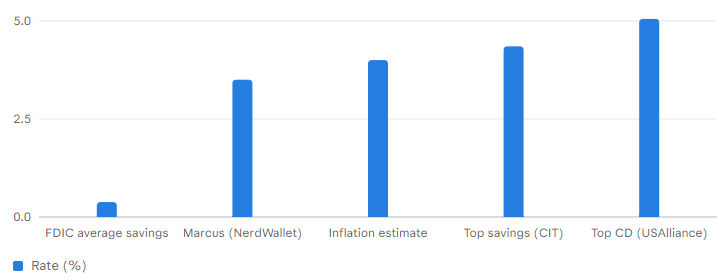
Inflation is running above the Federal Reserve’s target, but some savings accounts and CDs still offer rates that can help your cash keep pace. October 2026 CPI +0.4% monthly, no official annual rate; a private estimate of about 4.0%; Fed funds range 3.75%-4.00%; national average savings rate about 0.38%; top savings about 4.2% to 4.4%; top CDs about 5.0%.
High-yield savings rates, November 2026 (APY %)
APY % by Sources: WalletHub, Bankrate, NerdWallet; check each bank
Whether that beats inflation depends on which inflation number you use, and this month that is awkward. The Bureau of Labor Statistics said prices rose 0.4% in October on a seasonally adjusted basis, but it did not publish the usual annual rate. A private estimate puts the annual figure at about 4.0%. So the best accounts roughly match inflation, and the average account falls far behind.
In this post I explain the inflation picture, what the Fed is doing, which accounts and CDs are leading, how to compare them honestly, and how to choose. I do not recommend any single bank. I list what the sources say and tell you where they disagree.
Key takeaway: A savings rate only protects your cash if it is close to or above inflation. The best savings accounts and CDs are around 4% to 5%, which is near the estimated inflation rate. The average account, at under 1%, loses buying power every month.
Now the catch. The BLS did not report an annual inflation figure for October 2026. A government funding lapse in October 2025 meant prices were not collected that month, so there is no October 2025 baseline to compare with. That is why you will not find the usual "inflation is X% over the last year" headline for October.
Private estimates fill the gap. InflationData.com estimated the annual rate at about 4.0% by filling in the missing month with an assumed index value. It is a reasonable approach but it is not an official figure. The same site notes the unadjusted CPI index was 336.940 in September and 337.511 in October, a 0.17% monthly rise, against the 0.4% headline, which is seasonally adjusted
.
Two readings, then. Month on month, 0.4% repeated for twelve months would be about 4.9% a year, and September's 0.6% would be about 7.4% (my calculation, which is only an illustration, not a forecast). The estimated annual rate is about 4.0%. I will use 4.0% as a rough benchmark in this post, and I will say each time that it is an estimate.
Here is what that means in cash terms (my calculation). On $10,000, 0.38% earns about $38 a year. At 4.35% you would earn about $435. If inflation is about 4.0%, you need about $400 a year just to keep your $10,000 buying the same things. So the average account loses about $362 a year in buying power, and a 4.35% account roughly keeps pace.
High-yield accounts are mostly online banks. They tend to have lower costs and often pass more interest on. They are normal savings accounts, not investments.
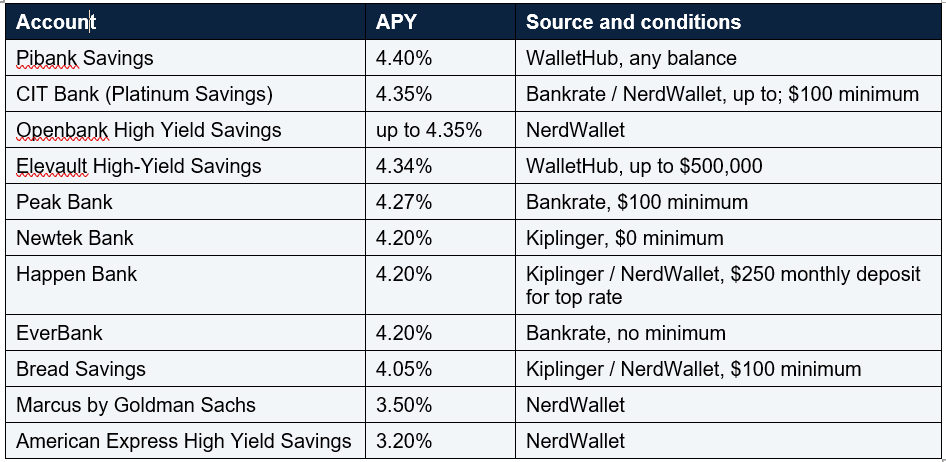
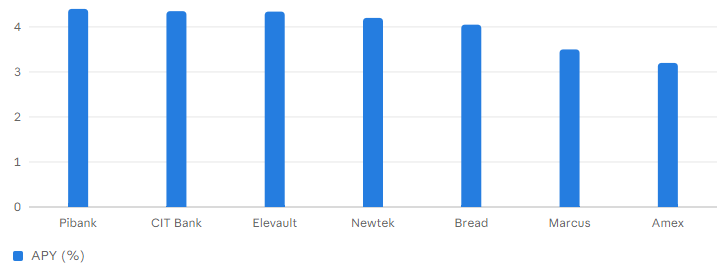
Sources: WalletHub, Bankrate, NerdWallet, Kiplinger. A caution: the Bankrate page I saw had an older cache date, so its rates may be out of date. Notice the spread. The best accounts are around 4.2% to 4.4%, while well-known brands such as Marcus and American Express pay 3.20% to 3.50%. On $10,000, the gap between 4.35% and 3.50% is about $85 a year (my calculation). Brand names do not guarantee a good rate.
Credit unions can pay more. Monitor Bank Rates lists Infuze Credit Union at 5.01% APY and UNIFY Financial Federal Credit Union at 5.00%. The same page shows a few eye-catching figures such as a 10.00% APY at a small credit union. I would check the terms on any rate like that, because high figures often apply only to small balances or require debit-card spending.
The test for a promotional rate is simple: what is the rate after the promotion ends, what do you have to do to qualify, and how much can you earn on how much money? Here, the CNBC page's standard Axos rate of up to 4.21% is the number to compare with the others .
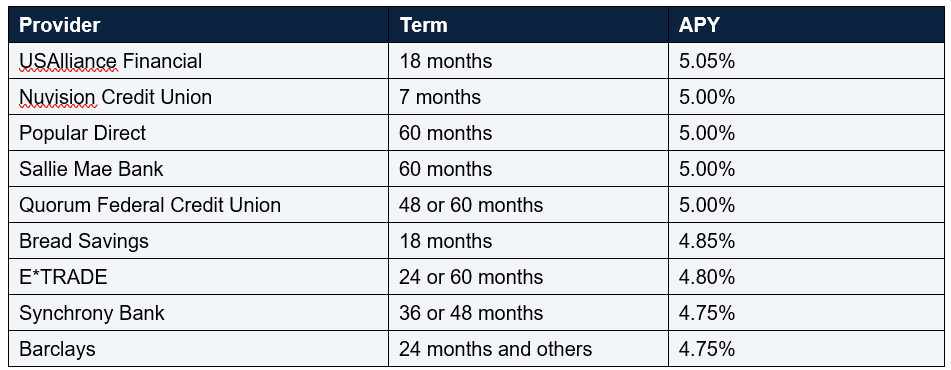
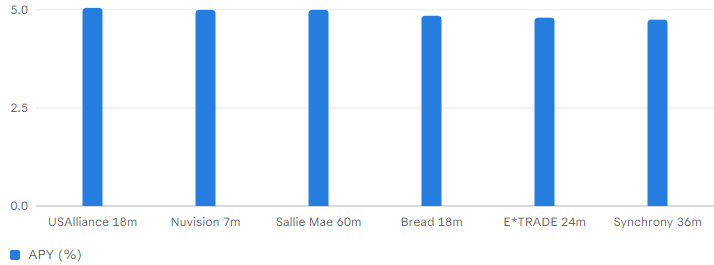
Source: CNBC Select . Bankrate's page says the top CD rate it tracks is 5.00% from Quorum Federal Credit Union, with Bread at 3.95% to 4.85% depending on term and E*TRADE at 4.20% to 4.80%. That page may be older, but the picture is consistent: the best CDs pay about 5%. One feature stands out. A 7-month CD at 5.00% and a 60-month CD at 5.00% pay the same rate, which means the market is not paying you much extra to lock up your money for five years. That matters in the next section.
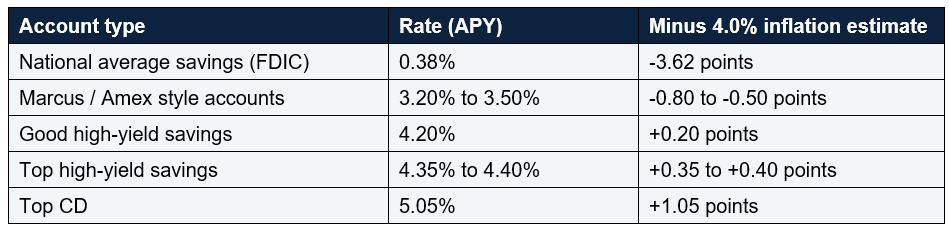
These are my calculations from the sources above. They show that the best savings accounts only slightly beat the estimate, while top CDs have a bigger cushion of about one percentage point. Two things reduce those gaps. First, interest is generally taxable. In the US it is usually taxed as ordinary income, so someone in a 22% bracket keeps about 3.4% of a 4.35% rate (my calculation, and a general-knowledge point, not from the sources above). Second, if inflation turns out to be higher than 4.0%, for example if monthly numbers like October's 0.4% continue, the gap narrows. So the honest answer is that the best accounts help your cash keep pace, but they may not make it grow in real terms, especially after tax. Without them, you are going backwards.
Because the 7-month and 60-month top rates are the same, I would think carefully before locking money for five years for no extra rate. A shorter CD, or a ladder with several CDs maturing at different times, gives flexibility. That is a general idea, not something from the sources. A simple split is to keep your emergency fund in a high-yield savings account, and consider a CD for money you will not need until a known date. Neither is risky in the way stocks are, but each has trade-offs.
Insurance: as noted, the usual limit is $250,000. If you have more than that, consider spreading balances across banks. Fine print: read the disclosure for rate changes, promotional periods and early-withdrawal penalties. Do not rely on a comparison site's headline alone, since the sites I used disagree by up to about 0.2 points on the leaders and show different dates. Also, comparison sites often earn money when you click an offer. I have no such relationship with any bank in this post.
Mistakes I see: leaving your emergency fund in an account paying 0.38% when 4% or more is available; chasing a 5% promotional rate and forgetting it drops after six months; locking a long CD without needing to; ignoring the minimum balance; and keeping more than the insured limit at one bank. Another is assuming rates will stay put. Variable rates move, and the Fed may act on 8 to 9 December.
Here is a simple plan, offered as education and not advice.
The BLS reported a 0.4% monthly rise (seasonally adjusted) but no annual rate, because October 2025 data was not collected [2][3]. One private estimate is about 4.0%.
What is the best savings account rate right now?
Among mainstream online banks, leading rates are about 4.2% to 4.4% APY, for example Pibank at 4.40% and CIT Bank at 4.35%, with some credit unions near 5%. Check each bank for the current rate.
Do savings accounts beat inflation?
The average one, at about 0.38%, does not. The best high-yield accounts roughly match it, and the top CDs, at about 5%, do slightly better, based on a 4.0% estimate.
Should I choose a CD or a savings account?
A savings account is flexible and its rate can rise if the Fed hikes [8]. A CD locks in a rate, which helps if rates fall. The best choice depends on when you need the money.
Will savings rates go up after a Fed hike?
Variable rates usually adjust upward over the following weeks, according to Raisin, but a December hike is not certain.
Table of Contents
- The quick answer
- What was October's inflation rate?
- What the Federal Reserve is doing
- What most savers actually earn
- The best high-yield savings rates right now
- Promotional rates and credit unions
- The best CD rates right now
- Do these rates beat inflation? The maths
- Savings account or CD?
- How to choose an account
- Taxes, insurance and other fine print
- Conclusion
- FAQ
What your cash earns vs estimated inflation (% a year)
% APY or inflation by Sources: ifyouspent/FDIC, NerdWallet, InflationData (estimate), Bankrate, CNBCHigh-yield savings rates, November 2026 (APY %)
APY % by Sources: WalletHub, Bankrate, NerdWallet; check each bank
Top CD rates, November 2026 (APY %)
APY % by Source: CNBC Select, November 2026
The quick answer
Prices are still rising faster than most savers would like, and the average savings account barely moves. The good news is that some accounts do pay a lot more. Top high-yield savings accounts are paying roughly 4.0% to 4.4% APY, and the best CDs pay about 5%, according to the lists I checked.Whether that beats inflation depends on which inflation number you use, and this month that is awkward. The Bureau of Labor Statistics said prices rose 0.4% in October on a seasonally adjusted basis, but it did not publish the usual annual rate. A private estimate puts the annual figure at about 4.0%. So the best accounts roughly match inflation, and the average account falls far behind.
In this post I explain the inflation picture, what the Fed is doing, which accounts and CDs are leading, how to compare them honestly, and how to choose. I do not recommend any single bank. I list what the sources say and tell you where they disagree.
Key takeaway: A savings rate only protects your cash if it is close to or above inflation. The best savings accounts and CDs are around 4% to 5%, which is near the estimated inflation rate. The average account, at under 1%, loses buying power every month.
What was October's inflation rate?
The official numbers first. The BLS reported that the Consumer Price Index rose 0.4% in October, seasonally adjusted, after rising 0.6% in September. The index excluding food and energy rose 0.3%. CNBC noted that was a slowdown from September but above what economists expected, and a level still described as uncomfortably high.Now the catch. The BLS did not report an annual inflation figure for October 2026. A government funding lapse in October 2025 meant prices were not collected that month, so there is no October 2025 baseline to compare with. That is why you will not find the usual "inflation is X% over the last year" headline for October.
Private estimates fill the gap. InflationData.com estimated the annual rate at about 4.0% by filling in the missing month with an assumed index value. It is a reasonable approach but it is not an official figure. The same site notes the unadjusted CPI index was 336.940 in September and 337.511 in October, a 0.17% monthly rise, against the 0.4% headline, which is seasonally adjusted
.
Two readings, then. Month on month, 0.4% repeated for twelve months would be about 4.9% a year, and September's 0.6% would be about 7.4% (my calculation, which is only an illustration, not a forecast). The estimated annual rate is about 4.0%. I will use 4.0% as a rough benchmark in this post, and I will say each time that it is an estimate.
What the Federal Reserve is doing
The Fed matters because it influences what banks pay on savings. Per NerdWallet, the Fed raised rates in September, its first increase since 2023, and kept the federal funds target at 3.75% to 4.00% at its 27 to 28 October meeting. Raisin says the vote was 10 to 2, with two officials preferring a quarter-point increase, and that persistent inflation and strong growth leave the door open for another hike in December. The next meeting is on 8 to 9 December. Ahead of the October meeting, Raisin reported that all surveyed economists and nearly 73% of financial markets expected a December hike. That was a pre-October-meeting snapshot, so check the current expectations before you act. For savers, a hike would likely push variable savings rates up over the following weeks. A hike is not certain, though, and rate expectations can change quickly.4. What most savers actually earn
Most people do not earn anything close to the leading rates. The FDIC's national average savings rate was about 0.38% in a table dated 19 October, with money market accounts at 0.63%. Bankrate gives a national average of 0.56% APY on its page. The two numbers differ because they use different methods and dates, but both are far below 1%.Here is what that means in cash terms (my calculation). On $10,000, 0.38% earns about $38 a year. At 4.35% you would earn about $435. If inflation is about 4.0%, you need about $400 a year just to keep your $10,000 buying the same things. So the average account loses about $362 a year in buying power, and a 4.35% account roughly keeps pace.
High-yield accounts are mostly online banks. They tend to have lower costs and often pass more interest on. They are normal savings accounts, not investments.
The best high-yield savings rates right now
Several comparison sites publish lists, and the leaders differ slightly by site and date. Here are the best-known rates I found, with the source. Remember that "up to" rates may need conditions.Sources: WalletHub, Bankrate, NerdWallet, Kiplinger. A caution: the Bankrate page I saw had an older cache date, so its rates may be out of date. Notice the spread. The best accounts are around 4.2% to 4.4%, while well-known brands such as Marcus and American Express pay 3.20% to 3.50%. On $10,000, the gap between 4.35% and 3.50% is about $85 a year (my calculation). Brand names do not guarantee a good rate.
Promotional rates and credit unions
Some rates look much higher but come with conditions. CNBC lists Axos ONE at up to 5.00% APY for six months if you meet direct-deposit requirements, with a standard rate of up to 4.21% afterwards. It also lists SoFi at 4.40% for up to six months with monthly deposits of $250. WalletHub highlights Western Alliance Bank at 4.30% plus a sign-up bonus of up to $1,000.Credit unions can pay more. Monitor Bank Rates lists Infuze Credit Union at 5.01% APY and UNIFY Financial Federal Credit Union at 5.00%. The same page shows a few eye-catching figures such as a 10.00% APY at a small credit union. I would check the terms on any rate like that, because high figures often apply only to small balances or require debit-card spending.
The test for a promotional rate is simple: what is the rate after the promotion ends, what do you have to do to qualify, and how much can you earn on how much money? Here, the CNBC page's standard Axos rate of up to 4.21% is the number to compare with the others .
The best CD rates right now
CDs, or certificates of deposit, lock your money for a fixed term in return for a fixed rate. CNBC's November list shows USAlliance Financial at 5.05% APY on an 18-month CD, Nuvision Credit Union at 5.00% on a 7-month share certificate, and Popular Direct and Sallie Mae at 5.00% on 60-month CDs.Source: CNBC Select . Bankrate's page says the top CD rate it tracks is 5.00% from Quorum Federal Credit Union, with Bread at 3.95% to 4.85% depending on term and E*TRADE at 4.20% to 4.80%. That page may be older, but the picture is consistent: the best CDs pay about 5%. One feature stands out. A 7-month CD at 5.00% and a 60-month CD at 5.00% pay the same rate, which means the market is not paying you much extra to lock up your money for five years. That matters in the next section.
Do these rates beat inflation? The maths
Now the question in the headline: do these rates beat inflation? I use 4.0% as a rough annual inflation estimate. It is an estimate, so treat the results as approximate.These are my calculations from the sources above. They show that the best savings accounts only slightly beat the estimate, while top CDs have a bigger cushion of about one percentage point. Two things reduce those gaps. First, interest is generally taxable. In the US it is usually taxed as ordinary income, so someone in a 22% bracket keeps about 3.4% of a 4.35% rate (my calculation, and a general-knowledge point, not from the sources above). Second, if inflation turns out to be higher than 4.0%, for example if monthly numbers like October's 0.4% continue, the gap narrows. So the honest answer is that the best accounts help your cash keep pace, but they may not make it grow in real terms, especially after tax. Without them, you are going backwards.
Savings account or CD?
Which is better? It depends on how soon you may need the money and what you expect rates to do. A high-yield savings account has a variable rate. It can go up if the Fed hikes, but it can also fall later. You can usually withdraw freely. That makes it useful for an emergency fund. A CD locks the rate. If rates fall, you keep your 5%. If rates rise, as some expect with a possible December hike, you are stuck with the older rate until maturity. Early withdrawal usually costs a penalty, though terms vary and I did not retrieve penalty details.Because the 7-month and 60-month top rates are the same, I would think carefully before locking money for five years for no extra rate. A shorter CD, or a ladder with several CDs maturing at different times, gives flexibility. That is a general idea, not something from the sources. A simple split is to keep your emergency fund in a high-yield savings account, and consider a CD for money you will not need until a known date. Neither is risky in the way stocks are, but each has trade-offs.
10. How to choose an account
Here is a checklist for comparing accounts.- Is it insured? In the US, bank deposits are generally covered by FDIC insurance up to $250,000 per depositor, per bank, per ownership category, and credit unions by NCUA at the same limit. This is general knowledge and not from the sources, so confirm it on the bank's own site.
- What is the APY, and is it guaranteed? "Up to" rates and promotional rates may drop.
- What are the conditions? Direct deposit, monthly deposits and balance caps are common.
- What is the minimum? Some accounts need $0, others $100 to $1,500.
- What fees apply? Check monthly fees and transfer limits.
- How fast can you withdraw? Online banks may take a day or two to transfer.
- How is the bank rated? Customer service, app quality and track record matter when you need your money quickly.
Taxes, insurance and other fine print
Taxes: interest is usually taxable, and your bank may send a form at year end. The details depend on your circumstances, so speak to a tax professional.Insurance: as noted, the usual limit is $250,000. If you have more than that, consider spreading balances across banks. Fine print: read the disclosure for rate changes, promotional periods and early-withdrawal penalties. Do not rely on a comparison site's headline alone, since the sites I used disagree by up to about 0.2 points on the leaders and show different dates. Also, comparison sites often earn money when you click an offer. I have no such relationship with any bank in this post.
Mistakes I see: leaving your emergency fund in an account paying 0.38% when 4% or more is available; chasing a 5% promotional rate and forgetting it drops after six months; locking a long CD without needing to; ignoring the minimum balance; and keeping more than the insured limit at one bank. Another is assuming rates will stay put. Variable rates move, and the Fed may act on 8 to 9 December.
Here is a simple plan, offered as education and not advice.
- Decide your emergency fund: often three to six months of essential spending, but it depends on your situation.
- Put that in an insured high-yield savings account paying close to the top rates, and check the conditions.
- For money you will not need for a known period, consider a CD or a ladder.
- Review every three to six months, because variable rates change.
- If you want long-term growth above inflation, savings accounts are only one tool. Other investments carry risk, and are outside the scope of this post.
- What could change
Conclusion
Inflation is running hot enough that cash in an average savings account is losing ground, since the FDIC average of about 0.38% is far below even the 4.0% estimated annual rate. The best high-yield savings accounts, at about 4.2% to 4.4%, roughly keep pace, and the best CDs, at about 5%, do a little better. The practical steps are simple: compare current APYs and conditions, check insurance, choose between flexible savings and a fixed CD based on when you need the money, and review regularly. This post is education only, not advice.FAQ
What was the inflation rate in October 2026?The BLS reported a 0.4% monthly rise (seasonally adjusted) but no annual rate, because October 2025 data was not collected [2][3]. One private estimate is about 4.0%.
What is the best savings account rate right now?
Among mainstream online banks, leading rates are about 4.2% to 4.4% APY, for example Pibank at 4.40% and CIT Bank at 4.35%, with some credit unions near 5%. Check each bank for the current rate.
Do savings accounts beat inflation?
The average one, at about 0.38%, does not. The best high-yield accounts roughly match it, and the top CDs, at about 5%, do slightly better, based on a 4.0% estimate.
Should I choose a CD or a savings account?
A savings account is flexible and its rate can rise if the Fed hikes [8]. A CD locks in a rate, which helps if rates fall. The best choice depends on when you need the money.
Will savings rates go up after a Fed hike?
Variable rates usually adjust upward over the following weeks, according to Raisin, but a December hike is not certain.
0 Comments
Be the first to share your thoughts on this article.