
Travel & holidays
Best & Worst Airlines for Holiday Delays: US and UK

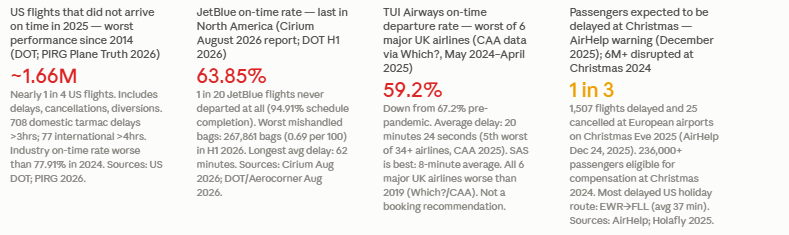
2025 was the worst year for US airline on-time performance since 2014. In the UK, every major airline is now less punctual than before the pandemic. 1 in 3 passengers can expect a delay during the Christmas season. AirHelp confirmed 1,507 flights were delayed or cancelled at major European airports on 24 December 2025 alone. Whether you’re flying from New York or Newcastle this holiday season, the data shows clearly which carriers are most likely to leave you waiting in a terminal — and which are most likely to get you there on time.
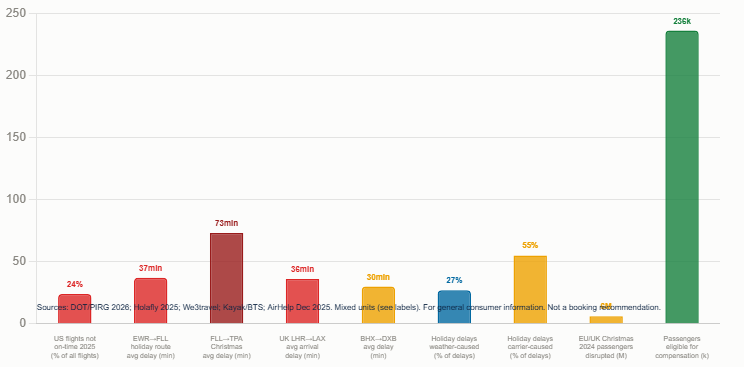
AirHelp, the passenger-rights firm, issued a specific warning ahead of Christmas 2025: ‘The Christmas period is one of the most unpredictable times for air travel, with winter weather, tight flight schedules and a surge in passenger demand all increasing the likelihood of delays and cancellations.’ Their data found that over 6 million passengers faced flight disruptions across Europe during the Christmas 2024 period, with over 236,000 eligible for compensation under EC261 or UK261 air passenger rights regulations.
What separates the best airlines from the worst at holiday time is not simply luck with the weather. It is operational resilience: the ability to absorb the cascading failure of one delayed aircraft without it derailing the next three flights on that aircraft’s schedule. Airlines that build buffer time into their schedules, maintain spare crews, and operate from less congested hubs consistently outperform those that maximise utilisation at the cost of slack. The data below shows which carriers have cracked it — and which have not.
2025: worst US airline on-time performance since 2014. ~1.66 million US flights did not arrive on time (delays, cancellations, diversions). US industry on-time rate worse than 77.91% recorded in 2024 (DOT; PIRG Plane Truth 2026). UK: all 6 major airlines less punctual than in 2019 (pre-pandemic) per CAA data analysed by Which? (May 2024-April 2025). Holiday: 1 in 3 passengers can expect a delay at Christmas (AirHelp, December 2025). 1,507 flights delayed/25 cancelled at European airports on Christmas Eve 2025 (AirHelp, December 24, 2025). Sources: PIRG/DOT; Which?/CAA; AirHelp Dec 2025.
All delay and punctuality data in this article is sourced from official government bodies (US Department of Transportation, UK Civil Aviation Authority) and published independent analyses. On-time performance figures change frequently and reflect the cited time period only. Rankings can shift between reporting periods. This article is for general consumer information only and does not constitute a recommendation to book or avoid any specific airline. Airline performance varies by route, season, and year. Always check current performance data before booking. UK passenger rights (UK261) and EU passenger rights (EC261) provide compensation entitlements for delays — see Section 12 for details.
The tarmac delay problem worsened dramatically. In 2025, US airlines experienced 708 tarmac delays of more than three hours on domestic flights and 77 tarmac delays of more than four hours on international flights — situations where passengers were held on the aircraft, on the ground, without the option to disembark. Airlines face fines of $27,500 per passenger for domestic tarmac delays exceeding three hours, yet PIRG’s analysts noted that enforcement has been inconsistent.
Into 2026, the picture has only partially improved. The Aerocorner / DOT Air Travel Consumer Report for the first half of 2026 shows that while some carriers have stabilised, the structural problems driving delays — hub congestion, ageing fleet management at budget carriers, and underfunded air traffic control infrastructure — have not been resolved. American Airlines alone accounted for 31% of every DOT complaint filed against any US airline in the first half of 2026.
There is, however, a note of cautious improvement. AirAdvisor’s analysis of CAA data covering January to September 2025 found that ‘disruptions are finally decreasing to close to pre-Covid levels,’ and the average UK departure delay across all 34 analysed airlines fell to 14 minutes and 48 seconds in 2025, down from 18 minutes and 18 seconds in 2024.
The causes are structural: air traffic control (ATC) staffing shortages across Europe, particularly at French, German, and Italian ATC centres, generate knock-on delays affecting UK departure banks. Ryanair launched a specific campaign website — ‘Air Traffic Control Ruined Your Flight’ — in 2025, claiming to expose the worst-performing ATC systems for delays across Europe. CAA Director Tim Johnson acknowledged: ‘Flight delays can occur for many reasons, including factors both within and beyond an airline’s control. Airlines are expected to minimise the impact of delays where possible, by providing timely information and upholding passengers’ rights during disruption.’
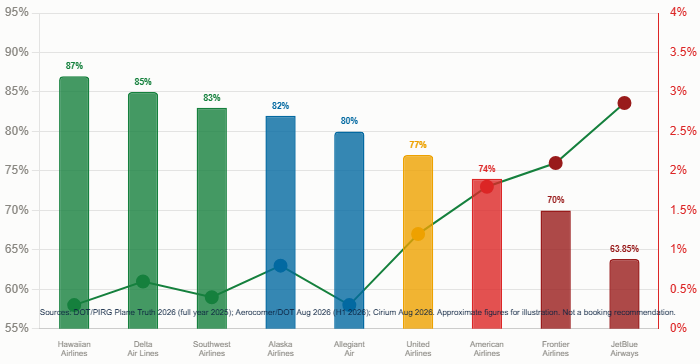
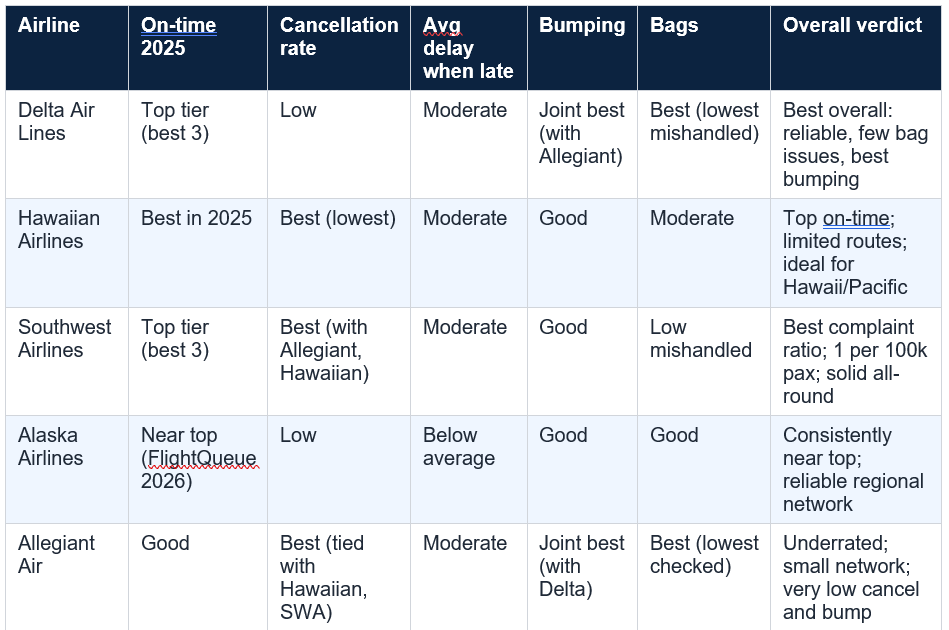
Delta Air Lines earns the best overall score for on-time performance among the major full-service US carriers. Delta ranked among the top performers for on-time arrivals in 2025 and tied for best involuntary bumping rate alongside Allegiant. Crucially, Delta has the best record for checked bag handling (lowest mishandled bags) — a particularly important metric during peak travel when baggage systems at major hubs are under maximum pressure. For the holiday traveller who cannot afford to arrive in Chicago without their luggage, Delta’s bag statistics matter as much as its delay numbers.
Hawaiian Airlines ranked best or among the best for on-time arrivals and cancellation rate throughout 2025. While its route network is limited to Hawaii and a small number of US mainland and Pacific routes, it was the top on-time airline of 2025. Southwest Airlines completed the top three — best on-time arrivals (alongside Hawaiian and Delta), best cancellation rate (with Allegiant and Hawaiian), and lowest complaint ratio of any US airline: just 1 complaint per 100,000 passengers.
Best Performer: Best US airlines for holiday delays (DOT/PIRG Plane Truth 2026, full year 2025): (1) Delta Air Lines: top-tier on-time; best checked baggage; joint-best bumping; consistent quality service. (2) Hawaiian Airlines: best on-time arrivals 2025; best cancellation rate. (3) Southwest Airlines: best on-time alongside Hawaiian/Delta; best cancellations; lowest complaint ratio (1 per 100,000 passengers). Also strong: Alaska Airlines (FlightQueue 2026: near top of on-time chart). Allegiant: joint-best bumping; best cancellation rate; best checked bags. Not a booking recommendation. Performance changes frequently. Sources: DOT/PIRG Plane Truth 2026; Aerocorner August 2026; FlightQueue 2026.
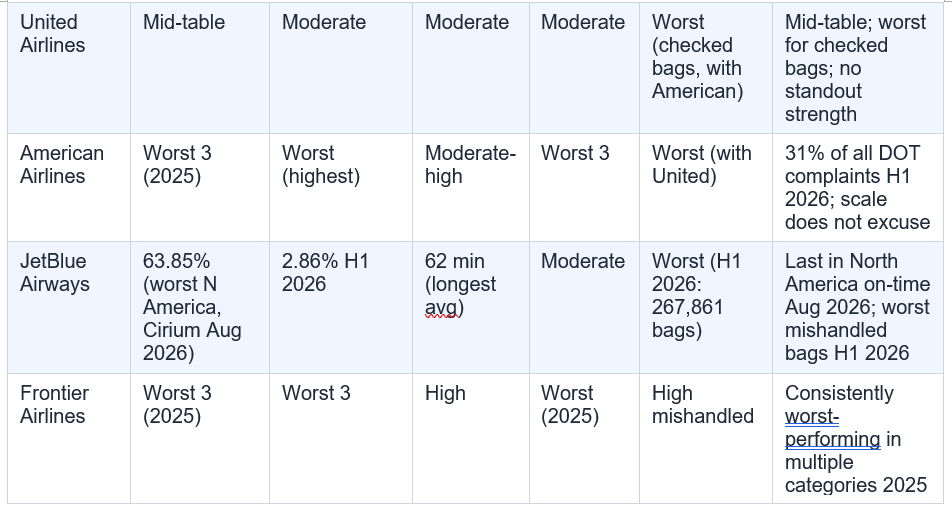
JetBlue Airways had the most specific and damaging data point. Cirium’s August 2026 report placed JetBlue last in North America for on-time performance: just 63.85% of flights on time. One flight in every twenty (5.09%) never departed at all. JetBlue also mishandled 0.69 of every 100 checked bags — 267,861 bags in total during H1 2026 — the worst mishandled bag rate of any US airline. Its average delay length when flights did run late was 62 minutes, the longest of any US carrier.
American Airlines rounds out the worst performers. American accounted for 31% of every DOT complaint filed against any US airline in the first half of 2026, drawing 9,046 complaints against itself. It had the highest cancellation rate of any large airline and ranked worst or near-worst for bumping. American’s scale partially explains some of the numbers — it scheduled approximately 25% more flights than Delta in H1 2026 — but the complaint ratio is a proportional figure that accounts for flight volumes.
Worst Performer: Worst US airlines for holiday delays (PIRG Plane Truth 2026 full year 2025 + DOT/Aerocorner H1 2026): (1) Frontier Airlines: worst on-time arrivals 2025; top-3 worst cancellations; worst involuntary bumping. (2) JetBlue Airways: 63.85% on-time (last in North America, Cirium August 2026); 1 in 20 flights never departed; worst mishandled bags in H1 2026; 62-minute average delay. (3) American Airlines: 31% of all US DOT complaints H1 2026; highest cancellation rate among major airlines; worst bumping alongside Frontier and Spirit. Sources: DOT; PIRG Plane Truth 2026; Aerocorner August 2026; Cirium August 2026.
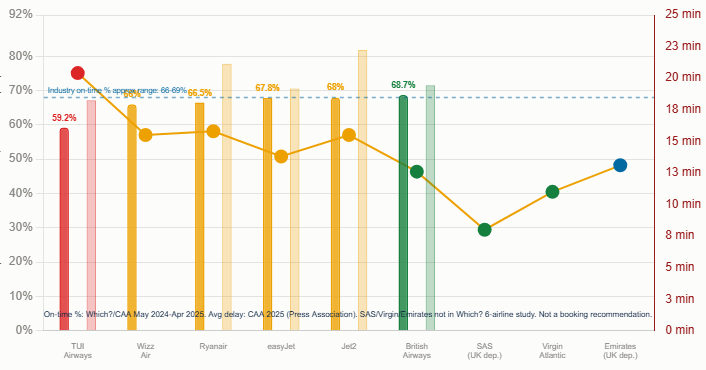
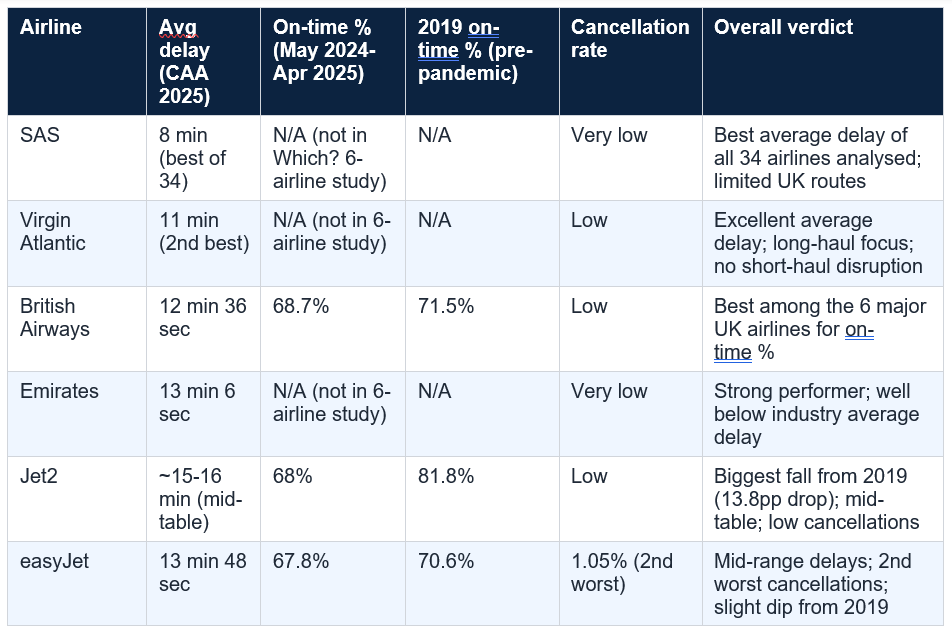
SAS (Scandinavian Airlines) recorded the shortest average departure delay from UK airports in 2025: just 8 minutes. This is less than half the 14 minutes and 48 seconds industry average across all 34 carriers analysed. Virgin Atlantic came second with an average of 11 minutes. Both operate smaller networks from UK airports than the budget carriers, which contributes to their better performance — fewer movements mean less congestion and more operational control.
Among the UK’s major holiday carriers, British Airways performed best, averaging 12 minutes and 36 seconds of delay — well below the industry average — and recorded 68.7% of flights departing on schedule (CAA May 2024–April 2025, analysed by Which?). Emirates performed at 13 minutes and 6 seconds on average, also well below the industry average. AirAdvisor’s analysis of Q1–Q3 2025 confirmed British Airways, Wizz Air, Emerald Airlines, Lufthansa, and United Airlines all achieving 76% on-time rates — the top-performing cluster for UK departures in that analysis period.
Best Performer: Best UK airlines for holiday delays (CAA 2025 data; Press Association; Which? May 2024-April 2025): (1) SAS: 8-minute average delay -- shortest in analysis of 34 airlines from UK airports. (2) Virgin Atlantic: 11-minute average delay. (3) British Airways: 12 min 36 sec average; 68.7% on-time departures; relatively well performing among major carriers. Emirates: 13 min 6 sec average. Q1-Q3 2025 (AirAdvisor/Scotsman): BA, Wizz Air, Emerald Airlines, Lufthansa, United all at 76% on-time. Not a booking recommendation. Sources: CAA 2025; Press Association/TravelGossip 2025; Which?/MrPlaneGuy 2025.
TUI pushed back on the ranking, specifically noting: ‘If we were to follow broader industry practices of cancelling flights more readily, our punctuality ranking would improve significantly.’ This points to a genuine measurement issue: airlines that cancel rather than delay flights can appear more punctual in delay rankings while causing arguably equal or greater disruption to passengers. TUI’s cancellation rate of 0.21% (Which? data) was in fact among the lowest of the UK carriers analysed.
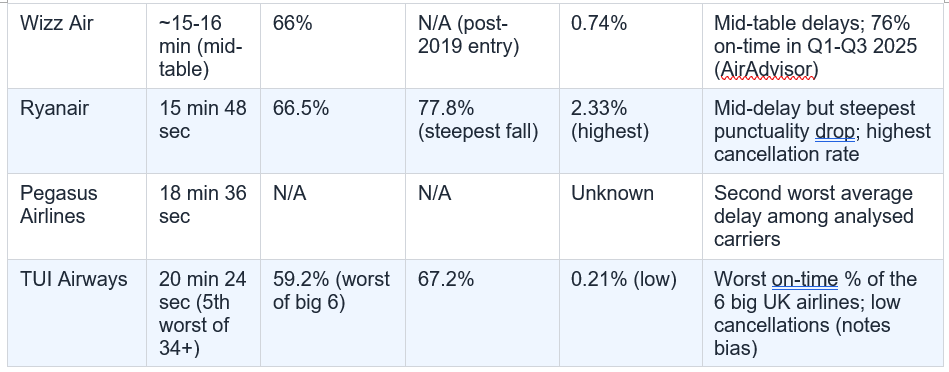
Pegasus Airlines (18 minutes and 36 seconds average delay) was the second worst in the CAA 2025 analysis. Ryanair, despite its high public profile for punctuality controversy, was in the middle of the table at 15 minutes and 48 seconds average delay — but its on-time departure rate of 66.5% (CAA May 2024–April 2025) represented one of the steepest drops from its 2019 rate of 77.8%. Ryanair also recorded the highest cancellation rate among the major UK carriers at 2.33%.
Worst Performer: Worst UK airlines for holiday delays (CAA 2025 data; Press Association; Which?): (1) TUI Airways: 20 min 24 sec average delay; 59.2% on-time departures (worst of the 6 big UK airlines). (2) Pegasus Airlines: 18 min 36 sec average. (3) Ryanair: 15 min 48 sec average delay; 66.5% on-time (down from 77.8% in 2019); highest cancellation rate: 2.33%. American Airlines UK routes: 14 min 42 sec. Delta Airlines UK routes: 14 min 36 sec. Sources: CAA 2025; Press Association/TravelGossip 2025; Which?/MrPlaneGuy 2025.
In the UK, we3travel.com’s analysis of chronic delay data identified two standout routes. London Heathrow to Los Angeles was identified as the UK’s most delayed long-haul route, with average arrivals lagging by 36 minutes over a full year. Birmingham to Dubai flights consistently ranked among the UK’s most delayed, averaging 30-minute delays. Both routes involve the kinds of long-haul operations most sensitive to knock-on effects: a delayed departure from a hub means either a very late arrival or aggressive speed increases that burn additional fuel.
Airport congestion is a parallel issue. For UK Christmas travellers, AirHelp’s annual ‘Naughty List’ of most disrupted European hubs is a useful pre-booking reference. London, Paris, Madrid, and Lisbon appeared among the most disrupted major European hubs in the pre-Christmas 2025 period. In the US, Fort Lauderdale (FLL) recorded more holiday delays than Atlanta Hartsfield-Jackson (ATL), despite ATL being the larger airport — counterintuitively, bigger airports often have more runway capacity and more ability to absorb delays.
Holiday route tactics: (1) For US Christmas flights: avoid Newark (EWR) to Florida routes if flexibility exists. Morning flights consistently have fewer accumulated delays than evening flights (the aircraft has had fewer opportunities to run late). (2) For UK Christmas flights: direct flights from regional UK airports to final destinations carry less hub-transfer delay risk than connections through Heathrow or Gatwick. (3) For transatlantic: Birmingham to US and Middle East routes carry higher delay risk; Heathrow generally has greater operational infrastructure for recovery. (4) Booking the first flight of the day reduces cascading delay risk. (5) Leave at least 90 minutes of transfer time at congested hubs (Heathrow, JFK, LAX) during peak holiday periods.
The cascade effect amplifies everything. In a normal-load operating period, a 45-minute delay on one flight is manageable: the aircraft returns to its schedule within a flight or two. During the Christmas or Thanksgiving rush, when the aircraft is immediately needed for the next full-load departure, the 45-minute delay cascades through the day’s schedule with no opportunity for recovery. Budget carriers and ultra-low-cost carriers (Frontier, Spirit, JetBlue in the US; Ryanair, Wizz Air, easyJet in the UK) operate with particularly tight turn times and minimal spare aircraft, making them more vulnerable to cascade failures.
European air traffic control (ATC) is the structural cause the airlines point to most consistently for UK and European delays. Ryanair’s ‘League of Delays’ campaign highlighted French, Italian, and German ATC centres as the worst-performing for avoidable delays in 2025. The UK’s National Air Traffic Services (NATS) experienced a significant systems failure in August 2023 that caused massive delays, and while the system has been upgraded, the broader European ATC network remains understaffed in key centres.
US Airlines — Full Year 2025 and H1 2026 (DOT/PIRG Plane Truth 2026; Aerocorner August 2026)
Do not accept a voucher without checking whether you would be entitled to cash compensation. UK261/EC261 cash compensation (see Section 12) does not apply to delays caused by ‘extraordinary circumstances’ such as severe weather, ATC strikes, or genuine safety issues — but the care entitlements (meals, accommodation) apply regardless of the cause. Airlines frequently offer vouchers as a substitute for cash compensation; you are not required to accept them.
Holiday delay action plan: (1) Screenshot or photograph the departure board showing the delay and time. (2) Ask the airline desk for written confirmation of the delay length and its cause. (3) Claim care (meals/refreshments) from the airline desk or airline app if delayed 2+ hours (UK/EU). (4) Keep ALL receipts for food, drink, accommodation, or transport during the delay. (5) Note the actual arrival time at the destination gate (for compensation calculation). (6) After travel: check eligibility for compensation via AirHelp (airhelp.com/en-gb), Which? Legal Service, or direct to the airline. (7) If airline refuses compensation: escalate to the CAA (UK) or your National Enforcement Body. In the US: file a DOT complaint at transportation.gov.
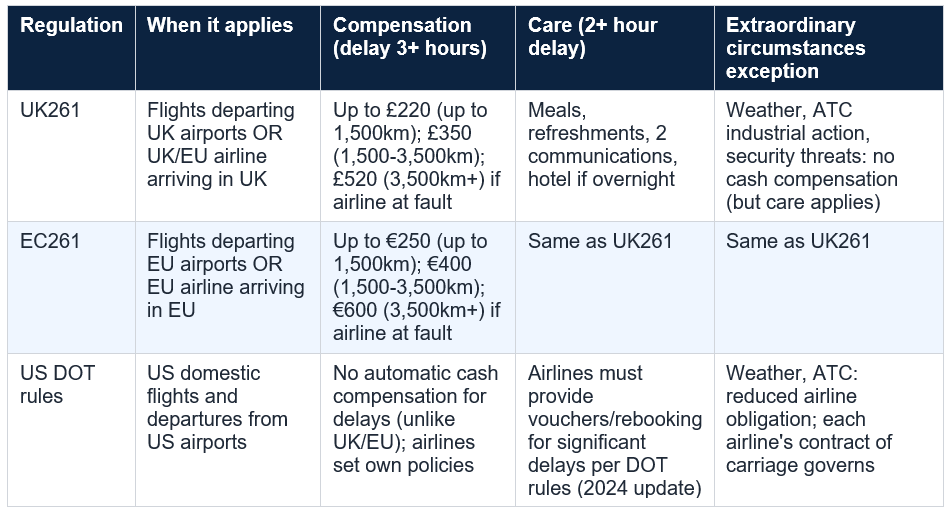
Important: UK261/EC261 compensation applies only when the delay was within the airline’s control. It does not apply if the airline can demonstrate the delay was caused by extraordinary circumstances (severe weather, ATC industrial action, security issues, medical emergencies). However, the care entitlements (meals, refreshments, accommodation) apply regardless of the cause. AirHelp has won compensation for over 3 million passengers. In the US, the DOT strengthened airline refund and compensation rules in 2024, requiring automatic refunds for cancelled or significantly changed flights. Not legal advice; individual rights depend on specific circumstances.
UK261/EC261 quick guide: delayed 3+ hours and the airline is at fault? You may be entitled to: £220/€250 (up to 1,500km); £350/€400 (1,500-3,500km); £520/€600 (3,500km+). PLUS: care from 2-hour delay (meals, refreshments, accommodation if overnight). To claim: contact the airline directly first; if refused, use AirHelp (airhelp.com/en-gb) or CEDR (cedrs.org.uk) for UK disputes. Time limit: 6 years in UK courts; 3 years in some EU states. Keep ALL receipts and evidence. Not legal advice.
Choosing a better airline is the most effective single action a holiday traveller can take to reduce delay risk. But it is not the only one. Flying early in the day, checking route-specific delay history before booking, building buffer into connections, and knowing your UK261/EC261 rights before you travel are all practical, actionable steps that cost nothing and pay dividends when the departure board turns red.
The aircraft waiting to take you home for Christmas does not know it is a public holiday. The airline that runs it does — and the best airlines prepare accordingly. The worst ones hope for the best and leave their passengers at the gate with a voucher.
Based on full-year 2025 DOT data (PIRG Plane Truth 2026) and H1 2026 DOT Air Travel Consumer Report data (Aerocorner August 2026): Delta Air Lines and Hawaiian Airlines consistently rank best for on-time arrivals. Southwest Airlines also ranks in the top tier for on-time performance and has the lowest complaint ratio of any major US airline (1 complaint per 100,000 passengers). Alaska Airlines consistently appears near the top of on-time charts. Allegiant Air has the joint-best involuntary bumping record and one of the best cancellation rates. For holiday-specific travel, Delta and Alaska's hub networks offer more resilience and recovery options when delays do occur. Not a booking recommendation. Airline performance changes; check current DOT data before booking.
Which UK airline is worst for flight delays?
Based on CAA 2025 data analysed by the Press Association and Which? magazine: TUI Airways had the worst average delay (20 minutes and 24 seconds from UK airports in 2025) and the lowest on-time departure percentage of the six major UK airlines analysed (59.2% for May 2024 to April 2025, vs 67.2% pre-pandemic). Pegasus Airlines had the second worst average delay (18 minutes and 36 seconds). Ryanair, while averaging 15 minutes and 48 seconds of delay (mid-table), recorded the steepest fall in on-time performance from 2019 levels (from 77.8% to 66.5%) and the highest cancellation rate of any of the big UK carriers (2.33%). Note that TUI disputes the validity of delay rankings that do not account for cancellation policy differences. Not a booking recommendation.
Are there more delays during Christmas flights?
Yes, the Christmas and Thanksgiving periods are among the highest-risk periods for delays. AirHelp (December 2025) warned that 1 in 3 passengers can expect a delay during the festive season. Over 6 million passengers faced disruption across Europe during the Christmas 2024 period. On Christmas Eve 2025, 1,507 flights were delayed and 25 cancelled at major European airports (AirHelp, December 24, 2025). That said, Kayak's analysis of BTS data found fewer delays flying on Thanksgiving Day and Christmas Day itself (when fewer people are moving) compared with the surrounding travel days. The highest-risk days are the 2-3 days before Christmas and the 2-3 days after. Internationally, Christmas flights see delay rates of up to 33%.
Am I entitled to compensation if my holiday flight is delayed?
If your flight departs from a UK or EU airport, or is operated by a UK or EU airline arriving in the UK or EU, UK261 or EC261 applies. You may be entitled to cash compensation of up to £520/€600 for delays of 3 or more hours at the destination, provided the delay was within the airline's control (not extraordinary circumstances such as weather or ATC strikes). You are entitled to care (meals, refreshments, accommodation if overnight) regardless of the cause for delays of 2 or more hours. Time limit for UK claims: 6 years (England and Wales); 5 years (Scotland). Use AirHelp (airhelp.com/en-gb), Which? Legal Service, or the CAA's Passenger Advice and Complaints Team (PACT) if the airline refuses. For US domestic flights: there is no automatic statutory cash compensation for delays equivalent to UK261/EC261; airline-specific policies govern. Not legal advice.
What causes holiday flight delays most often?
Fewer than 27% of holiday flight delays are caused by weather, according to Bureau of Transportation Statistics data (Kayak analysis). The majority are carrier-attributable: late aircraft (the previous flight on that aircraft ran late), late crew (crew scheduling failures), and maintenance. The cascade effect is particularly severe at holiday time: when every aircraft and crew is fully committed to back-to-back flights with no buffer, one delay compounds through the entire day's schedule. In Europe, air traffic control (ATC) staffing shortages at key centres (particularly French, Italian and German ATC) are a structural cause that airline management cannot directly control. Ryanair's 'Air Traffic Control Ruined Your Flight' campaign (2025) specifically highlighted ATC understaffing as a major delay driver. Airlines with more spare capacity (more buffer in their schedules, spare aircraft on standby) are better able to absorb these cascades -- which is why Delta, Alaska, and Southwest consistently outperform budget carriers during peak travel.
Table of Contents
- Why Holiday Flights Are the Hardest Test for Airlines
- The State of Play: US Airlines in 2025 – Worst Performance Since 2014
- The State of Play: UK Airlines in 2025 – All Worse Than Before the Pandemic
- Best US Airlines for Holiday Delays
- Worst US Airlines for Holiday Delays
- Best UK Airlines for Holiday Delays
- Worst UK Airlines for Holiday Delays
- The Holiday Delay Heat Map: Routes and Airports Most at Risk
- Why Do Holiday Delays Happen? The Real Causes
- Full Rankings: US and UK Airline Comparison Tables
- What To Do When Your Holiday Flight Is Delayed
- Your Rights: UK261, EC261, and US Passenger Protections
- Conclusion: Choose Wisely, Know Your Rights, Fly Prepared
- Frequently Asked Questions
US airline on-time performance — best to worst
UK airline punctuality — all worse than pre-pandemic
Holiday delay picture — routes, causes, rights
Why Holiday Flights Are the Hardest Test for Airlines
Flying at Christmas, Thanksgiving, or during the summer holiday peak is categorically different from flying on a Tuesday in February. The fundamentals of what makes a flight run smoothly — runway availability, gate access, crew positioning, aircraft turnaround time, and air traffic control capacity — are all strained simultaneously when every available seat on every available aircraft is full and the skies over the most popular routes are packed.AirHelp, the passenger-rights firm, issued a specific warning ahead of Christmas 2025: ‘The Christmas period is one of the most unpredictable times for air travel, with winter weather, tight flight schedules and a surge in passenger demand all increasing the likelihood of delays and cancellations.’ Their data found that over 6 million passengers faced flight disruptions across Europe during the Christmas 2024 period, with over 236,000 eligible for compensation under EC261 or UK261 air passenger rights regulations.
What separates the best airlines from the worst at holiday time is not simply luck with the weather. It is operational resilience: the ability to absorb the cascading failure of one delayed aircraft without it derailing the next three flights on that aircraft’s schedule. Airlines that build buffer time into their schedules, maintain spare crews, and operate from less congested hubs consistently outperform those that maximise utilisation at the cost of slack. The data below shows which carriers have cracked it — and which have not.
2025: worst US airline on-time performance since 2014. ~1.66 million US flights did not arrive on time (delays, cancellations, diversions). US industry on-time rate worse than 77.91% recorded in 2024 (DOT; PIRG Plane Truth 2026). UK: all 6 major airlines less punctual than in 2019 (pre-pandemic) per CAA data analysed by Which? (May 2024-April 2025). Holiday: 1 in 3 passengers can expect a delay at Christmas (AirHelp, December 2025). 1,507 flights delayed/25 cancelled at European airports on Christmas Eve 2025 (AirHelp, December 24, 2025). Sources: PIRG/DOT; Which?/CAA; AirHelp Dec 2025.
All delay and punctuality data in this article is sourced from official government bodies (US Department of Transportation, UK Civil Aviation Authority) and published independent analyses. On-time performance figures change frequently and reflect the cited time period only. Rankings can shift between reporting periods. This article is for general consumer information only and does not constitute a recommendation to book or avoid any specific airline. Airline performance varies by route, season, and year. Always check current performance data before booking. UK passenger rights (UK261) and EU passenger rights (EC261) provide compensation entitlements for delays — see Section 12 for details.
The State of Play: US Airlines in 2025 – Worst Performance Since 2014
The US airline industry’s 2025 report card, analysed by PIRG in its Plane Truth 2026 report using US Department of Transportation data, makes uncomfortable reading for travellers. Both cancellations and delays increased in 2025, producing the worst on-time performance since 2014. Nearly one-quarter of all flights — approximately 1.66 million — did not arrive on time. This includes outright cancellations as well as delays and diversions.The tarmac delay problem worsened dramatically. In 2025, US airlines experienced 708 tarmac delays of more than three hours on domestic flights and 77 tarmac delays of more than four hours on international flights — situations where passengers were held on the aircraft, on the ground, without the option to disembark. Airlines face fines of $27,500 per passenger for domestic tarmac delays exceeding three hours, yet PIRG’s analysts noted that enforcement has been inconsistent.
Into 2026, the picture has only partially improved. The Aerocorner / DOT Air Travel Consumer Report for the first half of 2026 shows that while some carriers have stabilised, the structural problems driving delays — hub congestion, ageing fleet management at budget carriers, and underfunded air traffic control infrastructure — have not been resolved. American Airlines alone accounted for 31% of every DOT complaint filed against any US airline in the first half of 2026.
The State of Play: UK Airlines in 2025 – All Worse Than Before the Pandemic
In the UK, the Civil Aviation Authority’s (CAA) punctuality data tells a similarly sobering story. Which? magazine analysed departure data for six of the UK’s biggest airlines — British Airways, easyJet, Jet2, Ryanair, TUI, and Wizz Air — for the period May 2024 to April 2025 and found that every single one was less punctual than it had been in 2019, before the pandemic.There is, however, a note of cautious improvement. AirAdvisor’s analysis of CAA data covering January to September 2025 found that ‘disruptions are finally decreasing to close to pre-Covid levels,’ and the average UK departure delay across all 34 analysed airlines fell to 14 minutes and 48 seconds in 2025, down from 18 minutes and 18 seconds in 2024.
The causes are structural: air traffic control (ATC) staffing shortages across Europe, particularly at French, German, and Italian ATC centres, generate knock-on delays affecting UK departure banks. Ryanair launched a specific campaign website — ‘Air Traffic Control Ruined Your Flight’ — in 2025, claiming to expose the worst-performing ATC systems for delays across Europe. CAA Director Tim Johnson acknowledged: ‘Flight delays can occur for many reasons, including factors both within and beyond an airline’s control. Airlines are expected to minimise the impact of delays where possible, by providing timely information and upholding passengers’ rights during disruption.’
Best US Airlines for Holiday Delays
Based on the PIRG Plane Truth 2026 report (DOT full-year 2025 data) and the Aerocorner / DOT analysis for the first half of 2026, three carriers consistently stand out as the most reliable choices for holiday travel.Delta Air Lines earns the best overall score for on-time performance among the major full-service US carriers. Delta ranked among the top performers for on-time arrivals in 2025 and tied for best involuntary bumping rate alongside Allegiant. Crucially, Delta has the best record for checked bag handling (lowest mishandled bags) — a particularly important metric during peak travel when baggage systems at major hubs are under maximum pressure. For the holiday traveller who cannot afford to arrive in Chicago without their luggage, Delta’s bag statistics matter as much as its delay numbers.
Hawaiian Airlines ranked best or among the best for on-time arrivals and cancellation rate throughout 2025. While its route network is limited to Hawaii and a small number of US mainland and Pacific routes, it was the top on-time airline of 2025. Southwest Airlines completed the top three — best on-time arrivals (alongside Hawaiian and Delta), best cancellation rate (with Allegiant and Hawaiian), and lowest complaint ratio of any US airline: just 1 complaint per 100,000 passengers.
Best Performer: Best US airlines for holiday delays (DOT/PIRG Plane Truth 2026, full year 2025): (1) Delta Air Lines: top-tier on-time; best checked baggage; joint-best bumping; consistent quality service. (2) Hawaiian Airlines: best on-time arrivals 2025; best cancellation rate. (3) Southwest Airlines: best on-time alongside Hawaiian/Delta; best cancellations; lowest complaint ratio (1 per 100,000 passengers). Also strong: Alaska Airlines (FlightQueue 2026: near top of on-time chart). Allegiant: joint-best bumping; best cancellation rate; best checked bags. Not a booking recommendation. Performance changes frequently. Sources: DOT/PIRG Plane Truth 2026; Aerocorner August 2026; FlightQueue 2026.
Worst US Airlines for Holiday Delays
Frontier Airlines earned the worst overall ranking in 2026 according to Aerocorner’s analysis of DOT data. It recorded the highest percentage of flights arriving more than one hour late and ranked in the top three for both cancellations and involuntary bumping throughout 2025. The PIRG Plane Truth 2026 report confirmed: Frontier was worst on-time, one of the worst for cancellations, and worst for involuntary bumping in 2025.JetBlue Airways had the most specific and damaging data point. Cirium’s August 2026 report placed JetBlue last in North America for on-time performance: just 63.85% of flights on time. One flight in every twenty (5.09%) never departed at all. JetBlue also mishandled 0.69 of every 100 checked bags — 267,861 bags in total during H1 2026 — the worst mishandled bag rate of any US airline. Its average delay length when flights did run late was 62 minutes, the longest of any US carrier.
American Airlines rounds out the worst performers. American accounted for 31% of every DOT complaint filed against any US airline in the first half of 2026, drawing 9,046 complaints against itself. It had the highest cancellation rate of any large airline and ranked worst or near-worst for bumping. American’s scale partially explains some of the numbers — it scheduled approximately 25% more flights than Delta in H1 2026 — but the complaint ratio is a proportional figure that accounts for flight volumes.
Worst Performer: Worst US airlines for holiday delays (PIRG Plane Truth 2026 full year 2025 + DOT/Aerocorner H1 2026): (1) Frontier Airlines: worst on-time arrivals 2025; top-3 worst cancellations; worst involuntary bumping. (2) JetBlue Airways: 63.85% on-time (last in North America, Cirium August 2026); 1 in 20 flights never departed; worst mishandled bags in H1 2026; 62-minute average delay. (3) American Airlines: 31% of all US DOT complaints H1 2026; highest cancellation rate among major airlines; worst bumping alongside Frontier and Spirit. Sources: DOT; PIRG Plane Truth 2026; Aerocorner August 2026; Cirium August 2026.
Best UK Airlines for Holiday Delays
In the UK, the CAA’s 2025 annual average delay data (analysed by the Press Association and reported across multiple outlets including TravelGossip and GMX) crowns two non-British carriers as the most punctual for UK departures.SAS (Scandinavian Airlines) recorded the shortest average departure delay from UK airports in 2025: just 8 minutes. This is less than half the 14 minutes and 48 seconds industry average across all 34 carriers analysed. Virgin Atlantic came second with an average of 11 minutes. Both operate smaller networks from UK airports than the budget carriers, which contributes to their better performance — fewer movements mean less congestion and more operational control.
Among the UK’s major holiday carriers, British Airways performed best, averaging 12 minutes and 36 seconds of delay — well below the industry average — and recorded 68.7% of flights departing on schedule (CAA May 2024–April 2025, analysed by Which?). Emirates performed at 13 minutes and 6 seconds on average, also well below the industry average. AirAdvisor’s analysis of Q1–Q3 2025 confirmed British Airways, Wizz Air, Emerald Airlines, Lufthansa, and United Airlines all achieving 76% on-time rates — the top-performing cluster for UK departures in that analysis period.
Best Performer: Best UK airlines for holiday delays (CAA 2025 data; Press Association; Which? May 2024-April 2025): (1) SAS: 8-minute average delay -- shortest in analysis of 34 airlines from UK airports. (2) Virgin Atlantic: 11-minute average delay. (3) British Airways: 12 min 36 sec average; 68.7% on-time departures; relatively well performing among major carriers. Emirates: 13 min 6 sec average. Q1-Q3 2025 (AirAdvisor/Scotsman): BA, Wizz Air, Emerald Airlines, Lufthansa, United all at 76% on-time. Not a booking recommendation. Sources: CAA 2025; Press Association/TravelGossip 2025; Which?/MrPlaneGuy 2025.
Worst UK Airlines for Holiday Delays
TUI Airways tops the worst list for the UK market with an average departure delay of 20 minutes and 24 seconds from UK airports in 2025 — nearly one and a half times the 14 minutes and 48 seconds industry average. TUI ranked fifth worst among all airlines operating more than 2,500 flights from UK airports in the CAA analysis. On the punctuality percentage metric, TUI fared even worse: just 59.2% of flights departed on time (CAA May 2024–April 2025, via Which?), the worst of any of the six major UK airlines analysed — and down from 67.2% before the pandemic.TUI pushed back on the ranking, specifically noting: ‘If we were to follow broader industry practices of cancelling flights more readily, our punctuality ranking would improve significantly.’ This points to a genuine measurement issue: airlines that cancel rather than delay flights can appear more punctual in delay rankings while causing arguably equal or greater disruption to passengers. TUI’s cancellation rate of 0.21% (Which? data) was in fact among the lowest of the UK carriers analysed.
Pegasus Airlines (18 minutes and 36 seconds average delay) was the second worst in the CAA 2025 analysis. Ryanair, despite its high public profile for punctuality controversy, was in the middle of the table at 15 minutes and 48 seconds average delay — but its on-time departure rate of 66.5% (CAA May 2024–April 2025) represented one of the steepest drops from its 2019 rate of 77.8%. Ryanair also recorded the highest cancellation rate among the major UK carriers at 2.33%.
Worst Performer: Worst UK airlines for holiday delays (CAA 2025 data; Press Association; Which?): (1) TUI Airways: 20 min 24 sec average delay; 59.2% on-time departures (worst of the 6 big UK airlines). (2) Pegasus Airlines: 18 min 36 sec average. (3) Ryanair: 15 min 48 sec average delay; 66.5% on-time (down from 77.8% in 2019); highest cancellation rate: 2.33%. American Airlines UK routes: 14 min 42 sec. Delta Airlines UK routes: 14 min 36 sec. Sources: CAA 2025; Press Association/TravelGossip 2025; Which?/MrPlaneGuy 2025.
The Holiday Delay Heat Map: Routes and Airports Most at Risk
Delays are not evenly distributed across all routes. Holafly’s 2025 Holiday Flight Delay Report, analysing FlightRadar24 data across 100 routes from 20 major US airports in December, found that Newark Liberty International (EWR) to Fort Lauderdale Hollywood International (FLL) was the most likely delayed US holiday route, averaging 37 minutes of delay. Florida routes generally dominated the most-delayed holiday lists: Fort Lauderdale to Tampa International topped the Christmas-specific ranking with an average delay of one hour and thirteen minutes.In the UK, we3travel.com’s analysis of chronic delay data identified two standout routes. London Heathrow to Los Angeles was identified as the UK’s most delayed long-haul route, with average arrivals lagging by 36 minutes over a full year. Birmingham to Dubai flights consistently ranked among the UK’s most delayed, averaging 30-minute delays. Both routes involve the kinds of long-haul operations most sensitive to knock-on effects: a delayed departure from a hub means either a very late arrival or aggressive speed increases that burn additional fuel.
Airport congestion is a parallel issue. For UK Christmas travellers, AirHelp’s annual ‘Naughty List’ of most disrupted European hubs is a useful pre-booking reference. London, Paris, Madrid, and Lisbon appeared among the most disrupted major European hubs in the pre-Christmas 2025 period. In the US, Fort Lauderdale (FLL) recorded more holiday delays than Atlanta Hartsfield-Jackson (ATL), despite ATL being the larger airport — counterintuitively, bigger airports often have more runway capacity and more ability to absorb delays.
Holiday route tactics: (1) For US Christmas flights: avoid Newark (EWR) to Florida routes if flexibility exists. Morning flights consistently have fewer accumulated delays than evening flights (the aircraft has had fewer opportunities to run late). (2) For UK Christmas flights: direct flights from regional UK airports to final destinations carry less hub-transfer delay risk than connections through Heathrow or Gatwick. (3) For transatlantic: Birmingham to US and Middle East routes carry higher delay risk; Heathrow generally has greater operational infrastructure for recovery. (4) Booking the first flight of the day reduces cascading delay risk. (5) Leave at least 90 minutes of transfer time at congested hubs (Heathrow, JFK, LAX) during peak holiday periods.
Why Do Holiday Delays Happen? The Real Causes
A persistent myth, identified by Kayak’s analysis of Bureau of Transportation Statistics data, is that weather causes most holiday delays. In reality, fewer than 27% of flight delays over the holiday period were weather-related in 2023 (BTS data). The most frequent causes are carrier-attributable — late aircraft, late crew, and aircraft maintenance — which means the airline itself is the source of the disruption, not an external factor.The cascade effect amplifies everything. In a normal-load operating period, a 45-minute delay on one flight is manageable: the aircraft returns to its schedule within a flight or two. During the Christmas or Thanksgiving rush, when the aircraft is immediately needed for the next full-load departure, the 45-minute delay cascades through the day’s schedule with no opportunity for recovery. Budget carriers and ultra-low-cost carriers (Frontier, Spirit, JetBlue in the US; Ryanair, Wizz Air, easyJet in the UK) operate with particularly tight turn times and minimal spare aircraft, making them more vulnerable to cascade failures.
European air traffic control (ATC) is the structural cause the airlines point to most consistently for UK and European delays. Ryanair’s ‘League of Delays’ campaign highlighted French, Italian, and German ATC centres as the worst-performing for avoidable delays in 2025. The UK’s National Air Traffic Services (NATS) experienced a significant systems failure in August 2023 that caused massive delays, and while the system has been upgraded, the broader European ATC network remains understaffed in key centres.
Full Rankings: US and UK Airline Comparison Tables
US Airlines — Full Year 2025 and H1 2026 (DOT/PIRG Plane Truth 2026; Aerocorner August 2026)
UK Airlines — 2025 Full Year (CAA data; Which?; Press Association; AirAdvisor)
What To Do When Your Holiday Flight Is Delayed
When a delay is announced, the clock on your passenger rights starts immediately. Document everything: photograph the departure board showing the delay, note the time the delay was announced, and keep all boarding passes, booking confirmations, and receipts for any costs incurred. If you are delayed at an EU or UK departure airport for more than two hours, you are entitled to care regardless of the cause of the delay: this means meals and refreshments, two free communications (phone calls, emails, or faxes), and hotel accommodation if an overnight stay is necessary.Do not accept a voucher without checking whether you would be entitled to cash compensation. UK261/EC261 cash compensation (see Section 12) does not apply to delays caused by ‘extraordinary circumstances’ such as severe weather, ATC strikes, or genuine safety issues — but the care entitlements (meals, accommodation) apply regardless of the cause. Airlines frequently offer vouchers as a substitute for cash compensation; you are not required to accept them.
Holiday delay action plan: (1) Screenshot or photograph the departure board showing the delay and time. (2) Ask the airline desk for written confirmation of the delay length and its cause. (3) Claim care (meals/refreshments) from the airline desk or airline app if delayed 2+ hours (UK/EU). (4) Keep ALL receipts for food, drink, accommodation, or transport during the delay. (5) Note the actual arrival time at the destination gate (for compensation calculation). (6) After travel: check eligibility for compensation via AirHelp (airhelp.com/en-gb), Which? Legal Service, or direct to the airline. (7) If airline refuses compensation: escalate to the CAA (UK) or your National Enforcement Body. In the US: file a DOT complaint at transportation.gov.
Your Rights: UK261, EC261, and US Passenger Protections
Passengers flying from a UK airport, or flying with a UK or EU airline into the UK, are protected by UK261 — the domestic equivalent of the EU’s EC261/2004 regulation. These are some of the strongest passenger rights frameworks in the world and apply specifically to delay and cancellation scenarios.Important: UK261/EC261 compensation applies only when the delay was within the airline’s control. It does not apply if the airline can demonstrate the delay was caused by extraordinary circumstances (severe weather, ATC industrial action, security issues, medical emergencies). However, the care entitlements (meals, refreshments, accommodation) apply regardless of the cause. AirHelp has won compensation for over 3 million passengers. In the US, the DOT strengthened airline refund and compensation rules in 2024, requiring automatic refunds for cancelled or significantly changed flights. Not legal advice; individual rights depend on specific circumstances.
UK261/EC261 quick guide: delayed 3+ hours and the airline is at fault? You may be entitled to: £220/€250 (up to 1,500km); £350/€400 (1,500-3,500km); £520/€600 (3,500km+). PLUS: care from 2-hour delay (meals, refreshments, accommodation if overnight). To claim: contact the airline directly first; if refused, use AirHelp (airhelp.com/en-gb) or CEDR (cedrs.org.uk) for UK disputes. Time limit: 6 years in UK courts; 3 years in some EU states. Keep ALL receipts and evidence. Not legal advice.
Conclusion
The data is clear: 2025 was a bad year for airline punctuality on both sides of the Atlantic, and the holiday season amplifies every structural weakness that airlines carry into their peak operating periods. Frontier, JetBlue, and American had the worst US delay records. TUI, Pegasus, and Ryanair had the worst UK delay records. Delta, Hawaiian, and Southwest led the US for reliability. SAS and Virgin Atlantic led the UK for average delay performance, with British Airways the best of the major UK carriers.Choosing a better airline is the most effective single action a holiday traveller can take to reduce delay risk. But it is not the only one. Flying early in the day, checking route-specific delay history before booking, building buffer into connections, and knowing your UK261/EC261 rights before you travel are all practical, actionable steps that cost nothing and pay dividends when the departure board turns red.
The aircraft waiting to take you home for Christmas does not know it is a public holiday. The airline that runs it does — and the best airlines prepare accordingly. The worst ones hope for the best and leave their passengers at the gate with a voucher.
Frequently Asked Questions
Which US airline is best for avoiding delays?Based on full-year 2025 DOT data (PIRG Plane Truth 2026) and H1 2026 DOT Air Travel Consumer Report data (Aerocorner August 2026): Delta Air Lines and Hawaiian Airlines consistently rank best for on-time arrivals. Southwest Airlines also ranks in the top tier for on-time performance and has the lowest complaint ratio of any major US airline (1 complaint per 100,000 passengers). Alaska Airlines consistently appears near the top of on-time charts. Allegiant Air has the joint-best involuntary bumping record and one of the best cancellation rates. For holiday-specific travel, Delta and Alaska's hub networks offer more resilience and recovery options when delays do occur. Not a booking recommendation. Airline performance changes; check current DOT data before booking.
Which UK airline is worst for flight delays?
Based on CAA 2025 data analysed by the Press Association and Which? magazine: TUI Airways had the worst average delay (20 minutes and 24 seconds from UK airports in 2025) and the lowest on-time departure percentage of the six major UK airlines analysed (59.2% for May 2024 to April 2025, vs 67.2% pre-pandemic). Pegasus Airlines had the second worst average delay (18 minutes and 36 seconds). Ryanair, while averaging 15 minutes and 48 seconds of delay (mid-table), recorded the steepest fall in on-time performance from 2019 levels (from 77.8% to 66.5%) and the highest cancellation rate of any of the big UK carriers (2.33%). Note that TUI disputes the validity of delay rankings that do not account for cancellation policy differences. Not a booking recommendation.
Are there more delays during Christmas flights?
Yes, the Christmas and Thanksgiving periods are among the highest-risk periods for delays. AirHelp (December 2025) warned that 1 in 3 passengers can expect a delay during the festive season. Over 6 million passengers faced disruption across Europe during the Christmas 2024 period. On Christmas Eve 2025, 1,507 flights were delayed and 25 cancelled at major European airports (AirHelp, December 24, 2025). That said, Kayak's analysis of BTS data found fewer delays flying on Thanksgiving Day and Christmas Day itself (when fewer people are moving) compared with the surrounding travel days. The highest-risk days are the 2-3 days before Christmas and the 2-3 days after. Internationally, Christmas flights see delay rates of up to 33%.
Am I entitled to compensation if my holiday flight is delayed?
If your flight departs from a UK or EU airport, or is operated by a UK or EU airline arriving in the UK or EU, UK261 or EC261 applies. You may be entitled to cash compensation of up to £520/€600 for delays of 3 or more hours at the destination, provided the delay was within the airline's control (not extraordinary circumstances such as weather or ATC strikes). You are entitled to care (meals, refreshments, accommodation if overnight) regardless of the cause for delays of 2 or more hours. Time limit for UK claims: 6 years (England and Wales); 5 years (Scotland). Use AirHelp (airhelp.com/en-gb), Which? Legal Service, or the CAA's Passenger Advice and Complaints Team (PACT) if the airline refuses. For US domestic flights: there is no automatic statutory cash compensation for delays equivalent to UK261/EC261; airline-specific policies govern. Not legal advice.
What causes holiday flight delays most often?
Fewer than 27% of holiday flight delays are caused by weather, according to Bureau of Transportation Statistics data (Kayak analysis). The majority are carrier-attributable: late aircraft (the previous flight on that aircraft ran late), late crew (crew scheduling failures), and maintenance. The cascade effect is particularly severe at holiday time: when every aircraft and crew is fully committed to back-to-back flights with no buffer, one delay compounds through the entire day's schedule. In Europe, air traffic control (ATC) staffing shortages at key centres (particularly French, Italian and German ATC) are a structural cause that airline management cannot directly control. Ryanair's 'Air Traffic Control Ruined Your Flight' campaign (2025) specifically highlighted ATC understaffing as a major delay driver. Airlines with more spare capacity (more buffer in their schedules, spare aircraft on standby) are better able to absorb these cascades -- which is why Delta, Alaska, and Southwest consistently outperform budget carriers during peak travel.
0 Comments
Be the first to share your thoughts on this article.