

Finance
Bank App Down or Account Frozen? What It Cost You, and Fixes

158 IT failures at nine large UK banks and building societies between January 2023 and February 2025, about 803 hours or 33 days of downtime (Treasury Committee); Santander and Cahoot had the most outages between April 2025 and March 2026 (Which?); third-party failures were 19% of cyber incidents reported to the FCA between 1 January and 9 July 2026; a Google Cloud outage on 20 October 2026 blocked several UK banks and Revolut. Your rights: banks are not legally required to pay compensation for outages; the Financial Ombudsman Service can order compensation, a correction to your credit file or an apology; across all complaints it found 34% in favour of consumers in 2024/25. My arithmetic: 803 hours across nine firms in two years is about 45 hours a year per firm, or 99.5% availability; on £2,500 take-home pay, three days of essentials is about £250; a hypothetical three-day outage can easily cost £80 or more in fees and time.
This is not rare. On 20 October a Google Cloud outage in London blocked cards, transfers and apps at several UK banks, including Revolut, according to one report, and on 25 October The Co-operative Bank’s online and mobile banking were affected for 17.3 hours, according to an outage tracker. Outages are only one way to be cut off: accounts can also be frozen or blocked. This guide asks what being cut off cost you, then shows how to claim, document it and prepare for next time.
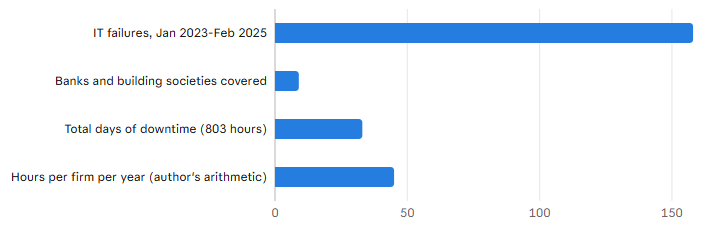
In my arithmetic, 803 hours across nine firms over two years is about 45 hours a year per firm, or roughly 99.5% availability. That sounds excellent until you realise failures cluster around busy times, with complaints spiking around payday according to coverage of a Lloyds outage. The average is about five hours per failure, though some last days, such as a Monese outbound-payments outage of about 3.8 days in the tracker I retrieved.
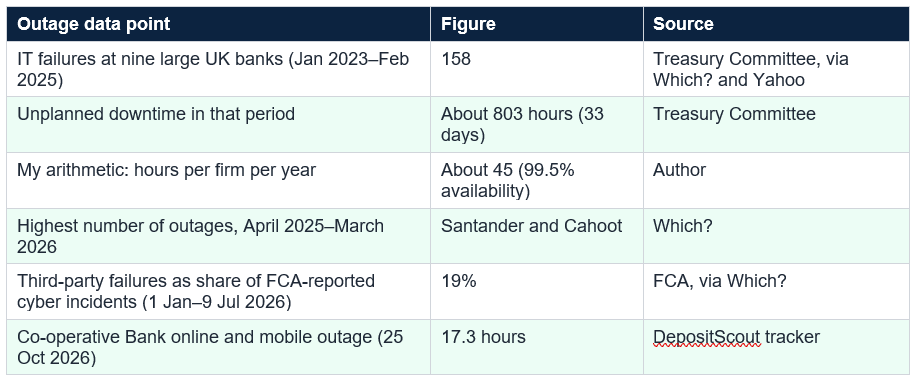
Treasury Committee: 158 IT failures at nine large UK banks and building societies in two years, about 803 hours (33 days) of downtime. That is about 45 hours a year per firm, or 99.5% availability, by my arithmetic. Santander and Cahoot had the most outages between April 2025 and March 2026 (Which?).
There is also account closure, sometimes called de-banking. The FCA reported UK banks closing nearly a thousand accounts a day, with just over 343,000 closed in 2022 against about 45,000 in 2017, according to an older, secondary summary. Not every closure is a freeze and not every freeze is unfair, but the effect is similar: you lose access to money and may be unable to pay bills or get paid. The remedies overlap, so the steps below apply to both.
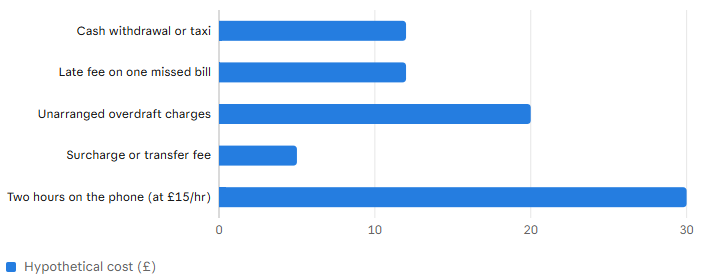
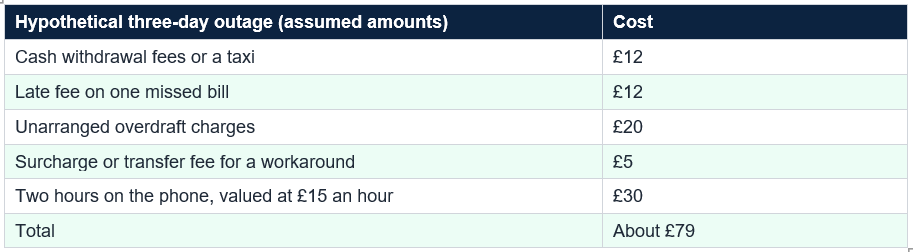
Here is a hypothetical cost log, with assumed amounts, for a three-day outage: £12 for a cash withdrawal or taxi, £12 for a late fee, £20 of unarranged overdraft charges, £5 for a surcharge or transfer fee and £30 for two hours on the phone, valued at £15 an hour, about £79 in all. Interest on £2,000 delayed three days at 4.87% would be under £1. The point is not the exact numbers but that small costs add up and are recoverable only if you recorded them.
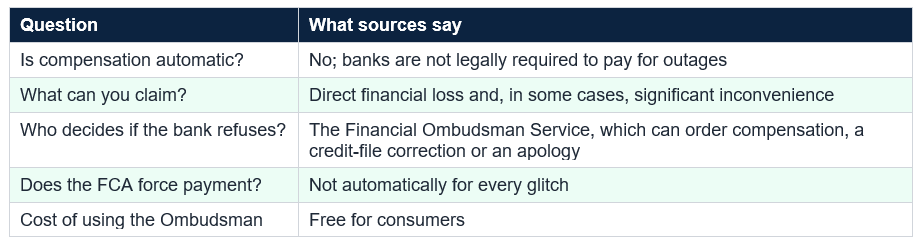
If the bank says no or offers too little, you can complain to the Financial Ombudsman Service, a free service. According to Which?, it can investigate and order a bank to pay compensation if it finds you were treated unfairly or left out of pocket, and it can also require a credit file correction or an apology. Across all complaints in 2024/25 it found 34% in favour of consumers, a figure not specific to outages. Time limits apply and sources differ on when it can step in, so check its website; a civil claim is a last resort.
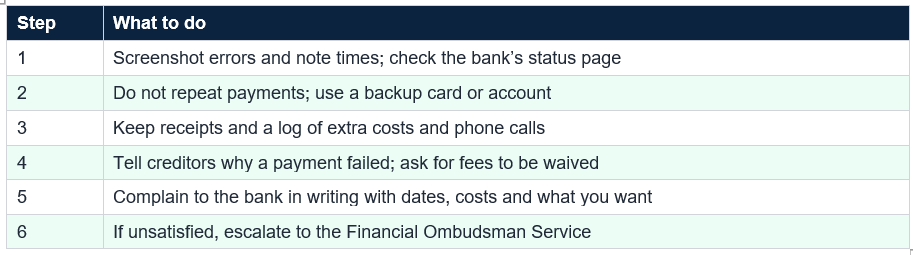
Then follow Which?’s steps: complain to the bank, ask for compensation to cover your losses and for it to take all steps to put things right, including correcting any inaccurate credit file marker. Give a short, factual summary, the dates, a list of costs with evidence and the outcome you want. If you do not receive a final response or are unhappy with it, escalate to the Ombudsman, and keep copies of everything. A brief complaint with evidence beats a long one without.
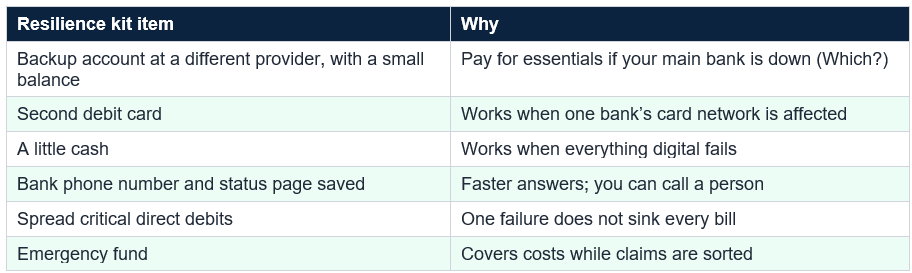
The bigger picture matters too: one in ten UK adults has no cash savings and a further 21% have less than £1,000, according to FCA Financial Lives research as summarised by Up The Gains, so a short outage can be a real emergency for many. A small emergency fund helps with outages and everything else, and relying on a single app makes outages worse; a plain debit card and PIN can get you through a day when the app is down.
10. The Buffer Math
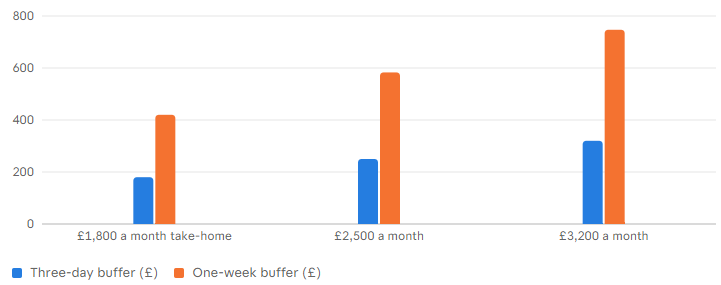
A rough rule for the backup buffer is a few days of essentials. In my illustration, a household with £2,500 a month of take-home pay spends about £83 a day, so three days is about £250 and a week about £583; on £1,800 a month three days is about £180, and on £3,200 about £320. That is not a large sum, and it can sit in a backup account or in cash. It will not replace an emergency fund, but it can turn a bad day into a minor inconvenience.
In my hypothetical log, a three-day outage cost about £79 in fees and time, but a missed rent payment or a failed deposit could cost far more. The buffer costs nothing: it is your own money held somewhere else. And if you do lose money to an outage, the log you keep will make a complaint much stronger.

This week, open a free backup account at a different provider, put one day’s essentials in it and save your main bank’s phone number. If you were hit by an outage recently, write down what it cost and send a short, factual complaint. Common mistakes include sending a payment twice during an outage, failing to keep evidence, not telling creditors why a payment failed, assuming compensation will arrive on its own, giving up after the first refusal, relying on a single bank and app and waiting too long to complain. With a frozen account, many people do not ask what the bank needs from them, when a document or a phone call might solve it.
So make being cut off boring. Keep a backup account at a different provider, a second card, a little cash and a three-day buffer of about £250 on £2,500 of monthly take-home pay. Keep a cost log, complain with evidence and escalate if you must. The outage will pass; what it costs you is partly up to you.
Sometimes, but not automatically. Which? says banks are not legally required to pay compensation just because they had an outage, and the amount depends on how you were affected. If you lost money, such as late fees, overdraft charges or a missed payment, complain to the bank and ask it to put you back in the position you would have been in. If you are unhappy, you can take the complaint to the Financial Ombudsman Service, which can order compensation.
How often do UK banks have outages?
More often than most customers realise. The Treasury Committee reported 158 IT failures across nine large banks and building societies between January 2023 and February 2025, totalling about 803 hours, or 33 days. Which? found Santander and its Cahoot brand had the most outages between April 2025 and March 2026, and a Lloyds app update defect stopped payments for thousands of customers in June.
What is the difference between an outage and a frozen account?
An outage is a systems failure that affects many customers at once and usually clears in hours or days. A frozen or blocked account is a decision about your account, often triggered by fraud checks, identity or compliance reviews or a legal order, and can last much longer. The remedies overlap: complain, keep evidence and use the Ombudsman if needed, but a freeze may also need identity documents or a call with a specialist team.
Will an outage hurt my credit score?
It should not if you act. Which? advises that if an outage leaves an inaccurate marker on your credit report, you should tell both your bank and the company that received the failed payment, and ask for the record to be corrected. Keep evidence that the payment failed because of the bank. This is general education, not personal advice.
What is the best way to protect myself?
Which? suggests setting up a free backup account with a different provider and keeping a small amount in it. I would add a second card, some cash and a three-day buffer of roughly one day’s essentials times three, which is about £250 on £2,500 a month of take-home pay. Know the bank’s phone number, check its status page before retrying and avoid sending the same payment twice.
Table of Contents
- When the App Goes Dark
- The Short Answer
- How Often This Happens
- Outage vs. Frozen Account
- What Being Cut Off Can Cost
- Your Rights and Compensation
- How to Document and Claim
- If Your Account Is Frozen
- How to Prepare: The Resilience Kit
- The Buffer Math
- Common Mistakes
- Conclusion
- Frequently Asked Questions
How often UK banks go down: Treasury Committee figures and my arithmetic
Number by Treasury Committee data via Yahoo News UK and Which?; the last bar is 803 hours / 9 firms / 2 years; secondary sources
What a three-day outage could cost: a hypothetical cost log (about £79 in total)
Pounds (£) by Author's hypothetical illustration with assumed amounts; real costs vary and are recoverable only if documented
The resilience buffer: three days and one week of essentials by take-home pay (£)
Pounds (£) by Author's arithmetic: monthly take-home divided by 30, times 3 and 7 days; keep it in a backup account at a different provider or in cash
When the App Goes Dark
It is payday, you are at the till or the petrol pump, the card is declined and the app will not open. For a few hours, or a few days, your money exists and you cannot reach it. Most of the time it passes. Sometimes it costs real money: a missed rent payment, a late fee, a taxi, a bill paid at a surcharge, an overdraft charge, a morning of phone calls.This is not rare. On 20 October a Google Cloud outage in London blocked cards, transfers and apps at several UK banks, including Revolut, according to one report, and on 25 October The Co-operative Bank’s online and mobile banking were affected for 17.3 hours, according to an outage tracker. Outages are only one way to be cut off: accounts can also be frozen or blocked. This guide asks what being cut off cost you, then shows how to claim, document it and prepare for next time.
The Short Answer
Being cut off can cost you fees, missed payments, credit file marks and a lot of time, and you may be able to claim some of it back, but not automatically. Banks are not legally required to pay compensation just because they had an outage, according to Which?, and the amount depends on how you were affected. Complain to the bank with evidence of your loss and, if you are not satisfied, take the case to the Financial Ombudsman Service, which can order compensation. The best protection is cheap: a backup account at a different provider, a second card, some cash and a few days’ buffer.How Often This Happens
More often than most customers realise. The Treasury Committee reported 158 IT failures at nine of the largest banks and building societies between January 2023 and February 2025, totalling more than 803 hours, or 33 days, of unplanned downtime. Which? found Santander and its Cahoot brand had the most outages between April 2025 and March 2026, and thousands of Lloyds Banking Group customers could not make payments in June because of a software defect in an app update. The FCA says third-party failures were 19% of cyber incidents reported to it between 1 January and 9 July 2026.In my arithmetic, 803 hours across nine firms over two years is about 45 hours a year per firm, or roughly 99.5% availability. That sounds excellent until you realise failures cluster around busy times, with complaints spiking around payday according to coverage of a Lloyds outage. The average is about five hours per failure, though some last days, such as a Monese outbound-payments outage of about 3.8 days in the tracker I retrieved.
Treasury Committee: 158 IT failures at nine large UK banks and building societies in two years, about 803 hours (33 days) of downtime. That is about 45 hours a year per firm, or 99.5% availability, by my arithmetic. Santander and Cahoot had the most outages between April 2025 and March 2026 (Which?).
Outage vs. Frozen Account
An outage is a systems failure that affects many customers at once and usually clears in hours or days. A frozen or blocked account is a decision about your account, and in my general knowledge it is often triggered by fraud checks, identity or compliance reviews, suspicious transactions, a court or tax order or a bank’s decision to restrict or close it; I did not retrieve a source on the causes. A freeze can last longer, can happen without warning and often needs you to prove who you are or explain a payment.There is also account closure, sometimes called de-banking. The FCA reported UK banks closing nearly a thousand accounts a day, with just over 343,000 closed in 2022 against about 45,000 in 2017, according to an older, secondary summary. Not every closure is a freeze and not every freeze is unfair, but the effect is similar: you lose access to money and may be unable to pay bills or get paid. The remedies overlap, so the steps below apply to both.
What Being Cut Off Can Cost
The costs come in layers. Direct costs are the easiest to prove: late payment fees, overdraft or unarranged charges, card surcharges, ATM fees, taxis or other workarounds. Indirect costs include missed payments that mark your credit file, which Which? says you should report to both the bank and the company that received the failed payment. Then there are costs that are hard to price: time on the phone, stress, a missed booking or a deposit lost because a payment did not go through.Here is a hypothetical cost log, with assumed amounts, for a three-day outage: £12 for a cash withdrawal or taxi, £12 for a late fee, £20 of unarranged overdraft charges, £5 for a surcharge or transfer fee and £30 for two hours on the phone, valued at £15 an hour, about £79 in all. Interest on £2,000 delayed three days at 4.87% would be under £1. The point is not the exact numbers but that small costs add up and are recoverable only if you recorded them.
Your Rights and Compensation
Banks are not obliged to pay compensation simply because they had a technical failure, and the FCA does not force automatic compensation for every glitch. Whether you get paid typically hinges on whether you suffered a direct financial loss or significant inconvenience. Resolver notes that the Financial Ombudsman Service expects banks to treat customers fairly and consider the practical impact on people’s lives, and Which? says banks do sometimes pay when contacted.If the bank says no or offers too little, you can complain to the Financial Ombudsman Service, a free service. According to Which?, it can investigate and order a bank to pay compensation if it finds you were treated unfairly or left out of pocket, and it can also require a credit file correction or an apology. Across all complaints in 2024/25 it found 34% in favour of consumers, a figure not specific to outages. Time limits apply and sources differ on when it can step in, so check its website; a civil claim is a last resort.
How to Document and Claim
Start documenting while it happens. Screenshot error messages and the time, and check your bank’s status page or social media to confirm it is a bank-side problem. Do not send the same payment twice: payments made during an outage can be delayed rather than lost, according to one tracker. Keep receipts for extra costs, write down who you called and when, and if a payment failed, tell the company you were paying why and ask them to waive any late fee.Then follow Which?’s steps: complain to the bank, ask for compensation to cover your losses and for it to take all steps to put things right, including correcting any inaccurate credit file marker. Give a short, factual summary, the dates, a list of costs with evidence and the outcome you want. If you do not receive a final response or are unhappy with it, escalate to the Ombudsman, and keep copies of everything. A brief complaint with evidence beats a long one without.
If Your Account Is Frozen
A freeze needs a slightly different approach. Call the bank and ask why, and what it needs from you, since many freezes follow a security or identity check and can be lifted with documents; ask for a timeline and a named contact. If you cannot reach your money for essentials, say you are in hardship and ask what emergency options exist. Use your backup account, cash or another bank for urgent bills, and tell key creditors and your employer so late fees are waived and wages are paid elsewhere.If the bank will not explain or lift a freeze, complain formally and, if necessary, take it to the Ombudsman, as with an outage. The FSCS protects deposits only if a firm fails and cannot pay, a different situation, and MoneyHelper can point you to basic bank accounts and money advice. I describe the freeze steps from general knowledge, so check your bank’s terms and the Ombudsman’s guidance.
How to Prepare: The Resilience Kit
You cannot stop outages, but you can make them boring. Which? recommends a free backup account with a different provider and a small amount of money in it, so you can still pay for things if your main bank goes down. I would add a second card from a different bank, a little cash at home and a note of your bank’s phone number and status page, and spread critical direct debits so one failure does not sink every bill.The bigger picture matters too: one in ten UK adults has no cash savings and a further 21% have less than £1,000, according to FCA Financial Lives research as summarised by Up The Gains, so a short outage can be a real emergency for many. A small emergency fund helps with outages and everything else, and relying on a single app makes outages worse; a plain debit card and PIN can get you through a day when the app is down.
10. The Buffer Math
A rough rule for the backup buffer is a few days of essentials. In my illustration, a household with £2,500 a month of take-home pay spends about £83 a day, so three days is about £250 and a week about £583; on £1,800 a month three days is about £180, and on £3,200 about £320. That is not a large sum, and it can sit in a backup account or in cash. It will not replace an emergency fund, but it can turn a bad day into a minor inconvenience.
In my hypothetical log, a three-day outage cost about £79 in fees and time, but a missed rent payment or a failed deposit could cost far more. The buffer costs nothing: it is your own money held somewhere else. And if you do lose money to an outage, the log you keep will make a complaint much stronger.
This week, open a free backup account at a different provider, put one day’s essentials in it and save your main bank’s phone number. If you were hit by an outage recently, write down what it cost and send a short, factual complaint. Common mistakes include sending a payment twice during an outage, failing to keep evidence, not telling creditors why a payment failed, assuming compensation will arrive on its own, giving up after the first refusal, relying on a single bank and app and waiting too long to complain. With a frozen account, many people do not ask what the bank needs from them, when a document or a phone call might solve it.
Conclusion
Banks go down more often than customers expect: 158 IT failures at nine large UK banks and building societies in two years, about 803 hours of downtime, and a Google Cloud outage on 20 October that blocked several of them. Frozen accounts can be worse and last longer. What being cut off costs you, in fees, missed payments, credit file marks and time, is recoverable only if you document it, and compensation is not automatic, though you can ask the bank and, failing that, the Financial Ombudsman Service.So make being cut off boring. Keep a backup account at a different provider, a second card, a little cash and a three-day buffer of about £250 on £2,500 of monthly take-home pay. Keep a cost log, complain with evidence and escalate if you must. The outage will pass; what it costs you is partly up to you.
Frequently Asked Questions
Can I get compensation if my bank app goes down?Sometimes, but not automatically. Which? says banks are not legally required to pay compensation just because they had an outage, and the amount depends on how you were affected. If you lost money, such as late fees, overdraft charges or a missed payment, complain to the bank and ask it to put you back in the position you would have been in. If you are unhappy, you can take the complaint to the Financial Ombudsman Service, which can order compensation.
How often do UK banks have outages?
More often than most customers realise. The Treasury Committee reported 158 IT failures across nine large banks and building societies between January 2023 and February 2025, totalling about 803 hours, or 33 days. Which? found Santander and its Cahoot brand had the most outages between April 2025 and March 2026, and a Lloyds app update defect stopped payments for thousands of customers in June.
What is the difference between an outage and a frozen account?
An outage is a systems failure that affects many customers at once and usually clears in hours or days. A frozen or blocked account is a decision about your account, often triggered by fraud checks, identity or compliance reviews or a legal order, and can last much longer. The remedies overlap: complain, keep evidence and use the Ombudsman if needed, but a freeze may also need identity documents or a call with a specialist team.
Will an outage hurt my credit score?
It should not if you act. Which? advises that if an outage leaves an inaccurate marker on your credit report, you should tell both your bank and the company that received the failed payment, and ask for the record to be corrected. Keep evidence that the payment failed because of the bank. This is general education, not personal advice.
What is the best way to protect myself?
Which? suggests setting up a free backup account with a different provider and keeping a small amount in it. I would add a second card, some cash and a three-day buffer of roughly one day’s essentials times three, which is about £250 on £2,500 a month of take-home pay. Know the bank’s phone number, check its status page before retrying and avoid sending the same payment twice.
0 Comments
Be the first to share your thoughts on this article.