

Investing
CrowdStrike Eyes Zscaler: Is CRWD a Better Investment Today?

Two cybersecurity giants could be joining forces. Here is what the reports say, what it could mean for investors, and where the catches are. Zscaler up about 17% and CrowdStrike down about 8% after hours; combined value about $265B per Bloomberg; CrowdStrike ARR $5.84B (+25%); Zscaler ARR $3.77B (+25%).
The cybersecurity industry may be on the verge of a blockbuster deal. On Friday, 20 November 2026, Reuters reported that CrowdStrike is in talks to acquire rival Zscaler, citing two people familiar with the matter. Bloomberg reported the same. The headline "CrowdStrike wants to buy Zscaler" is fair as a summary, but it is not yet a done deal. Reuters said the discussions could still end without an agreement.
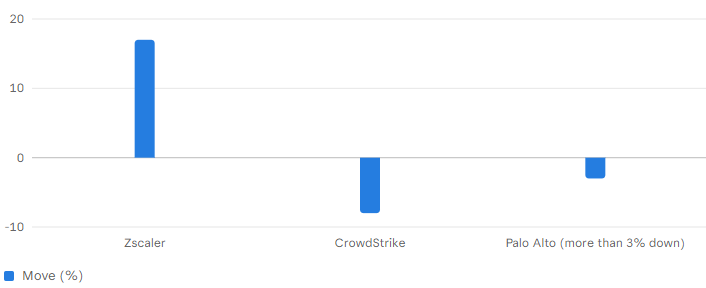
Investors reacted at once. Zscaler shares jumped about 17% in after-hours trading, and CrowdStrike shares fell about 8%. For a long-term investor, the useful question is not the one-day move but what a combined company would look like in five or ten years, and whether the price paid would leave room for a good return. My short answer: the strategic logic is real, because enterprises want fewer security vendors, but a great acquisition is not automatically a great investment. The outcome depends on price, integration and how Zscaler's growth holds up.
Key takeaway: The deal could fill CrowdStrike's biggest product gap and create a stronger rival to Palo Alto Networks. The risk is paying a large premium for a business whose growth guidance is slowing, then integrating two big platforms.
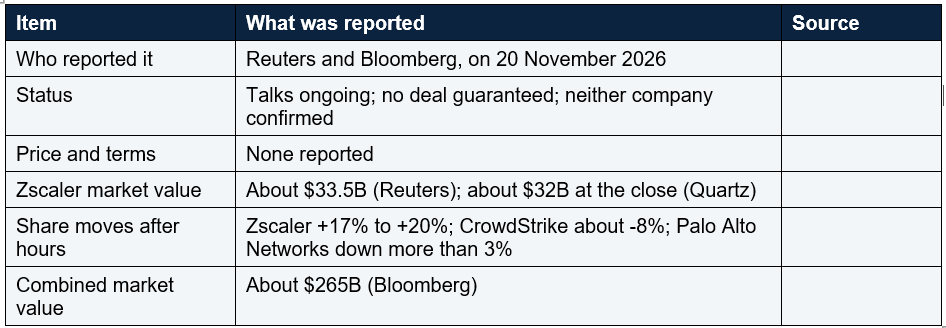
The Zscaler market value and the size of its jump differ between outlets because of timing and rounding. I have used ranges instead of picking one. The sources also note that in September, Zscaler and CrowdStrike announced an expanded partnership. So the two already work together, which makes a deal less of a leap.
A word of caution on one data point. BigGo Finance says CrowdStrike has roughly doubled in value this year while Zscaler is down 13%. That is a lower-quality source and I could not confirm it elsewhere, so treat it as indicative. If it is right, it would mean CrowdStrike would be using a richly valued stock to buy a company that has lagged. My rough subtraction from Bloomberg's combined figure and Reuters's Zscaler figure suggests CrowdStrike is worth around $230 billion. That is my calculation and depends on the timing of each number.
Put them together and you potentially have a broad platform protecting devices, users, networks and cloud applications. Reuters says the deal would fill one of CrowdStrike's biggest gaps, network security, and help it compete more directly with Palo Alto Networks. Why does the combination matter commercially? Reuters notes that enterprises are trying to reduce the number of security vendors they use and favor providers offering multiple products through one relationship. CyberScoop makes the same point, saying cybersecurity companies face pressure to offer comprehensive solutions rather than point products, as customers seek to streamline vendor relationships.
Management raised its outlook. Full-year net new ARR growth guidance rose to 34% at the midpoint, and the Motley Fool reported full-year revenue guidance of about $6 billion at the midpoint. Ending ARR from accounts using its Falcon Flex licensing model exceeded $2.29 billion, up 101%. One conflict to flag: Nasdaq's write-up says revenue rose 25%, while the company's release says 26%. I use the company figure. Valuation is the issue. After the August report, the Motley Fool said CrowdStrike was trading for 144 times next year's expected earnings. That figure is months old and the share price has moved since, so check a current source. But it shows that investors were already paying a high price for growth before the deal news.
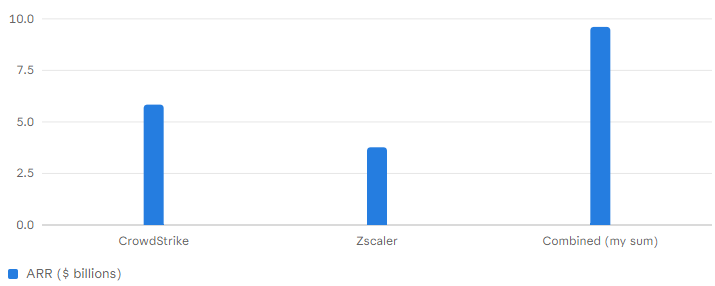
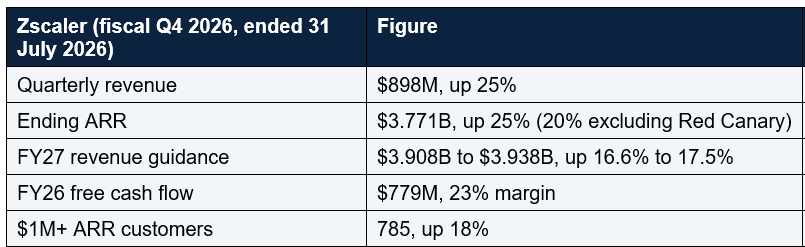
The forward view is slower. For fiscal 2027, Zscaler expects revenue of $3.908 billion to $3.938 billion, growth of 16.6% to 17.5%, and ARR of $4.396 billion to $4.426 billion [16]. Crypto Briefing describes this guidance as a meaningful step down that spooked investors. There are positives. The company had 785 customers paying more than $1 million in ARR, up 18%, and it targets $10 billion in ARR over time. There are negatives too. GAAP operating income was negative $15.5 million in the quarter, according to 24/7 Wall St., so the bull case rides on non-GAAP profit continuing to scale. Zscaler also plans a workforce restructuring affecting about 3% of employees. By my calculation, adding the two ARR figures, which are for the same quarter, gives about $9.6 billion for a combined company, and Zscaler would be roughly 39% of it.
The two firms already know each other. A September partnership expansion means integrations and relationships exist. That could shorten the path to cross-selling, although a partnership is not the same as one product. But cross-selling is never automatic. Customers may have long contracts with existing vendors, and some products overlap. From general knowledge, Zscaler's Red Canary managed detection business sits close to what CrowdStrike also sells, so some overlap would need to be sorted out. I have not verified this from a source, so treat it as a question to watch. CSO Online also reminds readers that cybersecurity acquisitions have a mixed track record at best.
The market appears to see it that way too. Palo Alto shares fell more than 3% after hours on the report. In my inference, that suggests some investors saw a stronger rival, although a single evening's move is weak evidence. Deal size puts this in context. Forrester says Palo Alto's CyberArk purchase was the third-largest cybersecurity M&A deal in history, following Google's $32 billion purchase of Wiz and Cisco's $28 billion acquisition of Splunk. Startup Fortune says a premium on Zscaler's roughly $33.5 billion value would push any CrowdStrike offer past $30 billion. By my calculation, any offer with a premium would exceed all three of those deals.
Zscaler reports that ARR tied to its AI-related offerings grew more than 100% year over year, and that security-for-AI bookings rose more than 50% sequentially in the fourth quarter. Those are company statements, and the starting base is not given in the sources I found, so the percentages may be from small numbers. In my inference, AI helps the deal story in two ways. It adds a growth narrative that could justify a higher price, and it raises the value of a broad platform that can see devices, users and cloud traffic together. But it also invites more competition, from Microsoft, Palo Alto and startups, so AI is a tailwind and not a guarantee.
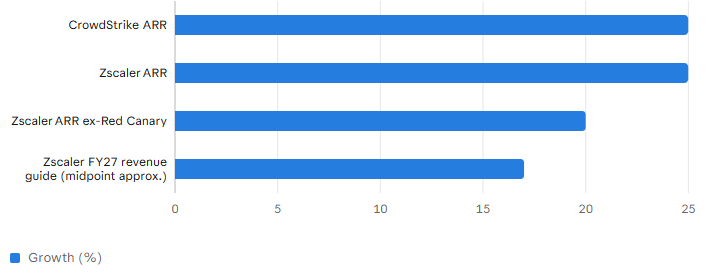
Next, the growth profile. CrowdStrike's ARR is growing 25% and its net new ARR growth guidance is 34%. Zscaler's fiscal 2027 revenue guidance implies growth of about 17%. Buying a slower grower at a large premium would put pressure on CrowdStrike to prove it can reaccelerate the acquired business. Then the valuation backdrop. CrowdStrike was trading at 144 times next year's earnings in August, which leaves less room for disappointment. And Zscaler's GAAP operating income was negative, so the deal would add a business with thinner reported profits.
Finally, integration and approvals. Two big platforms need to be combined, sales teams aligned, and products stitched together. CSO Online notes the mixed track record of these deals. From general knowledge, a deal this size would also likely face regulatory review, which could delay or reshape it. CrowdStrike's shares fell about 8% after hours. Investors seem to be saying that the price and risk matter. A falling acquirer and a rising target is a common pattern in the early reaction, but it is not proof the deal is bad.
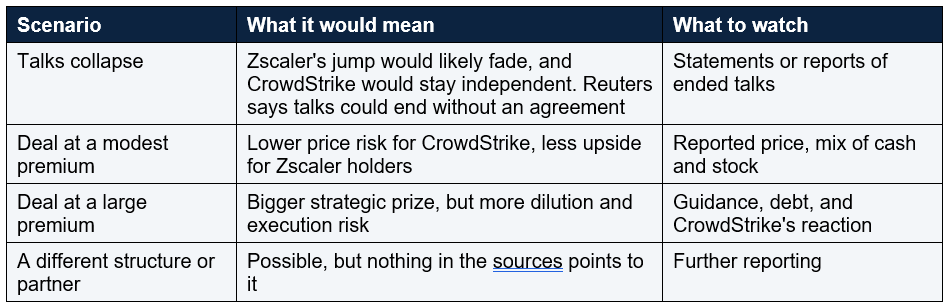
Scenarios are my framework. The statement about talks ending is from Reuters. One more point: Zscaler's shares already jumped 17% on the report. If you buy Zscaler now, part of the likely premium may already be in the price. That is my inference. And if you own CrowdStrike, the 8% fall may reflect worry about price, which only a reported deal price can resolve.
A few mistakes are common in situations like this. The first is treating a report as a done deal. Neither company had confirmed the talks. The second is reading the one-day share moves as a verdict. An after-hours move can reverse, and ticker moves differ by outlet. The third is chasing the target after a jump, without knowing the price. The fourth is assuming the acquirer must win because the strategy sounds good. Cybersecurity deals have a mixed record. The fifth is ignoring valuation. And the sixth is relying on opinion pieces. Several sources here are commentary written to make a case, so check the company filings when you can.
But the investor question is different. CrowdStrike is growing fast, with ARR up 25% [9], while Zscaler's guidance points to about 17% growth, and any deal would likely cost well over $30 billion. Whether this makes CrowdStrike a better investment depends on the price, the structure and the integration, none of which is known yet. So treat the news as a reason to do homework, not a signal to act. Watch for confirmation, terms and guidance, check current valuations, and consider advice from a qualified professional.
Not yet. Reuters and Bloomberg reported on 20 November 2026 that CrowdStrike is in talks to acquire Zscaler. Neither company had confirmed it, no terms were reported, and talks could end without a deal.
Why did Zscaler stock jump and CrowdStrike stock fall?
Zscaler shares rose about 17% after hours, as buyers often pay a premium to a target, while CrowdStrike fell about 8%. The premium point is general knowledge, and the sources do not explain the moves in detail.
How much could the deal be worth?
No price has been reported. Zscaler's market value was about $32 billion to $33.5 billion, and Startup Fortune says a premium would push any offer past $30 billion. Bloomberg puts the combined market value at about $265 billion.
Would the deal make CrowdStrike a better investment?
It depends on price and integration. The strategic case is clear: filling a network security gap and competing with Palo Alto. The risks are paying a large premium for a business with slower guided growth [16] and the mixed track record of such deals.
What does it mean for Palo Alto Networks?
A stronger CrowdStrike would compete harder for the one-stop-shop customer. Palo Alto shares fell more than 3% after hours on the report, and it has already added CyberArk for about $25 billion.
Table of Contents
- What has been reported, and what has not
- Two leaders, one possible platform
- CrowdStrike by the numbers
- Zscaler by the numbers
- Factor 1: Cross-selling
- Factor 2: Taking on Palo Alto Networks
- Factor 3: The AI opportunity
- But there is a catch: price and integration
- How this could play out
- A simple way to think about it
- Conclusion
- FAQ
After-hours moves on the reported talks, 20 Nov 2026
% change after hours by Sources: Reuters via Investing.com, AI Weekly (Bloomberg). Outlets differ: Zscaler +17% to +20%
Annual recurring revenue, quarter ended 31 July 2026
$ billions by Sources: CrowdStrike results (Morningstar), Zacks. Combined is my calculation
Growth rates: CrowdStrike vs Zscaler
% growth by Sources: Morningstar, Zacks, RTTNews. FY27 guide is a company forecast (16.6% to 17.5%)The cybersecurity industry may be on the verge of a blockbuster deal. On Friday, 20 November 2026, Reuters reported that CrowdStrike is in talks to acquire rival Zscaler, citing two people familiar with the matter. Bloomberg reported the same. The headline "CrowdStrike wants to buy Zscaler" is fair as a summary, but it is not yet a done deal. Reuters said the discussions could still end without an agreement.
Investors reacted at once. Zscaler shares jumped about 17% in after-hours trading, and CrowdStrike shares fell about 8%. For a long-term investor, the useful question is not the one-day move but what a combined company would look like in five or ten years, and whether the price paid would leave room for a good return. My short answer: the strategic logic is real, because enterprises want fewer security vendors, but a great acquisition is not automatically a great investment. The outcome depends on price, integration and how Zscaler's growth holds up.
Key takeaway: The deal could fill CrowdStrike's biggest product gap and create a stronger rival to Palo Alto Networks. The risk is paying a large premium for a business whose growth guidance is slowing, then integrating two big platforms.
What has been reported, and what has not
Here is what the sources say, and where they differ.The Zscaler market value and the size of its jump differ between outlets because of timing and rounding. I have used ranges instead of picking one. The sources also note that in September, Zscaler and CrowdStrike announced an expanded partnership. So the two already work together, which makes a deal less of a leap.
A word of caution on one data point. BigGo Finance says CrowdStrike has roughly doubled in value this year while Zscaler is down 13%. That is a lower-quality source and I could not confirm it elsewhere, so treat it as indicative. If it is right, it would mean CrowdStrike would be using a richly valued stock to buy a company that has lagged. My rough subtraction from Bloomberg's combined figure and Reuters's Zscaler figure suggests CrowdStrike is worth around $230 billion. That is my calculation and depends on the timing of each number.
Two leaders, one possible platform
CrowdStrike built its reputation protecting endpoints, meaning laptops, servers and mobile devices. Reuters says its Falcon platform is widely used for this, and that CrowdStrike, founded in 2011 by CEO George Kurtz, has expanded into cloud, identity and threat intelligence through acquisitions and internal development. Zscaler approaches security from another angle. Reuters describes it as providing cloud-based network security that connects users to applications without relying on traditional corporate networks. This is the zero-trust approach, which checks every connection instead of trusting anyone inside a network.Put them together and you potentially have a broad platform protecting devices, users, networks and cloud applications. Reuters says the deal would fill one of CrowdStrike's biggest gaps, network security, and help it compete more directly with Palo Alto Networks. Why does the combination matter commercially? Reuters notes that enterprises are trying to reduce the number of security vendors they use and favor providers offering multiple products through one relationship. CyberScoop makes the same point, saying cybersecurity companies face pressure to offer comprehensive solutions rather than point products, as customers seek to streamline vendor relationships.
CrowdStrike by the numbers
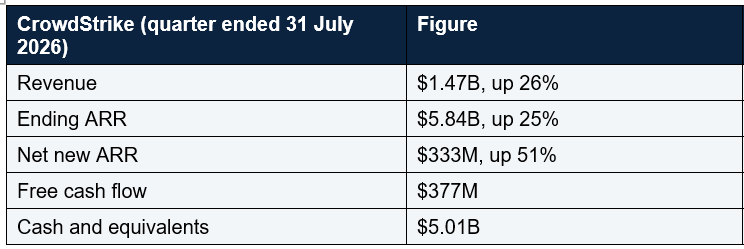
CrowdStrike reported its second quarter of fiscal 2027, which ended 31 July 2026, on 26 August. Revenue was $1.47 billion, up 26%, and annual recurring revenue (ARR) rose 25% to $5.84 billion. Record net new ARR was $333 million, up 51%. Profitability looks healthy. The company generated record free cash flow of $377 million in the quarter, and non-GAAP subscription gross margin was 81%. Cash and cash equivalents stood at $5.01 billion.Management raised its outlook. Full-year net new ARR growth guidance rose to 34% at the midpoint, and the Motley Fool reported full-year revenue guidance of about $6 billion at the midpoint. Ending ARR from accounts using its Falcon Flex licensing model exceeded $2.29 billion, up 101%. One conflict to flag: Nasdaq's write-up says revenue rose 25%, while the company's release says 26%. I use the company figure. Valuation is the issue. After the August report, the Motley Fool said CrowdStrike was trading for 144 times next year's expected earnings. That figure is months old and the share price has moved since, so check a current source. But it shows that investors were already paying a high price for growth before the deal news.
Zscaler by the numbers
Zscaler's fiscal year ends in July. For the fourth quarter of fiscal 2026, it reported revenue of $898 million, up 25%, and for the full year revenue of about $3.35 billion, up 25.4%. Free cash flow for the year was $779 million, a 23% margin. Adjusted operating income was 24% of revenue, a company record. ARR reached $3.771 billion, up 25%. But some of that growth was bought. Zscaler completed its $675 million purchase of Red Canary at the start of the fiscal year, and that business carried $141 million of ARR. Excluding it, total ARR rose 20% to $3.63 billion.The forward view is slower. For fiscal 2027, Zscaler expects revenue of $3.908 billion to $3.938 billion, growth of 16.6% to 17.5%, and ARR of $4.396 billion to $4.426 billion [16]. Crypto Briefing describes this guidance as a meaningful step down that spooked investors. There are positives. The company had 785 customers paying more than $1 million in ARR, up 18%, and it targets $10 billion in ARR over time. There are negatives too. GAAP operating income was negative $15.5 million in the quarter, according to 24/7 Wall St., so the bull case rides on non-GAAP profit continuing to scale. Zscaler also plans a workforce restructuring affecting about 3% of employees. By my calculation, adding the two ARR figures, which are for the same quarter, gives about $9.6 billion for a combined company, and Zscaler would be roughly 39% of it.
Factor 1: Cross-selling
The first reason this could work is cross-selling. CrowdStrike could introduce Zscaler's capabilities to its existing customers, while Zscaler could do the same with Falcon. This is the logic of vendor consolidation, which Reuters cites as a driver of the talks. There is evidence that customers will buy more from one vendor. CrowdStrike says ARR from accounts that adopted Falcon Flex grew 101%. In my inference, that suggests customers are willing to add modules inside one relationship. Zscaler, meanwhile, said it exited the fourth quarter with more than 950 Zero Trust Everywhere enterprises, up from above 700 in the third quarter, and has 785 customers above $1 million in ARR. Those are large accounts that CrowdStrike could try to reach.The two firms already know each other. A September partnership expansion means integrations and relationships exist. That could shorten the path to cross-selling, although a partnership is not the same as one product. But cross-selling is never automatic. Customers may have long contracts with existing vendors, and some products overlap. From general knowledge, Zscaler's Red Canary managed detection business sits close to what CrowdStrike also sells, so some overlap would need to be sorted out. I have not verified this from a source, so treat it as a question to watch. CSO Online also reminds readers that cybersecurity acquisitions have a mixed track record at best.
Factor 2: Taking on Palo Alto Networks
The second reason is competition. A combined company could become a more formidable rival to Palo Alto Networks. Palo Alto has been building what its CEO calls a "cybersecurity supermarket", and it closed its roughly $25 billion CyberArk acquisition to add identity security. Forrester says Palo Alto is assembling a platform-of-platforms to compete with the likes of CrowdStrike. The Motley Fool describes the three biggest stocks in the space as taking different approaches. Microsoft bundles protection with the Office subscription, CrowdStrike wins on product quality in endpoint security, and Palo Alto is building its moat as the one-stop shop. Buying Zscaler would move CrowdStrike toward the one-stop-shop model by closing its network security gap.The market appears to see it that way too. Palo Alto shares fell more than 3% after hours on the report. In my inference, that suggests some investors saw a stronger rival, although a single evening's move is weak evidence. Deal size puts this in context. Forrester says Palo Alto's CyberArk purchase was the third-largest cybersecurity M&A deal in history, following Google's $32 billion purchase of Wiz and Cisco's $28 billion acquisition of Splunk. Startup Fortune says a premium on Zscaler's roughly $33.5 billion value would push any CrowdStrike offer past $30 billion. By my calculation, any offer with a premium would exceed all three of those deals.
Factor 3: The AI opportunity
The third reason is artificial intelligence. As businesses deploy more AI-powered applications and autonomous agents, protecting their digital infrastructure becomes more complicated and more essential. Both companies are leaning into this. CrowdStrike called its second quarter a "Mythos moment," which Nasdaq explains as companies becoming concerned about the threat of rogue AI agents. CEO George Kurtz said securing AI is the largest market opportunity in the company's history.Zscaler reports that ARR tied to its AI-related offerings grew more than 100% year over year, and that security-for-AI bookings rose more than 50% sequentially in the fourth quarter. Those are company statements, and the starting base is not given in the sources I found, so the percentages may be from small numbers. In my inference, AI helps the deal story in two ways. It adds a growth narrative that could justify a higher price, and it raises the value of a broad platform that can see devices, users and cloud traffic together. But it also invites more competition, from Microsoft, Palo Alto and startups, so AI is a tailwind and not a guarantee.
But there is a catch: price and integration
Great acquisitions are not automatically great investments. Zscaler carried a market capitalization of roughly $32 billion to $33.5 billion before the reports surfaced. That is a substantial price tag, and integrating two large technology platforms is not easy. Start with the money. CrowdStrike had $5.01 billion of cash at the end of the quarter. My illustration: a 20%, 30% or 40% premium on $33.5 billion would be about $40.2 billion, $43.6 billion or $46.9 billion. The premiums are made up to show the scale, not a forecast. Even the lowest figure is many times CrowdStrike's cash, so I would expect stock, debt or both to be involved. Stock issuance can dilute existing shareholders, which is general knowledge, not something the sources address.Next, the growth profile. CrowdStrike's ARR is growing 25% and its net new ARR growth guidance is 34%. Zscaler's fiscal 2027 revenue guidance implies growth of about 17%. Buying a slower grower at a large premium would put pressure on CrowdStrike to prove it can reaccelerate the acquired business. Then the valuation backdrop. CrowdStrike was trading at 144 times next year's earnings in August, which leaves less room for disappointment. And Zscaler's GAAP operating income was negative, so the deal would add a business with thinner reported profits.
Finally, integration and approvals. Two big platforms need to be combined, sales teams aligned, and products stitched together. CSO Online notes the mixed track record of these deals. From general knowledge, a deal this size would also likely face regulatory review, which could delay or reshape it. CrowdStrike's shares fell about 8% after hours. Investors seem to be saying that the price and risk matter. A falling acquirer and a rising target is a common pattern in the early reaction, but it is not proof the deal is bad.
How this could play out
The talks could go several ways. This table is my framework, not a forecast.Scenarios are my framework. The statement about talks ending is from Reuters. One more point: Zscaler's shares already jumped 17% on the report. If you buy Zscaler now, part of the likely premium may already be in the price. That is my inference. And if you own CrowdStrike, the 8% fall may reflect worry about price, which only a reported deal price can resolve.
A simple way to think about it
A simple approach, as a framework and not advice. First, separate the strategy from the price. The strategy, filling a network security gap, looks sensible. The price is unknown. Second, wait for facts. No terms have been reported, so any conclusions are provisional. Third, compare growth and quality. CrowdStrike's 25% ARR growth against Zscaler's roughly 17% guided revenue growth is the central question. Fourth, check current valuation and your own exposure. Many investors own both through funds, which is general knowledge, so adding either stock may increase your concentration in cybersecurity or large tech. Fifth, think about your time horizon. If you invest for five to ten years, the question is whether the combined company could sustain growth and margins, not how the stock moves on Monday. And sixth, speak with a qualified financial adviser about your own goals before acting.A few mistakes are common in situations like this. The first is treating a report as a done deal. Neither company had confirmed the talks. The second is reading the one-day share moves as a verdict. An after-hours move can reverse, and ticker moves differ by outlet. The third is chasing the target after a jump, without knowing the price. The fourth is assuming the acquirer must win because the strategy sounds good. Cybersecurity deals have a mixed record. The fifth is ignoring valuation. And the sixth is relying on opinion pieces. Several sources here are commentary written to make a case, so check the company filings when you can.
Conclusion
CrowdStrike and Zscaler are reportedly in talks, and the logic is easy to see. CrowdStrike would fill its network security gap, ride the move toward fewer vendors, and get stronger against Palo Alto, which has already used a $25 billion purchase to widen its platform.But the investor question is different. CrowdStrike is growing fast, with ARR up 25% [9], while Zscaler's guidance points to about 17% growth, and any deal would likely cost well over $30 billion. Whether this makes CrowdStrike a better investment depends on the price, the structure and the integration, none of which is known yet. So treat the news as a reason to do homework, not a signal to act. Watch for confirmation, terms and guidance, check current valuations, and consider advice from a qualified professional.
FAQ
Is CrowdStrike really buying Zscaler?Not yet. Reuters and Bloomberg reported on 20 November 2026 that CrowdStrike is in talks to acquire Zscaler. Neither company had confirmed it, no terms were reported, and talks could end without a deal.
Why did Zscaler stock jump and CrowdStrike stock fall?
Zscaler shares rose about 17% after hours, as buyers often pay a premium to a target, while CrowdStrike fell about 8%. The premium point is general knowledge, and the sources do not explain the moves in detail.
How much could the deal be worth?
No price has been reported. Zscaler's market value was about $32 billion to $33.5 billion, and Startup Fortune says a premium would push any offer past $30 billion. Bloomberg puts the combined market value at about $265 billion.
Would the deal make CrowdStrike a better investment?
It depends on price and integration. The strategic case is clear: filling a network security gap and competing with Palo Alto. The risks are paying a large premium for a business with slower guided growth [16] and the mixed track record of such deals.
What does it mean for Palo Alto Networks?
A stronger CrowdStrike would compete harder for the one-stop-shop customer. Palo Alto shares fell more than 3% after hours on the report, and it has already added CyberArk for about $25 billion.
0 Comments
Be the first to share your thoughts on this article.