

Investing
Disney at a 52-Week High: 3 Reasons It Still Has Room to Run

Record parks and experiences demand sits awkwardly with fears of a consumer spending slowdown. Here is what the numbers say, and where the catches are. Q4 revenue $25.9B (+16%); segment operating income $5.0B (+43%); Experiences operating income $2.25B (+20%); fiscal 2027 guide: double-digit adjusted EPS growth, about $9B buybacks, $2.00 dividend.
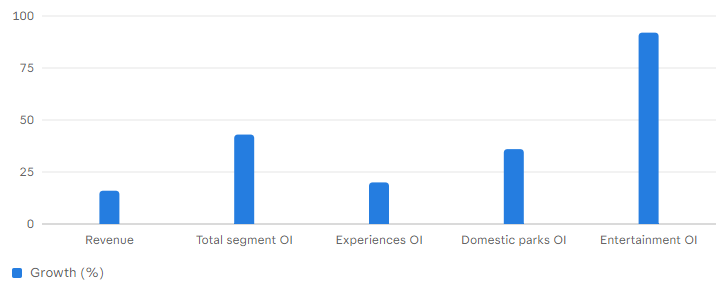
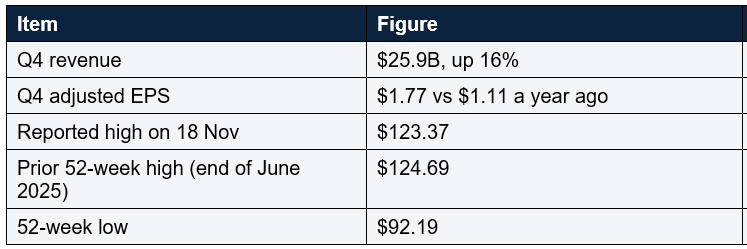
Walt Disney reported its fiscal 2026 fourth-quarter results on 17 November 2026, and the stock jumped to a 52-week high. The headline numbers were strong: revenue rose 16% to $25.9 billion, total segment operating income rose 43% to $5.0 billion, and adjusted earnings per share rose to $1.77 from $1.11. Management said the results were delivered amid a challenging macroeconomic environment.
The headline says Disney still has room to run. The source article was not retrievable, so these are my three reasons. First, parks, resorts and cruises keep growing, with record Experiences results. Second, streaming and ESPN are now contributing real profit. Third, Disney is returning more cash to shareholders, with a larger dividend and about $9 billion of planned buybacks, at a valuation that one analyst called reasonable at roughly 15 times forward earnings. I have a counterweight for each. An extra 53rd week flattered the quarter, Asia is soft, and Disney will stop reporting streaming operating income separately. A new high does not mean a stock cannot fall: Disney dropped nearly 8% after its previous November report.
Key takeaway: Disney's business looks strong, and guidance points to double-digit adjusted earnings growth next year. But the stock has already rallied, and the guidance assumes the economy does not get worse.
The sources do not agree on every price. Earnings Whispers puts the stock at $118.70 on the eve of earnings, up 16.4% since the August report, while Money365 shows a prior close of $116.94. TradingKey's headline says shares neared $126, which is above the $123.37 high reported elsewhere. I could not reconcile these, so treat intraday price levels as approximate. I also could not verify the 7.6% year-to-date gain in the article you quoted.
One useful context point: Zacks reported that Disney hit a 52-week high of $124.69 at the end of June 2025. In my inference, that is why the stock is described as a hair below its highest level in over four years: $123.37 is about 1% below $124.69 (my calculation). Disney's new CEO, Josh D'Amaro, has paired growth plans with a push for $3 billion in annual cost savings.
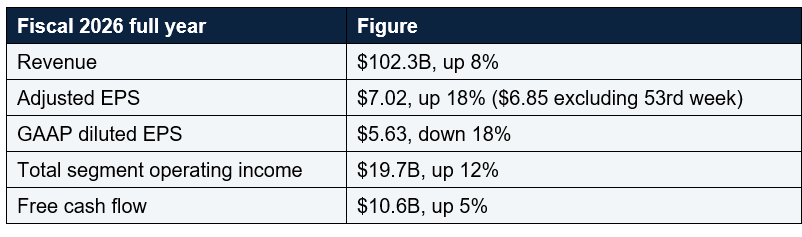
For the full year, revenue rose 8% to $102.3 billion. Adjusted EPS rose 18% to $7.02, or 16% to $6.85 excluding the 53rd week. Total segment operating income rose 12% to $19.7 billion. Free cash flow was $10.6 billion, up 5%. One mixed signal: full-year GAAP EPS fell 18% to $5.63 even though adjusted EPS rose 18%. Adjusted figures exclude certain items, so it is worth knowing the gap exists. The sources I found did not itemize every reason, so I will not guess.
Attendance supports the story. Global guests, which combine park attendance and cruise passenger days, rose 11% in the quarter, or 4% excluding the 53rd week. Domestic park attendance rose 11%, or 3% excluding the extra week. For the full year, Experiences revenue was $39.6 billion, up 9%, and segment operating income was $11.2 billion, up 12%.
Disney credits a steady run of new offerings, its IP, and a commercial strategy focused on domestic guests, aided by favorable comparisons to the prior-year quarter. The cruise fleet also grew, with new ships adding passenger days. From earlier in the year, Disney said Walt Disney World had a standout quarter and forward bookings there remained robust.
By my calculation, Experiences produced about 57% of fiscal 2026 segment operating income ($11.2 billion of $19.7 billion). That matters: when you buy Disney, you are mostly buying the parks. Management expects the momentum to continue, guiding fiscal 2027 Experiences operating income up by a high-single-digit rate excluding the 53rd week, despite softness in Asia. It also plans about $9 billion of capital spending, after $8.7 billion of parks and property investment in fiscal 2026.
Be careful: Asia is weaker. Hong Kong and Shanghai attendance worsened in the quarter, and management expects the pressure to continue through fiscal 2027. Internationally, operating income fell 13% to $369 million in the third quarter.
Disney's own words are cautious. The company said its results were delivered amid a challenging macroeconomic environment, and its fiscal 2027 guidance assumes no material deterioration of the global economy. It has also been here before: Disney Tourist Blog reported then-CEO Bob Iger warning of attendance softness and demand moderation heading into 2025.
There are signs of resilience, too. In the third quarter, Disney said attendance at Universal Orlando had softened while its own Florida and California parks rose 3%. International visitors to Disney's domestic parks are still down, but the drag is smaller than before.
In my inference, the fair reading is this: one strong quarter shows Disney's parks are holding up better than some rivals, but it does not prove consumer spending is safe. If the K shape widens, a business that leans on higher per-guest spending could feel it. Disney's per capita spending growth was cited as a driver of results.
For the full year, Entertainment revenue was $46.6 billion, up 10%, with operating income of $5.4 billion, up 16% and a streaming operating margin of 11.5%. Sports, led by ESPN, grew Q4 revenue 16% to $4.61 billion. For the year, Sports operating income was $3.1 billion, up 7%. ESPN is also set to broadcast its first Super Bowl in the second quarter of fiscal 2027. Upcoming catalysts include a unified Disney+ and Hulu app in December, and the film Avengers: Doomsday on 18 December, which Earnings Whispers says has strong early presales.
The catches matter here. Disney plans to spend about $26 billion on cash content in fiscal 2027, roughly 9% more, and sports rights costs are rising. And starting in the first quarter of fiscal 2027, Disney will stop separately reporting subscription streaming operating income. Earnings Whispers notes that this removes visibility just as profitability had become a selling point, and says bears have legitimate concerns.
Here is some arithmetic, which is my calculation. Disney had about 1.73 billion shares outstanding [30]. At roughly $122.72 a share, that implies a market value near $212 billion, so a $9 billion buyback is about 4% of it, and a $2.00 dividend is a yield of about 1.6%. The share count and price come from different dates, so treat these as rough.
Cost control adds to the picture. Disney is targeting about $3 billion of annual run-rate operating expense savings by fiscal 2029, mostly reinvested in growth, and has said more layoffs are coming. Valuation looks undemanding. Zacks said Disney traded at about 15 times forward earnings after the report, and an earlier Zacks piece put the forward multiple at 14.54 versus 15.91 for its media conglomerates industry. The date of that earlier piece is not clear, so use it as a guide only. I did not retrieve a live multiple.
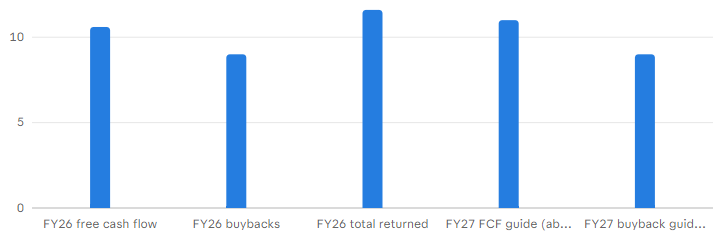
There is a caution. By my calculation, the $11.6 billion returned to shareholders was higher than the $10.6 billion of free cash flow, and borrowings rose to about $44.5 billion from about $42.0 billion. It is not alarming on its own, but it shows returns are not free.
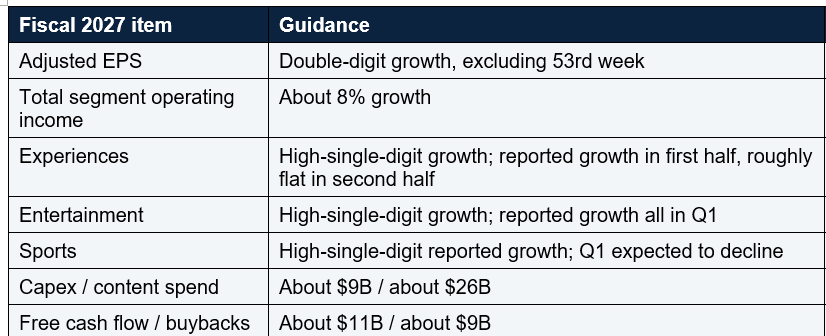
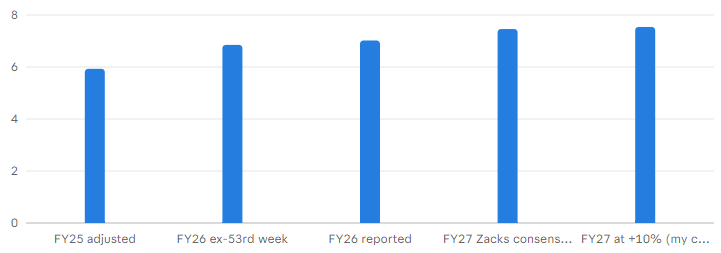
Here is my calculation. Double-digit growth on the $6.85 base (which excludes the 53rd week) implies adjusted EPS of at least about $7.54. The Zacks consensus cited after the report was $7.46, so guidance is a little above it. Zacks says the outlook could exceed the consensus. Two cautions. First, guidance assumes no material deterioration in the global macroeconomic environment. Second, Disney has scheduled a May investor event, where more detail on strategy should come.
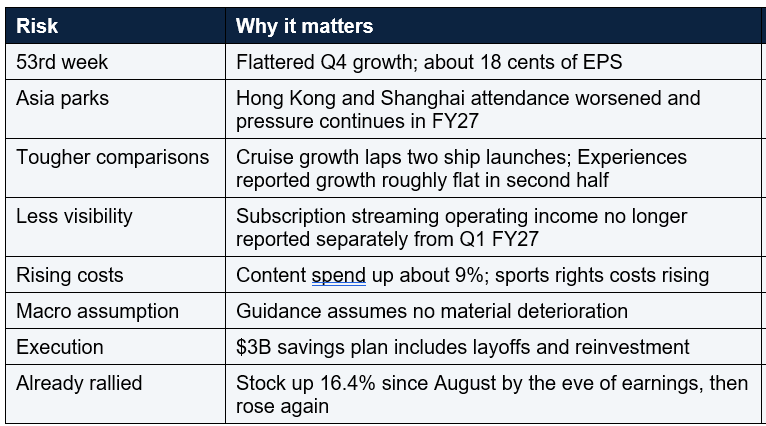
The last row is the investor's problem. A stock that has already climbed is priced for good news, and Disney has shown that good results can still meet a sell-off. The shares were hit after the previous November report, which I discuss next.
The point is not that history will repeat. It is that the stock can fall even with solid results, as expectations matter. By my calculation, at about $122.72 the stock is roughly 33% above its 52-week low of $92.19 [16], so some good news is already in the price.
Second, make a watch list. In my suggestion: Experiences operating income growth against the high-single-digit guide, Asia attendance, per capita spending, the first-quarter report, and the May investor event. Third, keep an eye on the consumer, using spending data such as retail sales . Fourth, check valuation yourself with a live source, since I did not. Fifth, consider your position size and whether you already own Disney through index funds, which is general knowledge. A qualified financial adviser can help you apply this to your situation.
A few mistakes are common after a stock hits a high. The first is chasing the price without a view on value. The second is treating one quarter as a trend. The third is ignoring the 53rd week, which inflates growth rates. The fourth is confusing adjusted EPS with GAAP EPS, which moved in opposite directions this year. The fifth is ignoring the macro assumption behind guidance. The sixth is overlooking Asia and cruise comparisons. And the seventh is relying on headlines. The article behind this post's headline reported a 52-week close on 18 November, but the sources I found show highs on 17 and 18 November at different levels. Check the source and date before acting on any number, including mine.
But the stock has already rallied, the quarter was flattered by an extra week, Asia is soft, and streaming disclosure is shrinking. Guidance also assumes the economy holds. Whether Disney has room to run depends on those things and on the price you pay. Treat this as a framework, not advice. A qualified financial adviser can help you decide whether Disney fits your goals.
Yes, sources report new highs after earnings, with prices of about $122 to $123 on 17 and 18 November. The exact levels differ by outlet, and I could not verify the 7.6% year-to-date figure.
What were Disney's fourth-quarter results?
Revenue was $25.9 billion, up 16%, segment operating income was $5.0 billion, up 43%, and adjusted EPS was $1.77. The 53rd week added 18 cents to adjusted EPS.
Why are parks and experiences so important to Disney?
Experiences earned $11.2 billion of the $19.7 billion in fiscal 2026 segment operating income, about 57% by my calculation. Q4 Experiences operating income rose 20% to $2.25 billion.
What are the main risks?
Asia parks softness, tougher cruise comparisons, rising costs, less streaming disclosure, and a guidance assumption of no macro deterioration. The stock has also already rallied.
Is Disney stock a buy now?
This post cannot answer that, because it is not personal advice and I did not retrieve a live price or valuation. One analyst called roughly 15 times forward earnings reasonable. Check current figures and consult a qualified financial adviser.
Table of Contents
- What happened on earnings day, and what the 52-week high means
- The numbers behind the beat
- Reason 1: Parks, resorts and cruises are still growing
- Does this contradict fears of a consumer slowdown?
- Reason 2: Streaming and ESPN are earning their keep
- Reason 3: Buybacks, a bigger dividend and a reasonable valuation
- What fiscal 2027 guidance says
- The catches: what could stop the run
- What history says about 52-week highs
- A simple way to think about it
- Conclusion
- FAQ
Disney Q4 fiscal 2026: year-over-year growth
% growth by Sources: Disney 8-K, BlogMickey, Benzinga. Quarter includes a 53rd week
Cash generated vs returned to shareholders ($ billions)
$ billions by Source: Disney 8-K summary. FY27 figures are company guidance
Disney adjusted EPS: actual, consensus and guidance math
$ per share by Sources: Betanews, Zacks. The FY27 bar at +10% is my calculation, not company guidanceWalt Disney reported its fiscal 2026 fourth-quarter results on 17 November 2026, and the stock jumped to a 52-week high. The headline numbers were strong: revenue rose 16% to $25.9 billion, total segment operating income rose 43% to $5.0 billion, and adjusted earnings per share rose to $1.77 from $1.11. Management said the results were delivered amid a challenging macroeconomic environment.
The headline says Disney still has room to run. The source article was not retrievable, so these are my three reasons. First, parks, resorts and cruises keep growing, with record Experiences results. Second, streaming and ESPN are now contributing real profit. Third, Disney is returning more cash to shareholders, with a larger dividend and about $9 billion of planned buybacks, at a valuation that one analyst called reasonable at roughly 15 times forward earnings. I have a counterweight for each. An extra 53rd week flattered the quarter, Asia is soft, and Disney will stop reporting streaming operating income separately. A new high does not mean a stock cannot fall: Disney dropped nearly 8% after its previous November report.
Key takeaway: Disney's business looks strong, and guidance points to double-digit adjusted earnings growth next year. But the stock has already rallied, and the guidance assumes the economy does not get worse.
What happened on earnings day, and what the 52-week high means
Disney's fourth quarter ended 3 October 2026. Adjusted EPS of $1.77 beat the $1.68 consensus, and revenue of $25.95 billion beat an estimate of about $25.15 billion. The stock first dipped, falling nearly 2% in premarket trading, then rallied. Money365 recorded a gain of 4.94% to $122.72 during the session, from a prior close of $116.94. StockTwits reported a 52-week high of $123.37 the following day.The sources do not agree on every price. Earnings Whispers puts the stock at $118.70 on the eve of earnings, up 16.4% since the August report, while Money365 shows a prior close of $116.94. TradingKey's headline says shares neared $126, which is above the $123.37 high reported elsewhere. I could not reconcile these, so treat intraday price levels as approximate. I also could not verify the 7.6% year-to-date gain in the article you quoted.
One useful context point: Zacks reported that Disney hit a 52-week high of $124.69 at the end of June 2025. In my inference, that is why the stock is described as a hair below its highest level in over four years: $123.37 is about 1% below $124.69 (my calculation). Disney's new CEO, Josh D'Amaro, has paired growth plans with a push for $3 billion in annual cost savings.
The numbers behind the beat
Start with the quarter. Revenue rose 16% to $25.9 billion from $22.5 billion. Income before taxes rose 71% to $3.5 billion. Diluted EPS rose to $1.51 from $0.73, and adjusted EPS to $1.77 from $1.11. Now the adjustment that matters. The quarter included a 53rd week, which added 18 cents to adjusted EPS. Excluding it, adjusted EPS was $1.59, still up 43%. The extra week contributed roughly $490 million to segment operating income. So the beat is real, but the headline growth rates are inflated by the calendar.For the full year, revenue rose 8% to $102.3 billion. Adjusted EPS rose 18% to $7.02, or 16% to $6.85 excluding the 53rd week. Total segment operating income rose 12% to $19.7 billion. Free cash flow was $10.6 billion, up 5%. One mixed signal: full-year GAAP EPS fell 18% to $5.63 even though adjusted EPS rose 18%. Adjusted figures exclude certain items, so it is worth knowing the gap exists. The sources I found did not itemize every reason, so I will not guess.
Reason 1: Parks, resorts and cruises are still growing
The first reason is the business that matters most. Experiences, which covers theme parks, resorts and cruises, earned $2.25 billion in fourth-quarter operating income, up 20%, on $10.1 billion of revenue. Domestic Parks and Experiences revenue grew 19%, and its operating income jumped 36% to $1.25 billion. Disney said both the quarter and the year would have been records even without the extra week.Attendance supports the story. Global guests, which combine park attendance and cruise passenger days, rose 11% in the quarter, or 4% excluding the 53rd week. Domestic park attendance rose 11%, or 3% excluding the extra week. For the full year, Experiences revenue was $39.6 billion, up 9%, and segment operating income was $11.2 billion, up 12%.
Disney credits a steady run of new offerings, its IP, and a commercial strategy focused on domestic guests, aided by favorable comparisons to the prior-year quarter. The cruise fleet also grew, with new ships adding passenger days. From earlier in the year, Disney said Walt Disney World had a standout quarter and forward bookings there remained robust.
By my calculation, Experiences produced about 57% of fiscal 2026 segment operating income ($11.2 billion of $19.7 billion). That matters: when you buy Disney, you are mostly buying the parks. Management expects the momentum to continue, guiding fiscal 2027 Experiences operating income up by a high-single-digit rate excluding the 53rd week, despite softness in Asia. It also plans about $9 billion of capital spending, after $8.7 billion of parks and property investment in fiscal 2026.
Be careful: Asia is weaker. Hong Kong and Shanghai attendance worsened in the quarter, and management expects the pressure to continue through fiscal 2027. Internationally, operating income fell 13% to $369 million in the third quarter.
Does this contradict fears of a consumer slowdown?
The headline suggests record parks demand contradicts fears of a consumer spending slowdown. That is partly true and partly too neat. The case for the slowdown fear is real. US retail sales rose for a 13th straight month in October 2026, but growth slowed as higher petrol prices pressured household budgets and shoppers sought promotions. Earlier in the year, commentators described a K-shaped economy, in which wealthier Americans keep spending, helped by the stock market, while lower-income consumers struggle.Disney's own words are cautious. The company said its results were delivered amid a challenging macroeconomic environment, and its fiscal 2027 guidance assumes no material deterioration of the global economy. It has also been here before: Disney Tourist Blog reported then-CEO Bob Iger warning of attendance softness and demand moderation heading into 2025.
There are signs of resilience, too. In the third quarter, Disney said attendance at Universal Orlando had softened while its own Florida and California parks rose 3%. International visitors to Disney's domestic parks are still down, but the drag is smaller than before.
In my inference, the fair reading is this: one strong quarter shows Disney's parks are holding up better than some rivals, but it does not prove consumer spending is safe. If the K shape widens, a business that leans on higher per-guest spending could feel it. Disney's per capita spending growth was cited as a driver of results.
Reason 2: Streaming and ESPN are earning their keep
The second reason is that the media side of Disney is no longer a drag. Entertainment segment operating income rose 92% to $1.33 billion on revenue of $11.9 billion, up 17%. Subscription video-on-demand revenue rose 19%. Subscription streaming operating income was $824 million in the quarter, including an estimated $160 million benefit from the extra week.For the full year, Entertainment revenue was $46.6 billion, up 10%, with operating income of $5.4 billion, up 16% and a streaming operating margin of 11.5%. Sports, led by ESPN, grew Q4 revenue 16% to $4.61 billion. For the year, Sports operating income was $3.1 billion, up 7%. ESPN is also set to broadcast its first Super Bowl in the second quarter of fiscal 2027. Upcoming catalysts include a unified Disney+ and Hulu app in December, and the film Avengers: Doomsday on 18 December, which Earnings Whispers says has strong early presales.
The catches matter here. Disney plans to spend about $26 billion on cash content in fiscal 2027, roughly 9% more, and sports rights costs are rising. And starting in the first quarter of fiscal 2027, Disney will stop separately reporting subscription streaming operating income. Earnings Whispers notes that this removes visibility just as profitability had become a selling point, and says bears have legitimate concerns.
Reason 3: Buybacks, a bigger dividend and a reasonable valuation
The third reason is shareholder returns. Disney repurchased $9.0 billion of stock in fiscal 2026, and total returns to shareholders were $11.6 billion including dividends. It plans about $9 billion of buybacks again in fiscal 2027, along with about $11 billion of free cash flow. The board also raised the annual dividend 33% to $2.00 per share, paid in two $1 installments. Barchart notes buybacks lowered the average share count by nearly 2.4% in the first nine months of fiscal 2026.Here is some arithmetic, which is my calculation. Disney had about 1.73 billion shares outstanding [30]. At roughly $122.72 a share, that implies a market value near $212 billion, so a $9 billion buyback is about 4% of it, and a $2.00 dividend is a yield of about 1.6%. The share count and price come from different dates, so treat these as rough.
Cost control adds to the picture. Disney is targeting about $3 billion of annual run-rate operating expense savings by fiscal 2029, mostly reinvested in growth, and has said more layoffs are coming. Valuation looks undemanding. Zacks said Disney traded at about 15 times forward earnings after the report, and an earlier Zacks piece put the forward multiple at 14.54 versus 15.91 for its media conglomerates industry. The date of that earlier piece is not clear, so use it as a guide only. I did not retrieve a live multiple.
There is a caution. By my calculation, the $11.6 billion returned to shareholders was higher than the $10.6 billion of free cash flow, and borrowings rose to about $44.5 billion from about $42.0 billion. It is not alarming on its own, but it shows returns are not free.
What fiscal 2027 guidance says
Guidance is where the bull case gets specific. For fiscal 2027, Disney expects double-digit adjusted EPS growth excluding the 53rd week, and about 8% growth in total segment operating income. Most of the growth is expected in the first half of the year. The company expects first-quarter segment operating income of about $5.4 billion.Here is my calculation. Double-digit growth on the $6.85 base (which excludes the 53rd week) implies adjusted EPS of at least about $7.54. The Zacks consensus cited after the report was $7.46, so guidance is a little above it. Zacks says the outlook could exceed the consensus. Two cautions. First, guidance assumes no material deterioration in the global macroeconomic environment. Second, Disney has scheduled a May investor event, where more detail on strategy should come.
The catches: what could stop the run
No bull case is complete without the risks. Here are the main ones.The last row is the investor's problem. A stock that has already climbed is priced for good news, and Disney has shown that good results can still meet a sell-off. The shares were hit after the previous November report, which I discuss next.
What history says about 52-week highs
A 52-week high is a fact about the past, not a promise about the future. Disney's own history shows this. In late June 2025, the stock hit a 52-week high of $124.69 [28]. Then, after its fiscal Q4 2025 report on 13 November 2025, the stock plunged nearly 8% [26]. TIKR recorded the price at $107.61 and noted it was a day when Disney beat expectations [29]. TIKR also noted that resolving a dispute with YouTube TV could help the stock find support [29].The point is not that history will repeat. It is that the stock can fall even with solid results, as expectations matter. By my calculation, at about $122.72 the stock is roughly 33% above its 52-week low of $92.19 [16], so some good news is already in the price.
A simple way to think about it
A simple approach, as a framework and not advice. First, separate the business from the stock. The business looks healthy: record Experiences results , profitable streaming, and double-digit EPS guidance. The stock is a separate question that depends on price.Second, make a watch list. In my suggestion: Experiences operating income growth against the high-single-digit guide, Asia attendance, per capita spending, the first-quarter report, and the May investor event. Third, keep an eye on the consumer, using spending data such as retail sales . Fourth, check valuation yourself with a live source, since I did not. Fifth, consider your position size and whether you already own Disney through index funds, which is general knowledge. A qualified financial adviser can help you apply this to your situation.
A few mistakes are common after a stock hits a high. The first is chasing the price without a view on value. The second is treating one quarter as a trend. The third is ignoring the 53rd week, which inflates growth rates. The fourth is confusing adjusted EPS with GAAP EPS, which moved in opposite directions this year. The fifth is ignoring the macro assumption behind guidance. The sixth is overlooking Asia and cruise comparisons. And the seventh is relying on headlines. The article behind this post's headline reported a 52-week close on 18 November, but the sources I found show highs on 17 and 18 November at different levels. Check the source and date before acting on any number, including mine.
Conclusion
Disney's fiscal 2026 ended strongly, with record Experiences results, rising streaming profit, and guidance for double-digit adjusted EPS growth. A larger dividend and about $9 billion of buybacks add support. At about 15 times forward earnings, the valuation does not look stretched, though I did not check a live figure.But the stock has already rallied, the quarter was flattered by an extra week, Asia is soft, and streaming disclosure is shrinking. Guidance also assumes the economy holds. Whether Disney has room to run depends on those things and on the price you pay. Treat this as a framework, not advice. A qualified financial adviser can help you decide whether Disney fits your goals.
FAQ
Did Disney really hit a 52-week high?Yes, sources report new highs after earnings, with prices of about $122 to $123 on 17 and 18 November. The exact levels differ by outlet, and I could not verify the 7.6% year-to-date figure.
What were Disney's fourth-quarter results?
Revenue was $25.9 billion, up 16%, segment operating income was $5.0 billion, up 43%, and adjusted EPS was $1.77. The 53rd week added 18 cents to adjusted EPS.
Why are parks and experiences so important to Disney?
Experiences earned $11.2 billion of the $19.7 billion in fiscal 2026 segment operating income, about 57% by my calculation. Q4 Experiences operating income rose 20% to $2.25 billion.
What are the main risks?
Asia parks softness, tougher cruise comparisons, rising costs, less streaming disclosure, and a guidance assumption of no macro deterioration. The stock has also already rallied.
Is Disney stock a buy now?
This post cannot answer that, because it is not personal advice and I did not retrieve a live price or valuation. One analyst called roughly 15 times forward earnings reasonable. Check current figures and consult a qualified financial adviser.
0 Comments
Be the first to share your thoughts on this article.