

Financial Literacy
Financial Security Comes From Ownership, Not a Paycheck

Table of Contents
- The Paycheck Trap and the Ownership Thesis
- The Data: Why Ownership Outperforms Income -- Every Time
- The Four Ownership Vehicles: What They Are and How Each One Builds Wealth
- Why Each Type of Ownership Matters -- And What a Paycheck Cannot Do
- How to Start Building Ownership Alongside Your Income -- Right Now
- Conclusion: Stop Working Only for Income. Start Building Ownership.
- Frequently Asked Questions (FAQ)
The Paycheck Trap and the Ownership Thesis
Most people are building their financial future on a platform that cannot do the job they are assigning to it. A paycheck is income -- money exchanged for time and effort. It arrives regularly, it pays the bills, and if you work more, you earn more. It is reliable, familiar, and for most of the population, it is the only financial mechanism they actively manage. It is also insufficient on its own as a path to lasting financial security.In 2025, wages in the United States grew by approximately 3.3%. In the same year, the S&P 500 returned 18%. Yahoo Finance (published one week ago -- most current): 'That means someone with $50,000 in an index fund gained more last year -- without lifting a finger -- than most workers got from a raise. And that gap compounds.' A person with $50,000 invested earned approximately $9,000 in 2025 from that investment alone. A person earning $60,000 who received a 3.3% raise earned $1,980 more. The ownership advantage was 4.5 times greater -- and it required zero additional hours.
The difference between these two outcomes is not intelligence, not luck, and not even primarily income. It is ownership. The person with the investment owns a stake in businesses that create value independent of their personal effort. As those businesses grow, the ownership stake grows with them. It compounds. It can be sold, borrowed against, or passed to the next generation. The paycheck cannot do any of this. This guide is the case for ownership -- the data behind it, the four vehicles through which ordinary people access it, the common mistakes that prevent it, and the specific steps to start building it alongside whatever income you currently earn. Never settle for income alone when you can own something too.
The Data: Why Ownership Outperforms Income -- Every Time
The empirical record on ownership versus income as a wealth-building mechanism is unambiguous. Yahoo Finance (1 week ago -- most current): 'What separates people within the same income bracket is whether they get their money onto the other track -- the one that compounds. Two families earning $85,000 can have wildly different financial lives depending on whether one of them started investing early, owns a home, or carries $40,000 in student debt.'This observation cuts to the centre of the ownership thesis. Income is the same. The outcomes are radically different. The difference is ownership -- or its absence. The top 10% of US households own 67% of total US wealth. The bottom 50% own 2.5%. The Global Statistics (April 2026): 'The 31.7% top-1% wealth share registered by the Federal Reserve in Q3 2025 represents a multi-decade trend of accelerating wealth concentration.' That concentration is not primarily driven by income inequality. It is driven by ownership inequality -- the compounding divergence between households that convert income into assets and those that convert income entirely into consumption.
Charles Schwab's 2025 Modern Wealth Survey found that Americans believe it takes $2.3 million to be considered wealthy and $839,000 just to feel financially comfortable. The national median household net worth is $192,700. The gap between what people say they need ($839,000) and what the median household has ($192,700) is the ownership gap. No amount of paycheck growth closes it unless a portion of that paycheck is consistently converted into assets that compound.
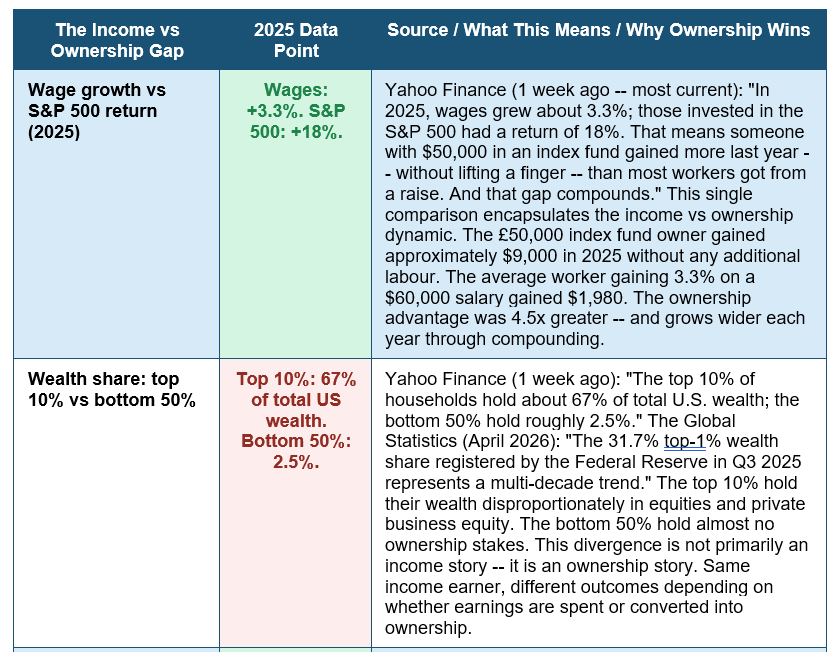
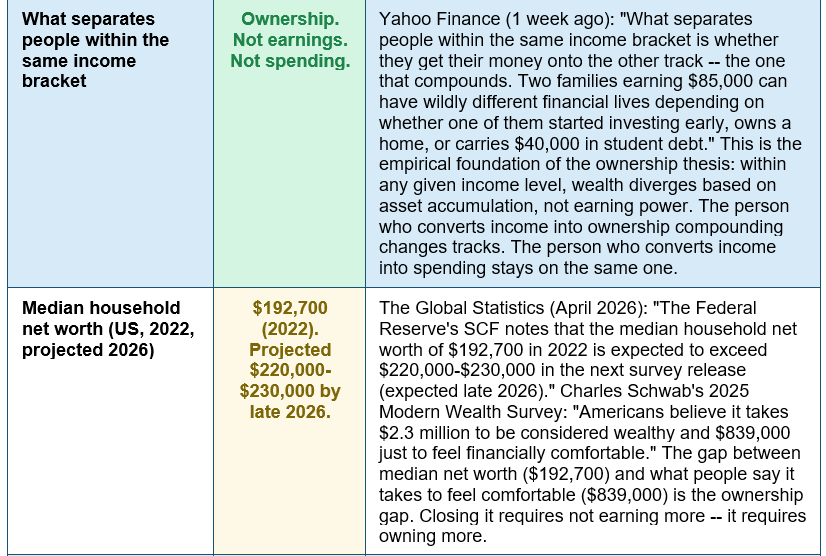
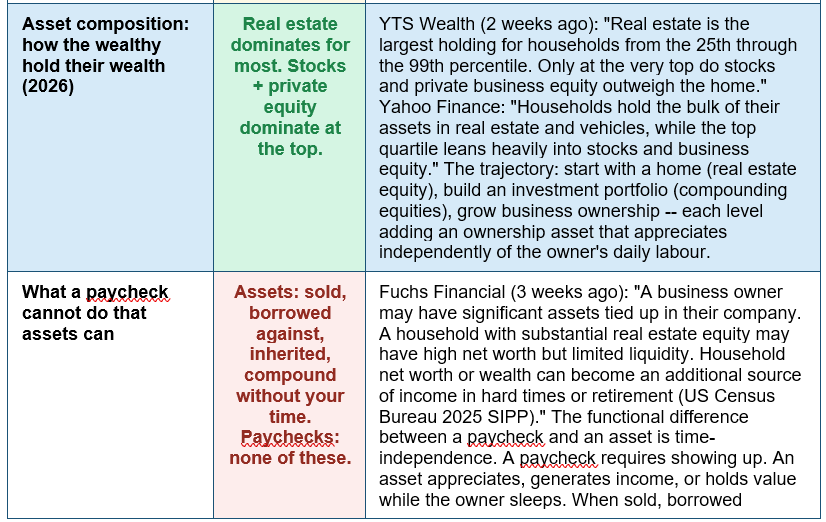

The ownership gap in numbers: Wages +3.3% in 2025. S&P 500 +18%. Top 10% own 67% of US wealth. $50k invested earned more than most workers' raises. Median net worth: $192,700. Wealthy threshold: $839,000. — Yahoo Finance (1 week ago -- most current): 'Wages grew about 3.3% in 2025; S&P 500 returned 18%. Someone with $50,000 in an index fund gained more without lifting a finger than most workers got from a raise. Top 10% of households hold 67% of total US wealth; bottom 50% hold 2.5%.' The Global Statistics (April 2026): 'Median net worth expected to exceed $220,000-$230,000 by late 2026.' Schwab Modern Wealth Survey 2025: 'Americans believe it takes $2.3 million to be considered wealthy and $839,000 just to feel financially comfortable.' YTS Wealth (2 weeks ago): 'Real estate is the largest holding for households from the 25th to the 99th percentile.'
The Four Ownership Vehicles: What They Are and How Each One Builds Wealth
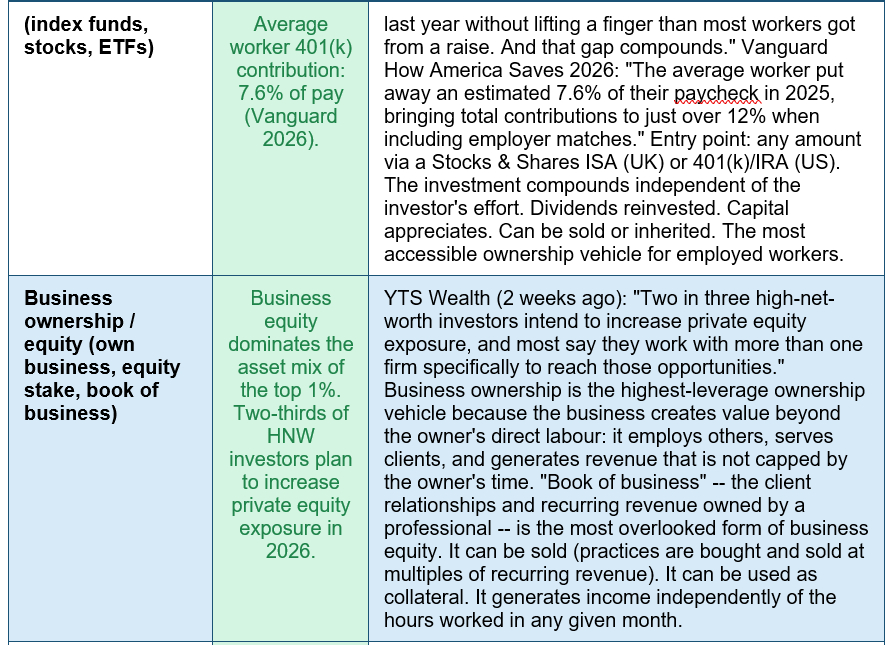
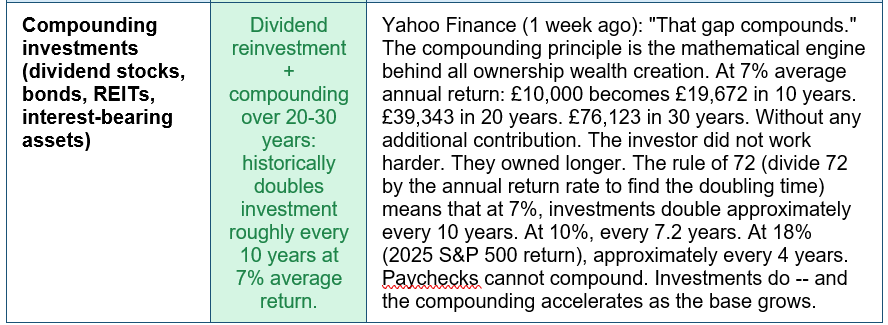
There are four primary vehicles through which ordinary people build ownership stakes that compound independently of their labour. The following table maps each one against current 2026 data: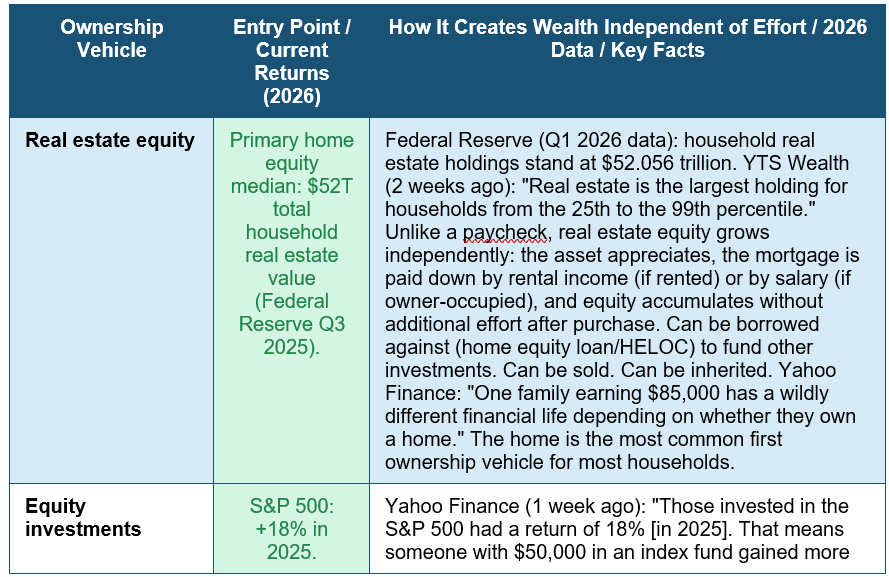
Why Each Type of Ownership Matters -- And What a Paycheck Cannot Do
REAL ESTATE Own your home. Build equity. Leverage to grow. | The most common ownership vehicle -- and the largest single asset for most householdsFederal Reserve Distributional Financial Accounts (Q3 2025, released January 2026): total household real estate holdings stand at $52.056 trillion. YTS Wealth (2 weeks ago): 'Real estate is the largest holding for households from the 25th through the 99th percentile.' For the vast majority of households that build meaningful net worth, the primary home is where it begins. Real estate ownership creates wealth through three simultaneous mechanisms. First, appreciation: the property increases in value over time -- the Federal Reserve tracks this and it has been consistent on a long-term basis across major markets. The owner did not labour to produce this increase. They owned the asset while the market moved. Second, equity build: every mortgage payment reduces the outstanding loan balance. The equity -- the difference between the property value and the mortgage balance -- grows automatically with each payment, combining with appreciation. Third, leverage: real estate can be purchased with borrowed money (a mortgage), meaning a 10-20% deposit controls 100% of an asset. A property bought for £300,000 with a £30,000 deposit that appreciates 10% has gained £30,000 in value -- a 100% return on the deposit, achieved through ownership leverage. Then there is what a paycheck cannot do that equity can: real estate can be borrowed against (home equity loans, HELOCs, equity release in retirement) to fund further investment. It can be sold and the proceeds used to buy more assets. It can be inherited, transferring wealth across generations. A paycheck dies with the working relationship.
EQUITY INVESTMENTS Own a piece of businesses you never have to work in. | The most accessible compounding ownership vehicle for any employed person
Yahoo Finance (1 week ago): 'Those invested in the S&P 500 had a return of 18% [in 2025]. That means someone with $50,000 in an index fund gained more last year without lifting a finger than most workers got from a raise. And that gap compounds.' Vanguard How America Saves 2026: 'The average worker put away an estimated 7.6% of their paycheck in 2025, bringing total contributions to just over 12% when including employer matches.' When you invest in an index fund or a diversified stock portfolio, you own a proportional stake in every company in that fund. You own a piece of Apple, Nvidia, HSBC, BP -- businesses generating billions in revenue. You did not work at any of them. You own them. As they generate profits, grow, and pay dividends, your ownership stake grows in value. This is ownership producing income independent of your time. The compounding accelerates over time: at 7% average annual return (the long-term historical average for diversified global equity portfolios), a £10,000 investment becomes £76,123 in 30 years without a single additional pound contributed. At 10%, it becomes £174,494. This is the mathematical engine that separates the financially secure from the financially dependent -- not income, but ownership compounding over time. Entry point: an ISA (UK) or 401(k)/IRA (US) with a single standing order into a low-cost global index fund. Available to anyone with any amount of monthly surplus after essential expenses.
BUSINESS EQUITY AND BOOK OF BUSINESS Own what generates revenue while you sleep. | The highest-leverage ownership vehicle -- available even without starting from scratch
YTS Wealth (2 weeks ago): 'Two in three high-net-worth investors intend to increase private equity exposure, and most say they work with more than one firm specifically to reach those opportunities.' Business ownership is the ownership vehicle most associated with the wealthiest households because it is the highest-leverage form of value creation. A business generates revenue from multiple sources simultaneously -- employees, clients, systems, intellectual property -- that are not capped by any individual's working hours. The owner captures the value produced by the entire organisation. The 'book of business' is a specific form of business equity that many professionals overlook. It is the portfolio of client relationships and recurring revenues that a professional has built in any field -- financial advisory, accounting, law, insurance, medical practice, recruitment, consulting. This book has monetary value independent of the professional's daily work. It can be sold: professional practice sales routinely achieve multiples of one to three times annual recurring revenue. A financial adviser with £200,000 in recurring annual fees owns a practice worth £400,000-£600,000 -- wealth created not just from working, but from owning the client relationships. This is the book of business as asset, not just as job. The book can be borrowed against as collateral. It can be sold on retirement. It can in some cases be inherited or transferred. None of these outcomes are available to someone who works for a salary in the same profession without building ownership.
COMPOUNDING INVESTMENTS Start now. Wait. Do nothing. Collect. | The only passive wealth-building mechanism that requires no talent, no expertise, and no ongoing effort
Yahoo Finance (1 week ago): 'And that gap compounds.' The most important word in any discussion of ownership and wealth is compounding -- the process by which investment returns generate their own returns. Albert Einstein reportedly called it the eighth wonder of the world, though the principle is straightforwardly mathematical: at 7% annual return, money doubles approximately every ten years (rule of 72: 72 divided by 7 equals approximately 10.3 years). At the 2025 S&P 500 return of 18%, money doubles in approximately four years. Compounding is the mechanism that makes the ownership advantage not just additive but exponential. A person who starts investing £200 per month at age 25 and stops at age 35 (contributing for 10 years, then leaving the investment untouched) ends up with more money at 65 than a person who starts at 35 and contributes £200 per month until 65 (contributing for 30 years) -- because of the additional decade of compounding on the early contributions. The paycheck cannot do this. A paycheck earned in 2010 does not generate additional income in 2026. An investment made in 2010 does -- automatically, while the investor does nothing. The specific compounding vehicles available to most people include: low-cost index funds in tax-advantaged wrappers (ISA, JISA, SIPP in the UK; 401(k), IRA, HSA in the US); dividend reinvestment plans that compound income automatically; REITs (Real Estate Investment Trusts) that provide real estate ownership returns in fund form without property management; and interest-bearing savings in competitive accounts that provide a compounding baseline while other assets are being accumulated.
The book of business: the most overlooked ownership asset. Many professionals spend decades building something they do not know they own. A doctor with an established patient list. An accountant with 200 longstanding clients. A mortgage broker with a database of clients who refinance every five years. A recruitment consultant whose clients call them directly and not the firm. Each of these represents a 'book of business' -- recurring client relationships with real monetary value. This book can be formalised, valued, and monetised. It can be used as a basis for starting an independent practice. It can be sold to a competitor or acquirer on retirement. It can be the foundation for a business that employs others, multiplying the owner's value-generating capacity beyond their personal hours. Yahoo Finance (1 week ago): 'A business owner may have significant assets tied up in their company.' The professional who recognises their client relationships as an asset -- not just as a job requirement -- starts thinking about that asset differently: protecting it, growing it, making it transferable, and eventually extracting its capital value. Most employees in client-facing roles are building a book of business for their employer. Building it for yourself is the ownership equivalent.
How to Start Building Ownership Alongside Your Income -- Right Now
The most common objection to the ownership thesis is that it requires money to invest before income arrives. This is partially true -- ownership requires capital, which typically must come from income surplus. But the entry points are lower, more flexible, and more accessible than most people believe. The strategy is not to stop earning income. It is to begin converting a portion of that income into ownership as early as possible.- 1. Automate a monthly transfer to an investment account: This is the entry point. Vanguard How America Saves 2026: "The average worker put away an estimated 7.6% of their paycheck in 2025." Set up a standing order from your current account to a Stocks & Shares ISA (UK) or a 401(k)/IRA (US) for the day your salary arrives. Even £50 or $50 per month purchases ownership in a global index fund. That ownership compounds. It grows. In 30 years it is unrecognisable from the original contribution. The key: automate before spending decisions are made. The £50 that transfers automatically is spent on ownership. The £50 that does not transfer is typically spent on something that generates no future value.
- 2. Work toward property ownership as the first major asset: Real estate equity is where most households build their first significant ownership stake. Federal Reserve (Q3 2025): household real estate holdings total $52.056 trillion. Building toward a property purchase -- even starting with aggressive saving for a deposit -- puts you on the ownership track. The home that appreciates, has its mortgage paid down, and can eventually be borrowed against or sold is an asset. The rent that pays the landlord's mortgage is someone else's ownership vehicle funded by your income.
- 3. Identify and document your book of business: If you work in any client-facing profession -- financial services, legal, medical, consulting, recruitment, insurance, real estate -- spend one hour listing every client relationship you have personally developed. This is the beginning of understanding your book of business as an asset. YTS Wealth (2 weeks ago): "two in three high-net-worth investors intend to increase private equity exposure." The professional who begins thinking about their client relationships as an ownership asset that has value, can be transferred, and can be sold begins to manage their career differently. They document, systematise, and protect that book.
- 4. Reinvest dividends and returns automatically: Any investment platform (Vanguard, AJ Bell, Fidelity in the UK; Fidelity, Schwab, Vanguard in the US) offers automatic dividend reinvestment. When your investments pay dividends, those dividends immediately purchase more ownership. This is compounding in its purest form. Yahoo Finance (1 week ago): "That gap compounds." Every time a dividend is reinvested rather than withdrawn, the compounding base grows. The future returns on that reinvested dividend will themselves be reinvested. The exponential growth of a compound investment is not intuitive until you run the numbers: £10,000 at 7% with dividends reinvested becomes £76,123 in 30 years. The same £10,000 with dividends withdrawn becomes approximately £38,000.
- 5. As income grows, direct increments to ownership -- not lifestyle: The ownership gap widens because lifestyle inflation absorbs income growth. Every pay rise gets spent on a better car, a bigger flat, more subscriptions. The ownership-first mindset directs incremental income to ownership vehicles before adjusting lifestyle spending. The Global Statistics (April 2026): "Upper-income households benefited disproportionately from both wage increases and asset appreciation during the post-pandemic period." They benefited from asset appreciation because they owned assets. They owned assets because they redirected income into ownership rather than consumption. This is the habit that separates converging outcomes from compounding ones.
FIVE MISTAKES THAT KEEP PEOPLE WORKING FOR INCOME INSTEAD OF BUILDING OWNERSHIP: (1) SPENDING EVERY PAY RISE. Every income increase that is fully absorbed by lifestyle spending is a missed ownership opportunity. The most powerful time to build ownership is immediately after an income increase, before lifestyle adjusts to match it. Automating an increased investment contribution on the same day a pay rise takes effect prevents lifestyle absorption. (2) TREATING HOME EQUITY AS A SPENDING ACCOUNT. A home equity loan taken to fund a holiday or a car purchase converts a compounding asset into consumption. Real estate equity is an ownership asset. Borrowing against it is appropriate for investment in more assets (a buy-to-let deposit, a business investment) -- not for spending that produces no ownership. (3) IGNORING THE EMPLOYER MATCH ON A 401(K) OR WORKPLACE PENSION. Not contributing enough to capture the full employer match is the equivalent of turning down a 50-100% guaranteed return on the matched contribution. Vanguard 2026: average worker total contributions (including employer match) reach just over 12% when the match is included. Maximise the match first -- it is the highest guaranteed return available to employed people. (4) KEEPING ALL WEALTH IN A SINGLE ASSET CLASS. YTS Wealth (2 weeks ago): 'Two in three high-net-worth investors intend to increase private equity exposure.' Concentrated wealth in one vehicle (only a home, only a pension, only a single business) carries concentration risk. The wealthy diversify across real estate, equities, and business ownership because diversification across compounding assets reduces volatility without reducing the compounding effect. (5) WAITING UNTIL THE INCOME IS 'HIGH ENOUGH' TO START INVESTING. Yahoo Finance (1 week ago): 'Two families earning $85,000 can have wildly different financial lives depending on whether one of them started investing early.' The families that started early own assets that have had years to compound. Starting with £50 or $50 per month at 30 produces more wealth at 65 than starting with £500 at 50, because time is the irreplaceable variable in compounding.
THE OWNERSHIP BUILDING ACTION PLAN: THIS WEEK: (1) Open a Stocks & Shares ISA (UK) or a Roth IRA (US) if you do not already have one. This takes 15-30 minutes online with Vanguard, AJ Bell, Fidelity, or Schwab. (2) Set up a monthly standing order from your current account into this account for the day after payday. Even £25 or $25. The amount is less important than the automation and the start date. (3) Choose a single low-cost global index fund (Vanguard FTSE All-World ETF in the UK; Vanguard Total World Stock ETF (VT) in the US) and direct all contributions to it. Keep it simple. (4) Set dividend reinvestment to automatic. THIS YEAR: (5) If you rent, begin saving specifically for a property deposit. Calculate the target amount, the monthly saving required, and set up a dedicated high-interest savings account for it. (6) Document your book of business: list every client or customer relationship you have personally built. Understand it as an asset. Begin thinking about what it would take to own it rather than contribute it to your employer. (7) If your employer offers a pension match or 401(k) match, contribute enough to capture the full match. This is free money. Do not leave it on the table. EVERY YEAR: (8) When income increases, redirect at least 50% of the increase to ownership vehicles before lifestyle adjusts. (9) Review your total ownership position: real estate equity + investment portfolio value + business/book value. Watch the number grow independently of your working hours. REMEMBER: Never settle for income alone when you can own something too. FREE GUIDANCE: UK: MoneyHelper 0800 138 7777. US: CFPB consumerfinance.gov | SEC investor.gov.
Conclusion: Stop Working Only for Income. Start Building Ownership.
In 2025, someone with $50,000 in an index fund earned more from ownership -- without any additional effort -- than most workers received from a pay rise. The S&P 500 returned 18%. Wages grew 3.3%. The gap between these two numbers is not new, and it is not temporary. It is structural. It compounds. And it is the foundational reason why the top 10% of US households own 67% of total wealth while the bottom 50% own 2.5%.The four ownership vehicles available to ordinary people -- real estate equity, investment portfolios, business ownership, and compounding assets -- all share a property that no paycheck can match: they produce value independent of the owner's daily effort. They can be sold. They can be borrowed against. They can be inherited. They grow while the owner sleeps. And because they compound, the earlier they are started, the more dramatic their long-term effect. YTS Wealth (2 weeks ago): 'Real estate is the largest holding for households from the 25th to the 99th percentile.' Most people who build meaningful net worth do so first through a home, then through an investment portfolio, and for some through business equity. The sequence is less important than the principle: converting some portion of every paycheck into ownership, consistently, before lifestyle absorbs the surplus.
The title of this guide is a statement of financial principle: the fastest path to real financial security is not a bigger paycheck. It is ownership. The paycheck pays this month's bills. Ownership builds next decade's freedom. One is linear. The other compounds. Building both simultaneously -- earning income and converting a portion of it, every month, into assets that appreciate and compound -- is the financial strategy that works. Never settle for income alone when you can own something too.
Frequently Asked Questions (FAQ)
Why does ownership build more wealth than a higher salary?The mathematical answer is compounding. Yahoo Finance (1 week ago -- most current): 'In 2025, wages grew about 3.3%; those invested in the S&P 500 had a return of 18%. That means someone with $50,000 in an index fund gained more last year without lifting a finger than most workers got from a raise. And that gap compounds.' A salary produces linear income: work this year, earn this year's income. An ownership stake in a compounding asset produces exponential returns: the investment made this year generates returns next year, those returns generate returns the year after, and the base of compounding grows every year without additional contributions. At 7% average annual return, money doubles approximately every ten years. At 18% (the 2025 S&P 500 return), it doubles approximately every four years. Furthermore, assets can generate income without the owner's presence: rental income, dividends, business profits, and capital appreciation all happen independently of the owner's labour. Income earned is taxed immediately. Assets appreciate, in many cases, with favourable tax treatment (capital gains rates, ISA/pension wrappers, step-up in basis on inheritance). The wealthy capture wealth through ownership because ownership compounds, diversifies risk, and produces income without effort. Paychecks cannot do this.
What is a book of business and why does it have ownership value?
A book of business is the portfolio of client relationships, recurring revenue, and professional trust that a person builds in any service-based career. It exists in financial advisory, accountancy, legal practice, medical practice, insurance, recruitment, mortgage broking, consulting, and dozens of other fields. Its defining characteristic: the client comes to you, not just to your employer. That personal relationship has economic value independent of any employer or firm. The ownership value of a book of business derives from its recurring revenue. If an accountant has 150 clients each paying £1,500 per year (£225,000 in annual revenue), that book typically sells at a multiple of one to two times annual revenue: £225,000 to £450,000. The accountant has not merely been earning a salary -- they have been building an asset worth hundreds of thousands. Fuchs Financial (3 weeks ago): 'A business owner may have significant assets tied up in their company.' The same principle applies to a professional with a strong client base. The book can be sold on retirement or career transition. It can be the basis for an independent practice that eventually employs staff and generates income beyond the owner's personal hours. It can be used as collateral. For anyone in a client-facing profession, documenting, systematising, and protecting the client relationships they have built is the first step toward recognising and monetising the ownership value already created.
How do I start building ownership with a modest income?
The entry point to ownership is lower than most people believe. Vanguard How America Saves 2026: 'The average worker put away an estimated 7.6% of their paycheck in 2025, bringing total contributions to just over 12% when including employer matches.' On a $50,000 salary, 7.6% is $3,800 per year or approximately $316 per month. This is enough to build meaningful ownership over time. The specific steps: (1) Capture the employer match first. If your employer matches pension or 401(k) contributions, contribute enough to get the full match. This is a guaranteed 50-100% return on the matched amount -- the highest guaranteed return available anywhere. (2) Open a Stocks & Shares ISA (UK) or a Roth IRA (US) and set up a monthly automatic contribution into a low-cost global index fund. Even £25 or $25 per month starts the compounding process and, more importantly, starts the ownership habit. (3) Every income increase should direct at least half of the increment to ownership vehicles before lifestyle adjusts. Yahoo Finance (1 week ago): 'Two families earning $85,000 can have wildly different financial lives depending on whether one of them started investing early.' The family that started early with modest amounts wins because of time in the market, not the size of contributions. (4) Build toward property ownership: even if buying immediately is not possible, saving specifically for a deposit in a high-interest savings account is the first step toward the most universally accessible ownership vehicle.
What is the difference between net worth and income, and why does it matter?
Income is what flows in each month or year -- salary, wages, self-employment earnings. Net worth is the total of everything you own (assets) minus everything you owe (liabilities). Net worth is the comprehensive measure of financial position; income is just one input. Yahoo Finance (1 week ago): 'What separates people within the same income bracket is whether they get their money onto the other track -- the one that compounds.' Two people on identical incomes can have dramatically different net worths: one owns a home, a pension, and an investment portfolio; the other rents, has no investments, and carries consumer debt. Their income is the same. Their net worth is not. Charles Schwab's 2025 Modern Wealth Survey found that Americans believe it takes $839,000 to feel financially comfortable. The national median household net worth is $192,700. The Global Statistics (April 2026): 'The median household net worth is expected to exceed $220,000-$230,000 by late 2026.' The gap between what people say they need ($839,000) and what the median household has ($192,700-$230,000) can only be closed by building net worth -- which requires converting income into ownership assets that compound. Income alone does not close this gap because income without ownership investment is consumed rather than compounded.
Is real estate still a good ownership vehicle in 2026?
The data continues to support real estate as the foundational ownership vehicle for most households. Federal Reserve Distributional Financial Accounts (Q3 2025, released January 2026): total household real estate holdings stand at $52.056 trillion. YTS Wealth (2 weeks ago): 'Real estate is the largest holding for households from the 25th through the 99th percentile. Only at the very top do stocks and private business equity outweigh the home.' The reasons real estate remains a powerful ownership vehicle in 2026: (1) leverage -- property can be purchased with a relatively small deposit controlling a much larger asset value, multiplying the return on the deposited capital when values rise; (2) dual return -- real estate provides both rental income (if rented) and capital appreciation, creating two simultaneous ownership returns; (3) inflation protection -- property values and rents tend to rise with inflation, protecting the ownership position's real value; (4) tangibility and utility -- the owner can live in the property, removing the need to pay rent while also building equity. The caveat from Fuchs Financial (3 weeks ago): 'A household with substantial real estate equity may have high net worth but limited liquidity. That's why comprehensive financial planning involves much more than tracking a single number.' Real estate is illiquid compared to equities -- selling takes time and cost. The optimal ownership strategy for most households combines property equity with a liquid investment portfolio, providing both the appreciation and leverage benefits of real estate and the liquidity and diversification benefits of equities.

0 Comments Comments