
Investing
How Fast Can $300,000 Double in Fidelity Index Funds?

The honest answer is a range, not a date. Here is the math, the fees and the risks for a $300,000 lump sum. FXAIX fee 0.015% ($45 a year on $300,000), 10-year return 14.80% a year to Dec 2025, Long-run S&P 500 9.92% nominal, 6.64% real, Doubling at 6.64% real: 10.8 years, Worst drawdown since 2011: minus 33.75%.
If you put $300,000 into a Fidelity index fund and leave it alone, how long until it becomes $600,000? The honest answer is somewhere between about 5 and 11 years, depending on the return you assume, with a longer wait if you measure in today's buying power. I cannot give you a single date, and anyone who does is guessing.
The reason for the wide range is simple. Fidelity's flagship S&P 500 fund has returned 14.80% a year over the 10 years to December 2025, which would double your money in about five years (my calculation). But the S&P 500's long-run record is nearer 9.92% a year before inflation and 6.64% after it, which means about 7 years in nominal dollars and about 11 years in real ones (my calculation).
Key takeaway: Fees are not the issue here. Fidelity's main index funds cost between zero and 0.06% a year. The real question is which return you assume, and whether you count inflation.
One more thing. Doubling is not a one-off. At a steady rate, $300,000 becomes $600,000, then $1.2 million, then $2.4 million, then $4.8 million (my calculation). Each doubling takes the same amount of time, so the dollars climb faster the longer you wait. But that also means the early years feel slow.
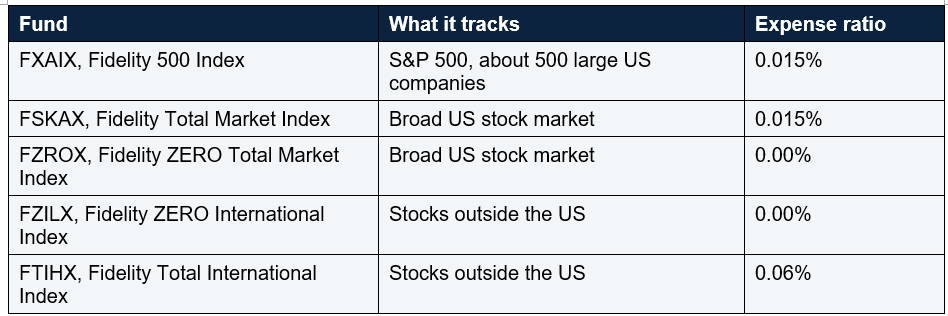
24/7 Wall St., The Finance Buff, WealthManagement.com, NerdWallet. Morningstar lists a net expense ratio of 0.010% for FXAIX against an adjusted 0.015%, so listings differ slightly.
FXAIX is the biggest and most widely used of them. It had roughly $832 billion in net assets as of 31 May 2026 and charges 0.015%, which works out to $1.50 a year on $10,000. Fidelity's fund sheet confirms the 0.015% fee, and Schwab's research page shows the same. The zero-fee funds are unusual. Fidelity launched FZROX and FZILX in 2018 with no minimum and a 0% expense ratio. AARP reported at launch that the total market fund held about 2,500 companies and the international fund about 2,300. NerdWallet notes that index funds with no expense ratio are still rare eight years later, and that the average index fund charged 0.05% in 2025. Throughout the rest of this post I use FXAIX as the worked example, because it has the longest published record in the family and its fee is tiny. If you choose a total market fund instead, the doubling math barely changes.
Here are recent calendar-year returns at net asset value from AAII, through 30 June 2026.
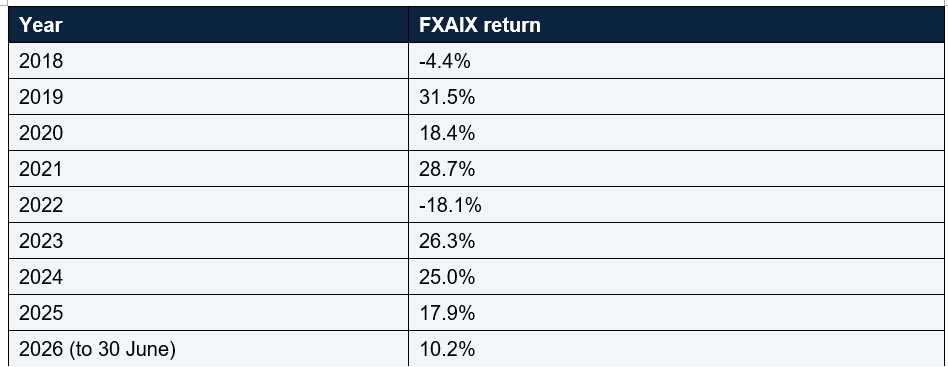
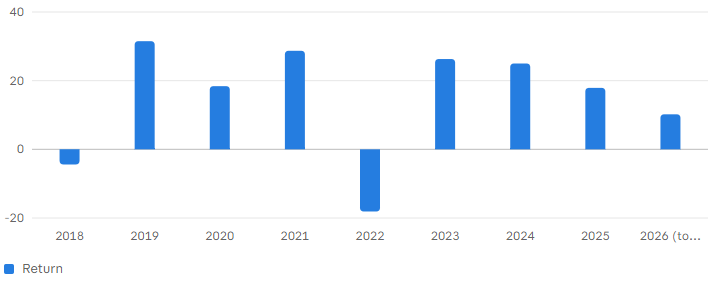
AAII, FXAIX annual NAV total returns, data as of 30 June 2026. Notice the pattern. Most years are strongly positive, but there are two losers in this window. A fund like this does not deliver a smooth number. How about this year? As of 13 November 2026, the S&P 500 was up 10.25% for the year but down 3.31% over the previous month. Treat this as a snapshot rather than a trend.
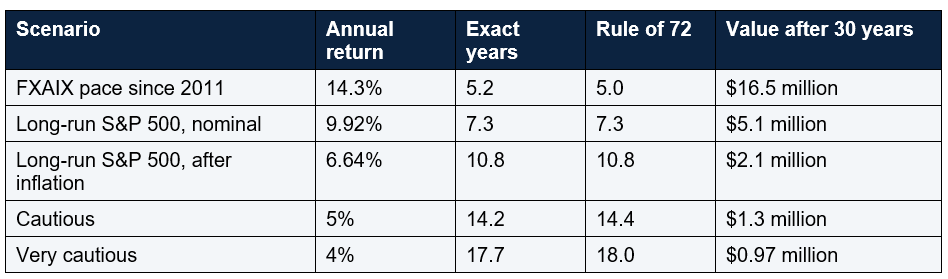
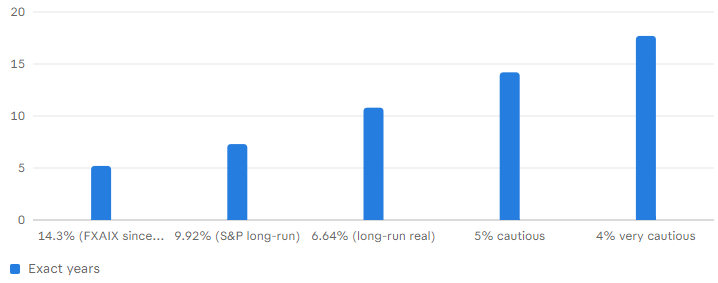
My calculation, lump sum, no withdrawals or new money. Return assumptions from Zacks, MyPlanIQ and Motley Fool. Values are illustrative, not forecasts. The 14.3% row is shown only to illustrate how strong the recent record has been. I do not recommend planning on it. A $16.5 million result from $300,000 would be extraordinary, and the next 30 years are very unlikely to repeat the last 15. A more grounded range is the middle two rows: roughly 7 years in nominal dollars if the long-run average holds, or about 11 years in today's purchasing power. If returns are weaker, the wait stretches to 14 or 18 years.
Another caution is in the details. The S&P 500 is heavily weighted toward a small group of giant companies. Fidelity's sheet shows the top 10 holdings made up 37.61% of the fund as of 31 July 2026, and Nvidia, Apple, Microsoft, Amazon, Alphabet and Broadcom were among them. If those companies slow down, the whole fund feels it. So I suggest running two or three scenarios instead of one: a cautious one, a long-run one, and a strong one. Planning for the middle and being pleasantly surprised is a healthier habit than planning for the top.
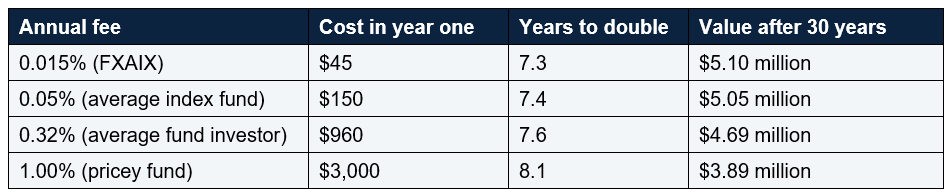
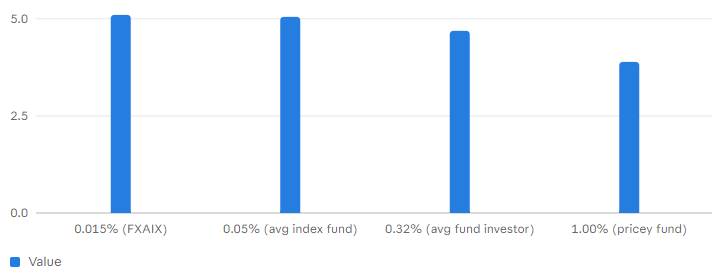
My calculation, 9.92% gross return, lump sum, no contributions. Fee averages from NerdWallet (ICI) and Morningstar. The gap between FXAIX and a 1% fund is more than a million dollars over 30 years in this illustration (my calculation). It is the difference of about 0.8 years in the doubling time that adds up. The index-fund choice is, in effect, a choice to keep that gap.
Using that 3.6% figure, prices double in about 20 years (72 divided by 3.6). So if you want your $300,000 to buy twice as much, it needs to beat inflation by a clear margin. At the long-run real return of 6.64%, that takes about 11 years (my calculation). In nominal terms, it is faster. But a $600,000 balance in 7 years might feel like less than $600,000 felt when you started. FXAIX itself has done well after inflation. TotalRealReturns shows an inflation-adjusted gain of about 10.9% a year since May 2011. That is a good result, but again a strong period, so I do not project it forward.
This matters because of how you might use the money. If you will need it in two years, a doubling table is not a plan. Money you might need soon belongs somewhere steadier. Money you will not touch for ten years or more is where an index fund tends to make sense, though nothing is guaranteed. Also remember that an index fund is diversified across companies, not across everything. A fund tracking only the US market will fall when the US market falls. Some investors add an international fund such as FZILX or FTIHX for balance .
In a taxable account, dividends and any fund capital gains can trigger a tax bill each year. Zacks shows a yield of about 1.11% [4], which means about $3,300 a year in dividends on $300,000 (my calculation), taxed according to your own situation. In a retirement account, that bill may be delayed or avoided, depending on the account rules in your country.
The rules differ by country and account type, so speak to a qualified tax professional. For this post, every doubling figure is before tax.
If you take one thing away, let it be this: plan on the middle, stress-test the low case, and do not build your future on the best decade in the data. This post is general education, and I am not a financial adviser. Please check current fund details and consider professional advice before investing.
Roughly 7 years at a 9.92% long-run nominal return, about 11 years at a 6.64% real return, and about 5 years at the 14.3% FXAIX has averaged since 2011 (my calculation). None of these is guaranteed.
What does FXAIX cost?
The expense ratio is 0.015%, or about $45 a year on $300,000 (my calculation). Morningstar shows a net figure of 0.010%.
Is FZROX really free?
Its expense ratio is 0.00% and it has no minimum. Taxes and any trading costs elsewhere still apply, and I did not review its other limits, so read the fund details.
Should I use the last 10 years of returns to plan?
I would not. FXAIX returned 14.80% a year over the 10 years to December 2025, well above the S&P 500's 9.92% long-run record.
Can I lose money in an index fund?
Yes. FXAIX fell 18.1% in 2022 [5] and had a drawdown of 33.75% in early 2020 [7]. The doubling math assumes a steady rate that real markets do not provide.
Table of Contents
- The Rule of 72 in one minute
- Which Fidelity index funds are we talking about?
- What the flagship fund has actually returned
- The doubling timetable for $300,000
- Do not use the last decade as your forecast
- What $300,000 costs in fees
- Doubling your buying power, not just your balance
- The risks: drawdowns and concentration
- Taxes and account type
- Putting it into practice
- Conclusion
- FAQ
If you put $300,000 into a Fidelity index fund and leave it alone, how long until it becomes $600,000? The honest answer is somewhere between about 5 and 11 years, depending on the return you assume, with a longer wait if you measure in today's buying power. I cannot give you a single date, and anyone who does is guessing.
The reason for the wide range is simple. Fidelity's flagship S&P 500 fund has returned 14.80% a year over the 10 years to December 2025, which would double your money in about five years (my calculation). But the S&P 500's long-run record is nearer 9.92% a year before inflation and 6.64% after it, which means about 7 years in nominal dollars and about 11 years in real ones (my calculation).
Key takeaway: Fees are not the issue here. Fidelity's main index funds cost between zero and 0.06% a year. The real question is which return you assume, and whether you count inflation.
The Rule of 72 in one minute
The Rule of 72 is a mental shortcut: divide 72 by the annual percentage return and you get the approximate years to double. At 8%, that is about nine years. It is a close estimate for returns in the middle range, roughly 6% to 12%, and less precise at very low or very high rates. For a $300,000 lump sum, I use exact compound math in the tables below, and I show the Rule of 72 alongside it. The two are close enough that the shortcut is useful for a quick check.Years for $300,000 to double, by assumed return
Years by Source: my calculation; return assumptions from MyPlanIQ and Motley FoolOne more thing. Doubling is not a one-off. At a steady rate, $300,000 becomes $600,000, then $1.2 million, then $2.4 million, then $4.8 million (my calculation). Each doubling takes the same amount of time, so the dollars climb faster the longer you wait. But that also means the early years feel slow.
Which Fidelity index funds are we talking about?
"Fidelity index funds" covers a family of funds, so here are the main ones. Fees come from third-party sources and fund pages, so check Fidelity's current prospectus before you buy.24/7 Wall St., The Finance Buff, WealthManagement.com, NerdWallet. Morningstar lists a net expense ratio of 0.010% for FXAIX against an adjusted 0.015%, so listings differ slightly.
FXAIX is the biggest and most widely used of them. It had roughly $832 billion in net assets as of 31 May 2026 and charges 0.015%, which works out to $1.50 a year on $10,000. Fidelity's fund sheet confirms the 0.015% fee, and Schwab's research page shows the same. The zero-fee funds are unusual. Fidelity launched FZROX and FZILX in 2018 with no minimum and a 0% expense ratio. AARP reported at launch that the total market fund held about 2,500 companies and the international fund about 2,300. NerdWallet notes that index funds with no expense ratio are still rare eight years later, and that the average index fund charged 0.05% in 2025. Throughout the rest of this post I use FXAIX as the worked example, because it has the longest published record in the family and its fee is tiny. If you choose a total market fund instead, the doubling math barely changes.
What the flagship fund has actually returned
Let me anchor this in data. As of 31 December 2025, FXAIX's annualized returns were 17.86% for one year, 22.99% for three years, 14.41% for five years and 14.80% for ten years, according to Zacks. Since the share class began in May 2011, it has compounded at about 14.3% a year with dividends reinvested, a cumulative gain of about 682% by 9 October 2026.Here are recent calendar-year returns at net asset value from AAII, through 30 June 2026.
AAII, FXAIX annual NAV total returns, data as of 30 June 2026. Notice the pattern. Most years are strongly positive, but there are two losers in this window. A fund like this does not deliver a smooth number. How about this year? As of 13 November 2026, the S&P 500 was up 10.25% for the year but down 3.31% over the previous month. Treat this as a snapshot rather than a trend.
The doubling timetable for $300,000
Now the part you came for. Here is how long $300,000 takes to double at several yearly returns. Exact years are my calculation, with the Rule of 72 beside them.My calculation, lump sum, no withdrawals or new money. Return assumptions from Zacks, MyPlanIQ and Motley Fool. Values are illustrative, not forecasts. The 14.3% row is shown only to illustrate how strong the recent record has been. I do not recommend planning on it. A $16.5 million result from $300,000 would be extraordinary, and the next 30 years are very unlikely to repeat the last 15. A more grounded range is the middle two rows: roughly 7 years in nominal dollars if the long-run average holds, or about 11 years in today's purchasing power. If returns are weaker, the wait stretches to 14 or 18 years.
FXAIX calendar-year returns (%)
% return by Source: AAII, annual NAV total returns, data to 30 June 2026
Do not use the last decade as your forecast
It is tempting to take the biggest number and run with it. The past decade was exceptional. FXAIX's 10-year annualized return of 14.80% is well above the 9.92% long-run record for the S&P 500. A forward-looking plan built on 14.8% would assume the next decade matches one of the best on record.Another caution is in the details. The S&P 500 is heavily weighted toward a small group of giant companies. Fidelity's sheet shows the top 10 holdings made up 37.61% of the fund as of 31 July 2026, and Nvidia, Apple, Microsoft, Amazon, Alphabet and Broadcom were among them. If those companies slow down, the whole fund feels it. So I suggest running two or three scenarios instead of one: a cautious one, a long-run one, and a strong one. Planning for the middle and being pleasantly surprised is a healthier habit than planning for the top.
What $300,000 costs in fees
Fees are the one part of this you can control, and for Fidelity index funds they are tiny. At 0.015%, the annual cost on $300,000 is about $45 (my calculation). 24/7 Wall St. puts it as $1.50 on $10,000. For comparison, Morningstar says the asset-weighted average expense ratio paid by US fund investors was 0.32% in 2025. Fidelity explains that expense ratios can have a meaningful effect on long-term returns. Here is what that looks like on $300,000 over 30 years at a 9.92% gross return (my calculation).My calculation, 9.92% gross return, lump sum, no contributions. Fee averages from NerdWallet (ICI) and Morningstar. The gap between FXAIX and a 1% fund is more than a million dollars over 30 years in this illustration (my calculation). It is the difference of about 0.8 years in the doubling time that adds up. The index-fund choice is, in effect, a choice to keep that gap.
Doubling your buying power, not just your balance
Doubling the dollars is not the same as doubling what you can buy. If prices rise, you need more dollars to afford the same things. That is why I show the 6.64% real return as the more conservative column. NerdWallet notes that investors can expect to lose 2% to 3% of their purchasing power a year to inflation. Recent readings have been higher: the PCE price index rose to 3.6% in September 2026, according to a TradingKey summary.Using that 3.6% figure, prices double in about 20 years (72 divided by 3.6). So if you want your $300,000 to buy twice as much, it needs to beat inflation by a clear margin. At the long-run real return of 6.64%, that takes about 11 years (my calculation). In nominal terms, it is faster. But a $600,000 balance in 7 years might feel like less than $600,000 felt when you started. FXAIX itself has done well after inflation. TotalRealReturns shows an inflation-adjusted gain of about 10.9% a year since May 2011. That is a good result, but again a strong period, so I do not project it forward.
$300,000 after 30 years at 9.92% gross, by fee ($ million)
$ million by Source: my calculation; fee averages from NerdWallet (ICI) and Morningstar
The risks: drawdowns and concentration
The doubling math assumes a steady rate. Real index funds do not behave that way. FXAIX's worst drawdown since 2011, in inflation-adjusted terms, was minus 33.75%, from 19 February to 23 March 2020. On $300,000, a fall of that size would take the balance to roughly $199,000 (my calculation) before any recovery. There were also full years of losses. AAII shows 2018 at minus 4.4% and 2022 at minus 18.1%. In a year like 2022, $300,000 would have dropped to about $245,700 (my calculation).This matters because of how you might use the money. If you will need it in two years, a doubling table is not a plan. Money you might need soon belongs somewhere steadier. Money you will not touch for ten years or more is where an index fund tends to make sense, though nothing is guaranteed. Also remember that an index fund is diversified across companies, not across everything. A fund tracking only the US market will fall when the US market falls. Some investors add an international fund such as FZILX or FTIHX for balance .
Taxes and account type
Taxes can change your result more than a fee difference. I cannot give you tax advice, but I can point out what matters. FXAIX is a mutual fund, not an ETF. 24/7 Wall St. notes that its structure means no intraday trading and less tax efficiency than some ETF rivals [8]. The same publication says it suits long-horizon investors holding it inside a tax-advantaged account [1].In a taxable account, dividends and any fund capital gains can trigger a tax bill each year. Zacks shows a yield of about 1.11% [4], which means about $3,300 a year in dividends on $300,000 (my calculation), taxed according to your own situation. In a retirement account, that bill may be delayed or avoided, depending on the account rules in your country.
The rules differ by country and account type, so speak to a qualified tax professional. For this post, every doubling figure is before tax.
Putting it into practice
Here is a simple way to turn the numbers into a plan. These are suggestions, not advice. First, decide what the money is for and when you need it. If the horizon is 10 years or more, the doubling table above is relevant. If it is under five, it is not. Second, pick an honest return. For planning, I would use the real figure, around 6% to 7%, because it tells you about buying power. Then see what happens at 4% as a stress test. Third, check the fee. For the funds in this post it is already tiny, so there is little to gain from fee-hunting further. The bigger decisions are the account type and the mix of funds. Fourth, think about timing. Putting a $300,000 lump sum in all at once, or in stages over several months, is a personal choice about risk and regret. I did not find a source that settles it, so I leave it to you and your adviser. Finally, do not check it every week. The doubling math works over years. Daily moves are noise.Conclusion
So how fast can $300,000 double in Fidelity index funds? On the long-run record, about 7 years in dollars and about 11 years in buying power. On the last decade's pace, about 5 years. On a cautious assumption, 14 to 18 years. The spread is the real answer. The good news is that the cost side is nearly solved. Fidelity's main index funds charge between zero and 0.06%, so you keep almost all of what the market gives. The remaining uncertainty is the market itself, inflation, taxes and your own behavior during the bad years.If you take one thing away, let it be this: plan on the middle, stress-test the low case, and do not build your future on the best decade in the data. This post is general education, and I am not a financial adviser. Please check current fund details and consider professional advice before investing.
FAQ
How long will $300,000 take to double in a Fidelity index fund?Roughly 7 years at a 9.92% long-run nominal return, about 11 years at a 6.64% real return, and about 5 years at the 14.3% FXAIX has averaged since 2011 (my calculation). None of these is guaranteed.
What does FXAIX cost?
The expense ratio is 0.015%, or about $45 a year on $300,000 (my calculation). Morningstar shows a net figure of 0.010%.
Is FZROX really free?
Its expense ratio is 0.00% and it has no minimum. Taxes and any trading costs elsewhere still apply, and I did not review its other limits, so read the fund details.
Should I use the last 10 years of returns to plan?
I would not. FXAIX returned 14.80% a year over the 10 years to December 2025, well above the S&P 500's 9.92% long-run record.
Can I lose money in an index fund?
Yes. FXAIX fell 18.1% in 2022 [5] and had a drawdown of 33.75% in early 2020 [7]. The doubling math assumes a steady rate that real markets do not provide.
0 Comments
Be the first to share your thoughts on this article.