
Spending
How Much Do You Spend on a Birthday Present?
Brits plan to spend an average of £238 on birthdays in 2025 — the third biggest spending occasion of the year after summer holidays and Christmas. But that national average hides enormous variation: most people wouldn’t spend more than £25 on a typical gift, while parents routinely spend £50+ on their children. The relationship is everything. Here is what the research actually shows about how much people spend, what they expect to receive, and how to set a budget that feels right for every person on your list.
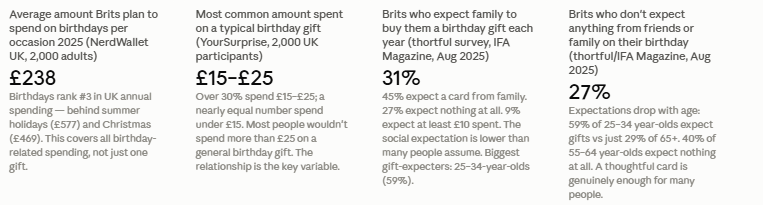
But the £238 average figure requires careful interpretation. This is the average amount planned across all birthday-related spending in a year — which includes not just gifts but potentially meals out, experiences, activities, and contributions to group celebrations. It is not necessarily what a single person spends on a single birthday gift, which the YourSurprise survey of 2,000 UK participants puts much lower: over 30% of people spend £15–£25 on a typical birthday gift, and an almost equal number spend less than £15. Most people wouldn’t spend more than £25 on a birthday gift in the general case.
The variance between these two numbers — £238 average per occasion vs £15–£25 per individual gift — reflects the reality that birthday spending in aggregate includes multiple gifts for multiple people across the year, plus celebrations, meals, and experiences. The number that matters most to any individual decision is not the national average but the specific relationship between the giver and the recipient. That is the single most powerful predictor of how much a birthday present should cost.
UK birthday spending 2025: £238 average per occasion (NerdWallet UK, 2,000 adults). Birthdays rank #3 in UK annual spending table behind summer holidays (£577) and Christmas (£469). Most people spend £15-£25 on a typical birthday gift; an almost equal number spend under £15 (YourSurprise, 2,000 UK participants). 31% of Brits expect family to buy them a gift each year. 27% expect nothing at all. 45% expect a card from family. There are over 187,000 birthdays every single day in the UK (thortful/IFA Magazine, August 2025). Sources: NerdWallet UK 2025; thortful/IFA Magazine August 2025; YourSurprise.
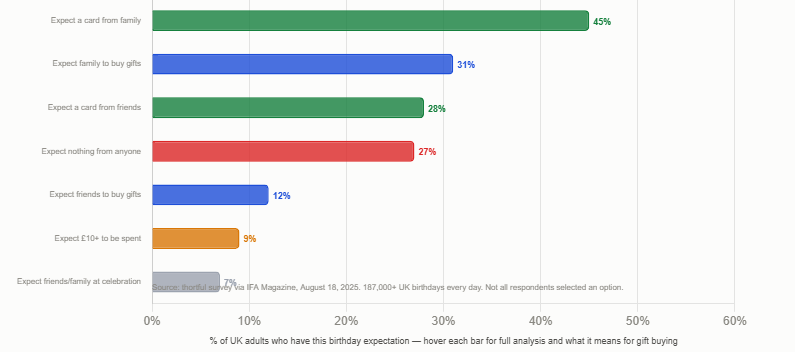
The most expected birthday gesture is not a gift at all — it is a card. Forty-five per cent of Brits expect a card from family each year; 28% expect a card from friends. Only 31% expect family to buy them a gift, and just 12% expect friends to buy them one. A significant 27% — more than one in four — don’t expect anything from friends or family on their birthday. Only 9% expect friends or family to spend at least £10 on their present. And just 7% expect anyone to come to their celebration.
These findings are somewhat counterintuitive given how much the average Brit plans to spend on birthdays (£238). The resolution is that spending and expectation are separate. Many people spend more than the recipient expects — and the research suggests that the default of ‘a nice card plus something small’ is well within what most people find both adequate and appreciated. The most common birthday celebration preference (39%) is low-key with family. An evening meal (25%) is the second most popular choice. Only 7% expect a party or large celebration.
The card vs gift question: 45% of Brits expect a card from family each year, but only 31% expect a gift. This means that for a significant proportion of people, a thoughtful card is genuinely sufficient — and is not a cop-out. Spending money on a gift that the recipient neither expected nor particularly wanted is not a better outcome than a card that clearly came with genuine care. Source: thortful survey via IFA Magazine, August 2025.
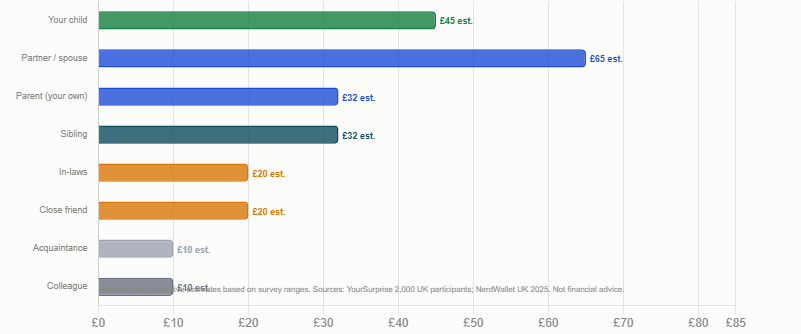
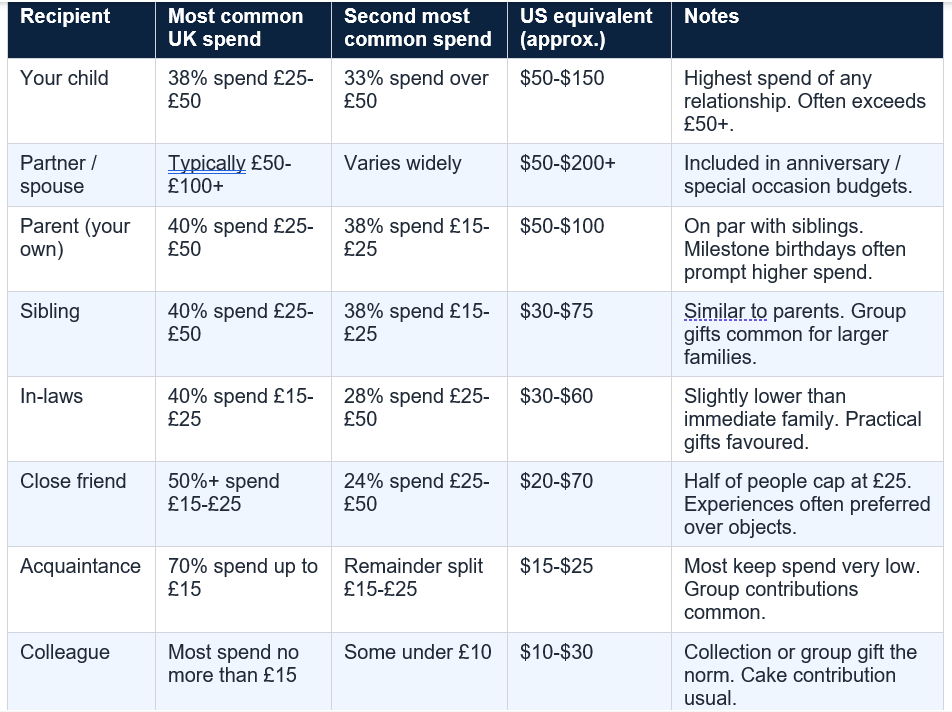
The YourSurprise survey of 2,000 UK participants provides the clearest breakdown. For a general birthday gift with no specified relationship, over 30% of people spend £15–£25 and nearly as many spend less than £15. Move to a child’s birthday and spending rises: 38% spend £25–£50, and a third spend over £50. For siblings and parents, 40% spend £25–£50 while 38% think £15–£25 is plenty. For in-laws, spending drops slightly: 40% at £15–£25, 28% at £25–£50. For good friends, over half (50%) spend £15–£25. For acquaintances, almost 70% spend up to £15. For colleagues, most spend no more than £15.
Several factors drive this elevated spending. First, children’s birthdays are often more publicly celebrated — with parties, friends, and visible presentation of gifts — which creates social comparison pressure that adult birthdays rarely generate. Second, toy and game pricing has risen substantially in recent years alongside general inflation, meaning that even a modest single toy can breach the £30 mark easily. Third, parents’ emotional investment in their children’s enjoyment and sense of being celebrated is typically higher than for any other relationship.
For gifts from other relatives — grandparents, aunts, uncles — spending on children tends to be lower than parental spending but still elevated relative to adult gifts: many relatives settle on £15–£25 for a child’s gift from outside the immediate family. YouGov research (February 2025, 4,693 GB adults) found that opinion is almost exactly split on whether parents ‘should’ buy presents for their child’s first birthday: 45% said yes, 44% said no, and 11% were unsure — reflecting a genuine social debate about the function of infant birthday celebrations.
Age matters significantly in children’s gift spending. Very young children (under three) have limited appreciation of gifts as objects, which reduces some parents’ willingness to spend heavily. Spending tends to peak in the primary school years (ages 5–11) when social comparison among children’s friend groups is highest, then evolves through adolescence into more experience-based or money-based gifts for teenagers.
Children’s birthday gift spending guide (UK 2026): Under 3: £10-£20 is typically adequate; children cannot appreciate higher spending. Ages 4-11 (party gifts from friends' parents): £10-£20 is the social norm for gifts at children's parties. Ages 4-11 (parents): £25-£50+ is common. Teenagers: cash, gift cards, or experience gifts in the £25-£50 range are widely preferred over objects. Young adults (18-21): experiences or larger cash contributions appropriate; group gifts common for milestone eighteenths. Sources: YourSurprise; general consumer research; YouGov February 2025.
General consumer research and gift industry data suggest that partner birthday spending in the UK falls most commonly in the £50–£100 range, with significant numbers spending both below and above this. The NerdWallet UK finding that Brits plan to spend £124 on anniversaries provides a useful comparison point: anniversary spending and partner birthday spending are broadly similar in scale, both reflecting the higher investment associated with a primary relationship.
In the US, birthday gifts for spouses and partners typically fall in the $50–$200 range, with milestone birthdays (30, 40, 50) significantly higher. Experiences — a concert, a restaurant visit, a weekend away — are increasingly preferred over objects in this category, which means the ‘gift spend’ figure can understate the true celebration cost.
For partner gifts, the ‘price per use’ test is more useful than any benchmark: a £60 experience that creates a shared memory typically delivers more relationship value than a £60 object that sits unused. The most appreciated partner birthday gifts tend to be those that required thought rather than simply high expenditure. Consider what the person has mentioned wanting, an experience they haven’t had, or something that acknowledges a specific interest or aspiration.
In-law spending is marginally lower: 40% spend £15–£25 on in-laws compared to the £25–£50 that is most common for siblings and parents. This likely reflects both the different emotional dynamic of the in-law relationship and the practical reality that many people give their in-laws a contribution toward a shared family gift or activity rather than a personal item.
Group gifting has become increasingly common for family occasions, particularly when adult siblings are purchasing collectively for a parent’s significant birthday. A group of three adult children each contributing £30 produces a £90 gift budget — enough for a quality experience or item that would be outside any individual’s solo birthday budget for a parent. Group gifting apps and platforms have made coordination easier, and the shift toward experiences (garden visits, theatre trips, spa days, cooking classes) has made collective gifting particularly natural.
Family birthday budget strategy: for parents and siblings, £15-£50 covers the norm. If budget is tight, a £15-£20 gift with a heartfelt card consistently outperforms an expensive gift bought under financial stress. For milestone birthdays (50th, 60th, 70th), consider proposing a family group gift: it allows a higher-quality present, shares the cost, and reduces the obligation on any individual. Not financial advice; individual budgets vary.
Thortful’s research adds a useful data point: only 12% of Brits expect their friends to buy them a gift at all. The social expectation for friend birthday gifts in the UK is lower than many people assume, particularly beyond the teenage and early adult years. The same data shows that 59% of 25–34 year-olds expect gifts on their birthday — the highest of any age group — while only 29% of those 65 and over expect one. Friend birthday gift spending is most loaded in the 25–34 demographic and lightens with age.
For a best friend, spending in the £25–£50 UK range (or $30–$70 in the US) is both socially appropriate and widely practised. The US data from Rising Sun Arts Centre puts best friend gifts at approximately $50 on average. Group gifts for friend birthdays are increasingly popular, particularly for landmark occasions: a group of five close friends each contributing £20 produces a £100 gift or experience budget without any individual feeling financially stretched.
One increasingly common approach is the experience gift for close friends: a joint cinema trip, a cooking class, tickets to an event, or dinner at a restaurant the recipient has wanted to try. These gifts have the practical advantage of doubling as shared time together, which is often what friendships need more than objects.
The office collection model resolves much of the social complexity: it allows the recipient to receive something meaningful without any individual contributor feeling they have over-invested in a professional relationship, and it avoids the awkwardness of some colleagues receiving individual gifts and others not. Most workplaces have informal norms about this — the birthday card that circulates, the contributions to a voucher — that people follow without much deliberate decision-making.
For acquaintances outside work — someone you know through a mutual friend, a neighbour, a fellow sports team member — the thortful research is instructive: almost 70% of Brits spend up to £15 on a gift for an acquaintance. In practice, this often means a £10–£15 bottle of wine, a box of chocolates, or a small plant. The function of the gift is recognition rather than relationship investment, and spending appropriate to that function feels right to both parties.
Office collection fatigue: workplace birthday collections have become a source of mild resentment in some workplaces, particularly when collections happen very frequently. If you organise or participate in office collections, it is worth considering whether everyone in the team wants to participate and whether a rotation system or a less frequent tradition might be more appreciated than a mandatory collection for every birthday. Voluntary participation is the generally accepted norm.
For milestone birthdays, spending norms across all relationship categories increase. An 18th or 21st birthday gift from a parent or close relative might reach £100–£200 — well above the usual £25–£50 range — particularly for a first adult birthday or the crossing into legal adulthood. A 50th or 60th birthday for a parent may prompt adult children to pool resources for a larger celebration or experience: a family dinner, a spa break, or tickets to a significant event.
The social expectation for milestone birthdays is less about the financial value of the gift and more about the quality of acknowledgement. A 50th birthday remembered with a heartfelt collective gesture is more appreciated than an expensive object given without thought. The experience gift — a hot air balloon ride, an art class, a wine tasting, a weekend cottage for the family — has become particularly popular for milestone occasions because it creates a story that belongs to the recipient rather than an object that might duplicate something already owned.
This gap suggests that birthday gifting conventions are not gender-neutral, and that default approaches — treating all birthdays the same regardless of recipient — may systematically under-serve or over-serve particular relationships. Women are somewhat more likely to have their birthday acknowledged as significant by their social circle; men are somewhat more likely to minimise the occasion.
The age dimension is equally revealing. The 25–34 age group is the most birthday-gift-expectant demographic: 59% expect gifts on their birthday. This is the decade of the life when social networks are most active, friendships are most intense, and birthday celebrations are most socially visible. By contrast, only 29% of those 65+ expect a gift, and 40% of 55–64 year-olds don’t expect anything at all. Birthday significance diminishes with age for a substantial portion of the population, which has practical implications for people buying gifts for older relatives and friends.
Glasgow presents a different picture: 8% of Glaswegians expect a surprise party on their birthday — the highest of any city — but 13% only expect a gift on a milestone birthday, suggesting that the expectation is high for big occasions but lower for ordinary annual birthdays. Belfast shows the most modest expectations: 20% of people from Belfast only want a card on a milestone birthday, while 15% of Sheffield residents specifically expect at least £10 spent on their present each year.
These regional variations reflect broader cultural differences in how people celebrate and acknowledge social bonds. The data does not support the stereotype of any particular UK region as more or less generous; rather, it shows that the form that celebration takes — parties, gifts, cards, experiences, or simple acknowledgement — varies meaningfully by city. The practical implication is that birthday customs you grew up with in one city may feel excessive or insufficient to someone from another region.
The best friend average of approximately $50 in the US is broadly comparable to the upper end of UK friend spending (£25–£50) when adjusted for purchasing power. The most notable US-UK difference is in the close family category: the $50–$150 range for close family in the US reflects both a higher average income level and a cultural tendency toward more elaborate birthday celebrations in the US, where milestone birthdays are often celebrated with parties of greater formality and cost than their UK equivalents.
Both the UK and US data show the same underlying relationship principle: the closer the relationship, the more is spent. And both sets of data confirm that for most relationships, the majority of people spend less than many assume — the £25 UK and $50 US friend gift budgets are upper norms, not minimums.
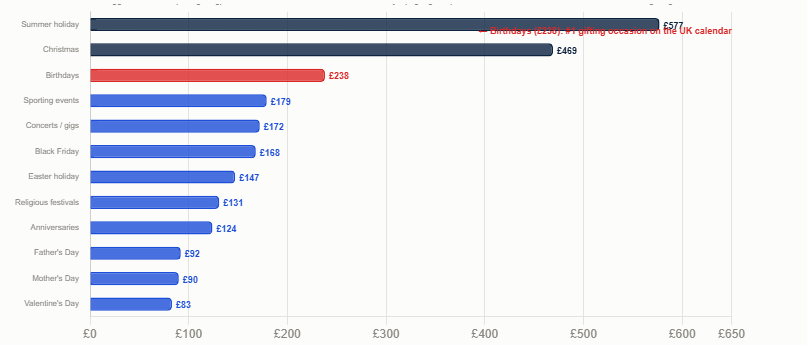
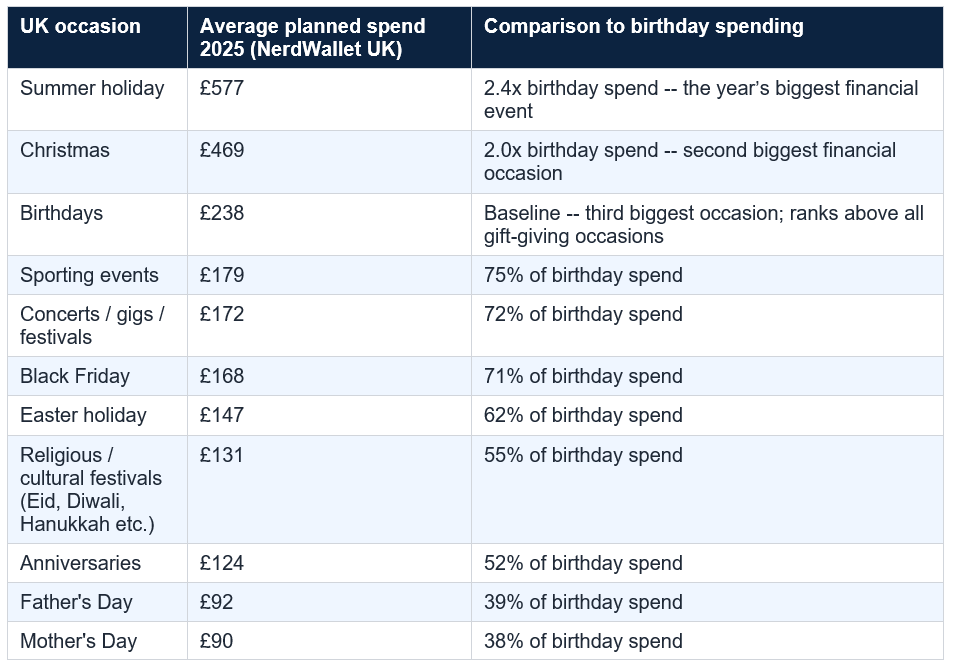
At the other end of the scale, Valentine’s Day spending (£83) is roughly a third of birthday spending, despite carrying significant commercial and cultural weight. Father’s Day (£92) and Mother’s Day (£90) are on similar terms with Valentine’s Day and well below birthdays. This hierarchy suggests that birthdays are genuinely considered more personally significant than seasonal commercial occasions by the British public.
The MyVoucherCodes research (via CMOtech UK, May 2026) found that average Father’s Day spending in 2026 was £54.38 — substantially higher than the Father’s Day figure in the NerdWallet table, and an interesting comparison to the £25–£50 range most people spend on a parent’s birthday gift. The implication is that seasonal occasions (Father’s Day, Mother’s Day) attract spending that is broadly comparable to birthday gift norms for the same relationship.
What the data also shows is that the relationship matters more than the amount. The closeness of the connection between giver and recipient — child, partner, parent, sibling, close friend, acquaintance, colleague — is the strongest predictor of appropriate spending. Within those categories, the national norms from UK surveys give useful calibration: most adults spend £15–£25 on a close friend, £25–£50 on parents and siblings, more on children and partners, and up to £15 on acquaintances and colleagues.
The most appreciated birthday gifts, across all the research, share one characteristic that has nothing to do with price: they demonstrate that the giver paid attention. A £15 book on a topic the recipient mentioned six months ago will be remembered longer than a £60 generic gift voucher. The research on birthday expectations confirms what most people already sense: the gesture matters more than the amount.
Most people spend £15–£25 on a typical birthday gift, and an almost equal number spend less than £15 (YourSurprise survey, 2,000 UK participants). In terms of total birthday spending across a year, Brits plan to spend an average of £238 per birthday occasion, which includes not just gifts but meals, celebrations, and experiences (NerdWallet UK, 2,000 UK adults, 2025). Spending varies significantly by relationship: parents typically spend £25–£50+ on a child's birthday; most people spend £15–£25 on a close friend; and most spend no more than £15 on a colleague. Not financial advice; individual spending varies.
How much should I spend on a child's birthday present?
For your own child, UK research shows 38% of parents spend £25–£50 and a third spend over £50 (YourSurprise, 2,000 UK participants). For another child's birthday party (as a friend's parent), £10–£20 is the widely accepted norm in the UK. The US range for children's gifts from close family is $50–$150. Spending tends to be higher for milestone birthdays (1st, 5th, 10th, 18th, 21st). Source: YourSurprise; Rising Sun Arts Centre 2026; YouGov February 2025.
What do most people actually expect on their birthday?
Research from thortful (August 2025, via IFA Magazine) found that the most expected birthday gesture is a card: 45% expect cards from family each year. Only 31% expect family to buy them a gift. Just 12% expect friends to buy them a gift. Twenty-seven per cent don't expect anything at all from friends or family. Only 9% expect at least £10 to be spent on their present. The most popular birthday celebration is low-key with family (39%), followed by an evening meal (25%). Expectations are highest among 25–34 year-olds (59% expect gifts) and lowest among 65+ (29% expect gifts). Source: thortful survey via IFA Magazine, August 2025.
Is it OK to give money or a gift card for a birthday?
Yes, and increasingly so. Gift cards are a widely accepted birthday present, particularly for teenagers and young adults who have specific preferences. Cash is appropriate for close family members (particularly children, where it goes into savings or is spent on something chosen by the recipient), though it can feel impersonal for some relationships. The research does not specifically address this question, but the general trend toward experience gifts and personalised choices suggests that giving flexibility (cash, gift cards) is viewed positively by many recipients. The key is to match the format to the person: cash in a card is perfectly acceptable for a parent or grandparent; a gift card to a specific shop the person loves is more personal than a generic one.
How much should I spend on a colleague's birthday?
Most people spend no more than £15 on a colleague's birthday gift (YourSurprise, 2,000 UK participants). In practice, the most common workplace birthday mechanism is a group collection, with individuals contributing £3–£5 each. If you are the one organising, a £10–£20 total collection for a team gift (a card and something small) is a widely accepted norm. Individual gifts between colleagues are less common and typically kept under £10–£15. US equivalents: $10–$30 for colleagues (Rising Sun Arts Centre 2026).
Table of Contents
- The Big Number: What Brits Actually Spend on Birthdays
- What People Actually Expect on Their Birthday
- The Relationship Rule: Spending by Who the Gift Is For
- Children’s Birthday Presents: Why Parents Spend More
- Partner and Spouse Birthday Gifts
- Buying for Family: Parents, Siblings, and In-Laws
- How Much to Spend on a Friend’s Birthday Present
- Colleague and Acquaintance Gifts: The Office Collection
- Milestone Birthdays: When to Spend More
- The Gender and Age Gap in Birthday Expectations
- Regional Differences: Manchester, Glasgow, Belfast, Sheffield
- The US Comparison: How American Birthday Spending Differs
- Birthday Spending in Context: How It Compares to Other Occasions
- How to Set a Birthday Budget That Works for You
- Conclusion: The Amount Matters Less Than You Think
- Frequently Asked Questions
Spending by relationship — what the research shows
What people expect on their birthday
Birthdays vs other UK occasions — the spending league table
The Big Number: What Brits Actually Spend on Birthdays
When NerdWallet UK surveyed 2,000 UK adults about their planned spending on key occasions in 2025, birthdays ranked third on the annual spending table at £238 per occasion — behind summer holidays (£577) and Christmas (£469), but ahead of sporting events (£179), concerts and gigs (£172), and every other occasion on the calendar including anniversaries (£124), Father’s Day (£92), Mother’s Day (£90), and Valentine’s Day (£83). Birthdays, in other words, are the third most financially significant event in the British social calendar.But the £238 average figure requires careful interpretation. This is the average amount planned across all birthday-related spending in a year — which includes not just gifts but potentially meals out, experiences, activities, and contributions to group celebrations. It is not necessarily what a single person spends on a single birthday gift, which the YourSurprise survey of 2,000 UK participants puts much lower: over 30% of people spend £15–£25 on a typical birthday gift, and an almost equal number spend less than £15. Most people wouldn’t spend more than £25 on a birthday gift in the general case.
The variance between these two numbers — £238 average per occasion vs £15–£25 per individual gift — reflects the reality that birthday spending in aggregate includes multiple gifts for multiple people across the year, plus celebrations, meals, and experiences. The number that matters most to any individual decision is not the national average but the specific relationship between the giver and the recipient. That is the single most powerful predictor of how much a birthday present should cost.
UK birthday spending 2025: £238 average per occasion (NerdWallet UK, 2,000 adults). Birthdays rank #3 in UK annual spending table behind summer holidays (£577) and Christmas (£469). Most people spend £15-£25 on a typical birthday gift; an almost equal number spend under £15 (YourSurprise, 2,000 UK participants). 31% of Brits expect family to buy them a gift each year. 27% expect nothing at all. 45% expect a card from family. There are over 187,000 birthdays every single day in the UK (thortful/IFA Magazine, August 2025). Sources: NerdWallet UK 2025; thortful/IFA Magazine August 2025; YourSurprise.
What People Actually Expect on Their Birthday
Before deciding how much to spend, it’s worth understanding what recipients actually want. The thortful research published by IFA Magazine in August 2025 provides one of the most detailed pictures of British birthday expectations in recent years. The findings reveal a significant mismatch between what people think is expected and what is actually expected.The most expected birthday gesture is not a gift at all — it is a card. Forty-five per cent of Brits expect a card from family each year; 28% expect a card from friends. Only 31% expect family to buy them a gift, and just 12% expect friends to buy them one. A significant 27% — more than one in four — don’t expect anything from friends or family on their birthday. Only 9% expect friends or family to spend at least £10 on their present. And just 7% expect anyone to come to their celebration.
These findings are somewhat counterintuitive given how much the average Brit plans to spend on birthdays (£238). The resolution is that spending and expectation are separate. Many people spend more than the recipient expects — and the research suggests that the default of ‘a nice card plus something small’ is well within what most people find both adequate and appreciated. The most common birthday celebration preference (39%) is low-key with family. An evening meal (25%) is the second most popular choice. Only 7% expect a party or large celebration.
The card vs gift question: 45% of Brits expect a card from family each year, but only 31% expect a gift. This means that for a significant proportion of people, a thoughtful card is genuinely sufficient — and is not a cop-out. Spending money on a gift that the recipient neither expected nor particularly wanted is not a better outcome than a card that clearly came with genuine care. Source: thortful survey via IFA Magazine, August 2025.
The Relationship Rule: Spending by Who the Gift Is For
The most consistent finding across all birthday gift research is that the amount spent scales with the closeness of the relationship. This is intuitive, but the specific amounts the data reveals are worth knowing because they provide useful social calibration — a sense of what is considered normal, generous, and excessive in each relationship category.The YourSurprise survey of 2,000 UK participants provides the clearest breakdown. For a general birthday gift with no specified relationship, over 30% of people spend £15–£25 and nearly as many spend less than £15. Move to a child’s birthday and spending rises: 38% spend £25–£50, and a third spend over £50. For siblings and parents, 40% spend £25–£50 while 38% think £15–£25 is plenty. For in-laws, spending drops slightly: 40% at £15–£25, 28% at £25–£50. For good friends, over half (50%) spend £15–£25. For acquaintances, almost 70% spend up to £15. For colleagues, most spend no more than £15.
Children’s Birthday Presents: Why Parents Spend More
Children’s birthday presents represent the highest-spend category in the YourSurprise research, and the pattern is consistent across both UK and US data. Over 38% of UK parents spend £25–£50 on their child’s birthday gift, and a full third spend over £50. In the US, children’s gifts at significant milestones regularly reach $100–$150.Several factors drive this elevated spending. First, children’s birthdays are often more publicly celebrated — with parties, friends, and visible presentation of gifts — which creates social comparison pressure that adult birthdays rarely generate. Second, toy and game pricing has risen substantially in recent years alongside general inflation, meaning that even a modest single toy can breach the £30 mark easily. Third, parents’ emotional investment in their children’s enjoyment and sense of being celebrated is typically higher than for any other relationship.
For gifts from other relatives — grandparents, aunts, uncles — spending on children tends to be lower than parental spending but still elevated relative to adult gifts: many relatives settle on £15–£25 for a child’s gift from outside the immediate family. YouGov research (February 2025, 4,693 GB adults) found that opinion is almost exactly split on whether parents ‘should’ buy presents for their child’s first birthday: 45% said yes, 44% said no, and 11% were unsure — reflecting a genuine social debate about the function of infant birthday celebrations.
Age matters significantly in children’s gift spending. Very young children (under three) have limited appreciation of gifts as objects, which reduces some parents’ willingness to spend heavily. Spending tends to peak in the primary school years (ages 5–11) when social comparison among children’s friend groups is highest, then evolves through adolescence into more experience-based or money-based gifts for teenagers.
Children’s birthday gift spending guide (UK 2026): Under 3: £10-£20 is typically adequate; children cannot appreciate higher spending. Ages 4-11 (party gifts from friends' parents): £10-£20 is the social norm for gifts at children's parties. Ages 4-11 (parents): £25-£50+ is common. Teenagers: cash, gift cards, or experience gifts in the £25-£50 range are widely preferred over objects. Young adults (18-21): experiences or larger cash contributions appropriate; group gifts common for milestone eighteenths. Sources: YourSurprise; general consumer research; YouGov February 2025.
Partner and Spouse Birthday Gifts
Partner and spouse birthday gifts are conspicuously absent from the published relationship-specific spending data, which reflects the enormous variation in this category. Partners are deeply personal relationships where spending is shaped not just by financial capacity but by relationship history, shared financial arrangements, and individual love languages. A couple who pools finances may approach a partner’s birthday very differently from one where finances are kept separate.General consumer research and gift industry data suggest that partner birthday spending in the UK falls most commonly in the £50–£100 range, with significant numbers spending both below and above this. The NerdWallet UK finding that Brits plan to spend £124 on anniversaries provides a useful comparison point: anniversary spending and partner birthday spending are broadly similar in scale, both reflecting the higher investment associated with a primary relationship.
In the US, birthday gifts for spouses and partners typically fall in the $50–$200 range, with milestone birthdays (30, 40, 50) significantly higher. Experiences — a concert, a restaurant visit, a weekend away — are increasingly preferred over objects in this category, which means the ‘gift spend’ figure can understate the true celebration cost.
For partner gifts, the ‘price per use’ test is more useful than any benchmark: a £60 experience that creates a shared memory typically delivers more relationship value than a £60 object that sits unused. The most appreciated partner birthday gifts tend to be those that required thought rather than simply high expenditure. Consider what the person has mentioned wanting, an experience they haven’t had, or something that acknowledges a specific interest or aspiration.
Buying for Family: Parents, Siblings, and In-Laws
Family gifts occupy a middle zone in UK birthday spending: more than you would spend on a friend or colleague, less than you would spend on your child or partner. The YourSurprise research found that 40% of UK adults spend £25–£50 on a sibling or parent’s birthday gift, while 38% think £15–£25 is sufficient. This produces a practical range of £15–£50 as the British social norm for immediate family birthday gifts.In-law spending is marginally lower: 40% spend £15–£25 on in-laws compared to the £25–£50 that is most common for siblings and parents. This likely reflects both the different emotional dynamic of the in-law relationship and the practical reality that many people give their in-laws a contribution toward a shared family gift or activity rather than a personal item.
Group gifting has become increasingly common for family occasions, particularly when adult siblings are purchasing collectively for a parent’s significant birthday. A group of three adult children each contributing £30 produces a £90 gift budget — enough for a quality experience or item that would be outside any individual’s solo birthday budget for a parent. Group gifting apps and platforms have made coordination easier, and the shift toward experiences (garden visits, theatre trips, spa days, cooking classes) has made collective gifting particularly natural.
Family birthday budget strategy: for parents and siblings, £15-£50 covers the norm. If budget is tight, a £15-£20 gift with a heartfelt card consistently outperforms an expensive gift bought under financial stress. For milestone birthdays (50th, 60th, 70th), consider proposing a family group gift: it allows a higher-quality present, shares the cost, and reduces the obligation on any individual. Not financial advice; individual budgets vary.
How Much to Spend on a Friend’s Birthday Present
Friends represent the most socially complex category for birthday gift spending because the closeness of friendships is highly variable. The distinction between a best friend of 20 years and an acquaintance from a work social event is enormous, yet both might be called ‘friends.’ The YourSurprise data sensibly differentiates between ‘good friends’ (£15–£25 for the majority; £25–£50 for 24%) and acquaintances (up to £15 for 70%).Thortful’s research adds a useful data point: only 12% of Brits expect their friends to buy them a gift at all. The social expectation for friend birthday gifts in the UK is lower than many people assume, particularly beyond the teenage and early adult years. The same data shows that 59% of 25–34 year-olds expect gifts on their birthday — the highest of any age group — while only 29% of those 65 and over expect one. Friend birthday gift spending is most loaded in the 25–34 demographic and lightens with age.
For a best friend, spending in the £25–£50 UK range (or $30–$70 in the US) is both socially appropriate and widely practised. The US data from Rising Sun Arts Centre puts best friend gifts at approximately $50 on average. Group gifts for friend birthdays are increasingly popular, particularly for landmark occasions: a group of five close friends each contributing £20 produces a £100 gift or experience budget without any individual feeling financially stretched.
One increasingly common approach is the experience gift for close friends: a joint cinema trip, a cooking class, tickets to an event, or dinner at a restaurant the recipient has wanted to try. These gifts have the practical advantage of doubling as shared time together, which is often what friendships need more than objects.
Colleague and Acquaintance Gifts: The Office Collection
Workplace birthday culture is one of the most socially awkward gift scenarios because it involves a degree of financial obligation within a professional relationship. The YourSurprise research shows that most people spend no more than £15 on a colleague’s birthday gift — and in practice, the most common mechanism is not an individual gift but a whip-round or office collection, with everyone contributing £3–£5 to a collective pot.The office collection model resolves much of the social complexity: it allows the recipient to receive something meaningful without any individual contributor feeling they have over-invested in a professional relationship, and it avoids the awkwardness of some colleagues receiving individual gifts and others not. Most workplaces have informal norms about this — the birthday card that circulates, the contributions to a voucher — that people follow without much deliberate decision-making.
For acquaintances outside work — someone you know through a mutual friend, a neighbour, a fellow sports team member — the thortful research is instructive: almost 70% of Brits spend up to £15 on a gift for an acquaintance. In practice, this often means a £10–£15 bottle of wine, a box of chocolates, or a small plant. The function of the gift is recognition rather than relationship investment, and spending appropriate to that function feels right to both parties.
Office collection fatigue: workplace birthday collections have become a source of mild resentment in some workplaces, particularly when collections happen very frequently. If you organise or participate in office collections, it is worth considering whether everyone in the team wants to participate and whether a rotation system or a less frequent tradition might be more appreciated than a mandatory collection for every birthday. Voluntary participation is the generally accepted norm.
Milestone Birthdays: When to Spend More
Milestone birthdays — typically 18, 21, 30, 40, 50, 60, 70, and 80 — carry a different social weight from ordinary birthdays. The thortful research captures this distinction: 13% of Glaswegians only expect a gift on a milestone birthday, and 20% of people from Belfast only want a card on a milestone birthday. The idea that some birthdays merit more significant celebration than ordinary ones is deeply embedded in British birthday culture.For milestone birthdays, spending norms across all relationship categories increase. An 18th or 21st birthday gift from a parent or close relative might reach £100–£200 — well above the usual £25–£50 range — particularly for a first adult birthday or the crossing into legal adulthood. A 50th or 60th birthday for a parent may prompt adult children to pool resources for a larger celebration or experience: a family dinner, a spa break, or tickets to a significant event.
The social expectation for milestone birthdays is less about the financial value of the gift and more about the quality of acknowledgement. A 50th birthday remembered with a heartfelt collective gesture is more appreciated than an expensive object given without thought. The experience gift — a hot air balloon ride, an art class, a wine tasting, a weekend cottage for the family — has become particularly popular for milestone occasions because it creates a story that belongs to the recipient rather than an object that might duplicate something already owned.
The Gender and Age Gap in Birthday Expectations
The thortful research reveals a meaningful gender gap in birthday expectations that has practical implications for how people navigate birthday gifting. Women have significantly higher birthday expectations than men: 33% of women expect family to buy them a gift each year, compared to 29% of men. Eighty-seven per cent of women expect cards from family and friends each year, compared to just 60% of men. And 31% of men don’t expect anything for their birthdays, compared to 23% of women.This gap suggests that birthday gifting conventions are not gender-neutral, and that default approaches — treating all birthdays the same regardless of recipient — may systematically under-serve or over-serve particular relationships. Women are somewhat more likely to have their birthday acknowledged as significant by their social circle; men are somewhat more likely to minimise the occasion.
The age dimension is equally revealing. The 25–34 age group is the most birthday-gift-expectant demographic: 59% expect gifts on their birthday. This is the decade of the life when social networks are most active, friendships are most intense, and birthday celebrations are most socially visible. By contrast, only 29% of those 65+ expect a gift, and 40% of 55–64 year-olds don’t expect anything at all. Birthday significance diminishes with age for a substantial portion of the population, which has practical implications for people buying gifts for older relatives and friends.
Regional Differences: Manchester, Glasgow, Belfast, Sheffield
The thortful data captures some genuinely surprising regional variations in birthday culture across the UK. Mancunians are the most gift-expectant city population in the UK: 64% of people in Manchester expect gifts on their birthday, the highest percentage of any city surveyed. Twenty-three per cent of Mancunians also like their birthday celebrations to last for as long as a week — and 10% have adopted the trend of the ‘half birthday’ as an additional celebration.Glasgow presents a different picture: 8% of Glaswegians expect a surprise party on their birthday — the highest of any city — but 13% only expect a gift on a milestone birthday, suggesting that the expectation is high for big occasions but lower for ordinary annual birthdays. Belfast shows the most modest expectations: 20% of people from Belfast only want a card on a milestone birthday, while 15% of Sheffield residents specifically expect at least £10 spent on their present each year.
These regional variations reflect broader cultural differences in how people celebrate and acknowledge social bonds. The data does not support the stereotype of any particular UK region as more or less generous; rather, it shows that the form that celebration takes — parties, gifts, cards, experiences, or simple acknowledgement — varies meaningfully by city. The practical implication is that birthday customs you grew up with in one city may feel excessive or insufficient to someone from another region.
The US Comparison: How American Birthday Spending Differs
While UK birthday gift spending centres on £15–£50 for most relationships, American birthday gift spending tends to run slightly higher in absolute dollar terms, reflecting both higher average incomes and different cultural gift-giving conventions. The 2026 guide from Rising Sun Arts Centre places the average overall US birthday gift cost at $30–$80, with close family at $50–$150, friends at $20–$70, and colleagues at $10–$30.The best friend average of approximately $50 in the US is broadly comparable to the upper end of UK friend spending (£25–£50) when adjusted for purchasing power. The most notable US-UK difference is in the close family category: the $50–$150 range for close family in the US reflects both a higher average income level and a cultural tendency toward more elaborate birthday celebrations in the US, where milestone birthdays are often celebrated with parties of greater formality and cost than their UK equivalents.
Both the UK and US data show the same underlying relationship principle: the closer the relationship, the more is spent. And both sets of data confirm that for most relationships, the majority of people spend less than many assume — the £25 UK and $50 US friend gift budgets are upper norms, not minimums.
Birthday Spending in Context: How It Compares to Other Occasions
Placing birthday spending in the broader context of UK gifting occasions reveals where birthdays sit in the hierarchy of social obligation and celebration. NerdWallet UK’s 2025 survey data makes the comparison straightforward: birthdays (£238) trail only summer holidays (£577) and Christmas (£469) in average planned spending. They substantially exceed sporting events (£179), concerts (£172), and every other gifting occasion.At the other end of the scale, Valentine’s Day spending (£83) is roughly a third of birthday spending, despite carrying significant commercial and cultural weight. Father’s Day (£92) and Mother’s Day (£90) are on similar terms with Valentine’s Day and well below birthdays. This hierarchy suggests that birthdays are genuinely considered more personally significant than seasonal commercial occasions by the British public.
The MyVoucherCodes research (via CMOtech UK, May 2026) found that average Father’s Day spending in 2026 was £54.38 — substantially higher than the Father’s Day figure in the NerdWallet table, and an interesting comparison to the £25–£50 range most people spend on a parent’s birthday gift. The implication is that seasonal occasions (Father’s Day, Mother’s Day) attract spending that is broadly comparable to birthday gift norms for the same relationship.
How to Set a Birthday Budget That Works for You
The data makes clear that there is no single correct amount to spend on a birthday present. What the research provides is a framework of social norms within which individuals can set their own approach, calibrated to their relationships, their financial circumstances, and their own values.- Start with a yearly gift budget: rather than deciding per gift, some people find it easier to set an annual discretionary budget for gifts (birthdays, Christmas, weddings, etc.) and then allocate within that. If you know 10 people whose birthdays you celebrate and you want to spend £200 on birthday gifts across the year, that’s an average of £20 per person — which is entirely within the social norm for friends and colleagues.
- Use the relationship principle, not a fixed amount: the YourSurprise and Rising Sun Arts Centre data both confirm that relationship closeness is the best guide to spending level. Children: £25–£50+. Partners: £50–£100+. Parents and siblings: £15–£50. Close friends: £15–£25. Good acquaintances: up to £15. Colleagues: up to £15 (or a group contribution of £3–£5).
- Don’t overspend on people who don’t expect it: the thortful data is clear that 27% of Brits don’t expect anything at all and 9% only expect at least £10 to be spent. Spending £50 on someone who would genuinely have been happy with a £8 card is not generosity — it can even create reciprocal obligation discomfort.
- Consider experiences over objects: for both close friends and partners, shared experiences — a meal, an activity, a theatre trip — are increasingly preferred over objects and often deliver more relationship value per pound spent. An experience at £25 a head shared between two people produces a £50 total experience at £25 each.
- Propose group gifts for larger amounts: for milestone birthdays or high-value relationships where an individual can’t comfortably reach the appropriate spend level alone, a well-organised group gift resolves the tension. Platforms like Wriggle and Splitwise make group contribution coordination easy.
- Be honest about financial pressure: the data from NerdWallet UK notes that the rising cost of living has made it difficult for many to spend confidently on special occasions. Over one in five Brits admitted to overspending at Christmas. It is entirely appropriate to communicate with close friends and family that your birthday gift budget is limited this year — most people will be relieved to hear it rather than disappointed.
Conclusion
The research is consistent in suggesting that the amount spent on a birthday present matters much less than popular culture implies, and less than most people fear when they are standing in a shop wondering whether their budget is adequate. Forty-five per cent of Brits expect a card. Twenty-seven per cent expect nothing at all. Only 9% expect at least £10. The financial threshold for being a good birthday gift-giver is lower than commercial gift culture suggests.What the data also shows is that the relationship matters more than the amount. The closeness of the connection between giver and recipient — child, partner, parent, sibling, close friend, acquaintance, colleague — is the strongest predictor of appropriate spending. Within those categories, the national norms from UK surveys give useful calibration: most adults spend £15–£25 on a close friend, £25–£50 on parents and siblings, more on children and partners, and up to £15 on acquaintances and colleagues.
The most appreciated birthday gifts, across all the research, share one characteristic that has nothing to do with price: they demonstrate that the giver paid attention. A £15 book on a topic the recipient mentioned six months ago will be remembered longer than a £60 generic gift voucher. The research on birthday expectations confirms what most people already sense: the gesture matters more than the amount.
Frequently Asked Questions
How much do most people spend on a birthday present in the UK?Most people spend £15–£25 on a typical birthday gift, and an almost equal number spend less than £15 (YourSurprise survey, 2,000 UK participants). In terms of total birthday spending across a year, Brits plan to spend an average of £238 per birthday occasion, which includes not just gifts but meals, celebrations, and experiences (NerdWallet UK, 2,000 UK adults, 2025). Spending varies significantly by relationship: parents typically spend £25–£50+ on a child's birthday; most people spend £15–£25 on a close friend; and most spend no more than £15 on a colleague. Not financial advice; individual spending varies.
How much should I spend on a child's birthday present?
For your own child, UK research shows 38% of parents spend £25–£50 and a third spend over £50 (YourSurprise, 2,000 UK participants). For another child's birthday party (as a friend's parent), £10–£20 is the widely accepted norm in the UK. The US range for children's gifts from close family is $50–$150. Spending tends to be higher for milestone birthdays (1st, 5th, 10th, 18th, 21st). Source: YourSurprise; Rising Sun Arts Centre 2026; YouGov February 2025.
What do most people actually expect on their birthday?
Research from thortful (August 2025, via IFA Magazine) found that the most expected birthday gesture is a card: 45% expect cards from family each year. Only 31% expect family to buy them a gift. Just 12% expect friends to buy them a gift. Twenty-seven per cent don't expect anything at all from friends or family. Only 9% expect at least £10 to be spent on their present. The most popular birthday celebration is low-key with family (39%), followed by an evening meal (25%). Expectations are highest among 25–34 year-olds (59% expect gifts) and lowest among 65+ (29% expect gifts). Source: thortful survey via IFA Magazine, August 2025.
Is it OK to give money or a gift card for a birthday?
Yes, and increasingly so. Gift cards are a widely accepted birthday present, particularly for teenagers and young adults who have specific preferences. Cash is appropriate for close family members (particularly children, where it goes into savings or is spent on something chosen by the recipient), though it can feel impersonal for some relationships. The research does not specifically address this question, but the general trend toward experience gifts and personalised choices suggests that giving flexibility (cash, gift cards) is viewed positively by many recipients. The key is to match the format to the person: cash in a card is perfectly acceptable for a parent or grandparent; a gift card to a specific shop the person loves is more personal than a generic one.
How much should I spend on a colleague's birthday?
Most people spend no more than £15 on a colleague's birthday gift (YourSurprise, 2,000 UK participants). In practice, the most common workplace birthday mechanism is a group collection, with individuals contributing £3–£5 each. If you are the one organising, a £10–£20 total collection for a team gift (a card and something small) is a widely accepted norm. Individual gifts between colleagues are less common and typically kept under £10–£15. US equivalents: $10–$30 for colleagues (Rising Sun Arts Centre 2026).

0 Comments Comments