

Financial Literacy
How to Give Kids Money Without Setting Them Up to Fail

Seventy percent of wealthy families lose their money by the second generation. Ninety percent by the third. The pattern is so universal it has a name in dozens of cultures — in English, ‘shirtsleeves to shirtsleeves in three generations’; in Chinese, ‘wealth never survives three generations’; in Scotland, ‘the father buys, the son builds, the grandchild sells, and his son begs.’ The Williams Group’s 20-year study found the cause is almost never market crashes or bad lawyers. It is failure of communication, failure of financial education, and failure to prepare heirs for the responsibility that wealth brings. With $105 trillion about to transfer from Baby Boomers to their heirs through 2048 — $2.5 trillion of it in 2025 alone — the question of how to give money to children without destroying their drive, judgment, or relationships is one of the most practically important in personal finance. Here is what the research, the experts, and the stories of the ultra-wealthy actually show. This is Not a legal, tax, or financial advice.
Baby Boomers currently hold approximately 51.2% of all US household wealth — roughly $83.3 trillion of the $163 trillion in total US household wealth as of Q4 2025 (Federal Reserve DFA data, cited Walnut Invest July 2026). Their average net worth is approximately $1.6 million. The transfer is already underway. But only 20% of American households have received a substantial gift, trust or inheritance in recent decades, meaning the wealth is concentrated and its transfer is not evenly distributed.
The question of how to transfer this wealth without destroying the recipients’ motivation, judgment, and financial competence is not academic. The research on what happens to inherited wealth in the second and third generation is alarming. Not legal or financial advice.
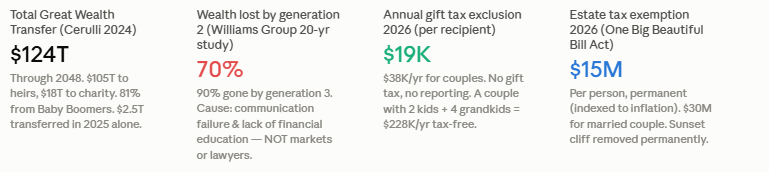
Great Wealth Transfer data (Cerulli Associates 2024; Federal Reserve Q4 2025; Walnut Invest July 2026): Total expected transfer through 2048: $124 trillion. To heirs: $105 trillion. To charity: $18 trillion. Boomers' share: ~81% of all transfers (~$100 trillion). Baby Boomers' current wealth: ~$83.3 trillion (51.2% of all US household wealth). Millennials' inheritance (through 2048): ~$46 trillion. Millennials' current share of US wealth: just 10.7% (~$17 trillion). Amount transferred in 2025 alone: $2.5 trillion. Households that have received a substantial inheritance: just 20% of American households (Bloomberg analysis).
The Williams Group’s study found the cause is not bad markets or poor legal planning — those account for only about 3% of failed wealth transfers. The real cause, in order of importance: failure of communication (64% of families never discuss how they manage wealth with their children); failure of financial education (78% of parents believe their children are not financially responsible enough to handle large inheritances); and failure to prepare heirs for the emotional and psychological responsibility that comes with money. Only 42% of high-net-worth individuals have high confidence that the next generation can handle an inheritance (US Trust Insights on Wealth and Worth).
The failure pattern is not primarily about investment returns or estate planning structures. It is about the difference between being given money and being prepared to steward it. Not legal or financial advice.
Williams Group 20-year study (cited Advisor.ca; Jewish Press July 2026): 70% of wealthy families lose their wealth by generation 2. 90% by generation 3. Financial mistakes and poor legal advice = only 3% of failures. Communication failure and lack of financial education = the real cause. 64% of families never discuss wealth management with their children. 78% of parents believe their children are not financially responsible enough to handle large inheritances. 42% of high-net-worth individuals have high confidence in the next generation's financial responsibility (US Trust Insights on Wealth and Worth).
Warren Buffett has said he plans to give his children ‘enough money so that they would feel they could do anything, but not so much that they could do nothing.’ The distinction is precise: enough to provide security, opportunity, and freedom from desperation; not so much as to eliminate the need for effort, purpose, or accountability. Buffett himself is donating the vast majority of his Berkshire Hathaway holdings to charity rather than to his children.
Bill Gates has been more direct: ‘It’s no favor to kids to have huge sums of wealth. Doing so distorts anything they might do as they create their own path.’ (Hello Magazine.) Gordon Ramsay: ‘Of course I want to leave my boys in a very sound financial state, but it’s terrible to give kids a silver spoon.’ Gloria Vanderbilt — herself the beneficiary of a trust fund worth $2.5–5 million in 1925 — refused to set up trust funds for her children, including Anderson Cooper, who went on to build a net worth of over $100 million independently before receiving $1.5 million from his mother’s estate. Not legal or financial advice.
Warren Buffett: 'I want to give my children enough money so that they would feel they could do anything, but not so much that they could do nothing.' Bill Gates: 'It's no favor to kids to have huge sums of wealth. Doing so distorts anything they might do as they create their own path.' (Hello Magazine.) Gerald Grant Jr. & III (Equitable Advisors, Miami — The Power of Generational Wealth, 2026): 'Giving your heirs the keys to an expensive new car without teaching them how to drive it and maintain it well is a mistake waiting to happen.'
The psychological research on this is clear: humans derive meaning, self-esteem, and identity in large part from effort, struggle, and earned achievement. When money arrives that was not earned, it short-circuits this process. It can produce what researchers call ‘learned helplessness in reverse’ — not the belief that nothing you do matters, but the belief that nothing you do needs to matter because the money is already there. The result can be a paradox of wealth: people with every material advantage but no internal compass for effort, challenge, or direction.
The pattern is particularly acute when the gift is large relative to what the child has earned independently. A $5,000 gift to a child earning $25,000 is a meaningful boost. The same $5,000 from a $2 million inheritance to a child who has never had to budget may be experienced as background noise. Not legal advice.
The affluenza warning signs: (1) Child expects money without effort. (2) Child can't discuss money without anxiety, shame, or entitlement. (3) Child has no realistic understanding of what their parents' lifestyle costs. (4) Child has not experienced the consequences of their own financial decisions. (5) Child has never worked for money they needed. These are not moral failures — they are predictable outcomes of certain types of wealth exposure. The Williams Group study confirms they predict failure of wealth transfer. The solution is preparation, not withholding. Not financial advice.
Gerald Grant Jr. and Gerald Grant III, father-son financial advisors at Equitable Advisors in Miami and authors of The Power of Generational Wealth (2026), advise setting up incentive trusts as the default for significant wealth transfers: ‘A trust is a legal entity that can hold almost any asset, including real estate, bank accounts, investment accounts, business interests, and life insurance policies. A benefactor can set up a trust during their lifetime and state exactly how and when they want their beneficiaries to be paid.’ Their matching income provision is particularly well-regarded: a trust that pays the beneficiary a dollar for every dollar they earn creates a structure where the child must maintain earned income to access the trust — eliminating the disincentive to work.
The key consideration: incentive conditions must be realistic, measurable, and not so restrictive that they become punitive or impossible. A trust that releases funds at age 40 only if the beneficiary has maintained five consecutive years of employment, a marriage, and a negative drug test is likely to produce litigation, not motivation. Conditions should build the behaviour you want, not punish the behaviours you fear. Not legal advice. Consult an estate planning attorney.
Incentive trust best practices (Gerald Grant Jr. & III, Equitable Advisors 2026): (1) Matching provisions: trust matches earned income dollar-for-dollar up to a cap. (2) Milestone releases: one-third at 25, one-third at 30, one-third at 35 — gives child skin in the game at each stage. (3) Education provisions: release on degree completion or vocational qualification. (4) No punitive conditions: avoid clauses tied to marriage, religion, or lifestyle choices that invite legal challenge. (5) Include a trust protector: a third party with authority to modify conditions as circumstances change. (6) Review regularly: what makes sense at age 10 for conditions may not at age 30. Not legal advice.
The strategy is powerful in aggregate. A couple with two children and four grandchildren can give $38,000 × 6 = $228,000 per year, completely tax-free and with no paperwork beyond the decision. Over 10 years, that is $2.28 million transferred outside the estate with no federal gift tax. The gradual nature of annual exclusion giving has an important psychological advantage over lump-sum inheritance: the amounts are manageable, the child experiences the gift alongside the giver, and there is an opportunity to observe how the child uses it before deciding whether to continue or scale up.
Jewish wisdom on giving, cited in the Jewish Press (July 2026), ranks the types of giving in order of value to the recipient. The highest form is helping someone become self-sufficient through a loan, a job, or a partnership — because it preserves dignity and builds capability. Annual gifts combined with financial conversations, mentoring, and shared investment decisions come closest to this model among purely financial transfers. Not tax advice. Consult a CPA.
A significant legislative change from 2024 removes a key 529 objection: unused 529 funds can now roll over into a Roth IRA for the beneficiary, up to $35,000 lifetime (subject to annual IRA contribution limits and a 15-year account-seasoning rule). This eliminates the ‘what if they don’t go to college’ penalty concern for many families. The 529 now functions as: tax-free education funding first; tax-advantaged retirement savings if unused.
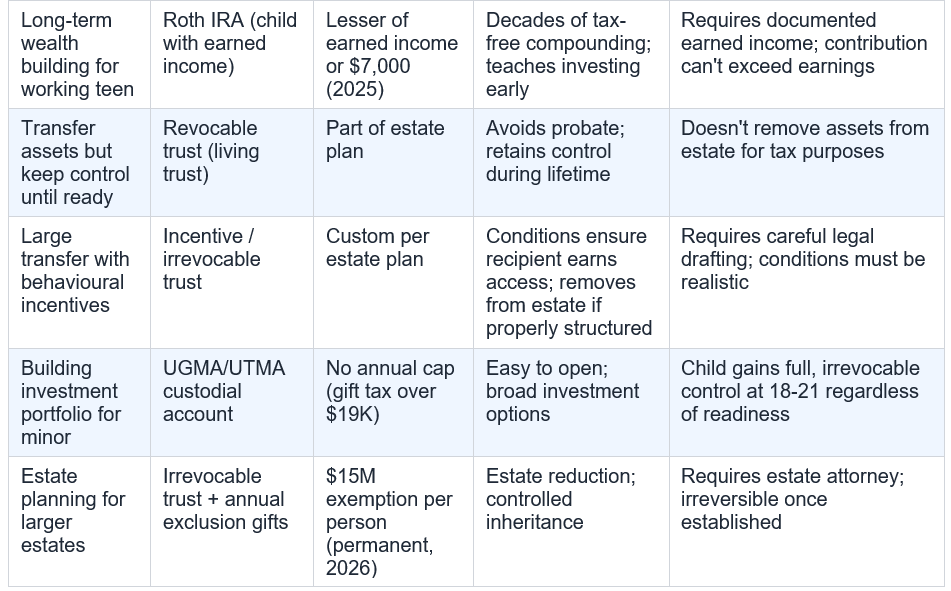
The Roth IRA for children with earned income is less commonly used but extraordinarily powerful for long-term wealth building. Any child with earned income — from a summer job, babysitting, or a family business — can contribute up to the lesser of their earned income or the annual IRA limit ($7,000 in 2025). Parents can contribute on the child’s behalf up to that earned-income amount. A $7,000 Roth IRA contribution for a 15-year-old invested in a low-cost index fund, left untouched, grows to approximately $400,000+ by age 65 at a 7% average annual return — entirely tax-free. Not financial or tax advice. Consult a CFP and CPA.
The practical implication for family wealth planning: the vast majority of American families will never pay federal estate tax under this regime. Only estates above $15 million per person face federal estate liability. For those families, the permanent exemption removes the urgency that previously drove rushed pre-sunset gifting strategies. For everyone else, it means that the primary wealth transfer tools — annual exclusion gifts, 529 plans, Roth IRAs, custodial accounts, and irrevocable trusts — are the relevant planning landscape rather than the estate tax. State estate taxes vary and are unaffected by the federal change. Not legal or tax advice. Consult a qualified estate attorney.
The conversation should cover: where the family wealth came from and what it required to build; what the family’s values around money, giving, and work are; what the child can expect to receive and when; what conditions (if any) apply; and what financial education the child needs before they are ready to manage larger sums. The Jewish Press (July 2026) recommends involving children in charitable giving before they receive personal gifts — because it teaches them that money carries responsibility, not just privilege, before they hold any of it personally.
The ‘build friction into the giving’ principle (Jewish Press July 2026) extends to the conversation itself: children who are required to present a budget, a plan, or a proposal before receiving a family gift develop the planning and communication skills that are the actual prerequisites for financial competence. Not financial advice.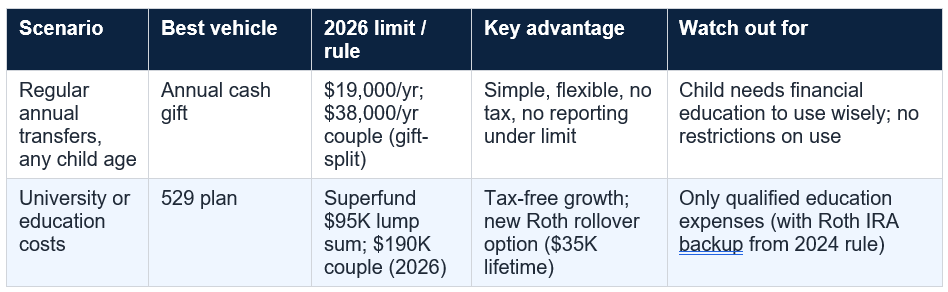
The billionaires have largely concluded that giving too much, too early, without conditions or context, is a disservice to children, not a gift. Warren Buffett’s formulation remains the most useful: enough to do anything; not so much that they can do nothing. The vehicles exist to implement that principle elegantly — incentive trusts that reward earned income, 529 plans that fund education, Roth IRAs that build long-term security, and annual gifts that transfer wealth gradually with the ability to observe and adjust.
But the vehicles are secondary to the conversation and the preparation. Families that preserve wealth across generations talk about it, teach it, and involve their children in it before the children hold any of it. The best inheritance you can give your children is not a sum of money. It is a set of values, habits, and skills that make them capable of being good stewards of whatever sum eventually arrives. Not legal, tax, or financial advice. Consult qualified professionals for your specific situation.
In 2026, the annual gift tax exclusion is $19,000 per recipient per year. A married couple electing gift-splitting can give $38,000 per recipient per year without gift tax and without the gifts counting against the lifetime exemption. You can give this amount to as many people as you want — two children and four grandchildren means $228,000 per year for a couple with no gift tax. Gifts above $19,000 per recipient in a year must be reported on a gift tax return (Form 709) and count against your lifetime exemption of $15 million per person (2026, permanent under the One Big Beautiful Bill Act). The exclusion was $18,000 in 2024 and $19,000 in 2026 following inflation adjustment. Sources: Jewish Press July 2026; Landmark Wealth Management 2026. Not tax advice. Consult a CPA.
Why do wealthy families lose their money within three generations?
The Williams Group's 20-year study found that 70% of wealthy families lose their wealth by the second generation and 90% by the third — a pattern so universal it appears in proverbs across dozens of cultures. Critically, the cause is not bad investments or estate planning failures, which account for only about 3% of failed transfers. The primary causes are: (1) communication failure — 64% of families never discuss wealth management with their children; (2) inadequate financial education — 78% of parents believe their children aren't financially responsible enough to handle large inheritances; and (3) failure to prepare heirs for the psychological responsibility wealth brings. The solution is preparation through conversation, education, and structured giving, not simply better legal documents. Sources: Williams Group (cited Advisor.ca; Jewish Press July 2026); US Trust Insights on Wealth and Worth (cited HWK Law Group).
What is an incentive trust and should I use one?
An incentive trust is a legal trust structure that releases money to beneficiaries only when specified conditions are met. Common conditions include: matching provisions (the trust matches the beneficiary's earned income dollar-for-dollar, up to a cap); educational milestones (a distribution when a degree or qualification is completed); age-based releases (one-third at 25, one-third at 30, one-third at 35); and career requirements. Gerald Grant Jr. and Gerald Grant III (Equitable Advisors, Miami — The Power of Generational Wealth, 2026) recommend incentive trusts as the default for significant transfers, particularly matching provisions that require the beneficiary to maintain earned income to access trust funds. Key considerations: conditions must be realistic and measurable; overly restrictive conditions invite legal challenge; a trust protector (a third party who can modify conditions as circumstances change) is advisable; and proper legal drafting is essential. Not legal advice. Consult a qualified estate planning attorney.
Is a 529 plan still worth it if my child might not go to college?
Yes, for most families. Since 2024 (SECURE 2.0 Act), unused 529 funds can roll over into a Roth IRA for the beneficiary — up to $35,000 lifetime, subject to annual IRA contribution limits and a 15-year account seasoning requirement. This eliminates the primary objection to 529 plans: the risk of being penalised if the child doesn't pursue higher education. The funds can now serve as education savings first and tax-free retirement savings as a backup. The 2026 superfunding limit of $95,000 ($190,000 for couples) allows a large lump sum using five years of annual exclusions, with no gift tax. State tax deductions for 529 contributions vary — check your state rules. Not tax or financial advice. Consult a CPA.
What is the right amount to leave children in an inheritance?
There is no universal answer — but several frameworks are useful. Warren Buffett's principle: enough to do anything; not so much that they can do nothing. Research on affluenza and the Williams Group failure data suggest that the right amount is a function not of a dollar figure but of the child's preparation. A child who has managed a budget, invested independently, experienced financial consequences, and been educated about wealth is better positioned to receive $2 million than an unprepared child is to receive $200,000. The strategic question is not 'how much?' but 'when is the child ready, and what have we done to prepare them?' The most effective approach observed by wealth advisors: smaller transfers during the parent's lifetime (where they can observe outcomes and provide guidance) rather than large posthumous lump sums. Not financial advice. Consult a CFP and estate attorney.
Table of Contents
- The $124 Trillion Problem: Why Getting This Right Matters
- Why Wealth Disappears: The 70-90% Failure Rate Explained
- What the Billionaires Say — and Do
- The Psychology: What Too Much Does to a Child
- The Four Giving Vehicles: Choosing the Right Tool
- Incentive Trusts: Building Conditions Into the Money
- The Annual Gift: $19,000 Per Year, Tax-Free (2026)
- 529 Plans and Roth IRAs for Kids: The Tax-Advantaged Routes
- The 2026 Estate Tax Landscape: What Changed
- The Conversation You Must Have Before the Money
- The Smart Framework: Eight Principles for Giving Wisely
- The Comparison Table: Giving Vehicles Side by Side
- Conclusion: The Best Inheritance Is Not Always Money
- Frequently Asked Questions
The $124 Trillion Problem: Why Getting This Right Matters
The United States is in the middle of the largest intergenerational wealth transfer in history. Cerulli Associates, the Boston-based wealth research firm, projects that approximately $124 trillion will transfer from Baby Boomers and older generations to their heirs and charitable organisations through 2048. Of that total, roughly $105 trillion is headed to heirs and about $18 trillion to charity. In 2025 alone, $2.5 trillion transferred to heirs. Millennials, who currently hold just 10.7% of US household wealth, are projected to inherit approximately $46 trillion over the next 25 years.Baby Boomers currently hold approximately 51.2% of all US household wealth — roughly $83.3 trillion of the $163 trillion in total US household wealth as of Q4 2025 (Federal Reserve DFA data, cited Walnut Invest July 2026). Their average net worth is approximately $1.6 million. The transfer is already underway. But only 20% of American households have received a substantial gift, trust or inheritance in recent decades, meaning the wealth is concentrated and its transfer is not evenly distributed.
The question of how to transfer this wealth without destroying the recipients’ motivation, judgment, and financial competence is not academic. The research on what happens to inherited wealth in the second and third generation is alarming. Not legal or financial advice.
Great Wealth Transfer data (Cerulli Associates 2024; Federal Reserve Q4 2025; Walnut Invest July 2026): Total expected transfer through 2048: $124 trillion. To heirs: $105 trillion. To charity: $18 trillion. Boomers' share: ~81% of all transfers (~$100 trillion). Baby Boomers' current wealth: ~$83.3 trillion (51.2% of all US household wealth). Millennials' inheritance (through 2048): ~$46 trillion. Millennials' current share of US wealth: just 10.7% (~$17 trillion). Amount transferred in 2025 alone: $2.5 trillion. Households that have received a substantial inheritance: just 20% of American households (Bloomberg analysis).
Why Wealth Disappears: The 70-90% Failure Rate Explained
The Williams Group, a US wealth consultancy that conducted a landmark 20-year study of wealthy families and wealth transfers, produced the most-cited finding in generational wealth management: 70% of wealthy families lose their wealth by the second generation; 90% by the third. The pattern is so consistent and so universal that it appears in equivalent proverbs across cultures: ‘shirtsleeves to shirtsleeves in three generations’ (English); ‘fu bu guo san dai’ — wealth doesn’t pass three generations (Chinese); ‘the father buys, the son builds, the grandchild sells, and his son begs’ (Scottish); ‘dalle stalle alle stelle alle stalle’ — from the stalls to the stars and back to the stalls (Italian).The Williams Group’s study found the cause is not bad markets or poor legal planning — those account for only about 3% of failed wealth transfers. The real cause, in order of importance: failure of communication (64% of families never discuss how they manage wealth with their children); failure of financial education (78% of parents believe their children are not financially responsible enough to handle large inheritances); and failure to prepare heirs for the emotional and psychological responsibility that comes with money. Only 42% of high-net-worth individuals have high confidence that the next generation can handle an inheritance (US Trust Insights on Wealth and Worth).
The failure pattern is not primarily about investment returns or estate planning structures. It is about the difference between being given money and being prepared to steward it. Not legal or financial advice.
Williams Group 20-year study (cited Advisor.ca; Jewish Press July 2026): 70% of wealthy families lose their wealth by generation 2. 90% by generation 3. Financial mistakes and poor legal advice = only 3% of failures. Communication failure and lack of financial education = the real cause. 64% of families never discuss wealth management with their children. 78% of parents believe their children are not financially responsible enough to handle large inheritances. 42% of high-net-worth individuals have high confidence in the next generation's financial responsibility (US Trust Insights on Wealth and Worth).
What the Billionaires Say — and Do
The generation that built the largest private fortunes in history is also the generation most publicly conflicted about passing that wealth to their children. Bill Gates, Warren Buffett, Mark Zuckerberg, Sting, Gordon Ramsay, and others have all made public statements about limiting their children’s inheritance — and in most cases, followed through. Their reasoning is strikingly consistent, and it aligns precisely with what the Williams Group data shows.Warren Buffett has said he plans to give his children ‘enough money so that they would feel they could do anything, but not so much that they could do nothing.’ The distinction is precise: enough to provide security, opportunity, and freedom from desperation; not so much as to eliminate the need for effort, purpose, or accountability. Buffett himself is donating the vast majority of his Berkshire Hathaway holdings to charity rather than to his children.
Bill Gates has been more direct: ‘It’s no favor to kids to have huge sums of wealth. Doing so distorts anything they might do as they create their own path.’ (Hello Magazine.) Gordon Ramsay: ‘Of course I want to leave my boys in a very sound financial state, but it’s terrible to give kids a silver spoon.’ Gloria Vanderbilt — herself the beneficiary of a trust fund worth $2.5–5 million in 1925 — refused to set up trust funds for her children, including Anderson Cooper, who went on to build a net worth of over $100 million independently before receiving $1.5 million from his mother’s estate. Not legal or financial advice.
Warren Buffett: 'I want to give my children enough money so that they would feel they could do anything, but not so much that they could do nothing.' Bill Gates: 'It's no favor to kids to have huge sums of wealth. Doing so distorts anything they might do as they create their own path.' (Hello Magazine.) Gerald Grant Jr. & III (Equitable Advisors, Miami — The Power of Generational Wealth, 2026): 'Giving your heirs the keys to an expensive new car without teaching them how to drive it and maintain it well is a mistake waiting to happen.'
The Psychology: What Too Much Does to a Child
The term ‘affluenza’ was coined by Jessie O’Neill — granddaughter of former General Motors CEO Charles E. Wilson — who founded the Affluenza Project after experiencing the corrupting influence of her own inheritance firsthand. Affluenza describes a cluster of symptoms experienced by people whose relationship with inherited wealth damages their motivation, identity, sense of purpose, and relationships. O’Neill found that the inheritance did not simply fail to improve her life; it actively distorted it by removing the need to create meaning through effort.The psychological research on this is clear: humans derive meaning, self-esteem, and identity in large part from effort, struggle, and earned achievement. When money arrives that was not earned, it short-circuits this process. It can produce what researchers call ‘learned helplessness in reverse’ — not the belief that nothing you do matters, but the belief that nothing you do needs to matter because the money is already there. The result can be a paradox of wealth: people with every material advantage but no internal compass for effort, challenge, or direction.
The pattern is particularly acute when the gift is large relative to what the child has earned independently. A $5,000 gift to a child earning $25,000 is a meaningful boost. The same $5,000 from a $2 million inheritance to a child who has never had to budget may be experienced as background noise. Not legal advice.
The affluenza warning signs: (1) Child expects money without effort. (2) Child can't discuss money without anxiety, shame, or entitlement. (3) Child has no realistic understanding of what their parents' lifestyle costs. (4) Child has not experienced the consequences of their own financial decisions. (5) Child has never worked for money they needed. These are not moral failures — they are predictable outcomes of certain types of wealth exposure. The Williams Group study confirms they predict failure of wealth transfer. The solution is preparation, not withholding. Not financial advice.
The Four Giving Vehicles: Choosing the Right Tool
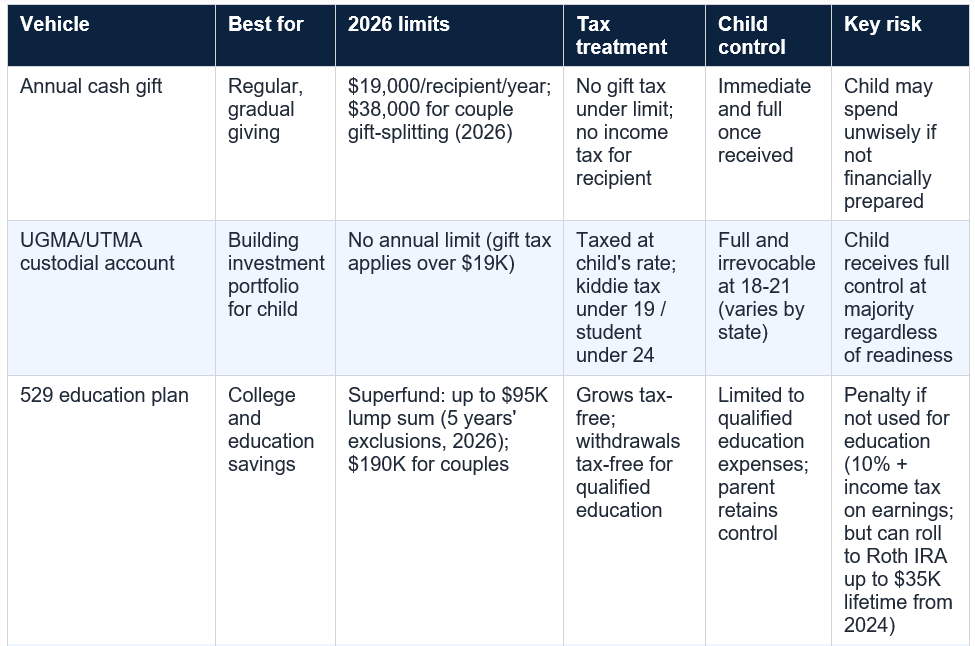
There is no single right way to give money to children. The right vehicle depends on the amount, the child’s age and financial maturity, the tax situation, and the intended purpose of the gift. The four most commonly used giving vehicles for parents are: outright gifts (cash or assets given directly); custodial accounts (UGMA/UTMA); 529 education savings plans; and trusts. Each has different tax treatment, different loss-of-control dynamics, and different implications for the child’s financial development. Roth IRAs for children with earned income are an increasingly important fifth option. Not legal or tax advice.
Incentive Trusts: Building Conditions Into the Money
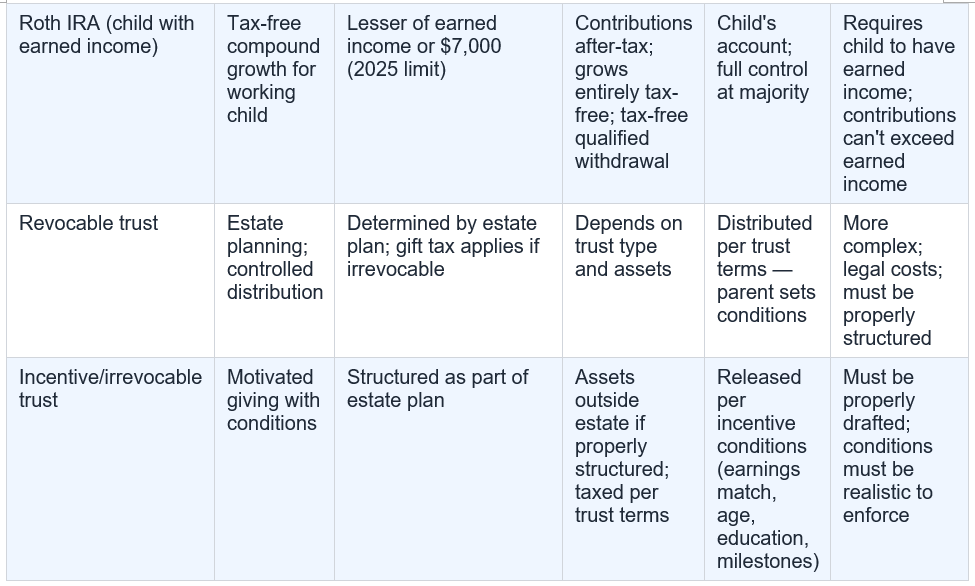
An incentive trust is a trust structured to release funds to beneficiaries only when certain conditions are met. It is the mechanism most recommended by wealth advisors for families who want to transfer significant assets without destroying the recipient’s motivation. The conditions can take almost any form the grantor specifies: matching distributions (the trust matches every dollar of earned income up to a cap), educational milestones (a distribution on completion of a degree), age-based releases (one-third at 25, one-third at 30, one-third at 35), career requirements, or sobriety clauses.Gerald Grant Jr. and Gerald Grant III, father-son financial advisors at Equitable Advisors in Miami and authors of The Power of Generational Wealth (2026), advise setting up incentive trusts as the default for significant wealth transfers: ‘A trust is a legal entity that can hold almost any asset, including real estate, bank accounts, investment accounts, business interests, and life insurance policies. A benefactor can set up a trust during their lifetime and state exactly how and when they want their beneficiaries to be paid.’ Their matching income provision is particularly well-regarded: a trust that pays the beneficiary a dollar for every dollar they earn creates a structure where the child must maintain earned income to access the trust — eliminating the disincentive to work.
The key consideration: incentive conditions must be realistic, measurable, and not so restrictive that they become punitive or impossible. A trust that releases funds at age 40 only if the beneficiary has maintained five consecutive years of employment, a marriage, and a negative drug test is likely to produce litigation, not motivation. Conditions should build the behaviour you want, not punish the behaviours you fear. Not legal advice. Consult an estate planning attorney.
Incentive trust best practices (Gerald Grant Jr. & III, Equitable Advisors 2026): (1) Matching provisions: trust matches earned income dollar-for-dollar up to a cap. (2) Milestone releases: one-third at 25, one-third at 30, one-third at 35 — gives child skin in the game at each stage. (3) Education provisions: release on degree completion or vocational qualification. (4) No punitive conditions: avoid clauses tied to marriage, religion, or lifestyle choices that invite legal challenge. (5) Include a trust protector: a third party with authority to modify conditions as circumstances change. (6) Review regularly: what makes sense at age 10 for conditions may not at age 30. Not legal advice.
The Annual Gift: $19,000 Per Year, Tax-Free (2026)
The annual gift tax exclusion is the simplest, most flexible, and most underused tool for gradual wealth transfer to children and grandchildren. In 2026, the exclusion is $19,000 per recipient per year — up from $18,000 in 2024. A married couple electing gift-splitting can give $38,000 per recipient per year with no gift tax implications and no reporting requirement (Jewish Press July 2026). These gifts do not reduce the lifetime estate tax exemption.The strategy is powerful in aggregate. A couple with two children and four grandchildren can give $38,000 × 6 = $228,000 per year, completely tax-free and with no paperwork beyond the decision. Over 10 years, that is $2.28 million transferred outside the estate with no federal gift tax. The gradual nature of annual exclusion giving has an important psychological advantage over lump-sum inheritance: the amounts are manageable, the child experiences the gift alongside the giver, and there is an opportunity to observe how the child uses it before deciding whether to continue or scale up.
Jewish wisdom on giving, cited in the Jewish Press (July 2026), ranks the types of giving in order of value to the recipient. The highest form is helping someone become self-sufficient through a loan, a job, or a partnership — because it preserves dignity and builds capability. Annual gifts combined with financial conversations, mentoring, and shared investment decisions come closest to this model among purely financial transfers. Not tax advice. Consult a CPA.
529 Plans and Roth IRAs for Kids: The Tax-Advantaged Routes
For parents who want to give money to children with a specific, growth-oriented purpose, the 529 college savings plan and the Roth IRA for children with earned income are the two most powerful tax-advantaged vehicles available. The 529 plan allows contributions that grow completely tax-free for qualified education expenses (tuition, fees, room and board at eligible institutions, K-12 up to $10,000/year, and more). The ‘superfunding’ provision allows a lump sum of up to $95,000 ($190,000 for couples) in 2026 using five years’ worth of annual exclusions at once, with no gift tax, spread evenly over those five years for reporting purposes.A significant legislative change from 2024 removes a key 529 objection: unused 529 funds can now roll over into a Roth IRA for the beneficiary, up to $35,000 lifetime (subject to annual IRA contribution limits and a 15-year account-seasoning rule). This eliminates the ‘what if they don’t go to college’ penalty concern for many families. The 529 now functions as: tax-free education funding first; tax-advantaged retirement savings if unused.
The Roth IRA for children with earned income is less commonly used but extraordinarily powerful for long-term wealth building. Any child with earned income — from a summer job, babysitting, or a family business — can contribute up to the lesser of their earned income or the annual IRA limit ($7,000 in 2025). Parents can contribute on the child’s behalf up to that earned-income amount. A $7,000 Roth IRA contribution for a 15-year-old invested in a low-cost index fund, left untouched, grows to approximately $400,000+ by age 65 at a 7% average annual return — entirely tax-free. Not financial or tax advice. Consult a CFP and CPA.
The 2026 Estate Tax Landscape: What Changed
The One Big Beautiful Bill Act, signed into law in 2025, made a historically significant change to the US estate and gift tax landscape: it permanently set the federal estate tax exemption at $15 million per individual ($30 million for a married couple), indexed to inflation going forward. Previously, the higher exemption — established by the 2017 Tax Cuts and Jobs Act at approximately $11.18 million per person, indexed to reach $13.99 million by 2025 — was scheduled to sunset back to approximately $7 million per person at the end of 2025. The One Big Beautiful Bill Act eliminated that sunset cliff.The practical implication for family wealth planning: the vast majority of American families will never pay federal estate tax under this regime. Only estates above $15 million per person face federal estate liability. For those families, the permanent exemption removes the urgency that previously drove rushed pre-sunset gifting strategies. For everyone else, it means that the primary wealth transfer tools — annual exclusion gifts, 529 plans, Roth IRAs, custodial accounts, and irrevocable trusts — are the relevant planning landscape rather than the estate tax. State estate taxes vary and are unaffected by the federal change. Not legal or tax advice. Consult a qualified estate attorney.
The Conversation You Must Have Before the Money
The Williams Group’s finding that 64% of families who lose their wealth never discussed financial management with their children points to the single most important action any parent can take: have the conversation before the money arrives. Families that preserve wealth across generations discuss it openly, involve children in investment decisions, explain the source and structure of the wealth, and teach financial management long before children receive meaningful sums.The conversation should cover: where the family wealth came from and what it required to build; what the family’s values around money, giving, and work are; what the child can expect to receive and when; what conditions (if any) apply; and what financial education the child needs before they are ready to manage larger sums. The Jewish Press (July 2026) recommends involving children in charitable giving before they receive personal gifts — because it teaches them that money carries responsibility, not just privilege, before they hold any of it personally.
The ‘build friction into the giving’ principle (Jewish Press July 2026) extends to the conversation itself: children who are required to present a budget, a plan, or a proposal before receiving a family gift develop the planning and communication skills that are the actual prerequisites for financial competence. Not financial advice.
The Smart Framework: Eight Principles for Giving Wisely
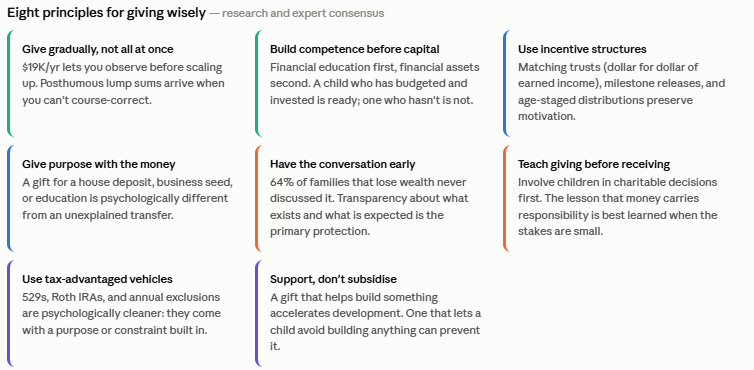
- Give gradually, not all at once. Annual exclusion gifts ($19,000/year per recipient in 2026) allow you to observe how the child uses money before scaling up. Lump-sum inheritance arrives when you are gone and cannot course-correct.
- Build competence before transferring capital. A child who has managed a budget, handled debt, invested in a Roth IRA, and experienced financial consequences is fundamentally more prepared than one who has not. Give financial education first, financial assets second.
- Use incentive structures to maintain motivation. Matching trusts (dollar for dollar of earned income), milestone-based releases, and age-staged distributions all build the accountability that straight gifts remove.
- Give purpose along with money. A gift for a house deposit, a business plan, a vocational course, or seed capital for a side project is a different psychological transaction than an unexplained transfer to a bank account. Named purpose preserves dignity and motivation.
- Have the conversation early and often. The 64% of families that lose wealth never discussed it. Transparency about what exists, where it comes from, and what is expected of heirs is the primary protection against the 70-90% failure rate.
- Teach giving before receiving. Involve children in charitable decisions — even at small amounts — before they receive significant personal gifts. The lesson that money carries responsibility is best learned when the stakes are small.
- Use tax-advantaged vehicles for compounding. 529 plans, Roth IRAs for working children, and annual exclusions are not just tax strategies — they are also psychologically cleaner forms of giving because they come with a purpose or constraint built in.
- Distinguish between support and subsidy. A gift that helps a child build something — a business, a home, a career — is fundamentally different from a gift that allows a child to avoid building anything. The former accelerates development; the latter can prevent it.
The Comparison Table: Giving Vehicles Side by Side
Conclusion
The data on generational wealth transfer is simultaneously alarming and clarifying. Seventy percent of families lose the wealth by the second generation. Ninety percent by the third. The cause is almost never markets or taxes. It is the failure to prepare the people who receive the money. With $105 trillion moving from Boomers to their heirs through 2048, the most important question families can ask is not ‘how much do we leave?’ but ‘how do we prepare the people who will receive it?’The billionaires have largely concluded that giving too much, too early, without conditions or context, is a disservice to children, not a gift. Warren Buffett’s formulation remains the most useful: enough to do anything; not so much that they can do nothing. The vehicles exist to implement that principle elegantly — incentive trusts that reward earned income, 529 plans that fund education, Roth IRAs that build long-term security, and annual gifts that transfer wealth gradually with the ability to observe and adjust.
But the vehicles are secondary to the conversation and the preparation. Families that preserve wealth across generations talk about it, teach it, and involve their children in it before the children hold any of it. The best inheritance you can give your children is not a sum of money. It is a set of values, habits, and skills that make them capable of being good stewards of whatever sum eventually arrives. Not legal, tax, or financial advice. Consult qualified professionals for your specific situation.
Frequently Asked Questions
How much money can I give my child tax-free in 2026?In 2026, the annual gift tax exclusion is $19,000 per recipient per year. A married couple electing gift-splitting can give $38,000 per recipient per year without gift tax and without the gifts counting against the lifetime exemption. You can give this amount to as many people as you want — two children and four grandchildren means $228,000 per year for a couple with no gift tax. Gifts above $19,000 per recipient in a year must be reported on a gift tax return (Form 709) and count against your lifetime exemption of $15 million per person (2026, permanent under the One Big Beautiful Bill Act). The exclusion was $18,000 in 2024 and $19,000 in 2026 following inflation adjustment. Sources: Jewish Press July 2026; Landmark Wealth Management 2026. Not tax advice. Consult a CPA.
Why do wealthy families lose their money within three generations?
The Williams Group's 20-year study found that 70% of wealthy families lose their wealth by the second generation and 90% by the third — a pattern so universal it appears in proverbs across dozens of cultures. Critically, the cause is not bad investments or estate planning failures, which account for only about 3% of failed transfers. The primary causes are: (1) communication failure — 64% of families never discuss wealth management with their children; (2) inadequate financial education — 78% of parents believe their children aren't financially responsible enough to handle large inheritances; and (3) failure to prepare heirs for the psychological responsibility wealth brings. The solution is preparation through conversation, education, and structured giving, not simply better legal documents. Sources: Williams Group (cited Advisor.ca; Jewish Press July 2026); US Trust Insights on Wealth and Worth (cited HWK Law Group).
What is an incentive trust and should I use one?
An incentive trust is a legal trust structure that releases money to beneficiaries only when specified conditions are met. Common conditions include: matching provisions (the trust matches the beneficiary's earned income dollar-for-dollar, up to a cap); educational milestones (a distribution when a degree or qualification is completed); age-based releases (one-third at 25, one-third at 30, one-third at 35); and career requirements. Gerald Grant Jr. and Gerald Grant III (Equitable Advisors, Miami — The Power of Generational Wealth, 2026) recommend incentive trusts as the default for significant transfers, particularly matching provisions that require the beneficiary to maintain earned income to access trust funds. Key considerations: conditions must be realistic and measurable; overly restrictive conditions invite legal challenge; a trust protector (a third party who can modify conditions as circumstances change) is advisable; and proper legal drafting is essential. Not legal advice. Consult a qualified estate planning attorney.
Is a 529 plan still worth it if my child might not go to college?
Yes, for most families. Since 2024 (SECURE 2.0 Act), unused 529 funds can roll over into a Roth IRA for the beneficiary — up to $35,000 lifetime, subject to annual IRA contribution limits and a 15-year account seasoning requirement. This eliminates the primary objection to 529 plans: the risk of being penalised if the child doesn't pursue higher education. The funds can now serve as education savings first and tax-free retirement savings as a backup. The 2026 superfunding limit of $95,000 ($190,000 for couples) allows a large lump sum using five years of annual exclusions, with no gift tax. State tax deductions for 529 contributions vary — check your state rules. Not tax or financial advice. Consult a CPA.
What is the right amount to leave children in an inheritance?
There is no universal answer — but several frameworks are useful. Warren Buffett's principle: enough to do anything; not so much that they can do nothing. Research on affluenza and the Williams Group failure data suggest that the right amount is a function not of a dollar figure but of the child's preparation. A child who has managed a budget, invested independently, experienced financial consequences, and been educated about wealth is better positioned to receive $2 million than an unprepared child is to receive $200,000. The strategic question is not 'how much?' but 'when is the child ready, and what have we done to prepare them?' The most effective approach observed by wealth advisors: smaller transfers during the parent's lifetime (where they can observe outcomes and provide guidance) rather than large posthumous lump sums. Not financial advice. Consult a CFP and estate attorney.
0 Comments
Be the first to share your thoughts on this article.