
Retirement
How to Prepare for RMDs at 75 When You're Only 60 Right Now!

Required minimum distributions may be years away, but the moves that shrink them start now. RMD start age 75 for those born 1960 or later; divisor 24.6 at age 75; missed-RMD penalty 25% or 10%; QCD limit $111,000 in 2026; 2027 standard deduction $16,600 single, $33,200 joint.
If you are 60 today, required minimum distributions, or RMDs, can feel like a problem for a much older version of you. Under current law they start at 75 for anyone born in 1960 or later. That gives you roughly 15 years, and the Motley Fool article behind this post makes the same point: time and flexibility are on your side.
The excerpt that prompted this post promises four specific actions but does not list them, and the article itself centres on one main strategy, a spread-out Roth conversion, plus several supporting points. So the four moves in this post are my own framing of what the sources support: spread out Roth conversions, map the ripple effects on Social Security and Medicare, steer new savings toward Roth and taxable accounts, and plan charitable giving while never skipping an RMD.
Key takeaway: You cannot avoid the rules, but at 60 you can choose when income is taxed. Most of the useful moves are about timing and account type, not about earning more.
One wrinkle: the CRS notes that people born in 1959 appear to fall under both the 73 and 75 rules, so anyone born that year should check their own date. Ref 3.
The amount is calculated by dividing your account balance by a life-expectancy factor from the IRS Uniform Lifetime Table. At 75 that factor is 24.6, at 74 it is 25.5, and at 76 it is 23.7. The CRS gives a worked example using the prior year-end balance. Two account types sit outside the lifetime RMD rules. Roth IRAs have never had them for the original owner, and since 2024 Roth 401(k)s do not either. Taxable brokerage accounts are not subject to RMDs. That fact drives most of the planning below.
The 2027 numbers show how much room there can be. The IRS says the 2027 standard deduction is $16,600 for single filers and $33,200 for married couples filing jointly, up $500 and $1,000 from 2026. KPMG reports that the 10% rate applies to income up to $12,800 for singles and $25,600 for joint filers. Thomson Reuters lists a $6,000 deduction for people 65 or older for tax years 2025 to 2028, though its page labels its 2027 figures as estimates. Low-income years are valuable because converting traditional money to Roth means paying tax on it now, ideally at a lower rate than you might face later. The Nasdaq/Fool piece puts the logic plainly: paying taxes when you are in a lower bracket could save money compared with waiting and paying a higher marginal rate.
The article's example is $1.5 million in a traditional IRA, converting $100,000 a year rather than a huge sum at once, which can help you stay in lower brackets. Its warning is clear: a large conversion in one tax year could mean a large IRS bill. At $100,000 a year, converting $1.5 million would take 15 years (my calculation, ignoring investment growth).
Timing matters because the tax is due now. If the converted money is simply moved, your traditional balance is smaller, so every later RMD is smaller too (my reasoning from the divisor formula). If you convert the entire balance, you will not have RMDs on it at all. Converting half might still shrink them enough to avoid Medicare surcharges or extra Social Security taxation. Watch the order: Once RMDs begin, the RMD itself has to come out first and cannot be converted, per the adviser quoted in reference.
Conversions are not free of side effects. Kiplinger describes a saver with a $1.2 million account and a $140,000 salary, where converting a quarter a year could mean a big tax bill and possibly higher Medicare premiums. If you are still earning at 60, your wages sit on top of any conversion (my reasoning). The same article describes a narrow window before RMDs begin as the time to move money into a Roth.
IRMAA uses a two-year look-back. Your 2025 tax return sets your 2027 Medicare premium, and your 2026 return will set 2028. Kiplinger notes that a conversion may trigger IRMAA two years later, although the resulting Roth assets can lower IRMAA exposure in future years by reducing RMDs. For scale, CMS has set the 2027 standard Part B premium at $209.40 a month, up $6.50 from 2026. Higher-income enrollees pay more than that. I have not quoted the 2027 income thresholds here because I did not verify them from an official source in this session, so check Medicare.gov for the current brackets.
Think of it as three buckets: pre-tax, Roth and taxable. At 75, the pre-tax bucket sets your forced income. The Roth bucket lets you spend without adding to taxable income. A taxable account can supply cash while keeping income low. Having all three can make the RMD less of a straitjacket (my reasoning).
For someone with RMDs, a QCD counts toward the required amount without adding to taxable income. A distribution is reported on Form 1099-R for the year it is made, so a January transfer counts for the new year. If you already give to charity, you can plan to direct some of that giving from your IRA at 70½ or later (my reasoning). If you do not give, there is nothing here that says you should.
The second half is the simplest rule in this post: do not skip an RMD. The Fool article says failing to take one typically triggers a 25% penalty. SECURE 2.0 cut the old 50% penalty to 25%, and it can drop to 10% if you fix the error in time. In this context, timely means by the end of the second year after the missed RMD, or earlier if the IRS assesses the penalty.
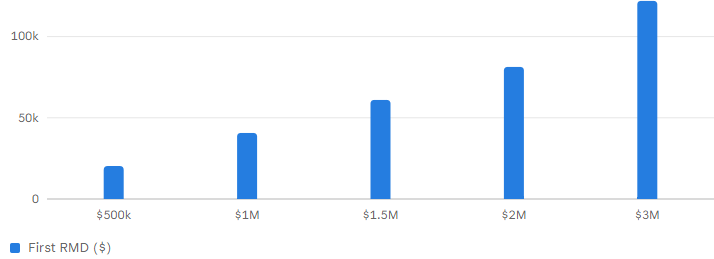
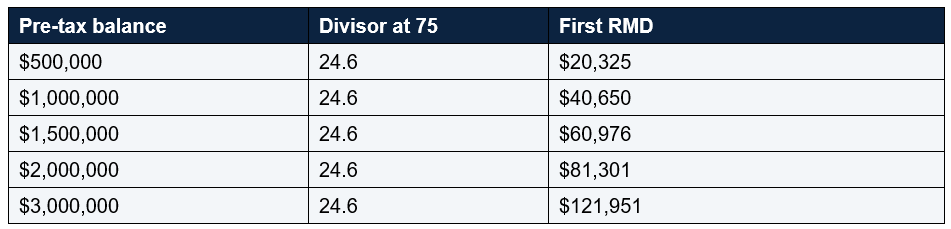
My calculation: balance divided by 24.6 (ref 4). Uses the age-75 factor from the Uniform Lifetime Table; actual RMDs use the prior year-end balance.
Now suppose you convert $200,000 at 60 and pay that tax from savings outside the IRA. Your traditional balance falls to $800,000, which would grow to about $1.66 million at 5%, giving a first RMD of roughly $67,600 (my calculation). That is about $16,900 less in forced income at 75 than the $84,500 above (my calculation).
Why this is only a sketch: It ignores the tax paid on the conversion, investment returns on the Roth side, withdrawals, contributions, inflation and any change in tax law. The tax paid now could outweigh the benefit later, depending on your rates (my reasoning). The same exercise shows why the penalty matters. On a $40,650 RMD, a missed withdrawal would mean a 25% penalty of about $10,160, or about $4,070 at the reduced 10% rate, against about $20,330 under the old 50% rule (my calculation). Those numbers are on top of the income tax owed on the withdrawal.
Converting too much in one year is the classic error. The Fool article warns that a big conversion in a single year could lead to a large IRS bill. Spreading it out gives you a way to stay in lower brackets. Ignoring IRMAA is another. Kiplinger lists conversions among the common triggers of Medicare surcharges. The two-year look-back means today's income shows up in a later Medicare bill. Finally, do not plan around today's law as if it were fixed. The age moved from 70½ to 72, then 73, and is scheduled to reach 75. Rules could change again over 15 years (my reasoning), so revisit the plan every year or two.
The four moves are spread-out Roth conversions, mapping the Social Security and Medicare effects, steering new savings across Roth, pre-tax and taxable accounts, and planning charitable giving without ever skipping an RMD. None is right for everyone, and each has a cost. This is general education, not advice, so run your own numbers with a qualified professional and check live figures.
At 75. People born in 1960 or later start RMDs at 75, while those born from 1951 to 1959 start at 73. The CRS notes that those born in 1959 may face both ages, so check your date.
How is my first RMD calculated?
You divide your account balance by a factor from the IRS Uniform Lifetime Table, and the factor at age 75 is 24.6. Some people use a different table, such as when a spouse is the sole beneficiary and more than 10 years younger (general rule, I did not source it fully here).
Can a Roth conversion reduce my RMDs?
Yes, because Roth IRAs have no lifetime RMDs, and a smaller traditional balance means smaller RMDs. But the conversion is taxable in the year you do it, so the Fool article suggests spreading it out.
What happens if I miss an RMD?
The penalty is 25% of the amount not taken, or 10% if corrected in time, and you file Form 5329. Timely generally means by the end of the second year after the missed RMD.
Do QCDs help with RMDs?
A QCD counts toward your RMD without being added to taxable income, and the 2026 limit is $111,000 per person. You must be at least 70½.
Table of Contents
- What RMDs are and the age-75 rule
- Why starting at 60 gives you an edge
- Move 1: Spread out Roth conversions
- Move 2: Map the Social Security and Medicare ripple effects
- Move 3: Steer future savings toward Roth and taxable accounts
- Move 4: Plan charitable giving and never skip an RMD
- A hypothetical example with numbers
- Conclusion
- FAQ
If you are 60 today, required minimum distributions, or RMDs, can feel like a problem for a much older version of you. Under current law they start at 75 for anyone born in 1960 or later. That gives you roughly 15 years, and the Motley Fool article behind this post makes the same point: time and flexibility are on your side.
The excerpt that prompted this post promises four specific actions but does not list them, and the article itself centres on one main strategy, a spread-out Roth conversion, plus several supporting points. So the four moves in this post are my own framing of what the sources support: spread out Roth conversions, map the ripple effects on Social Security and Medicare, steer new savings toward Roth and taxable accounts, and plan charitable giving while never skipping an RMD.
Key takeaway: You cannot avoid the rules, but at 60 you can choose when income is taxed. Most of the useful moves are about timing and account type, not about earning more.
First RMD age by birth year
Age by Birth year
What RMDs are and the age-75 rule
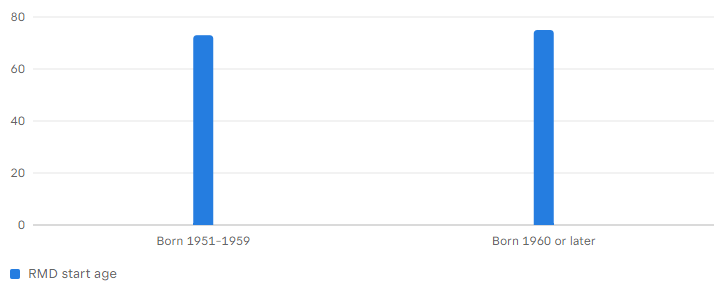
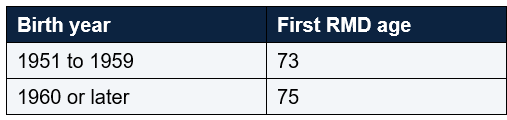
An RMD is the minimum amount you must withdraw each year from most tax-deferred retirement accounts once you reach a set age. The Congressional Research Service describes them as annual withdrawals required after reaching a specified age or inheriting an account. They apply to traditional IRAs and workplace plans, and the money you take out is generally taxed as ordinary income (general rule, which I have not separately sourced here). The starting age depends on your birth year. It is 73 for people born from 1951 to 1959 and 75 for those born in 1960 or later. SECURE 2.0 set that two-step schedule, with the age rising to 75 in 2033. If you are 60 in 2026, you were born around 1966 and would reach 75 around 2041 (my calculation).One wrinkle: the CRS notes that people born in 1959 appear to fall under both the 73 and 75 rules, so anyone born that year should check their own date. Ref 3.
The amount is calculated by dividing your account balance by a life-expectancy factor from the IRS Uniform Lifetime Table. At 75 that factor is 24.6, at 74 it is 25.5, and at 76 it is 23.7. The CRS gives a worked example using the prior year-end balance. Two account types sit outside the lifetime RMD rules. Roth IRAs have never had them for the original owner, and since 2024 Roth 401(k)s do not either. Taxable brokerage accounts are not subject to RMDs. That fact drives most of the planning below.
Why starting at 60 gives you an edge
Why does age 60 matter? Because the window before RMDs begin is often the most flexible stretch of a tax life. The Fool article notes that if you are 15 years away, you can spread a Roth conversion over many tax years. Morningstar adds that lower tax rates and a higher standard deduction, first introduced temporarily in 2017, are now permanent, which it describes as tax cuts on RMDs.The 2027 numbers show how much room there can be. The IRS says the 2027 standard deduction is $16,600 for single filers and $33,200 for married couples filing jointly, up $500 and $1,000 from 2026. KPMG reports that the 10% rate applies to income up to $12,800 for singles and $25,600 for joint filers. Thomson Reuters lists a $6,000 deduction for people 65 or older for tax years 2025 to 2028, though its page labels its 2027 figures as estimates. Low-income years are valuable because converting traditional money to Roth means paying tax on it now, ideally at a lower rate than you might face later. The Nasdaq/Fool piece puts the logic plainly: paying taxes when you are in a lower bracket could save money compared with waiting and paying a higher marginal rate.
Move 1: Spread out Roth conversions
The first move is the one the Fool article leans on most: consider a spread-out Roth conversion if you have a large amount in a traditional plan. A conversion moves money from a traditional IRA or 401(k) into a Roth IRA. It is taxable in the year you do it, but it can reduce your future RMDs or even remove them.The article's example is $1.5 million in a traditional IRA, converting $100,000 a year rather than a huge sum at once, which can help you stay in lower brackets. Its warning is clear: a large conversion in one tax year could mean a large IRS bill. At $100,000 a year, converting $1.5 million would take 15 years (my calculation, ignoring investment growth).
Timing matters because the tax is due now. If the converted money is simply moved, your traditional balance is smaller, so every later RMD is smaller too (my reasoning from the divisor formula). If you convert the entire balance, you will not have RMDs on it at all. Converting half might still shrink them enough to avoid Medicare surcharges or extra Social Security taxation. Watch the order: Once RMDs begin, the RMD itself has to come out first and cannot be converted, per the adviser quoted in reference.
Conversions are not free of side effects. Kiplinger describes a saver with a $1.2 million account and a $140,000 salary, where converting a quarter a year could mean a big tax bill and possibly higher Medicare premiums. If you are still earning at 60, your wages sit on top of any conversion (my reasoning). The same article describes a narrow window before RMDs begin as the time to move money into a Roth.
Move 2: Map the Social Security and Medicare ripple effects
The second move is to map the knock-on effects. RMDs, and conversions, raise your adjusted gross income, and that can ripple through other parts of your finances. The Fool article says RMDs can make Social Security benefits taxable and raise Medicare Part B and Part D premiums through income-related adjustments, known as IRMAA. It gives no dollar figures for those effects.IRMAA uses a two-year look-back. Your 2025 tax return sets your 2027 Medicare premium, and your 2026 return will set 2028. Kiplinger notes that a conversion may trigger IRMAA two years later, although the resulting Roth assets can lower IRMAA exposure in future years by reducing RMDs. For scale, CMS has set the 2027 standard Part B premium at $209.40 a month, up $6.50 from 2026. Higher-income enrollees pay more than that. I have not quoted the 2027 income thresholds here because I did not verify them from an official source in this session, so check Medicare.gov for the current brackets.
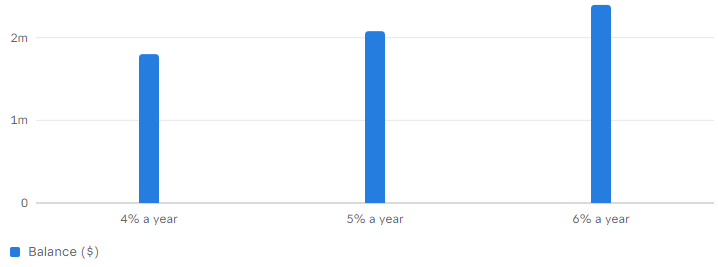
Hypothetical $1M pre-tax balance at 75 after 15 years of growth (my calculation)
US dollars by Assumed growth
Move 3: Steer future savings toward Roth and taxable accounts
The third move happens on the saving side. Roth IRAs and, since 2024, Roth 401(k)s have no RMDs for the original owner. Taxable brokerage accounts do not either. A Kiplinger adviser says that while employer matching contributions still need to be invested pre-tax, maxing out Roth contributions will minimize your RMDs.Think of it as three buckets: pre-tax, Roth and taxable. At 75, the pre-tax bucket sets your forced income. The Roth bucket lets you spend without adding to taxable income. A taxable account can supply cash while keeping income low. Having all three can make the RMD less of a straitjacket (my reasoning).
Move 4: Plan charitable giving and never skip an RMD
The fourth move has two halves. The first is to learn how qualified charitable distributions, or QCDs, work. A QCD sends money directly from an IRA to a qualified charity, and none of it counts as taxable income. You must be at least 70½ on the day of the distribution. The limit is $111,000 per person for 2026, up from $108,000 in 2025. I did not find a confirmed 2027 limit.For someone with RMDs, a QCD counts toward the required amount without adding to taxable income. A distribution is reported on Form 1099-R for the year it is made, so a January transfer counts for the new year. If you already give to charity, you can plan to direct some of that giving from your IRA at 70½ or later (my reasoning). If you do not give, there is nothing here that says you should.
The second half is the simplest rule in this post: do not skip an RMD. The Fool article says failing to take one typically triggers a 25% penalty. SECURE 2.0 cut the old 50% penalty to 25%, and it can drop to 10% if you fix the error in time. In this context, timely means by the end of the second year after the missed RMD, or earlier if the IRS assesses the penalty.
First RMD at 75 by balance (balance ÷ 24.6, my calculation)
US dollars by Pre-tax balance
A hypothetical example with numbers
Let's put numbers on this. These are hypothetical, built on simple assumptions, and not forecasts. Say you are 60 with $1,000,000 in a traditional IRA, add nothing and withdraw nothing, and it grows at a steady 5% a year for 15 years. It would reach about $2.08 million (my calculation). At 4% it would reach about $1.80 million, and at 6% about $2.40 million (my calculation). Now apply the age-75 divisor of 24.6. On a $2.08 million balance, the first RMD would be about $84,500 (my calculation). That is taxable income on top of anything else you have, such as Social Security.My calculation: balance divided by 24.6 (ref 4). Uses the age-75 factor from the Uniform Lifetime Table; actual RMDs use the prior year-end balance.
Now suppose you convert $200,000 at 60 and pay that tax from savings outside the IRA. Your traditional balance falls to $800,000, which would grow to about $1.66 million at 5%, giving a first RMD of roughly $67,600 (my calculation). That is about $16,900 less in forced income at 75 than the $84,500 above (my calculation).
Why this is only a sketch: It ignores the tax paid on the conversion, investment returns on the Roth side, withdrawals, contributions, inflation and any change in tax law. The tax paid now could outweigh the benefit later, depending on your rates (my reasoning). The same exercise shows why the penalty matters. On a $40,650 RMD, a missed withdrawal would mean a 25% penalty of about $10,160, or about $4,070 at the reduced 10% rate, against about $20,330 under the old 50% rule (my calculation). Those numbers are on top of the income tax owed on the withdrawal.
Converting too much in one year is the classic error. The Fool article warns that a big conversion in a single year could lead to a large IRS bill. Spreading it out gives you a way to stay in lower brackets. Ignoring IRMAA is another. Kiplinger lists conversions among the common triggers of Medicare surcharges. The two-year look-back means today's income shows up in a later Medicare bill. Finally, do not plan around today's law as if it were fixed. The age moved from 70½ to 72, then 73, and is scheduled to reach 75. Rules could change again over 15 years (my reasoning), so revisit the plan every year or two.
Conclusion
If you are 60, you have more time than most people who worry about RMDs. Under current law the clock starts at 75 for anyone born in 1960 or later, and the best moves are about using the years in between. That means thinking about when income is taxed, which accounts hold your money, and how conversions and giving interact with Social Security and Medicare.The four moves are spread-out Roth conversions, mapping the Social Security and Medicare effects, steering new savings across Roth, pre-tax and taxable accounts, and planning charitable giving without ever skipping an RMD. None is right for everyone, and each has a cost. This is general education, not advice, so run your own numbers with a qualified professional and check live figures.
FAQ
At what age do RMDs start if I was born in 1960?At 75. People born in 1960 or later start RMDs at 75, while those born from 1951 to 1959 start at 73. The CRS notes that those born in 1959 may face both ages, so check your date.
How is my first RMD calculated?
You divide your account balance by a factor from the IRS Uniform Lifetime Table, and the factor at age 75 is 24.6. Some people use a different table, such as when a spouse is the sole beneficiary and more than 10 years younger (general rule, I did not source it fully here).
Can a Roth conversion reduce my RMDs?
Yes, because Roth IRAs have no lifetime RMDs, and a smaller traditional balance means smaller RMDs. But the conversion is taxable in the year you do it, so the Fool article suggests spreading it out.
What happens if I miss an RMD?
The penalty is 25% of the amount not taken, or 10% if corrected in time, and you file Form 5329. Timely generally means by the end of the second year after the missed RMD.
Do QCDs help with RMDs?
A QCD counts toward your RMD without being added to taxable income, and the 2026 limit is $111,000 per person. You must be at least 70½.
0 Comments
Be the first to share your thoughts on this article.