

Savings
How UK ISAs Will Change in 2027: Every Rule Explained

£12,000 cash ISA limit for under-65s. A 22% charge on cash in investment ISAs. The Lifetime ISA replaced. Here is every change, what it means, and what to do before April 2027.
The UK government is making its most significant changes to the Individual Savings Account framework in years. From 6 April 2027, the annual cash ISA allowance will be cut from £20,000 to £12,000 for anyone under 65. A 22% charge will apply to interest earned on cash held in stocks and shares ISAs. Transfers from investment ISAs back into cash ISAs will be blocked for under-65s. And somewhere in 2027 or 2028, the Lifetime ISA will stop accepting new account holders and be replaced by a new First Time Buyer ISA whose key details are still being consulted on. Two sets of changes with two distinct targets: the government wants to nudge cash savers toward investment, and it wants to fix a first-time buyer savings product that had become notorious for trapping savers in a 25% withdrawal penalty. This article explains every change, who it affects, what the rules will look like in practice, and what actions to take before April 2027 to make the most of the allowances that still exist today.
The LISA reform has a separate and more specific motivation. The Lifetime ISA was launched in 2017 with good intentions — helping young people save for either a first home or retirement — but its 25% withdrawal penalty became notorious. By 2024-25, 8% of all LISA accounts had incurred an unauthorised withdrawal charge, meaning more holders had lost part of their own contributions than had used the product to buy a home (Trustnet, June 2026). The financial architecture of the penalty meant that accessing your own savings early cost you a net loss, not just a forfeiture of the bonus. Replacing it with a simpler first-time buyer product, solely focused on property, is an acknowledgement that the original design failed a significant proportion of its intended users.
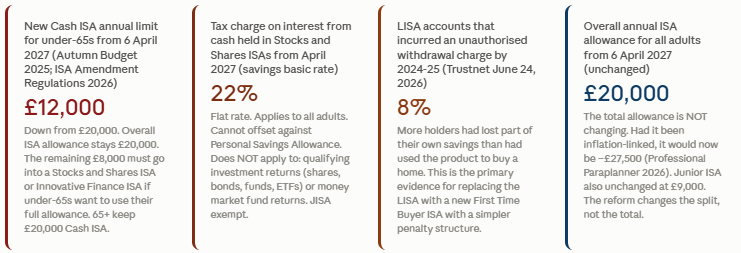
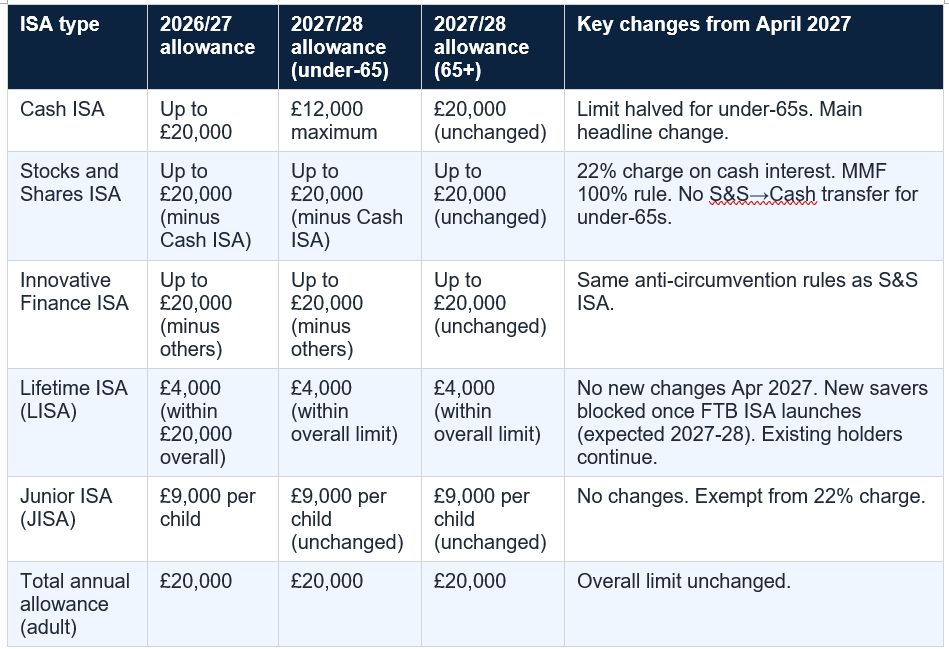
The 2027 ISA reforms in brief: Cash ISA allowance for under-65s: £20,000 → £12,000 from 6 April 2027. Overall ISA allowance: unchanged at £20,000. 22% charge on cash interest in Stocks and Shares ISAs from April 2027. Transfers from S&S ISA to Cash ISA: banned for under-65s from April 2027. LISA: no longer available to new savers once FTB ISA launches (expected 2027-2028). 8% of LISA accounts incurred withdrawal charge by 2024-25 — more than used it to buy a home. Sources: Trustnet June 2026; Ross Martin; AJ Bell; multiple 2026 sources.
The overall annual ISA allowance of £20,000 is unchanged. This means that under-65s who previously put their full £20,000 annual allowance into a cash ISA will no longer be able to do so. If they wish to use their full £20,000 allowance from April 2027, they will need to put the remaining £8,000 into a Stocks and Shares ISA or an Innovative Finance ISA. The government cannot force savers to invest in equities, but it can remove the option of sheltering more than £12,000 of new cash savings in an ISA in any given year. Professional Paraplanner noted that, had the £20,000 ISA limit been inflation-linked since it was introduced, it would now be approximately £27,500 — which means the real-terms value of the ISA allowance has already been eroding for years.
Cash ISA allowance from 6 April 2027: under-65s: £12,000 (reduced from £20,000). 65 and over: £20,000 (unchanged). Overall ISA allowance: £20,000 (unchanged). The remaining £8,000, if used by under-65s, must go into a Stocks and Shares ISA or Innovative Finance ISA. New contributions only — existing balances not affected. Sources: Autumn Budget 2025; ISA Amendment Regulations 2026; Ross Martin; AJ Bell; Trustnet June 2026. Not financial or tax advice.
Children are not affected. The Junior ISA (£9,000 per year) is entirely unaffected and the cash versus stocks-and-shares split within it remains unrestricted. The anti-circumvention rules on the 22% charge apply to all adults regardless of age, but the specific restrictions — the lower £12,000 limit and the transfer ban from S&S ISA to Cash ISA — are age-gated at 65. The Innovative Finance ISA is subject to the same anti-circumvention rules as the Stocks and Shares ISA for the 22% charge, but its specific rules on money market funds are less immediately relevant given the nature of the product.
The first and most headline-grabbing is a flat-rate 22% tax charge on interest earned on cash held in non-cash ISAs (Stocks and Shares ISAs and Innovative Finance ISAs). This rate is set at the savings basic rate, currently 20% for 2026/27 and expected to be 22% in 2027/28 assuming no change at Autumn Budget 2026 (Ross Martin; AJ Bell 2026). Critically, this charge cannot be offset against the Personal Savings Allowance or the starting rate band for savings — it applies in addition to any other tax position. The charge applies to all adults, not just under-65s. However, it does NOT apply to interest or returns from qualifying investments (shares, bonds, funds, ETFs), which means the vast majority of a normal stocks and shares ISA is entirely unaffected.
The 22% charge applies to: interest on uninvested cash sitting in a Stocks and Shares ISA or Innovative Finance ISA. It does NOT apply to: dividends, capital gains, returns from shares, bonds, funds, ETFs, or money market funds (subject to the 100% MMF rule). It CANNOT be offset against the Personal Savings Allowance. It applies to ALL adults, not just under-65s. Junior Cash ISAs are exempt. Sources: Ross Martin; AJ Bell; The Private Office July 2026.
This matters for savers who have been using their Stocks and Shares ISA as a flexible holding vehicle and periodically moving funds back into cash when they want lower-risk savings. From April 2027, that strategy is closed for under-65s. Savers who anticipate needing to access funds in cash form within the next few years should consider whether to make any S&S-to-Cash transfers before 5 April 2027 while the option remains available. Transact’s technical guide (2026) is specific: ‘Under the current rules, clients can transfer freely from a Stocks and Shares ISA to a Cash ISA. From 6 April 2027, transfers from a Stocks and Shares ISA (and Innovative Finance ISAs) into a Cash ISA will be prohibited for individuals aged under 65.
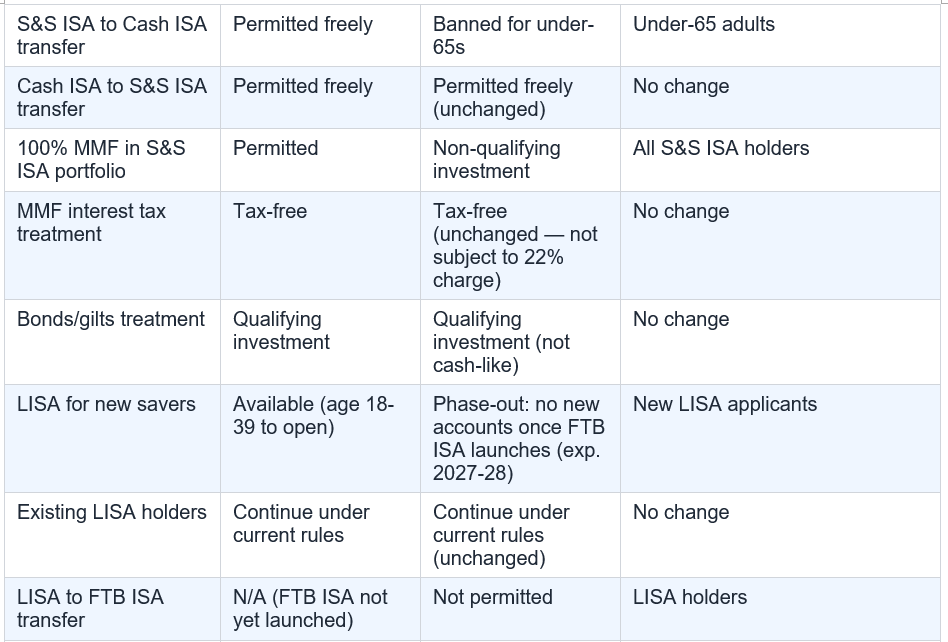
Before 5 April 2027: if you have funds in a Stocks and Shares ISA that you plan to move to cash within the next few years, consider making that transfer before the April 2027 deadline. After that date, under-65s cannot reverse the direction. Cash → S&S ISA transfers remain permitted in either direction for all ages after April 2027. Sources: Transact 2026; AJ Bell; The Private Office July 2026. Not financial or tax advice. Consult an FCA-regulated adviser.
AJ Bell’s detailed technical guide produced the clearest explanation of the practical implication: ‘The ISA holder cannot invest 100% of their (non-cash) investment portfolio in money market funds, or that would be classed as a non-qualifying investment. This means they could invest 99% in money market funds and 1% in UK equities and that would be allowed.’ Bonds, including UK gilts, will not be treated as cash-like assets — a Stocks and Shares ISA holding entirely in a gilt fund would not trigger the MMF rule. From a practical standpoint: most multi-asset funds and balanced portfolios in a Stocks and Shares ISA will already satisfy the 1% non-MMF requirement automatically. It is only investors who have specifically placed their entire ISA into a pure money market fund strategy who will need to act.
The MMF rule in plain English: you can hold up to 99% of your Stocks and Shares ISA in money market funds without triggering the non-qualifying investment rule — as long as at least 1% is in a qualifying investment (shares, bonds, funds, ETFs, gilts, etc). The 22% charge does NOT apply to MMF returns. The 100% cap is the only specific MMF restriction. Bonds and gilts are NOT treated as cash-like assets. Source: AJ Bell/Investcentre; Transact; The Private Office July 2026.
For a 65+ adult, the picture is simpler: the full £20,000 can still go into a Cash ISA, both transfer directions remain open, and the 22% charge on cash interest in S&S ISAs still applies (as this rule applies to all ages), but the cash ISA limit and transfer ban are not relevant. The Junior ISA remains entirely outside these changes at £9,000 per child.
The timing is not fully confirmed. The Private Office’s July 2026 update states that the FTB ISA is expected to launch on 6 April 2028, while Foresters notes ‘anticipated during 2027.’ The government has not yet published a confirmed implementation date. For anyone considering opening a LISA before the window closes, the current rules apply: you must open the account between 18 and 39 years of age (you can continue to contribute until 50), the bonus applies to first-home purchases up to the current property price cap, and the 25% withdrawal penalty on early withdrawals remains in force. The reason this penalty became the LISA’s undoing is worth understanding: the 25% charge applies to the total withdrawal amount including the bonus, meaning the government effectively takes back its bonus and then takes a further slice of your own original savings. By 2024-25, 8% of all LISA accounts had incurred this charge. Not financial or tax advice.
Trustnet (June 24, 2026): 'By 2024-25, 8% of all LISA accounts had incurred an unauthorised withdrawal charge — more holders had lost part of their own savings than had used the product to buy a home.' Griffin (Trustnet June 2026): 'It is vital that the final FTB ISA design avoids simply recreating the same barriers and confusion that have undermined confidence in the Lifetime ISA.' Source: Trustnet June 24, 2026.
What is not yet confirmed: the annual subscription limit; the level of the government bonus; the property price cap. All three will be announced at a future fiscal event (Trustnet; The Private Office July 2026). The expectation among financial commentators is that the design will be simpler than the LISA — a penalty that does not cost you your own contributions being the most pressing fix. Which? magazine’s coverage noted that with a LISA, the 25% withdrawal charge on early access means a net loss from your own savings; a better-designed replacement would separate the bonus from the original contributions in a withdrawal scenario.
The second key action is reviewing whether any S&S ISA to Cash ISA transfers are planned. Under-65s who want to make this transfer can do so freely until 5 April 2027. After that date, the transfer ban takes effect. If you have a Stocks and Shares ISA and anticipate wanting to move money back into cash within the next few years — for a house purchase, a significant expense, or a shift in risk appetite — making that transfer before April 2027 preserves the flexibility. The third action is reviewing any money market fund holdings in Stocks and Shares ISAs: if you hold 100% in MMFs, you will need to diversify by at least 1% into a qualifying investment before April 2027 to remain compliant.
Pre-April 2027 checklist: (1) Max out your 2025/26 and 2026/27 cash ISA allowances at £20,000 if feasible — use the full allowance while it remains available. (2) Review any S&S ISA to Cash ISA transfers you anticipate needing — do them before 5 April 2027. (3) Check any Stocks and Shares ISA portfolios that hold 100% money market funds — add at least 1% of a qualifying investment. (4) Review LISA strategy: if you are eligible and plan to use it to buy a first home, assess whether to continue under existing rules or await FTB ISA details. (5) Seek FCA-regulated financial advice for personalised guidance. Sources: Professional Paraplanner; AJ Bell; Transact.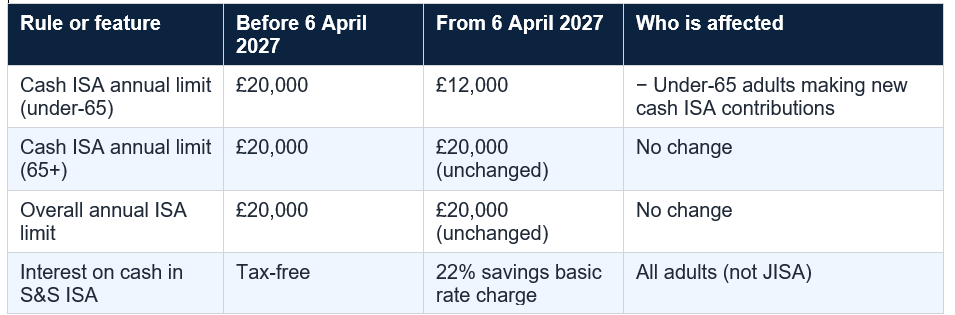

The Trustnet commentary from June 2026 identified the behavioural risk most clearly: ‘Faced with increasingly complex ISA rules, many would-be investors will stick with what they know: cash.’ If the policy’s intended outcome is to shift savers toward investment, rules that make ISAs harder to understand may produce the opposite of the intended effect. The FTB ISA consultation, if it delivers a genuinely simple first-home savings product with a fair penalty structure, has an opportunity to rebuild trust in the product category that the LISA damaged. Whether it succeeds depends on the subscription limit, bonus level, and property cap that the government has not yet set. Until those details are confirmed, the 2027 landscape is clearer for existing ISA holders than for first-time buyers planning their savings strategy. Not financial, investment, or tax advice. Consult an FCA-regulated financial adviser.
From 6 April 2027, the annual Cash ISA subscription limit for adults under 65 will reduce from £20,000 to £12,000. Those aged 65 or over (including those turning 65 during the 2027/28 tax year) retain the full £20,000 Cash ISA allowance. The overall annual ISA allowance remains at £20,000 — meaning under-65s who wish to use their full allowance can put the remaining £8,000 into a Stocks and Shares ISA or Innovative Finance ISA. The change was announced at Autumn Budget 2025 and confirmed in the Individual Savings Account (Amendment) (No. 2) Regulations 2026, which have been laid before Parliament. The change applies only to new contributions from 6 April 2027 — existing Cash ISA balances are unaffected. Sources: Autumn Budget 2025; Ross Martin (ISA Amendment Regulations 2026); AJ Bell/Investcentre; Trustnet June 2026.
What is the 22% charge on cash in a Stocks and Shares ISA?
From 6 April 2027, interest earned on cash held within a Stocks and Shares ISA (or Innovative Finance ISA) will be subject to a flat-rate charge at the savings basic rate — expected to be 22% in 2027/28 (Ross Martin). This charge is part of the anti-circumvention rules designed to prevent savers from sidestepping the reduced Cash ISA limit by holding cash in investment ISAs instead. The charge applies to all adults (not just under-65s) and cannot be offset against the Personal Savings Allowance or the starting rate band for savings. Critically, the charge does NOT apply to: returns from shares, bonds, funds, or ETFs; returns from money market funds (subject to the 100% MMF rule); or Junior Cash ISAs. For most stocks and shares ISA investors who are actually invested in qualifying investments, the charge will have no practical impact. It is specifically targeted at idle cash sitting in investment ISA wrappers. Sources: Ross Martin; AJ Bell; Hillier Hopkins; The Private Office July 2026.
What is happening to the Lifetime ISA?
The Lifetime ISA is being phased out. Once the new First Time Buyer ISA launches — expected during 2027 or from 6 April 2028 — the LISA will no longer accept new account holders. Existing LISA holders can continue contributing under the current rules indefinitely, even after the FTB ISA launches. The 25% annual government bonus (up to £1,000/year on up to £4,000 of contributions) continues to apply. Transfers from a LISA into the new FTB ISA will not be permitted. The background to the phase-out: by 2024-25, 8% of all LISA accounts had incurred an unauthorised withdrawal charge — more holders had lost part of their own savings than had used the product to buy a home (Trustnet June 2026). The 25% withdrawal penalty on the total balance, including the bonus, effectively cost savers a net loss from their own contributions if they needed to withdraw early. Sources: Trustnet June 2026; Foresters; Fidelity; The Private Office July 2026.
What is the new First Time Buyer ISA?
The First Time Buyer ISA (FTB ISA) is a proposed replacement for the Lifetime ISA, aimed specifically at helping first-time buyers save for a property purchase. The government has opened a consultation on its design. Confirmed features: it will be available as either a Cash ISA or a Stocks and Shares ISA; its sole purpose is first-home purchase (unlike the LISA which also covered retirement); it will offer a government bonus. Not yet confirmed: the annual subscription limit, the bonus level, and the property price cap — all three are to be announced at a future fiscal event (Trustnet; The Private Office July 2026). Existing LISA holders can hold a FTB ISA alongside their LISA (subject to overall subscription limits) but cannot transfer their LISA balance into the new product. Sources: Trustnet June 2026; The Private Office July 2026; Which?; Foresters. Not financial or tax advice. Monitor gov.uk for updates.
What should I do before 6 April 2027?
Three specific actions are worth considering before the April 2027 deadline. First: consider using your full £20,000 Cash ISA allowance in the 2025/26 and 2026/27 tax years while the higher limit remains available. From 6 April 2027, the under-65 Cash ISA limit falls to £12,000, so the 2026/27 tax year is the last opportunity to shelter up to £20,000 in cash in a single year (Professional Paraplanner). Second: if you have money in a Stocks and Shares ISA that you anticipate wanting in cash form within the next few years — for example, for a house purchase, a large expense, or a shift in risk tolerance — consider making a Stocks and Shares ISA to Cash ISA transfer before 5 April 2027. After that date, this transfer will be blocked for under-65s (Transact; The Private Office). Third: if you hold 100% of your Stocks and Shares ISA in money market funds, you will need to add at least 1% of another qualifying investment (shares, bonds, ETFs, gilts) before April 2027 to avoid the MMF non-qualifying investment rule. Sources: Professional Paraplanner; AJ Bell; Transact. Not financial or tax advice. Consult an FCA-regulated financial adviser for guidance specific to your circumstances.
The UK government is making its most significant changes to the Individual Savings Account framework in years. From 6 April 2027, the annual cash ISA allowance will be cut from £20,000 to £12,000 for anyone under 65. A 22% charge will apply to interest earned on cash held in stocks and shares ISAs. Transfers from investment ISAs back into cash ISAs will be blocked for under-65s. And somewhere in 2027 or 2028, the Lifetime ISA will stop accepting new account holders and be replaced by a new First Time Buyer ISA whose key details are still being consulted on. Two sets of changes with two distinct targets: the government wants to nudge cash savers toward investment, and it wants to fix a first-time buyer savings product that had become notorious for trapping savers in a 25% withdrawal penalty. This article explains every change, who it affects, what the rules will look like in practice, and what actions to take before April 2027 to make the most of the allowances that still exist today.
Table of Contents
- Why the Government Is Changing the ISA Rules
- Change 1: The Cash ISA Limit Drops to £12,000 for Under-65s
- Who Is Affected — and Who Isn’t
- Change 2: The 22% Charge on Cash in Stocks and Shares ISAs
- Change 3: The Transfer Ban — Stocks and Shares to Cash ISA
- The Money Market Fund Rules — The Detail That Matters
- What the Full ISA Allowance Picture Looks Like From April 2027
- The Lifetime ISA: What’s Happening and When
- The First Time Buyer ISA: What We Know So Far
- What to Do Before 6 April 2027: The Action Plan
- The Complete ISA Rules Summary Table: Before and After
- Conclusion: A More Complex System, With a Clear Direction of Travel
- Frequently Asked Questions
Why the Government Is Changing the ISA Rules
The government’s stated rationale for the 2027 ISA reforms is to shift UK savers away from cash and toward long-term investment. Hillier Hopkins, in its ISA changes guide for 2027, summarised the case plainly: more people currently use cash ISAs than stocks and shares ISAs, and cash savings may deliver lower long-term returns than investments. The government’s position is that keeping excess cash in tax-free savings accounts, when investment markets offer better long-term outcomes, represents a missed opportunity for household wealth accumulation. By reducing the tax advantage available to pure cash savers under 65, while leaving the full £20,000 allowance available for investment, the policy creates an incentive to allocate more savings to stocks and shares.The LISA reform has a separate and more specific motivation. The Lifetime ISA was launched in 2017 with good intentions — helping young people save for either a first home or retirement — but its 25% withdrawal penalty became notorious. By 2024-25, 8% of all LISA accounts had incurred an unauthorised withdrawal charge, meaning more holders had lost part of their own contributions than had used the product to buy a home (Trustnet, June 2026). The financial architecture of the penalty meant that accessing your own savings early cost you a net loss, not just a forfeiture of the bonus. Replacing it with a simpler first-time buyer product, solely focused on property, is an acknowledgement that the original design failed a significant proportion of its intended users.
The 2027 ISA reforms in brief: Cash ISA allowance for under-65s: £20,000 → £12,000 from 6 April 2027. Overall ISA allowance: unchanged at £20,000. 22% charge on cash interest in Stocks and Shares ISAs from April 2027. Transfers from S&S ISA to Cash ISA: banned for under-65s from April 2027. LISA: no longer available to new savers once FTB ISA launches (expected 2027-2028). 8% of LISA accounts incurred withdrawal charge by 2024-25 — more than used it to buy a home. Sources: Trustnet June 2026; Ross Martin; AJ Bell; multiple 2026 sources.
Change 1: The Cash ISA Limit Drops to £12,000 for Under-65s
From 6 April 2027, the annual Cash ISA subscription limit for adults under 65 will reduce from £20,000 to £12,000. This is the headline change from the 2025 Autumn Budget, confirmed through the Individual Savings Account (Amendment) (No. 2) Regulations 2026, which have been laid before Parliament. The change applies from the start of the 2027/28 tax year and will only affect new contributions made from 6 April 2027 onwards — existing cash ISA balances are unaffected.The overall annual ISA allowance of £20,000 is unchanged. This means that under-65s who previously put their full £20,000 annual allowance into a cash ISA will no longer be able to do so. If they wish to use their full £20,000 allowance from April 2027, they will need to put the remaining £8,000 into a Stocks and Shares ISA or an Innovative Finance ISA. The government cannot force savers to invest in equities, but it can remove the option of sheltering more than £12,000 of new cash savings in an ISA in any given year. Professional Paraplanner noted that, had the £20,000 ISA limit been inflation-linked since it was introduced, it would now be approximately £27,500 — which means the real-terms value of the ISA allowance has already been eroding for years.
Cash ISA allowance from 6 April 2027: under-65s: £12,000 (reduced from £20,000). 65 and over: £20,000 (unchanged). Overall ISA allowance: £20,000 (unchanged). The remaining £8,000, if used by under-65s, must go into a Stocks and Shares ISA or Innovative Finance ISA. New contributions only — existing balances not affected. Sources: Autumn Budget 2025; ISA Amendment Regulations 2026; Ross Martin; AJ Bell; Trustnet June 2026. Not financial or tax advice.
Who Is Affected — and Who Isn’t
The cash ISA reduction applies exclusively to adults who will be under 65 at any point during the relevant tax year. The age threshold is clear: if you turn 65 during the 2027/28 tax year (6 April 2027 to 5 April 2028), the lower cash ISA limit does not apply to you. You retain the £20,000 cash ISA allowance (AJ Bell; Foresters 2026). This is a meaningful carve-out: it protects the saving habits of older adults who are more likely to rely on cash ISAs as a core savings vehicle and who are closer to or in retirement, where capital preservation takes priority over long-term investment growth.Children are not affected. The Junior ISA (£9,000 per year) is entirely unaffected and the cash versus stocks-and-shares split within it remains unrestricted. The anti-circumvention rules on the 22% charge apply to all adults regardless of age, but the specific restrictions — the lower £12,000 limit and the transfer ban from S&S ISA to Cash ISA — are age-gated at 65. The Innovative Finance ISA is subject to the same anti-circumvention rules as the Stocks and Shares ISA for the 22% charge, but its specific rules on money market funds are less immediately relevant given the nature of the product.
Change 2: The 22% Charge on Cash in Stocks and Shares ISAs
The most technically complex of the April 2027 changes is the anti-circumvention package. The government’s concern was straightforward: if the cash ISA limit is cut to £12,000 for under-65s but the Stocks and Shares ISA limit remains at £20,000 and cash can be held within a Stocks and Shares ISA, savers could simply park their excess cash in the investment ISA wrapper and achieve the same outcome as a higher cash ISA allowance. Three rules address this.The first and most headline-grabbing is a flat-rate 22% tax charge on interest earned on cash held in non-cash ISAs (Stocks and Shares ISAs and Innovative Finance ISAs). This rate is set at the savings basic rate, currently 20% for 2026/27 and expected to be 22% in 2027/28 assuming no change at Autumn Budget 2026 (Ross Martin; AJ Bell 2026). Critically, this charge cannot be offset against the Personal Savings Allowance or the starting rate band for savings — it applies in addition to any other tax position. The charge applies to all adults, not just under-65s. However, it does NOT apply to interest or returns from qualifying investments (shares, bonds, funds, ETFs), which means the vast majority of a normal stocks and shares ISA is entirely unaffected.
The 22% charge applies to: interest on uninvested cash sitting in a Stocks and Shares ISA or Innovative Finance ISA. It does NOT apply to: dividends, capital gains, returns from shares, bonds, funds, ETFs, or money market funds (subject to the 100% MMF rule). It CANNOT be offset against the Personal Savings Allowance. It applies to ALL adults, not just under-65s. Junior Cash ISAs are exempt. Sources: Ross Martin; AJ Bell; The Private Office July 2026.
Change 3: The Transfer Ban — Stocks and Shares to Cash ISA
Under current rules, savers can transfer an existing Stocks and Shares ISA into a Cash ISA at any time. From 6 April 2027, this will no longer be permitted for under-65s. Transfers from a Cash ISA into a Stocks and Shares ISA remain freely permitted in both directions for all ages, but the reverse journey — from S&S ISA to Cash ISA — is blocked for anyone under 65. For those 65 and over, both directions remain open.This matters for savers who have been using their Stocks and Shares ISA as a flexible holding vehicle and periodically moving funds back into cash when they want lower-risk savings. From April 2027, that strategy is closed for under-65s. Savers who anticipate needing to access funds in cash form within the next few years should consider whether to make any S&S-to-Cash transfers before 5 April 2027 while the option remains available. Transact’s technical guide (2026) is specific: ‘Under the current rules, clients can transfer freely from a Stocks and Shares ISA to a Cash ISA. From 6 April 2027, transfers from a Stocks and Shares ISA (and Innovative Finance ISAs) into a Cash ISA will be prohibited for individuals aged under 65.
Before 5 April 2027: if you have funds in a Stocks and Shares ISA that you plan to move to cash within the next few years, consider making that transfer before the April 2027 deadline. After that date, under-65s cannot reverse the direction. Cash → S&S ISA transfers remain permitted in either direction for all ages after April 2027. Sources: Transact 2026; AJ Bell; The Private Office July 2026. Not financial or tax advice. Consult an FCA-regulated adviser.
The Money Market Fund Rules — The Detail That Matters
Money market funds (MMFs) occupy a specific position in the 2027 anti-circumvention framework. They are classified as ‘cash-like assets’ from April 2027 because they behave similarly to cash — they are very low-risk, track UK interest rates, and are easily accessible. However, they are not classified as cash, which means two key things. First, the 22% charge on cash interest does NOT apply to returns from money market funds. Second, a specific separate rule applies: if a Stocks and Shares ISA holds money market funds as 100% of its non-cash investment portfolio, those MMFs become a ‘non-qualifying investment’ and the ISA could lose its tax status.AJ Bell’s detailed technical guide produced the clearest explanation of the practical implication: ‘The ISA holder cannot invest 100% of their (non-cash) investment portfolio in money market funds, or that would be classed as a non-qualifying investment. This means they could invest 99% in money market funds and 1% in UK equities and that would be allowed.’ Bonds, including UK gilts, will not be treated as cash-like assets — a Stocks and Shares ISA holding entirely in a gilt fund would not trigger the MMF rule. From a practical standpoint: most multi-asset funds and balanced portfolios in a Stocks and Shares ISA will already satisfy the 1% non-MMF requirement automatically. It is only investors who have specifically placed their entire ISA into a pure money market fund strategy who will need to act.
The MMF rule in plain English: you can hold up to 99% of your Stocks and Shares ISA in money market funds without triggering the non-qualifying investment rule — as long as at least 1% is in a qualifying investment (shares, bonds, funds, ETFs, gilts, etc). The 22% charge does NOT apply to MMF returns. The 100% cap is the only specific MMF restriction. Bonds and gilts are NOT treated as cash-like assets. Source: AJ Bell/Investcentre; Transact; The Private Office July 2026.
What the Full ISA Allowance Picture Looks Like From April 2027
Once all three anti-circumvention rules are applied, the full ISA allowance picture for an under-65 adult from 6 April 2027 is as follows. The total annual ISA allowance remains £20,000. Of that, up to £12,000 can go into a Cash ISA. The remaining up to £8,000 (or more, if less than £12,000 is placed in a Cash ISA) can go into a Stocks and Shares ISA, an Innovative Finance ISA, or a combination. Cash held within the Stocks and Shares ISA earns interest subject to the 22% savings basic rate charge. Transfers from S&S ISA to Cash ISA are blocked. Money market funds are permitted in the S&S ISA provided they do not represent 100% of the non-cash investment portfolio.For a 65+ adult, the picture is simpler: the full £20,000 can still go into a Cash ISA, both transfer directions remain open, and the 22% charge on cash interest in S&S ISAs still applies (as this rule applies to all ages), but the cash ISA limit and transfer ban are not relevant. The Junior ISA remains entirely outside these changes at £9,000 per child.
The Lifetime ISA: What’s Happening and When
The Lifetime ISA is not being immediately abolished. The change is a phase-out: once the new First Time Buyer ISA launches, the LISA will no longer be available to new account holders. Existing LISA holders can continue contributing under the current rules indefinitely, even after the FTB ISA launches (Foresters; Fidelity 2026). The 25% annual government bonus (up to £1,000 per year on up to £4,000 of contributions) continues to apply for existing holders. The product will simply stop accepting new account openings.The timing is not fully confirmed. The Private Office’s July 2026 update states that the FTB ISA is expected to launch on 6 April 2028, while Foresters notes ‘anticipated during 2027.’ The government has not yet published a confirmed implementation date. For anyone considering opening a LISA before the window closes, the current rules apply: you must open the account between 18 and 39 years of age (you can continue to contribute until 50), the bonus applies to first-home purchases up to the current property price cap, and the 25% withdrawal penalty on early withdrawals remains in force. The reason this penalty became the LISA’s undoing is worth understanding: the 25% charge applies to the total withdrawal amount including the bonus, meaning the government effectively takes back its bonus and then takes a further slice of your own original savings. By 2024-25, 8% of all LISA accounts had incurred this charge. Not financial or tax advice.
Trustnet (June 24, 2026): 'By 2024-25, 8% of all LISA accounts had incurred an unauthorised withdrawal charge — more holders had lost part of their own savings than had used the product to buy a home.' Griffin (Trustnet June 2026): 'It is vital that the final FTB ISA design avoids simply recreating the same barriers and confusion that have undermined confidence in the Lifetime ISA.' Source: Trustnet June 24, 2026.
The First Time Buyer ISA: What We Know So Far
The First Time Buyer ISA (FTB ISA) is the LISA’s intended replacement and the most discussed element of the second tranche of ISA reforms. The government has opened a consultation on its design. Some things are confirmed; many are not. What is confirmed: the FTB ISA will be available as either a Cash ISA or a Stocks and Shares ISA (unlike the LISA, which restricted investment options); its sole purpose will be helping first-time buyers get on the property ladder (it will not double as a retirement savings vehicle as the LISA did); existing LISA holders will not be able to transfer their LISA balance into the FTB ISA; existing LISA holders will be able to hold both a LISA and a FTB ISA simultaneously, subject to overall subscription limits; the FTB ISA will offer a government bonus.What is not yet confirmed: the annual subscription limit; the level of the government bonus; the property price cap. All three will be announced at a future fiscal event (Trustnet; The Private Office July 2026). The expectation among financial commentators is that the design will be simpler than the LISA — a penalty that does not cost you your own contributions being the most pressing fix. Which? magazine’s coverage noted that with a LISA, the 25% withdrawal charge on early access means a net loss from your own savings; a better-designed replacement would separate the bonus from the original contributions in a withdrawal scenario.
What to Do Before 6 April 2027: The Action Plan
The April 2027 changes create a specific set of pre-deadline opportunities for savers. The most urgent is the use of the full £20,000 cash ISA allowance while it remains available. Professional Paraplanner’s guidance is direct: advisers should consider whether it is appropriate for clients to make full use of existing Cash ISA allowances in both the current 2025/26 and 2026/27 tax years, before the new limits take effect. Any cash ISA subscriptions made before 5 April 2027 are made under the existing £20,000 limit. From 6 April 2027, under-65s can only contribute up to £12,000 per year to a cash ISA. Using the full £20,000 in 2026/27 while it remains available is a legitimate tax-efficiency action.The second key action is reviewing whether any S&S ISA to Cash ISA transfers are planned. Under-65s who want to make this transfer can do so freely until 5 April 2027. After that date, the transfer ban takes effect. If you have a Stocks and Shares ISA and anticipate wanting to move money back into cash within the next few years — for a house purchase, a significant expense, or a shift in risk appetite — making that transfer before April 2027 preserves the flexibility. The third action is reviewing any money market fund holdings in Stocks and Shares ISAs: if you hold 100% in MMFs, you will need to diversify by at least 1% into a qualifying investment before April 2027 to remain compliant.
Pre-April 2027 checklist: (1) Max out your 2025/26 and 2026/27 cash ISA allowances at £20,000 if feasible — use the full allowance while it remains available. (2) Review any S&S ISA to Cash ISA transfers you anticipate needing — do them before 5 April 2027. (3) Check any Stocks and Shares ISA portfolios that hold 100% money market funds — add at least 1% of a qualifying investment. (4) Review LISA strategy: if you are eligible and plan to use it to buy a first home, assess whether to continue under existing rules or await FTB ISA details. (5) Seek FCA-regulated financial advice for personalised guidance. Sources: Professional Paraplanner; AJ Bell; Transact.
The Complete ISA Rules Summary Table: Before and After
Conclusion
The 2027 ISA reforms do not reduce the tax advantages of ISAs for most savers. The overall £20,000 annual allowance is unchanged, tax-free growth and income remain the core proposition, and the majority of stocks and shares ISA strategies are entirely unaffected. What the reforms do is redirect. Cash savers under 65 get a smaller dedicated shelter. Investment ISA holders face new complexity around cash and money market fund holdings. And first-time buyers are being promised a cleaner product to replace the one that spent nine years failing a significant proportion of its users.The Trustnet commentary from June 2026 identified the behavioural risk most clearly: ‘Faced with increasingly complex ISA rules, many would-be investors will stick with what they know: cash.’ If the policy’s intended outcome is to shift savers toward investment, rules that make ISAs harder to understand may produce the opposite of the intended effect. The FTB ISA consultation, if it delivers a genuinely simple first-home savings product with a fair penalty structure, has an opportunity to rebuild trust in the product category that the LISA damaged. Whether it succeeds depends on the subscription limit, bonus level, and property cap that the government has not yet set. Until those details are confirmed, the 2027 landscape is clearer for existing ISA holders than for first-time buyers planning their savings strategy. Not financial, investment, or tax advice. Consult an FCA-regulated financial adviser.
Frequently Asked Questions
What is changing with Cash ISAs from April 2027?From 6 April 2027, the annual Cash ISA subscription limit for adults under 65 will reduce from £20,000 to £12,000. Those aged 65 or over (including those turning 65 during the 2027/28 tax year) retain the full £20,000 Cash ISA allowance. The overall annual ISA allowance remains at £20,000 — meaning under-65s who wish to use their full allowance can put the remaining £8,000 into a Stocks and Shares ISA or Innovative Finance ISA. The change was announced at Autumn Budget 2025 and confirmed in the Individual Savings Account (Amendment) (No. 2) Regulations 2026, which have been laid before Parliament. The change applies only to new contributions from 6 April 2027 — existing Cash ISA balances are unaffected. Sources: Autumn Budget 2025; Ross Martin (ISA Amendment Regulations 2026); AJ Bell/Investcentre; Trustnet June 2026.
What is the 22% charge on cash in a Stocks and Shares ISA?
From 6 April 2027, interest earned on cash held within a Stocks and Shares ISA (or Innovative Finance ISA) will be subject to a flat-rate charge at the savings basic rate — expected to be 22% in 2027/28 (Ross Martin). This charge is part of the anti-circumvention rules designed to prevent savers from sidestepping the reduced Cash ISA limit by holding cash in investment ISAs instead. The charge applies to all adults (not just under-65s) and cannot be offset against the Personal Savings Allowance or the starting rate band for savings. Critically, the charge does NOT apply to: returns from shares, bonds, funds, or ETFs; returns from money market funds (subject to the 100% MMF rule); or Junior Cash ISAs. For most stocks and shares ISA investors who are actually invested in qualifying investments, the charge will have no practical impact. It is specifically targeted at idle cash sitting in investment ISA wrappers. Sources: Ross Martin; AJ Bell; Hillier Hopkins; The Private Office July 2026.
What is happening to the Lifetime ISA?
The Lifetime ISA is being phased out. Once the new First Time Buyer ISA launches — expected during 2027 or from 6 April 2028 — the LISA will no longer accept new account holders. Existing LISA holders can continue contributing under the current rules indefinitely, even after the FTB ISA launches. The 25% annual government bonus (up to £1,000/year on up to £4,000 of contributions) continues to apply. Transfers from a LISA into the new FTB ISA will not be permitted. The background to the phase-out: by 2024-25, 8% of all LISA accounts had incurred an unauthorised withdrawal charge — more holders had lost part of their own savings than had used the product to buy a home (Trustnet June 2026). The 25% withdrawal penalty on the total balance, including the bonus, effectively cost savers a net loss from their own contributions if they needed to withdraw early. Sources: Trustnet June 2026; Foresters; Fidelity; The Private Office July 2026.
What is the new First Time Buyer ISA?
The First Time Buyer ISA (FTB ISA) is a proposed replacement for the Lifetime ISA, aimed specifically at helping first-time buyers save for a property purchase. The government has opened a consultation on its design. Confirmed features: it will be available as either a Cash ISA or a Stocks and Shares ISA; its sole purpose is first-home purchase (unlike the LISA which also covered retirement); it will offer a government bonus. Not yet confirmed: the annual subscription limit, the bonus level, and the property price cap — all three are to be announced at a future fiscal event (Trustnet; The Private Office July 2026). Existing LISA holders can hold a FTB ISA alongside their LISA (subject to overall subscription limits) but cannot transfer their LISA balance into the new product. Sources: Trustnet June 2026; The Private Office July 2026; Which?; Foresters. Not financial or tax advice. Monitor gov.uk for updates.
What should I do before 6 April 2027?
Three specific actions are worth considering before the April 2027 deadline. First: consider using your full £20,000 Cash ISA allowance in the 2025/26 and 2026/27 tax years while the higher limit remains available. From 6 April 2027, the under-65 Cash ISA limit falls to £12,000, so the 2026/27 tax year is the last opportunity to shelter up to £20,000 in cash in a single year (Professional Paraplanner). Second: if you have money in a Stocks and Shares ISA that you anticipate wanting in cash form within the next few years — for example, for a house purchase, a large expense, or a shift in risk tolerance — consider making a Stocks and Shares ISA to Cash ISA transfer before 5 April 2027. After that date, this transfer will be blocked for under-65s (Transact; The Private Office). Third: if you hold 100% of your Stocks and Shares ISA in money market funds, you will need to add at least 1% of another qualifying investment (shares, bonds, ETFs, gilts) before April 2027 to avoid the MMF non-qualifying investment rule. Sources: Professional Paraplanner; AJ Bell; Transact. Not financial or tax advice. Consult an FCA-regulated financial adviser for guidance specific to your circumstances.
0 Comments
Be the first to share your thoughts on this article.