
Investing
Is J&J a Buy? $101B in 2026 Sales and a Dividend King Streak

J&J is a healthcare giant performing very well right now, but it will not be a great fit for every investor. Here is what the numbers say. 2026 sales guidance $101.2B (+7.4%), Q3 sales $25.4B (+5.9%), Adjusted EPS guidance $11.10 (+2.9%), 64 straight years of dividend increases, $5.5B proposed talc settlement, Forward P/E about 24x vs five-year average of 17x.
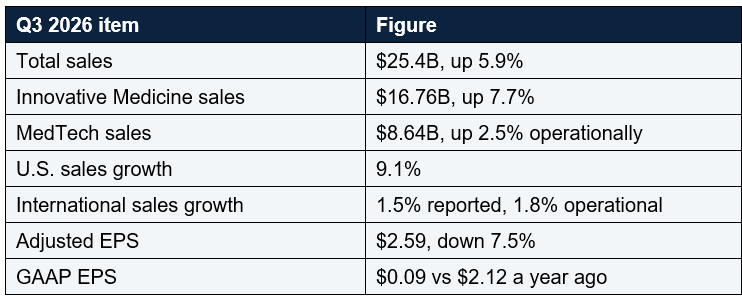
Johnson & Johnson is doing what a giant rarely does: speeding up. It reported third-quarter 2026 sales of $25.4 billion, up 5.9%, and raised its full-year guidance to reported sales of about $101.2 billion, up 7.4% at the midpoint. If it gets there, it will be the first year the company has ever passed $100 billion in sales.
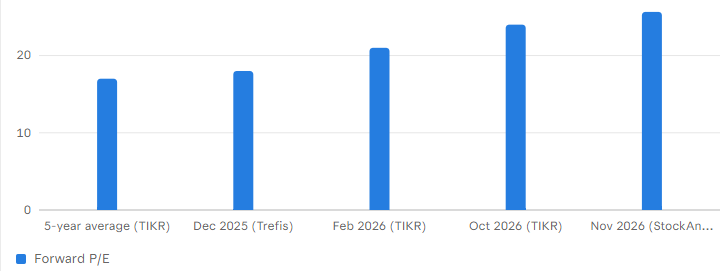
So is the stock still a buy? My honest answer is that the business looks excellent, while the price is a bigger question. The shares have risen strongly, with one data page showing a gain of about 35.6% so far this year and 51% over twelve months as of 6 November. At that point, a lot of good news is already in the price. One analysis put the forward price-to-earnings ratio at 24 times, against a five-year average of 17 times. The dividend adds a different kind of appeal. J&J raised its quarterly dividend to $1.34 in April, its 64th consecutive annual increase. But the yield is only around 1.9%, so this is a reliability story, not an income-maximising one.
Key takeaway: J&J looks like a strong, dependable business whose price already reflects much of that strength. It may suit patient, income-and-growth investors more than anyone hoping for a bargain or a quick gain.
One more point on language. Guidance can be raised and, occasionally, cut. Earlier this year, J&J lowered its adjusted earnings guidance in July after announcing deals, even as sales stayed strong. Treat the $101 billion as a target the company is on pace to meet, not a certainty.
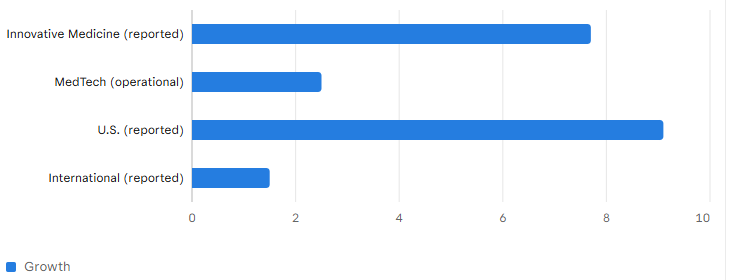
Regionally, the United States did most of the work. U.S. sales rose 9.1% to $14.96 billion, while international sales rose 1.5% reported (1.8% operational) to $10.44 billion. By segment, Innovative Medicine, the drug business, grew 7.7% to $16.76 billion, and MedTech grew 2.5% operationally to $8.64 billion.
The market's reaction is a useful reality check. One analysis reports that the stock fell 6% on 13 October, the day J&J reported, even though it raised its adjusted EPS guidance. Another headline noted that a sluggish MedTech business and steep one-time charges left investors unconvinced.
Cancer is the longer-term engine. J&J says it is on track to be the number one oncology company by 2030, with oncology sales projected to exceed $50 billion. One research note put Carvykti sales up 62% in the first quarter of 2026, though that note is undated and I treat it as indicative. Zacks lists Darzalex, Tremfya, Spravato, Carvykti, Tecvayli and Erleada among the key drivers, with newer launches such as Icotyde, Rybrevant/Lazcluze, Imaavy and Inlexzo adding to growth.
Put simply, Innovative Medicine's organic sales rose 6.9% in the first nine months of 2026 despite the loss of exclusivity on Stelara. That is the heart of the bull case: the company is replacing a giant drug with several growing ones. There is also heavy spending to keep the pipeline full. Research and development expense rose 26.7% to $4.7 billion in the third quarter. In my inference, this is a sign of confidence in the pipeline, but it is also a reason earnings do not grow as fast as sales.
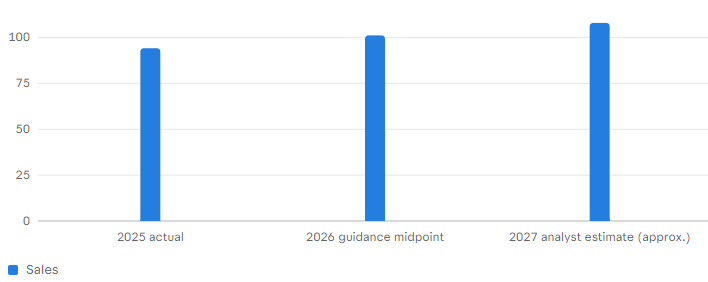
J&J annual sales: 2025, 2026 guidance, 2027 estimate (US$ billions)
US$ billions by Sources: Motley Fool via Finviz; J&J Q3 release (SEC); TIKR. 2027 is an approximate analyst figure.
The second is MedTech. Third-quarter sales grew only 2.5% operationally, and the segment missed estimates for a second straight quarter, with growth slowing from 4.6% in the first quarter. There were bright spots. Electrophysiology products and Shockwave supported cardiovascular sales, and contact lenses and orthopaedic trauma contributed. Vision care grew 5.1% operationally on strong contact lens sales. MedTech matters because it is about a third of sales (my calculation: $8.64 billion of $25.4 billion). If it keeps lagging while drugs carry the load, the group will look more like a pharma company than a diversified healthcare giant. That is not necessarily bad, but it changes what you own.
Deals. In July, J&J cut its 2026 adjusted EPS guidance to $10.96 to $11.11 from $11.60 to $11.75, citing the Firefly Bio and Sail Biomedicines transactions. One analysis says those deals reduce earnings by $0.64 a share in 2026 and $1.36 a share in 2027. The same analysis says analysts expect normalised EPS to grow less than 4% a year from 2025 to 2027, and that they have cut their 2027 estimate by 9% since the end of June.
This is where valuation and growth collide. Revenue is expected to reach about $108 billion in 2027, up roughly 7%, but earnings growth is expected to be slower. If you are paying a higher multiple, you want earnings to speed up, not slow down. Worth knowing: Acquisition and licensing costs hit earnings now, while the benefits (if any) arrive later. That is a normal trade-off in drug development, but it does mean 2026 and 2027 earnings growth looks weaker than the sales story.
The shares rose 2.5% on the news. Still, the issue is not fully over, Zacks says the matter is close to resolution but not yet completely resolved. My suggestion is to treat talc as a shrinking risk, not a vanished one, and to watch for confirmation that the participation threshold has been met.
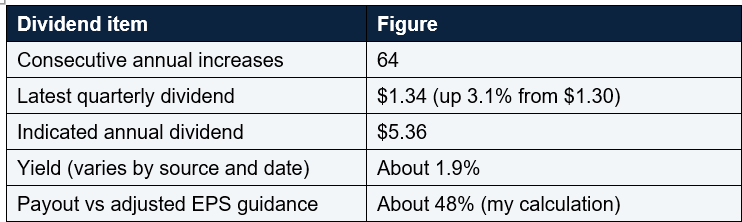
How safe is it? Using the guidance above, $5.36 against adjusted EPS of $11.10 is a payout ratio of about 48% (my calculation). Another source put the payout around 50% of free cash flow, with analysts forecasting free cash flow of $25.14 billion in 2026. J&J generated about $19.7 billion of free cash flow in 2025. A payout near half of earnings leaves room to keep raising it, even in a year with big litigation charges.
What about the yield? The sources vary a little, with $5.36 a year being 1.88% of the price on one data page and 1.94% on another. One quote page shows a yield of "193.89%", which is obviously a data error. The yield sits below where it was earlier in the year, because the price has risen so much. In January, for example, a Motley Fool article cited a 2.4% yield. The next ex-dividend date is 24 November 2026. As a general rule, buyers on or after the ex-dividend date do not receive the next payment. I did not retrieve the payment date, so check it before you act.
Price levels also differ by source. The Motley Fool page shows a 6 November close of $276.22, while StockAnalysis shows a day range of $281.68 to $288.11 and a 52-week high of $288.11. I did not retrieve a live quote, so the right price for your decision is the one on your screen. Analysts' average price target was about $279 in two sources, which implies little upside from recent prices. Investing.com lists an average target of $165, which does not fit the other numbers, so I ignore it.
To make this concrete, here is my illustration, not a forecast. Using the $11.10 guidance midpoint, a multiple of 17 times (the five-year average) gives about $189 a share, and 24 times gives about $266 (my calculation). If the stock trades near $276, you are paying a little above 24 times the current-year guidance. That is not crazy for a high-quality company, but it leaves less room for error.
Key takeaway: A great company can still be a poor purchase if you pay too much. At roughly 24 times forward earnings, J&J needs earnings growth to speed up to justify the price. The 8 December outlook for 2027 is the next big test.
It may suit you if you want a core, lower-volatility holding. One quote page shows a beta of about 0.2, which suggests the stock moves much less than the market. You can reinvest dividends over decades, and you are comfortable with a modest yield that grows. You also accept that some years the stock may simply trade sideways after a big run.
It may not suit you if you need high current income. A yield near 1.9% will not fund much of a retirement budget on its own. It may also not suit you if you want a cheap stock, because a forward P/E of 24 is not cheap by J&J's own history. And it may not suit you if you need the money within a year or two, since a stock up more than 35% in a year can fall back.
One more consideration is concentration. J&J is a large, famous company, so it is easy to let it grow into too big a share of a portfolio. Dividend investors in particular sometimes end up with several healthcare names at once. A simple check of how much healthcare exposure you already hold is worthwhile before you add more.
Reassess after the December outlook and after the talc settlement participation news. If your reason for owning has changed, your position may need to change too.
J&J guides to 2026 reported sales of about $101.2 billion, within a $101.0 billion to $101.4 billion range. That is guidance, not a final result.
Is J&J a Dividend King?
Yes. It raised its dividend for the 64th consecutive year in April 2026, to $1.34 a quarter. Dividend Kings have at least 50 consecutive years of increases.
What is J&J's dividend yield?
About 1.9% on the sources I found, with $5.36 a year being 1.88% on one page and 1.94% on another. The exact figure moves with the share price.
Is J&J stock expensive?
By its own history, yes: one analysis put the forward P/E at 24 times against a five-year average of 17 times. Whether that is too expensive depends on your return goals and on whether earnings growth speeds up.
What are the biggest risks?
Stelara's decline to biosimilars, weak MedTech growth, slower earnings growth because of deal costs, and the talc settlement not reaching its 95% participation bar.
Table of Contents
- Is J&J really on track for $101 billion?
- Inside the third quarter
- Where the growth is coming from
- The Stelara problem and the MedTech question
- Why earnings are growing slower than sales
- Talc: closer to the finish line
- The dividend: how safe is a 64-year streak?
- Valuation: how much is already priced in?
- Who J&J suits, and who it does not
- What to watch next
- A simple way to decide
- Conclusion
- FAQ
Johnson & Johnson is doing what a giant rarely does: speeding up. It reported third-quarter 2026 sales of $25.4 billion, up 5.9%, and raised its full-year guidance to reported sales of about $101.2 billion, up 7.4% at the midpoint. If it gets there, it will be the first year the company has ever passed $100 billion in sales.
So is the stock still a buy? My honest answer is that the business looks excellent, while the price is a bigger question. The shares have risen strongly, with one data page showing a gain of about 35.6% so far this year and 51% over twelve months as of 6 November. At that point, a lot of good news is already in the price. One analysis put the forward price-to-earnings ratio at 24 times, against a five-year average of 17 times. The dividend adds a different kind of appeal. J&J raised its quarterly dividend to $1.34 in April, its 64th consecutive annual increase. But the yield is only around 1.9%, so this is a reliability story, not an income-maximising one.
Key takeaway: J&J looks like a strong, dependable business whose price already reflects much of that strength. It may suit patient, income-and-growth investors more than anyone hoping for a bargain or a quick gain.
J&J Q3 2026 sales growth by segment and region (%)
% year on year by Source: J&J Q3 2026 results via Benzinga and Finviz. Mixed reported/operational bases.
Is J&J really on track for $101 billion?
Let us check the headline first. The $101 billion figure is guidance, not a result. In its third-quarter release, J&J estimated 2026 reported sales of $101.2 billion, a 7.4% increase at the midpoint. The range is $101.0 billion to $101.4 billion, up from a July range of $100.8 billion to $101.4 billion. For context, J&J had $94.2 billion in sales in 2025, up 6%, and about $19.7 billion in free cash flow. The 2026 guidance therefore implies roughly $7 billion of additional sales in a single year (my calculation). Management also said the fourth quarter benefits from a 53rd week in the financial calendar, which is worth remembering when you compare growth rates.One more point on language. Guidance can be raised and, occasionally, cut. Earlier this year, J&J lowered its adjusted earnings guidance in July after announcing deals, even as sales stayed strong. Treat the $101 billion as a target the company is on pace to meet, not a certainty.
Inside the third quarter
The third quarter was a strong sales story with a messy earnings line. Sales rose 5.9% to $25.4 billion, with operational growth of 6.0%. That beat analysts' expectations, though the sources differ on the exact consensus, with one reporting $25.25 billion and another $25.38 billion. Adjusted earnings per share were $2.59, down 7.5% from a year earlier but ahead of the $2.53 consensus. Reported (GAAP) earnings were far lower: net earnings fell to $210 million, or $0.09 a share, from $5.2 billion, or $2.12, a year ago. The main reason was $5.5 billion of litigation-related pre-tax charges in the quarter. J&J's GAAP result also included special charges tied to the proposed talc resolution, the Firefly Bio acquisition and the Sail Biomedicines collaboration.Regionally, the United States did most of the work. U.S. sales rose 9.1% to $14.96 billion, while international sales rose 1.5% reported (1.8% operational) to $10.44 billion. By segment, Innovative Medicine, the drug business, grew 7.7% to $16.76 billion, and MedTech grew 2.5% operationally to $8.64 billion.
The market's reaction is a useful reality check. One analysis reports that the stock fell 6% on 13 October, the day J&J reported, even though it raised its adjusted EPS guidance. Another headline noted that a sluggish MedTech business and steep one-time charges left investors unconvinced.
Where the growth is coming from
The growth is coming from the drug side, and in particular from a handful of newer medicines. Tremfya, J&J's immunology drug, brought in $2.40 billion in the third quarter, up 68%. Across the first nine months of 2026, Tremfya added $2.48 billion of sales, which nearly covered the $2.74 billion that Stelara lost to biosimilars.Cancer is the longer-term engine. J&J says it is on track to be the number one oncology company by 2030, with oncology sales projected to exceed $50 billion. One research note put Carvykti sales up 62% in the first quarter of 2026, though that note is undated and I treat it as indicative. Zacks lists Darzalex, Tremfya, Spravato, Carvykti, Tecvayli and Erleada among the key drivers, with newer launches such as Icotyde, Rybrevant/Lazcluze, Imaavy and Inlexzo adding to growth.
Put simply, Innovative Medicine's organic sales rose 6.9% in the first nine months of 2026 despite the loss of exclusivity on Stelara. That is the heart of the bull case: the company is replacing a giant drug with several growing ones. There is also heavy spending to keep the pipeline full. Research and development expense rose 26.7% to $4.7 billion in the third quarter. In my inference, this is a sign of confidence in the pipeline, but it is also a reason earnings do not grow as fast as sales.
J&J annual sales: 2025, 2026 guidance, 2027 estimate (US$ billions)
US$ billions by Sources: Motley Fool via Finviz; J&J Q3 release (SEC); TIKR. 2027 is an approximate analyst figure.
The Stelara problem and the MedTech question
Every strong story has a weak spot. J&J has two. The first is Stelara. Several biosimilar versions launched in the United States in 2025 as the drug lost patent exclusivity. One analyst estimate has Stelara sales falling from almost $11 billion in 2023 to around $3.0 billion in 2027. That is a drop of roughly $8 billion that new products have to replace (my calculation from that estimate). So far they are doing so, but the comparison stays tough. Zacks also notes that Simponi biosimilars entered the European market in the second quarter, with U.S. launches expected later.The second is MedTech. Third-quarter sales grew only 2.5% operationally, and the segment missed estimates for a second straight quarter, with growth slowing from 4.6% in the first quarter. There were bright spots. Electrophysiology products and Shockwave supported cardiovascular sales, and contact lenses and orthopaedic trauma contributed. Vision care grew 5.1% operationally on strong contact lens sales. MedTech matters because it is about a third of sales (my calculation: $8.64 billion of $25.4 billion). If it keeps lagging while drugs carry the load, the group will look more like a pharma company than a diversified healthcare giant. That is not necessarily bad, but it changes what you own.
Why earnings are growing slower than sales
Here is the part many headlines skip. Sales are growing 7.4% this year, but adjusted EPS guidance is up only 2.9%, to $11.10 at the midpoint. Why the gap?Deals. In July, J&J cut its 2026 adjusted EPS guidance to $10.96 to $11.11 from $11.60 to $11.75, citing the Firefly Bio and Sail Biomedicines transactions. One analysis says those deals reduce earnings by $0.64 a share in 2026 and $1.36 a share in 2027. The same analysis says analysts expect normalised EPS to grow less than 4% a year from 2025 to 2027, and that they have cut their 2027 estimate by 9% since the end of June.
This is where valuation and growth collide. Revenue is expected to reach about $108 billion in 2027, up roughly 7%, but earnings growth is expected to be slower. If you are paying a higher multiple, you want earnings to speed up, not slow down. Worth knowing: Acquisition and licensing costs hit earnings now, while the benefits (if any) arrive later. That is a normal trade-off in drug development, but it does mean 2026 and 2027 earnings growth looks weaker than the sales story.
J&J forward price-to-earnings ratio over time (x)
Forward P/E (times) by Different providers and methods; not strictly comparable. Not live.
Talc: closer to the finish line
For years, talc litigation has hung over J&J. In July 2026, the company proposed a $5.5 billion resolution of about 76,000 remaining ovarian cancer claims . The deal needs plaintiffs representing at least 95% of claims to take part, and J&J's CFO said participation was trending toward that bar. Several details matter. Mesothelioma suits are not part of the deal, though most such cases have already been resolved. A U.S. bankruptcy judge had earlier rejected a $9 billion settlement proposed by a J&J subsidiary, and J&J chose to fight on in court rather than appeal. Bloomberg reported the company had faced a likely cost of $10 billion to $12 billion if the cases continued, and one analyst called $5.5 billion "materially below" what J&J had intended to pay earlier. J&J denies that its products were harmful, and it stopped selling talc baby powder in the U.S. in 2020 and worldwide in 2023.The shares rose 2.5% on the news. Still, the issue is not fully over, Zacks says the matter is close to resolution but not yet completely resolved. My suggestion is to treat talc as a shrinking risk, not a vanished one, and to watch for confirmation that the participation threshold has been met.
The dividend: how safe is a 64-year streak?
J&J is a Dividend King, which means it has raised its dividend for at least 50 consecutive years. In April 2026, the board lifted the quarterly dividend 3.1% from $1.30 to $1.34 per share, the 64th straight annual increase, bringing the annual rate to $5.36. Nasdaq notes that only eight other Dividend Kings have a longer streak.How safe is it? Using the guidance above, $5.36 against adjusted EPS of $11.10 is a payout ratio of about 48% (my calculation). Another source put the payout around 50% of free cash flow, with analysts forecasting free cash flow of $25.14 billion in 2026. J&J generated about $19.7 billion of free cash flow in 2025. A payout near half of earnings leaves room to keep raising it, even in a year with big litigation charges.
What about the yield? The sources vary a little, with $5.36 a year being 1.88% of the price on one data page and 1.94% on another. One quote page shows a yield of "193.89%", which is obviously a data error. The yield sits below where it was earlier in the year, because the price has risen so much. In January, for example, a Motley Fool article cited a 2.4% yield. The next ex-dividend date is 24 November 2026. As a general rule, buyers on or after the ex-dividend date do not receive the next payment. I did not retrieve the payment date, so check it before you act.
Valuation: how much is already priced in?
Valuation is where I would slow down. The business is strong, but strong businesses can be expensive. TIKR calculated a forward price-to-earnings ratio of 24 times, far above a five-year average of 17 times and just below a peak of 25 times in early September. StockAnalysis lists a forward P/E of 25.65. For comparison, a Trefis article from December 2025 put J&J at 18 times forward earnings, and a PSG note put the peer pharma set at about 16.8 times. That PSG note is undated and likely older, so treat the peer figure as rough.Price levels also differ by source. The Motley Fool page shows a 6 November close of $276.22, while StockAnalysis shows a day range of $281.68 to $288.11 and a 52-week high of $288.11. I did not retrieve a live quote, so the right price for your decision is the one on your screen. Analysts' average price target was about $279 in two sources, which implies little upside from recent prices. Investing.com lists an average target of $165, which does not fit the other numbers, so I ignore it.
To make this concrete, here is my illustration, not a forecast. Using the $11.10 guidance midpoint, a multiple of 17 times (the five-year average) gives about $189 a share, and 24 times gives about $266 (my calculation). If the stock trades near $276, you are paying a little above 24 times the current-year guidance. That is not crazy for a high-quality company, but it leaves less room for error.
Key takeaway: A great company can still be a poor purchase if you pay too much. At roughly 24 times forward earnings, J&J needs earnings growth to speed up to justify the price. The 8 December outlook for 2027 is the next big test.
Who J&J suits, and who it does not
Now the part of the headline I like best: it is not a great fit for every investor. Here is how I would think about it. These are my suggestions, not advice.It may suit you if you want a core, lower-volatility holding. One quote page shows a beta of about 0.2, which suggests the stock moves much less than the market. You can reinvest dividends over decades, and you are comfortable with a modest yield that grows. You also accept that some years the stock may simply trade sideways after a big run.
It may not suit you if you need high current income. A yield near 1.9% will not fund much of a retirement budget on its own. It may also not suit you if you want a cheap stock, because a forward P/E of 24 is not cheap by J&J's own history. And it may not suit you if you need the money within a year or two, since a stock up more than 35% in a year can fall back.
One more consideration is concentration. J&J is a large, famous company, so it is easy to let it grow into too big a share of a portfolio. Dividend investors in particular sometimes end up with several healthcare names at once. A simple check of how much healthcare exposure you already hold is worthwhile before you add more.
What to watch next
If you are following J&J, a few dates and signals are worth watching. The 24 November ex-dividend date. The 8 December outlook for 2027, which the TIKR author says is the key test: a 2027 outlook at or above the $11.62 consensus, with deal dilution included, would make the valuation easier to defend. The talc participation threshold, which needs at least 95% of claims. MedTech growth, which has missed estimates twice. And the continued scaling of Tremfya and the oncology portfolio. The next earnings date is estimated at 26 January 2027 on one quote page. Dates like these can shift, so confirm them with the company.A simple way to decide
Here is a simple way to turn all this into a decision. Again, this is a framework, not advice. Step one: decide what job you want J&J to do. If it is stability and a rising dividend, the business fits. If it is a high yield or a bargain price, it fits less well. Step two: decide on a price you consider fair. Using my illustration, 17 times earnings is the long-run average and 24 times is where it traded recently. Which multiple you are willing to pay is a personal call. Step three: consider buying in stages. Splitting a purchase over several months reduces the risk of buying right before a pullback. It does not guarantee a better price.Reassess after the December outlook and after the talc settlement participation news. If your reason for owning has changed, your position may need to change too.
Conclusion
So, is this Dividend King still a buy? J&J is performing very well. Sales are on track for about $101 billion, drugs like Tremfya and the oncology portfolio are replacing Stelara, the talc overhang is shrinking, and the 64-year dividend streak is intact. But the stock has already rallied, the forward P/E sits well above its five-year average, MedTech is lagging, and earnings growth is much slower than sales growth. That is why I think the honest answer is: it depends on you. For a patient, long-term investor who values reliability and accepts a modest yield, J&J can make sense, ideally at a price you have thought about in advance. For someone chasing income or a discount, it may be a better fit on a pullback. This post is general education. Please check current prices, read the company's filings, and consider speaking with a qualified financial adviser before you decide.FAQ
Is Johnson & Johnson really on track for $101 billion in sales?J&J guides to 2026 reported sales of about $101.2 billion, within a $101.0 billion to $101.4 billion range. That is guidance, not a final result.
Is J&J a Dividend King?
Yes. It raised its dividend for the 64th consecutive year in April 2026, to $1.34 a quarter. Dividend Kings have at least 50 consecutive years of increases.
What is J&J's dividend yield?
About 1.9% on the sources I found, with $5.36 a year being 1.88% on one page and 1.94% on another. The exact figure moves with the share price.
Is J&J stock expensive?
By its own history, yes: one analysis put the forward P/E at 24 times against a five-year average of 17 times. Whether that is too expensive depends on your return goals and on whether earnings growth speeds up.
What are the biggest risks?
Stelara's decline to biosimilars, weak MedTech growth, slower earnings growth because of deal costs, and the talc settlement not reaching its 95% participation bar.
0 Comments
Be the first to share your thoughts on this article.