

Real Estate
Is Remortgaging Right for You? UK Accountant Explains


Table of Contents
- The Most Expensive Financial Decision Most Homeowners Are Not Making
- The UK Mortgage Market in July 2026: Where Rates Stand
- What Is Remortgaging? The Three Distinct Routes
- Should You Remortgage? The Accountant's Decision Framework
- The Accountant's Worked Example: SVR vs Remortgage
- The True Cost of Remortgaging: Every Fee Explained
- 2-Year Fix vs 5-Year Fix vs Tracker: The 2026 Choice
- Self-Employed, Complex Income, and the Remortgage: 2026 Guidance
- When Remortgaging Is NOT the Right Decision
- Conclusion
- Frequently Asked Questions (FAQ)
The Most Expensive Financial Decision Most Homeowners Are Not Making
For many UK homeowners, the mortgage is simultaneously the largest monthly expense and the most neglected financial product in their portfolio. Once the initial two-year or five-year fixed rate is set up and the direct debit is running, the instinct is to leave it alone — to focus on other financial matters and let the mortgage tick in the background. This instinct costs the average UK homeowner thousands of pounds. Every year. Silently.The reason is the standard variable rate (SVR). When a fixed-rate mortgage deal expires and the borrower does nothing, the lender automatically moves them onto its SVR — a rate that is set entirely at the lender's discretion, typically tracks well above the Bank of England base rate, and as of mid-2025, averaged approximately 7.6% across UK lenders. At 7.6%, a homeowner with a £250,000 outstanding mortgage is paying approximately £19,000 per year in interest. A competitive remortgage deal at 4.0% on the same balance costs approximately £10,000 per year — a difference of £9,000 annually. That is £750 per month lost to financial inertia.
Option Finance (January 2026) captures the stakes precisely: 'Remortgaging is no longer optional housekeeping — it is essential financial management.' Approximately 1.8 million UK households face fixed-rate mortgage expiry in 2026, according to UK Finance data cited by the HomeOwners Alliance. For all of them — and for those already on SVR, and for those approaching their deal expiry — the question 'should I remortgage?' is one of the most financially consequential questions they will answer this year. This guide provides the accountant's structured framework for answering it.
The UK Mortgage Market in July 2026: Where Rates Stand
The UK mortgage market in 2026 has been characterised by volatility driven by a complex interaction of domestic inflation data, Bank of England base rate decisions, and external geopolitical shocks. Understanding where rates stand — and why — is essential context for any remortgage decision.The Bank of England cut its base rate from 4% to 3.75% in December 2025, following November 2025 inflation data showing a fall to 3.2%. This was widely welcomed by the mortgage market, with lenders quickly cutting fixed-rate deals in response. However, January 2026 brought a reversal: inflation rose to 3.4% in December 2025, causing mortgage rates to edge back up. February and March 2026 then brought further disruption — the US-Israel conflict with Iran sent oil and gas prices soaring, increasing inflation risk and prompting the Bank of England to hold rates at 3.75% in March 2026 rather than cut further. HomeOwners Alliance (July 2026): 'In July 2026, mortgage rates have been falling after recent hikes but the mortgage market remains volatile.'
The practical rate landscape for borrowers in July 2026: competitive remortgage deals for borrowers with good credit and meaningful equity are available in the high-3% to low-4% range (Option Finance, January 2026). Rates have moderated significantly from their 2023 peak when two-year fixed rates briefly exceeded 6%. But they remain considerably higher than the ultra-low rates of 2020-2021, when sub-1% fixes were available. SmartSMSSolutions (December 2025): 'Hoping for sub-3% fixes in 2025-2026 is probably unrealistic. Hoping for 4% is more reasonable.' The rate environment for 2026 is one of moderated but still meaningful mortgage costs, where the difference between the best available deal and the SVR remains very large.
UK mortgage rates — July 2026: SVR average ~7.6%. Competitive remortgage deals: high-3% to low-4%. BoE base rate: 3.75% (held March 2026). ~1.8 million households face fixed-rate expiry. — HomeOwners Alliance (July 2026): 'In July 2026, mortgage rates have been falling after recent hikes but the market remains volatile.' Option Finance (January 2026): 'For borrowers with good credit and solid equity, competitive remortgage rates in 2026 will typically be found between the high-3% and low-4% range. The average standard variable rate is currently around 7.6% as of mid-October 2025.' UK Finance: approximately 1.8 million households face fixed-rate mortgage expiry in 2026. Mortgage One (June 2026): 'Trying to second-guess the bottom of the rate cycle is difficult even for the market'
What Is Remortgaging? The Three Distinct Routes
Remortgaging is not a single action — it is an umbrella term covering three distinct routes, each with different processes, costs, and suitability. Understanding which route applies to your situation is the first step of an informed remortgage decision:- Full remortgage with a new lender: The traditional definition — switching your mortgage from your current lender to a competitor who offers better terms. This involves a full new mortgage application, credit check, affordability assessment, new valuation of the property, and legal title work. Full remortgages access the whole market and can produce the best available rate — but involve more paperwork, take longer (typically 4-8 weeks from application to completion), and incur costs including arrangement fees, valuation costs, and legal fees. The competitive market is accessed through a whole-of-market broker or by applying directly to lenders.
- Product transfer with your existing lender: Switching to a new rate with the same lender — without changing the lender, requiring new legal work, or a new valuation. Product transfers are faster (often days rather than weeks), involve less paperwork, and have no legal costs. The downside: you are limited to your current lender's product range, which may not offer the best available rate. Home Me Mortgages (April 2026): 'Your existing lender will usually offer a product transfer — a new rate without a full application. You cannot release equity with most product transfers. Your lender may not offer the best rate available in the market.' Always compare a product transfer offer against the whole-market remortgage options before deciding.
- Remortgaging to release equity: Using the remortgage to borrow more than the existing outstanding mortgage — accessing the difference between the property's current value and the outstanding debt as cash. This can fund home improvements, debt consolidation, or other significant expenses. Option Finance (January 2026): 'If your income has grown since you first took out your mortgage, remortgaging could unlock not just a better rate but additional borrowing capacity.' Equity release through remortgage increases the loan balance and typically extends monthly payments — the total interest cost over the life of the mortgage must be carefully modelled before proceeding.
Should You Remortgage? The Accountant's Decision Framework
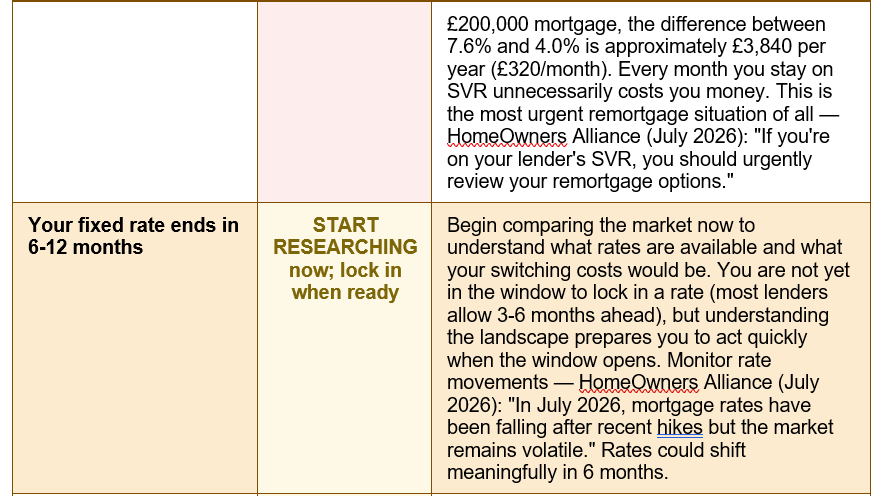
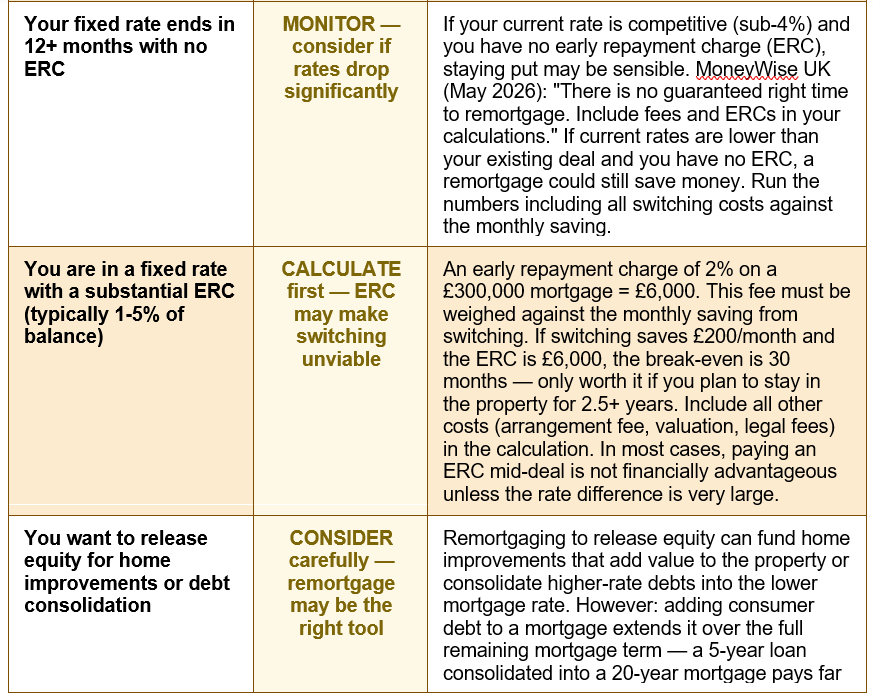
The right remortgage decision depends entirely on your specific situation — the time remaining on your current deal, whether you have an ERC, the current rate you are paying, and your personal financial circumstances. The following table maps every major scenario to the recommended action with the accountant's reasoning: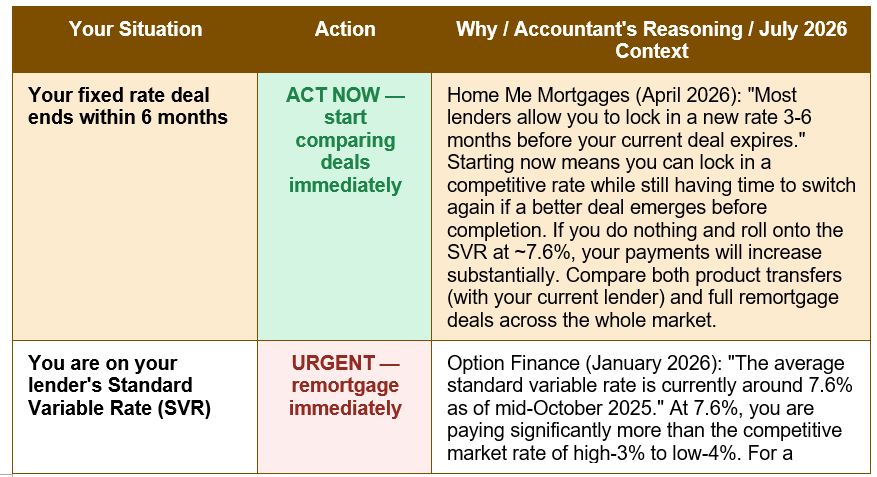

The Accountant's Worked Example: SVR vs Remortgage
The following example illustrates the financial stakes of the remortgage decision in concrete numbers, using typical July 2026 rates: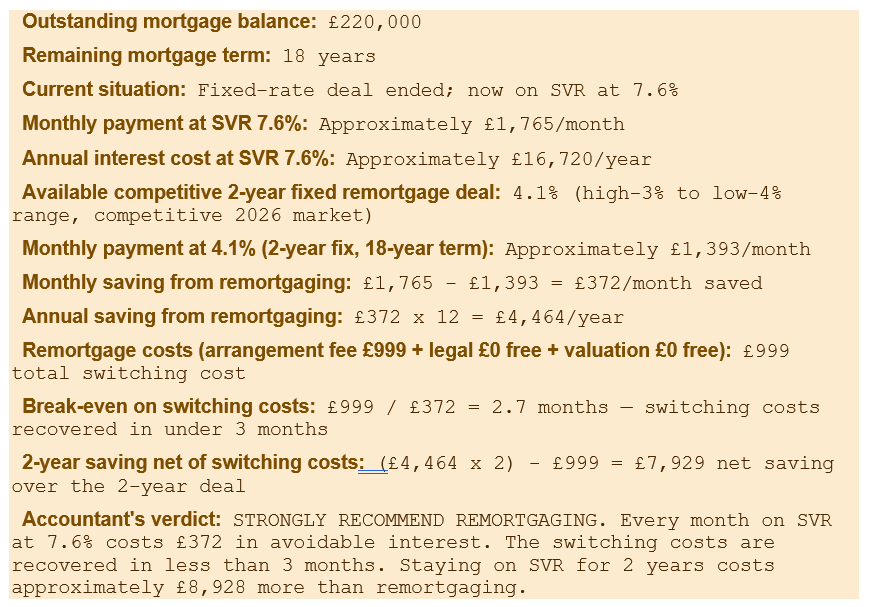
The True Cost of Remortgaging: Every Fee Explained
Every remortgage involves costs — and the gap between the headline rate and the true cost after fees and charges can significantly affect the financial case for switching. The following table maps every cost you may encounter, with guidance on how each is managed and what it means for your decision: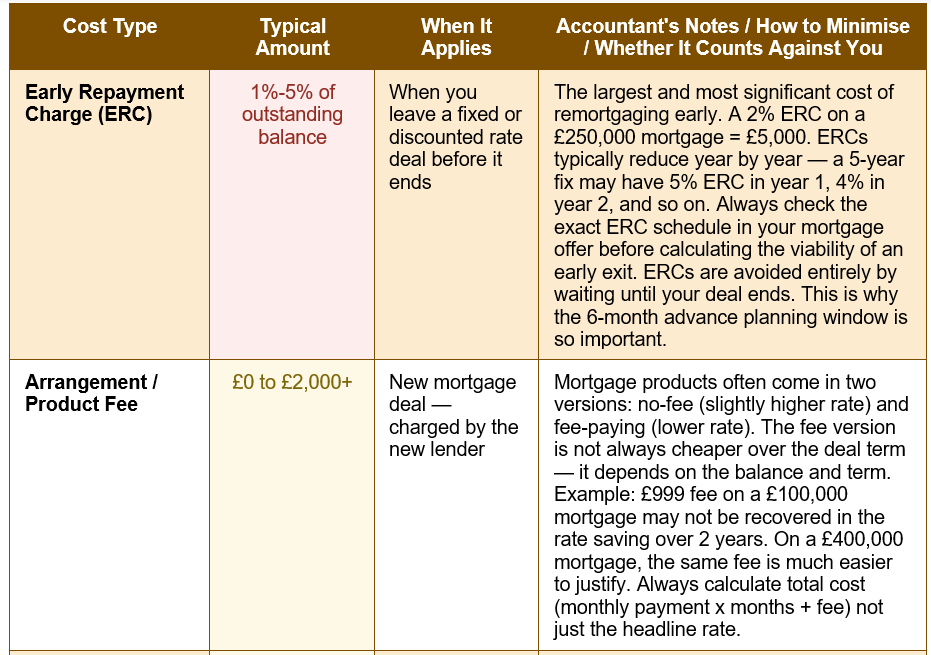
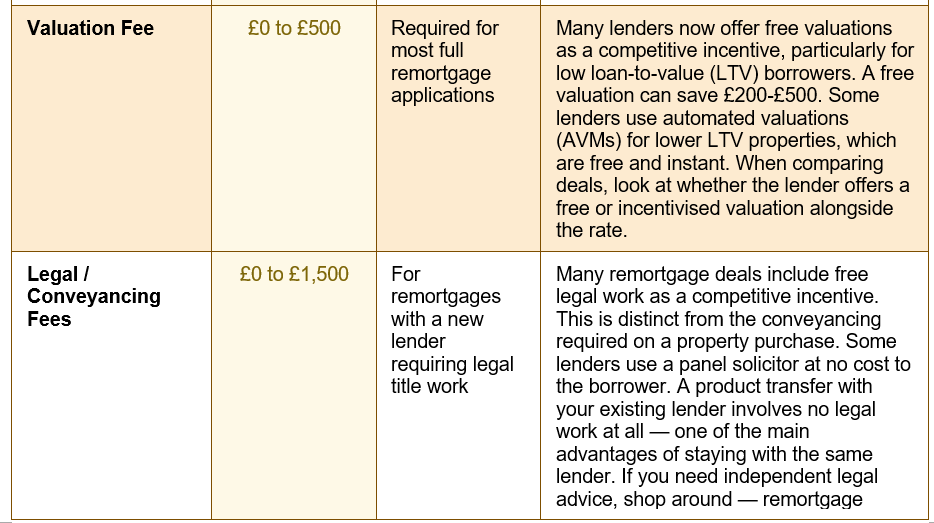
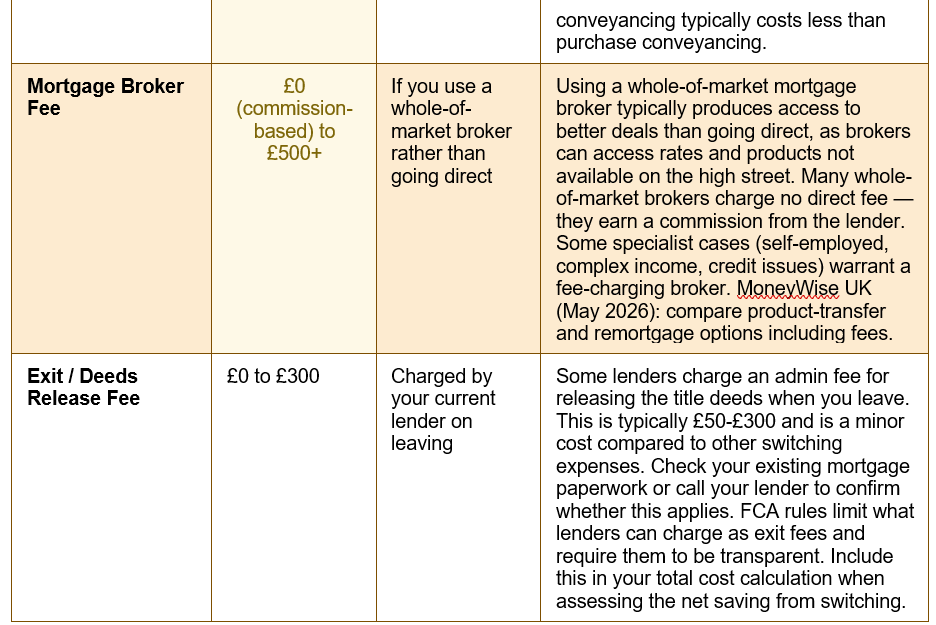
The accountant's total cost calculation approach: Never compare remortgage deals by monthly payment or headline rate alone. The correct comparison is: (Total monthly payment over deal term) PLUS (all fees paid upfront or added to the loan) MINUS (any cashback received). This gives you the true total cost of each option. Example: Deal A offers 3.85% with a £1,499 arrangement fee. Deal B offers 4.05% with no fee. On a £200,000 mortgage over 2 years, Deal A monthly payment is approximately £1,053; Deal B is approximately £1,074. Deal A appears cheaper by £21/month = £504 over 2 years. But the £1,499 fee means Deal A costs £1,499 - £504 = £995 more in total. Deal B is actually cheaper despite its higher headline rate. This counterintuitive result is common and is why the whole-of-market comparison must always include fees in the calculation, not just the rate.
2-Year Fix vs 5-Year Fix vs Tracker: The 2026 Choice
In 2026, borrowers remortgaging face a genuine choice between different product types — and the best option depends on personal circumstances, risk tolerance, and views on the trajectory of Bank of England base rate decisions:- 2-year fixed rate: Offers certainty for 24 months and flexibility to remortgage sooner if rates fall further. In a market where rate direction is uncertain, the 2-year fix provides a hedge: if rates fall, you can remortgage again in 2028 at potentially lower levels. The trade-off: 2-year fixes typically carry slightly higher rates than 5-year fixes in the current environment (reflecting the market's expectation of rate movements), and you will incur remortgage costs again in 2 years. Best for: borrowers who expect rates to fall further and are comfortable with the renewal process in 2028.
- 5-year fixed rate: Provides longer-term certainty — knowing exactly what the payment will be for five years is valuable for budgeting and financial planning. In a volatile rate environment like 2026, a 5-year fix can provide genuine peace of mind. The trade-off: if rates fall significantly in the next 2-3 years, you are locked in at a higher rate and face ERCs to exit early. Home Me Mortgages (April 2026): 'If rates drop further: You can often switch to an even better deal before completion if a lower rate becomes available.' Best for: borrowers prioritising payment certainty over rate optimisation.
- Tracker mortgage: A tracker mortgage moves in direct proportion to the Bank of England base rate — typically at base rate plus a margin. If the BoE cuts rates, your payment falls automatically. If the BoE raises rates, your payment rises. Money To The Masses (1 month ago): 'If you believe rates are going to fall further, it might make sense to consider remortgaging onto a new tracker mortgage if your existing deal is due to revert to your lender's higher SVR.' Trackers typically have lower or no ERCs, making it easier to switch to a fixed rate later if the rate environment changes. Best for: borrowers who believe rates will fall and who can absorb potential short-term payment increases if the base rate rises.
Self-Employed, Complex Income, and the Remortgage: 2026 Guidance
The remortgage process is more complex for borrowers who are self-employed, directors of limited companies, contractors, or who have multiple income streams. In 2026, lender affordability assessments have become more rigorous, and navigating them without specialist knowledge can result in either declined applications or access only to less competitive deals.Home Me Mortgages (April 2026) identifies specific considerations: 'Last 2 years' SA302s: or company accounts if you're a limited company director. Contractors have additional options. Some lenders will assess your income based on your day rate multiplied by 48 weeks, rather than requiring tax returns. This often produces a significantly higher income figure.' If your income has grown in recent years, the difference between a lender using SA302 net profit and one using the day rate methodology could be the difference between qualifying for the mortgage you need and not qualifying at all.
Option Finance (January 2026) highlights the broader affordability challenge: 'Lenders apply affordability stress tests that assume higher interest rates than the actual product rate. This means your mortgage must remain affordable even if rates rise significantly in the future. As a result, many borrowers are surprised to find that their maximum borrowing is lower than expected, particularly if they have existing loans, childcare costs or high discretionary spending.' For complex-income borrowers, using a specialist whole-of-market broker who understands which lenders are most favourable for specific income structures is essential — and typically costs nothing as brokers earn commission from the lender.
THE ACCOUNTANT'S REMORTGAGE CHECKLIST — BEFORE YOU APPLY: (1) CHECK YOUR ERC SCHEDULE — call your lender or check your mortgage offer document. Know exactly when your fixed rate ends and what ERC applies in each remaining month. This determines your optimal switch date. (2) GET YOUR CREDIT REPORT — check Equifax, Experian, and TransUnion before applying. Dispute any errors. Ensure all credit commitments are listed correctly. Most lenders have minimum credit score thresholds. (3) CALCULATE YOUR CURRENT LTV — your loan-to-value ratio (outstanding balance / current property value) determines which rate tiers you access. Sub-60% LTV typically gets the best rates; 60-75% and 75-85% LTV access progressively less competitive tiers. If your property has risen in value, your LTV may have improved significantly since you last remortgaged. (4) GATHER YOUR INCOME DOCUMENTS — last 2 years SA302s (self-employed) or 3 months payslips (employed). Having these ready accelerates the application. (5) CALCULATE THE TOTAL COST — monthly saving x deal months, minus all fees (ERC + arrangement + legal + valuation). This total cost comparison, not the headline rate, is the correct basis for your decision. (6) COMPARE PRODUCT TRANSFER vs WHOLE MARKET — always get your current lender's product transfer offer in writing before approaching the wider market. Use a whole-of-market broker to compare. Take the better overall deal.
When Remortgaging Is NOT the Right Decision
The accountant's assessment of remortgaging is not always 'yes'. There are specific circumstances where the financial case for remortgaging is weak or negative:- Your ERC exceeds the saving from switching: If the early repayment charge on your current mortgage exceeds the saving you would make from the lower rate over the remaining fixed period, remortgaging costs you money. Always calculate: (monthly saving) x (months remaining on your fix) minus (ERC + all other switching costs). If this is negative, wait until your fix ends or the ERC falls sufficiently.
- You plan to sell the property soon: If you are planning to sell the property within the next 12-24 months, taking a new 2-year or 5-year fixed rate may not make sense — particularly if the new deal carries an ERC that would apply on early redemption when you sell. In this scenario, a product transfer (often with no ERC or a very short tie-in) or a tracker with no ERC may be more appropriate than a standard fixed-rate remortgage.
- Your credit has deteriorated significantly: If your credit score has fallen sharply since your last mortgage — due to missed payments, high credit utilisation, a default, or a CCJ — you may not qualify for the competitive rates available to borrowers with strong credit histories. Remortgaging at this point might lock you into a higher rate than necessary. Take 6-12 months to rebuild your credit score before applying.
- Your income has fallen and affordability is in question: Lenders re-assess affordability at every full remortgage application. If your income has fallen significantly since your original mortgage — due to reduced hours, career changes, or business downturn — you may find that some lenders cannot offer as much as your current outstanding balance, effectively preventing a full remortgage. A product transfer with your current lender (which typically does not require a full affordability reassessment) may be the only viable option in this scenario.
THE RATE PREDICTION TRAP — THE MOST COSTLY MISTAKE IN REMORTGAGING: The single most expensive mistake homeowners make is waiting for rates to fall to an imagined perfect level before remortgaging — and rolling onto SVR in the meantime. Mortgage One (June 2026): 'Trying to second-guess the bottom of the rate cycle is difficult even for the market, and the cost of guessing wrong is real.' MoneyWise UK (May 2026): 'Do not delay a needed remortgage purely because a forecast says rates may fall.' The practical reality: every month spent on SVR at 7.6% while waiting for rates to reach 3.5% instead of 4.0% costs the average homeowner hundreds of pounds more in interest than would have been saved by locking in the 4.0% rate immediately. The SVR penalty is immediate and certain. The rate forecast is speculative and unreliable. Home Me Mortgages (April 2026): 'If rates drop further, you can often switch to an even better deal before completion if a lower rate becomes available.' Lock in a competitive rate now, and monitor — if a materially better rate appears before completion, many brokers can switch the application to the new deal.
Conclusion
Remortgaging in 2026 is not a question of whether the timing is perfect — the mortgage rate environment remains volatile and unpredictable, shaped by UK inflation data, Bank of England decisions, and geopolitical events including the 2026 Middle East conflict. It is a question of whether staying where you are is costing you money unnecessarily. The answer for the majority of homeowners whose fixed rate is expiring or who are already on SVR is unambiguous: yes, it is costing you money — often £300-£750 per month more than a competitive remortgage deal would cost.The accountant's framework reduces the remortgage decision to a single calculation: the total cost of staying (monthly SVR payment x remaining months before you would remortgage anyway) versus the total cost of switching now (monthly remortgage payment x deal months, plus all fees). In the vast majority of cases where a homeowner is on SVR or approaching deal expiry, the numbers decisively favour action. Option Finance (January 2026) stated it precisely: 'Remortgaging is no longer optional housekeeping — it is essential financial management.'
The practical steps are straightforward: check your ERC schedule and current deal terms; get your credit report and income documents ready; calculate your current LTV; compare your existing lender's product transfer offer against the whole market through a fee-free whole-of-market broker; run the total cost comparison including all fees; and act at least 3-6 months before your deal expires to maximise your options. In a market where mortgage rates have been falling in July 2026 but remain volatile, locking in a competitive deal while retaining the flexibility to switch before completion if rates fall further is the optimal strategy. Do not wait for perfect — act for good.
0 Comments
Be the first to share your thoughts on this article.