

Financial Literacy
Make Your December Paycheck Stretch Through January

Here’s the January problem in two sentences. December’s paycheck often comes early because of the holiday, which sounds like good news — until you realise it has to stretch five or six weeks instead of four to cover rent, bills, and groceries in January. Throw in an average of $1,181 in holiday debt carried by the 36% of Americans who borrowed to pay for Christmas (LendingTree 2024), and January becomes the most financially precarious month of the year for tens of millions of people. This article isn’t about shame or blame. Holiday spending is emotional, cultural, and sometimes almost mandatory when you have kids looking at you on Christmas morning. It’s about what you can do, right now, to make the money you have last longer and to dig out from under what the holidays left behind.
The mechanics of why January hurts more than other months are straightforward. First, December paychecks at many companies are paid early — sometimes a full week before Christmas — to accommodate the holiday. That means the money you received in mid-December has to stretch not four but five or six weeks to cover January rent or mortgage, utility bills (now elevated by winter heating), post-holiday credit card minimums, and everyday groceries and transport. Second, the holiday spending itself has already happened. The presents are opened. The food is eaten. The flights have landed. The bill is not yet fully due, but it’s coming.
Intuit Credit Karma’s analysis found that January 4 was the most popular date for people to apply for new credit products in the prior year. The machine is already running on January 4. January 15 is when more than half of those who expect to run out of money will have already done so, according to the same survey. This article is about not becoming part of those statistics. Not financial advice.
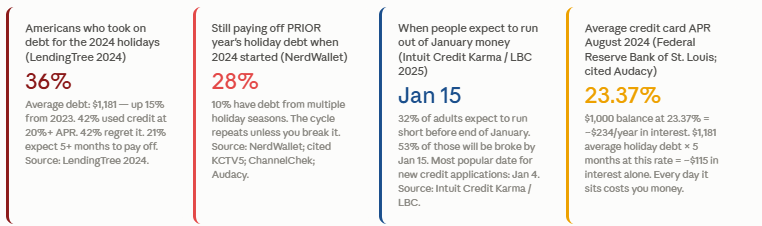
Holiday debt 2024 (LendingTree): 36% of Americans took on debt. Average debt: $1,181 (up 15% from $1,028 in 2023). 42% used credit at 20%+ APR. 21% expect it will take 5+ months to pay off. 42% regret spending as much as they did. 28% of credit card users were still paying off 2023 holiday debt when 2024 arrived (NerdWallet). Average credit card APR: 23.37% (Federal Reserve Bank of St. Louis, August 2024). Carrying $1,000 at 23.37% = ~$234/year in interest alone. Sources: LendingTree 2024; NerdWallet; Audacy; ChannelChek. Not financial advice.
Leslie Tayne, a debt relief attorney who advises on post-holiday recovery, is direct: ‘Open up all of your credit card and financial statements, look online, and check your dashboards. See where your money has gone and make a plan.’ (KCTV5 / KBTX, January 2025.) The plan cannot exist without the number. Many people avoid looking at the total because they are afraid of it — which is exactly why the debt tends to grow for months before anyone addresses it. The number you are afraid of is smaller than the number it will become if you leave it on a 23% APR card.
Once you have the total, calculate your minimum payments and your ideal payoff timeline. If you owe $1,181 at 23.37% APR and make only minimum payments (approximately 1% of balance + interest), the true cost over time is significantly more than $1,181. LendingTree’s data shows 21% of holiday debtors expect to take five months or longer to pay it off. Five months at 23.37% on $1,181 adds approximately $115 in interest on top of the principal. Not financial advice.
Leslie Tayne, debt relief attorney (KCTV5 / KBTX, January 2025): 'Budget early, know what you can and cannot spend and tighten up where you can, so you can pay more towards credit card debt that you might have racked up in 2024.' And: 'Open up all of your credit card and financial statements, look online, and check your dashboards. See where your money has gone and make a plan.' These two sentences contain most of what matters in January finance.
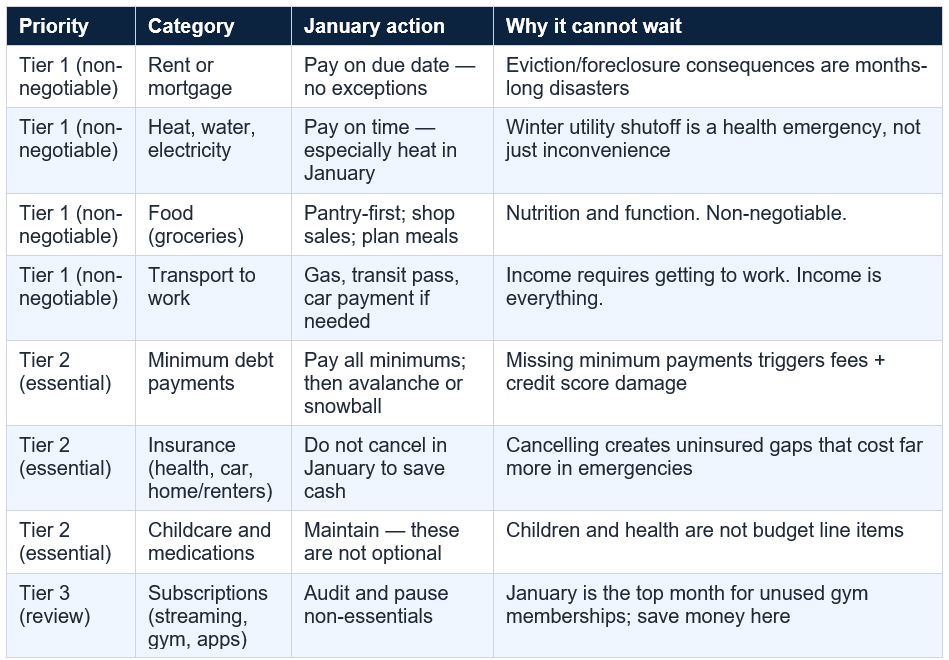
The hierarchy looks like this, in order of non-negotiable priority: housing (rent or mortgage), utilities (heat, water, electricity — especially critical in January), food (groceries only at this stage, not takeout), transportation to work, minimum debt payments on all accounts, any insurance premiums, and childcare or medications. Everything else — subscriptions, dining out, shopping, entertainment — is on hold until you’ve confirmed the essentials are covered.
The practical exercise: write down your take-home income and subtract the tier-one essentials. What’s left is what you actually have to work with for discretionary spending. For many people in January, the answer is very little — or a negative number. If you’re in deficit before discretionary spending even starts, the rest of this article is about closing that gap. Not financial advice.
This article is for general information and education purpose only and Not financial advice. Adjust tiers based on your specific situation.
The mental reframe that makes this work is to treat it as a challenge rather than a deprivation. Many people who do a spending dry January discover two things they didn’t expect: first, that they already have more than they need (the gifts, the food in the freezer, the unwatched shows on the streaming services they already pay for); and second, that the money saved in one month of genuine austerity is a meaningful amount — often $200–$400 for a typical household.
The True Energy Federal Credit Union’s 2025 winter newsletter puts it well: ‘Cutting out everything that brings you joy can lead to burnout. Instead, aim to reduce unnecessary expenses.’ So this is not about eliminating all pleasure from January. It’s about categorically removing purchases that are genuinely optional. If you normally make five morning coffee shop stops a week, try cutting that to one. If you order takeout three times a week, cut it to once. Not financial advice.
The spending dry January challenge: pick a number of 'no spend days' for January — aim for 20 out of 31. On those days, no spending except Tier 1 essentials. Track it on your phone notes or a paper calendar. Mark each no-spend day with a ✓. The money you didn't spend on each of those days is the money that stays in your account instead of January 15 running it dry. No-spend days often save $20-$50 per day for a typical household. Not financial advice.
The debt avalanche method — paying the minimum on all balances and putting every spare dollar toward the highest-interest balance first — minimises the total interest you pay. The debt snowball method — paying the minimum on everything and attacking the smallest balance first — produces earlier psychological wins that help people stay motivated. Both are valid. Neither is wrong. The critical thing is that you choose one and start this pay period, not next month.
If you have multiple holiday debts on different cards, check whether a 0% balance transfer offer is available to you. Moving your highest-interest holiday debt to a 0% APR card for 12–21 months eliminates the interest cost during that window entirely, allowing every payment to reduce the principal. Akansha Nath of Intuit Credit Karma recommends specifically: ‘take advantage of interest-free balance transfer offers’ in January. The transfer fee (typically 3–5% of the balance) is almost always less than the interest you’d pay on a 23% APR card over the same period. Not financial advice.
The minimum payment trap: if you owe $1,181 at 23.37% APR and make only minimum payments (approximately 2% of balance per month), you will spend over a year paying it off and pay significantly more than $1,181 in total. LendingTree found 21% of holiday debtors expect 5+ months to pay off. The interest adds up fast. Two actions that interrupt this: (1) Pay more than the minimum — even $50 extra per month makes a significant difference. (2) Explore a 0% balance transfer to stop the interest clock. Source: LendingTree 2024; Federal Reserve Bank of St. Louis (23.37% average APR August 2024; cited Audacy). Not financial advice.
The call takes about ten minutes. You call the number on the back of your card, explain that you have experienced higher-than-normal spending in December and are looking to manage your balance responsibly in January, and ask: ‘Do you have any hardship programs, temporary interest rate reductions, or payment deferral options?’ Many major card issuers will offer at least a one-month payment skip, a reduced minimum payment for 90 days, or a temporary rate reduction for customers who ask during a genuine hardship period.
The same logic applies to utility companies (which almost all have budget billing plans, low-income assistance programs, and payment plans), internet and phone providers (where January is one of the most competitive months for new customer offers — meaning you can threaten to switch and often get a retention offer), and landlords (who, in most cases, prefer a tenant who calls ahead of a difficult month over one who silently misses a payment). Not financial advice.
The creditor call script: 'Hi, I’m calling because I’ve had higher-than-usual expenses in December and want to make sure I manage my account responsibly in January. Do you have any hardship programs, temporary interest rate reductions, or minimum payment flexibility options available?' Ask specifically. Many will say yes. Make note of the representative's name, the date, and what they offered. A 2-3% rate reduction on $1,181 saves $23-35 in a single month. Not financial advice.
Beyond unwanted gifts, the post-Christmas period is a natural time to audit the things already in your home. A piece of furniture you no longer need, clothes that haven’t been worn in a year, books, DVDs, kitchen appliances stored in the back of a cupboard. The combination of post-holiday guilt about consumption and the practical need for January cash makes this the most motivated moment of the year to clear out.
A realistic expectation: a focused two-weekend selling effort in January can generate $100–$400 for most households. It’s not a salary. It’s a targeted cash injection at exactly the moment the calendar is most financially hostile. And the byproduct — a cleaner, clearer living space — provides the kind of psychological reset that money cannot buy directly. Not financial advice.
The rule for January sales: buy only what you were going to need to buy before Christmas, and only at a discount you can quantify. If your winter coat is genuinely worn out and needs replacing, January sales are the right time to buy one at 40% off. If you have a specific household appliance that has failed, January clearance events are excellent for this. But ‘buying ahead for next Christmas’ in January — stocking up on wrapping paper, decorations, and gift boxes — is genuinely smart if you have even a modest amount of January cash to spare.
The legitimate January sale strategy: buy consumables you will definitely use at a discounted price — cleaning products, personal care items, non-perishable food. Avoid anything that requires storage space you don't have or that addresses a problem you don't currently have. The test: 'Would I have bought this in February if it wasn't on sale?' If no, put it back. Not financial advice.
Go through your bank and credit card statements from November and December and identify every recurring charge. For each one, ask: have I used this at all in the past 30 days? If the answer is no, cancel it now. Most subscription services allow free cancellation at any time, and many offer a ‘pause’ option instead of full cancellation if you want to resume later. The saving is often $50–$150 per month in aggregate for a household with typical subscription creep.
The gym membership deserves its own sentence: if you are starting a new gym membership in January to honour a resolution, pay month-to-month in January rather than committing to an annual contract until you have confirmed the habit is real. Most gyms will offer month-to-month in January knowing many resolutions fade by February. The month-to-month rate is higher per month, but the total cost is lower if the commitment doesn’t stick. Not financial advice.
January subscription audit (takes 20 minutes): (1) Pull last 60 days of bank and credit card statements. (2) Highlight every recurring charge. (3) For each: is it Tier 1 or Tier 2 essential? No → cancel or pause. (4) Check for free alternatives: most streaming services can be replaced temporarily by a library card (free films, TV, e-books, audiobooks). (5) Log back in to services you paused when your January finances recover. Typical household saves $50-$150/month from a thorough audit. Not financial advice.
The practical approach: before you do any January grocery shopping, take a full inventory of your fridge, freezer, and pantry. Make a list of everything that needs to be used up. Plan your meals for the week around what you already have, supplementing with only fresh staples (milk, eggs, bread, fresh vegetables) rather than full weekly shops. This can reduce grocery spending by 40–60% in the weeks when you have a well-stocked post-holiday kitchen.
The Synchrony Bank post-holiday recovery guide captures the broader principle: ‘By assessing where you stand, creating a plan, and sticking to your goals, you can turn post-holiday stress into a financial success story.’ The pantry challenge is the practical food equivalent of that principle. Not financial advice.
One often-overlooked income source for January: checking whether any cash-back, reward points, or gift cards accumulated over the holiday period can be converted to cash or used to cover purchases you would otherwise make with cash. Amazon, PayPal, and many bank reward programs allow gift card or points redemption for statement credits or direct deposits. These are not large sums but they can bridge a specific gap.
Tax refunds are also primarily a January–March phenomenon for most Americans. If you expect a federal tax refund and have your W-2s early, filing your tax return in January rather than waiting can put hundreds or thousands of dollars back in your account sooner. The average federal tax refund is approximately $3,100 (IRS, recent years). Not financial advice.
Leslie Tayne, the debt relief attorney, is emphatic on this point: ‘Planning ahead for next Christmas is also essential. By setting aside money now, you can create a dedicated fund for holiday expenses, making December 2025 less financially stressful.’ (KCTV5, January 2025.) The psychological trick: label the savings account. Name it ‘Christmas 2026’ or ‘December Fund.’ Purpose-labelled savings accounts are more likely to be protected from raids for other purposes, because spending a labelled account feels more specific than just drawing down a generic savings buffer.
Automate the contribution so it leaves your account on payday before you see it. Even $50 per month automated from January gives you $550 before next December. That’s $550 that doesn’t go on a 23.37% APR credit card. Not financial advice.
The December Fund formula: decide how much you plan to spend on the holidays. Divide by 10 (February through November = 10 months). Set up an automatic monthly transfer for that amount to a dedicated savings account. Naming the account 'Christmas [year]' in your banking app makes it less likely you'll raid it. A high-yield savings account earning 4-5% APY makes the fund grow slightly while it sits. The best time to start: the first week of January. Not financial advice.
But January is also the most powerful month of the year to reset. The habits you establish in January — the spending hierarchy, the debt attack plan, the subscription audit, the pantry challenge, the first automated transfer into the December fund — last. The month that feels like the worst financial moment is also the one that contains the most opportunity, because the contrast between December’s spending and January’s necessity makes almost every money-saving action feel both justified and achievable.
The ten strategies in this article are not magic. They are practical, actionable, and cumulative — each one moves the needle a little, and together they can turn a month that most people just endure into one they actually manage. Start with the audit. Know your number. Build your hierarchy. Do the dry January. The rest follows. Not financial advice. If you need help with significant debt, contact the National Foundation for Credit Counseling (NFCC) for free or low-cost nonprofit credit counselling.
Many employers pay December salaries early — sometimes a week or more before Christmas — because of the holiday bank closures and payroll processing schedules. This means what felt like your 'December paycheck' might have arrived on December 19 or 20, but your next paycheck won't arrive until the normal January payday (often January 25-31 for monthly payers, or mid-January for bi-weekly payers). That's a gap of 5-6 weeks instead of the usual 4. During that window, you still face January's full set of bills: rent or mortgage, utilities (elevated in winter), post-holiday credit card minimum payments, groceries, and transport. The Intuit Credit Karma research (cited LBC 2025) found that January 15 is when more than half of those who expect to run out of money will have done so. Planning for this specific extended gap — rather than budgeting as if it were a normal 4-week month — is the key mindset shift. Not financial advice.
How much holiday debt is the average American carrying in January?
According to LendingTree's 2024 holiday survey, 36% of Americans took on debt to cover holiday purchases. Among those who went into debt, the average amount was $1,181 (up 15% from $1,028 in 2023). Of those with holiday debt, 42% used credit with an interest rate of 20% or higher, 42% said they regret spending as much as they did, and 21% expect it will take five months or longer to pay off. Additionally, a NerdWallet report found that 28% of credit card users were still paying off debt from the PREVIOUS holiday season when 2024 arrived. Average credit card APR was 23.37% as of August 2024 (Federal Reserve Bank of St. Louis). Sources: LendingTree 2024; NerdWallet; Federal Reserve Bank of St. Louis; cited Audacy; ChannelChek; News5Cleveland. Not financial advice.
What is a 0% balance transfer card and should I use one for holiday debt?
A 0% balance transfer credit card offers an introductory period — typically 12-21 months — during which no interest accrues on balances you transfer from other cards. If you have holiday debt at 20%+ APR, transferring it to a 0% card stops the interest clock for the duration of the introductory period, meaning every payment you make during that time goes entirely toward reducing the principal rather than partly to interest. There is typically a balance transfer fee of 3-5% of the amount transferred, which is almost always less than the interest you would pay on a 23%+ card over the same period. Akansha Nath of Intuit Credit Karma specifically recommended 'interest-free balance transfer offers' for people entering January with stretched budgets. The key conditions: you must stop adding new charges to the new card, and you must aim to pay off the balance before the 0% period ends (after which the rate resets to standard, often 20%+). Not financial advice. Check your credit eligibility before applying.
Is January actually a good month for deals, or is that a myth?
January sales are genuinely real and among the deepest discount periods of the retail year, particularly for: winter clothing and coats (stores clearing inventory for spring), electronics and appliances (post-Black Friday clearance), furniture (January is the biggest furniture sale month in the US and UK), gym memberships (heavy competition for resolution sign-ups pushes pricing down), and holiday decorations, wrapping paper, and gift supplies at 50-75% off (excellent value if buying for next year). The caution: January sales are only a 'deal' if you would have bought the item regardless of the discount. Buying something you don't need at 40% off is still spending 60% of the full price on something unnecessary. The financial rule: January sales are a good time to buy things on your genuine need list. They are a bad time for browsing while cash-tight. Sources: True Energy FCU 2025 winter newsletter; Intuit Credit Karma January tips (LBC). Not financial advice.
How do I make sure I don’t end up in the same position next December?
Start a dedicated December fund in January. The formula: decide your realistic total holiday budget (gifts, food, travel, decorations). Divide by 10 (the months February through November). Set up an automatic monthly transfer for that amount to a purpose-labelled savings account ('Christmas 2026' or 'December Fund'). A high-yield savings account earning 4-5% APY lets the fund grow slightly while it sits. Leslie Tayne, debt relief attorney, advises: 'By setting aside money now, you can create a dedicated fund for holiday expenses, making December 2025 less financially stressful.' (KCTV5, January 2025.) LendingTree's historical data shows holiday debt is a recurring pattern: 28% of people enter a new holiday season still paying off the previous one (NerdWallet). The only thing that breaks the cycle is starting the fund in January. Even $50/month produces $550 before December. $100/month produces $1,000. $150/month produces $1,500 — enough to cover average holiday spending without any credit card debt. Not financial advice.
Table of Contents
- The January Problem Nobody Talks About Honestly
- Step One: Know Exactly Where You Stand
- Way #1: Build Your January Spending Hierarchy Right Now
- Way #2: Do a Dry January on Your Spending
- Way #3: Attack the Holiday Debt Before Interest Does
- Way #4: Call Your Creditors — More Will Say Yes Than You Think
- Way #5: Sell What December Left Behind
- Way #6: Make January Sales Work For You, Not Against You
- Way #7: Use Your Subscriptions and Memberships Against Themselves
- Way #8: Eat What You Have (The Freezer and Pantry Challenge)
- Way #9: The January Income Boost — What’s Actually Realistic
- Way #10: Start Next December’s Fund in January
- The January Budget Plan: A Simple Week-by-Week Framework
- Conclusion: January Is Not a Crisis — It’s a Reset
- Frequently Asked Questions
The January Problem Nobody Talks About Honestly
Most personal finance articles about January talk about New Year’s resolutions and fresh starts. That’s fine for people who came through December financially intact. But for the 36% of Americans who borrowed to cover the holidays — averaging $1,181 each according to LendingTree’s 2024 survey — and for the 32% of adults who expect to run short of cash before January is over, the new year doesn’t feel like a fresh start. It feels like a financial hangover.The mechanics of why January hurts more than other months are straightforward. First, December paychecks at many companies are paid early — sometimes a full week before Christmas — to accommodate the holiday. That means the money you received in mid-December has to stretch not four but five or six weeks to cover January rent or mortgage, utility bills (now elevated by winter heating), post-holiday credit card minimums, and everyday groceries and transport. Second, the holiday spending itself has already happened. The presents are opened. The food is eaten. The flights have landed. The bill is not yet fully due, but it’s coming.
Intuit Credit Karma’s analysis found that January 4 was the most popular date for people to apply for new credit products in the prior year. The machine is already running on January 4. January 15 is when more than half of those who expect to run out of money will have already done so, according to the same survey. This article is about not becoming part of those statistics. Not financial advice.
Holiday debt 2024 (LendingTree): 36% of Americans took on debt. Average debt: $1,181 (up 15% from $1,028 in 2023). 42% used credit at 20%+ APR. 21% expect it will take 5+ months to pay off. 42% regret spending as much as they did. 28% of credit card users were still paying off 2023 holiday debt when 2024 arrived (NerdWallet). Average credit card APR: 23.37% (Federal Reserve Bank of St. Louis, August 2024). Carrying $1,000 at 23.37% = ~$234/year in interest alone. Sources: LendingTree 2024; NerdWallet; Audacy; ChannelChek. Not financial advice.
Step One: Know Exactly Where You Stand
Before you implement any strategy, you need one number: the total of what you owe right now that wasn’t there on November 1. That’s your holiday debt baseline. Open every credit card statement, every bank account, every buy-now-pay-later account, and add it up. Include the balance on your regular credit cards if it’s higher than it was before the holiday season. This is not a comfortable exercise, but it is a necessary one.Leslie Tayne, a debt relief attorney who advises on post-holiday recovery, is direct: ‘Open up all of your credit card and financial statements, look online, and check your dashboards. See where your money has gone and make a plan.’ (KCTV5 / KBTX, January 2025.) The plan cannot exist without the number. Many people avoid looking at the total because they are afraid of it — which is exactly why the debt tends to grow for months before anyone addresses it. The number you are afraid of is smaller than the number it will become if you leave it on a 23% APR card.
Once you have the total, calculate your minimum payments and your ideal payoff timeline. If you owe $1,181 at 23.37% APR and make only minimum payments (approximately 1% of balance + interest), the true cost over time is significantly more than $1,181. LendingTree’s data shows 21% of holiday debtors expect to take five months or longer to pay it off. Five months at 23.37% on $1,181 adds approximately $115 in interest on top of the principal. Not financial advice.
Leslie Tayne, debt relief attorney (KCTV5 / KBTX, January 2025): 'Budget early, know what you can and cannot spend and tighten up where you can, so you can pay more towards credit card debt that you might have racked up in 2024.' And: 'Open up all of your credit card and financial statements, look online, and check your dashboards. See where your money has gone and make a plan.' These two sentences contain most of what matters in January finance.
Way #1: Build Your January Spending Hierarchy Right Now
January calls for triage. You cannot pay everything with the same urgency, and treating a Netflix subscription with the same priority as rent is how cash runs out by January 10. A spending hierarchy organises your money in strict priority order so that the essential payments are always made first, and any discretionary spending only happens with what’s left over — not the other way around.The hierarchy looks like this, in order of non-negotiable priority: housing (rent or mortgage), utilities (heat, water, electricity — especially critical in January), food (groceries only at this stage, not takeout), transportation to work, minimum debt payments on all accounts, any insurance premiums, and childcare or medications. Everything else — subscriptions, dining out, shopping, entertainment — is on hold until you’ve confirmed the essentials are covered.
The practical exercise: write down your take-home income and subtract the tier-one essentials. What’s left is what you actually have to work with for discretionary spending. For many people in January, the answer is very little — or a negative number. If you’re in deficit before discretionary spending even starts, the rest of this article is about closing that gap. Not financial advice.
This article is for general information and education purpose only and Not financial advice. Adjust tiers based on your specific situation.
Way #2: Do a Dry January on Your Spending
You’ve heard of Dry January for alcohol. The same concept applied to non-essential spending is one of the most powerful financial recovery tools available, and it costs nothing to start. The principle: for the entire month of January, you spend money on nothing that isn’t in Tier 1 or Tier 2 of your spending hierarchy. No new clothes. No restaurant meals. No impulse buys. No online shopping for things that weren’t on a list before December 26. Nothing.The mental reframe that makes this work is to treat it as a challenge rather than a deprivation. Many people who do a spending dry January discover two things they didn’t expect: first, that they already have more than they need (the gifts, the food in the freezer, the unwatched shows on the streaming services they already pay for); and second, that the money saved in one month of genuine austerity is a meaningful amount — often $200–$400 for a typical household.
The True Energy Federal Credit Union’s 2025 winter newsletter puts it well: ‘Cutting out everything that brings you joy can lead to burnout. Instead, aim to reduce unnecessary expenses.’ So this is not about eliminating all pleasure from January. It’s about categorically removing purchases that are genuinely optional. If you normally make five morning coffee shop stops a week, try cutting that to one. If you order takeout three times a week, cut it to once. Not financial advice.
The spending dry January challenge: pick a number of 'no spend days' for January — aim for 20 out of 31. On those days, no spending except Tier 1 essentials. Track it on your phone notes or a paper calendar. Mark each no-spend day with a ✓. The money you didn't spend on each of those days is the money that stays in your account instead of January 15 running it dry. No-spend days often save $20-$50 per day for a typical household. Not financial advice.
Way #3: Attack the Holiday Debt Before Interest Does
If you are carrying holiday debt at 20%+ APR, every day you don’t pay it costs you money. The Federal Reserve Bank of St. Louis reported the average credit card interest rate at 23.37% in August 2024. At that rate, a $1,181 balance accrues approximately $23 in interest per month. It is not an emergency-scale cost per month, but it compounds, and the longer it sits, the more of your future paychecks it consumes.The debt avalanche method — paying the minimum on all balances and putting every spare dollar toward the highest-interest balance first — minimises the total interest you pay. The debt snowball method — paying the minimum on everything and attacking the smallest balance first — produces earlier psychological wins that help people stay motivated. Both are valid. Neither is wrong. The critical thing is that you choose one and start this pay period, not next month.
If you have multiple holiday debts on different cards, check whether a 0% balance transfer offer is available to you. Moving your highest-interest holiday debt to a 0% APR card for 12–21 months eliminates the interest cost during that window entirely, allowing every payment to reduce the principal. Akansha Nath of Intuit Credit Karma recommends specifically: ‘take advantage of interest-free balance transfer offers’ in January. The transfer fee (typically 3–5% of the balance) is almost always less than the interest you’d pay on a 23% APR card over the same period. Not financial advice.
The minimum payment trap: if you owe $1,181 at 23.37% APR and make only minimum payments (approximately 2% of balance per month), you will spend over a year paying it off and pay significantly more than $1,181 in total. LendingTree found 21% of holiday debtors expect 5+ months to pay off. The interest adds up fast. Two actions that interrupt this: (1) Pay more than the minimum — even $50 extra per month makes a significant difference. (2) Explore a 0% balance transfer to stop the interest clock. Source: LendingTree 2024; Federal Reserve Bank of St. Louis (23.37% average APR August 2024; cited Audacy). Not financial advice.
Way #4: Call Your Creditors — More Will Say Yes Than You Think
Most people never call their credit card company to ask for help. This is a mistake. Credit card companies have hardship programs, temporary rate reductions, deferred payment options, and waived late fee policies that are never advertised because they’re not supposed to be the first line of defence — but they exist, and they are available to customers who call and ask.The call takes about ten minutes. You call the number on the back of your card, explain that you have experienced higher-than-normal spending in December and are looking to manage your balance responsibly in January, and ask: ‘Do you have any hardship programs, temporary interest rate reductions, or payment deferral options?’ Many major card issuers will offer at least a one-month payment skip, a reduced minimum payment for 90 days, or a temporary rate reduction for customers who ask during a genuine hardship period.
The same logic applies to utility companies (which almost all have budget billing plans, low-income assistance programs, and payment plans), internet and phone providers (where January is one of the most competitive months for new customer offers — meaning you can threaten to switch and often get a retention offer), and landlords (who, in most cases, prefer a tenant who calls ahead of a difficult month over one who silently misses a payment). Not financial advice.
The creditor call script: 'Hi, I’m calling because I’ve had higher-than-usual expenses in December and want to make sure I manage my account responsibly in January. Do you have any hardship programs, temporary interest rate reductions, or minimum payment flexibility options available?' Ask specifically. Many will say yes. Make note of the representative's name, the date, and what they offered. A 2-3% rate reduction on $1,181 saves $23-35 in a single month. Not financial advice.
Way #5: Sell What December Left Behind
December usually leaves behind something valuable that you can convert to cash in January. The most obvious: unwanted gifts. If you received gifts that genuinely do not suit you — duplicates of things you already own, items in the wrong size, gadgets you’ll never use — January is the right time to sell them while they are still new, undamaged, and in original packaging. eBay, Facebook Marketplace, Poshmark (for clothing), and Decluttr (for electronics) all allow quick, free listing.Beyond unwanted gifts, the post-Christmas period is a natural time to audit the things already in your home. A piece of furniture you no longer need, clothes that haven’t been worn in a year, books, DVDs, kitchen appliances stored in the back of a cupboard. The combination of post-holiday guilt about consumption and the practical need for January cash makes this the most motivated moment of the year to clear out.
A realistic expectation: a focused two-weekend selling effort in January can generate $100–$400 for most households. It’s not a salary. It’s a targeted cash injection at exactly the moment the calendar is most financially hostile. And the byproduct — a cleaner, clearer living space — provides the kind of psychological reset that money cannot buy directly. Not financial advice.
Way #6: Make January Sales Work For You, Not Against You
January sales are real — department stores, electronics retailers, and clothing brands all clear their holiday inventory in January with deep discounts. The problem is that January sales are also one of the most dangerous money traps for someone who is already cash-tight. A 50% discount on something you don’t genuinely need is still spending money you don’t have.The rule for January sales: buy only what you were going to need to buy before Christmas, and only at a discount you can quantify. If your winter coat is genuinely worn out and needs replacing, January sales are the right time to buy one at 40% off. If you have a specific household appliance that has failed, January clearance events are excellent for this. But ‘buying ahead for next Christmas’ in January — stocking up on wrapping paper, decorations, and gift boxes — is genuinely smart if you have even a modest amount of January cash to spare.
The legitimate January sale strategy: buy consumables you will definitely use at a discounted price — cleaning products, personal care items, non-perishable food. Avoid anything that requires storage space you don't have or that addresses a problem you don't currently have. The test: 'Would I have bought this in February if it wasn't on sale?' If no, put it back. Not financial advice.
Way #7: Use Your Subscriptions and Memberships Against Themselves
January is the most popular month for gym sign-ups — and also the month when streaming services, subscription boxes, and app subscriptions that were added or gift-subscribed over the holiday season start billing. A thorough subscription audit in the first week of January typically reveals at least one or two services that can be paused or cancelled without any real sacrifice.Go through your bank and credit card statements from November and December and identify every recurring charge. For each one, ask: have I used this at all in the past 30 days? If the answer is no, cancel it now. Most subscription services allow free cancellation at any time, and many offer a ‘pause’ option instead of full cancellation if you want to resume later. The saving is often $50–$150 per month in aggregate for a household with typical subscription creep.
The gym membership deserves its own sentence: if you are starting a new gym membership in January to honour a resolution, pay month-to-month in January rather than committing to an annual contract until you have confirmed the habit is real. Most gyms will offer month-to-month in January knowing many resolutions fade by February. The month-to-month rate is higher per month, but the total cost is lower if the commitment doesn’t stick. Not financial advice.
January subscription audit (takes 20 minutes): (1) Pull last 60 days of bank and credit card statements. (2) Highlight every recurring charge. (3) For each: is it Tier 1 or Tier 2 essential? No → cancel or pause. (4) Check for free alternatives: most streaming services can be replaced temporarily by a library card (free films, TV, e-books, audiobooks). (5) Log back in to services you paused when your January finances recover. Typical household saves $50-$150/month from a thorough audit. Not financial advice.
Way #8: Eat What You Have (The Freezer and Pantry Challenge)
The Christmas period leaves most households with more food than usual: leftover holiday food in the fridge and freezer, bulk buys made before guests arrived, Christmas hamper items, and gifts of food. January is the perfect time to eat through all of it before buying new groceries. This is sometimes called the ‘pantry challenge’ and it is one of the most genuinely effective ways to reduce January spending because grocery bills are one of the most flexible costs in a household budget.The practical approach: before you do any January grocery shopping, take a full inventory of your fridge, freezer, and pantry. Make a list of everything that needs to be used up. Plan your meals for the week around what you already have, supplementing with only fresh staples (milk, eggs, bread, fresh vegetables) rather than full weekly shops. This can reduce grocery spending by 40–60% in the weeks when you have a well-stocked post-holiday kitchen.
The Synchrony Bank post-holiday recovery guide captures the broader principle: ‘By assessing where you stand, creating a plan, and sticking to your goals, you can turn post-holiday stress into a financial success story.’ The pantry challenge is the practical food equivalent of that principle. Not financial advice.
Way #9: The January Income Boost — What’s Actually Realistic
When people say ‘earn more’ in January, they usually mean either selling things (which we covered) or taking on extra work. The realistic options for a January income boost — without the fantasy of a viral side hustle — are: selling (eBay, Facebook Marketplace, as above); offering a service you already know how to do to people in your immediate network (babysitting, dog walking, cleaning, tutoring, handyman work, snow removal); picking up extra shifts at your current employer if overtime or shift-swapping is available; and looking at whether any of your skills translate into January demand (tax filing assistance is particularly in demand in January and February, for example).One often-overlooked income source for January: checking whether any cash-back, reward points, or gift cards accumulated over the holiday period can be converted to cash or used to cover purchases you would otherwise make with cash. Amazon, PayPal, and many bank reward programs allow gift card or points redemption for statement credits or direct deposits. These are not large sums but they can bridge a specific gap.
Tax refunds are also primarily a January–March phenomenon for most Americans. If you expect a federal tax refund and have your W-2s early, filing your tax return in January rather than waiting can put hundreds or thousands of dollars back in your account sooner. The average federal tax refund is approximately $3,100 (IRS, recent years). Not financial advice.
Way #10: Start Next December’s Fund in January
The most lasting thing you can do in January is decide, right now, that next December will be different. And the only thing that makes next December different is starting to fund it in January. The maths are generous: if you put away $100 per month starting in February, by November you have $1,000 set aside before December begins. $150 per month gives you $1,500. That is enough to cover the average American’s holiday spending ($1,536 per the National Retail Federation’s 2024 figures) without touching a credit card.Leslie Tayne, the debt relief attorney, is emphatic on this point: ‘Planning ahead for next Christmas is also essential. By setting aside money now, you can create a dedicated fund for holiday expenses, making December 2025 less financially stressful.’ (KCTV5, January 2025.) The psychological trick: label the savings account. Name it ‘Christmas 2026’ or ‘December Fund.’ Purpose-labelled savings accounts are more likely to be protected from raids for other purposes, because spending a labelled account feels more specific than just drawing down a generic savings buffer.
Automate the contribution so it leaves your account on payday before you see it. Even $50 per month automated from January gives you $550 before next December. That’s $550 that doesn’t go on a 23.37% APR credit card. Not financial advice.
The December Fund formula: decide how much you plan to spend on the holidays. Divide by 10 (February through November = 10 months). Set up an automatic monthly transfer for that amount to a dedicated savings account. Naming the account 'Christmas [year]' in your banking app makes it less likely you'll raid it. A high-yield savings account earning 4-5% APY makes the fund grow slightly while it sits. The best time to start: the first week of January. Not financial advice.
The January Budget Plan: A Simple Week-by-Week Framework
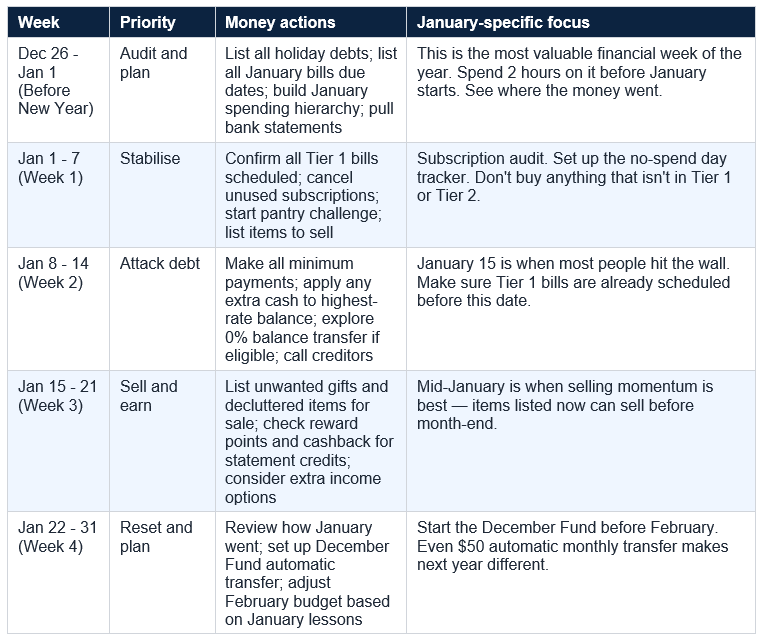
Rather than a generic monthly budget, the December-to-January stretch responds better to a week-by-week cash management plan. Here is a simple framework — adjust the specific numbers to your income and obligations:
Conclusion
January’s financial pressure is real. Thirty-six percent of Americans borrowed to pay for Christmas 2024, averaging $1,181 at credit card rates above 20%. December paychecks often arrive early, creating a five or six week stretch to January payday. A third of adults expect to run short before the month is over. These are not small numbers. These are the lived financial reality of a huge proportion of working people who decided that showing up for the people they love at Christmas was worth the financial cost.But January is also the most powerful month of the year to reset. The habits you establish in January — the spending hierarchy, the debt attack plan, the subscription audit, the pantry challenge, the first automated transfer into the December fund — last. The month that feels like the worst financial moment is also the one that contains the most opportunity, because the contrast between December’s spending and January’s necessity makes almost every money-saving action feel both justified and achievable.
The ten strategies in this article are not magic. They are practical, actionable, and cumulative — each one moves the needle a little, and together they can turn a month that most people just endure into one they actually manage. Start with the audit. Know your number. Build your hierarchy. Do the dry January. The rest follows. Not financial advice. If you need help with significant debt, contact the National Foundation for Credit Counseling (NFCC) for free or low-cost nonprofit credit counselling.
Frequently Asked Questions
Why does my December paycheck have to last so long into January?Many employers pay December salaries early — sometimes a week or more before Christmas — because of the holiday bank closures and payroll processing schedules. This means what felt like your 'December paycheck' might have arrived on December 19 or 20, but your next paycheck won't arrive until the normal January payday (often January 25-31 for monthly payers, or mid-January for bi-weekly payers). That's a gap of 5-6 weeks instead of the usual 4. During that window, you still face January's full set of bills: rent or mortgage, utilities (elevated in winter), post-holiday credit card minimum payments, groceries, and transport. The Intuit Credit Karma research (cited LBC 2025) found that January 15 is when more than half of those who expect to run out of money will have done so. Planning for this specific extended gap — rather than budgeting as if it were a normal 4-week month — is the key mindset shift. Not financial advice.
How much holiday debt is the average American carrying in January?
According to LendingTree's 2024 holiday survey, 36% of Americans took on debt to cover holiday purchases. Among those who went into debt, the average amount was $1,181 (up 15% from $1,028 in 2023). Of those with holiday debt, 42% used credit with an interest rate of 20% or higher, 42% said they regret spending as much as they did, and 21% expect it will take five months or longer to pay off. Additionally, a NerdWallet report found that 28% of credit card users were still paying off debt from the PREVIOUS holiday season when 2024 arrived. Average credit card APR was 23.37% as of August 2024 (Federal Reserve Bank of St. Louis). Sources: LendingTree 2024; NerdWallet; Federal Reserve Bank of St. Louis; cited Audacy; ChannelChek; News5Cleveland. Not financial advice.
What is a 0% balance transfer card and should I use one for holiday debt?
A 0% balance transfer credit card offers an introductory period — typically 12-21 months — during which no interest accrues on balances you transfer from other cards. If you have holiday debt at 20%+ APR, transferring it to a 0% card stops the interest clock for the duration of the introductory period, meaning every payment you make during that time goes entirely toward reducing the principal rather than partly to interest. There is typically a balance transfer fee of 3-5% of the amount transferred, which is almost always less than the interest you would pay on a 23%+ card over the same period. Akansha Nath of Intuit Credit Karma specifically recommended 'interest-free balance transfer offers' for people entering January with stretched budgets. The key conditions: you must stop adding new charges to the new card, and you must aim to pay off the balance before the 0% period ends (after which the rate resets to standard, often 20%+). Not financial advice. Check your credit eligibility before applying.
Is January actually a good month for deals, or is that a myth?
January sales are genuinely real and among the deepest discount periods of the retail year, particularly for: winter clothing and coats (stores clearing inventory for spring), electronics and appliances (post-Black Friday clearance), furniture (January is the biggest furniture sale month in the US and UK), gym memberships (heavy competition for resolution sign-ups pushes pricing down), and holiday decorations, wrapping paper, and gift supplies at 50-75% off (excellent value if buying for next year). The caution: January sales are only a 'deal' if you would have bought the item regardless of the discount. Buying something you don't need at 40% off is still spending 60% of the full price on something unnecessary. The financial rule: January sales are a good time to buy things on your genuine need list. They are a bad time for browsing while cash-tight. Sources: True Energy FCU 2025 winter newsletter; Intuit Credit Karma January tips (LBC). Not financial advice.
How do I make sure I don’t end up in the same position next December?
Start a dedicated December fund in January. The formula: decide your realistic total holiday budget (gifts, food, travel, decorations). Divide by 10 (the months February through November). Set up an automatic monthly transfer for that amount to a purpose-labelled savings account ('Christmas 2026' or 'December Fund'). A high-yield savings account earning 4-5% APY lets the fund grow slightly while it sits. Leslie Tayne, debt relief attorney, advises: 'By setting aside money now, you can create a dedicated fund for holiday expenses, making December 2025 less financially stressful.' (KCTV5, January 2025.) LendingTree's historical data shows holiday debt is a recurring pattern: 28% of people enter a new holiday season still paying off the previous one (NerdWallet). The only thing that breaks the cycle is starting the fund in January. Even $50/month produces $550 before December. $100/month produces $1,000. $150/month produces $1,500 — enough to cover average holiday spending without any credit card debt. Not financial advice.
0 Comments
Be the first to share your thoughts on this article.