
Investing
Nvidia Stock Down 32%: No-Brainer Buy or Value Trap at $155?

A 32% plunge has cut the valuation, but questions about AI spending and leadership remain.Close $162.85 on 13 Nov (about 32% below the 6 Oct record); forward P/E 17.5x; market value about $3.9T vs $5.8T in early October; options imply a move of roughly 7.8% after earnings.
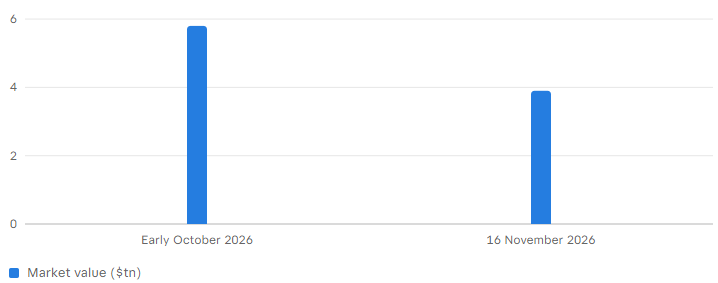
The stock closed at $162.85 on 13 November and was trading near $157 to $158 before the open on 16 November. Market value has fallen from about $5.8 trillion in early October to about $3.9 trillion. At the Friday close it traded at about 17.5 times forward earnings. The company reports third-quarter results on Tuesday 17 November, its first since Jensen Huang resigned [8]. Options markets were pricing a move of roughly 7.8% after the report. So the next day may change many of the numbers in this post.
Key takeaway: A big fall plus a lower valuation is not enough to call a bargain. A value trap is a cheap-looking stock whose earnings are about to fall. So the real question is whether Nvidia's earnings hold up, and the answer depends on AI spending more than on the share price.
Several things happened. Democrats gained control of Congress after running against unchecked data-centre expansion. The board launched an independent investigation into reports that Huang was the target of a foreign intelligence effort. Huang then resigned on 12 November and CFO Colette Kress became interim CEO. The shares fell as much as 13% on the day, before rebounding somewhat. On 16 November, Yahoo Finance said US stocks were sliding as investors braced for a momentous week for AI, with an Anthropic IPO and Nvidia's first post-Huang earnings both due. So there is also a broader risk-off mood in technology.
The business was strong in its latest reported quarter. Revenue rose 105.8% to $96.22 billion and Nvidia has beaten EPS estimates for six straight quarters. The company also has $99 billion remaining on its buyback authorisation [5]. Vera Rubin, its next chip platform, is in full production at several major cloud providers. Wall Street is still bullish. Of 62 analysts, 59 rated it Buy or Strong Buy (10 Strong Buy and 49 Buy), with one Sell, and the average target was $327.14. That target pre-dates the resignation, so treat it as stale. For reference, $327.14 is about 106% above $158.45 (my calculation).
That is exactly the debate on Wall St. When a dominant supplier keeps beating earnings but its multiple stops expanding, one reading is that the market is already pricing an earnings peak. That is my framing for thinking about it, not proof. There are four things that can push earnings off course: slower AI spending by customers, customer financial strain, leadership and execution problems, and China and political action. I take them in turn.
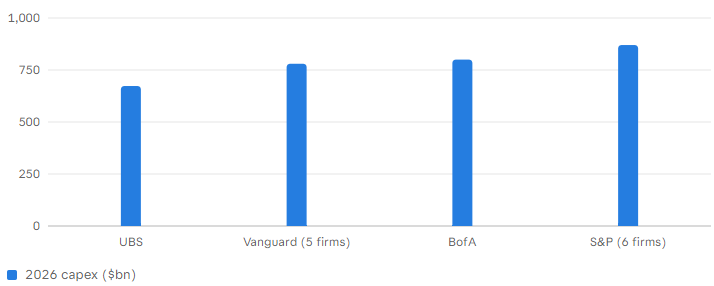
Currently, spending numbers are enormous but the sources disagree. Vanguard research, cited by the Motley Fool, says the five main hyperscalers will spend almost $780 billion in 2026, up 87%, and more than $1 trillion a year from 2027 to 2030. A separate S&P report, including six companies, projects $870 billion this year and $1.3 trillion next year, with only Microsoft expected to have positive free cash flow in 2027. BofA sees about $800 billion in 2026 and $1 trillion in 2027.
The figures differ because they cover different groups of companies and dates. Treat the totals as ranges, not facts. What they agree on is the direction: very large and still rising.
The bear argument is about the pace of growth. Reuters reported in July that UBS estimates hyperscaler capex would rise 76% in 2026 to $673 billion, but only 25% next year and 6% in 2028. By my calculation that is about $841 billion in 2027 and about $892 billion in 2028. Growth slowing from 76% to 25% is still growth, but investors in cyclical stocks often react to the rate of change, not the level.
On the other side, a Barron's analysis found that consensus 2027 capex estimates have risen on average 183% across five hyperscalers, versus a typical revision of 33% over the past decade, and Goldman Sachs said 2027 projections are likely too conservative [15]. So the Street is moving the other way from UBS's July view. Both can be right at different times.
Funding is another question. Alphabet's 2026 capex plan of $175 billion to $185 billion outpaces its trailing free cash flow of $73.3 billion, so it increasingly needs external finance. Analysts also debate how long chips stay useful, which affects how fast customers must replace them. That second source is a secondary one, so I flag it as such.
Invezz sets out the risk that management confirms guidance but investors still fear customer-financing or relationship disruption, and the stock keeps falling despite the numbers. That is what a value trap looks like from the inside.
Saxo's preview says Kress faces questions about customer commitments, product execution and who will shape the longer-term strategy. For a long-term investor, the leadership question is not just about one quarter. It is about whether Nvidia's culture and execution stay as strong without its founder.
The investigation is the swing factor. 24/7 Wall St says findings that Huang compromised company secrets, or binding federal limits on data-centre construction, would break the bullish thesis. The board says it has no reason to believe national security or company secrets were compromised. Politics adds a layer. A Texas governor-elect promised a moratorium on new data centres, and Democrats are expected to push legislation that could curb AI infrastructure expansion, though timing is unknown.
The options market's implied move of about 7.8% is roughly $12 either way on $158 to $163 (my calculation), so a swing to around $146 to $176 is within the range traders are pricing. FinanceFeeds sketches a bull case at $172 and a bear case at $145 for the next day, but those are one site's levels, not forecasts. Please read the actual results and the reaction before making any decision. This post cannot know them.
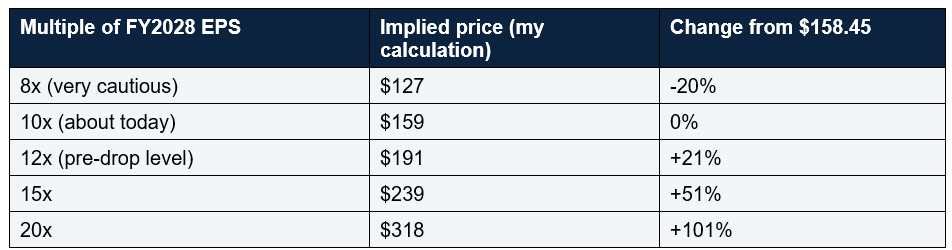
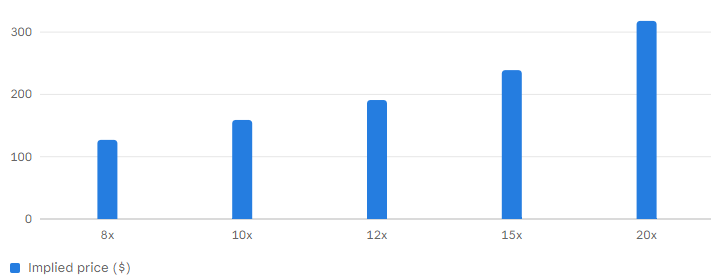
If you think of "no-brainer" as meaning limited downside, the table does not show that. A cut to EPS of 25%, say to $11.94, at 8 times earnings gives about $95 (my calculation), a 40% drop from $158.45. A return to 12 times earnings on unchanged estimates gives about $191, a 21% gain.
So the outcomes range from roughly -40% to +100% depending on assumptions. Investing.com's $251.85 fair value would need about 16 times the FY2028 estimate (my calculation). I cannot say which scenario is likeliest, and the next few days may shift all of them. One more point on risk: 24/7 Wall St lists a beta of 2.247, meaning large swings both ways are normal.
Mistakes I see: treating the percentage fall as the reason to buy, since a stock that fell 32% can fall another 32%; ignoring concentration in funds you already own; using borrowed money; buying only because analysts' targets are high, when those targets pre-date the resignation; and acting on the day's headline rather than a plan.
Another is assuming a low P/E means safe. As the value-trap test shows, a low multiple on peak earnings can be a trap.
So it is neither a no-brainer nor a certain trap. It is a high-uncertainty stock where the next results and the board's decisions matter. Make any decision based on your own goals, time horizon and risk tolerance, and consider speaking to a regulated adviser. This post is education only, not advice.
A mix of post-midterm worries about data-centre regulation, an investigation into its CEO, and then Huang's resignation on 12 November. The 32% is measured from the 6 October record to the $162.85 Friday close.
Is Nvidia stock a buy at $163?
It depends on your goals and risk tolerance. The valuation is lower, with a forward P/E of 17.5, but risks around AI spending and leadership are unresolved. Consider speaking to a regulated adviser.
What is a value trap?
A stock that looks cheap but is cheap for a reason, usually because its earnings are about to fall. A low P/E on peak earnings is the classic example.
When does Nvidia report earnings?
Tuesday 17 November 2026 after the US close, with the call at 5pm New York time.
What is the biggest risk?
The pace of AI spending by Nvidia's largest customers. Estimates differ, from UBS expecting slower growth to Barron's noting estimates rising sharply.
Table of Contents
- The quick answer
- What happened to the stock
- The bull case: the valuation reset
- The value-trap test
- Worry 1: AI spending may slow
- Worry 2: Can customers keep paying?
- Worry 3: Leadership after Huang
- Worry 4: China, export controls and politics
- Tomorrow's earnings: what the market expects
- Where the price could go: scenarios
- Who this might suit, and who it might not
- Conclusion
- FAQ
Nvidia market value ($ trillions)
US dollars, trillions by Source: LSEG data cited by Investing.com
Implied Nvidia price by multiple of FY2028 EPS ($15.91)
US dollars by My calculation on 24/7 Wall St consensus EPS; scenarios, not forecasts
Hyperscaler 2026 capex estimates differ by source ($bn)
US dollars, billions by Sources: Reuters, Motley Fool, Investing.com; company sets differ
The quick answer
Is Nvidia a no-brainer at $163? In my view, no. Is it an obvious value trap? Also no. The honest answer is that the price now reflects a much lower valuation, but the things that could still hurt earnings, namely AI spending, customer finances, leadership and China, are real and unresolved.The stock closed at $162.85 on 13 November and was trading near $157 to $158 before the open on 16 November. Market value has fallen from about $5.8 trillion in early October to about $3.9 trillion. At the Friday close it traded at about 17.5 times forward earnings. The company reports third-quarter results on Tuesday 17 November, its first since Jensen Huang resigned [8]. Options markets were pricing a move of roughly 7.8% after the report. So the next day may change many of the numbers in this post.
Key takeaway: A big fall plus a lower valuation is not enough to call a bargain. A value trap is a cheap-looking stock whose earnings are about to fall. So the real question is whether Nvidia's earnings hold up, and the answer depends on AI spending more than on the share price.
What happened to the stock
BigGo reports that the $162.85 Friday close is 31.9% below the stock's 6 October record. That implies a record close of about $239 (my calculation), and on that basis the premarket price of about $158.45 is roughly a 34% fall. That means the headline's 32% is the Friday close, and the stock has already slipped further. The 9 November article had the stock at $186.64, so the price has fallen about 15% in a week (my calculation: $186.64 to $158.45).Several things happened. Democrats gained control of Congress after running against unchecked data-centre expansion. The board launched an independent investigation into reports that Huang was the target of a foreign intelligence effort. Huang then resigned on 12 November and CFO Colette Kress became interim CEO. The shares fell as much as 13% on the day, before rebounding somewhat. On 16 November, Yahoo Finance said US stocks were sliding as investors braced for a momentous week for AI, with an Anthropic IPO and Nvidia's first post-Huang earnings both due. So there is also a broader risk-off mood in technology.
The bull case: the valuation reset
Start with the case for buying. Valuation has moved a long way. At $162.85, Investing.com lists a forward price-to-earnings ratio of 17.5 and a trailing ratio of 20.4. The same page quotes one analysis's fair value of $251.85, about 55% above the close, though I do not know how that figure was built. Earnings estimates have been rising, not falling. 24/7 Wall St reported that the fiscal 2028 EPS estimate went from $12.81 to $15.91 in 90 days with no downward revisions in 30 days. On that estimate, $158.45 is about 10 times earnings (my calculation). The same article says the stock traded at about 20 times fiscal 2027 EPS of $9.31 and about 12 times fiscal 2028 when it was at $186.64.The business was strong in its latest reported quarter. Revenue rose 105.8% to $96.22 billion and Nvidia has beaten EPS estimates for six straight quarters. The company also has $99 billion remaining on its buyback authorisation [5]. Vera Rubin, its next chip platform, is in full production at several major cloud providers. Wall Street is still bullish. Of 62 analysts, 59 rated it Buy or Strong Buy (10 Strong Buy and 49 Buy), with one Sell, and the average target was $327.14. That target pre-dates the resignation, so treat it as stale. For reference, $327.14 is about 106% above $158.45 (my calculation).
The value-trap test
A value trap is a stock that looks cheap on today's numbers because the numbers are about to get worse. The classic examples are businesses at the end of a cycle, with earnings at a peak and a low multiple that is correct, not a bargain. So the test is simple. If you believe Nvidia's earnings will keep rising, a 10 to 17 times multiple looks low. If you believe fiscal 2028 earnings are close to a peak, the stock could deserve a low multiple, and the price would not be a bargain at all. A low P/E on peak earnings is a trap.That is exactly the debate on Wall St. When a dominant supplier keeps beating earnings but its multiple stops expanding, one reading is that the market is already pricing an earnings peak. That is my framing for thinking about it, not proof. There are four things that can push earnings off course: slower AI spending by customers, customer financial strain, leadership and execution problems, and China and political action. I take them in turn.
Worry 1: AI spending may slow
The central worry is the spending cycle. Nvidia sells chips into the data-centre buildout, so its growth depends on a handful of giant customers continuing to spend.Currently, spending numbers are enormous but the sources disagree. Vanguard research, cited by the Motley Fool, says the five main hyperscalers will spend almost $780 billion in 2026, up 87%, and more than $1 trillion a year from 2027 to 2030. A separate S&P report, including six companies, projects $870 billion this year and $1.3 trillion next year, with only Microsoft expected to have positive free cash flow in 2027. BofA sees about $800 billion in 2026 and $1 trillion in 2027.
The figures differ because they cover different groups of companies and dates. Treat the totals as ranges, not facts. What they agree on is the direction: very large and still rising.
The bear argument is about the pace of growth. Reuters reported in July that UBS estimates hyperscaler capex would rise 76% in 2026 to $673 billion, but only 25% next year and 6% in 2028. By my calculation that is about $841 billion in 2027 and about $892 billion in 2028. Growth slowing from 76% to 25% is still growth, but investors in cyclical stocks often react to the rate of change, not the level.
On the other side, a Barron's analysis found that consensus 2027 capex estimates have risen on average 183% across five hyperscalers, versus a typical revision of 33% over the past decade, and Goldman Sachs said 2027 projections are likely too conservative [15]. So the Street is moving the other way from UBS's July view. Both can be right at different times.
Funding is another question. Alphabet's 2026 capex plan of $175 billion to $185 billion outpaces its trailing free cash flow of $73.3 billion, so it increasingly needs external finance. Analysts also debate how long chips stay useful, which affects how fast customers must replace them. That second source is a secondary one, so I flag it as such.
Worry 2: Can customers keep paying?
Related to spending is who pays. The same 24/7 Wall St article lists $279 billion of supply commitments at Nvidia, guarantee obligations of up to $108.5 billion, and days sales outstanding rising to 60 days from 45. It says a capex slowdown would hit all three. An analyst quoted in an older Barchart article estimated that the top eight customers could account for as much as 80% of Nvidia's business. That is an estimate, not a company disclosure. Even so, concentration means one or two customers cutting orders can matter.Invezz sets out the risk that management confirms guidance but investors still fear customer-financing or relationship disruption, and the stock keeps falling despite the numbers. That is what a value trap looks like from the inside.
Worry 3: Leadership after Huang
Founder-led companies carry a premium for vision. Huang resigned effective immediately, and Kress is interim CEO while keeping her CFO job. Analyst Daniel Ives, quoted by BigGo, says there is no chance of a comeback. Yahoo Finance notes that an outsider announcement could cause a sharp gap in either direction, because the market is repricing leadership uncertainty rather than chips. A lobbying fight could also distract Kress from rebuilding confidence.Saxo's preview says Kress faces questions about customer commitments, product execution and who will shape the longer-term strategy. For a long-term investor, the leadership question is not just about one quarter. It is about whether Nvidia's culture and execution stay as strong without its founder.
Worry 4: China, export controls and politics
China is a risk and potentially an upside. Nvidia's third-quarter guidance excludes China. Invezz says revenue from Chinese data centres is near zero and lawmakers from both parties are pushing for tougher export curbs after the Huang reports. Nvidia's annual report warns that US licensing decisions and China's support for local rivals can hurt sales and push customers to alternatives.The investigation is the swing factor. 24/7 Wall St says findings that Huang compromised company secrets, or binding federal limits on data-centre construction, would break the bullish thesis. The board says it has no reason to believe national security or company secrets were compromised. Politics adds a layer. A Texas governor-elect promised a moratorium on new data centres, and Democrats are expected to push legislation that could curb AI infrastructure expansion, though timing is unknown.
Tomorrow's earnings: what the market expects
Nvidia reports on Tuesday 17 November after the US close, with results at about 4:20pm New York time and the call at 5pm. Consensus expects earnings of $2.47 a share on revenue of about $109.2 billion. The earlier guidance was $108 billion, excluding China. Analysts quoted by Yahoo Finance describe near-term expectations as "somewhat sanguine", assuming Nvidia will reaffirm guidance, and caution that any rise after the announcement could meet selling. They also say they will listen less for the quarter and more for the backlog.The options market's implied move of about 7.8% is roughly $12 either way on $158 to $163 (my calculation), so a swing to around $146 to $176 is within the range traders are pricing. FinanceFeeds sketches a bull case at $172 and a bear case at $145 for the next day, but those are one site's levels, not forecasts. Please read the actual results and the reaction before making any decision. This post cannot know them.
Where the price could go: scenarios
Here is a simple valuation table, using the fiscal 2028 consensus EPS of $15.91 cited by 24/7 Wall St. It is a pre-resignation estimate and could be cut.If you think of "no-brainer" as meaning limited downside, the table does not show that. A cut to EPS of 25%, say to $11.94, at 8 times earnings gives about $95 (my calculation), a 40% drop from $158.45. A return to 12 times earnings on unchanged estimates gives about $191, a 21% gain.
So the outcomes range from roughly -40% to +100% depending on assumptions. Investing.com's $251.85 fair value would need about 16 times the FY2028 estimate (my calculation). I cannot say which scenario is likeliest, and the next few days may shift all of them. One more point on risk: 24/7 Wall St lists a beta of 2.247, meaning large swings both ways are normal.
Who this might suit, and who it might not
This section is general, not personal advice. A fallen stock may suit someone with a long time horizon, a diversified portfolio, and the temperament to sit through large swings. For many, the exposure may already be large, because Nvidia is a big holding in many index funds. It may suit people less if the money is needed within a few years, if Nvidia already makes up a large part of their wealth, or if a 40% fall would cause them to sell. If you are unsure, a regulated financial adviser can help. If you do want exposure, some people buy in stages, for example splitting a purchase across several weeks and the results date, which reduces the risk of picking the wrong day. It does not remove the risk of the stock falling further.Mistakes I see: treating the percentage fall as the reason to buy, since a stock that fell 32% can fall another 32%; ignoring concentration in funds you already own; using borrowed money; buying only because analysts' targets are high, when those targets pre-date the resignation; and acting on the day's headline rather than a plan.
Another is assuming a low P/E means safe. As the value-trap test shows, a low multiple on peak earnings can be a trap.
The bull case: a lower valuation, rising earnings estimates, six straight beats, $99 billion of buyback capacity and strong Vera Rubin demand; plus a possible clean investigation outcome and a good quarter. The bear case: spending growth slows, customer finances strain, the leadership gap lingers, and export or data-centre rules tighten. Both cases hold at once. Whether the price is a bargain depends on which risks materialise.
Watch the guidance and Kress's tone on 17 November, any update on customer commitments and backlog, the board's search for a permanent CEO, the investigation's findings, days sales outstanding, hyperscaler capex plans, and whether analysts cut their FY2028 EPS estimates. A sustained cut to those estimates would turn "cheap" into "fairly priced" very quickly.Conclusion
Nvidia at about $163 is far cheaper than a month ago, with a forward P/E of 17.5. But a cheaper price is not the same as a safe one. The decision comes down to whether earnings keep growing, and that rests on AI spending, customer health, leadership and politics.So it is neither a no-brainer nor a certain trap. It is a high-uncertainty stock where the next results and the board's decisions matter. Make any decision based on your own goals, time horizon and risk tolerance, and consider speaking to a regulated adviser. This post is education only, not advice.
FAQ
Why is Nvidia stock down 32%?A mix of post-midterm worries about data-centre regulation, an investigation into its CEO, and then Huang's resignation on 12 November. The 32% is measured from the 6 October record to the $162.85 Friday close.
Is Nvidia stock a buy at $163?
It depends on your goals and risk tolerance. The valuation is lower, with a forward P/E of 17.5, but risks around AI spending and leadership are unresolved. Consider speaking to a regulated adviser.
What is a value trap?
A stock that looks cheap but is cheap for a reason, usually because its earnings are about to fall. A low P/E on peak earnings is the classic example.
When does Nvidia report earnings?
Tuesday 17 November 2026 after the US close, with the call at 5pm New York time.
What is the biggest risk?
The pace of AI spending by Nvidia's largest customers. Estimates differ, from UBS expecting slower growth to Barron's noting estimates rising sharply.
0 Comments
Be the first to share your thoughts on this article.