

Business
Proposal Templates That Win Freelance Contracts

Average freelancer win rate: 20-30%. Top earners: 60%+. The gap is almost entirely in the proposal. Here are 10 ready-to-use templates with pricing tables, scope language, and built-in objection handling.
Most freelancers lose contracts before the client ever meets them. Not because their work is poor, not because their price is wrong, but because the proposal reads like a services menu rather than a solution to a specific problem. The jobbers.io July 2026 Complete Proposal Win Rate Optimization Guide puts the stakes plainly: the difference between a 20% win rate and a 60% win rate is the difference between struggling to cover expenses and building a thriving, sustainable freelance business. The ailawyer.pro 2026 analysis of web design proposal performance found that including a problem/understanding section increased conversion by 32%. Adding social proof or case studies added another 27%. The mewayz.com research found that discovery calls before proposal writing produced 3x higher conversion rates. This article covers the data behind winning proposals, the anatomy of what works, and ten ready-to-use templates for web designers, copywriters, and marketers — with pricing tables, scope language, and pre-written objection handling built in.
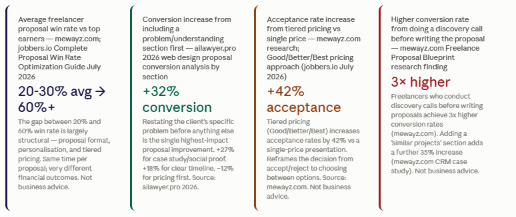
The numbers behind the failure are sobering. The jobbers.io July 2026 Proposal Win Rate Optimization Guide identifies the average freelancer conversion rate at 20-30%, with top earners consistently hitting 60% or higher. For web development specifically, the guide’s illustrative win rate ranges put average performers at 35-45%, top performers at 55-70%, and struggling freelancers at 15-25%. The difference between those ranges is rarely about the quality of the work. It is almost entirely about the quality of the proposal.
Average freelancer conversion rate: 20-30%. Top earners: 60%+. Web development top performers: 55-70% (jobbers.io July 2026). Discovery calls before proposal writing: 3x higher conversion (mewayz.com). Strategic proposal templates increase win rates up to 300% when properly customised (ravetree.com June 2025). Sources: jobbers.io; mewayz.com; ravetree.com.
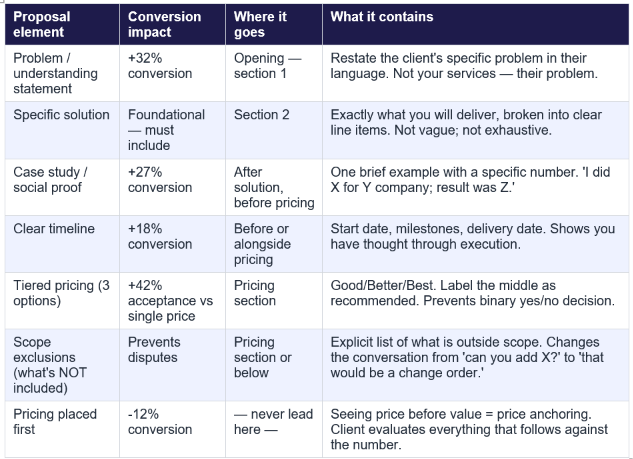
The ordering of these elements is not arbitrary. A client who has read a precise, empathetic description of their problem, followed by a specific solution matched to that problem, followed by evidence that you have done this before, arrives at the pricing section in a fundamentally different psychological state than a client who sees a price first. The jobbers.io guide identifies the psychology: proposals work best when they function as ‘solutions, not sales pitches.’ The ten templates in this article are built on this sequence.
Label the middle pricing tier 'Recommended' or 'Best fit for your goals' — never 'Most Popular' unless it genuinely is. The distinction: 'Recommended' implies professional judgment tailored to this client. 'Most Popular' implies sales language. The former builds trust; the latter erodes it.
A signed freelance proposal can be legally binding in some jurisdictions — but typically without the protections a proper contract includes (limitation of liability, IP transfer clauses, kill fees). Always follow up a signed proposal with a formal contract or service agreement before beginning work. Source: ailawyer.pro 2026 citing AIGA. Not legal advice — consult a qualified legal professional.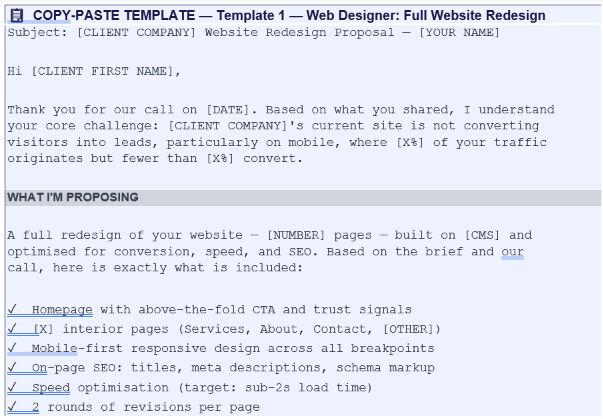
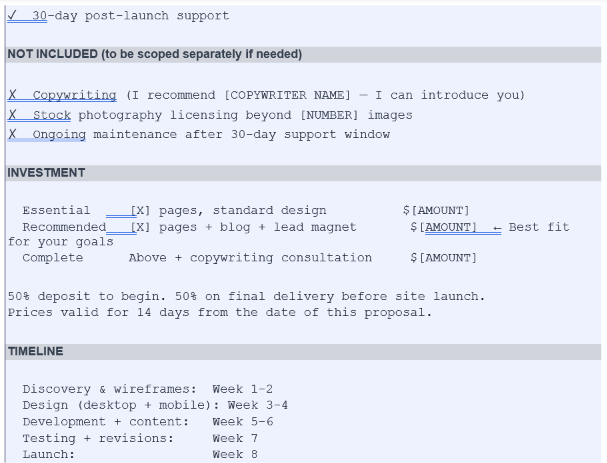
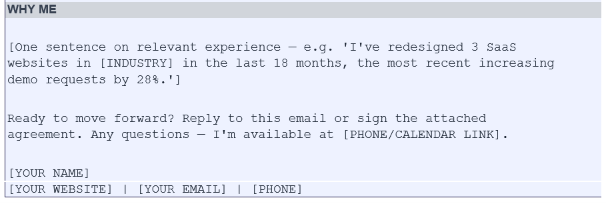
Why this works: Opens by restating the client's specific problem (not your services). Prices the middle option as 'Best fit for your goals' — anchoring the client toward the recommended tier. The 'Not Included' section prevents scope creep objections before they arise. Proposal expiry (14 days) creates urgency without pressure.
Objection handled: 'Your price is too high' — the tiered structure allows the client to self-select rather than reject the whole proposal. The Essential tier provides a genuine entry point. The recommended label on the middle option makes the decision feel guided rather than pushed.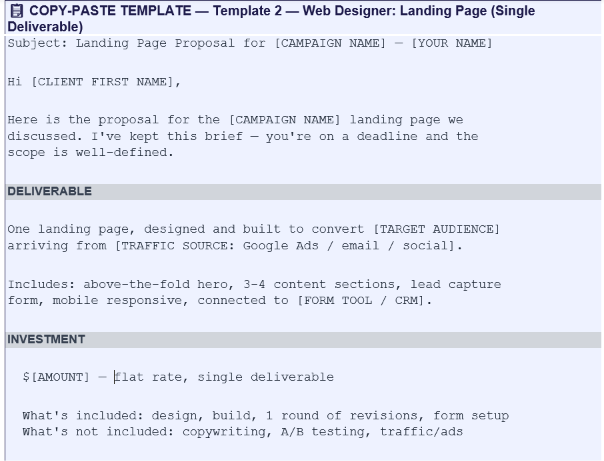
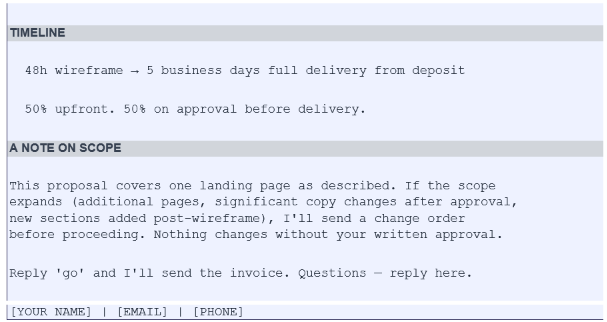
Short proposals for small projects respect the client's time and signal professional confidence. The scope note directly pre-handles the most common small-project dispute. 'Reply go and I'll send the invoice' — a frictionless call to action that makes approval a one-word decision.
Objection handled: 'What if I need changes after we start?' — the change order clause is stated clearly before signing, so this objection is pre-handled. The client knows the rule and accepts it upfront, preventing post-project disputes.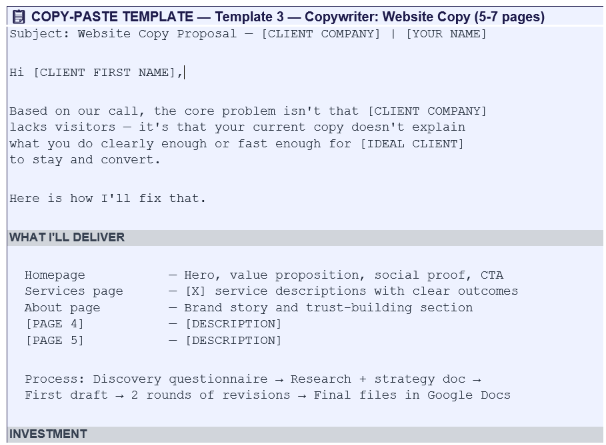
Opens with the client's specific conversion problem (not 'I'm a great copywriter'). The deliverable list uses client-outcome language ('explains your offer in 8 seconds') not feature language ('800 words per page'). Case study is brief and specific — one sentence with a real number.
Objection handled: 'How do I know it'll actually work?' — the specific outcome bullet points and the brief case study pre-handle ROI doubt. The client has evidence before they ask. The revision limit (2 rounds) is stated clearly to prevent unlimited revision requests.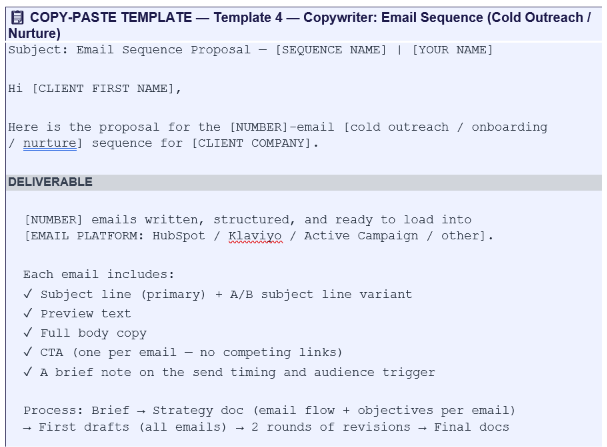

Including the subject line + A/B variant in the deliverable list immediately shows expertise beyond basic copywriting. The per-email rate for scope expansion pre-handles the 'can you add three more?' request. Benchmark context (open/click rates) with the caveat 'I'll share examples on request' creates curiosity without overpromising.
Objection handled: 'Can we add more emails later?' — the per-email rate for scope beyond included emails is stated upfront, so this is a pre-agreed process rather than an uncomfortable negotiation mid-project. The client knows exactly what additional emails cost.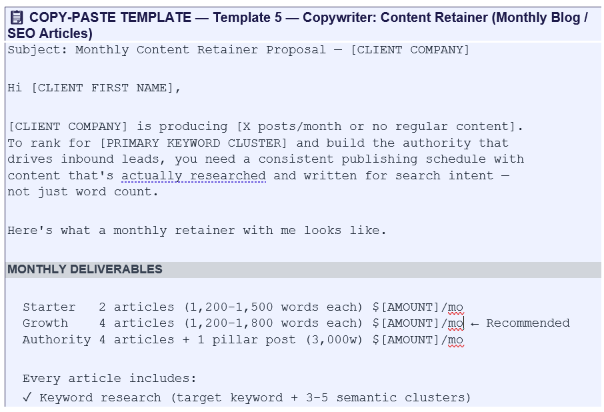
The minimum 3-month commitment educates the client on SEO timelines and filters out clients expecting immediate results. The 14-day approval clause is standard but rarely included in freelance retainers — it prevents indefinite hold-ups on payment. The 30-day cancel protects the client enough to sign without feeling locked in.
Objection handled: 'We might not need this every month' — the 30-day cancel notice with no long-term lock-in removes the biggest barrier to retainer sign-up. Clients can commit knowing they can exit. The 3-month minimum simply ensures they understand the SEO investment timeline.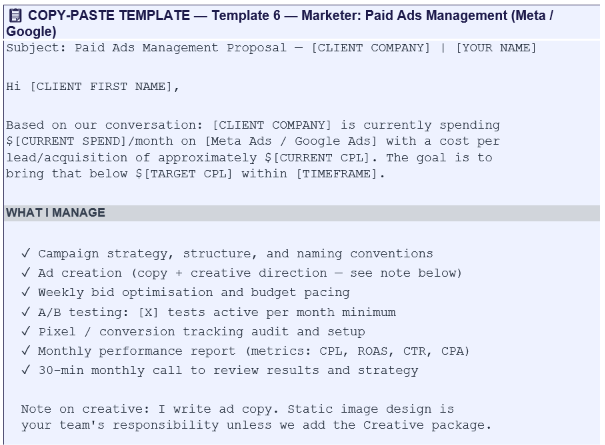
The 'I don't mark up ad spend' statement is high-trust and differentiates from agencies that take a percentage of spend regardless of performance. The explicit performance caveat ('I don't guarantee specific ROAS') is counterintuitive but protects the relationship — clients who expect guaranteed results become difficult clients. The minimum spend recommendation pre-handles 'can we test with $500/month?'.
Objection handled: 'Can you guarantee results?' — the caveat on guarantees is included in the proposal itself, not raised after a complaint. This sets honest expectations upfront and filters for clients who understand performance marketing. Clients who need a guarantee will self-select out.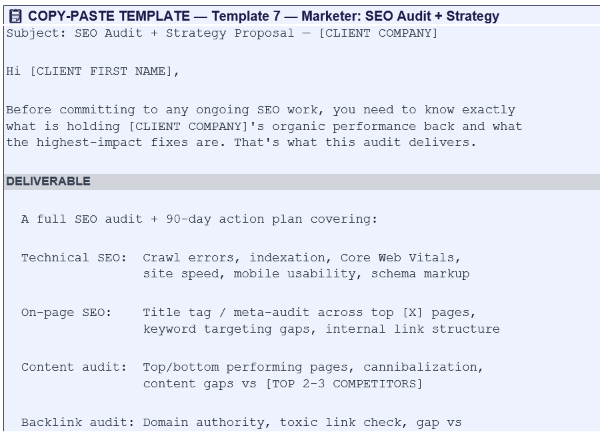
Leading with an audit is the highest-converting entry point for SEO services — it reduces the commitment barrier, generates immediate value, and positions a retainer as the natural next step. The 'audit fee deducted from month 1' pre-handles the transition question. Separating audit from implementation prevents scope confusion.
Objection handled: 'We're not ready to commit to monthly SEO work' — the audit is explicitly positioned as a standalone no-ongoing-commitment deliverable. This is an intentional objection handler: the right client will want to continue after seeing what the audit reveals. Low-commitment entry point, high conversion to retainer.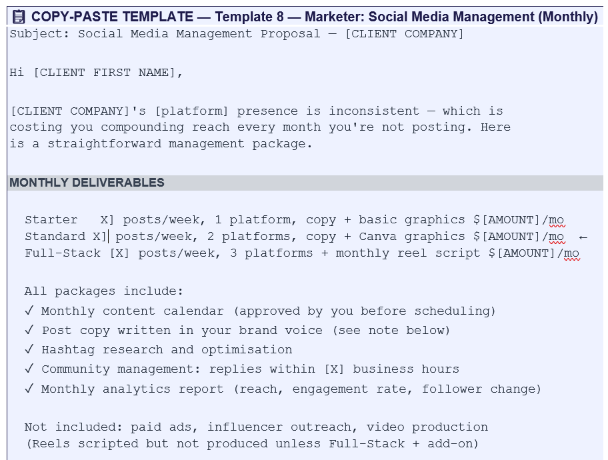
The content calendar approval deadline and the 'late approval = delayed scheduling' clause are essential — they prevent a client holding up an entire month's content and then expecting it posted in the final week. The onboarding section shows professionalism and sets realistic expectations on the 2-3 week ramp time. Not included section prevents scope expansion.
Objection handled: 'We might want to add platforms later' — the tiered structure allows natural upsell to higher packages. The client can see the pricing for more platforms before they ask, and the upgrade is presented as a step up rather than a bespoke negotiation.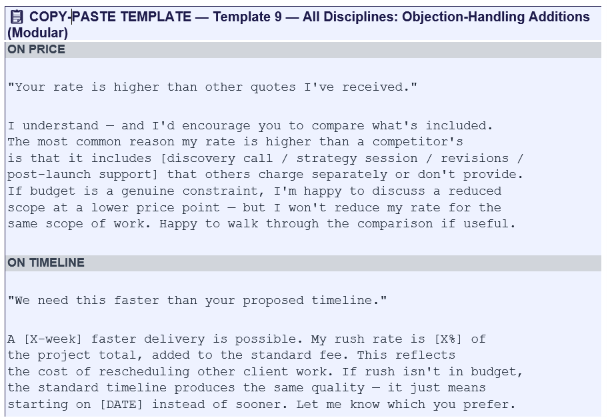
Pre-written objection responses that can be dropped into any proposal or used verbatim in follow-up emails. The price objection handler refuses to discount but offers scope reduction instead — protecting your rate while keeping the conversation open. The rush rate clause prices urgency fairly. The results caveat builds trust through honesty.
Objection handled: Covers the four most common freelance objections: price, timeline, ROI uncertainty, and trust with a new provider. Mewayz research: 'Anticipating and addressing objections within your proposal significantly increases conversion rates.'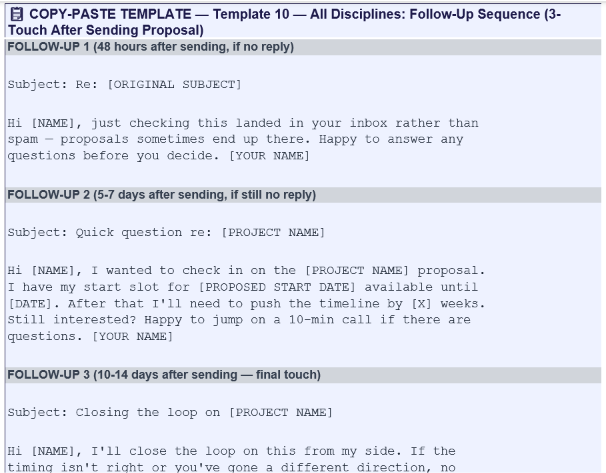

The three-touch follow-up sequence handles the most common proposal ghost: the client who is interested but busy. Follow-up 1 is non-pressure (technical excuse). Follow-up 2 creates legitimate urgency via start slot scarcity. Follow-up 3 gives permission to say no — which paradoxically increases response rates because it removes social awkwardness. Never send more than 3 unsolicited follow-ups.
The jobbers.io July 2026 data is the closing argument: the difference between a 20% win rate and a 60% win rate is the difference between spending 3 hours on a proposal that loses four times out of five and spending 3 hours on a proposal that wins three times out of five. Same time investment. Very different financial outcomes. The templates in this article are starting points. Personalise every bracket, add your own case studies, and test what works for your specific discipline and client type.
For most freelance projects, 1-3 pages (or the equivalent in an online proposal tool). Mewayz.com's research on winning proposals identifies length as less important than structure and personalisation — a 2-page proposal that opens with the client's specific problem and includes a precise scope will outperform a 6-page generic document. The exception: large enterprise or agency projects where a more detailed document is expected as a signal of process maturity. For small-to-mid-market freelance work, conciseness is a competitive advantage. A short proposal signals confidence; a long one can signal uncertainty covered by volume.
Should I include the price in my proposal or send it separately?
Include it in the proposal. The ailawyer.pro 2026 analysis found that placing pricing first reduces conversion by 12% — but not including it at all creates a different problem: clients who ask for a proposal without a price attached will often return with 'can you do it for less?' without having evaluated the value first. The correct position is to include the price, in a tiered format, after the problem statement, solution, and case study. The value context the first three sections provide is what allows the pricing section to be received fairly. Mewayz.com: tiered pricing increases acceptance by 42% vs a single price.
What is the best way to follow up after sending a proposal?
Template 10 in this article is a three-touch follow-up sequence. The research from mewayz.com identifies follow-up as a significant factor in winning proposals that initially receive no response. The three key principles: (1) first follow-up should be non-pressure (technical excuse — 'just checking it didn't go to spam'); (2) second follow-up should create legitimate scarcity ('my start slot is available until [DATE]'); (3) third follow-up gives permission to say no ('close the loop — if you've gone a different direction, no problem'). Never send more than three unsolicited follow-ups. If the client is not responding after three touches, they are either not interested or not ready — either way, pursuing further will not help.
How do I handle a client who asks me to lower my price?
Template 9 in this article contains a copy-paste price objection response. The core principle: never reduce the rate for the same scope of work. Offer to reduce the scope instead. This protects your rate integrity and signals that your pricing is based on genuine cost of delivery rather than negotiating margin. The jobbers.io July 2026 guide notes that price objections most often reflect insufficient perceived value in the proposal rather than genuine budget constraints — which is why the solution is better value communication before the price objection, not discounting after it.
What is the 'Not Included' section and why is it important?
A 'Not Included' section is an explicit list of deliverables, services, or tasks that fall outside the scope of the proposal. It serves two functions: preventing scope creep (the client cannot claim that something was implied to be included if it is listed as excluded) and managing expectations before work begins. Every template in this article includes a Not Included section. The ailawyer.pro 2026 analysis and AIGA guidance both identify scope ambiguity as the primary legal risk in freelance proposals. Pre-defining the boundaries in the proposal — before the contract and before work begins — is the most effective way to prevent the disputes that are most common in freelance service delivery.
Most freelancers lose contracts before the client ever meets them. Not because their work is poor, not because their price is wrong, but because the proposal reads like a services menu rather than a solution to a specific problem. The jobbers.io July 2026 Complete Proposal Win Rate Optimization Guide puts the stakes plainly: the difference between a 20% win rate and a 60% win rate is the difference between struggling to cover expenses and building a thriving, sustainable freelance business. The ailawyer.pro 2026 analysis of web design proposal performance found that including a problem/understanding section increased conversion by 32%. Adding social proof or case studies added another 27%. The mewayz.com research found that discovery calls before proposal writing produced 3x higher conversion rates. This article covers the data behind winning proposals, the anatomy of what works, and ten ready-to-use templates for web designers, copywriters, and marketers — with pricing tables, scope language, and pre-written objection handling built in.
Table of Contents
- 1. Why Most Freelance Proposals Lose Before the Client Reads Them
- 2. The Anatomy of a Winning Proposal: What the Research Shows
- 3. Pricing Tables That Work: The Tiered Pricing Principle
- 4. Scope Language That Prevents Disputes
- 5. The 10 Copy-Paste Proposal Templates
- Template 1 — Web Designer: Full Website Redesign
- Template 2 — Web Designer: Single Landing Page
- Template 3 — Copywriter: Website Copy (5-7 pages)
- Template 4 — Copywriter: Email Sequence
- Template 5 — Copywriter: Monthly Content Retainer
- Template 6 — Marketer: Paid Ads Management
- Template 7 — Marketer: SEO Audit + Strategy
- Template 8 — Marketer: Social Media Management
- Template 9 — All Disciplines: Objection-Handling Additions
- Template 10 — All Disciplines: 3-Touch Follow-Up Sequence
- 6. Conclusion: The Proposal Is the First Work Product the Client Sees
- 7. Frequently Asked Questions
Why Most Freelance Proposals Lose Before the Client Reads Them
The failure happens in the first three sentences. The client opens the proposal, reads 'Thank you for considering me for your project — I am a passionate [discipline] with X years of experience,' and mentally files it alongside the four other identical proposals they have received this week. The mewayz.com Freelance Proposal Blueprint identifies this as the primary failure mode: ‘Clients can spot copy-pasted proposals from miles away.’ Generic templates without personalisation, experience-first opening lines, and proposals that lead with the freelancer’s credentials rather than the client’s problem are the structural reasons most proposals fail before they are properly read.The numbers behind the failure are sobering. The jobbers.io July 2026 Proposal Win Rate Optimization Guide identifies the average freelancer conversion rate at 20-30%, with top earners consistently hitting 60% or higher. For web development specifically, the guide’s illustrative win rate ranges put average performers at 35-45%, top performers at 55-70%, and struggling freelancers at 15-25%. The difference between those ranges is rarely about the quality of the work. It is almost entirely about the quality of the proposal.
Average freelancer conversion rate: 20-30%. Top earners: 60%+. Web development top performers: 55-70% (jobbers.io July 2026). Discovery calls before proposal writing: 3x higher conversion (mewayz.com). Strategic proposal templates increase win rates up to 300% when properly customised (ravetree.com June 2025). Sources: jobbers.io; mewayz.com; ravetree.com.
The Anatomy of a Winning Proposal: What the Research Shows
The ailawyer.pro 2026 analysis of web design proposal performance measured conversion impact by section and found that the sequence of a proposal matters as much as its content. Including a problem or understanding section at the top increased conversion by 32%. Adding a case study or social proof section produced a further 27% uplift. A clear timeline section added 18%. By contrast, placing pricing first — the most common mistake among new freelancers who assume clients want to see numbers immediately — reduced conversion by 12%. The mewayz.com research identifies five non-negotiable elements in successful proposals: a restatement of the client’s problem; the specific solution you are proposing; social proof or case studies; clear pricing; and risk reversal or a guarantee.The ordering of these elements is not arbitrary. A client who has read a precise, empathetic description of their problem, followed by a specific solution matched to that problem, followed by evidence that you have done this before, arrives at the pricing section in a fundamentally different psychological state than a client who sees a price first. The jobbers.io guide identifies the psychology: proposals work best when they function as ‘solutions, not sales pitches.’ The ten templates in this article are built on this sequence.
Pricing Tables That Work: The Tiered Pricing Principle
The single most impactful structural change to any freelance pricing presentation is moving from a single price to three options. The mewayz.com research found that tiered pricing — presenting Good/Better/Best options — increases acceptance rates by 42% compared to a single-price presentation. The mechanism is psychological: a single price forces a binary accept/reject decision. Three tiers reframe the decision as a choice between options, where the default mental comparison is between tiers rather than between your proposal and a competitor’s. The middle tier should always be labelled as the recommended option, and it should genuinely represent the best fit for the specific client’s stated goals. The recommendation should be honest — clients can tell when the ‘recommended’ label is purely upsell-motivated. Where the Essential tier exists as a genuine entry point and the Premium tier exists as a genuine expanded version, the middle recommendation is credible.Label the middle pricing tier 'Recommended' or 'Best fit for your goals' — never 'Most Popular' unless it genuinely is. The distinction: 'Recommended' implies professional judgment tailored to this client. 'Most Popular' implies sales language. The former builds trust; the latter erodes it.
Scope Language That Prevents Disputes
The most common freelance contract dispute is not over price. It is over scope. What was included, what was not, and who decides when more work has been added. The solution is scope language that is explicit, bilateral, and present before signing rather than introduced as a shock after the client asks for ‘one more thing.’ Every template in this article includes a ‘Not Included’ section. This is not defensive or adversarial — it is professional. It tells the client exactly what the edges of the project are before they commit. The ailawyer.pro 2026 analysis notes the AIGA’s finding that the most common legal pitfall for web designers is the transition from proposal to contract, and recommends including a Proposal Expiration and Contract Conversion clause. This prevents the situation where a signed proposal is treated as legally binding without the protections a proper contract provides. The templates in this article include expiry dates and payment terms as standard.A signed freelance proposal can be legally binding in some jurisdictions — but typically without the protections a proper contract includes (limitation of liability, IP transfer clauses, kill fees). Always follow up a signed proposal with a formal contract or service agreement before beginning work. Source: ailawyer.pro 2026 citing AIGA. Not legal advice — consult a qualified legal professional.
The 10 Copy-Paste Proposal Templates
All brackets in the following templates are personalisation points. Fill in every bracket before sending. A template sent with visible brackets is worse than no template — it signals to the client that they are not being treated individually. Not legal or business advice. These templates are starting points that require personalisation to your specific service, client, and jurisdiction.Template 1 — Web Designer: Full Website Redesign
Why this works: Opens by restating the client's specific problem (not your services). Prices the middle option as 'Best fit for your goals' — anchoring the client toward the recommended tier. The 'Not Included' section prevents scope creep objections before they arise. Proposal expiry (14 days) creates urgency without pressure.
Objection handled: 'Your price is too high' — the tiered structure allows the client to self-select rather than reject the whole proposal. The Essential tier provides a genuine entry point. The recommended label on the middle option makes the decision feel guided rather than pushed.
Template 2 — Web Designer: Landing Page (Single Deliverable)
Short proposals for small projects respect the client's time and signal professional confidence. The scope note directly pre-handles the most common small-project dispute. 'Reply go and I'll send the invoice' — a frictionless call to action that makes approval a one-word decision.
Objection handled: 'What if I need changes after we start?' — the change order clause is stated clearly before signing, so this objection is pre-handled. The client knows the rule and accepts it upfront, preventing post-project disputes.
Template 3 — Copywriter: Website Copy (5-7 pages)
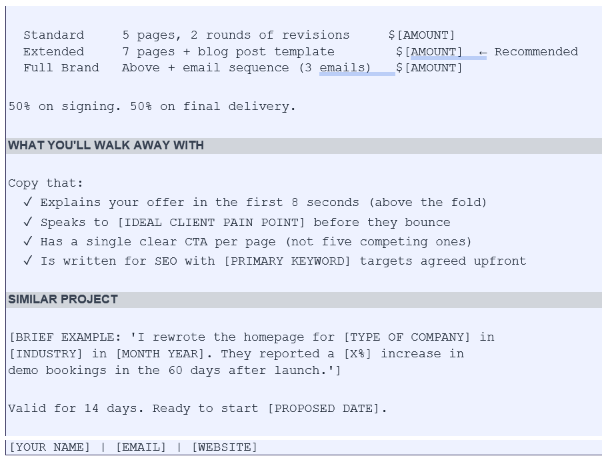
Opens with the client's specific conversion problem (not 'I'm a great copywriter'). The deliverable list uses client-outcome language ('explains your offer in 8 seconds') not feature language ('800 words per page'). Case study is brief and specific — one sentence with a real number.
Objection handled: 'How do I know it'll actually work?' — the specific outcome bullet points and the brief case study pre-handle ROI doubt. The client has evidence before they ask. The revision limit (2 rounds) is stated clearly to prevent unlimited revision requests.
Template 4 — Copywriter: Email Sequence (Cold Outreach / Nurture)
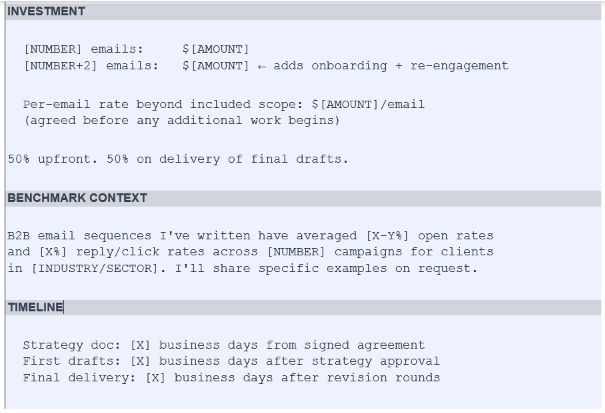
Including the subject line + A/B variant in the deliverable list immediately shows expertise beyond basic copywriting. The per-email rate for scope expansion pre-handles the 'can you add three more?' request. Benchmark context (open/click rates) with the caveat 'I'll share examples on request' creates curiosity without overpromising.
Objection handled: 'Can we add more emails later?' — the per-email rate for scope beyond included emails is stated upfront, so this is a pre-agreed process rather than an uncomfortable negotiation mid-project. The client knows exactly what additional emails cost.
Template 5 — Copywriter: Content Retainer (Monthly Blog / SEO Articles)
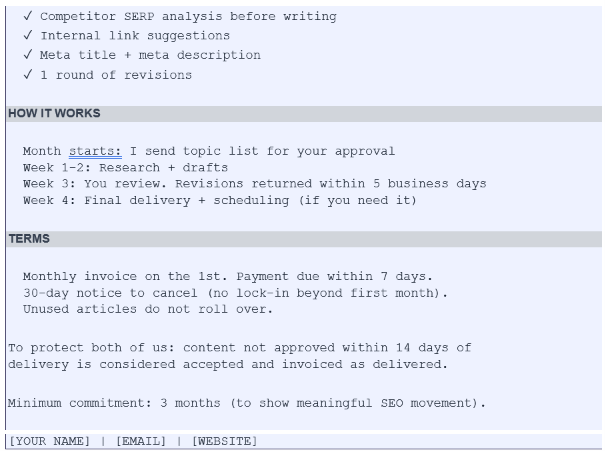
The minimum 3-month commitment educates the client on SEO timelines and filters out clients expecting immediate results. The 14-day approval clause is standard but rarely included in freelance retainers — it prevents indefinite hold-ups on payment. The 30-day cancel protects the client enough to sign without feeling locked in.
Objection handled: 'We might not need this every month' — the 30-day cancel notice with no long-term lock-in removes the biggest barrier to retainer sign-up. Clients can commit knowing they can exit. The 3-month minimum simply ensures they understand the SEO investment timeline.
Template 6 — Marketer: Paid Ads Management (Meta / Google)
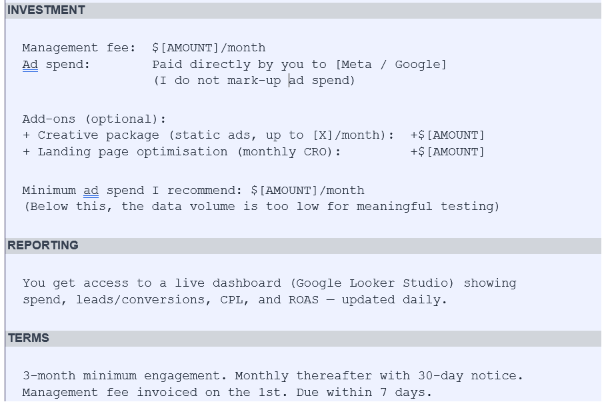
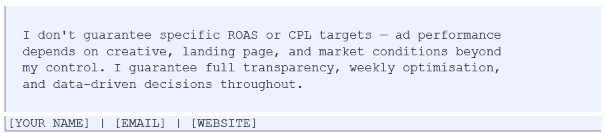
The 'I don't mark up ad spend' statement is high-trust and differentiates from agencies that take a percentage of spend regardless of performance. The explicit performance caveat ('I don't guarantee specific ROAS') is counterintuitive but protects the relationship — clients who expect guaranteed results become difficult clients. The minimum spend recommendation pre-handles 'can we test with $500/month?'.
Objection handled: 'Can you guarantee results?' — the caveat on guarantees is included in the proposal itself, not raised after a complaint. This sets honest expectations upfront and filters for clients who understand performance marketing. Clients who need a guarantee will self-select out.
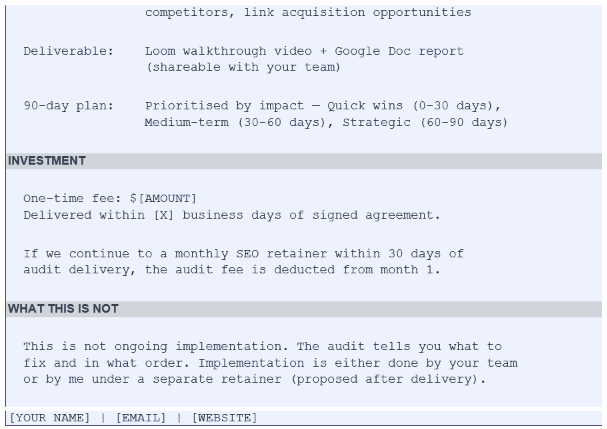
Template 7 — Marketer: SEO Audit + Strategy
Leading with an audit is the highest-converting entry point for SEO services — it reduces the commitment barrier, generates immediate value, and positions a retainer as the natural next step. The 'audit fee deducted from month 1' pre-handles the transition question. Separating audit from implementation prevents scope confusion.
Objection handled: 'We're not ready to commit to monthly SEO work' — the audit is explicitly positioned as a standalone no-ongoing-commitment deliverable. This is an intentional objection handler: the right client will want to continue after seeing what the audit reveals. Low-commitment entry point, high conversion to retainer.
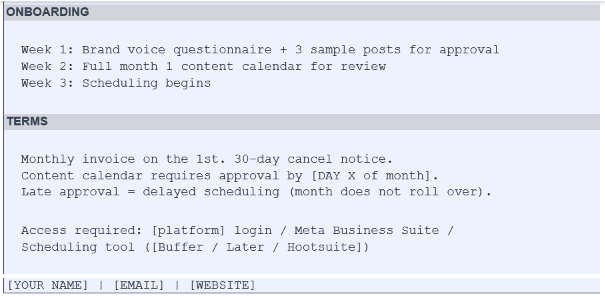
Template 8 — Marketer: Social Media Management (Monthly)
The content calendar approval deadline and the 'late approval = delayed scheduling' clause are essential — they prevent a client holding up an entire month's content and then expecting it posted in the final week. The onboarding section shows professionalism and sets realistic expectations on the 2-3 week ramp time. Not included section prevents scope expansion.
Objection handled: 'We might want to add platforms later' — the tiered structure allows natural upsell to higher packages. The client can see the pricing for more platforms before they ask, and the upgrade is presented as a step up rather than a bespoke negotiation.
Template 9 — All Disciplines: Objection-Handling Additions (Modular)
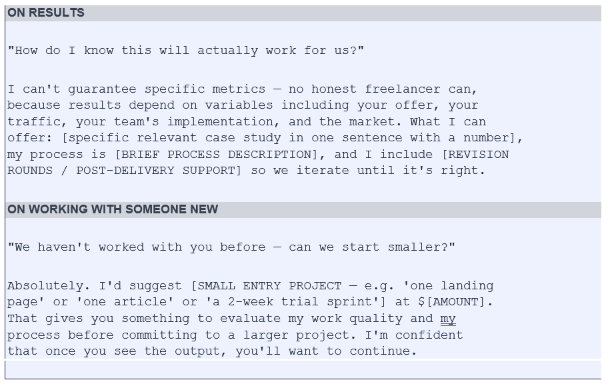
Pre-written objection responses that can be dropped into any proposal or used verbatim in follow-up emails. The price objection handler refuses to discount but offers scope reduction instead — protecting your rate while keeping the conversation open. The rush rate clause prices urgency fairly. The results caveat builds trust through honesty.
Objection handled: Covers the four most common freelance objections: price, timeline, ROI uncertainty, and trust with a new provider. Mewayz research: 'Anticipating and addressing objections within your proposal significantly increases conversion rates.'
Template 10 — All Disciplines: Follow-Up Sequence (3-Touch After Sending Proposal)
The three-touch follow-up sequence handles the most common proposal ghost: the client who is interested but busy. Follow-up 1 is non-pressure (technical excuse). Follow-up 2 creates legitimate urgency via start slot scarcity. Follow-up 3 gives permission to say no — which paradoxically increases response rates because it removes social awkwardness. Never send more than 3 unsolicited follow-ups.
Conclusion
The proposal is not administrative paperwork that happens before the real work begins. It is the first sample of how you think, how you communicate, and how you handle the commercial dimension of a professional relationship. A proposal that restates the client’s problem in their language, proposes a specific solution, shows evidence of having done something similar, prices clearly in tiers, and pre-handles the obvious objections is not just more likely to win the contract. It is the opening move in a professional relationship that the client has already begun to trust.The jobbers.io July 2026 data is the closing argument: the difference between a 20% win rate and a 60% win rate is the difference between spending 3 hours on a proposal that loses four times out of five and spending 3 hours on a proposal that wins three times out of five. Same time investment. Very different financial outcomes. The templates in this article are starting points. Personalise every bracket, add your own case studies, and test what works for your specific discipline and client type.
Frequently Asked Questions
How long should a freelance proposal be?For most freelance projects, 1-3 pages (or the equivalent in an online proposal tool). Mewayz.com's research on winning proposals identifies length as less important than structure and personalisation — a 2-page proposal that opens with the client's specific problem and includes a precise scope will outperform a 6-page generic document. The exception: large enterprise or agency projects where a more detailed document is expected as a signal of process maturity. For small-to-mid-market freelance work, conciseness is a competitive advantage. A short proposal signals confidence; a long one can signal uncertainty covered by volume.
Should I include the price in my proposal or send it separately?
Include it in the proposal. The ailawyer.pro 2026 analysis found that placing pricing first reduces conversion by 12% — but not including it at all creates a different problem: clients who ask for a proposal without a price attached will often return with 'can you do it for less?' without having evaluated the value first. The correct position is to include the price, in a tiered format, after the problem statement, solution, and case study. The value context the first three sections provide is what allows the pricing section to be received fairly. Mewayz.com: tiered pricing increases acceptance by 42% vs a single price.
What is the best way to follow up after sending a proposal?
Template 10 in this article is a three-touch follow-up sequence. The research from mewayz.com identifies follow-up as a significant factor in winning proposals that initially receive no response. The three key principles: (1) first follow-up should be non-pressure (technical excuse — 'just checking it didn't go to spam'); (2) second follow-up should create legitimate scarcity ('my start slot is available until [DATE]'); (3) third follow-up gives permission to say no ('close the loop — if you've gone a different direction, no problem'). Never send more than three unsolicited follow-ups. If the client is not responding after three touches, they are either not interested or not ready — either way, pursuing further will not help.
How do I handle a client who asks me to lower my price?
Template 9 in this article contains a copy-paste price objection response. The core principle: never reduce the rate for the same scope of work. Offer to reduce the scope instead. This protects your rate integrity and signals that your pricing is based on genuine cost of delivery rather than negotiating margin. The jobbers.io July 2026 guide notes that price objections most often reflect insufficient perceived value in the proposal rather than genuine budget constraints — which is why the solution is better value communication before the price objection, not discounting after it.
What is the 'Not Included' section and why is it important?
A 'Not Included' section is an explicit list of deliverables, services, or tasks that fall outside the scope of the proposal. It serves two functions: preventing scope creep (the client cannot claim that something was implied to be included if it is listed as excluded) and managing expectations before work begins. Every template in this article includes a Not Included section. The ailawyer.pro 2026 analysis and AIGA guidance both identify scope ambiguity as the primary legal risk in freelance proposals. Pre-defining the boundaries in the proposal — before the contract and before work begins — is the most effective way to prevent the disputes that are most common in freelance service delivery.
0 Comments
Be the first to share your thoughts on this article.