

Retirement
Saver’s Match 2027: A Federal Retirement Match Up to $1,000!

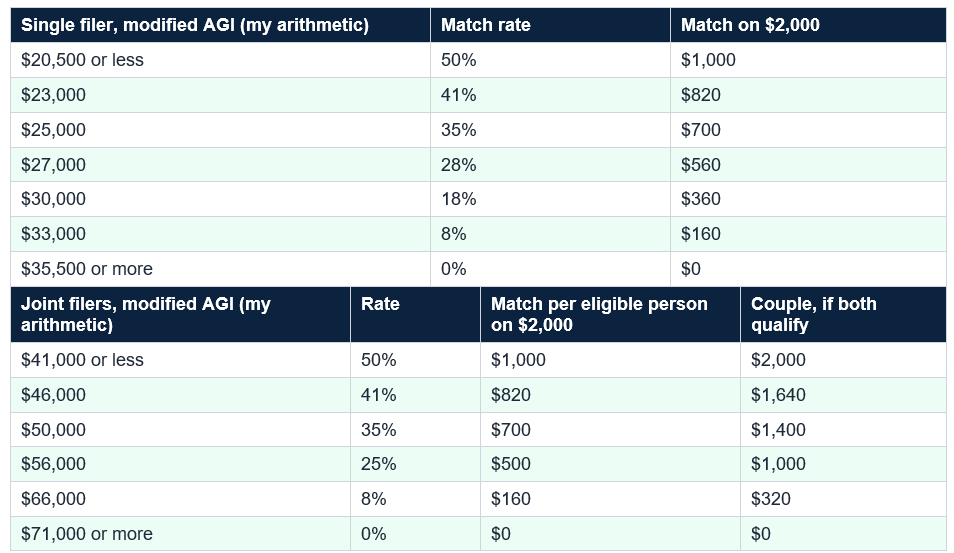
Starting with tax year 2027, a federal match of 50% on up to $2,000 of qualifying contributions, a maximum of $1,000 per eligible person a year ($2,000 for a couple with two eligible savers), deposited into the account. Full match up to $20,500 (single), $30,750 (head of household) and $41,000 (joint) of modified AGI; phased out completely at $35,500, $53,250 and $71,000; thresholds adjust for inflation after 2027. Status: Notice 2026-48 (August 7, 2026) sets out anticipated rules; comments were due October 5, 2026; proposed regulations are still to come. The Saver’s Credit ends for retirement contributions after December 31, 2026. Why it matters: only 46% of Americans could cover three months of expenses; the median 401(k) balance is about $38,176 (Vanguard). My arithmetic: saving $2,000 a year ($167 a month) earns a $1,000 match, which at a constant 7% adds about $13,800 after 10 years, $41,000 after 20 and $94,500 after 30; a single filer at $27,000 of income would get about $560, and a joint couple at $50,000 about $700 each; each extra $1,000 of income in the single phase-out range cuts the match on $2,000 by about $67.
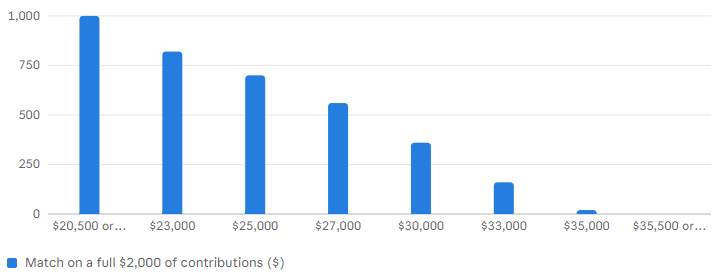
Match ($) by my illustration: 50% rate reduced proportionally across the $20,500-$35,500 range and rounded down to a whole percentage point (as described by Richify); final regulations may differ
It is also new, so some details are still being worked out: Treasury and the IRS issued their first guidance in August, with proposed regulations still to come. This guide explains what is known and what is not, who is likely to qualify, how much the match could be at different incomes, what to do before 2027 and where the limits are, flagging what is uncertain.
Think of it as an employer match provided by the government. If you contribute $2,000, you can receive $1,000 more, as long as your income fits the limits; $1,000 would earn $500, and $600 would earn $300, the Congressional Research Service’s example. The CRS notes the match has a lower maximum effective rate than the Saver’s Credit, 33% of total savings rather than up to 50%, but may reach more people because it does not depend on how much tax you owe.
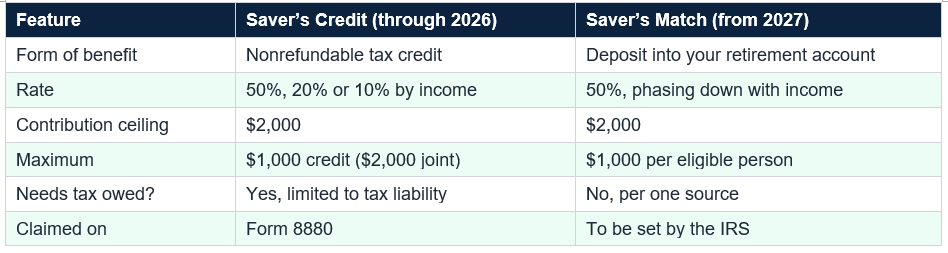
The match fixes that flaw. It is a deposit into your retirement account, not a reduction of your tax bill, and one source says it is not limited by the federal income tax you owe, so someone who owes no tax can still receive it. The trade-off is that the money must stay invested for retirement, and the maximum effective rate is lower than the old credit’s. For many low-income workers who got nothing before, it is a meaningful improvement.
There are other eligibility rules in the statute. From my general knowledge, not retrieved from these sources, savers must be adults, cannot be full-time students and cannot be claimed as a dependent on someone else’s return, as under the old Saver’s Credit; the final regulations will confirm. Remember, too, that modified AGI is not your salary: pre-tax contributions to a 401(k) or traditional IRA may lower it.

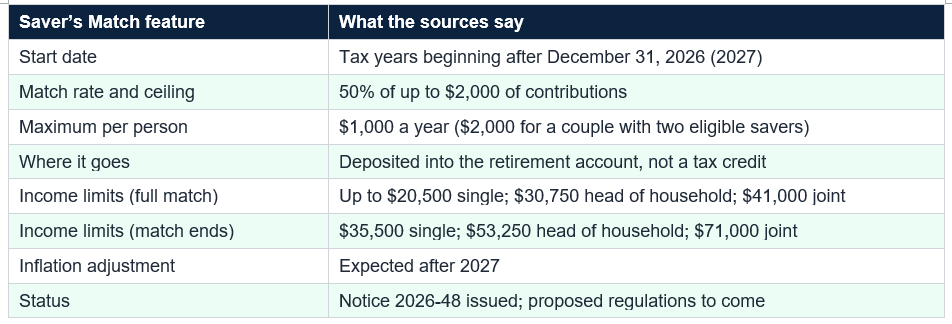
Saver’s Match from tax year 2027: 50% of up to $2,000 saved, a maximum of $1,000 per person. Full match up to $20,500 (single), $30,750 (head of household), $41,000 (joint); ends at $35,500, $53,250 and $71,000; inflation-adjusted after 2027. The Saver’s Credit ends for retirement contributions after December 31, 2026.
For a married couple filing jointly, the range runs from $41,000 to $71,000, so a couple earning $50,000 would get about 35%, $700 on $2,000 for each eligible spouse or $1,400 together, and one at $56,000 about 25%, $500 each; a head of household at $40,000 would get about 29%, or $580. These are illustrations of one reading of the rule, not official figures. A side effect: each extra $1,000 of income inside the single range reduces the match on $2,000 by about $67, a modest drag on the value of a raise.
For people with a workplace plan, a practical question is whether the plan will accept the government deposit, which depends on the plan and IRS operational rules; for IRA savers it is simpler, since the match would go into the IRA. The 2026 IRA limit is $7,500, and the final rules should clarify how the match interacts with contribution limits and taxes.
The government is also pushing awareness: Executive Order 14403 directs agencies to increase public awareness of the match and to make it easier to take part in eligible retirement savings vehicles, according to the IRS announcement as summarized by Thomson Reuters. Expect scams too, as impostors often follow announcements of free money: rely on IRS.gov and be wary of unsolicited messages asking for payment or personal information (a general caution).
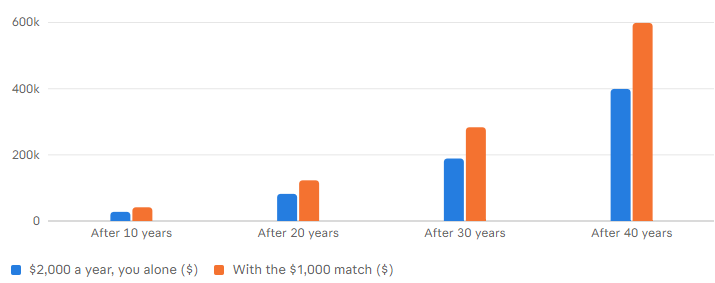
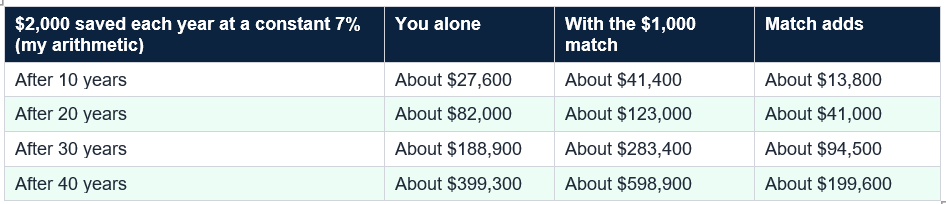
In my illustration at a constant 7% return, $2,000 a year grows to about $27,600 after 10 years, $82,000 after 20 and $188,900 after 30; adding the $1,000 match lifts those to about $41,400, $123,000 and $283,400, so the match adds about $13,800, $41,000 and $94,500. These are hypothetical and assume you qualify every year, which may not hold as income changes, but they show why a small match matters: it is money you did not have to earn.
The match is only available if you qualify in a given year and your savings stay in the account. Income changes, taxes and early withdrawals could reduce or erase the benefit, and the final rules may differ from the anticipated ones.
Fifth, keep an emergency fund, because a match is of little use if you must withdraw the money to pay a bill: Bankrate found only 46% of Americans could cover three months of expenses, and the Fed’s 2025 survey found 37% could not cover a $400 expense in cash, per a compilation. Sixth, watch for the proposed regulations and keep records of your contributions. And be alert to scams. If you cannot reach $2,000, save what you can: $1,000 saved would earn $500.
This month, find out which retirement account you will use in 2027, set up an automatic transfer of even $50 a month and check whether you qualify for the 2026 Saver’s Credit.
There are practical limits too. The match phases out as income rises, which may feel like a penalty on raises, and it must stay in the account, so it is not spendable cash. Its rules could change before 2027 and it may interact with other benefits and taxes in ways I have not retrieved. Treat it as a valuable bonus on top of a plan, not the plan itself. Common mistakes include assuming the match is automatic, forgetting to open an account that can receive it, ignoring the 2026 Saver’s Credit, not checking income against the limits, skipping saving because you cannot reach $2,000, withdrawing the money early and falling for scams. Starting the habit in 2026, with an emergency fund in place, costs nothing and puts you in position when the rules are final.
In my illustration, saving $2,000 a year, about $167 a month, earns $1,000 of match, which at a constant 7% adds about $94,500 over 30 years, and a single filer at $27,000 would get roughly $560. To prepare, claim the 2026 credit if you qualify, check your income against the limits, make sure you have an account that can receive the match, automate your saving, keep an emergency fund and watch IRS.gov for the proposed regulations.
It is a federal matching contribution created by the SECURE 2.0 Act that begins with tax year 2027. Eligible low- and moderate-income savers can receive 50% of up to $2,000 of qualifying retirement contributions, for a maximum of $1,000 a year per person, deposited into their retirement account instead of reducing their tax bill. It replaces the Saver’s Credit for most retirement contributions.
Who qualifies for the Saver’s Match?
Eligibility is based on modified adjusted gross income. The full 50% match applies up to $20,500 for single filers, $30,750 for heads of household and $41,000 for married couples filing jointly, phasing out completely at $35,500, $53,250 and $71,000. The limits are expected to adjust for inflation after 2027. Age and other eligibility rules are set in the statute and guidance, which I did not retrieve in full, so check the IRS.
Is the Saver’s Match the same as the Saver’s Credit?
No. The Saver’s Credit was a nonrefundable tax credit that only reduced the tax you owed, so many low-income savers got little or nothing. The Saver’s Match is a government deposit into your retirement account and is not limited by the amount of tax you owe. The credit ends for retirement contributions after December 31, 2026, though it continues for ABLE account contributions.
When will I receive the match?
That is not yet settled. Treasury and the IRS issued Notice 2026-48 on August 7, 2026, describing anticipated rules and promising proposed regulations, with comments due October 5. As of the sources I found, important operational details, such as exactly how and when matches are deposited, were still being finalized. Watch for the proposed regulations.
What should I do now to prepare?
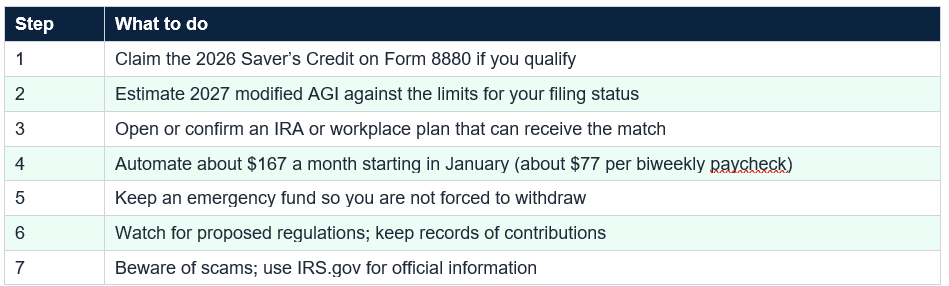
Claim the Saver’s Credit for 2026 if you qualify, estimate your 2027 income against the limits, make sure you have an IRA or workplace plan that can accept the match, and plan to save about $167 a month ($2,000 a year) starting in January. Keep an emergency fund so you are not forced to withdraw. This is general education, not personal advice.
Table of Contents
- Free Money With Fine Print
- The Short Answer
- What the Saver’s Match Is
- Saver’s Match vs. Saver’s Credit
- Who Qualifies: The Income Limits
- What Your Match Could Be at Different Incomes
- What Counts and Where the Money Goes
- What Is Still Unsettled
- The Math: What $1,000 a Year Becomes
- How to Prepare in 2026
- Limits and Fine Print
- Common Mistakes
- Conclusion
- Frequently Asked Questions
The match shrinks as income rises: single filer, match on $2,000 saved ($)
Match ($) by my illustration: 50% rate reduced proportionally across the $20,500-$35,500 range and rounded down to a whole percentage point (as described by Richify); final regulations may differ
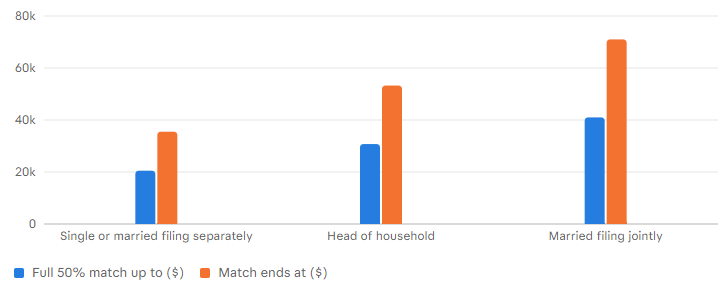
Saver's Match income limits by filing status, from 2027 (modified AGI, $)
Modified AGI ($) by Notice 2026-48 as summarized by ADP, Yahoo Finance and tax-information sites; thresholds adjust for inflation after 2027; one source states the single end point as $35,000
What the match is worth: $2,000 a year with and without the $1,000 match ($)
Value ($) by my hypothetical arithmetic: constant 7% return, year-end contributions; assumes you qualify every year; not a forecast
Free Money With Fine Print
Starting in 2027, the federal government will add money to some people’s retirement accounts. It is called the Saver’s Match, it comes from the SECURE 2.0 Act and it is aimed at low- and moderate-income workers. If you qualify, the government will match 50% of up to $2,000 you save, up to $1,000 a year deposited into your retirement account, a 50% return on the first dollars saved, before any investment gains.It is also new, so some details are still being worked out: Treasury and the IRS issued their first guidance in August, with proposed regulations still to come. This guide explains what is known and what is not, who is likely to qualify, how much the match could be at different incomes, what to do before 2027 and where the limits are, flagging what is uncertain.
The Short Answer
The Saver’s Match gives eligible savers a federal contribution equal to 50% of up to $2,000 they put into a qualifying retirement account, a maximum of $1,000 a year per person, starting with tax year 2027. The full match runs up to $20,500 of income for single filers, $30,750 for heads of household and $41,000 for joint filers, phasing out completely at $35,500, $53,250 and $71,000. It replaces the Saver’s Credit but, unlike that tax credit, is deposited into your account. To prepare, claim the 2026 credit if you qualify, plan to save about $167 a month from January and watch for the final rules.
What the Saver’s Match Is
The Saver’s Match is a federal matching contribution to an eligible saver’s retirement account. It was created by Section 103 of the SECURE 2.0 Act of 2022, which added Section 6433 to the tax code, and applies to tax years beginning after December 31, 2026. The match is a percentage of qualified contributions up to $2,000 a year, at a maximum rate of 50%, so the most the government will add is $1,000 a year per person, or up to $2,000 for a married couple with two eligible savers.Think of it as an employer match provided by the government. If you contribute $2,000, you can receive $1,000 more, as long as your income fits the limits; $1,000 would earn $500, and $600 would earn $300, the Congressional Research Service’s example. The CRS notes the match has a lower maximum effective rate than the Saver’s Credit, 33% of total savings rather than up to 50%, but may reach more people because it does not depend on how much tax you owe.
Saver’s Match vs. Saver’s Credit
The Saver’s Credit, which the match replaces for retirement contributions, is a nonrefundable tax credit worth 50%, 20% or 10% of up to $2,000 of contributions, depending on income, claimed on Form 8880. Nonrefundable means it can only reduce the tax you owe to zero, so a low-income worker with little or no income tax gets little or nothing, its biggest weakness. The credit ends for retirement contributions after December 31, 2026, though it continues for ABLE account contributions, where the maximum qualifying contribution rises from $2,000 to $2,100 from 2027, per the CRS.The match fixes that flaw. It is a deposit into your retirement account, not a reduction of your tax bill, and one source says it is not limited by the federal income tax you owe, so someone who owes no tax can still receive it. The trade-off is that the money must stay invested for retirement, and the maximum effective rate is lower than the old credit’s. For many low-income workers who got nothing before, it is a meaningful improvement.
Who Qualifies: The Income Limits
Eligibility depends first on modified adjusted gross income. The full 50% match applies up to $20,500 for single filers and married individuals filing separately, $30,750 for heads of household and $41,000 for married couples filing jointly, then shrinks and disappears entirely at $35,500, $53,250 and $71,000, according to several sources. The thresholds are set to adjust for inflation after 2027.There are other eligibility rules in the statute. From my general knowledge, not retrieved from these sources, savers must be adults, cannot be full-time students and cannot be claimed as a dependent on someone else’s return, as under the old Saver’s Credit; the final regulations will confirm. Remember, too, that modified AGI is not your salary: pre-tax contributions to a 401(k) or traditional IRA may lower it.
Saver’s Match from tax year 2027: 50% of up to $2,000 saved, a maximum of $1,000 per person. Full match up to $20,500 (single), $30,750 (head of household), $41,000 (joint); ends at $35,500, $53,250 and $71,000; inflation-adjusted after 2027. The Saver’s Credit ends for retirement contributions after December 31, 2026.
What Your Match Could Be at Different Incomes
In the phase-out range, the match shrinks. One source describes the rule as reducing the 50% rate proportionally across the range and rounding down to a whole percentage point. Applying that to a single filer, my arithmetic gives 50% up to $20,500, about 41% at $23,000, 35% at $25,000, 28% at $27,000, 18% at $30,000, 8% at $33,000 and 1% at $35,000, or roughly $1,000, $820, $700, $560, $360, $160 and $20 on a full $2,000.For a married couple filing jointly, the range runs from $41,000 to $71,000, so a couple earning $50,000 would get about 35%, $700 on $2,000 for each eligible spouse or $1,400 together, and one at $56,000 about 25%, $500 each; a head of household at $40,000 would get about 29%, or $580. These are illustrations of one reading of the rule, not official figures. A side effect: each extra $1,000 of income inside the single range reduces the match on $2,000 by about $67, a modest drag on the value of a raise.
What Counts and Where the Money Goes
The match is based on qualified retirement savings contributions, which, according to guidance summarized by Thomson Reuters, include contributions to traditional and Roth IRAs, 401(k) plans, 403(b) plans and other specified accounts. The match is deposited into the account, so you need an IRA or workplace plan that can receive it, one reason to open an account now if you do not have one. The sources do not agree on every detail, so wait for the proposed regulations before assuming how it applies to a particular plan.For people with a workplace plan, a practical question is whether the plan will accept the government deposit, which depends on the plan and IRS operational rules; for IRA savers it is simpler, since the match would go into the IRA. The 2026 IRA limit is $7,500, and the final rules should clarify how the match interacts with contribution limits and taxes.
What Is Still Unsettled
Treasury and the IRS opened implementation with Notice 2026-48 on August 7, 2026, describing the rules they expect to put in forthcoming proposed regulations, and took comments through October 5. Open questions include exactly how and when the match is deposited, how taxpayers claim it, how plans and custodians will handle it and how eligibility is verified; a tax-information site noted in August that important operational questions remained unresolved and final regulations had not been issued.The government is also pushing awareness: Executive Order 14403 directs agencies to increase public awareness of the match and to make it easier to take part in eligible retirement savings vehicles, according to the IRS announcement as summarized by Thomson Reuters. Expect scams too, as impostors often follow announcements of free money: rely on IRS.gov and be wary of unsolicited messages asking for payment or personal information (a general caution).
The Math: What $1,000 a Year Becomes
To receive the full $1,000, you need to save $2,000 a year, about $167 a month, $77 per biweekly paycheck or $38 a week. At a $20,500 income, $2,000 is about 9.8% of pay, a stretch but not impossible, and at $30,000 about 6.7%. The match then adds $1,000, so $2,000 of your own money becomes $3,000 invested, an instant 50% return.In my illustration at a constant 7% return, $2,000 a year grows to about $27,600 after 10 years, $82,000 after 20 and $188,900 after 30; adding the $1,000 match lifts those to about $41,400, $123,000 and $283,400, so the match adds about $13,800, $41,000 and $94,500. These are hypothetical and assume you qualify every year, which may not hold as income changes, but they show why a small match matters: it is money you did not have to earn.
The match is only available if you qualify in a given year and your savings stay in the account. Income changes, taxes and early withdrawals could reduce or erase the benefit, and the final rules may differ from the anticipated ones.
How to Prepare in 2026
You can act now. First, if you qualify, claim the Saver’s Credit for 2026 using Form 8880, still available for this year. Second, estimate your 2027 modified AGI against the limits for your filing status. Third, make sure you have a workplace plan or IRA that can receive the match, opening one before year-end if needed. Fourth, plan to save about $167 a month from January with an automatic transfer.Fifth, keep an emergency fund, because a match is of little use if you must withdraw the money to pay a bill: Bankrate found only 46% of Americans could cover three months of expenses, and the Fed’s 2025 survey found 37% could not cover a $400 expense in cash, per a compilation. Sixth, watch for the proposed regulations and keep records of your contributions. And be alert to scams. If you cannot reach $2,000, save what you can: $1,000 saved would earn $500.
This month, find out which retirement account you will use in 2027, set up an automatic transfer of even $50 a month and check whether you qualify for the 2026 Saver’s Credit.
Limits and Fine Print
The match is not a cure for the retirement savings gap. It helps people who can afford to save, but many low-income workers cannot find $167 a month, and the CRS notes it does not address other barriers, such as lack of access to an employer plan. The median 401(k) balance at Vanguard was $38,176 against an average of $148,153, and the personal saving rate was 3.8% in September, per a compilation. A $1,000 match is valuable but works only for those who can contribute.There are practical limits too. The match phases out as income rises, which may feel like a penalty on raises, and it must stay in the account, so it is not spendable cash. Its rules could change before 2027 and it may interact with other benefits and taxes in ways I have not retrieved. Treat it as a valuable bonus on top of a plan, not the plan itself. Common mistakes include assuming the match is automatic, forgetting to open an account that can receive it, ignoring the 2026 Saver’s Credit, not checking income against the limits, skipping saving because you cannot reach $2,000, withdrawing the money early and falling for scams. Starting the habit in 2026, with an emergency fund in place, costs nothing and puts you in position when the rules are final.
Conclusion
The Saver’s Match is a genuinely new benefit: from 2027, qualifying savers can receive a 50% federal match on up to $2,000 saved, a maximum of $1,000 a year, deposited directly into their retirement account. The full match applies up to $20,500 of income for single filers, $30,750 for heads of household and $41,000 for joint filers, phasing out by $35,500, $53,250 and $71,000. It replaces the Saver’s Credit, which only reduced the tax you owed. Initial guidance is out, but important details are pending.In my illustration, saving $2,000 a year, about $167 a month, earns $1,000 of match, which at a constant 7% adds about $94,500 over 30 years, and a single filer at $27,000 would get roughly $560. To prepare, claim the 2026 credit if you qualify, check your income against the limits, make sure you have an account that can receive the match, automate your saving, keep an emergency fund and watch IRS.gov for the proposed regulations.
Frequently Asked Questions
What is the Saver’s Match?It is a federal matching contribution created by the SECURE 2.0 Act that begins with tax year 2027. Eligible low- and moderate-income savers can receive 50% of up to $2,000 of qualifying retirement contributions, for a maximum of $1,000 a year per person, deposited into their retirement account instead of reducing their tax bill. It replaces the Saver’s Credit for most retirement contributions.
Who qualifies for the Saver’s Match?
Eligibility is based on modified adjusted gross income. The full 50% match applies up to $20,500 for single filers, $30,750 for heads of household and $41,000 for married couples filing jointly, phasing out completely at $35,500, $53,250 and $71,000. The limits are expected to adjust for inflation after 2027. Age and other eligibility rules are set in the statute and guidance, which I did not retrieve in full, so check the IRS.
Is the Saver’s Match the same as the Saver’s Credit?
No. The Saver’s Credit was a nonrefundable tax credit that only reduced the tax you owed, so many low-income savers got little or nothing. The Saver’s Match is a government deposit into your retirement account and is not limited by the amount of tax you owe. The credit ends for retirement contributions after December 31, 2026, though it continues for ABLE account contributions.
When will I receive the match?
That is not yet settled. Treasury and the IRS issued Notice 2026-48 on August 7, 2026, describing anticipated rules and promising proposed regulations, with comments due October 5. As of the sources I found, important operational details, such as exactly how and when matches are deposited, were still being finalized. Watch for the proposed regulations.
What should I do now to prepare?
Claim the Saver’s Credit for 2026 if you qualify, estimate your 2027 income against the limits, make sure you have an IRA or workplace plan that can accept the match, and plan to save about $167 a month ($2,000 a year) starting in January. Keep an emergency fund so you are not forced to withdraw. This is general education, not personal advice.
0 Comments
Be the first to share your thoughts on this article.