

Savings
The Best 3-Year CDs: Earn 4.60% to 4.85% With No Market Risk

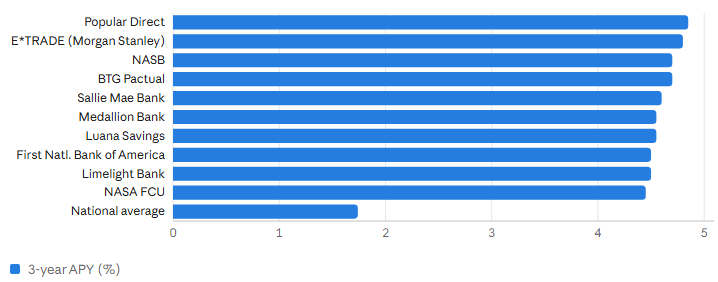
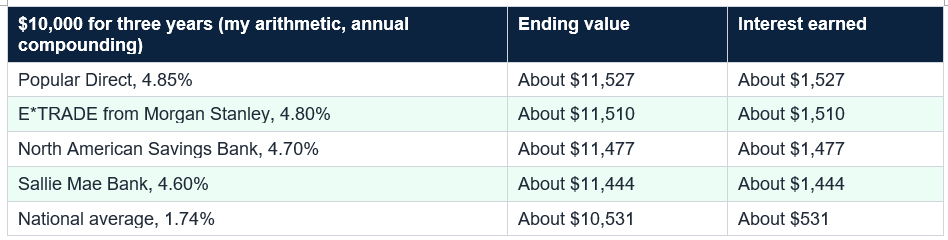
Top 3-year CD rates: Popular Direct 4.85% APY; E*TRADE from Morgan Stanley 4.80%; North American Savings Bank and BTG Pactual 4.70%; Sallie Mae Bank 4.60%; Medallion and Luana Savings 4.55%; several at 4.40%–4.50%. National average 3-year CD APY about 1.74% (Bankrate, Oct 11); FDIC national rate 1.36% (September). Alternatives: top high-yield savings 4.34%–4.50%; 52-week T-bill 4.46%; brokered 1-year CD 4.60% and 5-year 5.20%; I bond 5.51% with a 1.40% fixed rate; inflation 3.7%; Fed funds 3.75%–4.00% with a December hike possible. My arithmetic on $10,000 for three years: about $11,527 at 4.85%, $11,444 at 4.60% and $10,531 at the 1.74% average, so 4.60% earns about $913 more than the average; at an assumed 24% federal and 5% state tax, 4.60% nets about 3.27%, below 3.7% inflation.
This is a good moment to look. According to Bankrate’s survey, the national average three-year CD rate was about 1.74% in October, while the best banks and credit unions paid between 4.40% and 4.85%, and rates rose through the month: leading one-year rates climbed from about 4.35% in late September to 4.75% by October 9 to 11. This guide covers the top 3-year rates, what they mean after tax and inflation, and whether locking in is right for you.
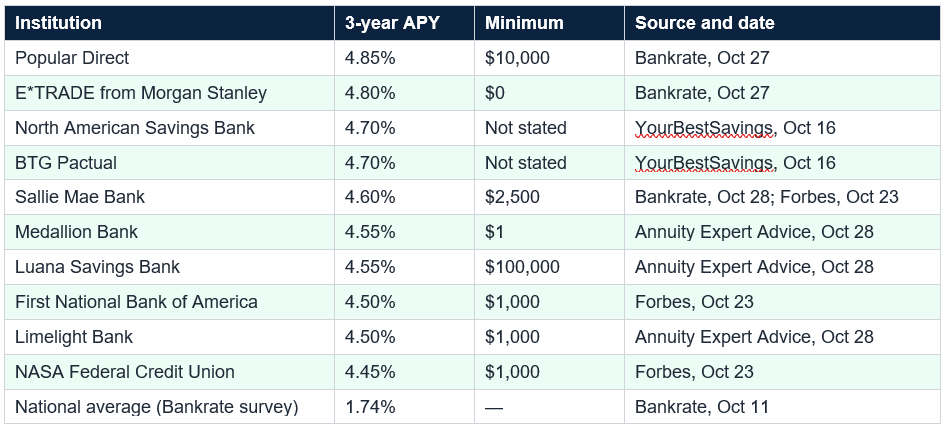
Late October 2026 three-year CD rates: Popular Direct 4.85%, E*TRADE from Morgan Stanley 4.80%, North American Savings Bank and BTG Pactual 4.70%, Sallie Mae Bank 4.60%. National average about 1.74% (Bankrate) or 1.36% (FDIC, September). Rates change daily.
Two lessons follow. Shopping around matters far more than chasing the last quarter point: the gap between a top rate and the average is worth hundreds of dollars on $10,000, while the gap between 4.60% and 4.85% is worth tens. And a CD’s APY already includes compounding, so quotes compare directly, but check whether interest is paid out or added to the balance and whether the rate is fixed for the full term.
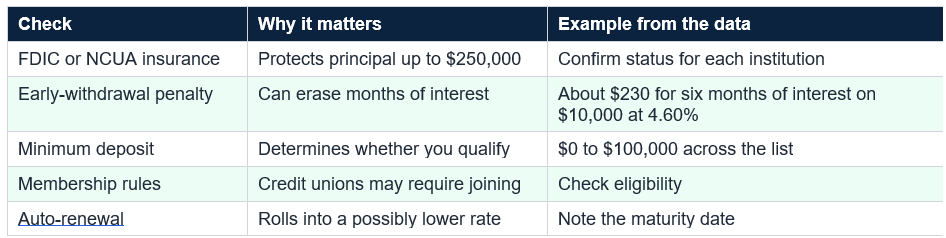
Fourth, eligibility: some credit unions require an affiliation or small fee. Fifth, maturity: many banks automatically renew the CD at whatever rate they then offer, which can be far lower, so mark the maturity date and grace period. Sixth, whether the CD is callable or has a bump-up or no-penalty feature. And check the rate is the standard rate, not a new-money promotion.
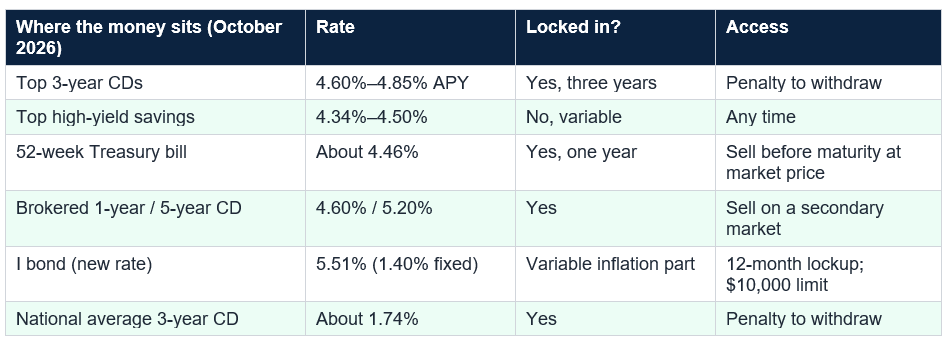
The real difference is the trade-off. A savings account lets you leave anytime but does not guarantee its rate will last; a CD guarantees its rate for three years but charges you for leaving. If you believe rates will fall, locking in is attractive; if you think they will rise, a shorter term or a savings account keeps flexibility. With the Fed holding at 3.75% to 4.00% on October 28 and a December hike possible, nobody knows which way rates will go.
There is also rate risk. If you lock in 4.60% and rates rise, you will be stuck below the market: in my illustration, a one-year CD at 4.60% followed by two years at 5.60% would leave the person who rolled about $220 ahead on $10,000. If rates fall, the person who locked in wins by a similar amount, and you cannot know in advance, which is why many savers blend terms. Treat a CD as a way to secure a decent, known return, not to beat inflation.
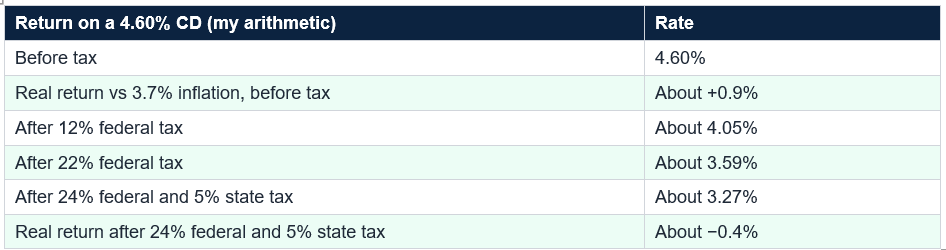
A CD protects your principal and locks your rate, but it does not protect your purchasing power. After tax, a 4.60% CD can earn less than 3.7% inflation, so use it for safety and predictability, not for beating prices.
It also softens the penalty problem: if you need money, you can use the CD about to mature instead of breaking one early. The downside is complexity, and shorter CDs may pay less; brokered one-year CDs showed 4.60%, two-year 4.95% and five-year 5.20% in mid-October, so the curve slopes upward. Ladders work best for people who value both yield and liquidity.
It makes less sense if you might need the money, since a penalty could cost months of interest, if you can earn similar rates in a savings account or Treasury bills with more flexibility, or if you need your investments to beat inflation over decades. If you expect rates to climb, a shorter term or a ladder may serve better. This is general information, not personal advice.
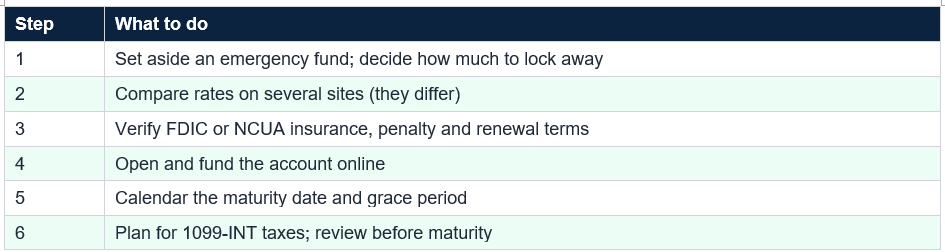
Sixth, keep records for taxes: you will receive a Form 1099-INT for interest earned. Seventh, review before maturity and compare the renewal rate with the market rather than accepting the default. Consider splitting large amounts between institutions to stay within the $250,000 insurance limit. For most savers, the process takes less than an hour and then runs on its own.
So use a 3-year CD for what it does well: safety, predictability and a decent fixed return on money you will not need. Check insurance, penalties and renewal terms, consider a ladder and keep your emergency fund somewhere flexible. Rates can change in a day, so compare on the day you buy. A qualified adviser can help you decide how CDs fit your plan.
As of late October 2026, Bankrate listed Popular Direct at 4.85% APY ($10,000 minimum), E*TRADE from Morgan Stanley at 4.80% (no minimum) and Sallie Mae Bank at 4.60% ($2,500 minimum). Other listings showed 4.70% at North American Savings Bank, and 4.50% to 4.55% at several banks. The national average three-year CD rate was about 1.74%. Rates change daily, so confirm before you open one.
Is a 3-year CD safe?
Yes, within limits. CDs at FDIC-insured banks and NCUA-insured credit unions are insured up to $250,000 per depositor, per institution, per ownership category, so there is no market risk to your principal. The risks are different: you may pay a penalty if you withdraw early, and inflation or rising rates can leave your locked rate looking less attractive.
Is 4.60% better than a high-yield savings account?
It is a little higher than the 4.34% to 4.50% that top savings accounts paid in mid-October, and it is fixed for three years while savings rates are variable. The trade-off is access: a savings account lets you withdraw anytime, while a CD usually charges a penalty. If you expect rates to fall, locking in helps; if you expect them to rise, it may not.
Is the interest from a CD taxable?
Yes. CD interest is generally taxed as ordinary income at the federal level and by most states, and it is taxed each year as it is earned even if you do not withdraw it. That is general information I did not retrieve from the sources above. At an assumed 24% federal and 5% state rate, a 4.60% CD nets about 3.27%, which is below 3.7% inflation.
What is a CD ladder?
A ladder splits your money across CDs with different maturities, for example one-, two- and three-year terms, so that part of your money becomes available every year. As each CD matures, you can spend it or reinvest it at the then-current rate. A ladder balances higher long-term rates with regular access and reduces the risk of locking everything in at the wrong time. This is general education, not personal advice.
Table of Contents
- Why Three Years?
- The Short Answer
- The Best 3-Year CD Rates Right Now
- How Much Does 4.60% Really Earn?
- What to Check Before You Lock In
- 3-Year CDs vs. Savings, T-Bills and I Bonds
- The Catch: Inflation, Taxes and Rate Risk
- Laddering: A Smarter Way to Lock In
- When a 3-Year CD Makes Sense
- How to Open One Step by Step
- Common Mistakes
- Conclusion
- Frequently Asked Questions
Top 3-year CD rates vs. the national average, late October 2026 (APY %)
APY (%) by Bankrate (Oct 27-28), Forbes Advisor (Oct 23), YourBestSavings (Oct 16), Annuity Expert Advice (Oct 28); rates change daily and institutions' insurance status was not verified
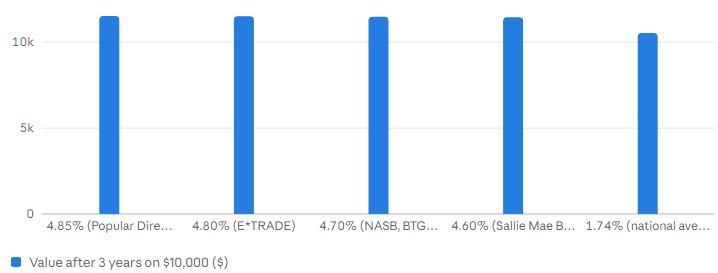
What $10,000 becomes in three years: top CD rates vs. the average ($)
Ending value ($) by Author's arithmetic, annual compounding of the quoted APY; 4.60% earns about $913 more than the average
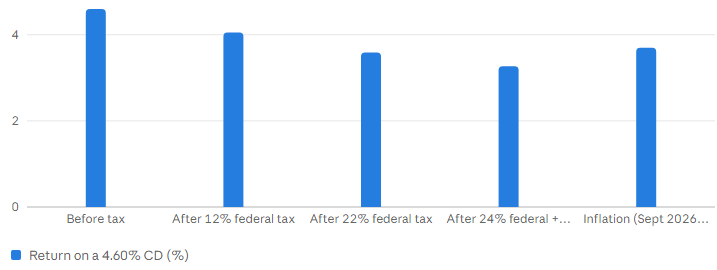
The catch: a 4.60% CD after tax vs. 3.7% inflation (%)
Percent by Author's illustration; tax rates are assumptions and tax treatment is general knowledge, not retrieved; inflation per First Trust
Why Three Years?
Savers have a quiet dilemma. Cash in a savings account is flexible but its rate can fall without warning, and stocks might grow more but can also fall. A certificate of deposit sits in the middle: you agree to leave your money alone for a set time and, in return, the bank promises a fixed rate and the government insures the principal. A three-year term is a popular middle ground, long enough to earn a good rate and short enough that you can see the finish line.This is a good moment to look. According to Bankrate’s survey, the national average three-year CD rate was about 1.74% in October, while the best banks and credit unions paid between 4.40% and 4.85%, and rates rose through the month: leading one-year rates climbed from about 4.35% in late September to 4.75% by October 9 to 11. This guide covers the top 3-year rates, what they mean after tax and inflation, and whether locking in is right for you.
The Short Answer
The best three-year CDs in late October paid 4.60% to 4.85% APY, with Popular Direct at 4.85%, E*TRADE from Morgan Stanley at 4.80% and Sallie Mae Bank at 4.60%, against a 1.74% national average. On $10,000, 4.60% grows to about $11,444 in three years: a solid, insured, fixed return, but not magic, since after assumed federal and state tax 4.60% nets about 3.27%, below 3.7% inflation. A 3-year CD works best for money you will not need for three years, ideally in a ladder, and only after you have an emergency fund.The Best 3-Year CD Rates Right Now
Here are the leading three-year rates I found in late October, with source and date. The headline 4.60% matches Sallie Mae Bank, which Bankrate and Forbes Advisor both list, but several institutions paid more. Higher rates sometimes come with higher minimums: Popular Direct requires $10,000, while E*TRADE from Morgan Stanley asked for none. Some of the highest listings came from smaller banks and credit unions, which may have eligibility rules.Late October 2026 three-year CD rates: Popular Direct 4.85%, E*TRADE from Morgan Stanley 4.80%, North American Savings Bank and BTG Pactual 4.70%, Sallie Mae Bank 4.60%. National average about 1.74% (Bankrate) or 1.36% (FDIC, September). Rates change daily.
How Much Does 4.60% Really Earn?
In my arithmetic, using annual compounding of the quoted APY, $10,000 in a three-year CD grows to about $11,527 at 4.85%, $11,510 at 4.80%, $11,477 at 4.70% and $11,444 at 4.60%, against only about $10,531 at the 1.74% national average. Choosing a 4.60% CD over an average one earns about $913 more on $10,000, and moving from 4.60% to 4.85% adds about $82. On $25,000 at 4.60%, three-year interest is about $3,611, and on $50,000 about $7,222.Two lessons follow. Shopping around matters far more than chasing the last quarter point: the gap between a top rate and the average is worth hundreds of dollars on $10,000, while the gap between 4.60% and 4.85% is worth tens. And a CD’s APY already includes compounding, so quotes compare directly, but check whether interest is paid out or added to the balance and whether the rate is fixed for the full term.
What to Check Before You Lock In
A rate is only part of a CD. First, insurance: CDs at FDIC-insured banks and NCUA-insured credit unions are covered up to $250,000 per depositor, per institution, per ownership category, and YourBestSavings notes the CDs it tracks are insured this way; confirm each institution’s status on the FDIC or NCUA website. Second, the early-withdrawal penalty, often expressed as months of interest, which I did not retrieve for these banks. Third, the minimum deposit: $0 at E*TRADE, $2,500 at Sallie Mae, $10,000 at Popular Direct and $100,000 at Luana Savings.Fourth, eligibility: some credit unions require an affiliation or small fee. Fifth, maturity: many banks automatically renew the CD at whatever rate they then offer, which can be far lower, so mark the maturity date and grace period. Sixth, whether the CD is callable or has a bump-up or no-penalty feature. And check the rate is the standard rate, not a new-money promotion.
3-Year CDs vs. Savings, T-Bills and I Bonds
A CD is not the only place to earn a decent rate. Top high-yield savings accounts paid 4.34% to 4.50% in mid-October, according to MyMoneyBlog, with no lockup but a variable rate. A 52-week Treasury bill yielded about 4.46%, with interest exempt from state tax, and brokered CDs showed 4.60% for one year and 5.20% for five. The new I bond rate is 5.51% with a 1.40% fixed rate, but with a $10,000 annual limit and a 12-month lockup. A three-year CD at 4.60% to 4.85% is competitive but not uniquely high.The real difference is the trade-off. A savings account lets you leave anytime but does not guarantee its rate will last; a CD guarantees its rate for three years but charges you for leaving. If you believe rates will fall, locking in is attractive; if you think they will rise, a shorter term or a savings account keeps flexibility. With the Fed holding at 3.75% to 4.00% on October 28 and a December hike possible, nobody knows which way rates will go.
The Catch: Inflation, Taxes and Rate Risk
The honest catch is that 4.60% is not as generous as it looks. Inflation was 3.7% in September, so before tax a 4.60% CD earns a real return of about 0.9%. After tax it changes: CD interest is generally taxed as ordinary income federally and by most states, each year as it accrues. At an assumed 24% federal and 5% state rate, 4.60% nets about 3.27%, below inflation; at a 12% federal bracket it nets about 4.05%, a small real gain. I describe the tax treatment as general knowledge, not retrieved from the sources above.There is also rate risk. If you lock in 4.60% and rates rise, you will be stuck below the market: in my illustration, a one-year CD at 4.60% followed by two years at 5.60% would leave the person who rolled about $220 ahead on $10,000. If rates fall, the person who locked in wins by a similar amount, and you cannot know in advance, which is why many savers blend terms. Treat a CD as a way to secure a decent, known return, not to beat inflation.
A CD protects your principal and locks your rate, but it does not protect your purchasing power. After tax, a 4.60% CD can earn less than 3.7% inflation, so use it for safety and predictability, not for beating prices.
Laddering: A Smarter Way to Lock In
A ladder splits your money across CDs of different lengths. With $30,000, you might put $10,000 each in one-, two- and three-year CDs; each year one matures, and you can spend it or reinvest it in a new three-year CD, so that after two years you hold three-year CDs maturing annually. A ladder gives regular access to cash, reduces the risk of locking everything in at the wrong time and captures higher long-term rates over time.It also softens the penalty problem: if you need money, you can use the CD about to mature instead of breaking one early. The downside is complexity, and shorter CDs may pay less; brokered one-year CDs showed 4.60%, two-year 4.95% and five-year 5.20% in mid-October, so the curve slopes upward. Ladders work best for people who value both yield and liquidity.
When a 3-Year CD Makes Sense
A 3-year CD makes sense for money you know you will not need for three years: a down payment on a fixed timeline, a planned purchase, a tuition payment or the safe part of a retirement portfolio. It suits people who want a guaranteed return, worry that rates may fall and have already built an emergency fund of three to six months of expenses. Bankrate found only 46% of Americans could cover three months, so for many the first priority is that cushion, in an account they can access.It makes less sense if you might need the money, since a penalty could cost months of interest, if you can earn similar rates in a savings account or Treasury bills with more flexibility, or if you need your investments to beat inflation over decades. If you expect rates to climb, a shorter term or a ladder may serve better. This is general information, not personal advice.
How to Open One Step by Step
First, decide how much you can lock away without needing it, after setting aside an emergency fund. Second, compare rates on at least three sites, since the lists differ: Bankrate, Forbes Advisor and rate trackers each showed different leaders. Third, verify insurance on the FDIC or NCUA site and read the penalty and renewal terms. Fourth, open and fund the account online. Fifth, calendar the maturity date and grace period, and decide in advance whether to withdraw, renew or move the money.Sixth, keep records for taxes: you will receive a Form 1099-INT for interest earned. Seventh, review before maturity and compare the renewal rate with the market rather than accepting the default. Consider splitting large amounts between institutions to stay within the $250,000 insurance limit. For most savers, the process takes less than an hour and then runs on its own.
Common Mistakes
Common mistakes include putting emergency money in a CD and paying a penalty, accepting auto-renewal at a lower rate, chasing the highest rate at an institution you have not checked for insurance, ignoring minimum deposits, forgetting taxes, locking everything into one term and comparing a CD’s rate with inflation before tax. The fix is a checklist, a ladder and a clear purpose for the money. Before you open a CD, write down what the money is for, when you will need it and what the penalty would be. If you cannot answer all three, wait.Conclusion
Three-year CDs are paying well in late October: Popular Direct at 4.85%, E*TRADE from Morgan Stanley at 4.80%, North American Savings Bank at 4.70% and Sallie Mae Bank at 4.60%, against a 1.74% national average. On $10,000, 4.60% grows to about $11,444 in three years, about $913 more than an average CD. The money is insured up to $250,000 and your rate is locked, but the real return is thinner than it looks: after assumed federal and state tax, 4.60% nets about 3.27%, below 3.7% inflation, and an early withdrawal can cost months of interest.So use a 3-year CD for what it does well: safety, predictability and a decent fixed return on money you will not need. Check insurance, penalties and renewal terms, consider a ladder and keep your emergency fund somewhere flexible. Rates can change in a day, so compare on the day you buy. A qualified adviser can help you decide how CDs fit your plan.
Frequently Asked Questions
What are the best 3-year CD rates right now?As of late October 2026, Bankrate listed Popular Direct at 4.85% APY ($10,000 minimum), E*TRADE from Morgan Stanley at 4.80% (no minimum) and Sallie Mae Bank at 4.60% ($2,500 minimum). Other listings showed 4.70% at North American Savings Bank, and 4.50% to 4.55% at several banks. The national average three-year CD rate was about 1.74%. Rates change daily, so confirm before you open one.
Is a 3-year CD safe?
Yes, within limits. CDs at FDIC-insured banks and NCUA-insured credit unions are insured up to $250,000 per depositor, per institution, per ownership category, so there is no market risk to your principal. The risks are different: you may pay a penalty if you withdraw early, and inflation or rising rates can leave your locked rate looking less attractive.
Is 4.60% better than a high-yield savings account?
It is a little higher than the 4.34% to 4.50% that top savings accounts paid in mid-October, and it is fixed for three years while savings rates are variable. The trade-off is access: a savings account lets you withdraw anytime, while a CD usually charges a penalty. If you expect rates to fall, locking in helps; if you expect them to rise, it may not.
Is the interest from a CD taxable?
Yes. CD interest is generally taxed as ordinary income at the federal level and by most states, and it is taxed each year as it is earned even if you do not withdraw it. That is general information I did not retrieve from the sources above. At an assumed 24% federal and 5% state rate, a 4.60% CD nets about 3.27%, which is below 3.7% inflation.
What is a CD ladder?
A ladder splits your money across CDs with different maturities, for example one-, two- and three-year terms, so that part of your money becomes available every year. As each CD matures, you can spend it or reinvest it at the then-current rate. A ladder balances higher long-term rates with regular access and reduces the risk of locking everything in at the wrong time. This is general education, not personal advice.
0 Comments
Be the first to share your thoughts on this article.