

Investing
The Rule of 72 and Real Index Funds: Why People Get It Wrong

Large-cap stocks 10.5% a year (1926–2025), long-term Treasuries 5%, T-bills 3.3% (Wells Fargo Investment Institute via Kiplinger); SPY 11% and QQQ 16.1% over 20 years (Kiplinger); top savings 4.35%; card APR 20.9%; inflation 3.7%. Rule of 72 vs exact doubling time: 8% gives 9.0 vs 9.01 years; 2% gives 36 vs 35.0; 20% gives 3.6 vs 3.8; S&P 500 at 10.5% doubles in about 6.9 years; credit card at 20.9% in about 3.65 years; prices at 3.7% inflation in about 19 years. My arithmetic on real returns, 2021–2025: QQQ averaged 19.2% a year but compounded at only 15.1%, so $1,000 became about $2,018 in five years, not a doubling in 3.75 years as the average implies; SPY averaged 15.9% but compounded at 14.3% ($1,954); at 3.7% inflation the S&P 500’s 10.5% is about 6.6% real, doubling purchasing power in about 11 years, not 6.9.
This guide explains how the rule works and how accurate it is, then does something most explainers skip: applies it to real index funds with real returns. The S&P 500, the Nasdaq-100, bonds and savings accounts all behave differently from the smooth line the rule assumes, which shows both why the rule is useful and why people get it wrong.
The rule drifts at the extremes. At 2% the exact time is 35.0 years against 36 from the rule, and at 1% 69.7 against 72. At 15% the exact time is 4.96 years against 4.8, and at 20% 3.8 against 3.6, an understatement of 5.3%. A common refinement, which I verified numerically, adds one to 72 for every three points of return above 8%, so at 15% you use 74.3 divided by 15 for 4.96 years, matching the exact value; for low rates, 70 works better. These are small errors, but they show the rule is a guide, not a law.
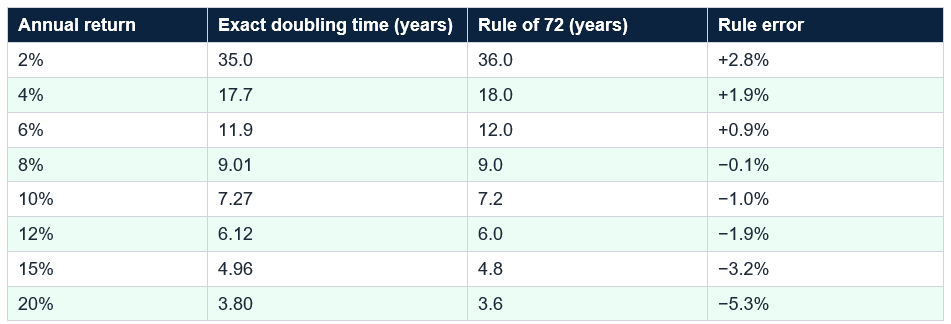
Exact doubling time vs the Rule of 72: 8% gives 9.01 vs 9.0 years (−0.1%); 2% gives 35.0 vs 36.0 (+2.8%); 20% gives 3.80 vs 3.6 (−5.3%). The rule is best between about 6% and 10%.
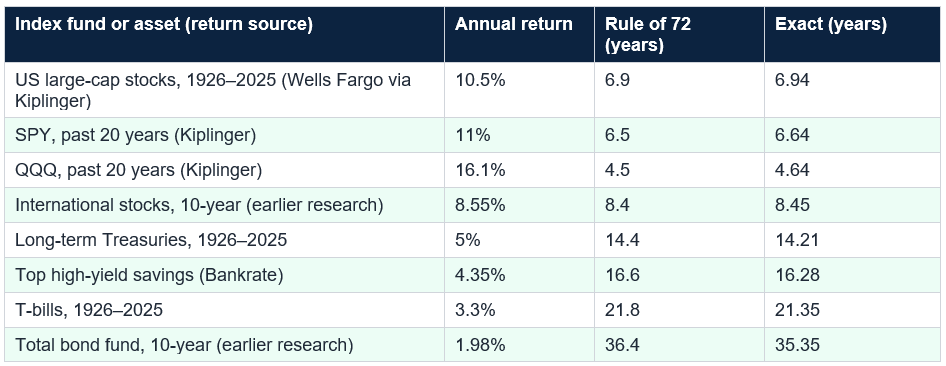
The answer depends heavily on what you own: a stock index at a long-run average near 10% doubles roughly every seven years, while bonds and cash take two to five times longer. And the rule gives a clean number from a messy reality, since each return is an average across years that varied wildly, which is the source of most errors in the next sections.
Real funds show it clearly. From 2021 through 2025, SPY returned 28.73%, minus 18.18%, 26.18%, 24.89% and 17.72%, per PortfoliosLab, an average of 15.9% a year but a compound 14.3%, so $1,000 became about $1,954. QQQ returned 27.42%, minus 32.58%, 54.86%, 25.58% and 20.77%, an average of 19.2% but a compound 15.1%, turning $1,000 into about $2,018. The rule on QQQ’s average says doubling in 3.75 years; the real money took about 4.9. Always use the compound annual growth rate, which fund fact sheets report as annualized return.

The same logic shows why cash is risky in a different way: a savings account at 4.35% against 3.7% inflation earns about 0.6% real, which the rule says would take about 115 years to double your buying power. When you plan for a goal such as retirement, use real returns, or inflate your target, so the doubling you count on is the one that matters.

Taxes work the same way: dividends and realized gains in a taxable account are taxed along the way, an effect I describe from general knowledge, not a retrieved figure. And the average investor does worse than the index: DALBAR found 6.8% a year over 30 years against 10.2% for the S&P 500, doubling in 10.6 years instead of 7.1. For a realistic estimate, use your net return after fees, taxes and your own behavior.
The rule does help with your starting balance and each lump sum: $10,000 at 10% becomes about $20,000 in 7.3 years and about $39,800 in 14.5, and at 7% takes 10.3 years to reach $20,000. For contributions, use a compound interest calculator, such as the SEC’s Investor.gov tool, or a future-value formula.
A related trap is very high return claims. If someone promises 25% a year, the rule says doubling in 2.9 years, and the exact figure is 3.1; but 25% a year for two decades would multiply your money 87 times, so a headline number should prompt a question about how long it lasted and whether it can persist.
Missing a handful of strong days can change the outcome: JPMorgan found that missing the 10 best days over 20 years cut the S&P 500’s annualized return from about 10.6% to about 6.4%, which moves the doubling time from about 6.8 to about 11.2 years. Use the rule to compare options and set expectations, then expect a bumpy real path; a plan that works only if returns are smooth is fragile.

This is a good way to start a first money conversation: ask how long a balance takes to double at the card rate, or how long a dollar takes to lose half its value at current inflation. The answers are memorable, and they make the case for paying off high-interest debt, since nothing you can safely earn on savings offsets a balance that doubles in under four years.

You can also chain doublings: at 10.5%, three doublings, an eightfold increase, take about 21 years, and $1,000 at 10.5% for 20 years becomes about $7,370, close to that. In a quick conversation a rough number is enough; when money is on the line, check with a calculator. The rule’s best use is building intuition about time and compounding, perhaps the most important idea in investing.
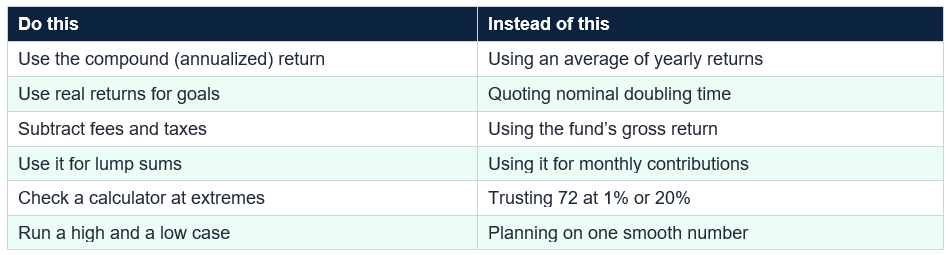
Pick your own fund’s annualized return, divide 72 by it, then subtract your fees and 3.7% inflation and divide again. The two answers show the difference between the headline and your real doubling time. Common mistakes include using an average of yearly returns, applying nominal returns to real goals, ignoring fees and taxes, using the rule for monthly savings, trusting it at very low or high rates, treating it as a prediction and believing a fund that doubled quickly will keep doing so. The rule can show how fast money could grow at a given rate; it cannot tell you what rate you will get.
The real examples make the point: QQQ’s 19.2% average over 2021 to 2025 suggested doubling in under four years, but its 15.1% compound return produced only about $2,018 from $1,000 in five years, and at 3.7% inflation the S&P 500’s purchasing power doubles in about 11 years, not 7. Use compound, real, net returns, run a low case and remember the rule also warns about debt: a 20.9% card balance doubles in under four years.
It is a mental-math shortcut: divide 72 by an annual rate of return to estimate how many years it takes money to double. At 8% it gives 9 years, at 10% about 7.2 years and at 6% 12 years. It is approximate, works best for rates from about 6% to 10% and assumes a steady return with no additions or withdrawals.
How accurate is the Rule of 72?
Quite accurate in the middle of the range. The exact doubling time at 8% is 9.01 years against 9.0 from the rule, a difference of 0.1%. At 2% it overstates by 2.8% and at 20% it understates by 5.3%, because the exact time is 3.8 years against 3.6. For rates above about 10%, adding one to 72 for every three points above 8 improves it.
Does the Rule of 72 work for index funds?
As a rough guide, yes, if you use compound (geometric) returns, not simple averages. At the S&P 500’s long-run 10.5% a year it gives about 6.9 years for money to double. But real returns vary widely year to year, so a fund will not double on a schedule, and the rule ignores inflation, fees and taxes. Use it for estimates, not predictions.
Why do people get the Rule of 72 wrong?
Common errors include using average annual returns instead of compound returns, ignoring inflation so that nominal doubling is mistaken for real doubling, forgetting fees, applying it to regular contributions, using it at very high or low rates and treating a smooth estimate as a forecast. This is general education, not personal advice.
Can I use the Rule of 72 for debt and inflation?
Yes, it works in reverse. A credit card balance at 20.9% APR that is never paid down doubles in about 3.65 years (3.4 by the rule). Prices rising 3.7% a year, the latest inflation reading, double in about 19 years, which means money loses half its buying power in that time. Both show why the rule is useful for bad compounding too.
Table of Contents
- A Shortcut Everyone Quotes
- The Short Answer
- How the Rule Works and How Accurate It Is
- The Rule Applied to Real Index Funds
- Mistake 1: Using Average Returns
- Mistake 2: Forgetting Inflation
- Mistake 3: Ignoring Fees and Taxes
- Mistake 4: Applying It to Contributions
- Mistake 5: Using It at Extreme Rates
- Mistake 6: Treating It as a Forecast
- The Rule in Reverse: Debt and Inflation
- How to Use the Rule Well
- Common Mistakes
- Conclusion
- Frequently Asked Questions
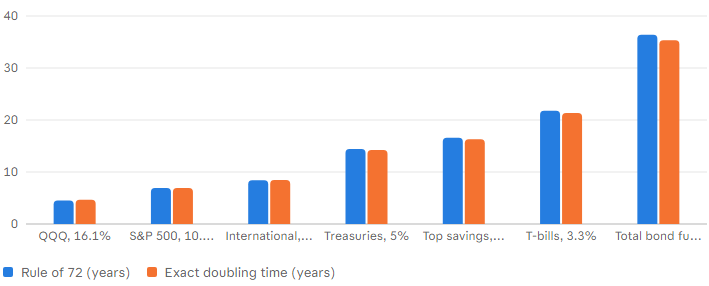
The Rule of 72 on real index funds and assets: years to double
Years to double by Wells Fargo Investment Institute via Kiplinger (1926-2025), Kiplinger (20-year), Bankrate; international and bond fund 10-year returns from earlier research; author's arithmetic with annual compounding
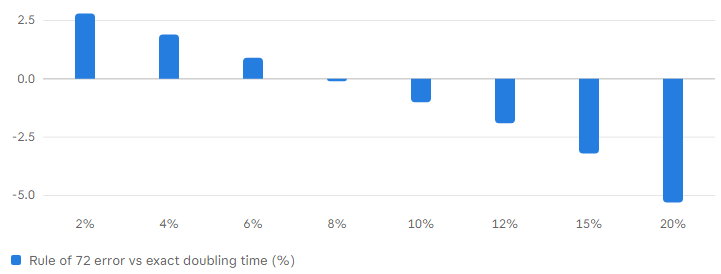
How accurate is the Rule of 72? Error by annual return (%)
Error (%) by my arithmetic: (72 / r) versus ln(2) / ln(1 + r); positive means the rule overstates the years, negative means it understates; best between about 6% and 10%
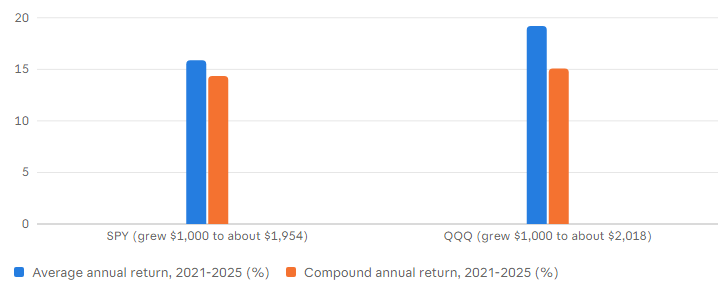
The classic mistake: average vs. compound returns for SPY and QQQ, 2021-2025 (%)
% a year by PortfoliosLab calendar-year returns (secondary source); author's arithmetic; the rule on QQQ's average implies doubling in 3.75 years, on its compound return about 4.8 years
A Shortcut Everyone Quotes
The Rule of 72 is one of the most quoted pieces of financial arithmetic. Divide 72 by your annual return and you get the years it takes money to double: nine at 8%, twelve at 6%, a little over seven at 10%. You can do it in your head at a barbecue, which is why it is so popular and why it so often gets misused: a shortcut that is easy to say is easy to apply to things it was never built for.This guide explains how the rule works and how accurate it is, then does something most explainers skip: applies it to real index funds with real returns. The S&P 500, the Nasdaq-100, bonds and savings accounts all behave differently from the smooth line the rule assumes, which shows both why the rule is useful and why people get it wrong.
The Short Answer
The Rule of 72 estimates the years to double as 72 divided by the annual return, and it is remarkably accurate for rates from roughly 6% to 10%. For the S&P 500’s long-run 10.5% a year, it gives about 6.9 years. People get it wrong by using average instead of compound returns, forgetting inflation, ignoring fees and taxes, applying it to regular contributions, using it at very high or low rates and treating it as a forecast. In my real-fund example, QQQ’s five-year average return of 19.2% implies doubling in 3.75 years, but its compound return of 15.1% grew $1,000 to only about $2,018 in five years.
How the Rule Works and How Accurate It Is
The rule comes from compound interest. Money doubles when (1 + r) raised to the number of years equals 2, so the exact time is the natural log of 2 divided by the log of (1 + r), about 69.3 divided by the rate for small rates. The number 72 is used because it has many divisors, which makes mental math easy, and because it fits best for rates near 8%. In my arithmetic, the exact doubling time at 8% is 9.01 years against 9.0 from the rule, and at 6% 11.9 against 12.0.The rule drifts at the extremes. At 2% the exact time is 35.0 years against 36 from the rule, and at 1% 69.7 against 72. At 15% the exact time is 4.96 years against 4.8, and at 20% 3.8 against 3.6, an understatement of 5.3%. A common refinement, which I verified numerically, adds one to 72 for every three points of return above 8%, so at 15% you use 74.3 divided by 15 for 4.96 years, matching the exact value; for low rates, 70 works better. These are small errors, but they show the rule is a guide, not a law.
Exact doubling time vs the Rule of 72: 8% gives 9.01 vs 9.0 years (−0.1%); 2% gives 35.0 vs 36.0 (+2.8%); 20% gives 3.80 vs 3.6 (−5.3%). The rule is best between about 6% and 10%.
The Rule Applied to Real Index Funds
According to Wells Fargo Investment Institute data cited by Kiplinger, large-cap US stocks returned 10.5% a year from 1926 through 2025, which the rule turns into about 6.9 years to double, against an exact 6.94. SPY’s 20-year 11% implies about 6.5 years and QQQ’s 16.1% about 4.5. Long-term Treasuries at 5% double in about 14.4 years, T-bills at 3.3% in about 21.8 and a top savings account at 4.35% in about 16.6; an international fund at 8.55% over 10 years in about 8.4 and a total bond fund at 1.98% in about 36, using fund figures from earlier research.The answer depends heavily on what you own: a stock index at a long-run average near 10% doubles roughly every seven years, while bonds and cash take two to five times longer. And the rule gives a clean number from a messy reality, since each return is an average across years that varied wildly, which is the source of most errors in the next sections.
Mistake 1: Using Average Returns
The most common error is feeding the rule an average annual return instead of a compound one. A fund that gains 50% one year and loses 33.3% the next has an average of 8.3% a year, but your money is back where it started, a compound return of zero; the rule on 8.3% would claim doubling in nine years. The gap between arithmetic average and compound (geometric) return is called volatility drag, and it grows with volatility.Real funds show it clearly. From 2021 through 2025, SPY returned 28.73%, minus 18.18%, 26.18%, 24.89% and 17.72%, per PortfoliosLab, an average of 15.9% a year but a compound 14.3%, so $1,000 became about $1,954. QQQ returned 27.42%, minus 32.58%, 54.86%, 25.58% and 20.77%, an average of 19.2% but a compound 15.1%, turning $1,000 into about $2,018. The rule on QQQ’s average says doubling in 3.75 years; the real money took about 4.9. Always use the compound annual growth rate, which fund fact sheets report as annualized return.
Mistake 2: Forgetting Inflation
The rule is usually applied to nominal returns, and doubling your dollars is not doubling your purchasing power. Inflation was 3.7% in September, so the S&P 500’s long-run nominal 10.5% is about 6.6% after inflation, and purchasing power doubles in about 11 years, not 6.9. At a more typical historical inflation near 3%, the real return would be about 7.3% and the doubling time about 9.9 years. Either way, the nominal figure flatters the result by years.The same logic shows why cash is risky in a different way: a savings account at 4.35% against 3.7% inflation earns about 0.6% real, which the rule says would take about 115 years to double your buying power. When you plan for a goal such as retirement, use real returns, or inflate your target, so the doubling you count on is the one that matters.
Mistake 3: Ignoring Fees and Taxes
The rule assumes you keep the whole return, but fees come out first. A broad index fund charges 0.015% to 0.04% a year, according to Bankrate, so a 10% gross return nets about 9.97% and doubles in about 7.29 years. A 1% fund nets 9% and doubles in about 8.04 years, three-quarters of a year longer for the first doubling and far more after several.Taxes work the same way: dividends and realized gains in a taxable account are taxed along the way, an effect I describe from general knowledge, not a retrieved figure. And the average investor does worse than the index: DALBAR found 6.8% a year over 30 years against 10.2% for the S&P 500, doubling in 10.6 years instead of 7.1. For a realistic estimate, use your net return after fees, taxes and your own behavior.
Mistake 4: Applying It to Contributions
The Rule of 72 describes a single sum left alone and says nothing about regular contributions. People sometimes reason that at 10% money doubles every 7.2 years, so $500 a month for 7.2 years will double what they put in. In my arithmetic, $500 a month for about 7.3 years at 10% means $43,600 contributed, which grows to about $63,500, a gain of 46%, not 100%, because each contribution has less time to compound than the first.The rule does help with your starting balance and each lump sum: $10,000 at 10% becomes about $20,000 in 7.3 years and about $39,800 in 14.5, and at 7% takes 10.3 years to reach $20,000. For contributions, use a compound interest calculator, such as the SEC’s Investor.gov tool, or a future-value formula.
Mistake 5: Using It at Extreme Rates
The rule is least accurate at very low and very high rates, which are often the headline numbers: at 1% it says 72 years against an exact 69.7, and at 20% 3.6 against 3.8. For a credit card at 20.9% APR, the rule gives about 3.4 years against an exact 3.65, about 44 months, for an unpaid balance to double. The error is small in absolute terms but matters for debt decisions and aggressive return claims.A related trap is very high return claims. If someone promises 25% a year, the rule says doubling in 2.9 years, and the exact figure is 3.1; but 25% a year for two decades would multiply your money 87 times, so a headline number should prompt a question about how long it lasted and whether it can persist.
Mistake 6: Treating It as a Forecast
The deepest error is treating a doubling time as a prediction. The rule describes a smooth, constant return that no index fund delivers. The S&P 500 averaged about 10.5% a year over nearly a century, but that includes years like 2022, when SPY lost 18.18%, and 27 bear markets since 1928 averaging a 35% decline, which needs a 54% gain to recover. Over short horizons, a stock fund may double in three years or not at all.Missing a handful of strong days can change the outcome: JPMorgan found that missing the 10 best days over 20 years cut the S&P 500’s annualized return from about 10.6% to about 6.4%, which moves the doubling time from about 6.8 to about 11.2 years. Use the rule to compare options and set expectations, then expect a bumpy real path; a plan that works only if returns are smooth is fragile.
The Rule in Reverse: Debt and Inflation
The rule is just as useful for compounding that works against you. A credit card balance at 20.9% APR that is never paid down doubles in about 3.65 years, 3.4 by the rule, and prices rising 3.7% a year double in about 19 years, so a fixed sum’s purchasing power halves in that time; even a 3% rate halves it in 24 years.This is a good way to start a first money conversation: ask how long a balance takes to double at the card rate, or how long a dollar takes to lose half its value at current inflation. The answers are memorable, and they make the case for paying off high-interest debt, since nothing you can safely earn on savings offsets a balance that doubles in under four years.
How to Use the Rule Well
Used carefully, the rule is a valuable shortcut. Use compound returns, not averages; real returns for goals that depend on buying power; net-of-fee returns; lump sums, not contributions; an adjustment at rates well above 10% or below 4%; and treat the result as an estimate. Run it at two rates, your hopeful one and a lower one: at 10% money doubles in about seven years and at 6% in 12, a gap that shows how much the return assumption matters.You can also chain doublings: at 10.5%, three doublings, an eightfold increase, take about 21 years, and $1,000 at 10.5% for 20 years becomes about $7,370, close to that. In a quick conversation a rough number is enough; when money is on the line, check with a calculator. The rule’s best use is building intuition about time and compounding, perhaps the most important idea in investing.
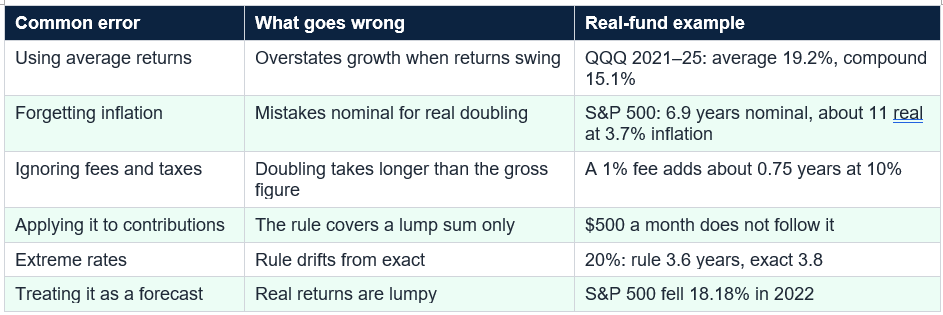
Pick your own fund’s annualized return, divide 72 by it, then subtract your fees and 3.7% inflation and divide again. The two answers show the difference between the headline and your real doubling time. Common mistakes include using an average of yearly returns, applying nominal returns to real goals, ignoring fees and taxes, using the rule for monthly savings, trusting it at very low or high rates, treating it as a prediction and believing a fund that doubled quickly will keep doing so. The rule can show how fast money could grow at a given rate; it cannot tell you what rate you will get.
Conclusion
The Rule of 72 is a great shortcut: 72 divided by the annual return gives the years to double, within a few percent of the exact answer for rates from about 2% to 20%. Applied to real index funds, it says the S&P 500’s long-run 10.5% doubles money in about 6.9 years, QQQ’s 16.1% in about 4.5, long-term Treasuries at 5% in 14.4 and T-bills at 3.3% in about 22. But people misuse it by using averages instead of compound returns, forgetting inflation and fees, applying it to contributions and treating it as a forecast.The real examples make the point: QQQ’s 19.2% average over 2021 to 2025 suggested doubling in under four years, but its 15.1% compound return produced only about $2,018 from $1,000 in five years, and at 3.7% inflation the S&P 500’s purchasing power doubles in about 11 years, not 7. Use compound, real, net returns, run a low case and remember the rule also warns about debt: a 20.9% card balance doubles in under four years.
Frequently Asked Questions
What is the Rule of 72?It is a mental-math shortcut: divide 72 by an annual rate of return to estimate how many years it takes money to double. At 8% it gives 9 years, at 10% about 7.2 years and at 6% 12 years. It is approximate, works best for rates from about 6% to 10% and assumes a steady return with no additions or withdrawals.
How accurate is the Rule of 72?
Quite accurate in the middle of the range. The exact doubling time at 8% is 9.01 years against 9.0 from the rule, a difference of 0.1%. At 2% it overstates by 2.8% and at 20% it understates by 5.3%, because the exact time is 3.8 years against 3.6. For rates above about 10%, adding one to 72 for every three points above 8 improves it.
Does the Rule of 72 work for index funds?
As a rough guide, yes, if you use compound (geometric) returns, not simple averages. At the S&P 500’s long-run 10.5% a year it gives about 6.9 years for money to double. But real returns vary widely year to year, so a fund will not double on a schedule, and the rule ignores inflation, fees and taxes. Use it for estimates, not predictions.
Why do people get the Rule of 72 wrong?
Common errors include using average annual returns instead of compound returns, ignoring inflation so that nominal doubling is mistaken for real doubling, forgetting fees, applying it to regular contributions, using it at very high or low rates and treating a smooth estimate as a forecast. This is general education, not personal advice.
Can I use the Rule of 72 for debt and inflation?
Yes, it works in reverse. A credit card balance at 20.9% APR that is never paid down doubles in about 3.65 years (3.4 by the rule). Prices rising 3.7% a year, the latest inflation reading, double in about 19 years, which means money loses half its buying power in that time. Both show why the rule is useful for bad compounding too.
0 Comments
Be the first to share your thoughts on this article.