

Investing
The Rule of 72 Explained With Index Funds: 5 Costly Mistakes

A plain-English guide to doubling your money with index funds, and the five slips that make the shortcut mislead.S&P 500 about 9.92% a year nominal, 6.64% real (1928 to 2025), Doubling at 7% is 10.2 years, Average fund fee 0.32%, Index equity ETF fee 0.14%, 1% extra fee adds about 1.7 years to doubling (my calculation).
The Rule of 72 says you can estimate how long an investment takes to double by dividing 72 by the yearly return. At 8%, that is 72 divided by 8, or about nine years. It is quick, it works in your head, and for the returns most index fund investors talk about it is surprisingly close. The trouble starts when people plug in the wrong number. The most common slip is dividing 72 by 10 because the stock market is said to average 10%. That gives 7.2 years. But 10% is before inflation, before fees and before the bumps of real life. Use a more realistic figure, and the answer moves to ten years or more.
Key takeaway: The rule itself is fine. The inputs are where people go wrong. Use a return after inflation and fees, apply it to a lump sum, and treat the answer as a rough guide, not a promise.
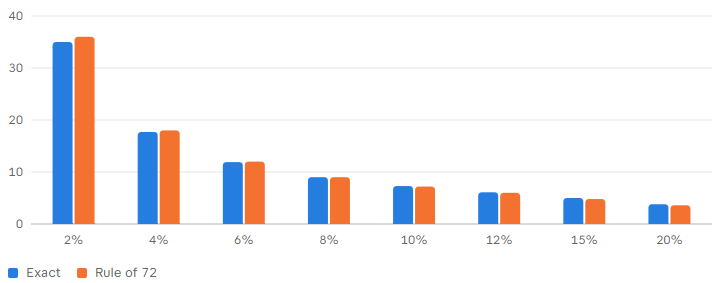
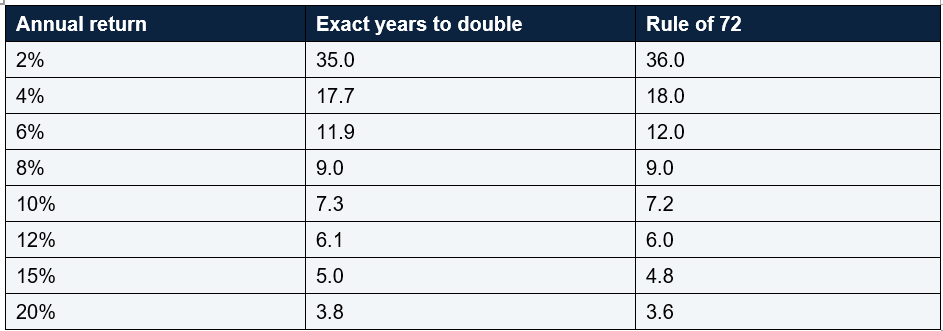
Source: my calculation, exact years = ln(2) / ln(1 + rate). Rule of 72 = 72 / rate. Between about 6% and 12%, it is within a few percent of the exact answer, which is why guides call it surprisingly accurate in that range. At very low rates a lower number such as 69.3 or 70 does better, and at high rates a higher number does. WTOP makes the same point: accuracy fades as rates move well away from the middle range. For index fund investing, where realistic returns sit in that middle range, 72 is good enough. The bigger errors come from what you put into the rule, not from the rule.
How is this year going? As of 13 November 2026, the S&P 500 was up 10.25% year to date, though down 3.31% over the previous month. That is one year and tells you very little about the next 20. One more caution. Some institutional forecasts for the next decade are lower than history, ranging from about 3% in a bear case to 4% to 7% in a base case, according to one summary. I would treat that as a reminder to test a lower rate too, not as a prediction.
Inflation is not hypothetical now. The PCE price index rose to 3.6% in September 2026, according to a TradingKey summary, with the Cleveland Fed's nowcast pointing higher for October and November. October consumer prices rose 0.4% for the month, though annual CPI figures were unavailable because of the 2025 shutdown. I am not predicting where inflation goes. I am saying a plan that ignores it can be badly off. Fix: Use a real return, such as 6% to 7%, if you want to know when your money doubles in today's buying power. Use the nominal figure only if you want the dollar amount on the statement.
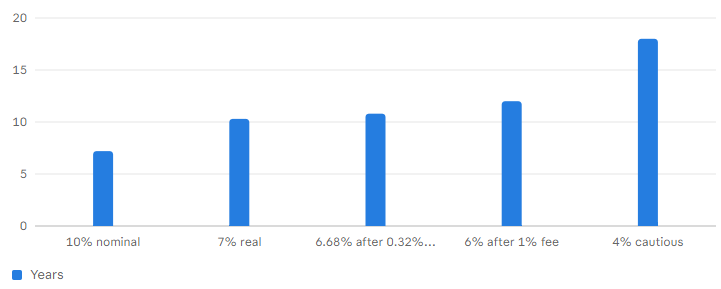
Here is what that looks like, starting from a 7% real return before fees. These are my calculations.
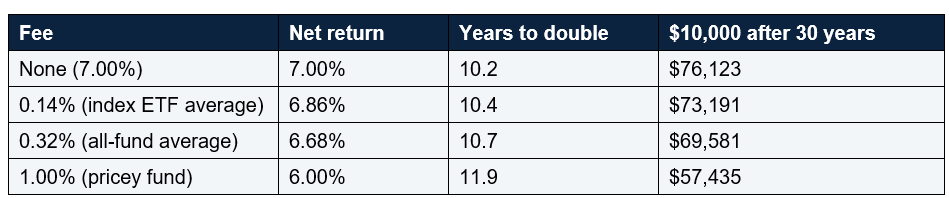
My calculation, assuming a 7% real return before fees and no contributions. Fee averages from Morningstar and ICI. A 1% fee adds only about 1.7 years to each doubling. But over 30 years it costs roughly $18,700 on a $10,000 start (my calculation). The index-fund edge is largely this: you keep more of each doubling.
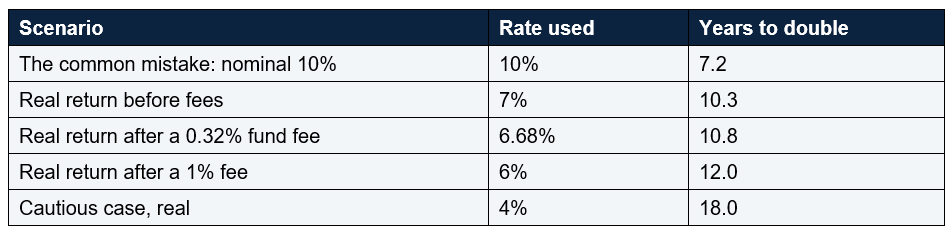
My calculation using 72 divided by the rate; exact doubling times are slightly different, see section 3. The spread, from 7.2 to 18 years, is the point. The same index fund gives a very different answer depending on what you assume. That does not mean the rule is bad. It means the number you feed it should be honest.
If you remember one thing, make it this: run the rule at two or three rates and look at the range. The honest answer is not "seven years", it is "somewhere between seven and eighteen, depending on what I assume". This post is general education, and I am not a financial adviser. Please check current figures and consider professional advice for your situation.
Divide 72 by your yearly percentage return to estimate the years needed to double your money. At 6% that is about 12 years .
How long will an S&P 500 index fund take to double?
At the long-run nominal rate of about 9.92% a year, roughly 7 years. At the real rate of 6.64%, roughly 11 years (my calculation). Real life will vary.
Is the Rule of 72 accurate?
It is close for returns between about 6% and 12%, and less accurate at very low or very high rates. The exact doubling time uses a log formula, and 69.3 suits continuous compounding.
Should I use the nominal or real return?
Use the real, after-inflation figure if you care about buying power, and the nominal figure if you want the dollar total. Nominal is roughly 10% and real roughly 6% to 7% over long periods.
Do fees really change the answer?
Yes, though less than people fear for index funds. The average fund fee is 0.32% and index equity ETFs average 0.14%. In my calculation a 1% fee adds about 1.7 years to each doubling.
Table of Contents
- What the Rule of 72 says, and why 72
- How accurate is it?
- What index funds have actually returned
- Mistake 1: using the 10% number as if inflation did not exist
- Mistake 2: forgetting the fund fee
- Mistake 3: assuming a smooth ride
- Mistake 4: using it for monthly contributions
- Mistake 5: the small slips, plus taxes
- The rule in reverse: inflation
- Worked examples side by side
- Conclusion
- FAQ
The Rule of 72 says you can estimate how long an investment takes to double by dividing 72 by the yearly return. At 8%, that is 72 divided by 8, or about nine years. It is quick, it works in your head, and for the returns most index fund investors talk about it is surprisingly close. The trouble starts when people plug in the wrong number. The most common slip is dividing 72 by 10 because the stock market is said to average 10%. That gives 7.2 years. But 10% is before inflation, before fees and before the bumps of real life. Use a more realistic figure, and the answer moves to ten years or more.
Key takeaway: The rule itself is fine. The inputs are where people go wrong. Use a return after inflation and fees, apply it to a lump sum, and treat the answer as a rough guide, not a promise.
What the Rule of 72 says, and why 72
The rule is a shortcut for compound growth, where your gains earn their own gains. You take 72, divide by the annual percentage return as a whole number, and the answer is the approximate years to double [6]. Use 6, not 0.06. Why 72 and not another number? The math behind it points to about 69.3 for continuous compounding. But 69.3 is awkward to divide in your head, while 72 divides neatly by 2, 3, 4, 6, 8, 9 and 12. So the world settled on 72. One credit union guide adds that 69.3 fits continuous compounding, while 72 is nearer to a fixed annual rate. It is a convenience, not a law. The same trick works backwards. Divide 72 by the number of years you have, and you get the return needed to double in that time. It also works for halving, such as the buying power of cash under inflation.Years to double: exact vs Rule of 72
Years by Annual return. Source: my calculation (ln2 / ln(1+r))
How accurate is it?
How close is it? Here is the exact doubling time next to the shortcut. The exact figures are my calculation using the standard compound growth formula.Source: my calculation, exact years = ln(2) / ln(1 + rate). Rule of 72 = 72 / rate. Between about 6% and 12%, it is within a few percent of the exact answer, which is why guides call it surprisingly accurate in that range. At very low rates a lower number such as 69.3 or 70 does better, and at high rates a higher number does. WTOP makes the same point: accuracy fades as rates move well away from the middle range. For index fund investing, where realistic returns sit in that middle range, 72 is good enough. The bigger errors come from what you put into the rule, not from the rule.
What index funds have actually returned
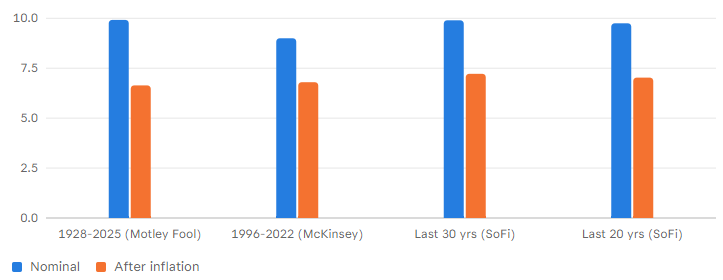
To use the rule with index funds, you need a sensible return. Here is what the data say. Motley Fool calculated that the S&P 500 had a nominal compound annual growth rate of 9.92% from 1928 to 2025, and 6.64% after inflation. McKinsey found a mean total return of 9% nominal and 6.8% real from 1996 to mid-June 2022. SoFi shows 9.90% nominal and 7.22% real over the last 30 years, and 9.75% and 7.03% over 20 years. So the usual summary, about 10% before inflation and about 6% to 7% after, holds up. Different sources land on slightly different numbers because they use different start dates and methods .How is this year going? As of 13 November 2026, the S&P 500 was up 10.25% year to date, though down 3.31% over the previous month. That is one year and tells you very little about the next 20. One more caution. Some institutional forecasts for the next decade are lower than history, ranging from about 3% in a bear case to 4% to 7% in a base case, according to one summary. I would treat that as a reminder to test a lower rate too, not as a prediction.
Mistake 1: using the 10% number as if inflation did not exist
This is the big one. If you divide 72 by 10, you get 7.2 years. But prices rise over time, so a dollar in seven years buys less than today. In real terms, using about 7%, doubling takes about 10.2 years (my calculation). That is a gap of three years, and it widens over time. Moneywise gives a simple example: a 7% nominal return with 3% inflation leaves a real return of only 4% . At 4%, the Rule of 72 says 18 years to double, not ten.Inflation is not hypothetical now. The PCE price index rose to 3.6% in September 2026, according to a TradingKey summary, with the Cleveland Fed's nowcast pointing higher for October and November. October consumer prices rose 0.4% for the month, though annual CPI figures were unavailable because of the 2025 shutdown. I am not predicting where inflation goes. I am saying a plan that ignores it can be badly off. Fix: Use a real return, such as 6% to 7%, if you want to know when your money doubles in today's buying power. Use the nominal figure only if you want the dollar amount on the statement.
Years to double depends on the input (Rule of 72)
Years to double by Source: my calculation, 72 / rate; fee averages from Morningstar
Mistake 2: forgetting the fund fee
Fees are quiet but real. Index funds are cheap, but not free. Morningstar says the asset-weighted average expense ratio paid by US fund investors fell to 0.32% in 2025, from 0.80% in 2006. The Investment Company Institute puts the average for index equity ETFs at 0.14%. Fidelity notes that expense ratios can have a meaningful effect on long-term returns.Here is what that looks like, starting from a 7% real return before fees. These are my calculations.
My calculation, assuming a 7% real return before fees and no contributions. Fee averages from Morningstar and ICI. A 1% fee adds only about 1.7 years to each doubling. But over 30 years it costs roughly $18,700 on a $10,000 start (my calculation). The index-fund edge is largely this: you keep more of each doubling.
Mistake 3: assuming a smooth ride
The rule uses a single, steady rate. The stock market does not. Even the S&P 500's 9.92% figure is a compound growth rate, which smooths out a bumpy path. Money Crashers makes the point that average does not mean regular or predictable. Look at three recent years. One table shows the S&P 500 at minus 19.4% in 2022, then plus 24.2% in 2023 and plus 23.3% in 2024. Those swings average out, but you would not have felt a smooth 7% in any of them. This matters because order matters. If you need your money in the middle of a bad stretch, the rule's tidy doubling date does not help. A UK-focused guide puts it well: you do not invest in the long-run average, you invest across one specific sequence of years. How to use it: run the rule at a few rates, say 4%, 6% and 8%, and treat the spread of answers as your range. At 4% it is 18 years, at 6% it is 12, and at 8% it is nine.Mistake 4: using it for monthly contributions
The Rule of 72 answers one question: how long until a single sum doubles if you add nothing. Most index fund investors do not work that way. They add money every month. Money Crashers warns about exactly this: to account for new contributions, use a compound interest calculator instead of the rule. Kiplinger also points to tools like the free calculator on Investor.gov and to planners that can include taxes, inflation and fees. Here is why it matters. With regular contributions, your balance grows faster than the rule suggests, because new money keeps arriving. The rule might tell you your first $10,000 doubles in ten years, but it says nothing about the $500 you add each month. A fair way to use it: apply it to what you already have to see how the existing pot can grow, and use a full calculator for the contribution plan.S&P 500 long-run returns: nominal vs real (% a year)
% per year by Sources: Motley Fool, McKinsey, SoFi. Periods and methods differ
Mistake 5: the small slips, plus taxes
A few smaller slips are worth naming. Using decimals. Plug in 0.07 and the result is 1,029, which is meaningless. The rate must be a whole number such as 7. Applying it to wild rates. At very low or very high rates, 72 gets less reliable. Mixing up price and total return. Total return includes dividends, and the price-only figure is lower over the long run. Make sure the number you use matches what you will actually earn. Ignoring taxes. Tax depends on your country and account type, and I did not find a single reliable figure, so I leave it out of the math. Tools that include tax and inflation do exist. If you hold funds in a taxable account, your after-tax return will be lower than what the rule shows. Treating the answer as a promise. Even the most careful doubling date is an estimate. Plan with a margin.The rule in reverse: inflation
The rule works in reverse for inflation, which makes it useful for a sobering check. At 3% inflation, prices double in about 24 years (72 divided by 3). NerdWallet notes that investors can expect to lose 2% to 3% of their purchasing power every year. At the 3.6% PCE reading mentioned earlier, the rule gives 20 years (my calculation). That is a good reason to invest at all. Cash that earns less than inflation shrinks in real terms. An index fund that earns a real 6% to 7% doubles your buying power in roughly 10 to 12 years, if history is a fair guide (my calculation). It is not guaranteed, but it shows why many people choose stocks for long goals.Worked examples side by side
Here is a side-by-side that puts the mistakes in one place. Each row uses the Rule of 72, and I flag my own arithmetic.My calculation using 72 divided by the rate; exact doubling times are slightly different, see section 3. The spread, from 7.2 to 18 years, is the point. The same index fund gives a very different answer depending on what you assume. That does not mean the rule is bad. It means the number you feed it should be honest.
Conclusion
The Rule of 72 is one of the best mental shortcuts in personal finance. Divide 72 by the yearly return and you get a quick sense of how compounding works. For index funds, with realistic returns in the 4% to 10% range, it is accurate enough. The mistakes are in the inputs. Use a return after inflation, so you know what your money will actually buy. Subtract the fund fee, because even a low one adds up. Remember that markets do not move in a straight line. And use the rule for a lump sum, not for monthly contributions.If you remember one thing, make it this: run the rule at two or three rates and look at the range. The honest answer is not "seven years", it is "somewhere between seven and eighteen, depending on what I assume". This post is general education, and I am not a financial adviser. Please check current figures and consider professional advice for your situation.
FAQ
What is the Rule of 72 in simple terms?Divide 72 by your yearly percentage return to estimate the years needed to double your money. At 6% that is about 12 years .
How long will an S&P 500 index fund take to double?
At the long-run nominal rate of about 9.92% a year, roughly 7 years. At the real rate of 6.64%, roughly 11 years (my calculation). Real life will vary.
Is the Rule of 72 accurate?
It is close for returns between about 6% and 12%, and less accurate at very low or very high rates. The exact doubling time uses a log formula, and 69.3 suits continuous compounding.
Should I use the nominal or real return?
Use the real, after-inflation figure if you care about buying power, and the nominal figure if you want the dollar total. Nominal is roughly 10% and real roughly 6% to 7% over long periods.
Do fees really change the answer?
Yes, though less than people fear for index funds. The average fund fee is 0.32% and index equity ETFs average 0.14%. In my calculation a 1% fee adds about 1.7 years to each doubling.
0 Comments
Be the first to share your thoughts on this article.