

Real Estate
UK Mortgage Rates Rise to a Month High: Accountants' Guide
UK MORTGAGE RATES -- AUGUST 2026 | Average 2-year fixed: 5.54-5.62% (Moneyfacts). Best 2-year at 60% LTV: 4.13% (Danske Bank, August 2026). Bank Rate held at 3.75% (30 July). 750,000 homeowners leaving sub-3% deals face £170/month increase. Rates edging back up in August after falling in June. Here is what it means and what to do.
Rates Edge Back Up After a Brief June Relief
The Current Rate Picture: UK Mortgage Rates in August 2026
Why Are UK Mortgage Rates Rising in August 2026?
Who Is Affected: What the Rate Rise Means by Borrower Type
The 750,000 Homeowners Facing £170/Month More: The Sub-3% Deal Expiry
Two-Year vs Five-Year Fixed: Which Should You Choose in August 2026?
What Happens Next: The Bank of England September Decision and Rate Outlook
Conclusion: Higher for the Month, Lower Than the Peak -- Act on Your Own Timeline
Frequently Asked Questions (FAQ)
HomeOwners Alliance (6 days ago -- most current): 'After falling sharply during June, average mortgage rates have started edging back up in August 2026 as many lenders increased fixed mortgage rates. The Bank of England held the base rate at 3.75% on 30 July.' The August rate increases are not driven by a Bank of England decision -- the base rate remains unchanged since May 2025. They are driven by swap rates: the wholesale cost of money that banks and building societies use to price fixed-rate mortgages, which are influenced by financial markets' expectations for future interest rates and by current global uncertainty.
For homeowners and buyers, the August 2026 rate environment is materially different from the start of the year: the average two-year fix that was 4.83% in March is now 5.54-5.62%. That increase on a £200,000 mortgage adds approximately £130-150 to the monthly payment. This guide presents the full picture: the latest rate data, who is affected and how, what is driving the movements, what the Bank of England's next decision could mean, and the specific actions that different types of borrower should take right now.
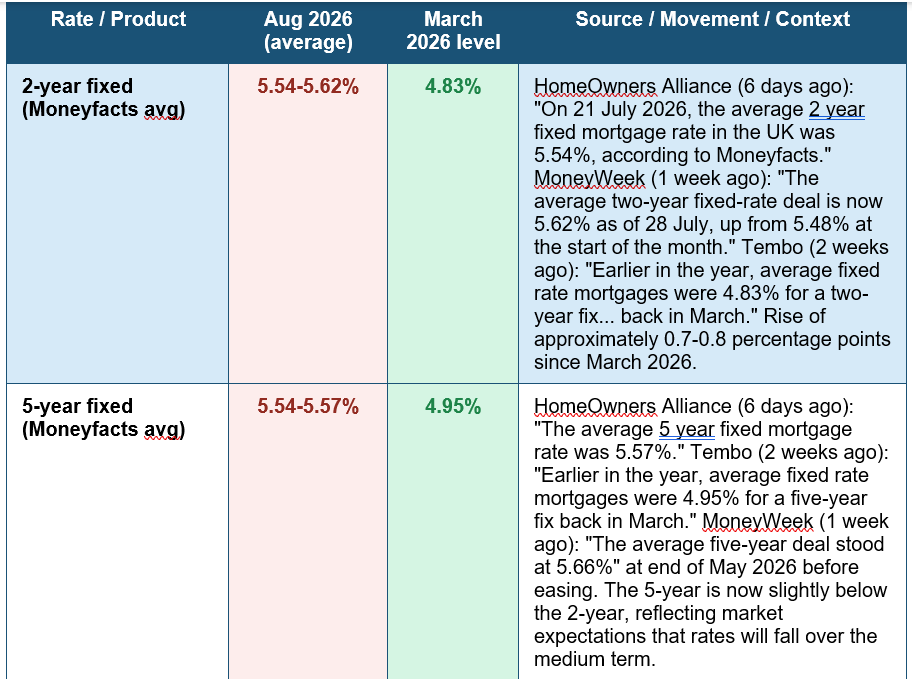
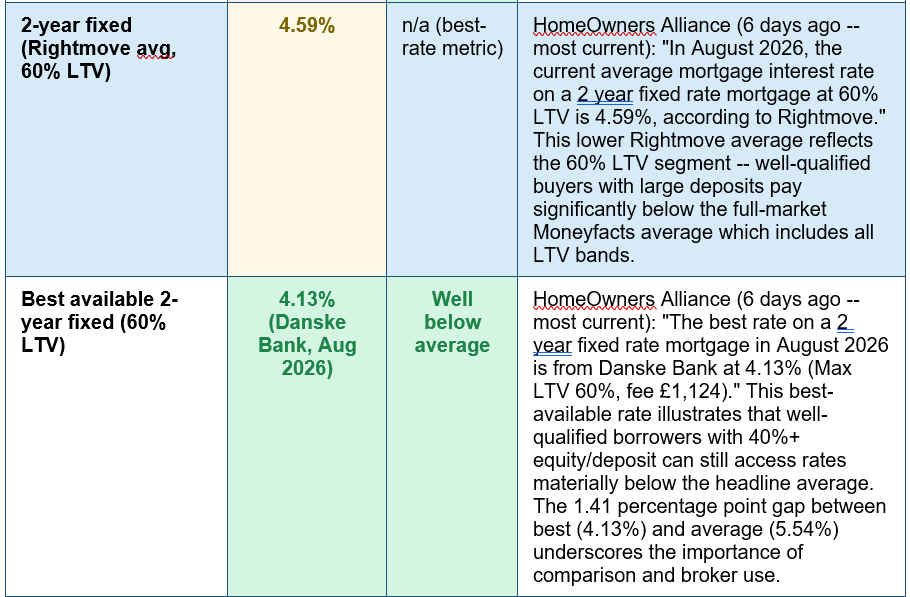
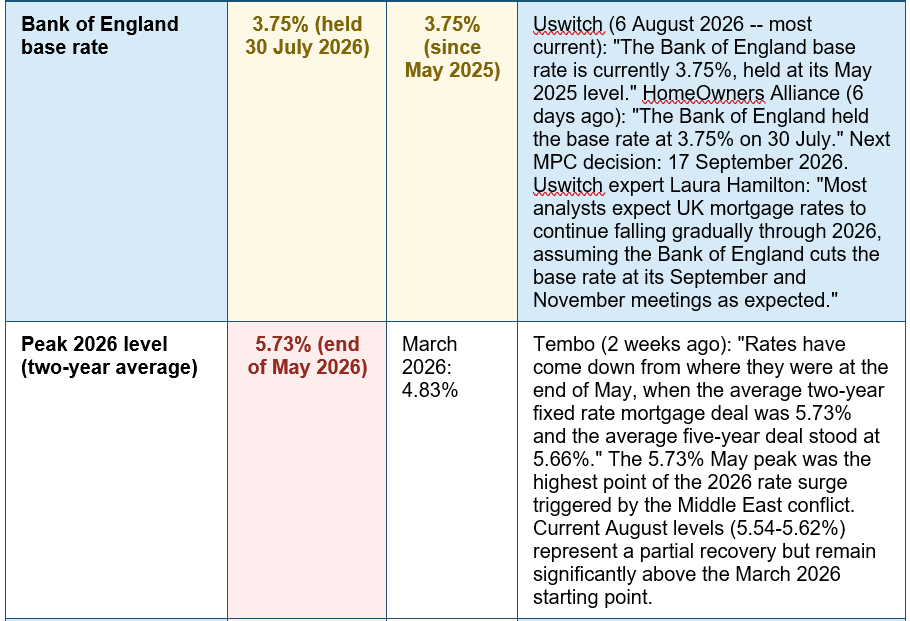
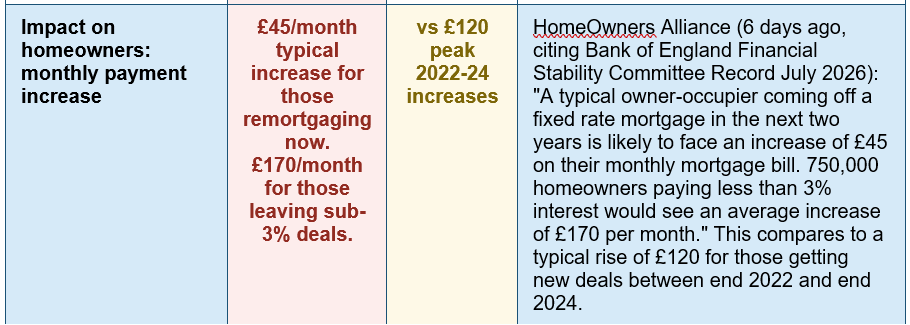
UK mortgage rates August 2026 -- the defining numbers: 2-yr avg: 5.54-5.62%. 5-yr avg: 5.54-5.57%. Best 2-yr at 60% LTV: 4.13%. Bank Rate: 3.75% (held). March 2026 starting point: 4.83%. — Uswitch (6 August 2026 -- most current, 20 hours ago): 'Bank of England base rate 3.75%, held at May 2025 level.' HomeOwners Alliance (6 days ago): '21 July 2026 average 2-year fix 5.54% (Moneyfacts). Best 2-year 60% LTV: 4.13% Danske Bank August 2026. Average 5-year fix 5.57%.' MoneyWeek (1 week ago): 'Average two-year fixed 5.62% as of 28 July, up from 5.48% start of July.' Tembo (2 weeks ago): 'March 2026 averages: 2-year 4.83%, 5-year 4.95%. Peak May 2026: 5.73% two-year.'
HomeOwners Alliance (6 days ago, citing the Bank of England Financial Stability Committee Record, July 2026): '750,000 homeowners who are paying less than 3% interest on their current deal would be coming off these deals this year and would see an average increase of £170 per month in repayments, the Bank said.' The Bank's July 2026 Financial Stability report also updated its forecast for the total number of homeowners facing higher repayments: 'A million more homeowners face higher mortgage bills than the Bank of England had previously expected due to the impact of the Middle East conflict. Just over five million homeowners are expected to see their monthly mortgage repayments increase by the end of 2028, according to the forecast. This is up from four million projected by the Bank in December.'
The £170/month increase for the 750,000 sub-3% deal expirers is particularly striking in context. For a couple who fixed at 2.5% on a £200,000 mortgage in 2021 and are now remortgaging to a 5.5% two-year fix: their monthly payment rises from approximately £897 to approximately £1,226 -- an increase of £329 per month on the interest component alone. The Bank's £170/month average figure reflects the full distribution including those with smaller mortgage balances, but for many households the impact is far larger. This group -- 750,000 households facing an average £170/month permanent increase, coming in the same period as elevated food prices, energy bills above pre-2021 levels, and a softening labour market -- represents the most acute household financial stress signal in the current mortgage landscape.
HomeOwners Alliance (6 days ago): the average five-year fixed rate (5.57%) is slightly below the average two-year fixed rate (5.54% on 21 July, 5.62% by 28 July). This inverted relationship -- where the longer fix is cheaper -- reflects financial market expectations that interest rates will be lower over the 3-5 year horizon than in the immediate 24 months. Mortgage One Finance (May 2026): 'The differential reflects market expectations that interest rates will be lower over the 3-to-5 year horizon than across the immediate 24-month window.' This market pricing signal is the clearest available indicator that mortgage markets expect rates to fall over the medium term, even as they have risen in the short term.
The case for a two-year fix in August 2026: Uswitch expert Laura Hamilton (6 August 2026): 'Most analysts expect UK mortgage rates to continue falling gradually through 2026, assuming the Bank of England cuts the base rate at its September and November meetings as expected.' If this forecast materialises, a two-year fix allows the borrower to renegotiate at lower rates in 2028, when rates may be meaningfully lower. The case for a five-year fix: certainty. A five-year fix at the current rate (approximately 5.54-5.57%) guarantees the payment for 60 months, regardless of what happens with Middle East tensions, Bank of England decisions, or political developments. For borrowers who cannot afford the risk of rates rising further or who value payment stability above the possibility of lower rates in two years, the five-year fix is the right choice. HomeOwners Alliance: 'Some people choose five year fixed rate mortgages to have certainty over their payments for the next five years, however it does mean you could miss out on better mortgage deals in the meantime if rates go down.'
HomeOwners Alliance (6 days ago) captures the uncertainty clearly: 'The Bank of England held the base rate at 3.75% on 30 July. Attention will now turn to whether rates will remain unchanged for the rest of 2026 or whether renewed inflation pressures will eventually require an increase.' The HomeOwners Alliance's own research found that UK consumer expectations are split: 'Around a quarter of Brits expect rates to rise (23%) and a similar proportion think they will fall (25%), while 28% expect them to stay the same and 24% are unsure.' This division reflects genuine uncertainty -- the same uncertainty that makes fixed mortgage rate movements difficult to predict.
Tembo (2 weeks ago) traces the 2026 rate journey to its origin: 'Rewind to the start of 2026, and mortgage rates were gradually declining, and expectations were high for a booming market this year. However, a curveball came at the end of February when the conflict in the Middle East sent mortgage rates skyward. But over the last few weeks, a mini-price war has broken out as lenders respond to falling swap rates, with fixed rates being cut by up to 0.26% last week.' The 'mini-price war' among lenders cutting rates in response to falling swap rates in June-July 2026 shows that competition between lenders can produce rate cuts even in a rising rate environment -- reinforcing the importance of comparison rather than product transfer.
The gap between the average rate and the best rate: why comparison matters enormously in August 2026. HomeOwners Alliance (6 days ago): the average 2-year fixed mortgage rate is 5.54% (Moneyfacts average, 21 July 2026). The best available 2-year fixed at 60% LTV is 4.13% from Danske Bank (August 2026). The gap between these two numbers is 1.41 percentage points. On a £200,000 mortgage over 25 years, the difference between 5.54% and 4.13% is approximately £155/month (£1,860/year) in mortgage payments. For a borrower who takes the average rate when a better rate was available -- because they accepted their current lender's product transfer without shopping the market -- this gap compounds across the two-year fix term to approximately £3,720 in unnecessary additional mortgage costs. The Rightmove 60% LTV average (4.59%) sits between the Moneyfacts full-market average and the Danske Bank best rate, illustrating that well-qualified borrowers with 40%+ equity or deposit can access rates materially below the headline average. The message: in August 2026's rate environment, the act of comparison -- using a whole-of-market fee-free broker -- is worth more than any other single mortgage decision.
FIVE MORTGAGE MISTAKES TO AVOID IN THE AUGUST 2026 RATE ENVIRONMENT: (1) ACCEPTING YOUR CURRENT LENDER'S PRODUCT TRANSFER WITHOUT COMPARING. Your existing lender's renewal offer is not the best available rate. HomeOwners Alliance (6 days ago): the best available 2-year fix is 4.13% against a market average of 5.54%. Use a fee-free whole-of-market broker to access the full market. L&C Mortgages (landc.co.uk) and Habito (habito.com) both offer fee-free whole-of-market advice. (2) WAITING UNTIL YOUR FIXED DEAL EXPIRES BEFORE COMPARING. Once a fixed deal expires, you move to the lender's standard variable rate (typically 7-8%). Mortgage offers can be locked 6 months in advance. Start comparing now if your deal ends within 6 months. (3) FIXING FOR FIVE YEARS WHEN YOU PLAN TO MOVE WITHIN THREE YEARS. Five-year fixes carry early repayment charges (ERCs) that typically run 1-5% of the outstanding balance in early years. If you sell or need to change mortgage within the fix period, the ERCs can eliminate any rate benefit. Match the fix length to your realistic horizon. (4) IGNORING THE EFFECT OF FEES ON THE TRUE RATE. A mortgage with a lower headline rate but a high arrangement fee (£1,000+) may cost more overall than a slightly higher rate with no fee. HomeOwners Alliance: Danske Bank's 4.13% rate carries a £1,124 fee. Calculate the total cost of mortgage including fees over the fixed period, not just the headline rate. (5) NOT USING A FEE-FREE BROKER WHEN RATES ARE VOLATILE. In volatile rate environments like August 2026, a broker tracks rate movements across the whole market, can renegotiate before completion if rates fall, and advises on the most suitable product given your circumstances. MoneyHelper (0800 138 7777) can refer you to a regulated adviser.
IMMEDIATE ACTIONS FOR EVERY BORROWER TYPE IN AUGUST 2026: (1) FIXED DEAL ENDING WITHIN 6 MONTHS: Contact a fee-free whole-of-market broker today. L&C Mortgages: landc.co.uk. Habito: habito.com. Mojo Mortgages: mojomortgages.com. All three are fee-free and access the whole market. Lock in an offer now (rates can be secured 6 months ahead) with the ability to renegotiate if rates fall before completion. (2) CURRENTLY ON SVR: Remortgage immediately. SVRs at 7-8% are costing you £150-250+/month more than the best available fixed rate. Every month on SVR is unnecessary expenditure. (3) TRACKER MORTGAGE HOLDER: Your rate has not changed (Bank Rate held at 3.75%). Monitor the September BoE decision: a cut would reduce your tracker rate automatically. If you prefer certainty, speak to a broker about switching to a fix. (4) FIRST-TIME BUYER: Use the Rightmove Mortgage Finder or Habito's online comparison. The best available rate at 60% LTV is 4.13% (HomeOwners Alliance, August 2026) -- only achievable with a 40% deposit. With lower deposits, rates are higher but still materially below their 2023 peaks. Consider timing against the BoE September decision. (5) ALL BORROWERS: Check your credit score before applying. Experian, Equifax, and TransUnion all offer free credit reports. A higher credit score = better mortgage rates. Small improvements (closing unused cards, reducing utilisation, being on the electoral register) can make a material difference to the rate you are offered.
FINDING THE BEST MORTGAGE RATE IN AUGUST 2026 -- STEP BY STEP: STEP 1 -- KNOW YOUR LTV: Loan-to-value (outstanding mortgage balance ÷ property value x 100) is the single biggest determinant of mortgage rate. If you have significant equity built since purchase, your LTV may have fallen enough to access a lower rate band. STEP 2 -- USE A WHOLE-OF-MARKET FEE-FREE BROKER: L&C Mortgages (landc.co.uk), Habito (habito.com), Mojo Mortgages (mojomortgages.com), Trussle (trussle.com). These access deals from across the market including some not on comparison sites. No advice fee -- they earn from the lender. STEP 3 -- COMPARE WITH COMPARISON SITES TOO: MoneySuperMarket, Uswitch, and Which? Mortgage Finder for additional comparison. Some deals are online-only and not available through brokers. STEP 4 -- CALCULATE TOTAL COST INCLUDING FEES: For each shortlisted deal: (rate x remaining balance ÷ 100 ÷ 12) x fixed period months + arrangement fee = total cost over the period. Compare totals, not just headline rates. STEP 5 -- LOCK IN AND MONITOR: Once you have an offer, your broker can monitor rates and renegotiate before completion if rates fall. Do not assume the rate you lock today is the rate you will get at completion -- the offer can be improved. FREE REGULATED ADVICE: MoneyHelper 0800 138 7777 | Citizens Advice citizensadvice.org.uk | Shelter (mortgage arrears) 0808 800 4444.
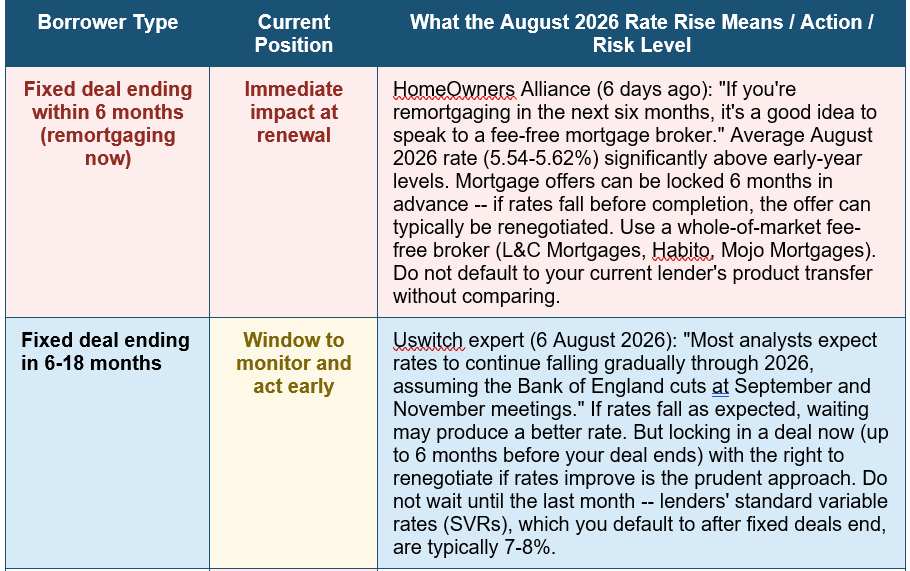
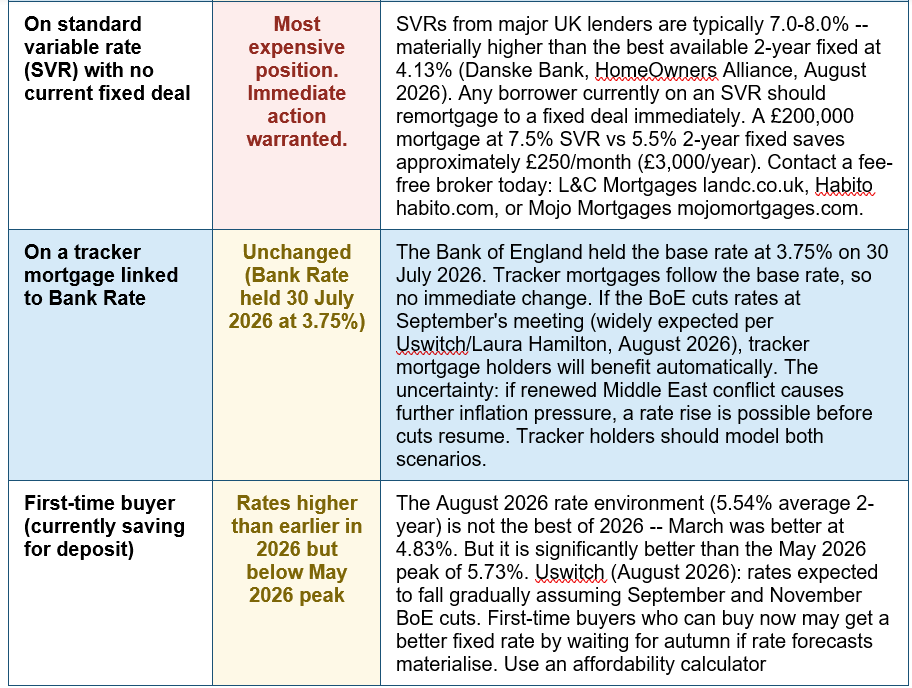
For borrowers, the August position requires action proportional to their situation. Those on SVR should remortgage immediately -- SVRs at 7-8% cost hundreds per month more than the best available fix. Those with deals ending within 6 months should secure an offer now (locking in up to 6 months ahead is standard). Those whose deals run for 12-18 months more can monitor the rate outlook following the September BoE decision -- which most analysts expect to deliver a cut. The 750,000 homeowners coming off sub-3% deals face an average £170/month increase regardless of rate movements, because even the most competitive available rate is significantly above where they are coming from.
The rate outlook is uncertain but points toward gradual easing. Uswitch expert Laura Hamilton (6 August 2026): 'Most analysts expect UK mortgage rates to continue falling gradually through 2026, assuming the Bank of England cuts the base rate at its September and November meetings as expected. However, swap rate volatility means individual lenders' rates can move independently of BoE decisions.' The most important insight from the current environment: the gap between the average rate and the best available rate is so wide (1.41 percentage points in August 2026) that comparison is more valuable than rate timing. Getting the right rate for your circumstances, through a fee-free whole-of-market broker, matters more than perfect timing.
Based on the most current data available: HomeOwners Alliance (6 days ago, citing Moneyfacts): 'On 21 July 2026, the average 2 year fixed mortgage rate in the UK was 5.54%.' MoneyWeek (1 week ago, citing Moneyfacts): 'The average two-year fixed-rate deal is now 5.62% as of 28 July, up from 5.48% at the start of the month.' The average 5-year fixed rate is 5.54-5.57% (slightly below the 2-year). These are Moneyfacts market averages across all loan-to-value ratios and lenders. For comparison, Rightmove's 60% LTV average -- reflecting better-qualified borrowers with large deposits or substantial equity -- is 4.59% for a 2-year fix in August 2026 (HomeOwners Alliance). The best available rate at 60% LTV is 4.13% from Danske Bank (HomeOwners Alliance, 6 days ago). For context on the 2026 journey: rates started 2026 at approximately 4.83% for a 2-year fix (March 2026, per Tembo), peaked at 5.73% in late May following the outbreak of Middle East conflict, fell back during June, and have risen again to 5.54-5.62% in late July/early August. The current rate environment is higher than the start of the year but below the May 2026 peak. The Bank of England base rate remains at 3.75% (held 30 July 2026, Uswitch 6 August 2026), but fixed mortgage rates are priced off swap rates rather than directly off the base rate.
Why have UK mortgage rates gone up in August 2026?
UK mortgage rates in August 2026 have risen because of increases in swap rates -- the wholesale market rates that lenders use to price fixed mortgages -- not because of a Bank of England base rate decision. The Bank of England held the base rate at 3.75% on 30 July 2026. MoneyWeek (1 week ago): 'It comes as swap rates, the wholesale cost of borrowing for banks and lenders, have increased in recent weeks.' Two main factors are driving the swap rate increase. Geopolitical pressure: MoneyWeek: 'Mortgage rates have been climbing again amid renewed tensions between the US and Iran and political uncertainty in the UK.' The conflict in the Middle East has elevated energy price expectations, which feed through to inflation expectations, which influence swap rates. The original February 2026 conflict spike drove rates from 4.83% to 5.73% between March and May. The current August increase represents a secondary wave. Political uncertainty: HomeOwners Alliance (6 days ago): 'Having a new prime minister has added some political uncertainty into the mix.' Political transitions -- even without fundamental policy change -- temporarily increase uncertainty in financial markets, which can widen swap rates and therefore mortgage pricing. The counter-narrative: Tembo (2 weeks ago) notes that 'over the last few weeks, a mini-price war has broken out as lenders respond to falling swap rates.' This shows the two-way nature of the market -- competitive pressure between lenders can cut rates even as swap rates rise, and the August increase comes after a period when lenders were cutting. The outlook: swap rates and therefore fixed mortgage rates are likely to remain volatile as long as geopolitical uncertainty persists.
Should I fix my mortgage for 2 or 5 years in August 2026?
This is the most common question for borrowers remortgaging in August 2026, and the current market structure provides an interesting data point: the 5-year fix (5.54-5.57%) is priced slightly below the 2-year fix (5.54-5.62%) as of late July/early August 2026. This inverted rate structure -- where the longer fix is cheaper -- is unusual and reflects financial market expectations that interest rates will be lower over the 3-5 year horizon than in the immediate 24 months. Mortgage One Finance (May 2026): 'The differential reflects market expectations that interest rates will be lower over the 3-to-5 year horizon than across the immediate 24-month window.' The case for a 2-year fix: Uswitch expert Laura Hamilton (6 August 2026) says most analysts expect rates to fall gradually through 2026-2027 if the Bank of England cuts at its September and November meetings. A 2-year fix allows a renegotiation in 2028 when rates may be lower. The case for a 5-year fix: certainty. The 5-year fix guarantees your payment for 60 months regardless of what happens to geopolitical tensions, Bank of England decisions, or economic conditions. HomeOwners Alliance: it 'could miss out on better mortgage deals in the meantime if rates go down.' The practical decision factor: consider how long you plan to remain in the property. If moving within 3 years, a 5-year fix with early repayment charges (ERCs) is risky. If confident in staying for 5+ years, the payment certainty of the 5-year fix is valuable in a volatile rate environment.
How much will my mortgage payments increase when I remortgage in 2026?
The increase depends on your current rate and your new rate. HomeOwners Alliance (6 days ago, citing the Bank of England Financial Stability Committee Record, July 2026): 'A typical owner-occupier coming off a fixed rate mortgage in the next two years is likely to face an increase of £45 on their monthly mortgage bill. 750,000 homeowners paying less than 3% interest would see an average increase of £170 per month.' The £45 average across all remortgagers reflects that many borrowers are coming off 4-5% deals from 2022-2024 and moving to similar or slightly lower current rates. The £170 average for those leaving sub-3% deals reflects the large rate differential between pandemic-era lows and current levels. You can calculate your personal impact: current outstanding balance, your current rate, your new rate, and remaining term. A practical example: £200,000 outstanding, 22 years remaining, leaving 2.5% fixed for 5.5% two-year fixed: monthly payment rises from approximately £927 to approximately £1,250 -- an increase of £323/month. The same borrower who qualifies for the Danske Bank best-rate of 4.13% at 60% LTV would pay approximately £1,137/month -- a saving of £113/month versus the market average. This is why qualifying for a lower LTV rate band (by having more equity or a larger deposit) and using a broker to find the best available rate are both so financially significant. Use an online mortgage calculator (MoneySuperMarket, Rightmove, or Habito) with your specific numbers for a personalised figure.
Are UK mortgage rates expected to fall in 2026?
The broad consensus among analysts is that UK mortgage rates are expected to fall gradually through the remainder of 2026, but the path is uncertain. Uswitch (6 August 2026 -- most current): expert Laura Hamilton states 'most analysts expect UK mortgage rates to continue falling gradually through 2026, assuming the Bank of England cuts the base rate at its September and November meetings as expected. However, swap rate volatility means individual lenders' rates can move independently of BoE decisions.' The key assumptions: the Bank of England cuts the base rate in September and November 2026, reducing the base rate from its current 3.75%. If these cuts materialise, swap rates are likely to follow, which would reduce fixed mortgage rates. The risk: HomeOwners Alliance (6 days ago): 'Attention will now turn to whether rates will remain unchanged for the rest of 2026 or whether renewed inflation pressures will eventually require an increase.' The Middle East conflict has already caused one unexpected rate spike in 2026 (March to May). Further geopolitical developments could cause additional spikes. Tembo (2 weeks ago) confirms the trajectory uncertainty: 'Although nothing is known for certain, we predict mortgage rates will stay steady in 2026, or possibly increase if a base rate rise looks more likely.' The practical implication: do not make your mortgage decision on the assumption that rates will fall -- that is a forecast, not a certainty. Make the decision that works best at current rates, with the flexibility to benefit from improvements if rates do fall. A broker who can renegotiate your offer before completion provides the best of both approaches.
Table of Contents
Rates Edge Back Up After a Brief June Relief
The Current Rate Picture: UK Mortgage Rates in August 2026
Why Are UK Mortgage Rates Rising in August 2026?
Who Is Affected: What the Rate Rise Means by Borrower Type
The 750,000 Homeowners Facing £170/Month More: The Sub-3% Deal Expiry
Two-Year vs Five-Year Fixed: Which Should You Choose in August 2026?
What Happens Next: The Bank of England September Decision and Rate Outlook
Conclusion: Higher for the Month, Lower Than the Peak -- Act on Your Own Timeline
Frequently Asked Questions (FAQ)
Rates Edge Back Up After a Brief June Relief
UK mortgage rates have risen to their highest level in over a month. After falling sharply during June 2026, average fixed mortgage rates have started climbing again in August as lenders respond to rising swap rates and renewed uncertainty from geopolitical tensions and political developments at home. The average two-year fixed mortgage rate stood at 5.62% on 28 July 2026, according to financial data firm Moneyfacts -- up from 5.48% at the start of that month and the highest point since the peak of 5.73% recorded at the end of May.HomeOwners Alliance (6 days ago -- most current): 'After falling sharply during June, average mortgage rates have started edging back up in August 2026 as many lenders increased fixed mortgage rates. The Bank of England held the base rate at 3.75% on 30 July.' The August rate increases are not driven by a Bank of England decision -- the base rate remains unchanged since May 2025. They are driven by swap rates: the wholesale cost of money that banks and building societies use to price fixed-rate mortgages, which are influenced by financial markets' expectations for future interest rates and by current global uncertainty.
For homeowners and buyers, the August 2026 rate environment is materially different from the start of the year: the average two-year fix that was 4.83% in March is now 5.54-5.62%. That increase on a £200,000 mortgage adds approximately £130-150 to the monthly payment. This guide presents the full picture: the latest rate data, who is affected and how, what is driving the movements, what the Bank of England's next decision could mean, and the specific actions that different types of borrower should take right now.
The Current Rate Picture: UK Mortgage Rates in August 2026
The following table tracks the full rate picture as of the first week of August 2026, from average market rates to the best available deals:UK mortgage rates August 2026 -- the defining numbers: 2-yr avg: 5.54-5.62%. 5-yr avg: 5.54-5.57%. Best 2-yr at 60% LTV: 4.13%. Bank Rate: 3.75% (held). March 2026 starting point: 4.83%. — Uswitch (6 August 2026 -- most current, 20 hours ago): 'Bank of England base rate 3.75%, held at May 2025 level.' HomeOwners Alliance (6 days ago): '21 July 2026 average 2-year fix 5.54% (Moneyfacts). Best 2-year 60% LTV: 4.13% Danske Bank August 2026. Average 5-year fix 5.57%.' MoneyWeek (1 week ago): 'Average two-year fixed 5.62% as of 28 July, up from 5.48% start of July.' Tembo (2 weeks ago): 'March 2026 averages: 2-year 4.83%, 5-year 4.95%. Peak May 2026: 5.73% two-year.'
Why Are UK Mortgage Rates Rising in August 2026?
The August 2026 mortgage rate increases are the product of three converging pressures, none of which is the Bank of England base rate -- which has remained at 3.75% since May 2025.- Swap rate movements: Fixed mortgage rates are priced off swap rates -- the financial market instruments that reflect expectations for future interest rates. MoneyWeek (1 week ago): "It comes as swap rates, the wholesale cost of borrowing for banks and lenders, have increased in recent weeks." When swap rates rise -- because markets expect higher future rates or because of uncertainty -- lenders respond by increasing fixed mortgage rates, typically within days. Swap rates are influenced by UK inflation expectations, global economic developments, and geopolitical events.
- Middle East conflict and energy price impact: Tembo (2 weeks ago): "A curveball came at the end of February when the conflict in the Middle East sent mortgage rates skyward." The early 2026 conflict drove energy prices higher, which flowed through to inflation expectations, which in turn raised swap rates and pushed mortgage rates up sharply from 4.83% to 5.73% between March and May 2026. After falling back in June, renewed Middle East tensions in late July have caused a secondary wave of rate pressure. MoneyWeek (1 week ago): "Mortgage rates have been climbing again amid renewed tensions between the US and Iran."
- Political uncertainty at home: HomeOwners Alliance (6 days ago): "While at home, having a new prime minister has added some political uncertainty into the mix." Political transitions create short-term uncertainty in financial markets, which can feed into swap rates and therefore mortgage pricing. This is typically a temporary effect, but it adds to the pressure from external factors in August 2026.
Who Is Affected: What the Rate Rise Means by Borrower Type
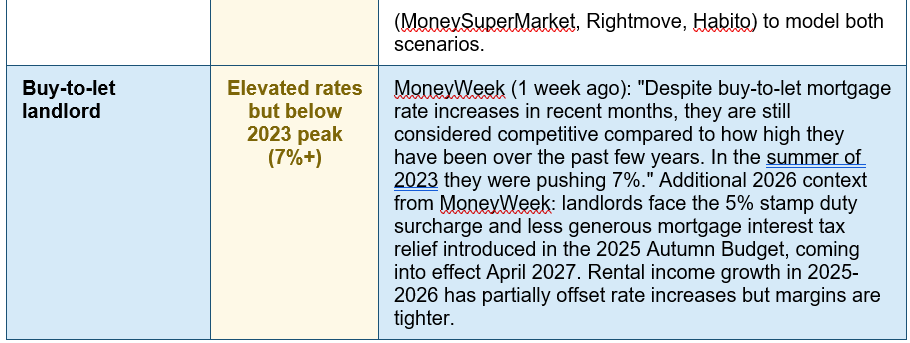
The impact of the August 2026 rate increases differs significantly depending on a borrower's current position. The following table maps every major borrower type to their current situation and the appropriate response:
The 750,000 Homeowners Facing £170/Month More: The Sub-3% Deal Expiry
The most significant group of homeowners affected by the current rate environment is not those remortgaging from recent deals -- it is the 750,000 households who locked in mortgage rates below 3% in 2020-2022 during the pandemic-era historic rate lows and whose fixed deals are expiring in 2026 and 2027.HomeOwners Alliance (6 days ago, citing the Bank of England Financial Stability Committee Record, July 2026): '750,000 homeowners who are paying less than 3% interest on their current deal would be coming off these deals this year and would see an average increase of £170 per month in repayments, the Bank said.' The Bank's July 2026 Financial Stability report also updated its forecast for the total number of homeowners facing higher repayments: 'A million more homeowners face higher mortgage bills than the Bank of England had previously expected due to the impact of the Middle East conflict. Just over five million homeowners are expected to see their monthly mortgage repayments increase by the end of 2028, according to the forecast. This is up from four million projected by the Bank in December.'
The £170/month increase for the 750,000 sub-3% deal expirers is particularly striking in context. For a couple who fixed at 2.5% on a £200,000 mortgage in 2021 and are now remortgaging to a 5.5% two-year fix: their monthly payment rises from approximately £897 to approximately £1,226 -- an increase of £329 per month on the interest component alone. The Bank's £170/month average figure reflects the full distribution including those with smaller mortgage balances, but for many households the impact is far larger. This group -- 750,000 households facing an average £170/month permanent increase, coming in the same period as elevated food prices, energy bills above pre-2021 levels, and a softening labour market -- represents the most acute household financial stress signal in the current mortgage landscape.
Two-Year vs Five-Year Fixed: Which Should You Choose in August 2026?
The choice between a two-year and a five-year fixed rate mortgage is the most consequential decision for most borrowers remortgaging in August 2026, and the current market has produced an unusual rate structure that makes the decision less straightforward than usual.HomeOwners Alliance (6 days ago): the average five-year fixed rate (5.57%) is slightly below the average two-year fixed rate (5.54% on 21 July, 5.62% by 28 July). This inverted relationship -- where the longer fix is cheaper -- reflects financial market expectations that interest rates will be lower over the 3-5 year horizon than in the immediate 24 months. Mortgage One Finance (May 2026): 'The differential reflects market expectations that interest rates will be lower over the 3-to-5 year horizon than across the immediate 24-month window.' This market pricing signal is the clearest available indicator that mortgage markets expect rates to fall over the medium term, even as they have risen in the short term.
The case for a two-year fix in August 2026: Uswitch expert Laura Hamilton (6 August 2026): 'Most analysts expect UK mortgage rates to continue falling gradually through 2026, assuming the Bank of England cuts the base rate at its September and November meetings as expected.' If this forecast materialises, a two-year fix allows the borrower to renegotiate at lower rates in 2028, when rates may be meaningfully lower. The case for a five-year fix: certainty. A five-year fix at the current rate (approximately 5.54-5.57%) guarantees the payment for 60 months, regardless of what happens with Middle East tensions, Bank of England decisions, or political developments. For borrowers who cannot afford the risk of rates rising further or who value payment stability above the possibility of lower rates in two years, the five-year fix is the right choice. HomeOwners Alliance: 'Some people choose five year fixed rate mortgages to have certainty over their payments for the next five years, however it does mean you could miss out on better mortgage deals in the meantime if rates go down.'
What Happens Next: The Bank of England September Decision and Rate Outlook
The Bank of England held the base rate at 3.75% at its 30 July 2026 Monetary Policy Committee meeting. The next decision is scheduled for 17 September 2026. Uswitch (6 August 2026): expert Laura Hamilton notes that 'most analysts expect UK mortgage rates to continue falling gradually through 2026, assuming the Bank of England cuts the base rate at its September and November meetings as expected. However, swap rate volatility means individual lenders' rates can move independently of BoE decisions.'HomeOwners Alliance (6 days ago) captures the uncertainty clearly: 'The Bank of England held the base rate at 3.75% on 30 July. Attention will now turn to whether rates will remain unchanged for the rest of 2026 or whether renewed inflation pressures will eventually require an increase.' The HomeOwners Alliance's own research found that UK consumer expectations are split: 'Around a quarter of Brits expect rates to rise (23%) and a similar proportion think they will fall (25%), while 28% expect them to stay the same and 24% are unsure.' This division reflects genuine uncertainty -- the same uncertainty that makes fixed mortgage rate movements difficult to predict.
Tembo (2 weeks ago) traces the 2026 rate journey to its origin: 'Rewind to the start of 2026, and mortgage rates were gradually declining, and expectations were high for a booming market this year. However, a curveball came at the end of February when the conflict in the Middle East sent mortgage rates skyward. But over the last few weeks, a mini-price war has broken out as lenders respond to falling swap rates, with fixed rates being cut by up to 0.26% last week.' The 'mini-price war' among lenders cutting rates in response to falling swap rates in June-July 2026 shows that competition between lenders can produce rate cuts even in a rising rate environment -- reinforcing the importance of comparison rather than product transfer.
The gap between the average rate and the best rate: why comparison matters enormously in August 2026. HomeOwners Alliance (6 days ago): the average 2-year fixed mortgage rate is 5.54% (Moneyfacts average, 21 July 2026). The best available 2-year fixed at 60% LTV is 4.13% from Danske Bank (August 2026). The gap between these two numbers is 1.41 percentage points. On a £200,000 mortgage over 25 years, the difference between 5.54% and 4.13% is approximately £155/month (£1,860/year) in mortgage payments. For a borrower who takes the average rate when a better rate was available -- because they accepted their current lender's product transfer without shopping the market -- this gap compounds across the two-year fix term to approximately £3,720 in unnecessary additional mortgage costs. The Rightmove 60% LTV average (4.59%) sits between the Moneyfacts full-market average and the Danske Bank best rate, illustrating that well-qualified borrowers with 40%+ equity or deposit can access rates materially below the headline average. The message: in August 2026's rate environment, the act of comparison -- using a whole-of-market fee-free broker -- is worth more than any other single mortgage decision.
FIVE MORTGAGE MISTAKES TO AVOID IN THE AUGUST 2026 RATE ENVIRONMENT: (1) ACCEPTING YOUR CURRENT LENDER'S PRODUCT TRANSFER WITHOUT COMPARING. Your existing lender's renewal offer is not the best available rate. HomeOwners Alliance (6 days ago): the best available 2-year fix is 4.13% against a market average of 5.54%. Use a fee-free whole-of-market broker to access the full market. L&C Mortgages (landc.co.uk) and Habito (habito.com) both offer fee-free whole-of-market advice. (2) WAITING UNTIL YOUR FIXED DEAL EXPIRES BEFORE COMPARING. Once a fixed deal expires, you move to the lender's standard variable rate (typically 7-8%). Mortgage offers can be locked 6 months in advance. Start comparing now if your deal ends within 6 months. (3) FIXING FOR FIVE YEARS WHEN YOU PLAN TO MOVE WITHIN THREE YEARS. Five-year fixes carry early repayment charges (ERCs) that typically run 1-5% of the outstanding balance in early years. If you sell or need to change mortgage within the fix period, the ERCs can eliminate any rate benefit. Match the fix length to your realistic horizon. (4) IGNORING THE EFFECT OF FEES ON THE TRUE RATE. A mortgage with a lower headline rate but a high arrangement fee (£1,000+) may cost more overall than a slightly higher rate with no fee. HomeOwners Alliance: Danske Bank's 4.13% rate carries a £1,124 fee. Calculate the total cost of mortgage including fees over the fixed period, not just the headline rate. (5) NOT USING A FEE-FREE BROKER WHEN RATES ARE VOLATILE. In volatile rate environments like August 2026, a broker tracks rate movements across the whole market, can renegotiate before completion if rates fall, and advises on the most suitable product given your circumstances. MoneyHelper (0800 138 7777) can refer you to a regulated adviser.
IMMEDIATE ACTIONS FOR EVERY BORROWER TYPE IN AUGUST 2026: (1) FIXED DEAL ENDING WITHIN 6 MONTHS: Contact a fee-free whole-of-market broker today. L&C Mortgages: landc.co.uk. Habito: habito.com. Mojo Mortgages: mojomortgages.com. All three are fee-free and access the whole market. Lock in an offer now (rates can be secured 6 months ahead) with the ability to renegotiate if rates fall before completion. (2) CURRENTLY ON SVR: Remortgage immediately. SVRs at 7-8% are costing you £150-250+/month more than the best available fixed rate. Every month on SVR is unnecessary expenditure. (3) TRACKER MORTGAGE HOLDER: Your rate has not changed (Bank Rate held at 3.75%). Monitor the September BoE decision: a cut would reduce your tracker rate automatically. If you prefer certainty, speak to a broker about switching to a fix. (4) FIRST-TIME BUYER: Use the Rightmove Mortgage Finder or Habito's online comparison. The best available rate at 60% LTV is 4.13% (HomeOwners Alliance, August 2026) -- only achievable with a 40% deposit. With lower deposits, rates are higher but still materially below their 2023 peaks. Consider timing against the BoE September decision. (5) ALL BORROWERS: Check your credit score before applying. Experian, Equifax, and TransUnion all offer free credit reports. A higher credit score = better mortgage rates. Small improvements (closing unused cards, reducing utilisation, being on the electoral register) can make a material difference to the rate you are offered.
FINDING THE BEST MORTGAGE RATE IN AUGUST 2026 -- STEP BY STEP: STEP 1 -- KNOW YOUR LTV: Loan-to-value (outstanding mortgage balance ÷ property value x 100) is the single biggest determinant of mortgage rate. If you have significant equity built since purchase, your LTV may have fallen enough to access a lower rate band. STEP 2 -- USE A WHOLE-OF-MARKET FEE-FREE BROKER: L&C Mortgages (landc.co.uk), Habito (habito.com), Mojo Mortgages (mojomortgages.com), Trussle (trussle.com). These access deals from across the market including some not on comparison sites. No advice fee -- they earn from the lender. STEP 3 -- COMPARE WITH COMPARISON SITES TOO: MoneySuperMarket, Uswitch, and Which? Mortgage Finder for additional comparison. Some deals are online-only and not available through brokers. STEP 4 -- CALCULATE TOTAL COST INCLUDING FEES: For each shortlisted deal: (rate x remaining balance ÷ 100 ÷ 12) x fixed period months + arrangement fee = total cost over the period. Compare totals, not just headline rates. STEP 5 -- LOCK IN AND MONITOR: Once you have an offer, your broker can monitor rates and renegotiate before completion if rates fall. Do not assume the rate you lock today is the rate you will get at completion -- the offer can be improved. FREE REGULATED ADVICE: MoneyHelper 0800 138 7777 | Citizens Advice citizensadvice.org.uk | Shelter (mortgage arrears) 0808 800 4444.
Conclusion
UK mortgage rates have risen to their highest level in over a month. The average two-year fixed rate reached 5.62% on 28 July 2026 -- up from 5.48% at the start of July -- driven by rising swap rates following renewed geopolitical tensions and political uncertainty at home. This is above the March 2026 starting point of 4.83%, but below the May 2026 peak of 5.73%. The best available two-year fix at 60% LTV stands at 4.13% from Danske Bank in August 2026 -- a 1.41 percentage point gap below the Moneyfacts average that underscores the financial value of proper comparison.For borrowers, the August position requires action proportional to their situation. Those on SVR should remortgage immediately -- SVRs at 7-8% cost hundreds per month more than the best available fix. Those with deals ending within 6 months should secure an offer now (locking in up to 6 months ahead is standard). Those whose deals run for 12-18 months more can monitor the rate outlook following the September BoE decision -- which most analysts expect to deliver a cut. The 750,000 homeowners coming off sub-3% deals face an average £170/month increase regardless of rate movements, because even the most competitive available rate is significantly above where they are coming from.
The rate outlook is uncertain but points toward gradual easing. Uswitch expert Laura Hamilton (6 August 2026): 'Most analysts expect UK mortgage rates to continue falling gradually through 2026, assuming the Bank of England cuts the base rate at its September and November meetings as expected. However, swap rate volatility means individual lenders' rates can move independently of BoE decisions.' The most important insight from the current environment: the gap between the average rate and the best available rate is so wide (1.41 percentage points in August 2026) that comparison is more valuable than rate timing. Getting the right rate for your circumstances, through a fee-free whole-of-market broker, matters more than perfect timing.
Frequently Asked Questions (FAQ)
What is the average UK mortgage rate in August 2026?Based on the most current data available: HomeOwners Alliance (6 days ago, citing Moneyfacts): 'On 21 July 2026, the average 2 year fixed mortgage rate in the UK was 5.54%.' MoneyWeek (1 week ago, citing Moneyfacts): 'The average two-year fixed-rate deal is now 5.62% as of 28 July, up from 5.48% at the start of the month.' The average 5-year fixed rate is 5.54-5.57% (slightly below the 2-year). These are Moneyfacts market averages across all loan-to-value ratios and lenders. For comparison, Rightmove's 60% LTV average -- reflecting better-qualified borrowers with large deposits or substantial equity -- is 4.59% for a 2-year fix in August 2026 (HomeOwners Alliance). The best available rate at 60% LTV is 4.13% from Danske Bank (HomeOwners Alliance, 6 days ago). For context on the 2026 journey: rates started 2026 at approximately 4.83% for a 2-year fix (March 2026, per Tembo), peaked at 5.73% in late May following the outbreak of Middle East conflict, fell back during June, and have risen again to 5.54-5.62% in late July/early August. The current rate environment is higher than the start of the year but below the May 2026 peak. The Bank of England base rate remains at 3.75% (held 30 July 2026, Uswitch 6 August 2026), but fixed mortgage rates are priced off swap rates rather than directly off the base rate.
Why have UK mortgage rates gone up in August 2026?
UK mortgage rates in August 2026 have risen because of increases in swap rates -- the wholesale market rates that lenders use to price fixed mortgages -- not because of a Bank of England base rate decision. The Bank of England held the base rate at 3.75% on 30 July 2026. MoneyWeek (1 week ago): 'It comes as swap rates, the wholesale cost of borrowing for banks and lenders, have increased in recent weeks.' Two main factors are driving the swap rate increase. Geopolitical pressure: MoneyWeek: 'Mortgage rates have been climbing again amid renewed tensions between the US and Iran and political uncertainty in the UK.' The conflict in the Middle East has elevated energy price expectations, which feed through to inflation expectations, which influence swap rates. The original February 2026 conflict spike drove rates from 4.83% to 5.73% between March and May. The current August increase represents a secondary wave. Political uncertainty: HomeOwners Alliance (6 days ago): 'Having a new prime minister has added some political uncertainty into the mix.' Political transitions -- even without fundamental policy change -- temporarily increase uncertainty in financial markets, which can widen swap rates and therefore mortgage pricing. The counter-narrative: Tembo (2 weeks ago) notes that 'over the last few weeks, a mini-price war has broken out as lenders respond to falling swap rates.' This shows the two-way nature of the market -- competitive pressure between lenders can cut rates even as swap rates rise, and the August increase comes after a period when lenders were cutting. The outlook: swap rates and therefore fixed mortgage rates are likely to remain volatile as long as geopolitical uncertainty persists.
Should I fix my mortgage for 2 or 5 years in August 2026?
This is the most common question for borrowers remortgaging in August 2026, and the current market structure provides an interesting data point: the 5-year fix (5.54-5.57%) is priced slightly below the 2-year fix (5.54-5.62%) as of late July/early August 2026. This inverted rate structure -- where the longer fix is cheaper -- is unusual and reflects financial market expectations that interest rates will be lower over the 3-5 year horizon than in the immediate 24 months. Mortgage One Finance (May 2026): 'The differential reflects market expectations that interest rates will be lower over the 3-to-5 year horizon than across the immediate 24-month window.' The case for a 2-year fix: Uswitch expert Laura Hamilton (6 August 2026) says most analysts expect rates to fall gradually through 2026-2027 if the Bank of England cuts at its September and November meetings. A 2-year fix allows a renegotiation in 2028 when rates may be lower. The case for a 5-year fix: certainty. The 5-year fix guarantees your payment for 60 months regardless of what happens to geopolitical tensions, Bank of England decisions, or economic conditions. HomeOwners Alliance: it 'could miss out on better mortgage deals in the meantime if rates go down.' The practical decision factor: consider how long you plan to remain in the property. If moving within 3 years, a 5-year fix with early repayment charges (ERCs) is risky. If confident in staying for 5+ years, the payment certainty of the 5-year fix is valuable in a volatile rate environment.
How much will my mortgage payments increase when I remortgage in 2026?
The increase depends on your current rate and your new rate. HomeOwners Alliance (6 days ago, citing the Bank of England Financial Stability Committee Record, July 2026): 'A typical owner-occupier coming off a fixed rate mortgage in the next two years is likely to face an increase of £45 on their monthly mortgage bill. 750,000 homeowners paying less than 3% interest would see an average increase of £170 per month.' The £45 average across all remortgagers reflects that many borrowers are coming off 4-5% deals from 2022-2024 and moving to similar or slightly lower current rates. The £170 average for those leaving sub-3% deals reflects the large rate differential between pandemic-era lows and current levels. You can calculate your personal impact: current outstanding balance, your current rate, your new rate, and remaining term. A practical example: £200,000 outstanding, 22 years remaining, leaving 2.5% fixed for 5.5% two-year fixed: monthly payment rises from approximately £927 to approximately £1,250 -- an increase of £323/month. The same borrower who qualifies for the Danske Bank best-rate of 4.13% at 60% LTV would pay approximately £1,137/month -- a saving of £113/month versus the market average. This is why qualifying for a lower LTV rate band (by having more equity or a larger deposit) and using a broker to find the best available rate are both so financially significant. Use an online mortgage calculator (MoneySuperMarket, Rightmove, or Habito) with your specific numbers for a personalised figure.
Are UK mortgage rates expected to fall in 2026?
The broad consensus among analysts is that UK mortgage rates are expected to fall gradually through the remainder of 2026, but the path is uncertain. Uswitch (6 August 2026 -- most current): expert Laura Hamilton states 'most analysts expect UK mortgage rates to continue falling gradually through 2026, assuming the Bank of England cuts the base rate at its September and November meetings as expected. However, swap rate volatility means individual lenders' rates can move independently of BoE decisions.' The key assumptions: the Bank of England cuts the base rate in September and November 2026, reducing the base rate from its current 3.75%. If these cuts materialise, swap rates are likely to follow, which would reduce fixed mortgage rates. The risk: HomeOwners Alliance (6 days ago): 'Attention will now turn to whether rates will remain unchanged for the rest of 2026 or whether renewed inflation pressures will eventually require an increase.' The Middle East conflict has already caused one unexpected rate spike in 2026 (March to May). Further geopolitical developments could cause additional spikes. Tembo (2 weeks ago) confirms the trajectory uncertainty: 'Although nothing is known for certain, we predict mortgage rates will stay steady in 2026, or possibly increase if a base rate rise looks more likely.' The practical implication: do not make your mortgage decision on the assumption that rates will fall -- that is a forecast, not a certainty. Make the decision that works best at current rates, with the flexibility to benefit from improvements if rates do fall. A broker who can renegotiate your offer before completion provides the best of both approaches.

0 Comments Comments