
Real Estate
US Mortgage Rates Near 7%: Should You Buy a House in 2026?

RATES UPDATE| Freddie Mac (July 30, 2026): 30-year fixed rate 6.66%. 15-year: 6.04%. 62% of buyers waited for rates to fall in 2025 -- and they didn't. Home values rose 17% since 2022. MBA forecasts 6.5% through 2028. No major forecaster expects sub-5% rates before at least 2027.
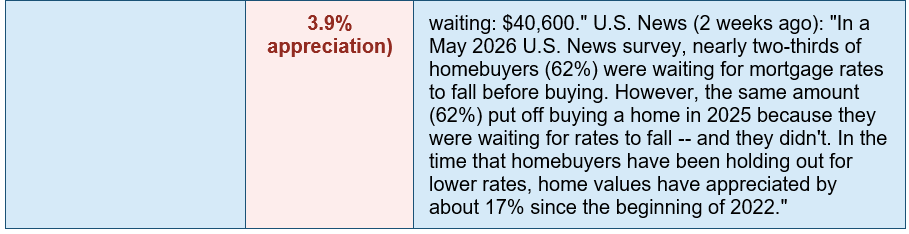
The waiting game has a documented cost. U.S. News (2 weeks ago): 'In a May 2026 U.S. News survey, nearly two-thirds of homebuyers (62%) were waiting for mortgage rates to fall before buying a home. However, the same amount (62%) put off buying a home in 2025 because they were waiting for rates to fall -- and they didn't. In the time that homebuyers have been holding out for lower rates, home values have appreciated by about 17% since the beginning of 2022.' The 17% statistic is the critical number for any buyer running a wait-or-buy calculation. Waiting has a cost. It is measured in higher purchase prices paid and rent paid while waiting.
This guide examines the current rate environment, the expert forecasts for where rates are going, the home price data from every major institution, and the specific financial decision framework that determines whether buying now or waiting makes sense for each individual situation. The answer is not the same for everyone -- and this guide provides the data needed to determine which category you are in.
Redfin (2 weeks ago) identifies the specific forces keeping rates elevated: 'Global volatility, AI fears, tariff uncertainty, and a difficult job market are all weighing on consumers and keeping rates elevated. The Fed is also considering raising rates this year to bring down inflation. Adding to the difficulty, mortgage rates remain elevated and volatile due to prolonged conflicts in the Middle East. Even if a long-term peace deal were to be struck, economists don't expect major improvements until economic pressures ease.' This multi-factor analysis explains why rates have not fallen as many buyers anticipated in 2025 -- and why the same forces are likely to keep them elevated through the remainder of 2026.
The rate environment is best understood relative to history. The 2020-2021 pandemic rates (2.65%-3.0% on the 30-year) were the lowest in modern history and were a function of emergency monetary policy. The reversion to a more normalised rate environment, while painful for buyers accustomed to pandemic-era affordability expectations, represents rates that were historically common throughout the 1990s and 2000s. LendingTree (June 30, 2026): 'In today's market, any rate below 6.49% is better than the national average.' The framing has shifted: the question is not when rates return to 3%, but what a buyer can achieve at 6.5-6.7% and whether the decision to buy at this level is financially sound.
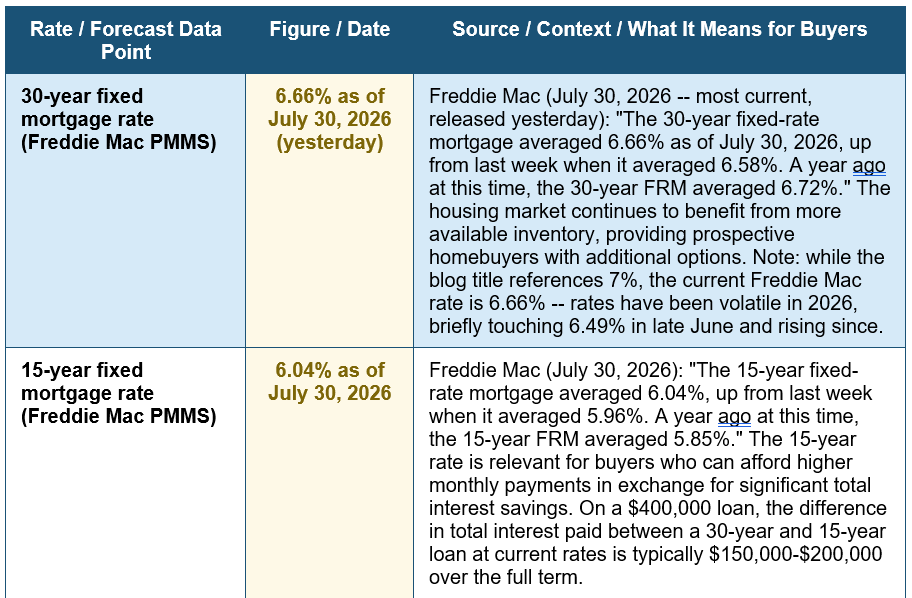
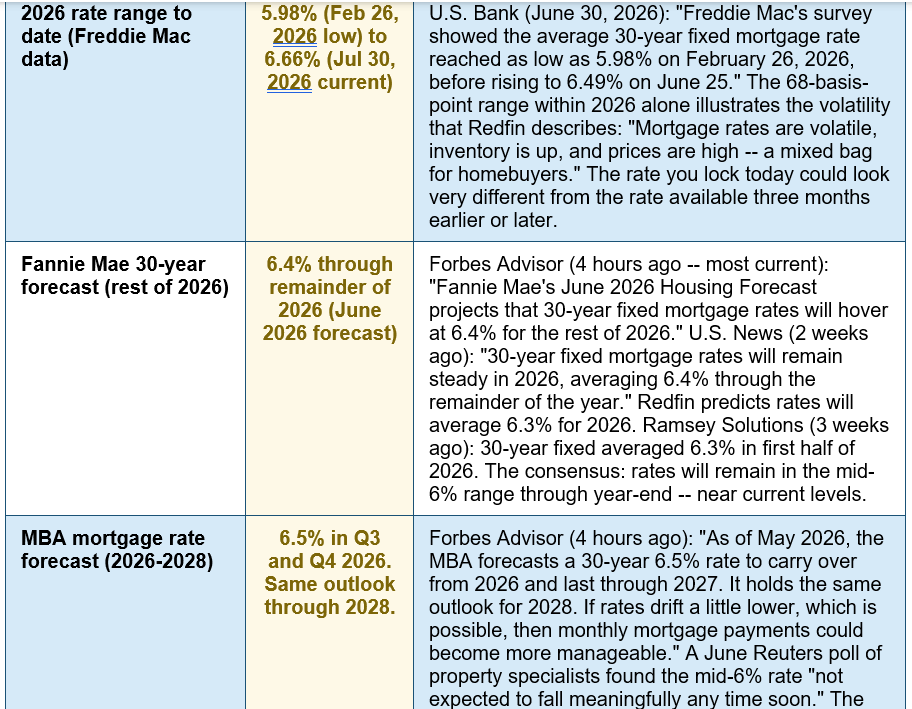
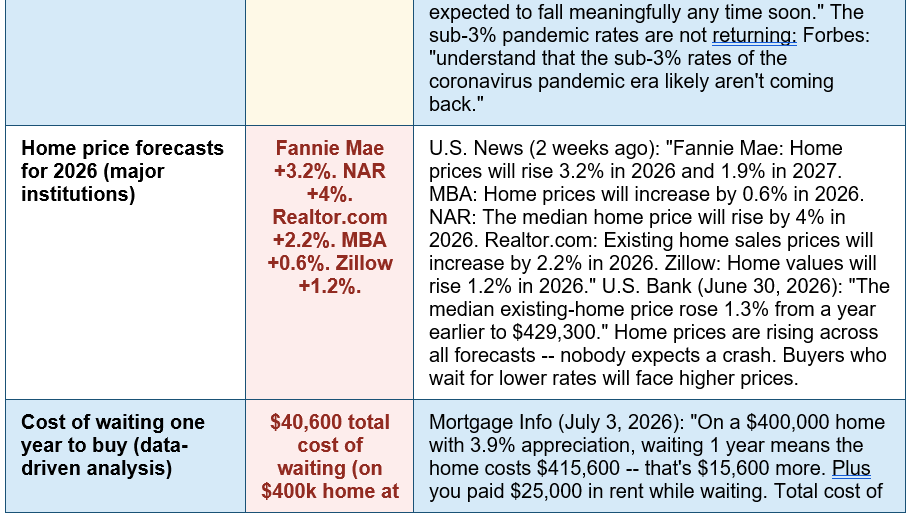
Mortgage rate snapshot -- 31 July 2026: 30-year fixed: 6.66% (Freddie Mac July 30). 15-year: 6.04%. 2026 low: 5.98% (Feb 26). Forecasts: 6.3-6.5% year-end. MBA: 6.5% through 2028. — Freddie Mac (July 30, 2026 -- yesterday, most current): '30-year fixed-rate mortgage averaged 6.66%.' Forbes Advisor (4 hours ago -- most current analysis): 'Fannie Mae projects 6.4% for rest of 2026. MBA forecasts 6.5% through 2027 and 2028.' LendingTree (June 30, 2026): 'Rates expected to hover between 6% and 7%.' U.S. News (2 weeks ago): '62% waited for rates to fall in 2025. They didn't. Home values up 17% since 2022.' Mortgage Info (July 3, 2026): 'On $400k home, cost of waiting 1 year = $40,600 (price appreciation + rent paid).'
The Institutional Forecasts
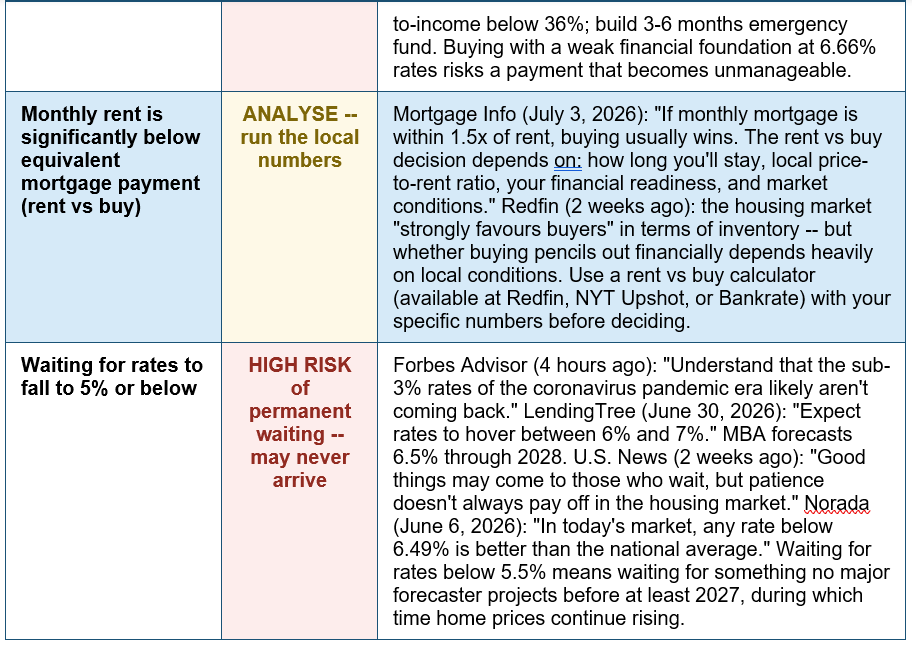
The critical point that all forecasters agree on: the sub-3% pandemic era is definitively over. Forbes Advisor (4 hours ago): 'Understand that the sub-3% rates of the coronavirus pandemic era likely aren't coming back.' Any buyer waiting for rates below 5% -- let alone 3% -- is waiting for something that no credible forecast projects returning. The question is not whether to hold out for 3% rates. The question is whether to buy at 6.66% now, or wait for the modest potential reduction to 6.3-6.4% and pay more for the home in the interim.
U.S. News (2 weeks ago): 'Home prices have appreciated by about 17% since the beginning of 2022, according to the S&P Cotality Case-Shiller Home Price Index -- despite mortgage rates rapidly increasing in that time frame.' A buyer who in 2022 decided to wait for rates to fall before purchasing paid approximately $68,000 more for a $400,000 (2022) home that has risen to approximately $468,000 today, plus 4 years of rent payments that built no equity. U.S. Bank (June 30, 2026): 'The median existing-home price rose 1.3% from a year earlier to $429,300.'
The supply dynamics are not going to produce the price crash many waiting buyers are hoping for. U.S. News (2 weeks ago): 'Housing supply remains 3-4 million units short of demand, new construction can't keep pace, and the lock-in effect keeps existing homeowners from selling (they have 3% mortgages).' The lock-in effect -- existing homeowners unwilling to sell and give up their sub-3% mortgage for a new purchase at 6.66% -- is the structural constraint that is keeping supply below demand and prices supported. Mortgage Info (July 3, 2026): 'A national crash like 2008 is extremely unlikely due to strict lending standards and low foreclosure rates.'
U.S. News: 'Housing price increases have slowed, but buyers shouldn't expect prices to come crashing down, at least not on a national level.' The forecasts across every major institution agree: Fannie Mae +3.2%, NAR +4%, Realtor.com +2.2%, MBA +0.6%, Zillow +1.2%. Not one major institution projects a national price decline. The buyer who waits another year to buy at hoped-for lower rates will pay more for the home -- potentially $8,600-$17,200 more on a $430,000 median-priced home -- while also paying rent that builds no equity.
The refinancing opportunity: why today's rate may not be your rate for 30 years. Norada Real Estate (June 6, 2026): 'Refinancing Realities: Honestly, unless rates drop by at least 0.75% to 1% below your current rate (and you factor in the closing costs), there's probably not much point in refinancing right now. Keep an eye out for dips, though.' Mortgage Info (July 3, 2026): 'If you buy today at 6.25% and refinance when rates hit 5.5% (projected late 2026/early 2027), you save $180/month on a $400K loan.' The strategy: buy the home when the price and property are right. Lock the 30-year fixed at today's rate as protection against further rises. Then monitor rates actively for the 0.75-1% drop that makes refinancing financially worthwhile. The break-even calculation for refinancing: divide closing costs by monthly payment reduction. If closing costs are $4,000 and monthly saving is $200, break-even is 20 months -- meaning if you plan to stay for at least 20 more months after refinancing, it is worth doing. A buyer who buys at 6.66% today and refinances at 5.7% in 2027 will have captured both the 2026 home price and the lower 2027 rate. A buyer who waits for 5.7% may find the home costs $20,000 more in 2027.
FIVE THINGS TO KNOW BEFORE MAKING A DECISION IN THE 6.66% RATE ENVIRONMENT: (1) DO NOT BASE YOUR DECISION ON A RATE YOU CANNOT QUALIFY FOR. Forbes Advisor (4 hours ago): 'Getting an optimal rate requires keeping your eye on rates, a great credit score, a larger down payment, and negotiating seller concessions.' The average advertised rate (6.66%) is for well-qualified borrowers. If your credit score is below 720, your actual offered rate will be higher. Get pre-approved before any rate-driven decision-making. (2) FACTOR IN THE FULL MONTHLY COST, NOT JUST THE MORTGAGE PAYMENT. The 6.66% rate on a $400,000 loan at 20% down produces approximately $2,065/month in principal and interest. But total monthly homeownership costs also include property taxes (typically 1-2.5% of value annually), homeowners insurance ($1,200-$2,000/year), HOA fees where applicable, and maintenance (typically 1% of value/year). The real monthly cost for a $400,000 home is typically $2,800-$3,500/month all-in. Budget from this number, not from the mortgage payment alone. (3) UNDERSTAND PMI IF YOUR DOWN PAYMENT IS BELOW 20%. Private mortgage insurance (PMI) adds approximately 0.5-1.5% of the loan balance annually to your payment. On a $350,000 loan with 10% down, PMI adds approximately $146-$438 per month. PMI is eliminated when the loan-to-value ratio reaches 80% -- but at today's slow appreciation rates, this may take several years. (4) DO NOT COUNT ON A SPECIFIC REFINANCING TIMELINE. Norada (June 6, 2026): rates need to drop at least 0.75-1% below your current rate for refinancing to make financial sense after closing costs. No forecaster predicts with certainty when this will occur. Budget for the current payment to be your payment for at least 3-5 years. (5) THE ASKING TITLE OF THIS POST REFERS TO 7% RATES -- THE ACTUAL CURRENT RATE IS 6.66%. Freddie Mac's July 30, 2026 survey shows 6.66%. Rates have been volatile between 5.98% and 6.66% in 2026. Any specific rate decision should use the actual rate you are offered through pre-approval, not the national average.
YOUR 2026 HOME BUYING ACTION PLAN: IF YOU ARE FINANCIALLY READY (good credit, down payment saved, stable income, 3-6 months emergency fund): (1) Get pre-approved immediately at 2-3 lenders to compare rates. Shop within 14-45 days to limit credit score impact. (2) Lock a rate when you are under contract -- do not float unless you have specific intelligence suggesting a rate drop within 60 days. (3) Plan to stay 5+ years. Use the date-the-rate strategy: buy the house, refinance when rates fall 0.75-1% below your locked rate. (4) Budget from the all-in monthly cost (mortgage + taxes + insurance + maintenance + HOA), not just the mortgage payment. (5) Review local market conditions with a buyer's agent -- national trends may not reflect your specific market. IF YOU ARE NOT YET FINANCIALLY READY: (6) Target a 740+ credit score for the best rate (every 20-point increase saves approximately 0.25% on rate). (7) Save aggressively for a 20% down payment to eliminate PMI. (8) Reduce debt-to-income below 36% (total monthly debt payments / gross monthly income). (9) Build 3-6 months of emergency savings before purchasing. (10) Consider the HUD housing counsellor programme (hud.gov) for free pre-purchase counselling. RATE RESOURCES: Freddie Mac PMMS (weekly): freddiemac.com/pmms | Bankrate mortgage rate comparison: bankrate.com/mortgages | CFPB mortgage guide: consumerfinance.gov/mortgage.
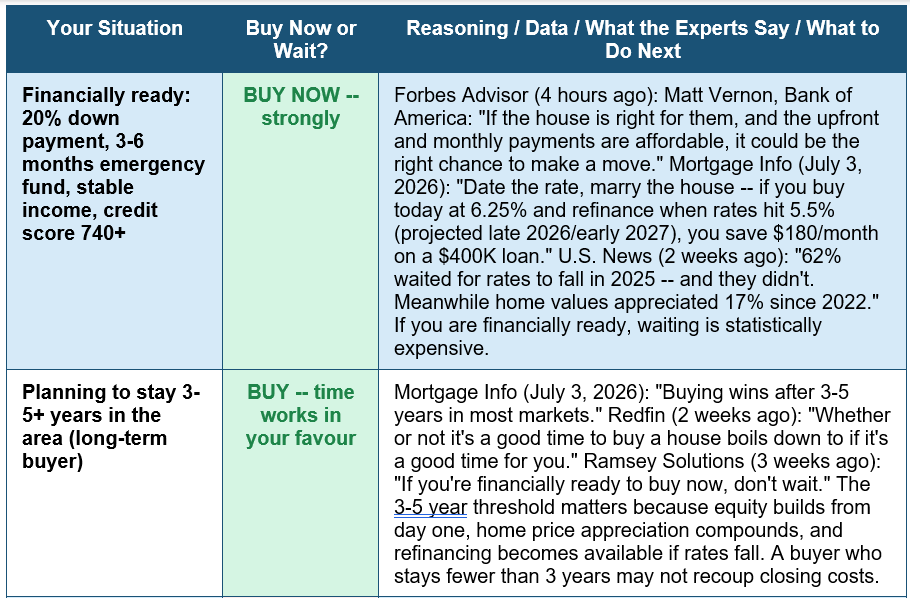
For buyers who are financially prepared -- solid credit, 20% down payment, stable income, emergency fund intact -- the data argues for acting rather than waiting. Home prices are rising under every major forecast. The cost of a one-year wait on a $400,000 home is approximately $40,600 in combined price appreciation and rent paid (Mortgage Info, July 3, 2026). Sixty-two percent of buyers waited through 2025 for rates to fall -- and paid higher prices instead (U.S. News, 2 weeks ago). The refinancing option means today's rate is not necessarily the rate for 30 years: as Forbes Advisor (4 hours ago) notes, if rates fall to 5.5%, the monthly saving on a $400,000 loan is $180. Buying now locks in the price; refinancing later locks in a better rate.
For buyers who are not yet financially ready, or who are planning to move within two to three years, waiting to strengthen the financial position is the correct decision at any rate level. The rate environment does not override the fundamentals of personal financial preparedness. But for the financially ready buyer asking whether to wait another year for the rate to fall from 6.66% to 6.3% -- the answer that the data supports is: buy the house, date the rate. The 0.36% rate reduction you are waiting for will cost you approximately $17,000 in home price appreciation and $25,000 in rent in the meantime.
The current 30-year fixed mortgage rate is 6.66%, as reported by Freddie Mac's Primary Mortgage Market Survey on July 30, 2026 -- the most authoritative weekly benchmark for US mortgage rates. The 15-year fixed rate is 6.04%. Both rates increased slightly from the previous week (6.58% and 5.96% respectively). For context: the 2026 low was 5.98% on February 26, 2026. The 2023 peak was 7.79%. Today's rate is below the recent peak but significantly above the 2020-2021 pandemic lows of 2.65-3%. U.S. Bank (June 30, 2026): rates reached as low as 5.98% on February 26 before rising to 6.49% on June 25. The subsequent rise to 6.66% as of July 30 illustrates the volatility of the current rate environment. Freddie Mac notes that 'the housing market continues to benefit from more available inventory, providing prospective homebuyers with additional options and helping support buyer activity as mortgage rates fluctuate.' The specific rate you are offered will depend on your credit score, down payment, loan type, and lender -- the national average is for well-qualified borrowers, and your actual rate may be higher or lower.
Will mortgage rates drop below 6% in 2026 or 2027?
The major housing and mortgage forecasters do not project 30-year fixed rates falling below 6% in 2026, and the MBA's forecast does not project it through 2028 either. Forbes Advisor (4 hours ago -- most current): 'Fannie Mae projects 6.4% for the rest of 2026. The MBA forecasts 6.5% in Q3 and Q4 of 2026 and holds the same outlook for 2027 and 2028.' LendingTree (June 30, 2026): 'Expect rates to hover between 6% and 7%.' Redfin (2 weeks ago): rates are 'elevated and volatile' due to multiple global and domestic factors including Middle East conflict, AI uncertainty, tariff impacts, and the Fed's stance on inflation. Ramsey Solutions (3 weeks ago): rates predicted to 'stay within the current range through 2027.' The Reuters poll of property specialists (June 2026) found mid-6% rates 'not expected to fall meaningfully any time soon.' The closest any major forecaster comes to projecting sub-6% rates is Fannie Mae's projection of 5.9% by end of 2026 (its November forecast, predating the 2026 rate volatility). Most current forecasts have revised this upward to 6.3-6.5%. Forbes Advisor is explicit: the sub-3% pandemic era rates 'likely aren't coming back.' Buyers waiting for rates below 6% should understand they may be waiting for something no major institution currently projects happening within the next 2-3 years.
What does "date the rate, marry the house" mean?
'Date the rate, marry the house' is a real estate buying philosophy that separates the two primary decisions in a home purchase: the price you pay for the home (the marriage -- a long-term commitment) and the interest rate on your mortgage (the date -- temporary and changeable). Mortgage Info (July 3, 2026): 'If you buy today at 6.25% and refinance when rates hit 5.5% (projected late 2026/early 2027), you save $180/month on a $400K loan. The date the rate, marry the house strategy works.' The reasoning: when you buy a home, you lock in a purchase price that is permanent -- if you wait and the home appreciates, you cannot buy it later at today's price. The mortgage rate, however, is not permanent. If rates fall sufficiently (typically 0.75-1% below your current rate to justify closing costs), you can refinance to a lower rate. So the correct decision sequence is: buy the house when the price and property are right; lock the best available rate today; then refinance when rates fall to a level that makes it financially worthwhile. Norada (June 6, 2026): 'Unless rates drop by at least 0.75% to 1% below your current rate, there's probably not much point in refinancing right now. Keep an eye out for dips, though.' The strategy works best for buyers who plan to stay in the home at least 5 years -- sufficient time to refinance and recoup closing costs when rates fall.
How much does waiting one year to buy a house actually cost?
The cost of waiting depends on local home price appreciation and rent, but Mortgage Info (July 3, 2026) provides a widely cited data-driven calculation: 'On a $400,000 home with 3.9% appreciation, waiting 1 year means the home costs $415,600 -- that's $15,600 more. Plus you paid $25,000 in rent while waiting. Total cost of waiting: $40,600.' Using the conservative end of 2026 home price forecasts: on a $429,300 median home (U.S. Bank, June 30, 2026), even the most conservative forecast (+0.6% from MBA) means the home costs $2,576 more after one year. At the NAR's +4% forecast, it costs $17,172 more. Add one year of rent payments (national average $1,739/month per Zillow, approximately $20,868/year) and the total financial cost of waiting one year is $23,444-$38,040 -- depending on which price appreciation estimate you use. U.S. News (2 weeks ago): homebuyers who waited through 2025 for lower rates faced higher prices instead, with home values appreciating 17% since the beginning of 2022. The calculation does not favour waiting for buyers who are financially ready. For buyers who are not ready -- insufficient down payment, low credit score, high debt-to-income -- the calculation is different: strengthening the financial position reduces the rate you are offered and potentially reduces PMI costs by enough to offset price appreciation.
Is 2026 a buyer's market or a seller's market?
The 2026 US housing market is better described as a transitional market than a clear buyer's or seller's market -- and the balance varies significantly by location. U.S. Bank (June 30, 2026): 'Total existing-home inventory rose 3.3% from April to 1.55 million units, equal to 4.5 months of supply. Existing-home sales increased 3.2% from April and 3.2% from a year earlier to a seasonally adjusted annual rate of 4.17 million. Those figures point to a housing market that is thawing rather than accelerating.' Redfin (2 weeks ago): 'The housing market strongly favors buyers' in terms of available inventory -- but affordability remains challenging due to elevated rates and high prices. Freddie Mac (July 30, 2026): the market 'benefits from more available inventory, providing prospective homebuyers with additional options.' Four to five months of supply (the current national level) is historically considered a balanced market (six months is the traditional definition of balance; below three favours sellers). In national terms, buyers have more choice and negotiating power than at any point since 2019-2020. However, Mortgage Info (July 3, 2026) identifies that specific markets vary: 'Midwest (affordable), Southeast (population inflow), and suburbs (remote work trend)' are likely to appreciate most in 2026. Markets like Austin, Boise, and Phoenix 'may see 0-2% declines or flat prices.' The buyer's or seller's market determination is most meaningfully made at the local level with current data from a local buyer's agent.
Table of Contents
- The Question Every Prospective Buyer Is Asking in 2026
- The Current Rate Environment: Where Rates Are and Why They Are Elevated
- Where Mortgage Rates Are Going: Every Major Forecast for 2026-2028
- The Institutional Forecasts
- Home Prices in 2026: Why Waiting Costs More Than Buyers Expect
- Should You Buy or Keep Waiting? The Decision Framework
- The Case for Buying Now: Five Arguments for Acting in 2026
- When Waiting IS the Right Answer
- Conclusion: The Decision Is Personal -- But the Data Favours the Financially Ready
- Frequently Asked Questions (FAQ)
- What is the current 30-year mortgage rate in July 2026?
- Will mortgage rates drop below 6% in 2026 or 2027?
- What does "date the rate, marry the house" mean?
- How much does waiting one year to buy a house actually cost?
- Is 2026 a buyer's market or a seller's market?
- External References & Further Reading
The Question Every Prospective Buyer Is Asking in 2026
If you are considering buying a home in 2026, you are navigating one of the most psychologically difficult housing markets in decades. Mortgage rates that seemed briefly to be retreating have climbed again. As of July 30, 2026 -- yesterday -- Freddie Mac's Primary Mortgage Market Survey recorded the 30-year fixed rate at 6.66%, up from 6.58% the previous week. The 15-year fixed rate stands at 6.04%. These are not the rock-bottom pandemic rates of 2020-2021. They are not the punishing peak rates of October 2023 (7.79%). They are somewhere in between -- elevated by historical standards, lower than the recent peak, and according to every major forecaster, not going meaningfully lower any time soon.The waiting game has a documented cost. U.S. News (2 weeks ago): 'In a May 2026 U.S. News survey, nearly two-thirds of homebuyers (62%) were waiting for mortgage rates to fall before buying a home. However, the same amount (62%) put off buying a home in 2025 because they were waiting for rates to fall -- and they didn't. In the time that homebuyers have been holding out for lower rates, home values have appreciated by about 17% since the beginning of 2022.' The 17% statistic is the critical number for any buyer running a wait-or-buy calculation. Waiting has a cost. It is measured in higher purchase prices paid and rent paid while waiting.
This guide examines the current rate environment, the expert forecasts for where rates are going, the home price data from every major institution, and the specific financial decision framework that determines whether buying now or waiting makes sense for each individual situation. The answer is not the same for everyone -- and this guide provides the data needed to determine which category you are in.
The Current Rate Environment: Where Rates Are and Why They Are Elevated
Freddie Mac's Primary Mortgage Market Survey -- the most widely cited weekly mortgage rate benchmark in the US -- recorded the 30-year fixed rate at 6.66% on July 30, 2026. This represents a rise from the 2026 low of 5.98% reached on February 26, a swing of 68 basis points within a single year. U.S. Bank (June 30, 2026): 'Many households now budget around the payment first and the home price second, which keeps sales activity sensitive to rate volatility.'Redfin (2 weeks ago) identifies the specific forces keeping rates elevated: 'Global volatility, AI fears, tariff uncertainty, and a difficult job market are all weighing on consumers and keeping rates elevated. The Fed is also considering raising rates this year to bring down inflation. Adding to the difficulty, mortgage rates remain elevated and volatile due to prolonged conflicts in the Middle East. Even if a long-term peace deal were to be struck, economists don't expect major improvements until economic pressures ease.' This multi-factor analysis explains why rates have not fallen as many buyers anticipated in 2025 -- and why the same forces are likely to keep them elevated through the remainder of 2026.
The rate environment is best understood relative to history. The 2020-2021 pandemic rates (2.65%-3.0% on the 30-year) were the lowest in modern history and were a function of emergency monetary policy. The reversion to a more normalised rate environment, while painful for buyers accustomed to pandemic-era affordability expectations, represents rates that were historically common throughout the 1990s and 2000s. LendingTree (June 30, 2026): 'In today's market, any rate below 6.49% is better than the national average.' The framing has shifted: the question is not when rates return to 3%, but what a buyer can achieve at 6.5-6.7% and whether the decision to buy at this level is financially sound.
Mortgage rate snapshot -- 31 July 2026: 30-year fixed: 6.66% (Freddie Mac July 30). 15-year: 6.04%. 2026 low: 5.98% (Feb 26). Forecasts: 6.3-6.5% year-end. MBA: 6.5% through 2028. — Freddie Mac (July 30, 2026 -- yesterday, most current): '30-year fixed-rate mortgage averaged 6.66%.' Forbes Advisor (4 hours ago -- most current analysis): 'Fannie Mae projects 6.4% for rest of 2026. MBA forecasts 6.5% through 2027 and 2028.' LendingTree (June 30, 2026): 'Rates expected to hover between 6% and 7%.' U.S. News (2 weeks ago): '62% waited for rates to fall in 2025. They didn't. Home values up 17% since 2022.' Mortgage Info (July 3, 2026): 'On $400k home, cost of waiting 1 year = $40,600 (price appreciation + rent paid).'
Where Mortgage Rates Are Going: Every Major Forecast for 2026-2028
The consensus among major housing institutions is clear: mortgage rates are not going to fall to levels that make waiting meaningfully financially rational for buyers who are otherwise ready to purchase. Forbes Advisor (4 hours ago -- most current): 'A June Reuters poll of property specialists found that the current mid-6% mortgage rate is not expected to fall meaningfully any time soon.'The Institutional Forecasts
- Fannie Mae (June 2026 Housing Forecast): 30-year fixed mortgage rates will hover at 6.4% for the rest of 2026, and home prices will rise 3.2% in 2026 and 1.9% in 2027.
- MBA (May 2026 Mortgage Finance Forecast): 6.5% in Q3 and Q4 of 2026, maintaining the same outlook for 2027 and 2028. This is among the most persistently elevated forecasts from any major institution.
- Redfin: Mortgage rates will average 6.3% for 2026. Rates have been volatile and inventory is up.
- Ramsey Solutions (3 weeks ago): 30-year fixed averaged 6.3% in the first half of 2026, predicted to stay within the current range through 2027.
- Reuters poll of property specialists (June 2026): Mid-6% rates not expected to fall meaningfully any time soon. Modest decrease to 6.4% in Q3 and 6.3% in Q4 predicted.
- LendingTree (June 30, 2026): Expect rates to hover between 6% and 7%. Sub-3% pandemic rates are not coming back.
The critical point that all forecasters agree on: the sub-3% pandemic era is definitively over. Forbes Advisor (4 hours ago): 'Understand that the sub-3% rates of the coronavirus pandemic era likely aren't coming back.' Any buyer waiting for rates below 5% -- let alone 3% -- is waiting for something that no credible forecast projects returning. The question is not whether to hold out for 3% rates. The question is whether to buy at 6.66% now, or wait for the modest potential reduction to 6.3-6.4% and pay more for the home in the interim.
Home Prices in 2026: Why Waiting Costs More Than Buyers Expect
The most underestimated cost of waiting for mortgage rates to fall is the ongoing appreciation of home prices during the waiting period. This is not a theoretical risk -- it has been the documented experience of buyers who waited through 2022, 2023, 2024, and 2025.U.S. News (2 weeks ago): 'Home prices have appreciated by about 17% since the beginning of 2022, according to the S&P Cotality Case-Shiller Home Price Index -- despite mortgage rates rapidly increasing in that time frame.' A buyer who in 2022 decided to wait for rates to fall before purchasing paid approximately $68,000 more for a $400,000 (2022) home that has risen to approximately $468,000 today, plus 4 years of rent payments that built no equity. U.S. Bank (June 30, 2026): 'The median existing-home price rose 1.3% from a year earlier to $429,300.'
The supply dynamics are not going to produce the price crash many waiting buyers are hoping for. U.S. News (2 weeks ago): 'Housing supply remains 3-4 million units short of demand, new construction can't keep pace, and the lock-in effect keeps existing homeowners from selling (they have 3% mortgages).' The lock-in effect -- existing homeowners unwilling to sell and give up their sub-3% mortgage for a new purchase at 6.66% -- is the structural constraint that is keeping supply below demand and prices supported. Mortgage Info (July 3, 2026): 'A national crash like 2008 is extremely unlikely due to strict lending standards and low foreclosure rates.'
U.S. News: 'Housing price increases have slowed, but buyers shouldn't expect prices to come crashing down, at least not on a national level.' The forecasts across every major institution agree: Fannie Mae +3.2%, NAR +4%, Realtor.com +2.2%, MBA +0.6%, Zillow +1.2%. Not one major institution projects a national price decline. The buyer who waits another year to buy at hoped-for lower rates will pay more for the home -- potentially $8,600-$17,200 more on a $430,000 median-priced home -- while also paying rent that builds no equity.
Should You Buy or Keep Waiting? The Decision Framework
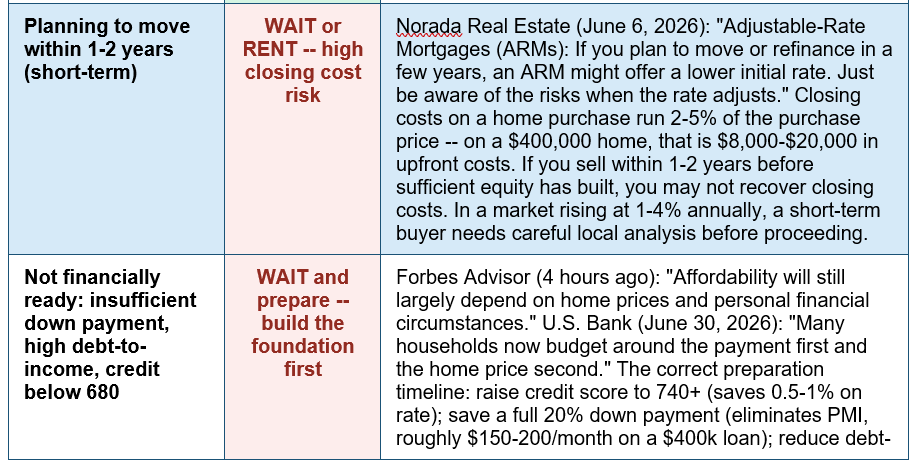
The buy-or-wait question does not have a universal answer -- it has a personal answer determined by specific financial circumstances. The following table maps the key scenarios:
The Case for Buying Now: Five Arguments for Acting in 2026
1 DATE THE RATE, MARRY THE HOUSE | Refinance when rates fall; you cannot renegotiate the price you paid
Mortgage Info (July 3, 2026): 'If you buy today at 6.25% and refinance when rates hit 5.5% (projected late 2026/early 2027), you save $180/month on a $400K loan. The date the rate, marry the house strategy works. Lock today's rate and refinance when rates hit 5.5%.' Forbes Advisor (4 hours ago): Matt Vernon, head of consumer lending at Bank of America: 'Rather than waiting it out for a rate that they like better, hopeful homebuyers should assess their personal financial situation -- if the house is right for them, and the upfront and monthly payments are affordable, it could be the right chance to make a move. Getting an optimal rate on a home loan can save you a significant amount of money over time.' The refinancing option means today's rate is not necessarily your rate for 30 years. When rates fall -- if/when they fall to 5.5% or below -- refinancing a loan originated today produces an immediate monthly saving. But the price of the home you bought today cannot be renegotiated downward. Lock the price now, refinance the rate later.2 62% WAITED IN 2025 AND PAID MORE ANYWAY | The waiting strategy has a documented failure rate
U.S. News (2 weeks ago): 'In a May 2026 U.S. News survey, nearly two-thirds of homebuyers (62%) were waiting for mortgage rates to fall before buying a home. However, the same amount (62%) put off buying a home in 2025 because they were waiting for rates to fall -- and they didn't. In the time that homebuyers have been holding out for lower rates, home values have continued to rise.' The homebuyer who waited through 2025 for lower rates did not get lower rates. They got higher home prices. The same risk applies to 2026: every month spent waiting for rates to fall is a month in which the home being targeted for purchase is becoming more expensive. Waiting is not a risk-free strategy. It is a strategy with its own specific cost: higher purchase price plus rent paid while waiting. Mortgage Info (July 3, 2026) calculates this explicitly at $40,600 for a one-year wait on a $400,000 home.3 INVENTORY IS IMPROVING -- MORE CHOICE AVAILABLE | The buyer's bargaining position is better in 2026 than at any point since 2019
U.S. Bank (June 30, 2026): 'Total existing-home inventory rose 3.3% from April to 1.55 million units, equal to 4.5 months of supply. Those figures point to a housing market that is thawing rather than accelerating.' Freddie Mac (July 30, 2026): 'The housing market continues to benefit from more available inventory, providing prospective homebuyers with additional options and helping support buyer activity as mortgage rates fluctuate.' Redfin (2 weeks ago): 'The housing market strongly favors buyers' in terms of inventory conditions. More available inventory means more choice, reduced bidding war pressure, and more opportunity for negotiation. Buyers who purchase in a market with 4.5 months of supply have significantly more negotiating power than those who purchased in the sub-2-months supply market of 2021-2022. This improvement in buyer conditions is available now -- not guaranteed to persist if rates fall and demand surges again.4 HOME PRICES WILL BE HIGHER NEXT YEAR -- BY EVERY FORECAST | The cost of waiting is not just rent. It is price appreciation foregone.
No major institution projects a national home price decline for 2026. Fannie Mae projects +3.2%, NAR projects +4%, Realtor.com projects +2.2%, MBA projects +0.6%, Zillow projects +1.2%. U.S. News (2 weeks ago): 'Buyers shouldn't expect prices to come crashing down, at least not on a national level.' On a $429,300 median home price (U.S. Bank, June 30, 2026), even the most conservative forecast (+0.6% MBA) means the home costs $2,576 more in one year. At the NAR's +4% forecast, it costs $17,172 more. The buyer who waits a year for rates to fall modestly while prices rise 2-4% will find the monthly payment on a more expensive home at a slightly lower rate -- barely changed, or possibly higher. The financial benefit of a 0.3% rate reduction is erased by a 1-2% home price increase.5 EQUITY BUILDS FROM DAY ONE -- RENT BUILDS NONE | Every mortgage payment builds an ownership stake. Every rent payment builds the landlord's.
Mortgage Info (July 3, 2026): 'Home prices rising 3.9% annually plus rising rents means the math favors buying now in most markets.' Yahoo Finance (July 1, 2026): 'If you're financially ready to buy a home, consider doing so sooner rather than later, as this allows you to start building equity in the house.' Every month that a financially ready buyer rents while waiting for rates to fall is a month in which: (1) the rent payment builds no equity; (2) the home being targeted appreciates in price; (3) home price appreciation on a home already owned would have been captured. The equity accumulation from ownership -- both from mortgage paydown and price appreciation -- is permanent. The rent paid while waiting is gone. For buyers who are financially ready, the equity clock starts on the day of purchase, not the day rates reach a preferred level.When Waiting IS the Right Answer
The case for buying now is strong for financially prepared buyers with long-term horizons. But waiting is the correct answer for buyers in specific circumstances -- and being honest about which category you are in matters more than the rate environment.- Your financial foundation is not yet solid: If your credit score is below 680, your down payment is less than 5-10%, your debt-to-income ratio exceeds 43%, or you have less than 3 months of emergency savings, waiting to build a stronger financial position is the right decision at any rate level. Forbes Advisor (4 hours ago): "Affordability will still largely depend on home prices and personal financial circumstances." Norada (June 6, 2026): "A great credit score, a larger down payment, and negotiating seller concessions can all help you get a better deal." The waiting time should be used aggressively to build credit, pay down debt, and accumulate a larger down payment.
- You are planning to move within 1-2 years: Closing costs on a home purchase run 2-5% of the purchase price. At $429,300 (median price), that is $8,586-$21,465 in upfront costs. If you sell within 2 years before sufficient equity has built, you may not recover these costs. The break-even point for home purchase versus renting typically requires 3-5 years of ownership in most markets, particularly at current price and rate levels. If your time horizon is shorter, renting and saving provides more financial flexibility.
- Your local market is one of the overheated exceptions: Mortgage Info (July 3, 2026): "Some overheated markets (Austin, Boise, Phoenix) may see 0-2% declines or flat prices." While national forecasts project price increases, specific markets that experienced the most dramatic pandemic-era appreciation may experience flatness or modest declines. Check local data, not national headlines.
The refinancing opportunity: why today's rate may not be your rate for 30 years. Norada Real Estate (June 6, 2026): 'Refinancing Realities: Honestly, unless rates drop by at least 0.75% to 1% below your current rate (and you factor in the closing costs), there's probably not much point in refinancing right now. Keep an eye out for dips, though.' Mortgage Info (July 3, 2026): 'If you buy today at 6.25% and refinance when rates hit 5.5% (projected late 2026/early 2027), you save $180/month on a $400K loan.' The strategy: buy the home when the price and property are right. Lock the 30-year fixed at today's rate as protection against further rises. Then monitor rates actively for the 0.75-1% drop that makes refinancing financially worthwhile. The break-even calculation for refinancing: divide closing costs by monthly payment reduction. If closing costs are $4,000 and monthly saving is $200, break-even is 20 months -- meaning if you plan to stay for at least 20 more months after refinancing, it is worth doing. A buyer who buys at 6.66% today and refinances at 5.7% in 2027 will have captured both the 2026 home price and the lower 2027 rate. A buyer who waits for 5.7% may find the home costs $20,000 more in 2027.
FIVE THINGS TO KNOW BEFORE MAKING A DECISION IN THE 6.66% RATE ENVIRONMENT: (1) DO NOT BASE YOUR DECISION ON A RATE YOU CANNOT QUALIFY FOR. Forbes Advisor (4 hours ago): 'Getting an optimal rate requires keeping your eye on rates, a great credit score, a larger down payment, and negotiating seller concessions.' The average advertised rate (6.66%) is for well-qualified borrowers. If your credit score is below 720, your actual offered rate will be higher. Get pre-approved before any rate-driven decision-making. (2) FACTOR IN THE FULL MONTHLY COST, NOT JUST THE MORTGAGE PAYMENT. The 6.66% rate on a $400,000 loan at 20% down produces approximately $2,065/month in principal and interest. But total monthly homeownership costs also include property taxes (typically 1-2.5% of value annually), homeowners insurance ($1,200-$2,000/year), HOA fees where applicable, and maintenance (typically 1% of value/year). The real monthly cost for a $400,000 home is typically $2,800-$3,500/month all-in. Budget from this number, not from the mortgage payment alone. (3) UNDERSTAND PMI IF YOUR DOWN PAYMENT IS BELOW 20%. Private mortgage insurance (PMI) adds approximately 0.5-1.5% of the loan balance annually to your payment. On a $350,000 loan with 10% down, PMI adds approximately $146-$438 per month. PMI is eliminated when the loan-to-value ratio reaches 80% -- but at today's slow appreciation rates, this may take several years. (4) DO NOT COUNT ON A SPECIFIC REFINANCING TIMELINE. Norada (June 6, 2026): rates need to drop at least 0.75-1% below your current rate for refinancing to make financial sense after closing costs. No forecaster predicts with certainty when this will occur. Budget for the current payment to be your payment for at least 3-5 years. (5) THE ASKING TITLE OF THIS POST REFERS TO 7% RATES -- THE ACTUAL CURRENT RATE IS 6.66%. Freddie Mac's July 30, 2026 survey shows 6.66%. Rates have been volatile between 5.98% and 6.66% in 2026. Any specific rate decision should use the actual rate you are offered through pre-approval, not the national average.
YOUR 2026 HOME BUYING ACTION PLAN: IF YOU ARE FINANCIALLY READY (good credit, down payment saved, stable income, 3-6 months emergency fund): (1) Get pre-approved immediately at 2-3 lenders to compare rates. Shop within 14-45 days to limit credit score impact. (2) Lock a rate when you are under contract -- do not float unless you have specific intelligence suggesting a rate drop within 60 days. (3) Plan to stay 5+ years. Use the date-the-rate strategy: buy the house, refinance when rates fall 0.75-1% below your locked rate. (4) Budget from the all-in monthly cost (mortgage + taxes + insurance + maintenance + HOA), not just the mortgage payment. (5) Review local market conditions with a buyer's agent -- national trends may not reflect your specific market. IF YOU ARE NOT YET FINANCIALLY READY: (6) Target a 740+ credit score for the best rate (every 20-point increase saves approximately 0.25% on rate). (7) Save aggressively for a 20% down payment to eliminate PMI. (8) Reduce debt-to-income below 36% (total monthly debt payments / gross monthly income). (9) Build 3-6 months of emergency savings before purchasing. (10) Consider the HUD housing counsellor programme (hud.gov) for free pre-purchase counselling. RATE RESOURCES: Freddie Mac PMMS (weekly): freddiemac.com/pmms | Bankrate mortgage rate comparison: bankrate.com/mortgages | CFPB mortgage guide: consumerfinance.gov/mortgage.
Conclusion
The 30-year fixed mortgage rate stands at 6.66% as of July 30, 2026, according to Freddie Mac's most recent survey. Every major institution forecasts rates remaining in the mid-6% range through at least the end of 2026 -- Fannie Mae at 6.4%, MBA at 6.5%, Reuters consensus at 6.3-6.4%. No major forecaster projects a return to rates below 6% in 2026, and the MBA forecasts 6.5% through 2028.For buyers who are financially prepared -- solid credit, 20% down payment, stable income, emergency fund intact -- the data argues for acting rather than waiting. Home prices are rising under every major forecast. The cost of a one-year wait on a $400,000 home is approximately $40,600 in combined price appreciation and rent paid (Mortgage Info, July 3, 2026). Sixty-two percent of buyers waited through 2025 for rates to fall -- and paid higher prices instead (U.S. News, 2 weeks ago). The refinancing option means today's rate is not necessarily the rate for 30 years: as Forbes Advisor (4 hours ago) notes, if rates fall to 5.5%, the monthly saving on a $400,000 loan is $180. Buying now locks in the price; refinancing later locks in a better rate.
For buyers who are not yet financially ready, or who are planning to move within two to three years, waiting to strengthen the financial position is the correct decision at any rate level. The rate environment does not override the fundamentals of personal financial preparedness. But for the financially ready buyer asking whether to wait another year for the rate to fall from 6.66% to 6.3% -- the answer that the data supports is: buy the house, date the rate. The 0.36% rate reduction you are waiting for will cost you approximately $17,000 in home price appreciation and $25,000 in rent in the meantime.
Frequently Asked Questions (FAQ)
What is the current 30-year mortgage rate in July 2026?The current 30-year fixed mortgage rate is 6.66%, as reported by Freddie Mac's Primary Mortgage Market Survey on July 30, 2026 -- the most authoritative weekly benchmark for US mortgage rates. The 15-year fixed rate is 6.04%. Both rates increased slightly from the previous week (6.58% and 5.96% respectively). For context: the 2026 low was 5.98% on February 26, 2026. The 2023 peak was 7.79%. Today's rate is below the recent peak but significantly above the 2020-2021 pandemic lows of 2.65-3%. U.S. Bank (June 30, 2026): rates reached as low as 5.98% on February 26 before rising to 6.49% on June 25. The subsequent rise to 6.66% as of July 30 illustrates the volatility of the current rate environment. Freddie Mac notes that 'the housing market continues to benefit from more available inventory, providing prospective homebuyers with additional options and helping support buyer activity as mortgage rates fluctuate.' The specific rate you are offered will depend on your credit score, down payment, loan type, and lender -- the national average is for well-qualified borrowers, and your actual rate may be higher or lower.
Will mortgage rates drop below 6% in 2026 or 2027?
The major housing and mortgage forecasters do not project 30-year fixed rates falling below 6% in 2026, and the MBA's forecast does not project it through 2028 either. Forbes Advisor (4 hours ago -- most current): 'Fannie Mae projects 6.4% for the rest of 2026. The MBA forecasts 6.5% in Q3 and Q4 of 2026 and holds the same outlook for 2027 and 2028.' LendingTree (June 30, 2026): 'Expect rates to hover between 6% and 7%.' Redfin (2 weeks ago): rates are 'elevated and volatile' due to multiple global and domestic factors including Middle East conflict, AI uncertainty, tariff impacts, and the Fed's stance on inflation. Ramsey Solutions (3 weeks ago): rates predicted to 'stay within the current range through 2027.' The Reuters poll of property specialists (June 2026) found mid-6% rates 'not expected to fall meaningfully any time soon.' The closest any major forecaster comes to projecting sub-6% rates is Fannie Mae's projection of 5.9% by end of 2026 (its November forecast, predating the 2026 rate volatility). Most current forecasts have revised this upward to 6.3-6.5%. Forbes Advisor is explicit: the sub-3% pandemic era rates 'likely aren't coming back.' Buyers waiting for rates below 6% should understand they may be waiting for something no major institution currently projects happening within the next 2-3 years.
What does "date the rate, marry the house" mean?
'Date the rate, marry the house' is a real estate buying philosophy that separates the two primary decisions in a home purchase: the price you pay for the home (the marriage -- a long-term commitment) and the interest rate on your mortgage (the date -- temporary and changeable). Mortgage Info (July 3, 2026): 'If you buy today at 6.25% and refinance when rates hit 5.5% (projected late 2026/early 2027), you save $180/month on a $400K loan. The date the rate, marry the house strategy works.' The reasoning: when you buy a home, you lock in a purchase price that is permanent -- if you wait and the home appreciates, you cannot buy it later at today's price. The mortgage rate, however, is not permanent. If rates fall sufficiently (typically 0.75-1% below your current rate to justify closing costs), you can refinance to a lower rate. So the correct decision sequence is: buy the house when the price and property are right; lock the best available rate today; then refinance when rates fall to a level that makes it financially worthwhile. Norada (June 6, 2026): 'Unless rates drop by at least 0.75% to 1% below your current rate, there's probably not much point in refinancing right now. Keep an eye out for dips, though.' The strategy works best for buyers who plan to stay in the home at least 5 years -- sufficient time to refinance and recoup closing costs when rates fall.
How much does waiting one year to buy a house actually cost?
The cost of waiting depends on local home price appreciation and rent, but Mortgage Info (July 3, 2026) provides a widely cited data-driven calculation: 'On a $400,000 home with 3.9% appreciation, waiting 1 year means the home costs $415,600 -- that's $15,600 more. Plus you paid $25,000 in rent while waiting. Total cost of waiting: $40,600.' Using the conservative end of 2026 home price forecasts: on a $429,300 median home (U.S. Bank, June 30, 2026), even the most conservative forecast (+0.6% from MBA) means the home costs $2,576 more after one year. At the NAR's +4% forecast, it costs $17,172 more. Add one year of rent payments (national average $1,739/month per Zillow, approximately $20,868/year) and the total financial cost of waiting one year is $23,444-$38,040 -- depending on which price appreciation estimate you use. U.S. News (2 weeks ago): homebuyers who waited through 2025 for lower rates faced higher prices instead, with home values appreciating 17% since the beginning of 2022. The calculation does not favour waiting for buyers who are financially ready. For buyers who are not ready -- insufficient down payment, low credit score, high debt-to-income -- the calculation is different: strengthening the financial position reduces the rate you are offered and potentially reduces PMI costs by enough to offset price appreciation.
Is 2026 a buyer's market or a seller's market?
The 2026 US housing market is better described as a transitional market than a clear buyer's or seller's market -- and the balance varies significantly by location. U.S. Bank (June 30, 2026): 'Total existing-home inventory rose 3.3% from April to 1.55 million units, equal to 4.5 months of supply. Existing-home sales increased 3.2% from April and 3.2% from a year earlier to a seasonally adjusted annual rate of 4.17 million. Those figures point to a housing market that is thawing rather than accelerating.' Redfin (2 weeks ago): 'The housing market strongly favors buyers' in terms of available inventory -- but affordability remains challenging due to elevated rates and high prices. Freddie Mac (July 30, 2026): the market 'benefits from more available inventory, providing prospective homebuyers with additional options.' Four to five months of supply (the current national level) is historically considered a balanced market (six months is the traditional definition of balance; below three favours sellers). In national terms, buyers have more choice and negotiating power than at any point since 2019-2020. However, Mortgage Info (July 3, 2026) identifies that specific markets vary: 'Midwest (affordable), Southeast (population inflow), and suburbs (remote work trend)' are likely to appreciate most in 2026. Markets like Austin, Boise, and Phoenix 'may see 0-2% declines or flat prices.' The buyer's or seller's market determination is most meaningfully made at the local level with current data from a local buyer's agent.
0 Comments
Be the first to share your thoughts on this article.