

Savings
Use the Newton Rule to Grow Your 401(k) Savings

Newton’s First Law states that objects at rest stay at rest — and objects in motion stay in motion. The median 401(k) balance is $44,115. Americans believe they need $1.46 million to retire comfortably. The gap is a ratio of 33:1. The problem is not intelligence, income, or opportunity. It is inertia: the tendency to stay exactly where you are, financially, until something forces a change. The Newton Rule for retirement savings has three parts: overcome the inertia that keeps you from starting, build the momentum that makes your 401(k) grow faster the larger it gets, and apply a force each year that escalates your contributions automatically. Not financial advice.
The 401(k) system has a Newton problem. Objects at rest — people who have not enrolled, not increased their contributions, or not started investing their employer match — tend to stay at rest. The inertia is both psychological and structural: the contribution form is not filled in, the percentage is left at the default rate, the escalation feature is not activated, and each year that passes is another year of compound growth foregone. The 401(k) Specialist Magazine has explicitly identified this: ‘Newton’s law of inertia — objects at rest tend to stay at rest — reminds us it can be very difficult to get people to take that first step of enrollment.’
But Newton’s law has a second, more powerful dimension: objects in motion tend to stay in motion. A 401(k) account that is enrolled, funded, automatically escalating, and receiving an employer match is an object in motion. And in finance, an object in motion does not just maintain its momentum — it accelerates. This is the compound interest effect that Einstein reportedly called the eighth wonder of the world. The Newton Rule for 401(k) savings translates the three laws of motion into three actionable financial principles that, together, describe the most reliable path to retirement security available to ordinary Americans. Not financial advice.
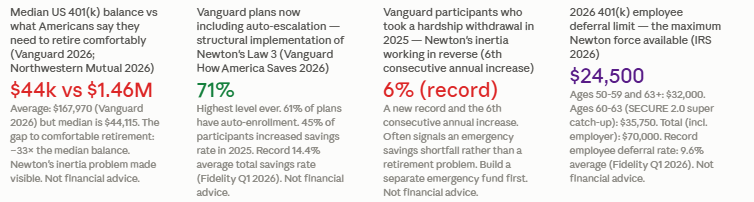
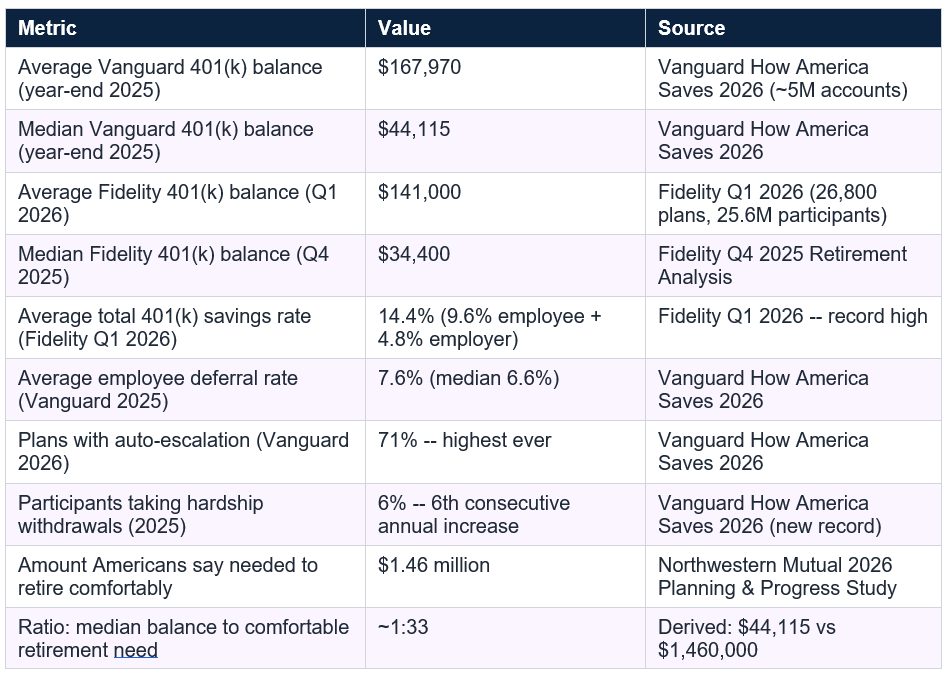
Median US 401(k) balance: $44,115 (Vanguard, year-end 2025). Average: $167,970 (Vanguard) -- pulled upward by large accounts. Fidelity average: $141,000 (Q1 2026). Fidelity median: $34,400. Americans say they need $1.46 million to retire comfortably (Northwestern Mutual 2026 Planning and Progress Study). The median account leaves savers behind by a factor of ~33:1. 71% of Vanguard plans now include auto-escalation (2026 -- highest ever). 6% of Vanguard participants took hardship withdrawals in 2025 -- 6th consecutive annual increase (new record). Sources: Vanguard 'How America Saves 2026'; Fidelity Q1 2026; Northwestern Mutual 2026. Not financial advice.
The median tells a different story. The median Vanguard 401(k) balance at year-end 2025 was $44,115. The Fidelity median at Q4 2025 was $34,400. The gap between the mean and the median — averaging $167,970 vs the typical saver holding $44,115 — reflects the concentration of retirement wealth in a relatively small number of large accounts. For the typical American, the retirement savings picture is significantly more precarious than the average suggests.
Northwestern Mutual’s 2026 Planning and Progress Study found that Americans now believe they need approximately $1.46 million to retire comfortably. Against the median 401(k) balance of $44,115, the typical account is behind by a factor of roughly 33. The Newton inertia problem is real, measurable, and expensive. Not financial advice.
As of 2025, 61% of Vanguard plans had adopted automatic enrollment — the structural solution to enrollment inertia that defaults new employees into the 401(k) rather than requiring them to opt in. The evidence on auto-enrollment is unambiguous: participation rates in plans with auto-enrollment are dramatically higher than in plans requiring active enrollment. WealthManagement.com describes the dynamic for high earners specifically: many people who earn well are ‘behind in their savings for very different reasons’ — not income inadequacy but ‘investor inertia.’ The Medical Economics guide to overcoming inertia is direct: ‘Start now. You may find that the corollary to inertia — objects in motion tend to stay in motion — is also true.’
The practical implementation of Newton’s First Law for 401(k) participants: enroll today, at any contribution rate that does not prevent it, and automate the contribution so it happens without a monthly decision. The object must be set in motion. Everything else follows from this. Not financial advice.
Newton's Law Applied: Newton's Law 1 applied to 401(k): 'An object at rest tends to stay at rest.' Every year not enrolled in the 401(k) is a year of compound growth lost that cannot be recovered. The employer match that was not claimed is free money permanently gone. The action required to overcome retirement inertia: enroll, automate the contribution, and capture at least enough to receive the full employer match. Once the 401(k) is in motion, the momentum builds without further effort. The hardest step is the first one. Not financial advice.
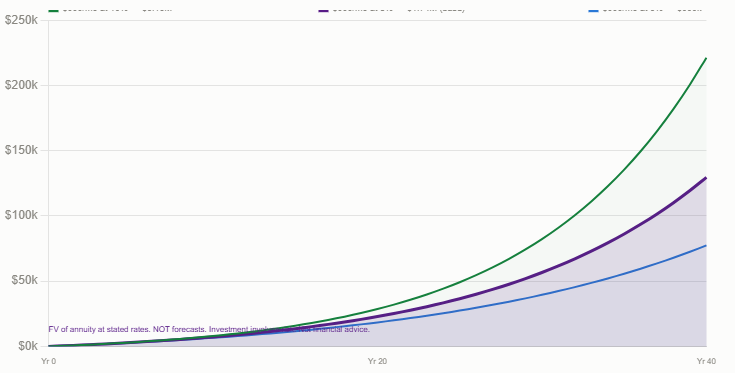
The Chapelboro retirement coaching article captures this precisely: ‘It’s a natural law of economics that the more we have, the faster it grows, especially when compound interest is involved... the Law of Inertia begins to work in our favor.’ The specific illustration of the momentum effect: a $500/month 401(k) contribution at 8% average annual return grows to approximately $91,000 after 10 years. After 20 years: approximately $294,000. After 30 years: approximately $746,000. After 40 years: approximately $1.74 million. The final ten years alone add approximately $994,000 — more than the combined total of the first thirty years. This is Newton’s momentum made financial: the larger the object (the portfolio), the faster it moves at the same applied force (the monthly contribution).
This is also why time is the most irreplaceable component of the Newton Rule. Every year of delay does not merely reduce the terminal portfolio by one year’s worth of contributions; it removes one year of compounding from the entire remaining lifetime of the account. The object in motion builds momentum that cannot be replicated by contributing more later. Not financial advice.
The Math: The momentum math: $500/month at 8%/yr. Year 10: ~$91,000. Year 20: ~$294,000. Year 30: ~$746,000. Year 40: ~$1,740,000. The LAST 10 years (year 30 to 40): add ~$994,000. The FIRST 10 years (year 0 to 10): added ~$91,000. Ratio: the last decade contributes more than 10× the first decade to the terminal value. This is Newton's momentum: every dollar invested early has more time to compound and more base to compound upon. $1 at 8% for 40 years = $21.72. The same $1 at 8% for 30 years = $10.06. Starting 10 years earlier more than doubles the terminal value of every dollar. Not a forecast. FV of annuity formula. Investment involves risk. Not financial advice.
This principle is now structurally embedded in 71% of Vanguard plans through auto-escalation features — the highest level in the history of the Vanguard survey, and one of the key drivers of the record 14.4% average total savings rate reported by Fidelity in Q1 2026. Auto-escalation automatically increases the employee’s deferral rate by 1 percentage point each year, typically up to a maximum (commonly 10% or 15%). An employee starting at 6% with auto-escalation reaches 10% within four years without a single conscious decision. Vanguard’s 2026 report found that 45% of participants increased their savings rate in 2025, either voluntarily or through auto-escalation.
The Newton Rule specifically recommends combining auto-enrollment (Law 1) with auto-escalation (Law 3) as the structural implementation of the physics analogy: start the object moving, then apply an annual force that continuously increases its speed. Not financial advice.
Newton's Law 3 action: log in to your 401(k) plan portal today and activate auto-escalation if your plan offers it. Set it to increase by 1% per year, with no ceiling below 15%. If your plan does not offer auto-escalation, set a recurring calendar reminder for January 1 each year to manually increase your contribution by 1%. Pair each pay raise with an immediate 1% contribution increase before lifestyle inflation absorbs the raise. This is the force-application step that converts a flat trajectory into an upward curve. Not financial advice.
Failing to contribute at least enough to receive the full employer match is one of the most expensive financial mistakes available to an employed American. On a $60,000 salary with a 50% match on the first 6%: the employer match is worth $1,800 per year of free money. At 8% annual growth over 30 years, $1,800 per year compounds to approximately $204,000 — entirely free, representing no cost to the employee beyond contributing what they should have been contributing anyway. Not financial advice.
The Center for Retirement Research at Boston College (Geoffrey T.) frames the inertia problem precisely in the context of the match: employees who are ‘at rest’ regarding their contribution level — who have never increased from the default auto-enrollment rate — are often leaving significant employer matching on the table. The Newton Rule prioritises matching above all other 401(k) actions: capture the full employer match before doing anything else. Not financial advice.
Geoffrey T., Research Fellow, Center for Retirement Research at Boston College: 'I have always viewed inertia as an impediment to retirement savings. If not followed, the first law of physics -- and apparently human behavior -- can set people way back in their savings.' The Center's research also finds that, once invested in age-appropriate allocations, inertia can work in savers' favor by keeping them invested through market volatility rather than panic-selling. Source: Center for Retirement Research at Boston College. Not financial advice.
Fidelity’s Q1 2026 data from 25.6 million participants shows an average of $141,000 and a median of $34,400. The skew is even more pronounced at the Fidelity scale: the average is more than four times the median. For the purposes of the Newton Rule, the median is the more relevant benchmark: it is the balance held by a typical saver, not the balance distorted by outliers. The typical 45-year-old with a $34,400 median balance who needs $1.46 million to retire comfortably has a gap that requires urgent application of Newton’s Laws 1, 2, and 3. Not financial advice.
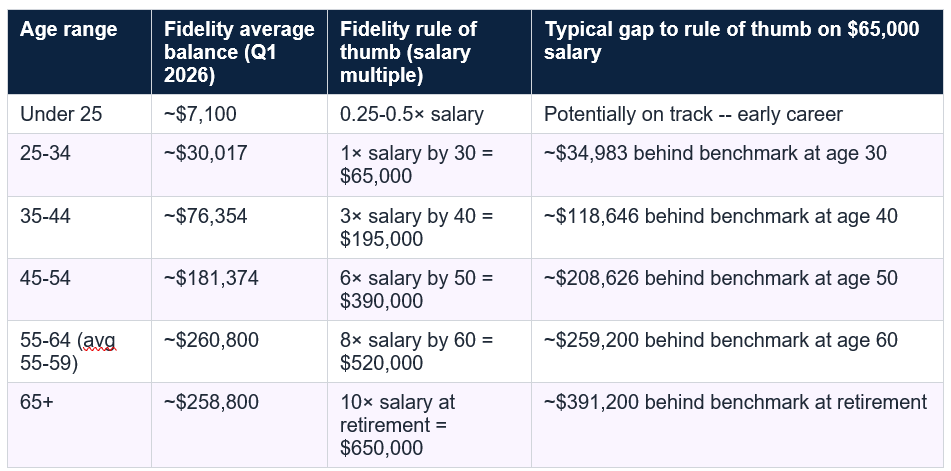
Fidelity age brackets: Under 25 balance based on Q1 2026 data; 25-34 ($30,017), 35-44 ($76,354), 45-54 ($181,374) from Fidelity Q1 2026 (via financer.com aggregator); 55-59 ($260,800), 60-64 ($257,400), 65-69 ($258,800) from Fidelity Q1 2026 (Motley Fool July 2026). Salary multiple benchmarks from Fidelity's retirement savings guidelines. $65,000 salary used as reference. Actual benchmarks should be applied to the individual's own current and projected salary. Not financial advice.
Vanguard’s equivalent guidance is a total contribution rate (employee plus employer) of 12–15% throughout a career. At Fidelity, the record Q1 2026 average total savings rate of 14.4% is for the first time approaching this range. The gap between the average savings rate (14.4%) and the participation rate — meaning the proportion of eligible employees actually enrolled — is the Newton inertia problem. High rates among those who are contributing are encouraging; the challenge is the population that has not yet overcome the initial inertia of enrollment.
For someone currently behind the Fidelity benchmarks: the Newton Rule provides the acceleration mechanism. A saver who is 38 years old with $60,000 saved against a 3× benchmark of $165,000 (on a $55,000 salary) is $105,000 behind. The combination of maximizing the employer match, activating auto-escalation, and directing every pay raise partially to the 401(k) are the three Newtonian forces that close this gap. Not financial advice.
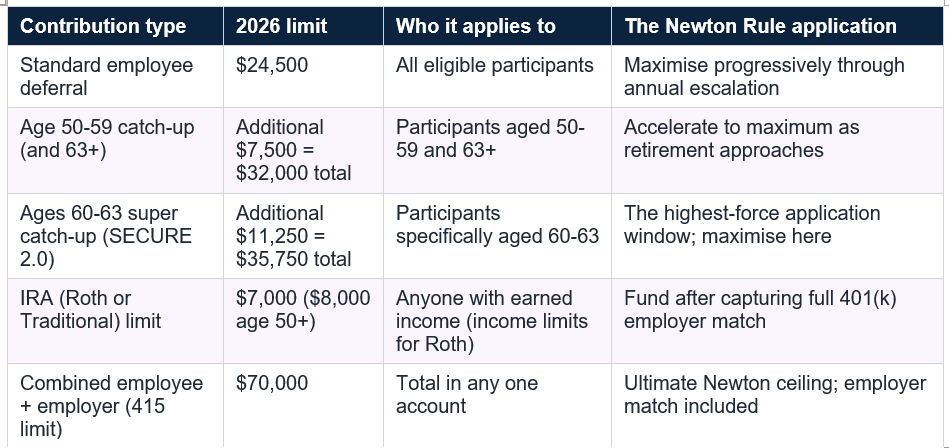
Maximising the contribution limit is the maximum application of Newtonian force: the largest annual addition to the compound engine. At 8% annual growth, $24,500 per year for 30 years produces approximately $2.97 million. For most American workers, maximising the contribution limit is a long-term goal rather than an immediate reality — the median employee deferral rate of 6.6% on a median household income would produce a contribution well below the limit. The Newton Rule approach is not to immediately reach the limit but to continuously move toward it: enroll, meet the employer match, escalate 1% per year, and capture each pay raise. Not financial advice.
The target-date fund is the structural implementation of beneficial inertia: a single fund that automatically rebalances toward more conservative allocations as the participant approaches retirement, requires no active management decisions, and benefits from the investor’s tendency to leave things unchanged. Vanguard reports that 79% of plan contribution dollars were invested in equities during 2025 — a level consistent with appropriate long-term growth orientation for most working-age investors. The Newton Rule recommends leveraging the beneficial inertia of a set-and-forget target-date fund once enrollment, matching, and escalation are configured. Not financial advice.
At age 25, the cost of a one-year delay is even higher, because the foregone year has five more years to compound. At age 40, the cost is lower in absolute terms but no less significant relative to the reduced time horizon. The inertia problem compounds in the opposite direction to the investment: every year of inaction multiplies the catch-up required in future years. The VU Research Portal’s 2026 inaction inertia research is explicit: early retirement saving is critical because ‘the earlier you start to save, the lower your yearly savings rate needs to be.’ Not financial advice.
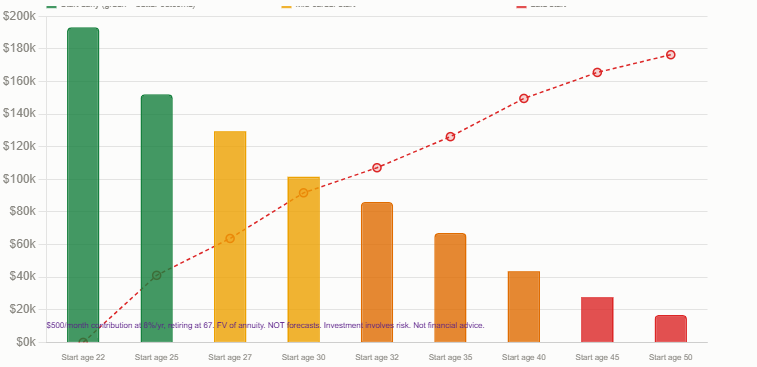
The cost of inertia: one year of delay in starting $500/month 401(k) contributions at 8%/yr from age 30 costs approximately $130,000 in terminal portfolio value at age 70. From age 25: approximately $190,000 for one year of delay. This is not a round number or an approximation: it is the precise compound growth difference between starting 12 months earlier vs later. The money does not have to be lost; it simply has to not be started. That is the specific and devastating cost of objects remaining at rest. Not a forecast. FV of annuity calculation. Not financial advice.
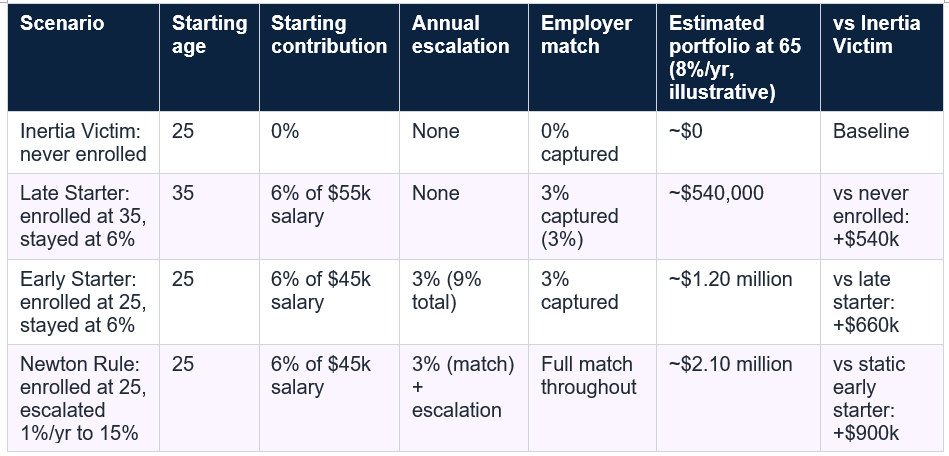
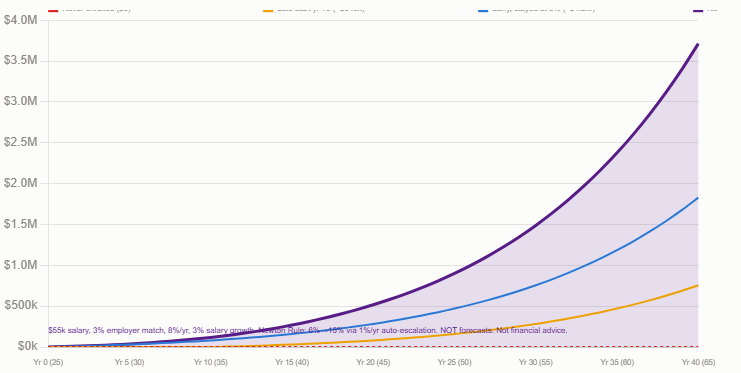
All figures are illustrative estimates using compound growth principles at 8%/yr average annual return. Salary assumed to grow 3% annually (contributions scale with salary). Not forecasts or guarantees. Individual results will vary based on investment returns, salary trajectory, plan terms, and tax treatment. Not financial advice.
An object in motion stays in motion: a 401(k) account that is enrolled, matched, and compounding builds momentum that grows faster as the balance grows larger. The last decade of a 40-year contribution period adds more to the portfolio than the previous three decades combined. This is Newton’s momentum working in the saver’s favour — and it is available to anyone who sets the object in motion, regardless of how late they feel they have started.
And a force applied consistently overcomes inertia and builds acceleration: 1% per year in auto-escalation, every pay raise directed partially to the 401(k), and full employer match capture are the three forces that transform the Newton inertia problem into the Newton momentum advantage. The 401(k) system already has the tools built in: auto-enrollment, auto-escalation, and target-date funds. The Newton Rule is using them, today, with whatever contribution rate is possible. Start the object moving. Not financial, tax, or retirement advice. Consult a qualified financial adviser.
The Newton Rule applies Isaac Newton's First Law of Motion (the law of inertia) to retirement savings. Newton's law states that objects at rest tend to stay at rest, and objects in motion tend to stay in motion. Applied to a 401(k): (1) 'At rest' describes people who are not enrolled, not contributing enough, or not escalating their contributions -- they tend to stay in that state, losing years of compound growth. (2) 'In motion' describes a funded, growing 401(k) account -- the compound growth builds momentum that accelerates over time, with the largest gains in the final years. The Newton Rule has three steps: enroll and automate (overcome inertia), allow compound growth to build momentum, and apply an annual force (increase contributions 1% per year through auto-escalation). Sources: 401k Specialist Magazine; Center for Retirement Research at Boston College; Chapelboro. Not financial advice.
How much do I need in my 401(k) to retire comfortably?
According to Northwestern Mutual's 2026 Planning and Progress Study, Americans believe they need approximately $1.46 million to retire comfortably. Fidelity's rule of thumb suggests saving 10× your final salary by retirement (age 67). For a $65,000 salary, that would be $650,000; for a $100,000 salary, $1 million. Vanguard recommends a total contribution rate (employee plus employer) of 12% to 15% throughout your career to stay on track. The median US 401(k) balance as of 2025 was $44,115 (Vanguard) -- significantly below any retirement comfort benchmark. The gap underscores the urgency of applying the Newton Rule immediately. Not financial advice. Retirement income needs vary by individual spending, Social Security entitlement, other savings, and desired lifestyle.
What is auto-escalation and should I use it?
Auto-escalation is a 401(k) plan feature that automatically increases your contribution deferral rate by a set percentage (typically 1%) each year, usually up to a maximum ceiling. As of 2026, 71% of Vanguard plans offer auto-escalation -- the highest level ever recorded (Vanguard How America Saves 2026). It is the structural implementation of Newton's Law 3 (applying an annual force). Vanguard reports that 45% of participants increased their savings rate in 2025, either voluntarily or through auto-escalation. If your plan offers auto-escalation: activate it immediately, set the annual increase to 1% or higher, and set the ceiling at 15% or the employer match maximum. If your plan does not: set a calendar reminder for January 1 each year to manually increase by 1%. Not financial advice.
What is the 401(k) contribution limit in 2026?
In 2026, the IRS employee deferral limit for 401(k) plans is $24,500. For participants aged 50-59 and 63 and older, an additional catch-up contribution of $7,500 is allowed ($32,000 total). Participants specifically aged 60-63 (under the SECURE 2.0 Act super catch-up) can contribute an additional $11,250 ($35,750 total). The combined employee plus employer contribution limit (the 415 limit) is $70,000. IRA limits in 2026 are $7,000 ($8,000 for age 50+). Always verify current IRS limits at irs.gov, as limits typically increase each year with inflation adjustments. Sources: IRS; Motley Fool July 2026 (catch-up limits). Not tax or financial advice.
I'm behind on my 401(k) savings -- is it too late to catch up?
It is not too late. The Newton Rule applies at any age: the object in motion (a funded 401(k)) builds momentum regardless of when it starts. Starting at 40 with 27 years to retirement (age 67) at 8% average return: $1,000/month grows to approximately $1.04 million. Starting at 45 with 22 years: approximately $635,000. The IRS specifically provides catch-up contributions for this reason: ages 50-59 and 63+ can contribute an additional $7,500/year in 2026; ages 60-63 can contribute an additional $11,250 under SECURE 2.0. Additionally: maximize the employer match first, activate auto-escalation, direct every pay raise partially to the 401(k), and consider consulting a CFP or RIA to build an accelerated contribution strategy. The VU Research Portal 2026 research on inaction inertia specifically warns against the trap of feeling too far behind to start -- this feeling itself is the inertia that perpetuates the problem. Not financial advice. Consult a qualified financial adviser.
Table of Contents
- Newton Meets Wall Street: Why Physics Explains Your 401(k)
- The State of American Retirement Savings in 2026
- Newton’s Law 1 — Overcoming Inertia: Enroll and Start Now
- Newton’s Law 2 — Building Momentum: The Compound Growth Engine
- Newton’s Law 3 — Applying Force: The Auto-Escalation Principle
- The Employer Match: Newton’s Multiplier
- The 401(k) Balance Gap: Average vs Median and What It Means
- The Fidelity Benchmark: 10× Salary at Retirement
- The 2026 Contribution Limits: How to Max Newton’s Force
- When Inertia Works For You: The Auto-Pilot Portfolio
- The Cost of Inertia: What Waiting One Year Costs
- The Newton Rule in Action: A 40-Year Illustration
- Conclusion: Start the Object Moving
- Frequently Asked Questions
Newton's momentum — how your 401(k) accelerates over time
The cost of inertia — what waiting costs in dollars
Newton Rule vs inertia — four career scenarios
Newton Meets Wall Street: Why Physics Explains Your 401(k)
In 1687, Sir Isaac Newton published his three laws of motion in Philosophiæ Naturalis Principia Mathematica. His first law — the law of inertia — states that an object at rest tends to stay at rest, and an object in motion tends to stay in motion, unless acted upon by an external force. Newton was describing the physical world. He was also, it turns out, describing the American retirement savings landscape three centuries before it existed.The 401(k) system has a Newton problem. Objects at rest — people who have not enrolled, not increased their contributions, or not started investing their employer match — tend to stay at rest. The inertia is both psychological and structural: the contribution form is not filled in, the percentage is left at the default rate, the escalation feature is not activated, and each year that passes is another year of compound growth foregone. The 401(k) Specialist Magazine has explicitly identified this: ‘Newton’s law of inertia — objects at rest tend to stay at rest — reminds us it can be very difficult to get people to take that first step of enrollment.’
But Newton’s law has a second, more powerful dimension: objects in motion tend to stay in motion. A 401(k) account that is enrolled, funded, automatically escalating, and receiving an employer match is an object in motion. And in finance, an object in motion does not just maintain its momentum — it accelerates. This is the compound interest effect that Einstein reportedly called the eighth wonder of the world. The Newton Rule for 401(k) savings translates the three laws of motion into three actionable financial principles that, together, describe the most reliable path to retirement security available to ordinary Americans. Not financial advice.
Median US 401(k) balance: $44,115 (Vanguard, year-end 2025). Average: $167,970 (Vanguard) -- pulled upward by large accounts. Fidelity average: $141,000 (Q1 2026). Fidelity median: $34,400. Americans say they need $1.46 million to retire comfortably (Northwestern Mutual 2026 Planning and Progress Study). The median account leaves savers behind by a factor of ~33:1. 71% of Vanguard plans now include auto-escalation (2026 -- highest ever). 6% of Vanguard participants took hardship withdrawals in 2025 -- 6th consecutive annual increase (new record). Sources: Vanguard 'How America Saves 2026'; Fidelity Q1 2026; Northwestern Mutual 2026. Not financial advice.
The State of American Retirement Savings in 2026
The headline number from Vanguard’s 2026 ‘How America Saves’ report is encouraging: the average 401(k) balance across nearly five million participant accounts hit $167,970 at year-end 2025 — a 13% increase from 2024, driven primarily by strong market performance including a 19.3% average one-year participant total return. Fidelity’s data from 26,800 plans and 25.6 million participants shows an average of $141,000 in Q1 2026.The median tells a different story. The median Vanguard 401(k) balance at year-end 2025 was $44,115. The Fidelity median at Q4 2025 was $34,400. The gap between the mean and the median — averaging $167,970 vs the typical saver holding $44,115 — reflects the concentration of retirement wealth in a relatively small number of large accounts. For the typical American, the retirement savings picture is significantly more precarious than the average suggests.
Northwestern Mutual’s 2026 Planning and Progress Study found that Americans now believe they need approximately $1.46 million to retire comfortably. Against the median 401(k) balance of $44,115, the typical account is behind by a factor of roughly 33. The Newton inertia problem is real, measurable, and expensive. Not financial advice.
Newton’s Law 1 — Overcoming Inertia: Enroll and Start Now
An object at rest tends to stay at rest. In retirement savings terms, this manifests as non-enrollment, minimum-contribution stagnation, and the perpetual deferral of the decision to increase savings to ‘when things settle down.’ Research published in 2026 by VU Research Portal specifically identifies ‘inaction inertia in retirement saving’ as a documented cognitive phenomenon: missing an early savings opportunity makes it psychologically harder to start later, because the missed gains make any future contribution seem inadequate by comparison. The feeling that ‘I should have started at 22, so there’s no point starting at 32’ is precisely the inaction inertia trap.As of 2025, 61% of Vanguard plans had adopted automatic enrollment — the structural solution to enrollment inertia that defaults new employees into the 401(k) rather than requiring them to opt in. The evidence on auto-enrollment is unambiguous: participation rates in plans with auto-enrollment are dramatically higher than in plans requiring active enrollment. WealthManagement.com describes the dynamic for high earners specifically: many people who earn well are ‘behind in their savings for very different reasons’ — not income inadequacy but ‘investor inertia.’ The Medical Economics guide to overcoming inertia is direct: ‘Start now. You may find that the corollary to inertia — objects in motion tend to stay in motion — is also true.’
The practical implementation of Newton’s First Law for 401(k) participants: enroll today, at any contribution rate that does not prevent it, and automate the contribution so it happens without a monthly decision. The object must be set in motion. Everything else follows from this. Not financial advice.
Newton's Law Applied: Newton's Law 1 applied to 401(k): 'An object at rest tends to stay at rest.' Every year not enrolled in the 401(k) is a year of compound growth lost that cannot be recovered. The employer match that was not claimed is free money permanently gone. The action required to overcome retirement inertia: enroll, automate the contribution, and capture at least enough to receive the full employer match. Once the 401(k) is in motion, the momentum builds without further effort. The hardest step is the first one. Not financial advice.
Newton’s Law 2 — Building Momentum: The Compound Growth Engine
An object in motion tends to stay in motion. In retirement savings, the object in motion is a funded 401(k) account, and what keeps it in motion — and accelerates it — is compound growth. The mechanics: your contributions earn investment returns. Those returns are added to the principal. Next period, the larger principal earns returns. The returns then earn returns on the returns. Over decades, this compounding creates exponential acceleration: the portfolio does not grow in a straight line; it curves upward, with the rate of growth increasing as the base gets larger.The Chapelboro retirement coaching article captures this precisely: ‘It’s a natural law of economics that the more we have, the faster it grows, especially when compound interest is involved... the Law of Inertia begins to work in our favor.’ The specific illustration of the momentum effect: a $500/month 401(k) contribution at 8% average annual return grows to approximately $91,000 after 10 years. After 20 years: approximately $294,000. After 30 years: approximately $746,000. After 40 years: approximately $1.74 million. The final ten years alone add approximately $994,000 — more than the combined total of the first thirty years. This is Newton’s momentum made financial: the larger the object (the portfolio), the faster it moves at the same applied force (the monthly contribution).
This is also why time is the most irreplaceable component of the Newton Rule. Every year of delay does not merely reduce the terminal portfolio by one year’s worth of contributions; it removes one year of compounding from the entire remaining lifetime of the account. The object in motion builds momentum that cannot be replicated by contributing more later. Not financial advice.
The Math: The momentum math: $500/month at 8%/yr. Year 10: ~$91,000. Year 20: ~$294,000. Year 30: ~$746,000. Year 40: ~$1,740,000. The LAST 10 years (year 30 to 40): add ~$994,000. The FIRST 10 years (year 0 to 10): added ~$91,000. Ratio: the last decade contributes more than 10× the first decade to the terminal value. This is Newton's momentum: every dollar invested early has more time to compound and more base to compound upon. $1 at 8% for 40 years = $21.72. The same $1 at 8% for 30 years = $10.06. Starting 10 years earlier more than doubles the terminal value of every dollar. Not a forecast. FV of annuity formula. Investment involves risk. Not financial advice.
Newton’s Law 3 — Applying Force: The Auto-Escalation Principle
Newton’s Second Law states that force equals mass times acceleration (F = ma). In 401(k) terms, the ‘force’ applied to growing the retirement account is the contribution rate, and the ‘acceleration’ is the annual increase in that contribution rate. A contribution rate that stays fixed at 6% throughout a 40-year career produces a smaller terminal portfolio than one that starts at 6% and increases by 1% per year, even though both began at the same point. The escalating contribution captures more of the salary growth that typically occurs across a career and applies it directly to the compound growth engine before lifestyle inflation can absorb it.This principle is now structurally embedded in 71% of Vanguard plans through auto-escalation features — the highest level in the history of the Vanguard survey, and one of the key drivers of the record 14.4% average total savings rate reported by Fidelity in Q1 2026. Auto-escalation automatically increases the employee’s deferral rate by 1 percentage point each year, typically up to a maximum (commonly 10% or 15%). An employee starting at 6% with auto-escalation reaches 10% within four years without a single conscious decision. Vanguard’s 2026 report found that 45% of participants increased their savings rate in 2025, either voluntarily or through auto-escalation.
The Newton Rule specifically recommends combining auto-enrollment (Law 1) with auto-escalation (Law 3) as the structural implementation of the physics analogy: start the object moving, then apply an annual force that continuously increases its speed. Not financial advice.
Newton's Law 3 action: log in to your 401(k) plan portal today and activate auto-escalation if your plan offers it. Set it to increase by 1% per year, with no ceiling below 15%. If your plan does not offer auto-escalation, set a recurring calendar reminder for January 1 each year to manually increase your contribution by 1%. Pair each pay raise with an immediate 1% contribution increase before lifestyle inflation absorbs the raise. This is the force-application step that converts a flat trajectory into an upward curve. Not financial advice.
The Employer Match: Newton’s Multiplier
The employer 401(k) match is not strictly a Newtonian concept, but in the Newton Rule framework it functions as a multiplier on the applied force: it increases the effective contribution by 50–100% without any additional cost to the employee. Vanguard’s data shows an average employer contribution of approximately 4.6% of pay (median 4%). Fidelity reports an average employer contribution of 4.8% in Q1 2026. The most common match formula is a 50% match on the first 6% of employee contributions — meaning an employee who contributes 6% receives an additional 3% from the employer, for a total of 9% per year.Failing to contribute at least enough to receive the full employer match is one of the most expensive financial mistakes available to an employed American. On a $60,000 salary with a 50% match on the first 6%: the employer match is worth $1,800 per year of free money. At 8% annual growth over 30 years, $1,800 per year compounds to approximately $204,000 — entirely free, representing no cost to the employee beyond contributing what they should have been contributing anyway. Not financial advice.
The Center for Retirement Research at Boston College (Geoffrey T.) frames the inertia problem precisely in the context of the match: employees who are ‘at rest’ regarding their contribution level — who have never increased from the default auto-enrollment rate — are often leaving significant employer matching on the table. The Newton Rule prioritises matching above all other 401(k) actions: capture the full employer match before doing anything else. Not financial advice.
Geoffrey T., Research Fellow, Center for Retirement Research at Boston College: 'I have always viewed inertia as an impediment to retirement savings. If not followed, the first law of physics -- and apparently human behavior -- can set people way back in their savings.' The Center's research also finds that, once invested in age-appropriate allocations, inertia can work in savers' favor by keeping them invested through market volatility rather than panic-selling. Source: Center for Retirement Research at Boston College. Not financial advice.
The 401(k) Balance Gap: Average vs Median and What It Means
The gap between the average and median 401(k) balance is the data point that most clearly reveals the inertia problem in American retirement savings. The average Vanguard balance at year-end 2025 was $167,970; the median was $44,115. The average is 3.8 times the median. This extreme skew — where a relatively small number of large accounts pull the average far above what the typical participant holds — means that most readers who compare themselves to the ‘average’ 401(k) balance are comparing to a number that significantly overstates the typical situation.Fidelity’s Q1 2026 data from 25.6 million participants shows an average of $141,000 and a median of $34,400. The skew is even more pronounced at the Fidelity scale: the average is more than four times the median. For the purposes of the Newton Rule, the median is the more relevant benchmark: it is the balance held by a typical saver, not the balance distorted by outliers. The typical 45-year-old with a $34,400 median balance who needs $1.46 million to retire comfortably has a gap that requires urgent application of Newton’s Laws 1, 2, and 3. Not financial advice.
Fidelity age brackets: Under 25 balance based on Q1 2026 data; 25-34 ($30,017), 35-44 ($76,354), 45-54 ($181,374) from Fidelity Q1 2026 (via financer.com aggregator); 55-59 ($260,800), 60-64 ($257,400), 65-69 ($258,800) from Fidelity Q1 2026 (Motley Fool July 2026). Salary multiple benchmarks from Fidelity's retirement savings guidelines. $65,000 salary used as reference. Actual benchmarks should be applied to the individual's own current and projected salary. Not financial advice.
The Fidelity Benchmark: 10× Salary at Retirement
Fidelity’s widely used retirement savings rule of thumb provides the clearest milestone framework for applying the Newton Rule. The benchmarks: 1× your current salary saved by age 30; 3× by age 40; 6× by age 50; 8× by age 60; and 10× by retirement (age 67). These are not guarantees or precise targets; they are approximations designed to indicate whether a saver is on a trajectory that might fund a comfortable retirement with a combination of 401(k) withdrawals and Social Security.Vanguard’s equivalent guidance is a total contribution rate (employee plus employer) of 12–15% throughout a career. At Fidelity, the record Q1 2026 average total savings rate of 14.4% is for the first time approaching this range. The gap between the average savings rate (14.4%) and the participation rate — meaning the proportion of eligible employees actually enrolled — is the Newton inertia problem. High rates among those who are contributing are encouraging; the challenge is the population that has not yet overcome the initial inertia of enrollment.
For someone currently behind the Fidelity benchmarks: the Newton Rule provides the acceleration mechanism. A saver who is 38 years old with $60,000 saved against a 3× benchmark of $165,000 (on a $55,000 salary) is $105,000 behind. The combination of maximizing the employer match, activating auto-escalation, and directing every pay raise partially to the 401(k) are the three Newtonian forces that close this gap. Not financial advice.
The 2026 Contribution Limits: How to Max Newton’s Force
The IRS sets annual limits on how much can be contributed to a 401(k). In 2026, the employee deferral limit is $24,500. For participants aged 50–59 and 63 and older, there is a catch-up contribution of $7,500, allowing a maximum of $32,000. For participants aged 60–63 specifically (under the SECURE 2.0 Act super catch-up provision), the additional catch-up is $11,250, allowing a maximum of $35,750. The combined employee plus employer contribution limit (415 limit) in 2026 is $70,000.Maximising the contribution limit is the maximum application of Newtonian force: the largest annual addition to the compound engine. At 8% annual growth, $24,500 per year for 30 years produces approximately $2.97 million. For most American workers, maximising the contribution limit is a long-term goal rather than an immediate reality — the median employee deferral rate of 6.6% on a median household income would produce a contribution well below the limit. The Newton Rule approach is not to immediately reach the limit but to continuously move toward it: enroll, meet the employer match, escalate 1% per year, and capture each pay raise. Not financial advice.
When Inertia Works For You: The Auto-Pilot Portfolio
Newton’s First Law has a corollary that is usually overlooked in discussions of retirement inertia: objects in motion tend to stay in motion. Once a 401(k) is enrolled, funded, and invested in an age-appropriate target-date fund, positive inertia works in the investor’s favour. The Center for Retirement Research at Boston College found that inertia keeps investors invested during market volatility rather than panic-selling — survey participants held higher equity allocations than they said they wanted, but the outcome was better than if they had acted on their stated preferences by reducing equity exposure at the wrong time.The target-date fund is the structural implementation of beneficial inertia: a single fund that automatically rebalances toward more conservative allocations as the participant approaches retirement, requires no active management decisions, and benefits from the investor’s tendency to leave things unchanged. Vanguard reports that 79% of plan contribution dollars were invested in equities during 2025 — a level consistent with appropriate long-term growth orientation for most working-age investors. The Newton Rule recommends leveraging the beneficial inertia of a set-and-forget target-date fund once enrollment, matching, and escalation are configured. Not financial advice.
The Cost of Inertia: What Waiting One Year Costs
The Newtonian cost of inertia is calculated in the compound growth foregone by waiting. A 30-year-old who delays starting 401(k) contributions for one year misses one year of compounding on every subsequent contribution for the rest of their career. Using $500/month at 8% annual return: the 30-year-old who starts today has $1.74 million at 70. The same person who waits one year and contributes the same $500/month has approximately $1.61 million — $130,000 less, for one year of inertia. The cost of waiting one year at age 30 is approximately $130,000 in terminal portfolio value.At age 25, the cost of a one-year delay is even higher, because the foregone year has five more years to compound. At age 40, the cost is lower in absolute terms but no less significant relative to the reduced time horizon. The inertia problem compounds in the opposite direction to the investment: every year of inaction multiplies the catch-up required in future years. The VU Research Portal’s 2026 inaction inertia research is explicit: early retirement saving is critical because ‘the earlier you start to save, the lower your yearly savings rate needs to be.’ Not financial advice.
The cost of inertia: one year of delay in starting $500/month 401(k) contributions at 8%/yr from age 30 costs approximately $130,000 in terminal portfolio value at age 70. From age 25: approximately $190,000 for one year of delay. This is not a round number or an approximation: it is the precise compound growth difference between starting 12 months earlier vs later. The money does not have to be lost; it simply has to not be started. That is the specific and devastating cost of objects remaining at rest. Not a forecast. FV of annuity calculation. Not financial advice.
The Newton Rule in Action: A 40-Year Illustration
The Newton Rule combines all three laws: Law 1 (enroll and automate on Day 1), Law 2 (allow compound growth to build momentum), and Law 3 (escalate contributions by 1% per year). Applied together, the difference in terminal portfolio value between the Newton Rule follower and the inertia victim — who enrolls eventually but never escalates — is substantial.All figures are illustrative estimates using compound growth principles at 8%/yr average annual return. Salary assumed to grow 3% annually (contributions scale with salary). Not forecasts or guarantees. Individual results will vary based on investment returns, salary trajectory, plan terms, and tax treatment. Not financial advice.
Conclusion
Sir Isaac Newton published his laws of motion in 1687. He was describing the movement of planets and cannonballs. But the laws he identified apply with equal force to the movement of money in a 401(k) account across a 40-year career. An object at rest stays at rest: retirement savings that have not been started, automated, or escalated remain exactly where they are, while the compound growth clock ticks and the gap between the median balance ($44,115) and the comfortable retirement target ($1.46 million) widens.An object in motion stays in motion: a 401(k) account that is enrolled, matched, and compounding builds momentum that grows faster as the balance grows larger. The last decade of a 40-year contribution period adds more to the portfolio than the previous three decades combined. This is Newton’s momentum working in the saver’s favour — and it is available to anyone who sets the object in motion, regardless of how late they feel they have started.
And a force applied consistently overcomes inertia and builds acceleration: 1% per year in auto-escalation, every pay raise directed partially to the 401(k), and full employer match capture are the three forces that transform the Newton inertia problem into the Newton momentum advantage. The 401(k) system already has the tools built in: auto-enrollment, auto-escalation, and target-date funds. The Newton Rule is using them, today, with whatever contribution rate is possible. Start the object moving. Not financial, tax, or retirement advice. Consult a qualified financial adviser.
Frequently Asked Questions
What is the Newton Rule for 401(k) savings?The Newton Rule applies Isaac Newton's First Law of Motion (the law of inertia) to retirement savings. Newton's law states that objects at rest tend to stay at rest, and objects in motion tend to stay in motion. Applied to a 401(k): (1) 'At rest' describes people who are not enrolled, not contributing enough, or not escalating their contributions -- they tend to stay in that state, losing years of compound growth. (2) 'In motion' describes a funded, growing 401(k) account -- the compound growth builds momentum that accelerates over time, with the largest gains in the final years. The Newton Rule has three steps: enroll and automate (overcome inertia), allow compound growth to build momentum, and apply an annual force (increase contributions 1% per year through auto-escalation). Sources: 401k Specialist Magazine; Center for Retirement Research at Boston College; Chapelboro. Not financial advice.
How much do I need in my 401(k) to retire comfortably?
According to Northwestern Mutual's 2026 Planning and Progress Study, Americans believe they need approximately $1.46 million to retire comfortably. Fidelity's rule of thumb suggests saving 10× your final salary by retirement (age 67). For a $65,000 salary, that would be $650,000; for a $100,000 salary, $1 million. Vanguard recommends a total contribution rate (employee plus employer) of 12% to 15% throughout your career to stay on track. The median US 401(k) balance as of 2025 was $44,115 (Vanguard) -- significantly below any retirement comfort benchmark. The gap underscores the urgency of applying the Newton Rule immediately. Not financial advice. Retirement income needs vary by individual spending, Social Security entitlement, other savings, and desired lifestyle.
What is auto-escalation and should I use it?
Auto-escalation is a 401(k) plan feature that automatically increases your contribution deferral rate by a set percentage (typically 1%) each year, usually up to a maximum ceiling. As of 2026, 71% of Vanguard plans offer auto-escalation -- the highest level ever recorded (Vanguard How America Saves 2026). It is the structural implementation of Newton's Law 3 (applying an annual force). Vanguard reports that 45% of participants increased their savings rate in 2025, either voluntarily or through auto-escalation. If your plan offers auto-escalation: activate it immediately, set the annual increase to 1% or higher, and set the ceiling at 15% or the employer match maximum. If your plan does not: set a calendar reminder for January 1 each year to manually increase by 1%. Not financial advice.
What is the 401(k) contribution limit in 2026?
In 2026, the IRS employee deferral limit for 401(k) plans is $24,500. For participants aged 50-59 and 63 and older, an additional catch-up contribution of $7,500 is allowed ($32,000 total). Participants specifically aged 60-63 (under the SECURE 2.0 Act super catch-up) can contribute an additional $11,250 ($35,750 total). The combined employee plus employer contribution limit (the 415 limit) is $70,000. IRA limits in 2026 are $7,000 ($8,000 for age 50+). Always verify current IRS limits at irs.gov, as limits typically increase each year with inflation adjustments. Sources: IRS; Motley Fool July 2026 (catch-up limits). Not tax or financial advice.
I'm behind on my 401(k) savings -- is it too late to catch up?
It is not too late. The Newton Rule applies at any age: the object in motion (a funded 401(k)) builds momentum regardless of when it starts. Starting at 40 with 27 years to retirement (age 67) at 8% average return: $1,000/month grows to approximately $1.04 million. Starting at 45 with 22 years: approximately $635,000. The IRS specifically provides catch-up contributions for this reason: ages 50-59 and 63+ can contribute an additional $7,500/year in 2026; ages 60-63 can contribute an additional $11,250 under SECURE 2.0. Additionally: maximize the employer match first, activate auto-escalation, direct every pay raise partially to the 401(k), and consider consulting a CFP or RIA to build an accelerated contribution strategy. The VU Research Portal 2026 research on inaction inertia specifically warns against the trap of feeling too far behind to start -- this feeling itself is the inertia that perpetuates the problem. Not financial advice. Consult a qualified financial adviser.
0 Comments
Be the first to share your thoughts on this article.