
Investing
What Are Currency Pairs? Complete Forex Trading Guide


Table of Contents
- The Foundation of the World's Largest Financial Market
- What Is a Currency Pair? The Core Structure
- Base Currency and Quote Currency: The Fundamental Distinction
- How to Read a Forex Quote: Bid, Ask, and Spread
- The Major Currency Pairs: The Backbone of the Forex Market
- Major, Minor, and Exotic Currency Pairs: The Complete Comparison
- Minor Currency Pairs (Crosses): What They Are and When to Trade Them
- Key Minor Pairs to Know in 2026
- Exotic Currency Pairs: High Risk, High Spread, High Complexity
- What Moves Currency Pairs? The Key Drivers
- Reading a Currency Pair Quote: Worked Examples
- Trading Sessions: When Are Currency Pairs Most Active?
- Conclusion
- Frequently Asked Questions (FAQ)
- External References
The Foundation of the World's Largest Financial Market
The foreign exchange market — forex, or FX — is the largest financial market in the world by daily trading volume. With an average of $7.5 trillion changing hands every single trading day according to TIOmarkets' 2026 market analysis, it dwarfs every stock exchange, bond market, and commodity exchange on the planet. At the heart of every single one of those trillions of dollars' worth of transactions is a currency pair: two currencies quoted against each other, representing the rate at which one can be exchanged for the other.A currency pair is not a complicated concept. If you have ever checked an exchange rate before booking a foreign holiday, transferred money internationally, or watched a news ticker displaying 'EUR/USD 1.10', you have already encountered a currency pair. EUR/USD at 1.10 simply means that one euro buys 1.10 US dollars. Every forex trade involves simultaneously buying one currency and selling another — and that simultaneous transaction is what a currency pair represents.
What makes currency pairs interesting beyond their apparent simplicity is the scale of their significance, the depth of their diversity, and the economic logic that determines how they move. There are approximately 180 currencies in circulation worldwide, which creates a theoretical total of 16,110 possible currency pair combinations according to FXSSI's analysis. In practice, a handful of pairs dominated by the US dollar account for the vast majority of global trading activity — EUR/USD alone represents 21.2% to 30% of all forex turnover depending on the source and methodology (BIS 2025 Triennial Survey, final revised data published June 2026). This guide explains everything about currency pairs: what they are, how they are structured, the three categories of pairs (major, minor, and exotic), what drives their movements, how to read a forex quote, and what the 2026 market environment looks like for each category.
What Is a Currency Pair? The Core Structure
A currency pair is a price quotation that expresses the value of one currency relative to another. Every currency pair consists of two components: the base currency (the first currency listed) and the quote currency, also called the counter currency (the second currency listed). The price shown for any currency pair tells you how many units of the quote currency are needed to buy one unit of the base currency.Base Currency and Quote Currency: The Fundamental Distinction
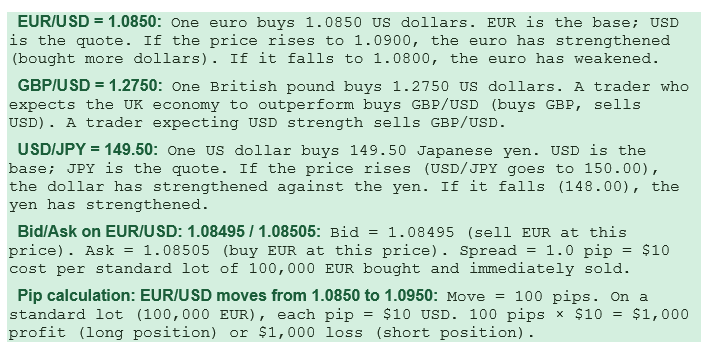
In the pair EUR/USD, the euro (EUR) is the base currency and the US dollar (USD) is the quote currency. If the price is 1.0850, it means one euro buys 1.0850 US dollars. When you buy EUR/USD, you are buying euros and simultaneously selling dollars. When you sell EUR/USD, you are selling euros and buying dollars. The base currency is always the currency you are effectively buying or selling — the quote currency is the unit in which the price is expressed.This might seem abstract in text but becomes intuitive with a real-world parallel. If you walk into a currency exchange bureau in the UK with pounds and want euros, you are effectively trading GBP/EUR. The price you are quoted — how many euros you get per pound — is the exchange rate of the currency pair. Every international currency exchange transaction in the world, whether conducted by a tourist, a multinational corporation, a central bank, or an algorithmic trading system, follows this same base/quote structure.
How to Read a Forex Quote: Bid, Ask, and Spread
When you look up a currency pair in any trading platform or financial data provider, you will see two prices: the bid and the ask. The bid is the price at which you can sell the base currency (the price buyers will pay you for it). The ask is the price at which you can buy the base currency (the price sellers will charge you for it). The ask is always slightly higher than the bid. The difference between them is the spread — the primary transaction cost in forex trading.Spreads are measured in pips. A pip (Percentage in Point) is the smallest standardised price increment in forex — for most major pairs quoted to four decimal places, one pip is 0.0001 of the quote currency. For USD/JPY, which is quoted to two decimal places, one pip is 0.01. If EUR/USD is quoted with a bid of 1.08500 and an ask of 1.08510, the spread is 1.0 pip. This is a highly competitive, tight spread typical of major pairs during active market hours. Exotic pairs — USD/TRY or USD/ZAR — can have spreads of 50 to 100 pips or more, making them significantly more expensive to trade.
The forex market in four numbers: $7.5 trillion daily volume — EUR/USD = 21.2% — USD in 88% of all trades — 16,110 possible pair combinations — the BIS Triennial Central Bank Survey 2025 (final revised data, June 2026) is the most authoritative source for forex market structure data. EUR/USD's dominant share reflects the two largest economic blocs; the USD's 88% involvement reflects its status as the world's primary reserve currency and the international invoicing currency of choice for commodities, energy, and trade.
The Major Currency Pairs: The Backbone of the Forex Market.
Major currency pairs are those that include the US dollar on one side — either as the base or quote currency — paired with another major global currency. The USD's involvement in approximately 88% of all forex transactions globally, according to Bimalinstitute's 2026 major pairs guide, explains why major pairs account for approximately 66.3% of all forex volume (BIS 2025 data). The table below maps every major pair with its BIS 2025 volume data (final revised, June 2026), typical spread, and key 2026 market drivers:
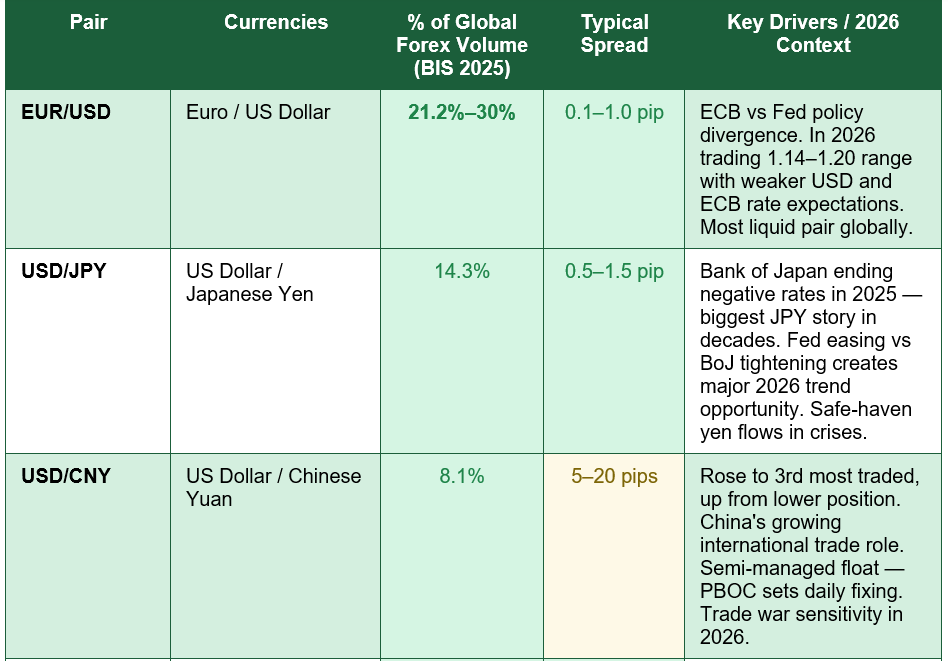
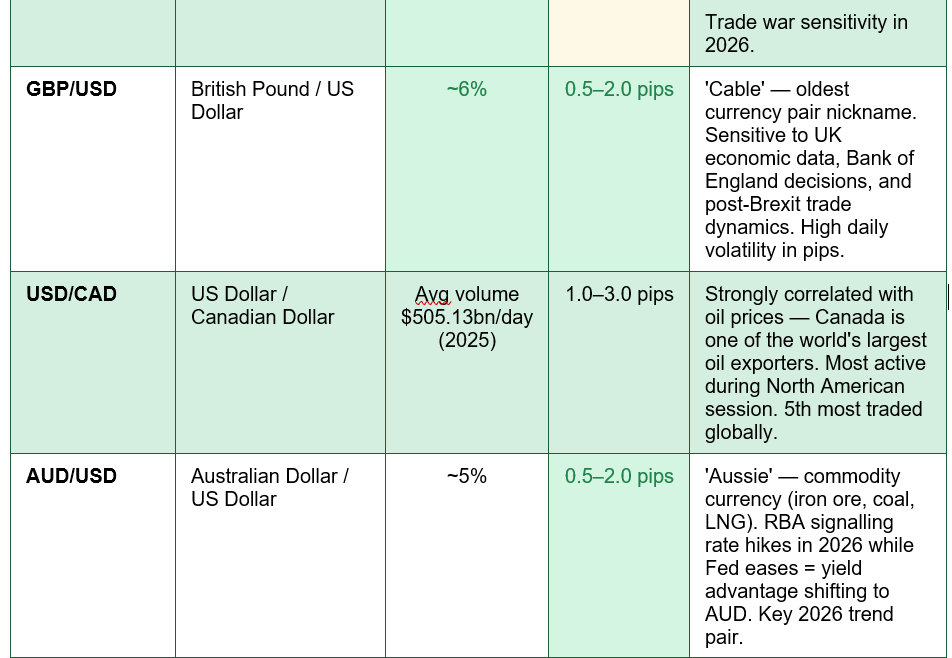
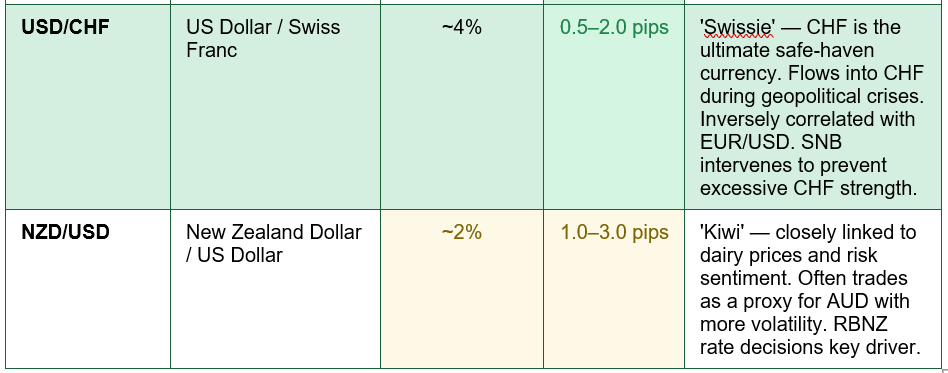
Why the US dollar dominates: The USD is the world's primary reserve currency — held by central banks worldwide as a store of value and used as the invoicing currency for global commodities (oil, gold, copper), international trade, and cross-border financial transactions. Even in a trade between a Japanese company and a Brazilian company in a commodity like soybeans, the transaction is likely denominated in US dollars rather than yen or reals. This ubiquity of dollar usage means that almost every international money flow at some point involves a USD conversion, which is why the dollar appears on one side of 88% of all forex transactions. Understanding the dollar's reserve currency status is fundamental to understanding why major pairs exist and why they dominate trading.
Major, Minor, and Exotic Currency Pairs: The Complete Comparison
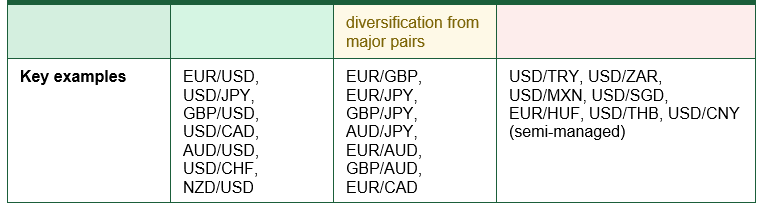
The forex market categorises currency pairs into three groups based on the currencies involved, their trading volume, and their liquidity characteristics. Understanding the distinctions determines which type of pair is appropriate for your experience level, trading style, and risk tolerance: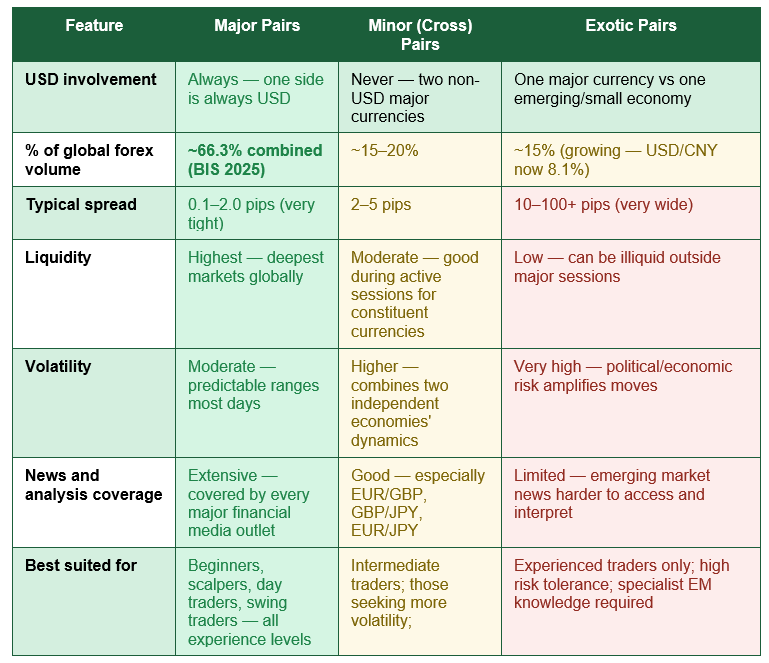
Minor Currency Pairs (Crosses): What They Are and When to Trade Them
Minor currency pairs — also called cross pairs or simply crosses — are pairs that do not include the US dollar. They pair two of the other major currencies directly against each other, bypassing the dollar as an intermediary. Examples include EUR/GBP (euro against British pound), GBP/JPY (sterling against yen), EUR/JPY (euro against yen), AUD/JPY (Australian dollar against yen), EUR/AUD (euro against Australian dollar), and EUR/CAD (euro against Canadian dollar).Before electronic trading became widespread, it was not actually possible to trade EUR/GBP directly. To convert euros into pounds, a trader would have to first convert euros to dollars (using EUR/USD) and then convert dollars to pounds (using GBP/USD). The cross pair EUR/GBP is literally the mathematical cross of those two major pairs — EUR/USD divided by GBP/USD. While modern platforms execute minor pairs directly, the economic relationship between minor pairs and their parent major pairs remains, and cross pair traders must monitor both constituent economies simultaneously.
The GBP/JPY is a particularly notable minor pair — often called the 'dragon' or 'the widowmaker' by experienced traders because of its combination of high daily volatility (the pound and yen are both individually volatile currencies that can move significantly on domestic economic data), significant pip range, and the fact that it combines two economies with very different characteristics: the UK's service-dominated, post-Brexit economy and Japan's export-manufacturing powerhouse that is in the process of ending decades of ultra-loose monetary policy.
Key Minor Pairs to Know in 2026
- EUR/GBP: The euro-pound pair is one of the most stable and most institutionally traded crosses. It accounts for approximately 1.8% of global forex turnover (BIS 2025). Driven by the relative economic performance of the eurozone versus the UK, Bank of England versus ECB policy decisions, and post-Brexit trade dynamics. Tight range-bound trading characteristics make it suitable for range traders.
- GBP/JPY: High volatility, wide daily ranges, and significant sensitivity to both UK data and Bank of Japan policy decisions. The BoJ's normalisation of interest rates in 2025 — ending negative rates for the first time in decades — makes JPY pairs including GBP/JPY among the highest-profile strategic trades of 2026.
- EUR/JPY: One of the most actively traded crosses. Combines eurozone fundamental analysis with yen safe-haven dynamics. Often used as a barometer of global risk appetite: when investors are comfortable with risk, EUR/JPY rises (yen weakens as investors move out of safe havens); in crises, EUR/JPY falls sharply.
- AUD/JPY: Known as a risk sentiment indicator. In bull markets, the high-yielding AUD strengthens against the safe-haven JPY (carry trade dynamics). In risk-off environments, the trade reverses sharply. RBA rate hike signals in 2026 add a fundamental tailwind to AUD on this pair.
Exotic Currency Pairs: High Risk, High Spread, High Complexity
Exotic currency pairs match one major currency — typically the US dollar or euro — against a currency from an emerging market, a developing economy, or a smaller economy. Examples include USD/TRY (US dollar against Turkish lira), USD/ZAR (dollar against South African rand), USD/MXN (dollar against Mexican peso), USD/SGD (dollar against Singapore dollar), EUR/HUF (euro against Hungarian forint), and USD/THB (dollar against Thai baht). The USD/CNY (dollar against Chinese yuan), though involving the world's second-largest economy, occupies a distinctive position because the yuan is a semi-managed currency where the People's Bank of China sets a daily fixing rate.Exotic pairs are categorically not for beginner traders. ChartMini's 2026 forex pair guide is explicit about this: 'Avoid exotic pairs until you're consistently profitable. Pairs like USD/ZAR and USD/TRY have spreads of 50-100+ pips and extreme volatility. You start every trade in a deep hole. Only trade exotics if you have 12+ months of experience and a $10,000+ account.' The wide spread means that an exotic pair trade begins with a larger built-in loss (the spread cost) before the price even moves. Combined with the elevated political and economic risk in emerging market economies, this creates a challenging trading environment that demands specialist knowledge.
The BIS 2025 data (June 2026 final revision) shows that USD/TRY returned to $44.6 billion per day in average turnover in 2025, recovering from a low of $44.6 billion daily after the lira's extreme volatility in previous years. USD/RUB has almost disappeared from global trading following sanctions imposed on Russia in 2022. The growth of USD/CNY — now the third most traded pair globally at 8.1% of turnover — reflects the growing internationalisation of the Chinese yuan rather than the characteristics of a traditional exotic pair; USD/CNY is increasingly treated as a 'major-exotic' category of its own.
EXOTIC PAIR WARNING — THE SPREAD TRAP: An EUR/USD spread of 0.8 pips on a standard lot represents a cost of $8. A USD/TRY spread of 80 pips on the same lot represents a cost of roughly $240 — thirty times more expensive to enter the same-sized trade. This spread difference is the cost of every entry you make in an exotic pair, before any profit or loss from price movement. In volatile markets, exotic pair spreads can widen dramatically during news events, adding further hidden costs. Never trade exotic pairs without calculating the full round-trip cost (entry spread + exit spread) as a percentage of your expected profit target — in many exotic pair setups, the cost alone makes the trade uneconomical.
What Moves Currency Pairs? The Key Drivers
Exchange rates are determined by the interaction of supply and demand for currencies in the global market. Understanding what drives that supply and demand is the foundation of forex fundamental analysis. The primary drivers fall into five categories:- Interest rate differentials: The single most important driver of long-term currency pair movements. When a central bank raises interest rates, it attracts capital from international investors seeking higher yields — demand for that currency rises, and it appreciates against lower-yielding alternatives. The FXNX 2026 analysis states the key rule: 'capital tends to flow toward the currency whose central bank is more hawkish.' The 2026 macro environment is particularly interesting: the Fed cut rates throughout 2025 and continues easing, while the Bank of Japan is tightening after decades of ultra-loose policy. This divergence creates one of the largest USD/JPY directional signals in years.
- Economic growth and data: Strong GDP growth, low unemployment, robust retail sales, and expanding manufacturing activity all suggest a healthy economy and tend to strengthen a currency. Weak data does the opposite. Key economic releases — non-farm payrolls (NFP), CPI inflation, GDP growth, and retail sales — routinely cause significant intraday moves in major pairs when they deviate from expectations.
- Inflation and central bank policy: Central banks raise rates to fight inflation and cut rates to stimulate growth. Anticipating central bank decisions — and the inflation and growth data that drive those decisions — is the primary analytical task of fundamental forex traders. Speeches by Fed Chair Jerome Powell, ECB President Christine Lagarde, or Bank of England Governor Andrew Bailey can move major pairs by hundreds of pips.
- Commodity prices: Several currencies are strongly correlated with commodity prices. The Australian dollar (AUD) is closely tied to iron ore, coal, and natural gas prices. The Canadian dollar (CAD) tracks crude oil. The New Zealand dollar (NZD) is influenced by dairy prices. The Norwegian krone (NOK) tracks North Sea oil. Understanding these correlations allows traders to use commodity price movements as a leading indicator for currency pair direction.
- Risk sentiment and safe-haven flows: In times of global uncertainty — geopolitical crises, pandemic events, financial market stress — investors move out of higher-risk currencies into safe havens. The Japanese yen (JPY) and Swiss franc (CHF) are the primary safe-haven currencies in the forex market. USD also benefits from safe-haven flows in severe crises. These risk-off flows can override fundamental factors and produce sharp, fast currency pair moves that have nothing to do with the domestic economic conditions of the countries involved.
Reading a Currency Pair Quote: Worked Examples
Trading Sessions: When Are Currency Pairs Most Active?
The forex market operates 24 hours a day, five days a week — from the opening of the Sydney session on Monday morning (Sunday evening in the US and UK) to the closing of the New York session on Friday. However, different currency pairs are most active during the trading sessions that correspond to the major financial centres of the currencies involved.- London session (8 AM – 5 PM GMT): The world's largest forex trading centre. EUR/USD, GBP/USD, EUR/GBP, USD/CHF, and all European currency pairs are most active. The London open frequently produces significant directional moves and is the session where institutional order flow is heaviest.
- New York session (1 PM – 10 PM GMT): Second largest session. Overlaps with London from 1 PM to 5 PM GMT — the London-New York overlap is the most active period of the entire trading week, producing the largest price moves across major pairs.
- Tokyo/Asian session (midnight – 9 AM GMT): USD/JPY, AUD/USD, AUD/JPY, NZD/USD, and Asian currency pairs are most active. EUR/USD and GBP/USD tend to consolidate during this session unless major Asian data is released.
- Sydney session (10 PM – 7 AM GMT): Quieter session, but AUD/USD and NZD/USD tend to show the earliest activity of the trading week. Market generally thinnest during this period.
2026 KEY MACRO THEMES FOR CURRENCY PAIRS: Three macro themes are shaping currency pair movements in 2026. (1) USD weakness thesis: the Fed cut rates throughout 2025 and is expected to continue easing — favours long EUR/USD, GBP/USD, and AUD/USD positions. (2) JPY normalisation: the Bank of Japan ended negative rates in 2025 and is tightening — the biggest yen story in decades. USD/JPY could be the defining directional trade of 2026. (3) Commodity currency strength: RBA signalling rate hikes while the Fed eases shifts yield advantage to AUD — makes AUD/USD a key trend trade. Always align currency pair selection with the dominant macro theme of the period.
Conclusion
Currency pairs are the fundamental unit of the world's largest financial market. Every forex trade — from the retail trader executing a single micro lot on EUR/USD to the central bank conducting a $10 billion currency intervention — involves the simultaneous buying of one currency and selling of another, expressed as a pair with a base and a quote currency. The forex market's $7.5 trillion daily volume, its 24-hour operation, and its global reach make currency pairs the most liquid and continuously accessible financial instruments available to traders anywhere in the world.The three-category structure — major pairs (all containing the USD, 66.3% of global volume), minor or cross pairs (two major non-USD currencies, good liquidity, moderate spreads), and exotic pairs (one major currency vs one emerging market currency, wide spreads, high volatility, complex drivers) — provides the framework for matching pair selection to experience level and risk tolerance. EUR/USD, with 21.2% of all global forex volume and spreads as low as 0.1 pips, remains the definitive starting point for forex education and trading. The BIS 2025 data also highlights the rising significance of USD/CNY, now the third most traded pair globally at 8.1% of turnover, reflecting China's growing role in international trade.
Understanding what moves currency pairs — interest rate differentials, economic data, central bank policy, commodity prices, and risk sentiment — is the analytical framework that converts the raw price data of a currency pair into an actionable trading thesis. In 2026 specifically, three macro themes stand out: the US dollar weakness narrative from Federal Reserve easing, the Bank of Japan's historic policy normalisation making JPY pairs among the most directionally significant in years, and the commodity currency strength argument as the RBA signals rate hikes while the Fed cuts. Currency pairs are not simply price ratios — they are the quantitative expression of the relative economic fortunes of nations, updated tick by tick in real time.
Frequently Asked Questions (FAQ)
What is a currency pair in forex trading?
A currency pair is a price quotation expressing the exchange rate between two currencies. Every forex trade involves simultaneously buying one currency and selling another. The first currency listed is the base currency; the second is the quote currency. The price shows how many units of the quote currency are needed to buy one unit of the base currency. For example, EUR/USD at 1.0850 means one euro buys 1.0850 US dollars. There are approximately 180 currencies in circulation globally, creating 16,110 possible pair combinations, though in practice a small number of pairs — led by EUR/USD — account for the vast majority of global trading volume. EUR/USD alone represents 21.2% of all forex turnover according to BIS 2025 data.What is the difference between major, minor, and exotic currency pairs?
Major currency pairs always include the US dollar on one side — EUR/USD, USD/JPY, GBP/USD, USD/CAD, AUD/USD, USD/CHF, and NZD/USD are the seven major pairs. They account for approximately 66.3% of all forex volume, have the tightest spreads (0.1 to 2 pips), the highest liquidity, and the most extensive analyst and media coverage. Minor pairs (also called cross pairs or crosses) do not include the USD — they pair two other major currencies, such as EUR/GBP, GBP/JPY, or EUR/JPY. They have moderate liquidity and spreads of 2 to 5 pips. Exotic pairs match a major currency against a currency from an emerging or smaller economy — USD/TRY, USD/ZAR, USD/MXN. They have wide spreads (50 to 100+ pips), high volatility, low liquidity outside major sessions, and complex drivers requiring specialist knowledge.What is the most traded currency pair in the world?
EUR/USD is the most traded currency pair in the world, accounting for approximately 21.2% of all global forex turnover according to the BIS Triennial Central Bank Survey 2025 (final revised data, June 2026). Some analyses cite figures as high as 30% for EUR/USD's share depending on whether they include spot, forwards, and swaps. The pair's dominance reflects the fact that it represents the two largest economic blocs in the world — the United States and the European Union. USD/JPY is the second most traded pair at 14.3% of turnover, and USD/CNY has risen to become the third most traded at 8.1%, reflecting China's growing international trade role. EUR/USD is also the pair with the tightest available spreads — as low as 0.1 pips — making it the most cost-efficient pair to trade.What is a pip in currency pairs?
A pip (Percentage in Point) is the standardised smallest unit of price movement in the forex market. For most currency pairs quoted to four decimal places, one pip is 0.0001 of the quote currency. For pairs involving the Japanese yen, which are quoted to two decimal places, one pip is 0.01. On a standard lot of 100,000 units of the base currency, one pip movement in EUR/USD equals $10 USD in profit or loss. On a mini lot of 10,000 units, one pip equals $1. On a micro lot of 1,000 units, one pip equals $0.10. The pip value varies slightly for non-USD quote currencies because the pip is denominated in the quote currency and then converted back to the account currency. Most trading platforms calculate pip values automatically. Many platforms also quote prices to five decimal places (pipettes), where the fifth decimal place represents a fraction of a pip (0.1 pip or 0.00001).What currency pairs are best for beginners?
The best currency pair for beginners is EUR/USD, and this recommendation is consistent across virtually every forex education source. EUR/USD has the highest global trading volume, the tightest spreads (as low as 0.1 pips, meaning very low transaction costs), the most extensive analyst coverage and educational resources, and the most reliable technical analysis signals of any forex pair — because so many participants trade it using the same frameworks that support and resistance levels are self-reinforcing. After EUR/USD, USD/JPY and GBP/USD are the most recommended beginner pairs. ChartMini's 2026 forex guide states directly: 'EUR/USD is the best pair for beginners — it accounts for 30% of all forex volume and has spreads as low as 0.1 pips. Master EUR/USD before touching anything else.' Beginners should avoid exotic pairs until they have at least 12 months of consistent profitability on major pairs.External References
1. CompareForexBrokers — Forex Trading Industry + Market Statistics 2026 (BIS 2025 Triennial Survey data, updated 4 days ago)https://www.compareforexbrokers.com/trading/statistics/
2. TIOmarkets — Forex Currency Pairs in 2026: Majors, Minors and How Exchange Rates Work (March 2026)
https://tiomarkets.com/article/forex-currency-pairs-in-2026-majors-minors-and-how-exchange-rates-work
3. Bimalinstitute — The Ultimate Guide to Major, Minor and Exotic Forex Pairs 2026 (May 2026)
https://bimalinstitute.com/major-minor-and-exotic-currency-pairs/
4. Mitrade — 10 Best Forex Pairs to Trade in 2026: Major, Minor and Exotic Pairs (April 2026)
https://www.mitrade.com/au/insights/forex/forex-basics/best-forex-pairs-to-trade
5. ChartMini — Best Forex Pairs to Trade 2026: Major, Minor and Exotic Currency Guide (February 2026)
https://chartmini.com/blog/best-forex-pairs-to-trade-2026-major-minor-exotic-currency-guide-2026
6. FXSSI — Most Traded Currency Pairs by Volume in 2026 (Forex Sentiment Board)
https://fxssi.com/the-most-traded-currency-pairs
7. Admirals — Understanding the Most Traded Forex Pairs in 2026 (BIS data, updated September 2025)
https://admiralmarkets.com/education/articles/forex-basics/what-are-the-best-currency-pairs-to-trade
8. FXNX — The 10 Forex Pairs to Know in 2026: Liquidity, Drivers, and Macro Themes (3 weeks ago)
https://fxnx.com/en/blog/top-10-forex-pairs-2026-profit-liquidity
0 Comments
Be the first to share your thoughts on this article.