

Investing
What Is a Derivative in Finance? Accountant Explains


Table of Contents
- The $846 Trillion Market That Runs the World's Financial System
- What Is a Financial Derivative?
- How Do Derivatives Work? The Core Mechanics
- The Five Main Types of Derivatives: A Complete Reference
- Derivatives in Action: Real-World Worked Examples
- Example 1 — The Farmer's Wheat Futures Hedge
- Example 2 — The CFD Speculator: Crude Oil Trade (AvaTrade, 2026)
- Exchange-Traded vs OTC Derivatives: The Two Markets Compared
- The Two Primary Uses of Derivatives: Hedging and Speculation
- Hedging: Using Derivatives to Reduce Risk
- Speculation: Using Derivatives for Leveraged Market Exposure
- The Risks of Derivatives: What Every Investor Must Understand
- Conclusion
- Frequently Asked Questions (FAQ)
The $846 Trillion Market That Runs the World's Financial System
In 2002, Warren Buffett warned in his annual letter to Berkshire Hathaway shareholders that derivatives were 'financial weapons of mass destruction.' Two decades later, that warning carries historical weight — the 2008 financial crisis, fuelled partly by the opacity and interconnectedness of the derivatives market, reshaped the global financial system and triggered the most comprehensive financial reform legislation in a generation. Yet derivatives remain at the absolute core of how the modern financial world manages risk, prices assets, and allocates capital. As of June 2025, the over-the-counter derivatives market alone had an estimated notional value of $846 trillion — according to Bank for International Settlements data cited in Wikipedia's most recently updated figures.That $846 trillion figure requires immediate context: notional value is not the same as money at risk. It represents the total face value of all outstanding contracts, not the amount that would be lost if everything went wrong simultaneously. But even after adjusting for netting and collateralisation, the derivatives market represents the most complex, most interconnected, and largest financial market structure ever created. Understanding what derivatives are, how they work, why they exist, and what risks they carry is therefore one of the most important concepts in modern financial literacy — relevant not just to professional traders and investment bankers, but to any investor, business owner, or pension holder whose financial position is affected by movements in interest rates, currency exchange rates, commodity prices, or equity markets.
This guide explains financial derivatives completely and practically: the definition, the underlying asset concept, the four main types (futures, options, forwards, and swaps) with examples of each, the distinction between exchange-traded and over-the-counter markets, the two primary uses of derivatives (hedging and speculation), leverage and how it amplifies both gains and losses, CFDs as the UK retail investor's most common derivative product, the risks that make derivatives unsuitable for many investors, the post-2008 regulatory reforms that reshaped the market, and the five categories of market participant who use derivatives in 2026.
What Is a Financial Derivative?
A financial derivative is a contract between two or more parties whose value is derived from the price of an underlying asset, index, interest rate, or other financial measure. Fidelity's definition is precise: 'Derivatives are financial contracts between 2 parties whose value comes from another underlying asset.' The word 'derivative' itself captures the defining characteristic: the instrument's value is not intrinsic to itself but is derived from something else — the underlying.The underlying asset that determines a derivative's value can be almost anything with an observable price: a stock or basket of stocks, a stock market index (S&P 500, FTSE 100), a commodity (crude oil, gold, wheat, copper), a currency pair (GBP/USD, EUR/JPY), an interest rate (LIBOR, SONIA, the US Federal Funds Rate), a credit instrument (a company's bond or its probability of default), or even another derivative. The derivative contract specifies the underlying asset, the quantity involved, the agreed price or rate, the expiry date, and the settlement method (cash or physical delivery). From these terms, the derivative's value at any future point is calculated entirely from the value of the underlying at that time.
The IMF's definition adds the functional dimension: 'Derivatives are financial instruments that are linked to a specific financial instrument or indicator or commodity, and through which specific financial risks can be traded in financial markets in their own right.' This 'traded in their own right' element is crucial: a derivative is not simply a contract between two companies that happens to reference an asset — it is a financial instrument through which risk itself can be bought, sold, transferred, and priced as a standalone product. This is what makes derivatives so powerful for risk management and so potentially dangerous when misused or misunderstood.
The scale of the derivatives market: OTC derivatives notional value: $846 trillion as of June 2025 — exceeding global GDP by more than 10 times. — Bank for International Settlements (BIS) data, as reported in Wikipedia's derivatives article (updated July 14, 2026). The global financial derivatives market (industry revenues, not notional) was valued at US$ 36.1 billion in 2026, projected to reach $75.8 billion by 2035 at a CAGR of 8.6% (EconMarketResearch, February 2026). The $846 trillion notional figure represents the aggregate face value of all outstanding OTC contracts — not the actual money at risk, which is significantly lower after netting and collateral adjustments, but still the largest market in the world by this measure
How Do Derivatives Work? The Core Mechanics
Every derivative contract shares three foundational characteristics that define how it works regardless of the specific type:- The underlying asset: Every derivative references something. The derivative's price moves in relation to the price of the underlying. If you hold a crude oil futures contract, the contract's value rises and falls as the price of crude oil moves. If you hold a put option on Apple stock, the option's value increases as Apple's share price falls. The derivative is mathematically linked to the underlying — its value cannot be determined independently.
- The contract terms: A derivative specifies the exact terms of the agreement: the underlying asset (which specific commodity, stock, index, or rate), the quantity or notional value (how many barrels of oil, how many shares, what dollar principal), the agreed price or rate (the futures price, the option's strike price, the swap's fixed rate), the expiry or maturity date (when the contract terminates or settles), and the settlement method (will the parties exchange the actual asset, or settle the difference in cash?). These terms fully specify the financial rights and obligations of both parties.
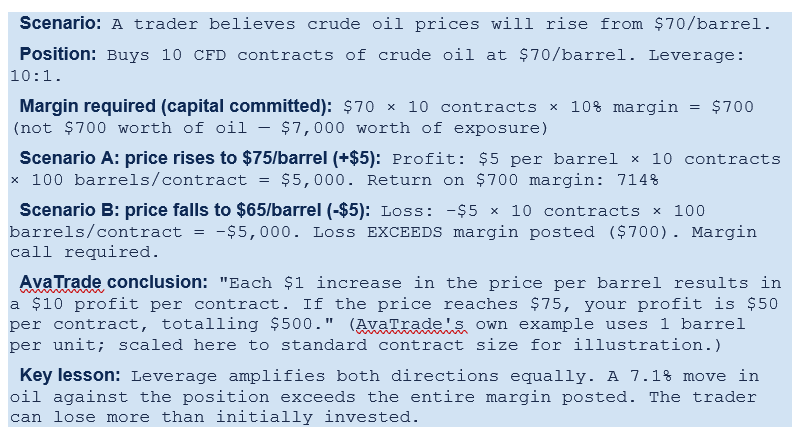
- The leverage effect: Most derivatives require only a fraction of the full contract value to be posted upfront — called margin (for futures) or premium (for options). This creates leverage: a small price movement in the underlying produces a proportionally larger change in the derivative's value relative to the capital committed. AvaTrade's 2026 guide illustrates: 'With 10:1 leverage, a 1% price move in your favour translates to a 10% return on your initial investment. Conversely, the same move against you will result in a 10% loss.' Fidelity identifies the fundamental consequence: 'Derivatives can magnify both your potential gains and losses.'
The lock vs option distinction: Wikipedia's derivatives article identifies one of the most useful ways to categorise all derivatives: 'Derivatives may broadly be categorised as lock or option products. Lock products (such as swaps, futures, or forwards) obligate the contractual parties to the terms over the life of the contract. Option products provide the buyer the right, but not the obligation to enter the contract under the terms specified.' This lock/option distinction captures a fundamental difference in the risk profile of derivatives: lock derivatives (futures, forwards, swaps) bind both parties symmetrically — both can profit and both can lose. Option derivatives give the buyer asymmetric rights: they participate in favourable moves and can walk away from unfavourable ones (losing only the premium paid). This asymmetry in options explains why they are widely used as insurance-like instruments for portfolio protection, while futures and forwards are more commonly used for direct hedging of known exposures.
The Five Main Types of Derivatives: A Complete Reference
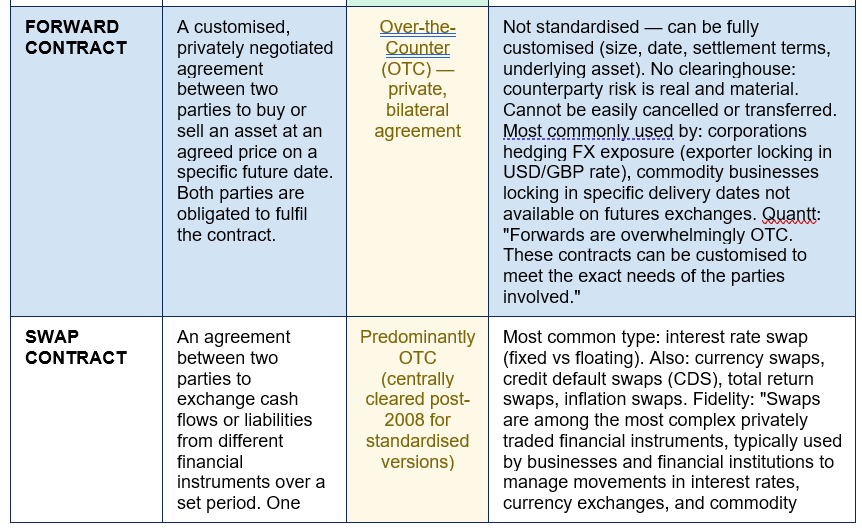
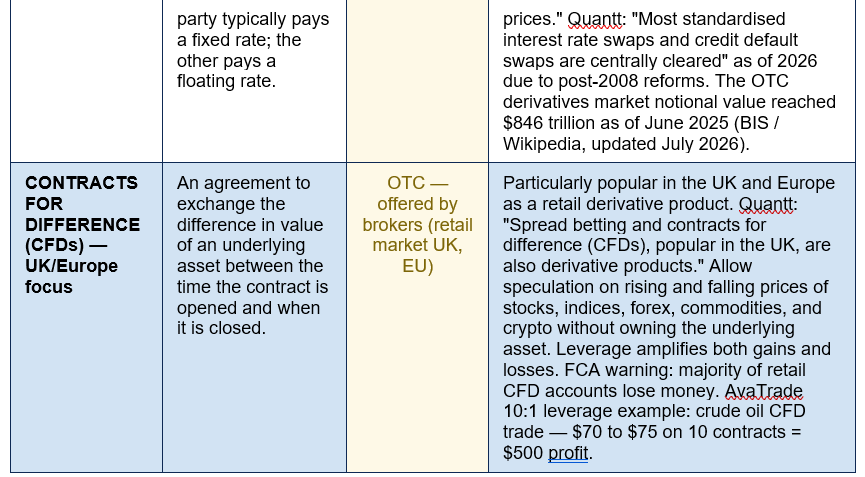
Derivatives come in dozens of variations, but four core types — futures, options, forwards, and swaps — account for the vast majority of all derivative activity globally. In the UK retail market, contracts for difference (CFDs) are an additional category worth understanding. The table below maps each type comprehensively: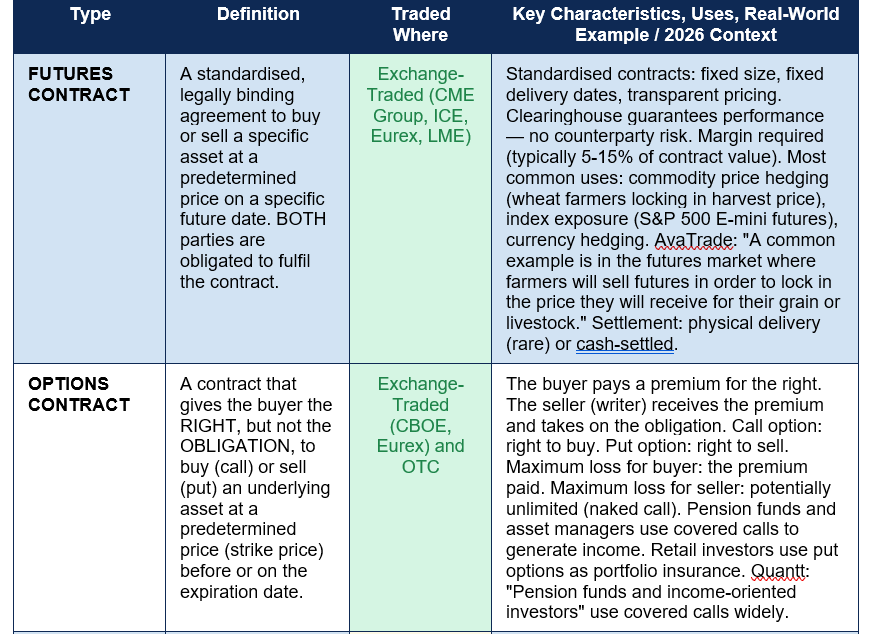
Derivatives in Action: Real-World Worked Examples
Example 1 — The Farmer's Wheat Futures Hedge
The classic illustration of why derivatives were created — hedging a known future price risk: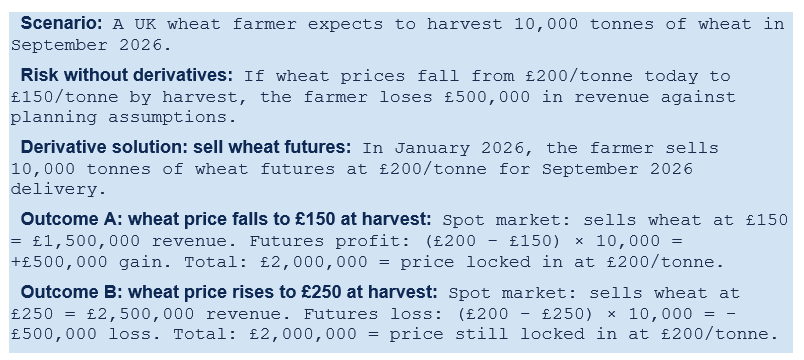

Example 2 — The CFD Speculator: Crude Oil Trade (AvaTrade, 2026)
Exchange-Traded vs OTC Derivatives: The Two Markets Compared
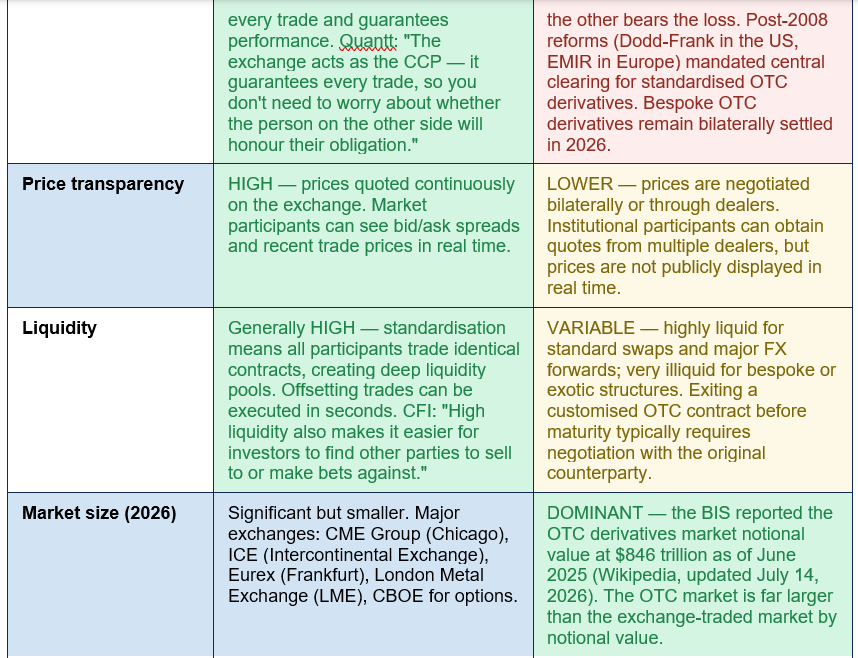
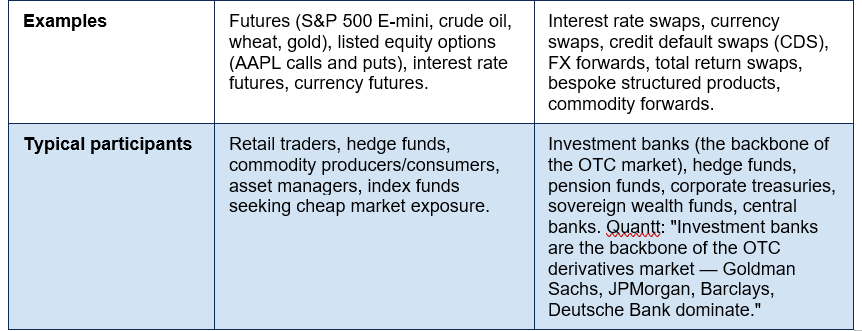
The derivatives market is divided into two distinct segments that operate under fundamentally different structures and regulations. Understanding this distinction is essential for understanding who uses which instruments and why: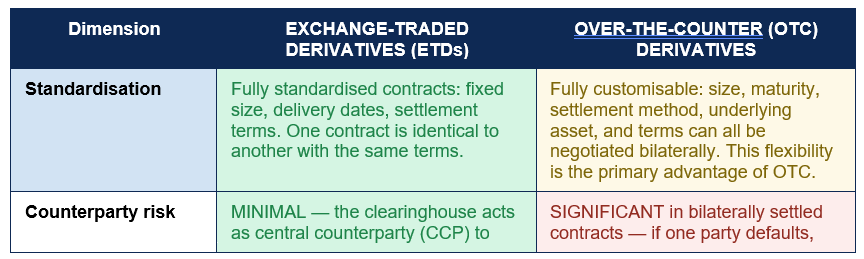
The Two Primary Uses of Derivatives: Hedging and Speculation
Hedging: Using Derivatives to Reduce Risk
Hedging is the defensive, risk-reducing use of derivatives — using a derivative position to offset the risk of an adverse price movement in an asset you already own or have a known future exposure to. Wikipedia defines it precisely: 'Hedge or to mitigate risk in the underlying, by entering into a derivative contract whose value moves in the opposite direction to their underlying position and cancels part or all of it out.'The wheat farmer example above illustrates hedging in its simplest form. Corporate hedging is equally pervasive: an airline that burns millions of gallons of fuel annually uses crude oil futures or options to lock in a portion of its fuel costs months in advance — protecting profitability against price spikes. A UK exporter receiving USD revenue uses FX forward contracts to lock in a GBP/USD exchange rate, protecting margins against sterling appreciation. A pension fund holding a £500 million equity portfolio buys FTSE 100 put options as 'portfolio insurance' against a market crash. Each of these represents derivatives being used exactly as intended: reducing financial uncertainty and protecting against adverse outcomes without requiring the complete elimination of the underlying exposure.
Speculation: Using Derivatives for Leveraged Market Exposure
Speculation is the offensive, profit-seeking use of derivatives — taking a position in a derivative to profit from an expected price movement in the underlying, using the leverage available through derivatives to amplify the potential return relative to capital committed. Wikipedia: 'Speculate and make a profit if the value of the underlying asset moves the way they expect.'A hedge fund that believes interest rates will fall buys interest rate futures, gaining leveraged exposure to the expected rate movement without purchasing bonds directly. A retail trader who expects Tesla stock to rise buys call options, gaining leveraged upside exposure while limiting maximum loss to the premium paid. An algorithmic trading firm simultaneously trades derivatives across multiple markets to exploit pricing discrepancies (arbitrage). In each case, the derivative is being used not to reduce an existing risk but to take on new risk in pursuit of profit — the opposite of hedging in intent, though the instruments used may be identical.
Quantt's April 2026 guide identifies a third, often overlooked use: 'Switch asset allocations between different asset classes without disturbing the underlying assets, as part of transition management.' A pension fund manager who wants to temporarily reduce equity exposure can sell equity index futures rather than selling the physical equity portfolio — faster, cheaper, and without disrupting the portfolio's long-term construction. This transition management function is one of the most practically important uses of derivatives in institutional investment management.
THE FIVE TYPES OF DERIVATIVE MARKET PARTICIPANT (2026): Quantt (April 9, 2026) identifies the full landscape of who trades derivatives and why: (1) Investment banks — the backbone of the OTC market, acting as dealers making markets in swaps, options, and structured products. Goldman Sachs, JPMorgan, Barclays, Deutsche Bank dominate. (2) Hedge funds — use derivatives extensively for speculation, hedging, and portfolio construction. (3) Pension funds and asset managers — interest rate swaps to match duration of liabilities; equity index futures for cheap market exposure; options for income generation or downside protection. (4) Corporates — treasury departments use FX forwards and commodity futures to hedge currency and input cost exposures. (5) Retail traders — growing access through listed options, futures, CFDs, and spread betting platforms in 2026, though complexity and leverage make many instruments unsuitable for inexperienced investors.
The Risks of Derivatives: What Every Investor Must Understand
Derivatives are powerful instruments — and their power to amplify outcomes applies equally to losses as to gains. The following risks are inherent to derivatives and must be fully understood before any participation:- Market risk — losses can exceed initial investment: Because derivatives are typically leveraged, adverse price movements in the underlying can produce losses that exceed the capital initially committed. AvaTrade: 'A sudden drop in crude oil prices could lead to substantial losses for a trader holding a long CFD position.' For some derivatives (selling naked options, for example), the theoretical maximum loss is unlimited. Fidelity: 'Derivatives can magnify both your potential gains and losses.'
- Counterparty risk (OTC derivatives): In bilaterally settled OTC derivatives, if the counterparty defaults before the contract matures, the surviving party faces the loss of their position's current market value. The 2008 financial crisis demonstrated how counterparty failures can cascade through the derivatives market (AIG's near-failure on credit default swaps being the most cited example). Post-2008 central clearing reforms have reduced but not eliminated this risk.
- Liquidity risk: Many OTC derivatives — particularly bespoke or exotic structures — cannot be easily sold or transferred before maturity. An investor who needs to exit a position before the contract expires may be unable to do so at a fair price, or at all. Exchange-traded derivatives avoid this problem through their standardisation and centralised trading.
- Complexity risk: Derivatives, particularly multi-layered structured products, can be extremely complex — to the point where even sophisticated institutional investors may not fully understand the risk profile they have taken on. The 2008 crisis involved many participants who held CDO (collateralised debt obligation) positions whose true risk was obscured by layers of structuring. Quantt: 'Retail traders have growing access to derivatives through online brokers, though the complexity and leverage involved make these instruments unsuitable for many.'
- Leverage concentration: Wikipedia notes an additional risk often underappreciated: post-crisis reforms that moved OTC derivatives to central clearinghouses did reduce bilateral counterparty risk — but concentrated it in the clearinghouses themselves, creating new systemically important nodes in the financial system. A clearinghouse failure would have enormous systemic consequences. This concentration risk remains a concern for regulators in 2026.
BUFFETT'S 'FINANCIAL WEAPONS OF MASS DESTRUCTION' — THE LEVERAGE AND SYSTEMIC RISK WARNING: Warren Buffett's 2002 warning about derivatives has proved prescient in its identification of the systemic risks that materialised in 2008. The specific concern: derivatives create obligations that can chain through the financial system in ways that are not visible until a crisis occurs. A derivative whose value depends on another derivative, which depends on a credit instrument, which depends on a mortgage pool — the layering creates opacity about where risk actually sits. The Dodd-Frank Act in the US (2010) and EMIR in Europe mandated central clearing, trade reporting, and higher capital requirements for uncleared OTC derivatives. Quantt's April 2026 guide confirms these reforms have 'made the derivatives market considerably more transparent and resilient' — but regulators continue to monitor for new concentrations of risk. The individual investor's takeaway: derivatives are instruments for those who understand what they own. Using a derivative without fully understanding its risk profile, leverage, and potential maximum loss is not investing — it is speculation with undefined risk.
Conclusion
A financial derivative is a contract between two parties whose value is derived from the price of an underlying asset — a stock, index, commodity, currency, interest rate, or credit instrument. The four main types — futures (standardised, exchange-traded, both parties obligated), options (buyer has a right but not obligation, seller receives a premium), forwards (customised, OTC, both parties obligated), and swaps (exchange of cash flows, predominantly OTC) — collectively form the foundation of the $846 trillion OTC derivatives market that underpins global finance, risk management, and capital allocation.Derivatives serve two primary purposes: hedging, where existing exposures to price risk are offset using derivative contracts that move in the opposite direction; and speculation, where leveraged exposure to expected price movements is taken in pursuit of profit. The leverage available through derivatives — which allows a small margin deposit to control a much larger notional position — is their most powerful characteristic and their most dangerous. As AvaTrade's 2026 guide illustrates with a 10:1 leverage crude oil example, a 7% move in the underlying can exceed the entire margin posted on the position. Fidelity states the consequence clearly: derivatives magnify both gains and losses proportionally.
For the vast majority of individual investors, derivatives are instruments to understand conceptually rather than to trade actively. Pension funds and large corporations use them with teams of risk professionals, models, and regulatory oversight — and still encounter difficulties when market conditions deviate from model assumptions. For retail investors in the UK, CFDs and spread betting provide the most accessible (and most regulated) entry point into derivative markets — but the FCA's risk warnings about the percentage of retail accounts that lose money in these instruments are not bureaucratic formalities. They reflect the empirical reality of leveraged derivative trading for inexperienced participants. Understanding what derivatives are, why they exist, and how they work is essential financial literacy in 2026. Trading them without fully understanding their risk profile is not.
0 Comments
Be the first to share your thoughts on this article.