

Credits
What Is Buy Now Pay Later! Is It Good for You? Find Out


Table of Contents
What Is Buy Now Pay Later? Is It Good for You? US vs UK -- 2026 Guide
Table of Contents
Introduction: The Payment Method That Changed Everything -- and the Questions It Raises
What Is Buy Now Pay Later? How It Actually Works
BNPL vs Credit Cards: What's the Real Difference?
UK vs US BNPL: Key Facts and Regulatory Status for 2026
The 2026 Regulatory Revolution: What Is Changing for BNPL Users
UK: FCA Regulation from July 2026 -- The Biggest Change to BNPL
US: CFPB Withdrawal and FICO Integration -- A Different Trajectory
Is BNPL Good for You? The Honest Answer Depends on How You Use It
The Hidden Debt Problem: How BNPL Creates Debt Without Feeling Like Debt
Who Is Most at Risk From BNPL? The Demographic Picture
The 5 Rules for Using BNPL Responsibly in 2026
Conclusion
Frequently Asked Questions (FAQ)
The Payment Method That Changed Everything -- and the Questions It Raises
Buy Now Pay Later has gone from a niche checkout option to one of the most significant developments in consumer finance of the past decade. In 2026, there are approximately 380 million global BNPL users, with projections reaching 670 million by 2028 (Chargeflow, 1 week ago). In the UK, 54% of adults have used BNPL as of 2026 -- up from 42% in 2025 (OmniCalculator, April 2026). Over 86 million Americans now use it. The global BNPL market reached approximately $560 billion in gross merchandise volume in 2025 and is growing at 13.7% year-on-year.The appeal is easy to understand. BNPL offers what looks like a straightforward proposition: buy something today, pay for it in three or four equal instalments over the coming weeks or months, typically with no interest if paid on time. No credit card required. No lengthy application. Instant approval at the checkout of hundreds of thousands of online and physical retailers. For millions of consumers, particularly younger buyers who are wary of credit cards, BNPL has become the default method for managing larger purchases within a monthly budget.
But the data tells a more complicated story. OmniCalculator (April 2026): 'About 41% of consumers avoid BNPL because they worry about interest or late fees, 32% fear overspending, and 13% worry about losing track of payments.' And from those who have already used it: approximately 41% of BNPL users report having missed at least one payment. 51% of Americans believe BNPL leads to more debt. 25% of Americans regret using BNPL because of unexpected costs. And 2026 has brought the most significant regulatory changes to BNPL in both the UK and the US -- changes that reflect regulators' growing concern that the product carries risks most consumers do not adequately understand before they use it. This guide explains what BNPL is, how it works, what the risks are, what has changed in 2026, and most importantly -- whether it is genuinely good for you.
What Is Buy Now Pay Later? How It Actually Works
Buy Now Pay Later (BNPL) is a short-term consumer credit product that allows shoppers to purchase goods or services immediately and pay for them in a series of instalments over a defined period, typically at no interest -- provided all instalments are paid on time and in full. The most common structure is a 'Pay in 3' or 'Pay in 4' arrangement: the total purchase price is divided into three or four equal instalments, with the first instalment due at the point of purchase and subsequent instalments due at two-weekly or monthly intervals. No interest is charged if all instalments are made on schedule.The providers -- Klarna, Afterpay/Clearpay, Affirm, PayPal Pay Later, Zip, and others -- make their revenue through: merchant fees (a percentage of each transaction paid by the retailer, typically 2-8%, in exchange for the increased conversion rates BNPL drives); late payment fees charged to consumers who miss an instalment; and in some products, interest charged on longer-term BNPL arrangements (monthly payment plans running 6-24 months often carry interest). The interest-free short-term product is therefore subsidised by retailer fees and late payment revenue -- which creates a structural incentive for providers to offer the product as broadly as possible, including to consumers who may not be well-placed to manage it.
Chargeflow (1 week ago): 'BNPL market share accounts for approximately 5-6% of global eCommerce payment methods, with significantly higher penetration in markets like Sweden and Australia.' In the US, BNPL financed about 6% of e-commerce sales in 2024, up from 2% in 2020 (Morgan Stanley). The growth is real, the scale is significant, and the product has genuinely become part of the mainstream consumer payment infrastructure -- which is precisely why the regulatory and consumer protection questions around it matter so much in 2026.
Buy Now Pay Later in 2026 -- the scale: 380 million global users. 54% of UK adults have used BNPL (up from 42% in 2025). 86 million+ US users. $560bn GMV globally in 2025. 41% have missed a payment. — Chargeflow (1 week ago, most current): '380 million global BNPL users in 2024, projections reaching 670 million by 2028. Global BNPL GMV approximately $560bn in 2025.' OmniCalculator (April 2026): '54% of adults in the UK have used BNPL as of 2026, up from 42% in 2025.' AbsRbd (2026): 'Over 86 million Americans now use BNPL.' SQ Magazine (February 2026): '41% of BNPL users reported missing at least one payment.' OmniCalculator: '51% of Americans believe BNPL leads to more debt.'
BNPL vs Credit Cards: What's the Real Difference?
The most common reason consumers cite for preferring BNPL over a credit card is the avoidance of credit card debt and interest. This is a genuine motivation with a genuine logic -- but the comparison is more nuanced than it first appears. The relevant differences:- Interest structure: Most BNPL short-term products (Pay in 3/Pay in 4) charge zero interest if paid on time. A credit card used for the same purchase and not paid in full at the end of the month charges interest (UK average: approximately 24.65% APR per Bank of England December 2025 data; US average: approximately 22-25% APR). If BNPL instalments are made on time, it is genuinely interest-free. If a credit card is used and paid in full each month, it is also genuinely interest-free -- and comes with additional consumer protections.
- Consumer protection: UK: Section 75 of the Consumer Credit Act provides credit card holders with joint liability from the card issuer for purchases between £100 and £30,000. This protection does NOT extend to BNPL purchases. A consumer who pays with Klarna and the retailer fails to deliver has no Section 75 recourse. US: credit cards carry zero-liability policies on fraud and dispute rights under the Fair Credit Billing Act. Most BNPL providers have more limited dispute resolution mechanisms. The consumer protection difference is significant for high-value purchases.
- Credit score impact: Using a credit card and paying it in full monthly builds positive credit history. BNPL has historically not reported to credit bureaus -- but this is changing. SQ Magazine (February 2026): 'FICO began including BNPL loan data in credit scores in late 2025.' In the UK, Klarna began voluntarily reporting to UK credit reference agencies in 2023, and FCA regulation from July 2026 will formalise this for regulated products. A missed BNPL payment is increasingly likely to appear on the credit file.
- Approval process and credit checks: Credit cards require a full credit application and typically a hard credit inquiry. BNPL providers typically use soft credit checks or proprietary risk scoring that does not involve a full credit bureau inquiry. This easier access is a deliberate feature -- and a key driver of the product's appeal and its adoption by consumers who have been declined for credit cards. The risk: it means BNPL is accessible to consumers who may not be well-placed to manage additional short-term debt obligations.
- Visibility and tracking: A credit card statement shows all spending on a single account. Multiple simultaneous BNPL agreements with different providers are tracked separately, with different apps or websites, different payment dates, and different outstanding balances. The total debt across all BNPL agreements is not aggregated anywhere automatically. OmniCalculator: 13% of BNPL users worry about losing track of payments -- and many who do not worry about it are nonetheless losing track without realising it.
The 'no interest' framing: what BNPL providers do not say loudly enough. BNPL is marketed as interest-free. The short-term Pay in 3/Pay in 4 product often is, if paid on time. But: late payment fees of £6-£30 per missed instalment (UK) or $15-$30+ (US) apply when payments are missed; some BNPL products for larger purchases carry interest rates of 10-30% APR on the monthly payment plan option (this is buried in the product terms and not the product headline); and BNPL providers make revenue from both merchant fees AND late payment fees -- creating a structural incentive that is not aligned with the consumer's interest in paying on time. Always read the full product terms, not just the checkout headline. Always ask: what happens if I miss a payment on this product? The answer, across every provider, should be read and understood before any purchase is made.
UK vs US BNPL: Key Facts and Regulatory Status for 2026
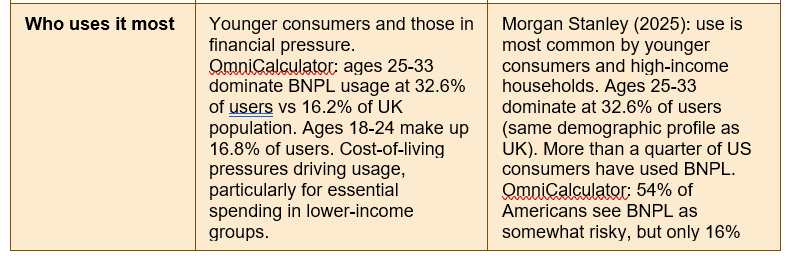
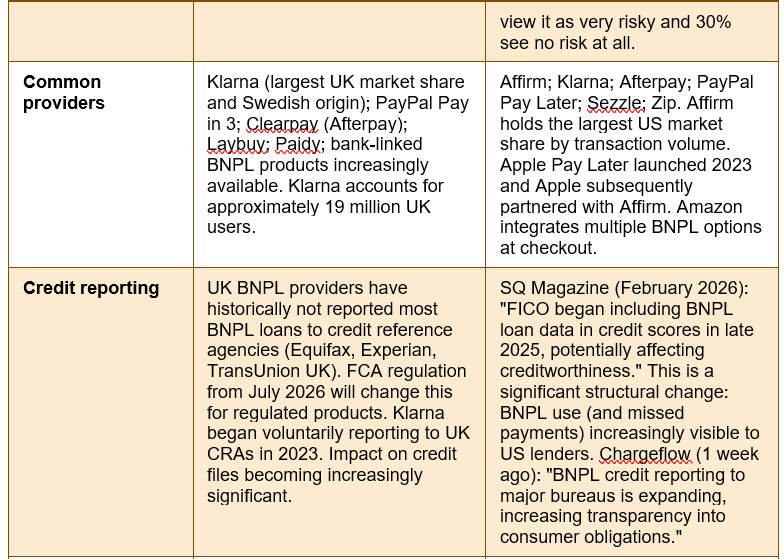
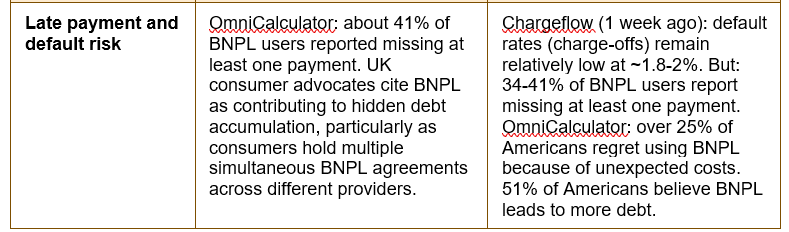
The BNPL markets in the UK and US share the same fundamental product mechanics but differ significantly in regulatory environment, market penetration, and the pace of credit reporting changes. The following table maps every key dimension: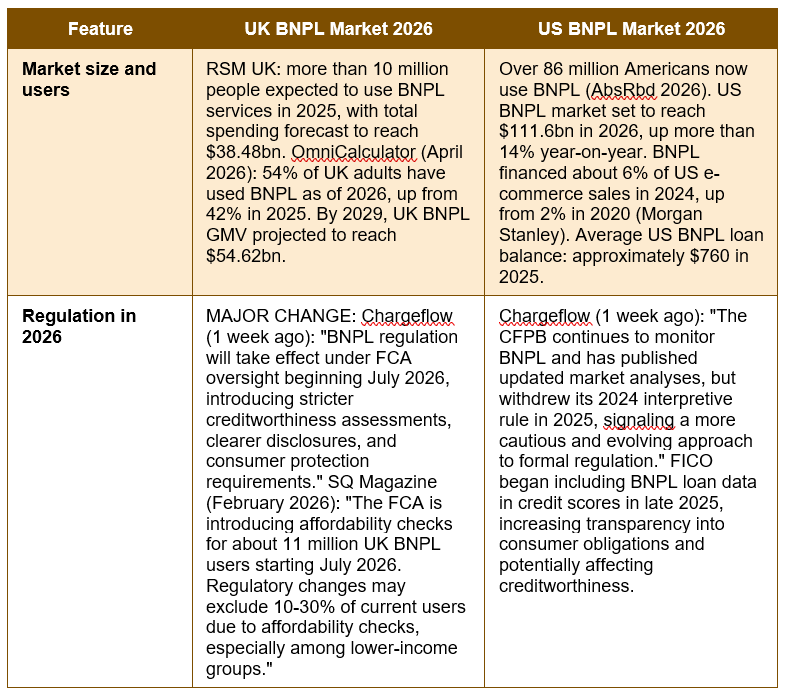
The 2026 Regulatory Revolution: What Is Changing for BNPL Users
UK: FCA Regulation from July 2026 -- The Biggest Change to BNPL
The most significant change to the UK BNPL market in 2026 is the introduction of FCA (Financial Conduct Authority) regulation, which takes effect from July 2026. Chargeflow (1 week ago): 'BNPL regulation will take effect under FCA oversight beginning July 2026, introducing stricter creditworthiness assessments, clearer disclosures, and consumer protection requirements.' SQ Magazine (February 2026): 'The FCA is introducing affordability checks for about 11 million UK BNPL users starting July 2026. Regulatory changes may exclude 10-30% of current BNPL users due to affordability checks, especially among lower-income groups.'What FCA regulation means in practice for UK BNPL users from July 2026: BNPL providers will be required to conduct formal affordability assessments before approving purchases -- similar to the checks required for other forms of consumer credit; BNPL products will be required to provide clearer disclosures about costs, fees, and the consequences of missed payments; BNPL purchases will have improved dispute resolution rights aligned with regulated credit standards; and BNPL providers will be required to be FCA-authorised, meeting the same baseline standards as other regulated lenders. This is the most significant consumer protection development in UK BNPL history and represents a direct response to the widespread concerns about BNPL's contribution to consumer debt and the lack of transparency around its terms.
US: CFPB Withdrawal and FICO Integration -- A Different Trajectory
The US trajectory in 2026 is more complex. The CFPB proposed in 2024 to bring BNPL under federal credit card regulations, which would have required full credit disclosures, dispute rights, and refund protections. Chargeflow (1 week ago): 'The CFPB withdrew its 2024 interpretive rule in 2025, signaling a more cautious and evolving approach to formal regulation.' This means US BNPL regulation in 2026 is less prescriptive than the UK's July 2026 changes -- but a significant structural shift is happening through the credit reporting system: SQ Magazine: 'FICO began including BNPL loan data in credit scores in late 2025, potentially affecting creditworthiness.' This means that while US BNPL remains less formally regulated than UK BNPL from July 2026, the credit score consequences of BNPL use -- and particularly of missed BNPL payments -- are becoming increasingly significant for US consumers.The practical implication for US consumers: a missed BNPL payment that previously had no credit bureau impact is now more likely to affect the credit score. This changes the risk calculus of BNPL significantly. A late payment fee of $15-$30 was the previous consequence of missing a BNPL instalment; a credit score drop that affects a future mortgage application is a categorically more serious consequence.
Is BNPL Good for You? The Honest Answer Depends on How You Use It
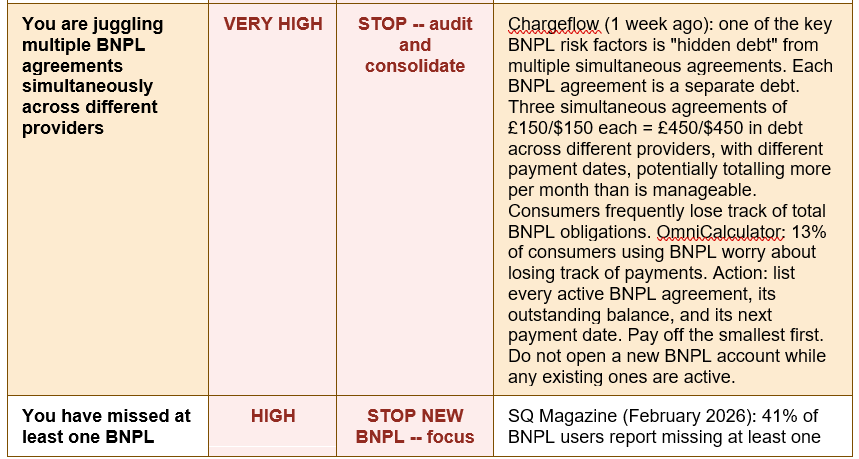
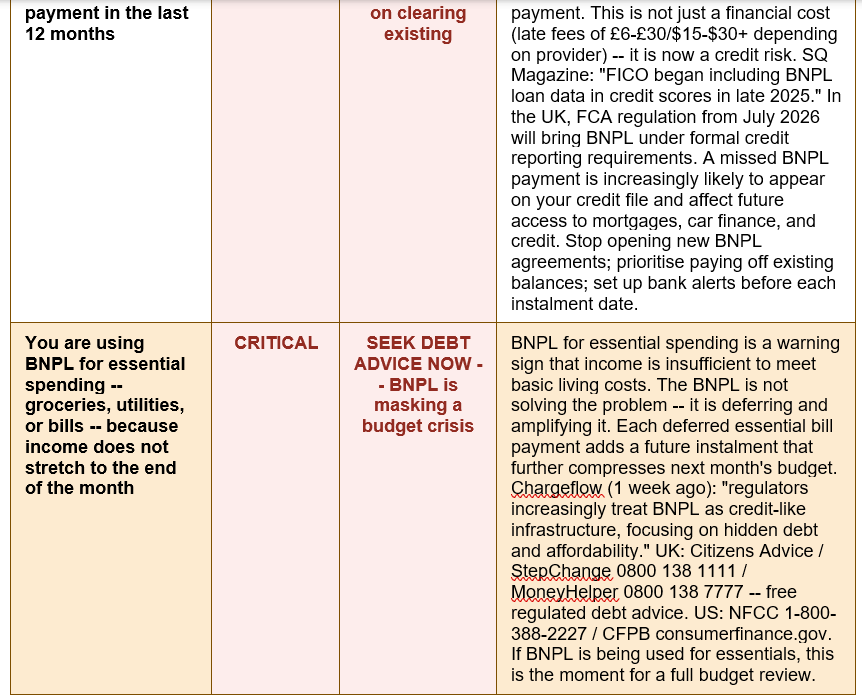
The question 'is BNPL good for you?' does not have a universal answer. The product itself is neither inherently predatory nor inherently beneficial -- it is a financial tool whose impact depends entirely on the circumstances in which it is used, the financial position of the person using it, and how carefully the repayment obligations are managed. The following table maps five specific scenarios against an honest verdict: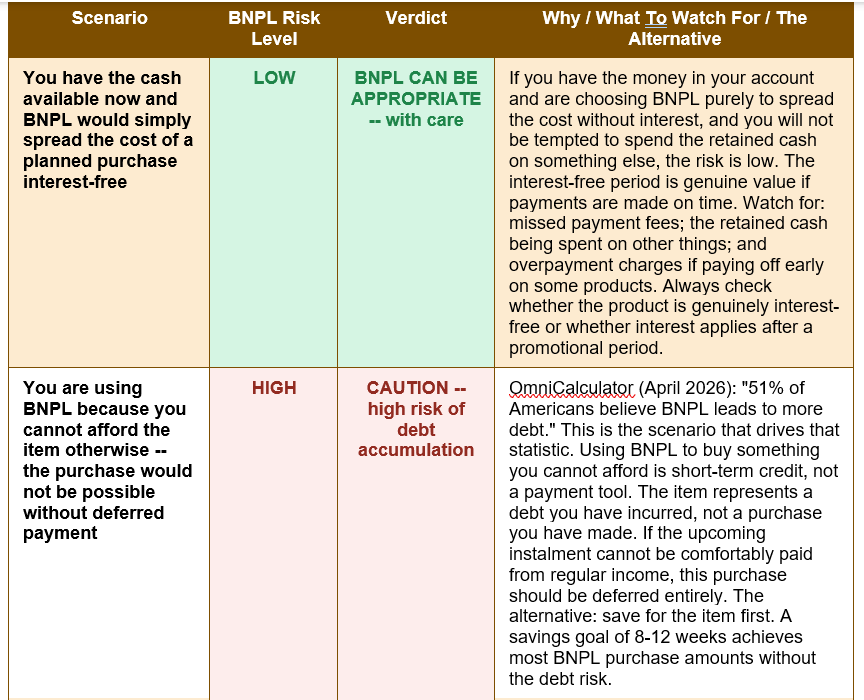
The Hidden Debt Problem: How BNPL Creates Debt Without Feeling Like Debt
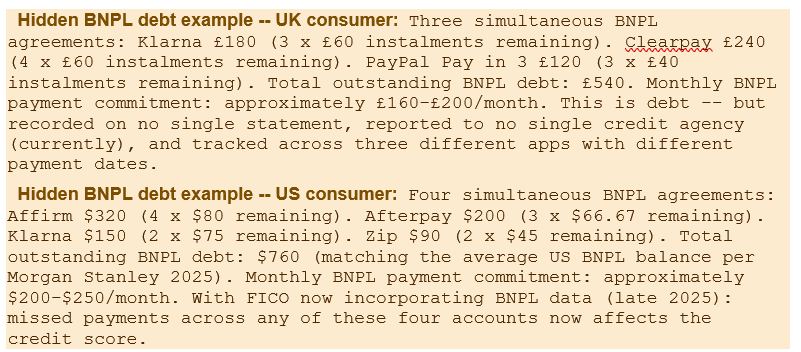
The most pervasive financial risk of BNPL is not the interest rate (many products genuinely charge no interest) -- it is the invisibility of the debt it creates. A credit card statement shows a single number: total balance outstanding. A consumer with three simultaneous Klarna agreements, two Clearpay agreements, and a Affirm arrangement has six separate debt obligations with six different payment dates, across six different apps or accounts, adding up to a total that is recorded nowhere in aggregate.Chargeflow (1 week ago): 'BNPL default rates remain relatively low at around 1.8-2%, but approximately 34-41% of users report missing at least one payment.' The gap between these two statistics is revealing: most missed payments are caught and recovered before they reach formal default. But the 34-41% of users who miss at least one payment -- that is more than 130 million of the global 380 million users -- are experiencing a financial difficulty that their BNPL provider's approval process did not anticipate. This is precisely the gap that the UK FCA's affordability checks from July 2026 are designed to address.
OmniCalculator (April 2026): 'Over 25% of Americans regret using BNPL because of unexpected costs.' This figure includes both unexpected fees (late payment charges, interest on the monthly plan option) and the more diffuse regret of having bought something on BNPL that, in retrospect, they wished they had not bought at all. BNPL's design -- frictionless checkout, instant approval, the purchase happening before the financial cost is felt -- is specifically engineered to lower the psychological barrier to spending. The first payment is small. The purchase is immediate. The total cost is spread into parts small enough to feel manageable. The cumulative effect of multiple simultaneous BNPL arrangements is the financial reality that catches many users by surprise.
Who Is Most at Risk From BNPL? The Demographic Picture
BNPL is not equally risky for all users. The demographic data reveals a clear pattern of who is most exposed to BNPL's potential harms:- Young adults aged 18-33: SQ Magazine (February 2026): 'Ages 25-33 dominate BNPL usage with 32.6% of users vs 16.2% of the US population. Ages 18-24 make up 16.8% of users vs 11.7% population share.' Young adults are disproportionate BNPL users relative to their share of the population. This demographic is also more likely to be managing finances on tighter margins, more likely to be building credit histories, and more likely to have multiple simultaneous financial commitments. The credit score consequences of missed BNPL payments (now more significant following FICO's late 2025 changes) are particularly impactful for young adults who are still establishing their credit files.
- Lower-income consumers: SQ Magazine (February 2026): 'Regulatory changes may exclude 10-30% of current BNPL users due to affordability checks, especially among lower-income groups.' The UK FCA's July 2026 affordability checks are specifically designed to prevent BNPL from being approved for consumers who cannot afford the repayments -- but the fact that 10-30% of current users may fail these checks reveals the scale of financial fragility already present in the BNPL user base. These are consumers for whom BNPL was not a convenience tool for managing cash flow -- it was a credit facility being used to fund spending that current income could not support.
- Consumers with multiple simultaneous agreements: Chargeflow (1 week ago): 'hidden debt' from multiple simultaneous BNPL agreements is identified as a primary risk factor. There is no central system that tracks a consumer's total BNPL commitments across providers. The FCA affordability checks from July 2026 will require UK providers to factor in known other credit commitments -- but cross-provider BNPL visibility remains imperfect. In the US, the FICO integration of BNPL data from late 2025 will gradually improve this visibility, but the transition period creates ongoing risk.
- Consumers using BNPL for non-discretionary spending: The shift of BNPL into essential spending categories -- groceries, utility bills, school supplies, healthcare costs -- is the regulatory red flag that has most alarmed consumer advocates in both the UK and the US. BNPL for a fashion purchase is a different risk profile from BNPL for next month's electricity bill. The latter is a symptom of income insufficiency that BNPL defers but does not solve.
The 5 Rules for Using BNPL Responsibly in 2026
- Rule 1 -- Only use BNPL for purchases you could afford to pay for today: The fundamental test for responsible BNPL use: if the item is not in your budget this month, BNPL does not put it in your budget. It defers the cost. If future months' budgets will not absorb the instalments any better than this month's budget absorbs the full price, BNPL is not a solution -- it is a delay. OmniCalculator: 51% of Americans believe BNPL leads to more debt. For those users, this is the rule that was broken.
- Rule 2 -- Never have more than one active BNPL agreement at a time: Multiple simultaneous BNPL agreements are the most reliable path to losing track of obligations. Each additional agreement adds payment dates, outstanding balances, and complexity to the financial picture. The 13% of consumers who worry about losing track of payments (OmniCalculator) are responding to a real risk that grows with each additional agreement. Set yourself a rule: no new BNPL agreement while any existing one is active.
- Rule 3 -- Set up automatic payments for every BNPL instalment: OmniCalculator: 41% of BNPL users have missed at least one payment. Many of these missed payments are the result of forgetting, not inability. Set up a direct debit or automatic bank transfer for every BNPL instalment on the day it is due. Bank balance alerts at the instalment amount plus a £/$50 buffer before each payment date. Missing a BNPL payment in 2026 is increasingly a credit score event, not just a fee event.
- Rule 4 -- Read the full terms before every purchase: Specifically understand: what is the late payment fee on this product? Does any interest apply, and if so, when and at what rate? Is there a monthly payment plan option that carries interest disguised in the product offering? How does this provider report to credit agencies? The checkout offer is a headline -- the full product terms contain the costs that apply when things do not go as planned.
- Rule 5 -- Track your total outstanding BNPL balance monthly: Create a single running document (notes app, spreadsheet, piece of paper) that lists every active BNPL agreement, its provider, outstanding balance, and next payment date. Review and update it monthly. The total outstanding number should be known and comfortable before any new BNPL purchase is made. Chargeflow (1 week ago): the key BNPL risk factor is hidden debt from multiple agreements -- visibility is the antidote.
BNPL SELF-AUDIT CHECKLIST -- DO THIS NOW: STEP 1 -- LIST EVERY ACTIVE BNPL AGREEMENT: Open every BNPL app or account. Write down provider / outstanding balance / next payment date / total remaining instalments for each. Add up the total outstanding across all providers. If you do not know the total: that is the first problem. STEP 2 -- CHECK PAYMENT DATES AGAINST YOUR ACCOUNT BALANCE: For each upcoming BNPL instalment date, check whether your bank balance will cover the payment plus your regular essential outgoings in that period. If not: rearrange spending or contact the provider before the missed payment occurs -- NOT after. STEP 3 -- STOP OPENING NEW AGREEMENTS: Until all existing BNPL balances are cleared, do not open any new BNPL account or make any new BNPL purchase. STEP 4 -- SET UP AUTOMATIC PAYMENTS: For every active BNPL agreement, set up an automatic bank transfer or direct debit for the instalment date. STEP 5 -- IF STRUGGLING: UK free help: StepChange 0800 138 1111 | Citizens Advice 0800 144 8848 | MoneyHelper 0800 138 7777. US free help: NFCC 1-800-388-2227 | CFPB consumerfinance.gov.
FIVE BNPL MISTAKES THAT TURN A CONVENIENT TOOL INTO A DEBT PROBLEM: (1) OPENING MULTIPLE SIMULTANEOUS BNPL AGREEMENTS ACROSS DIFFERENT PROVIDERS. Each agreement is a separate debt. Three agreements of £150 each = £450 in debt across three different apps with different payment dates. The aggregate debt is tracked nowhere centrally. Many consumers underestimate their total BNPL exposure by hundreds of pounds or dollars. (2) MISSING A BNPL PAYMENT BECAUSE YOU FORGOT, NOT BECAUSE YOU COULD NOT AFFORD IT. SQ Magazine (February 2026): 41% of users have missed at least one payment. FICO now includes BNPL data in US credit scores (late 2025). FCA regulation from July 2026 will formalise UK credit reporting requirements. A missed BNPL payment is no longer just a late fee -- it is increasingly a credit score event. Set up automatic payments. (3) USING THE MONTHLY PAYMENT PLAN BNPL OPTION WITHOUT READING THE INTEREST TERMS. Most providers offer both a Pay in 3/4 (interest-free if on time) and a longer monthly payment plan (which often carries 10-30% APR). These look similar at checkout. The difference is significant. Always check whether the plan you are choosing charges interest and at what rate. (4) USING BNPL FOR EVERYDAY SPENDING OR ESSENTIAL COSTS. Groceries and bills paid via BNPL are a signal of a budget crisis, not a payment tool choice. Each BNPL essential purchase adds a future instalment that compresses next month's budget further. If BNPL is being used for essentials, seek free debt advice now. (5) TREATING BNPL AS A BUDGET MANAGEMENT TOOL RATHER THAN AS DEBT. Chargeflow (1 week ago): 'regulators increasingly treat BNPL as credit-like infrastructure.' BNPL is short-term consumer credit. It is debt. Every BNPL purchase creates a liability. The question before every BNPL purchase is not 'can I afford the instalment?' but 'can I afford this purchase in total?' If the answer to the second question is no, the first question is moot.
Conclusion
Buy Now Pay Later is not inherently good or bad. It is a short-term consumer credit product that can be used responsibly or recklessly, and the difference between those two uses has consequences that are more significant in 2026 than they have ever been. With 380 million global users and $560 billion in annual GMV, BNPL has become a mainstream payment infrastructure. With 41% of users reporting missed payments, 51% of Americans believing it leads to more debt, and 25% regretting use due to unexpected costs, the evidence for its widespread misuse is equally clear.The regulatory response confirms the concern. The UK FCA is introducing affordability checks and consumer protection requirements from July 2026 -- changes that may exclude 10-30% of current users because they cannot demonstrate the financial capacity to repay reliably. In the US, FICO's late 2025 integration of BNPL data into credit scores means that missed payments that previously cost only a late fee are now increasingly affecting the credit scores that determine access to mortgages, car finance, and other credit.
The answer to 'is BNPL good for you?' is: it can be, if you have the money available and are using it purely to spread a planned purchase interest-free, with automatic payments set up and no other active BNPL agreements running. It is almost certainly not good for you if you are using it because you cannot afford the item otherwise; if you have multiple simultaneous agreements; if you have missed a payment; or if you are using it for essential spending. The five rules and the self-audit checklist in this guide provide the framework for using BNPL responsibly -- or for recognising when you should not be using it at all.
0 Comments
Be the first to share your thoughts on this article.