

Financial Literacy
What To Do When Your Bank Balance Hits Zero Before Payday
You're not alone. About 67% of Americans lived paycheck to paycheck in 2025, and 53% couldn't cover a $1,000 emergency from savings. When your bank balance hits zero three days before payday, the question isn't 'how did I get here' — it's 'what do I do right now, and how do I make sure this is the last time?' This guide covers both: the immediate triage steps for the next 72 hours, and the practical plan to build enough of a buffer that zero stops being a monthly visitor.
The economic context is direct: prices increased 4.2% as of May 2026, while wages increased only 3.6% — a gap confirmed by BLS data and the Federal Reserve Bank of Atlanta, reported by MoneyLion (June 28, 2026). The math is simple. When the cost of living rises faster than income, the margin between income and expenses narrows. When that margin reaches zero, running out of money before the next deposit is not laziness or poor discipline — it is arithmetic.
None of that changes the fact that you need to know what to do right now. This guide is structured in two parts. The first part covers the next 72 hours: the specific, ordered steps to take when your balance is at zero and payday is days away. The second part covers the longer game: why this keeps happening and what a realistic plan looks like to build enough of a buffer that zero stops being a regular experience.
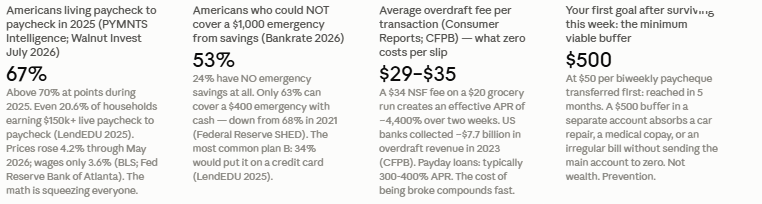
67% of US consumers said they lived paycheck to paycheck in 2025; above 70% at points (PYMNTS Intelligence; Walnut Invest July 2026). 53% of Americans could NOT cover a $1,000 emergency from savings (Bankrate 2026). 24% have NO emergency savings at all (Bankrate 2026). Prices up 4.2% through May 2026; wages up only 3.6% (BLS; Federal Reserve Bank of Atlanta via MoneyLion June 2026). Even 20.6% of households earning $150,000+ live paycheck to paycheck (LendEDU 2025). Only 63% of adults can cover a $400 emergency with cash -- down from 68% in 2021 (Federal Reserve SHED). Average US personal savings rate: 4.6% (BEA.gov). Overdraft fees: average $29-$35. Payday loan APR: typically 300-400%.
The priority order for zero-balance situations is not the same as a normal budget priority. In a normal month, you might pay rent, utilities, insurance, credit cards, and subscriptions in whatever order makes sense. When the balance is zero, the priorities compress to three categories: housing (losing housing is catastrophic), food (non-negotiable), and utilities that directly affect housing and food (power, water). Everything else — credit cards, subscriptions, loans, savings contributions — drops in priority. This is not a recommendation to ignore these obligations. It is a recognition that the consequences of missing a Netflix payment are fundamentally different from the consequences of a bounced rent cheque.
The specific steps below are ordered by the sequence in which they should be taken over the next 72 hours. None of them require credit. None of them require a payday loan. All of them are actions you can take immediately.
Log into your bank’s app or website right now and check every pending or scheduled payment in the next seven days. For each non-essential one, pause it, cancel it, or contact the company to delay it until after your pay date. Most streaming services and subscription platforms allow you to pause billing through their account settings without penalty. This takes ten minutes and can prevent $50–$150 in fees and missed-payment complications.
If your bank offers an overdraft alert or low-balance notification, activate it immediately at whatever threshold gives you a warning before the balance hits zero. Most major banks allow this in their app settings at no charge. Going forward, a low-balance alert at $50 or $100 gives you a 24–48 hour window to act before you are already at zero.
Right now: open your bank app and check 'upcoming payments' or 'scheduled transactions' for the next 7 days. Identify every non-essential automatic charge. Pause or cancel each one. Priority: keep anything related to housing, food access, phone (for job/communication), and health. Pause: streaming, gym, subscription boxes, savings auto-transfers (temporarily), and any non-critical recurring charges. Not financial advice.
Lay these out in a simple list. On one side: income expected (payday date and net amount). On the other: every obligation due before that date and its amount. The difference — if positive, you are fine; if negative or zero, you have a specific gap to address. Knowing the exact gap is more useful than knowing only that ‘there is no money.’ A $47 gap is a completely different problem from a $340 gap, and they require different responses.
Common items to include: rent or mortgage (date due and any grace period), car payment, utilities (power, gas, water, phone), minimum credit card payment due, any automatic loans, and essential grocery and transport costs for the days until payday. Do not include anything that is not genuinely due or essential in this period. Credit card payments due after payday can wait until after payday. Subscriptions already paused from Step 1 are off the list.
The output of this step is a number: the specific dollar gap between what you have (zero) and what must be covered before payday. Everything in the rest of this guide is aimed at addressing that specific number, not a vague sense of being broke.
Utility companies — power, gas, water, and phone — almost universally have hardship programmes, payment plan options, or extensions available to customers who call before missing payment. These are not widely advertised but are standard practice for regulated utilities. A single call saying ‘I can’t pay my full bill this month; what options do I have?’ will typically produce an offer: a payment plan, a deferred due date, or a connection to a state or local assistance programme the company is required to inform you about.
Landlords, while less formally regulated, are often willing to discuss a short-term arrangement rather than begin an eviction process, which is slow, expensive, and uncertain for them as well. A brief, honest conversation (‘I’m a few days short; I’ll have the full amount on [specific date]’) before the rent is due is always better than a missed payment with no explanation.
Credit card companies may also offer temporary hardship arrangements, minimum payment reductions, or interest rate adjustments for customers in genuine difficulty. Call the number on the back of the card and ask for the hardship department or financial relief team. These programmes exist and are underused. Not the first call to make in a zero-balance situation — housing and utilities come first — but worth making if credit card payments are part of the gap calculation.
The hardship call script: 'I’m currently in a short-term financial difficulty and wanted to call before missing my payment. My next income arrives on [date]. Can you tell me what options I have to keep my account in good standing until then?' Most companies have a protocol for exactly this conversation. Document the date, the representative’s name, and any arrangement agreed. Follow up in writing if possible. Not financial advice.
The pantry and freezer audit: before spending anything on food, take a complete inventory of what you already have. Most households have more food available than they realise, but it is often in the form of ingredients rather than complete meals. Rice, pasta, canned beans, tinned fish, eggs, frozen vegetables, and condiments can produce a significant number of meals at essentially zero marginal cost. Commit to eating what you have for the next two to three days before buying anything new.
Local food resources: most communities have food banks, food pantries, or church-operated food programmes that are available without an appointment, without proof of income, and without any documentation. Feeding America’s network (feedingamerica.org) allows you to find a food bank by zip code. 211 (dial 2-1-1 in the US) connects to local food assistance, utility assistance, and emergency cash programmes. These resources exist specifically for short-term situations like the one you are in. Using them is not a permanent identity change — it is a practical solution to a temporary problem.
If you have any money at all — even $5–10 — the highest-calorie-per-dollar foods at any grocery store are dried beans, rice, oats, eggs, bananas, potatoes, and store-brand bread. These are not exciting, but they are nutritious and filling, and $10 spent strategically on these items can cover meals for three to four days for one person.
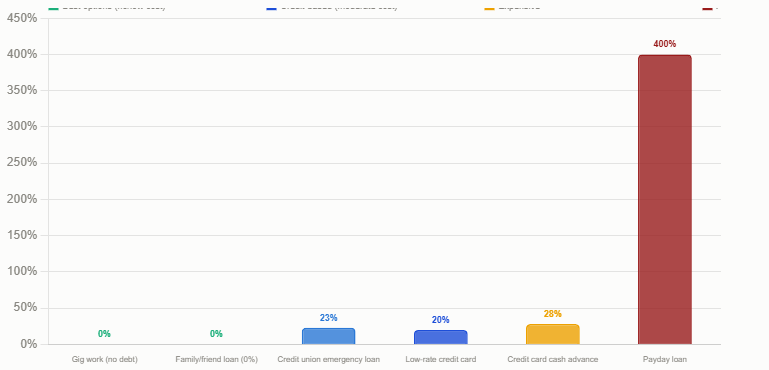
The cost of desperation products: Payday loan of $375 at a typical fee structure: if not repaid on the next payday (which statistically most are not), the loan rolls over and fees accumulate. Carried for 5 months: $520 in fees on a $375 loan. Effective APR: 300-400% (CFPB data). Overdraft fee on a $20 grocery run: $34 NSF fee. Effective APR on a 2-week $20 overdraft at $34 fee: approximately 4,400%. Title loan: typically 25% per month (300% APR); risk losing the vehicle that provides transport to work. Rent-to-own electronics: effective APR often above 100% when total payments are calculated against cash price. Compare to: personal loan from a credit union for a member in difficulty: often 18-28% APR -- expensive but a fraction of the alternatives. Source: CFPB data; Consumer Reports; general financial literacy sources. Not financial advice.
The logic of payday loans deserves specific attention because they are heavily marketed to the exact situation you are in right now. A payday loan appears to solve the problem: you get cash today and repay it on payday. The problem is that repaying the principal plus fees on your next payday leaves you short for the following pay period, creating pressure to take another loan. The CFPB has documented that 80% of payday loans are rolled over or renewed within 14 days, and borrowers who use payday loans are in debt for an average of 200 days per year. The loan does not break the zero-balance cycle. It deepens it.
The most immediate financial cost is overdraft and NSF fees. The average overdraft fee is $29–35, and a single overdraft on a $10 transaction creates an effective APR of thousands of percent. Banks collectively collected approximately $7.7 billion in overdraft revenue in 2023 (CFPB). If your account is set up for overdraft ‘protection’ (which is actually a fee-based service, not free protection), each overdraft charges this fee automatically.
Late payment fees and credit score damage compound the cost further. A credit card late payment fee is typically $29–40. A missed minimum payment reported to the credit bureaus can lower your credit score by 50–100 points or more, which affects your ability to rent housing, access loans, and in some states even your car insurance rate.
The psychological cost is documented and real. Gerald Wallet’s March 2026 guide on paycheck-to-paycheck living identifies one of the signs of the cycle as ‘Avoiding your account balance because the number stresses you out.’ Financial anxiety of this kind reduces cognitive bandwidth, impairs decision-making, and correlates with lower productivity and health outcomes in research literature. The stress of running out is not separate from the financial cost of running out — it is part of it.
The most common reasons a balance reaches zero monthly are: income that is genuinely insufficient relative to necessary expenses (the arithmetic problem); income that would be sufficient but spending is not tracked, leading to underestimation of what is being spent (the awareness problem); spending on the right categories but in wrong amounts due to social pressure, lifestyle inflation, or automatic upgrades to services (the calibration problem); or periodic large expenses (annual fees, irregular bills, car repairs) that are not budgeted for and land as shocks each time they occur (the timing problem).
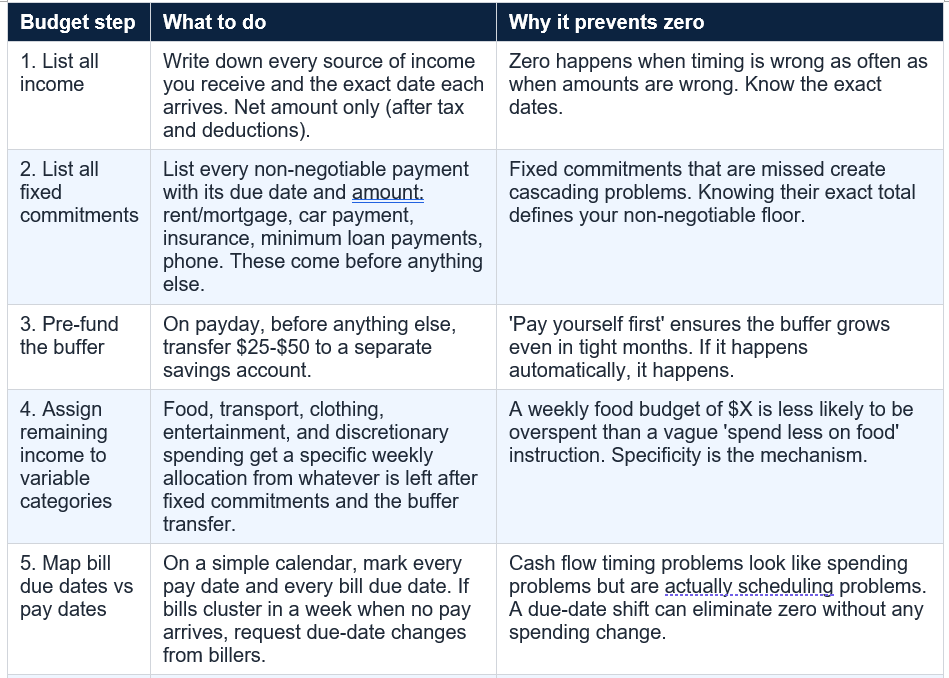
A zero balance that happens in the same week of every month — say, the last five days before payday — is a cash flow timing problem rather than a spending problem. The money exists but arrives on the wrong schedule relative to when bills fall due. A cash flow timing problem can sometimes be solved by shifting due dates (many utilities and credit card companies will change your due date on request) to better align with pay dates.
The paycheck-to-paycheck cycle as described by LendEDU: 'Living paycheck to paycheck means your money runs out before the month does. There's no cushion, no breathing room... just a race to make it to the next payday without falling behind.' Breaking the cycle requires identifying which of the four causes (arithmetic, awareness, calibration, timing) is primary in your situation. Each has a different solution. Treating an awareness problem with income-growth tactics, or treating an arithmetic problem with budgeting alone, produces frustration rather than progress. Not financial advice.
Five hundred dollars is not a three-month emergency fund. It is not the recommended six months of expenses. It is the minimum viable buffer that prevents a single unexpected expense (a $200 car repair, a $150 medical copay, a $300 emergency flight) from sending your account to zero in a month it would otherwise have been fine. Research consistently shows that this small buffer produces a disproportionate improvement in financial stability and stress reduction. The 22% of lower-income Americans in the AOL 2026 research who said a $1,000 emergency fund would make them feel financially secure are describing this phenomenon from experience.
The mechanics: open a separate savings account (ideally at a different bank or a high-yield savings account where the money is accessible but not visible in your main banking app). Transfer exactly $50 from every paycheque to this account before paying anything else. If $50 is too much, start with $25. If pay arrives twice a month, that is $100–$1,200 per year in a dedicated buffer fund. At $50 per pay period on a biweekly schedule, $500 is reached in 5 months. The account is not for bills, not for groceries, not for anything except the category of expense that would otherwise send the main account to zero.
The buffer goal: $500 in a separate account that is not visible in your daily banking app. Timeline: 3-6 months at $25-$50 per paycheque. Rule: it can only be used for a true unexpected emergency -- not for a weekend trip, not for an item on sale, not for a bill you forgot about. The test: would zero-balance-before-payday have been prevented by having this $500 available? If yes, the expense qualifies. Not financial advice.
The second is that the zero-balance experience itself has a real cost: overdraft fees, late payment penalties, credit score damage, potential debt from expensive short-term borrowing, and the documented psychological cost of financial anxiety that affects decision-making, health, and productivity in measurable ways. The experience is common, but it is not free.
The immediate path is triage: pause non-essential outflows, map the exact gap, find legitimate sources of emergency cash, contact billers proactively, and use food resources available to you without shame. The longer path is structural: identify what produces the zero (arithmetic, awareness, calibration, or timing), build a $500 buffer before the next emergency arrives, and build a cash-flow-aware budget that maps pay dates against bill dates explicitly.
The goal is not to become wealthy before the next payday. It is to make this the last time the balance hits zero. That requires one month of tighter action followed by five months of consistent $25–50 buffer building, which then changes the mathematical structure of your next budget crisis from ‘I have $0’ to ‘I have $500 and a plan.’ Not financial advice — contact 211 or a nonprofit credit counsellor if you need personalised guidance.
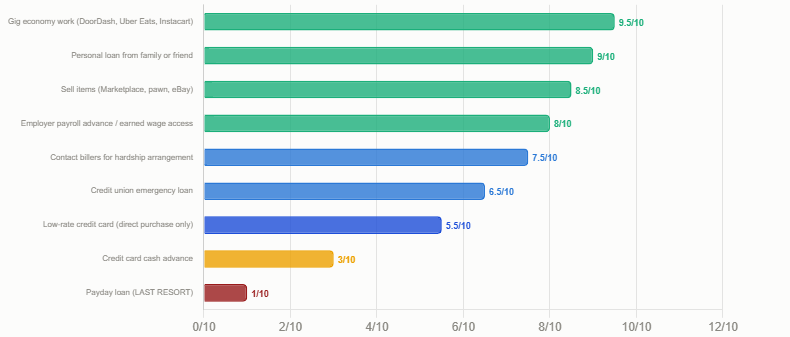
The immediate steps are: (1) Open your bank app and pause any non-essential automatic payments due in the next 7 days to prevent overdraft fees. (2) Make a list of every payment due before your payday and the exact gap you need to fill. (3) Look for fast, debt-free money sources: sell something on Facebook Marketplace or eBay, ask a trusted person for a short-term loan, pick up a few hours of gig economy work (DoorDash, Instacart, Uber Eats), or check whether your employer offers payroll advances or earned wage access. (4) Contact any billers with payments due before payday and ask about hardship arrangements or due-date extensions before missing the payment. (5) Audit your pantry and freezer before spending any money on food, and look up your local food bank at feedingamerica.org if needed. (6) Dial 2-1-1 for local emergency assistance programmes including food, utilities, and short-term cash assistance. Not financial advice. If in crisis, contact a certified nonprofit credit counsellor.
How do I get through until payday with no money?
The practical path to payday with zero money involves three tracks running simultaneously. First, stop any further outflows: pause subscriptions and auto-payments that would trigger overdraft fees. Second, find resources you already have: sell items you own, use food you already have at home before buying more, and contact local food banks (feedingamerica.org or dial 211) for free food resources. Third, generate small amounts of income if possible: gig economy platforms (DoorDash, Instacart, Uber Eats, Amazon Flex, Lyft) allow you to earn money in days and receive instant payouts for a small fee. Some platforms pay same-day or next-day. For essential bills due before payday: contact the biller proactively and explain you’ll have funds on your specific payday. Most utility companies and many landlords have arrangements for short-term delays. The key is to call before missing the payment, not after. Not financial advice.
Is it normal to run out of money before payday?
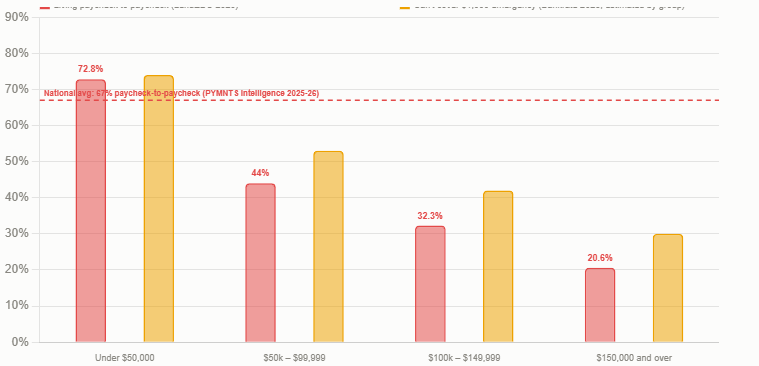
Yes, it is statistically common, though that doesn’t make it comfortable. About 67% of US consumers said they lived paycheck to paycheck in 2025, according to PYMNTS Intelligence data compiled by Walnut Invest (July 2026). Bankrate’s 2026 research found 53% of Americans could not cover a $1,000 emergency from savings and 24% have no emergency savings at all. The LendEDU 2025 Personal Finance Survey found 53% of Americans describe themselves as living paycheck to paycheck, including 44% of those earning $50,000–$99,000 and 20.6% of those earning $150,000 or more. The underlying driver in 2026 is a cost-of-living squeeze: prices increased 4.2% through May 2026 while wages grew only 3.6% (BLS; Federal Reserve Bank of Atlanta via MoneyLion June 2026). When costs outpace income, even responsible budgeters can find themselves at zero. The experience is common. Its causes and solutions vary by individual circumstance. Not financial advice.
Should I take a payday loan if I have no money before payday?
A payday loan is one of the most expensive financial products available and should be a last resort after exhausting all alternatives, not a first response. A typical payday loan charges $15 per $100 borrowed, which translates to an APR of approximately 300–400% (CFPB data). If not repaid immediately, the loan rolls over and fees multiply: a $375 payday loan can cost $520 in fees if carried for five months. The CFPB has documented that 80% of payday loans are renewed within 14 days, meaning most borrowers are not able to fully repay on the first payday as intended. The alternatives to consider first: selling items you own; asking a trusted person for an interest-free short loan; gig economy earnings; employer payroll advance or earned wage access programmes; credit union emergency loans (typically 18–28% APR); community assistance programmes through 211; and food bank resources to reduce the cash need for food. If a payday loan is genuinely the only option to prevent a housing or utility shutoff, understand the full repayment amount before signing and have a specific plan for repaying it in full on the next payday. Not financial advice. Contact a nonprofit credit counsellor (NFCC.org) for guidance.
How do I stop running out of money before payday?
Stopping the cycle requires identifying which of four specific causes is producing the zero: (1) Arithmetic: income is genuinely insufficient for necessary expenses — solution involves income growth or reducing fixed costs like housing or insurance. (2) Awareness: income would cover expenses but spending is not tracked, leading to underestimating what goes out — solution is a weekly spending check against a category budget. (3) Calibration: the right categories are funded but amounts are wrong due to lifestyle inflation or gradual cost creep — solution is a category-by-category audit against actual bank statements. (4) Timing: income arrives on the wrong days relative to when bills fall due, creating a cash-flow gap in specific weeks — solution is requesting due-date changes from billers to align with pay dates. The most consistent structural change is building a $500 buffer: transfer $25–50 from every paycheque to a separate account before paying anything else. In five to ten pay periods, this creates a buffer that absorbs unexpected expenses and prevents the zero. Not financial advice.
Table of Contents
- First, Some Honest Context: This Is Not a Character Flaw
- The Next 72 Hours: Your Immediate Priority List
- Step 1: Stop the Bleeding — Pause Non-Essential Outgoings
- Step 2: Audit Everything Coming Out This Week
- Step 3: Find Fast Money — Legitimate Options Only
- Step 4: Contact Billers Before They Contact You
- Step 5: What to Do About Food Right Now
- Step 6: What to Avoid When You’re Desperate
- The Hidden Costs of Running Out: What This Really Costs You
- Breaking the Cycle: Why Zero Keeps Happening
- The $500 Buffer Strategy: Your First Goal After This Week
- A Practical Budget That Prevents the Next Zero
- Conclusion: The Last Time Your Balance Hits Zero
- Frequently Asked Questions
Who this happens to — the paycheck-to-paycheck reality
The hidden cost of running out before payday
Your options ranked: getting through to payday
First, Some Honest Context: This Is Not a Character Flaw
If your bank balance just hit zero before payday, the first thing to understand is that you are in the company of most Americans. About 67% of US consumers reported living paycheck to paycheck in 2025, with the share pushing above 70% at points during the year, according to PYMNTS Intelligence data compiled by Walnut Invest (July 2026). The figure is not confined to low earners: about half of consumers earning $100,000 or more said they lived paycheck to paycheck as recently as January 2025.The economic context is direct: prices increased 4.2% as of May 2026, while wages increased only 3.6% — a gap confirmed by BLS data and the Federal Reserve Bank of Atlanta, reported by MoneyLion (June 28, 2026). The math is simple. When the cost of living rises faster than income, the margin between income and expenses narrows. When that margin reaches zero, running out of money before the next deposit is not laziness or poor discipline — it is arithmetic.
None of that changes the fact that you need to know what to do right now. This guide is structured in two parts. The first part covers the next 72 hours: the specific, ordered steps to take when your balance is at zero and payday is days away. The second part covers the longer game: why this keeps happening and what a realistic plan looks like to build enough of a buffer that zero stops being a regular experience.
67% of US consumers said they lived paycheck to paycheck in 2025; above 70% at points (PYMNTS Intelligence; Walnut Invest July 2026). 53% of Americans could NOT cover a $1,000 emergency from savings (Bankrate 2026). 24% have NO emergency savings at all (Bankrate 2026). Prices up 4.2% through May 2026; wages up only 3.6% (BLS; Federal Reserve Bank of Atlanta via MoneyLion June 2026). Even 20.6% of households earning $150,000+ live paycheck to paycheck (LendEDU 2025). Only 63% of adults can cover a $400 emergency with cash -- down from 68% in 2021 (Federal Reserve SHED). Average US personal savings rate: 4.6% (BEA.gov). Overdraft fees: average $29-$35. Payday loan APR: typically 300-400%.
The Next 72 Hours: Your Immediate Priority List
When your balance is at zero and payday is two to five days away, the goal is to stay current on the things that matter most, avoid any fees or charges that make the situation worse, and find any legitimate source of cash or relief that gets you through without creating a bigger problem on the other side.The priority order for zero-balance situations is not the same as a normal budget priority. In a normal month, you might pay rent, utilities, insurance, credit cards, and subscriptions in whatever order makes sense. When the balance is zero, the priorities compress to three categories: housing (losing housing is catastrophic), food (non-negotiable), and utilities that directly affect housing and food (power, water). Everything else — credit cards, subscriptions, loans, savings contributions — drops in priority. This is not a recommendation to ignore these obligations. It is a recognition that the consequences of missing a Netflix payment are fundamentally different from the consequences of a bounced rent cheque.
The specific steps below are ordered by the sequence in which they should be taken over the next 72 hours. None of them require credit. None of them require a payday loan. All of them are actions you can take immediately.
Step 1: Stop the Bleeding — Pause Non-Essential Outgoings
Before you can assess how far the money needs to stretch, you need to stop any further outflows that are not immediately necessary. The most common culprits are subscriptions and automatic payments that are set to process in the next few days. A streaming service, a gym membership, an annual software subscription, a news site — any automatic charge that processes when the balance is zero becomes either an overdraft (costing $29–35 in fees) or a declined payment (costing you the service temporarily but potentially a fee as well).Log into your bank’s app or website right now and check every pending or scheduled payment in the next seven days. For each non-essential one, pause it, cancel it, or contact the company to delay it until after your pay date. Most streaming services and subscription platforms allow you to pause billing through their account settings without penalty. This takes ten minutes and can prevent $50–$150 in fees and missed-payment complications.
If your bank offers an overdraft alert or low-balance notification, activate it immediately at whatever threshold gives you a warning before the balance hits zero. Most major banks allow this in their app settings at no charge. Going forward, a low-balance alert at $50 or $100 gives you a 24–48 hour window to act before you are already at zero.
Right now: open your bank app and check 'upcoming payments' or 'scheduled transactions' for the next 7 days. Identify every non-essential automatic charge. Pause or cancel each one. Priority: keep anything related to housing, food access, phone (for job/communication), and health. Pause: streaming, gym, subscription boxes, savings auto-transfers (temporarily), and any non-critical recurring charges. Not financial advice.
Step 2: Audit Everything Coming Out This Week
Once you have stopped discretionary outflows, the next step is to map exactly what is still due before your payday arrives. You need three numbers: the precise date and amount of your next pay deposit, the date and amount of every non-negotiable payment due before that deposit, and the minimum amount of cash you need for food and transport to get to payday.Lay these out in a simple list. On one side: income expected (payday date and net amount). On the other: every obligation due before that date and its amount. The difference — if positive, you are fine; if negative or zero, you have a specific gap to address. Knowing the exact gap is more useful than knowing only that ‘there is no money.’ A $47 gap is a completely different problem from a $340 gap, and they require different responses.
Common items to include: rent or mortgage (date due and any grace period), car payment, utilities (power, gas, water, phone), minimum credit card payment due, any automatic loans, and essential grocery and transport costs for the days until payday. Do not include anything that is not genuinely due or essential in this period. Credit card payments due after payday can wait until after payday. Subscriptions already paused from Step 1 are off the list.
The output of this step is a number: the specific dollar gap between what you have (zero) and what must be covered before payday. Everything in the rest of this guide is aimed at addressing that specific number, not a vague sense of being broke.
Step 3: Find Fast Money — Legitimate Options Only
There are several sources of fast money that do not require taking on expensive debt. They should be considered in roughly this order of preference:- Sell something: the fastest zero-friction source of emergency cash is selling something you own but do not need. Facebook Marketplace, eBay, Craigslist, OfferUp, and pawn shops (for items with clear value like electronics, instruments, or jewellery) can all generate cash within 24–48 hours. A gaming console, a spare laptop, unused exercise equipment, musical instruments, power tools, or designer items can generate $50–$500 quickly. The question to ask is not ‘do I want to sell this?’ but ‘would I rather have this item or $X in my account right now?’
- Ask a friend or family member for a short-term loan: this is uncomfortable to do and uncomfortable to be asked. It is also the cheapest form of borrowing available — most personal loans from people you know carry zero interest and no fees. If you ask, be specific about the amount and the exact repayment date (your next payday), and follow through. The relationship cost of not repaying on time is significantly higher than the relationship cost of asking.
- Gig economy work for immediate cash: if you have a car, DoorDash, Uber Eats, Lyft, Amazon Flex, or Instacart can generate same-day or next-day earnings. The pay periods vary by platform, but most offer instant payout to a bank account or prepaid debit card for a small fee ($0.50–$1.99 per instant transfer). A few hours of delivery work over two or three days can cover a $100–$300 gap. This requires a car, insurance, and a functioning phone, but if those are available, it is the most reliable immediate income source that creates no debt.
- Employer payroll advance: many employers offer payroll advances or access to earned wages early through payroll providers like Even, DailyPay, or PayActiv. These allow you to access wages you have already earned but not yet been paid. The cost is typically very low (often a flat $1–3 fee) compared to any alternative. Ask your HR department or payroll team whether this is available before your next scheduled deposit.
- Bank or credit union personal loan or overdraft line: if you have an established relationship with a bank or credit union, a personal loan or an approved overdraft line of credit is significantly cheaper than a payday loan. Credit unions in particular often offer small emergency loans to members at rates far below payday lenders. AARP, NFCC, and the NCUA list credit union member services online.
- 0% APR credit card cash advance alternative: if you have a credit card with available credit, a direct purchase (not a cash advance) of a gift card or a grocery run avoids the cash advance fee (typically 3–5% plus immediate interest). Note: cash advances on credit cards are expensive — the cash advance APR is usually higher than the purchase APR and interest accrues immediately with no grace period. Using the card for direct purchases is a better option than a cash advance from the same card.
Step 4: Contact Billers Before They Contact You
Most people in a cash crisis wait until they miss a payment and then deal with the consequence. A more effective approach is to contact creditors before the due date and explain the situation. This may feel uncomfortable, but it is nearly always more productive than going silent.Utility companies — power, gas, water, and phone — almost universally have hardship programmes, payment plan options, or extensions available to customers who call before missing payment. These are not widely advertised but are standard practice for regulated utilities. A single call saying ‘I can’t pay my full bill this month; what options do I have?’ will typically produce an offer: a payment plan, a deferred due date, or a connection to a state or local assistance programme the company is required to inform you about.
Landlords, while less formally regulated, are often willing to discuss a short-term arrangement rather than begin an eviction process, which is slow, expensive, and uncertain for them as well. A brief, honest conversation (‘I’m a few days short; I’ll have the full amount on [specific date]’) before the rent is due is always better than a missed payment with no explanation.
Credit card companies may also offer temporary hardship arrangements, minimum payment reductions, or interest rate adjustments for customers in genuine difficulty. Call the number on the back of the card and ask for the hardship department or financial relief team. These programmes exist and are underused. Not the first call to make in a zero-balance situation — housing and utilities come first — but worth making if credit card payments are part of the gap calculation.
The hardship call script: 'I’m currently in a short-term financial difficulty and wanted to call before missing my payment. My next income arrives on [date]. Can you tell me what options I have to keep my account in good standing until then?' Most companies have a protocol for exactly this conversation. Document the date, the representative’s name, and any arrangement agreed. Follow up in writing if possible. Not financial advice.
Step 5: What to Do About Food Right Now
Food is a non-negotiable priority but also one of the most flexible expense categories in a short-term cash crisis. The goal for the next few days is to eat without spending money you don’t have on food you don’t need.The pantry and freezer audit: before spending anything on food, take a complete inventory of what you already have. Most households have more food available than they realise, but it is often in the form of ingredients rather than complete meals. Rice, pasta, canned beans, tinned fish, eggs, frozen vegetables, and condiments can produce a significant number of meals at essentially zero marginal cost. Commit to eating what you have for the next two to three days before buying anything new.
Local food resources: most communities have food banks, food pantries, or church-operated food programmes that are available without an appointment, without proof of income, and without any documentation. Feeding America’s network (feedingamerica.org) allows you to find a food bank by zip code. 211 (dial 2-1-1 in the US) connects to local food assistance, utility assistance, and emergency cash programmes. These resources exist specifically for short-term situations like the one you are in. Using them is not a permanent identity change — it is a practical solution to a temporary problem.
If you have any money at all — even $5–10 — the highest-calorie-per-dollar foods at any grocery store are dried beans, rice, oats, eggs, bananas, potatoes, and store-brand bread. These are not exciting, but they are nutritious and filling, and $10 spent strategically on these items can cover meals for three to four days for one person.
Step 6: What to Avoid When You’re Desperate
Financial desperation is the condition that the most expensive financial products are designed to exploit. The options that look like solutions when you have no money are often the ones that make the situation worse on the other side. Understanding why they are expensive is the fastest way to avoid them.The cost of desperation products: Payday loan of $375 at a typical fee structure: if not repaid on the next payday (which statistically most are not), the loan rolls over and fees accumulate. Carried for 5 months: $520 in fees on a $375 loan. Effective APR: 300-400% (CFPB data). Overdraft fee on a $20 grocery run: $34 NSF fee. Effective APR on a 2-week $20 overdraft at $34 fee: approximately 4,400%. Title loan: typically 25% per month (300% APR); risk losing the vehicle that provides transport to work. Rent-to-own electronics: effective APR often above 100% when total payments are calculated against cash price. Compare to: personal loan from a credit union for a member in difficulty: often 18-28% APR -- expensive but a fraction of the alternatives. Source: CFPB data; Consumer Reports; general financial literacy sources. Not financial advice.
The logic of payday loans deserves specific attention because they are heavily marketed to the exact situation you are in right now. A payday loan appears to solve the problem: you get cash today and repay it on payday. The problem is that repaying the principal plus fees on your next payday leaves you short for the following pay period, creating pressure to take another loan. The CFPB has documented that 80% of payday loans are rolled over or renewed within 14 days, and borrowers who use payday loans are in debt for an average of 200 days per year. The loan does not break the zero-balance cycle. It deepens it.
The Hidden Costs of Running Out: What This Really Costs You
Running out of money before payday is not only stressful in the moment. It has a set of downstream costs that are worth naming clearly, because they accumulate invisibly and make the next month harder even when this one resolves.The most immediate financial cost is overdraft and NSF fees. The average overdraft fee is $29–35, and a single overdraft on a $10 transaction creates an effective APR of thousands of percent. Banks collectively collected approximately $7.7 billion in overdraft revenue in 2023 (CFPB). If your account is set up for overdraft ‘protection’ (which is actually a fee-based service, not free protection), each overdraft charges this fee automatically.
Late payment fees and credit score damage compound the cost further. A credit card late payment fee is typically $29–40. A missed minimum payment reported to the credit bureaus can lower your credit score by 50–100 points or more, which affects your ability to rent housing, access loans, and in some states even your car insurance rate.
The psychological cost is documented and real. Gerald Wallet’s March 2026 guide on paycheck-to-paycheck living identifies one of the signs of the cycle as ‘Avoiding your account balance because the number stresses you out.’ Financial anxiety of this kind reduces cognitive bandwidth, impairs decision-making, and correlates with lower productivity and health outcomes in research literature. The stress of running out is not separate from the financial cost of running out — it is part of it.
Breaking the Cycle: Why Zero Keeps Happening
If your balance hits zero most months before payday, the issue is structural, not situational. Something in the relationship between income and outgoings produces this result consistently, and a single month of tighter spending will not change the structure. Understanding the specific mechanism in your case is the first step to addressing it.The most common reasons a balance reaches zero monthly are: income that is genuinely insufficient relative to necessary expenses (the arithmetic problem); income that would be sufficient but spending is not tracked, leading to underestimation of what is being spent (the awareness problem); spending on the right categories but in wrong amounts due to social pressure, lifestyle inflation, or automatic upgrades to services (the calibration problem); or periodic large expenses (annual fees, irregular bills, car repairs) that are not budgeted for and land as shocks each time they occur (the timing problem).
A zero balance that happens in the same week of every month — say, the last five days before payday — is a cash flow timing problem rather than a spending problem. The money exists but arrives on the wrong schedule relative to when bills fall due. A cash flow timing problem can sometimes be solved by shifting due dates (many utilities and credit card companies will change your due date on request) to better align with pay dates.
The paycheck-to-paycheck cycle as described by LendEDU: 'Living paycheck to paycheck means your money runs out before the month does. There's no cushion, no breathing room... just a race to make it to the next payday without falling behind.' Breaking the cycle requires identifying which of the four causes (arithmetic, awareness, calibration, timing) is primary in your situation. Each has a different solution. Treating an awareness problem with income-growth tactics, or treating an arithmetic problem with budgeting alone, produces frustration rather than progress. Not financial advice.
The $500 Buffer Strategy: Your First Goal After This Week
Once this week resolves and your pay arrives, the most important single action to take is to prevent the next zero from happening. The most effective immediate mechanism for this is building a $500 buffer in a separate account that you do not touch except for genuine emergencies.Five hundred dollars is not a three-month emergency fund. It is not the recommended six months of expenses. It is the minimum viable buffer that prevents a single unexpected expense (a $200 car repair, a $150 medical copay, a $300 emergency flight) from sending your account to zero in a month it would otherwise have been fine. Research consistently shows that this small buffer produces a disproportionate improvement in financial stability and stress reduction. The 22% of lower-income Americans in the AOL 2026 research who said a $1,000 emergency fund would make them feel financially secure are describing this phenomenon from experience.
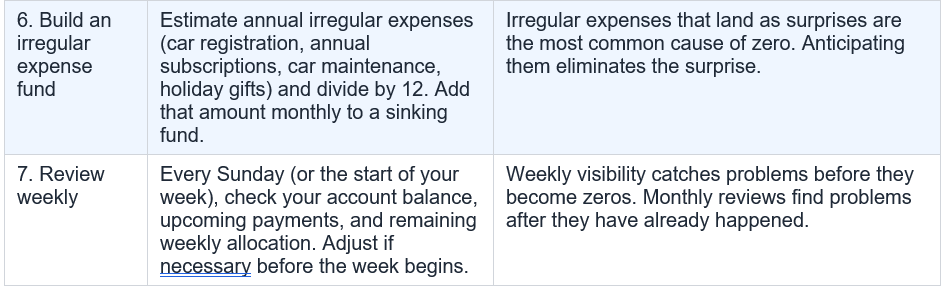
The mechanics: open a separate savings account (ideally at a different bank or a high-yield savings account where the money is accessible but not visible in your main banking app). Transfer exactly $50 from every paycheque to this account before paying anything else. If $50 is too much, start with $25. If pay arrives twice a month, that is $100–$1,200 per year in a dedicated buffer fund. At $50 per pay period on a biweekly schedule, $500 is reached in 5 months. The account is not for bills, not for groceries, not for anything except the category of expense that would otherwise send the main account to zero.
The buffer goal: $500 in a separate account that is not visible in your daily banking app. Timeline: 3-6 months at $25-$50 per paycheque. Rule: it can only be used for a true unexpected emergency -- not for a weekend trip, not for an item on sale, not for a bill you forgot about. The test: would zero-balance-before-payday have been prevented by having this $500 available? If yes, the expense qualifies. Not financial advice.
A Practical Budget That Prevents the Next Zero
A budget that prevents your balance from hitting zero is not the same as a conventional budget. The conventional approach starts with income and assigns percentages to categories. The zero-prevention budget starts with the consequences of running out and works backward to the decisions that would prevent them.
Conclusion
Two things are true simultaneously about a zero bank balance before payday. The first is that it is an extremely common experience — shared by 53 to 67% of Americans depending on the measure, spanning every income level, and made worse by the gap between rising prices (+4.2% through May 2026) and slower-growing wages (+3.6%). It is not a moral failing. It is arithmetic under pressure.The second is that the zero-balance experience itself has a real cost: overdraft fees, late payment penalties, credit score damage, potential debt from expensive short-term borrowing, and the documented psychological cost of financial anxiety that affects decision-making, health, and productivity in measurable ways. The experience is common, but it is not free.
The immediate path is triage: pause non-essential outflows, map the exact gap, find legitimate sources of emergency cash, contact billers proactively, and use food resources available to you without shame. The longer path is structural: identify what produces the zero (arithmetic, awareness, calibration, or timing), build a $500 buffer before the next emergency arrives, and build a cash-flow-aware budget that maps pay dates against bill dates explicitly.
The goal is not to become wealthy before the next payday. It is to make this the last time the balance hits zero. That requires one month of tighter action followed by five months of consistent $25–50 buffer building, which then changes the mathematical structure of your next budget crisis from ‘I have $0’ to ‘I have $500 and a plan.’ Not financial advice — contact 211 or a nonprofit credit counsellor if you need personalised guidance.
Frequently Asked Questions
What can I do right now if my bank balance is zero before payday?The immediate steps are: (1) Open your bank app and pause any non-essential automatic payments due in the next 7 days to prevent overdraft fees. (2) Make a list of every payment due before your payday and the exact gap you need to fill. (3) Look for fast, debt-free money sources: sell something on Facebook Marketplace or eBay, ask a trusted person for a short-term loan, pick up a few hours of gig economy work (DoorDash, Instacart, Uber Eats), or check whether your employer offers payroll advances or earned wage access. (4) Contact any billers with payments due before payday and ask about hardship arrangements or due-date extensions before missing the payment. (5) Audit your pantry and freezer before spending any money on food, and look up your local food bank at feedingamerica.org if needed. (6) Dial 2-1-1 for local emergency assistance programmes including food, utilities, and short-term cash assistance. Not financial advice. If in crisis, contact a certified nonprofit credit counsellor.
How do I get through until payday with no money?
The practical path to payday with zero money involves three tracks running simultaneously. First, stop any further outflows: pause subscriptions and auto-payments that would trigger overdraft fees. Second, find resources you already have: sell items you own, use food you already have at home before buying more, and contact local food banks (feedingamerica.org or dial 211) for free food resources. Third, generate small amounts of income if possible: gig economy platforms (DoorDash, Instacart, Uber Eats, Amazon Flex, Lyft) allow you to earn money in days and receive instant payouts for a small fee. Some platforms pay same-day or next-day. For essential bills due before payday: contact the biller proactively and explain you’ll have funds on your specific payday. Most utility companies and many landlords have arrangements for short-term delays. The key is to call before missing the payment, not after. Not financial advice.
Is it normal to run out of money before payday?
Yes, it is statistically common, though that doesn’t make it comfortable. About 67% of US consumers said they lived paycheck to paycheck in 2025, according to PYMNTS Intelligence data compiled by Walnut Invest (July 2026). Bankrate’s 2026 research found 53% of Americans could not cover a $1,000 emergency from savings and 24% have no emergency savings at all. The LendEDU 2025 Personal Finance Survey found 53% of Americans describe themselves as living paycheck to paycheck, including 44% of those earning $50,000–$99,000 and 20.6% of those earning $150,000 or more. The underlying driver in 2026 is a cost-of-living squeeze: prices increased 4.2% through May 2026 while wages grew only 3.6% (BLS; Federal Reserve Bank of Atlanta via MoneyLion June 2026). When costs outpace income, even responsible budgeters can find themselves at zero. The experience is common. Its causes and solutions vary by individual circumstance. Not financial advice.
Should I take a payday loan if I have no money before payday?
A payday loan is one of the most expensive financial products available and should be a last resort after exhausting all alternatives, not a first response. A typical payday loan charges $15 per $100 borrowed, which translates to an APR of approximately 300–400% (CFPB data). If not repaid immediately, the loan rolls over and fees multiply: a $375 payday loan can cost $520 in fees if carried for five months. The CFPB has documented that 80% of payday loans are renewed within 14 days, meaning most borrowers are not able to fully repay on the first payday as intended. The alternatives to consider first: selling items you own; asking a trusted person for an interest-free short loan; gig economy earnings; employer payroll advance or earned wage access programmes; credit union emergency loans (typically 18–28% APR); community assistance programmes through 211; and food bank resources to reduce the cash need for food. If a payday loan is genuinely the only option to prevent a housing or utility shutoff, understand the full repayment amount before signing and have a specific plan for repaying it in full on the next payday. Not financial advice. Contact a nonprofit credit counsellor (NFCC.org) for guidance.
How do I stop running out of money before payday?
Stopping the cycle requires identifying which of four specific causes is producing the zero: (1) Arithmetic: income is genuinely insufficient for necessary expenses — solution involves income growth or reducing fixed costs like housing or insurance. (2) Awareness: income would cover expenses but spending is not tracked, leading to underestimating what goes out — solution is a weekly spending check against a category budget. (3) Calibration: the right categories are funded but amounts are wrong due to lifestyle inflation or gradual cost creep — solution is a category-by-category audit against actual bank statements. (4) Timing: income arrives on the wrong days relative to when bills fall due, creating a cash-flow gap in specific weeks — solution is requesting due-date changes from billers to align with pay dates. The most consistent structural change is building a $500 buffer: transfer $25–50 from every paycheque to a separate account before paying anything else. In five to ten pay periods, this creates a buffer that absorbs unexpected expenses and prevents the zero. Not financial advice.

0 Comments Comments