

Savings
Where to Find 4.50% One-Year CDs Now (Some Pay Up to 4.75%).

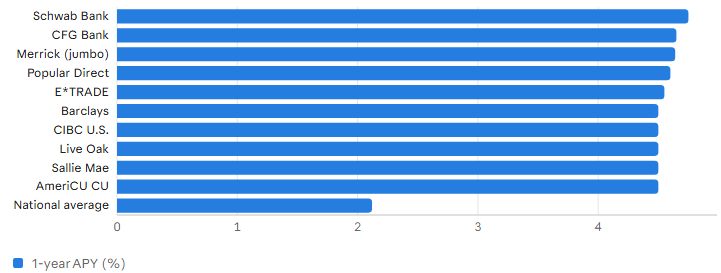
One-year CD rates: Charles Schwab Bank 4.75%; CFG Bank 4.65% (4.46% in another listing); Merrick Bank jumbo 4.64%; Popular Direct 4.60%; E*TRADE 4.55%; Barclays, CIBC U.S., Live Oak, Sallie Mae and AmeriCU Credit Union 4.50%. National average 2.12% (Bankrate, Oct 31); FDIC national rate 1.73% (September). Context: Fed funds 3.75%–4.00% after the September 16 hike, with a December hike possible; top savings 4.34%–4.50%; 52-week T-bill 4.46%; best 3-year CD about 4.85% and best 5-year 5.00%; inflation 3.7%. My arithmetic: $10,000 at 4.50% earns $450 in a year vs $212 at the 2.12% average; after assumed 24% federal and 5% state tax it nets about 3.19%, below 3.7% inflation; a 90-day penalty at 4.50% costs about $111 per $10,000.
APY (%) by NerdWallet and Forbes Advisor (Nov 2026), WalletHub (Oct), Bankrate (Oct 31 average); CFG also appears at 4.46%; rates change daily; insurance not verified
At the top, one-year CDs now pay almost as much as five-year CDs, which reach about 5.00%, so you can earn a strong rate without tying up money for five years, while the national average one-year CD paid only about 2.12% on October 31, according to Bankrate. This guide shows where the 4.50% rates are, what the fine print says, what they earn after tax and inflation and how they compare with savings accounts and Treasury bills.
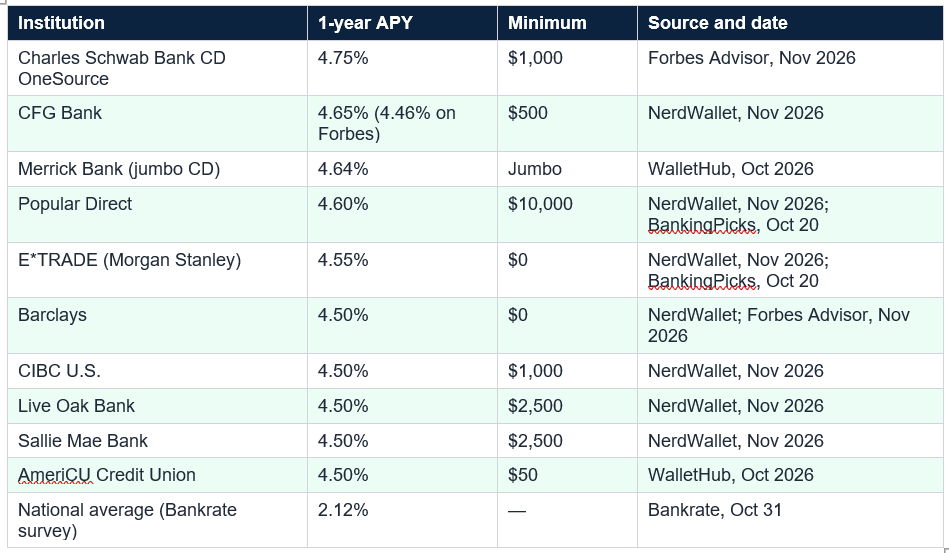
One-year CD rates at or above 4.50% (late October to early November 2026): Schwab 4.75%, CFG 4.65%, Merrick jumbo 4.64%, Popular Direct 4.60%, E*TRADE 4.55%, and 4.50% at Barclays, CIBC U.S., Live Oak, Sallie Mae and AmeriCU Credit Union. National average 2.12% (Bankrate); FDIC national rate 1.73% (September). Rates change daily.
And credit unions, such as AmeriCU at 4.50% with a $50 minimum, though membership rules apply and some pay less: NASA Federal Credit Union’s early savers CD paid 4.35%. Shop on a comparison site, then confirm on the institution’s own page, because the published APY can change while the comparison lags. Also look beyond the one-year term: Forbes Advisor showed Capital One at 4.50% on an 11-month CD, which can be useful if the timing fits.

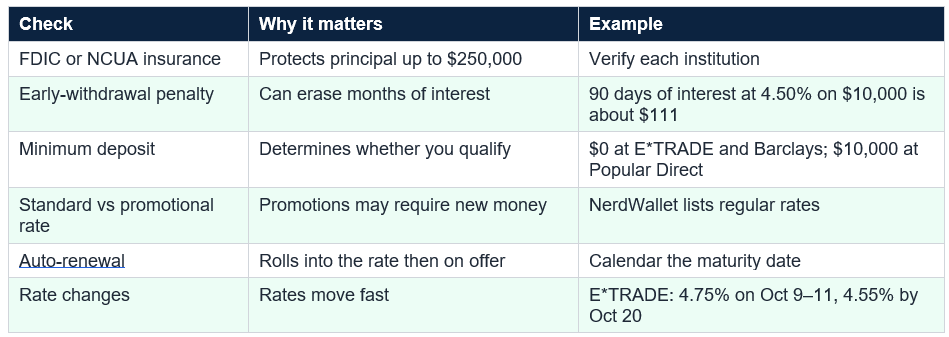
Fifth, maturity: many CDs renew automatically, often at the then-current rate, so note the date and grace period. Sixth, whether the CD is a jumbo, which needs a large deposit, or a brokered CD, which you may sell on a secondary market before maturity instead of paying a penalty. And check that the rate is the one quoted: with rates moving, a comparison site can be out of date by the time you apply.
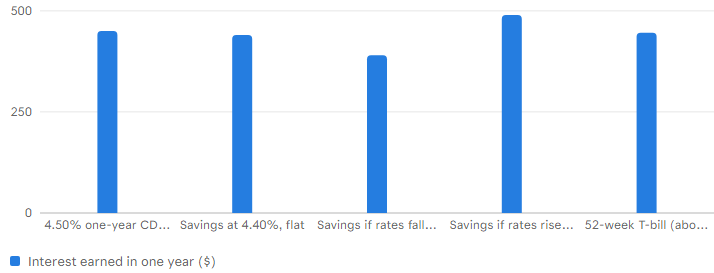
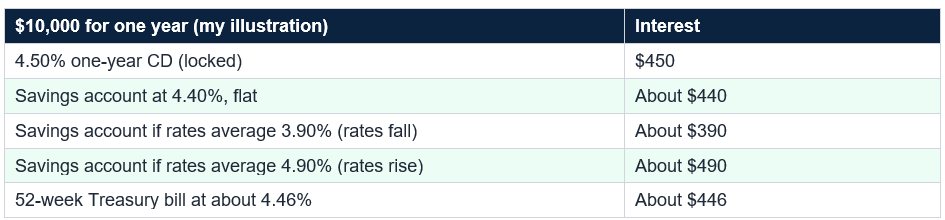
The deciding factor is the direction of rates. With the Fed at 3.75% to 4.00% and a December hike possible, savings rates could rise, which would favor a flexible account. If instead rates fall, the CD’s locked 4.50% looks better. In my illustration, $10,000 in a 4.50% CD earns $450 over a year. A savings account starting at 4.40% would earn about $440 if flat, about $390 if rates averaged 3.90% over the year and about $490 if they averaged 4.90%. The CD sits in the middle, which is the point of locking in.
A one-year CD protects your principal and locks your rate, but it does not guarantee your money buys more next year. It is a tool for safety and predictability, especially for money you will need within one to two years, such as a down payment or tuition, where the alternative is a stock market that can fall. After tax, even a strong CD roughly keeps pace with prices, a worthy goal for short-term money.
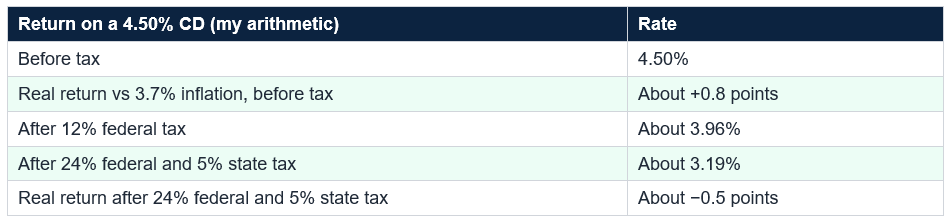
After tax, a 4.50% CD can earn less than 3.7% inflation. Treat it as a way to hold short-term money safely at a known rate, not as a way to grow your purchasing power.
You can also mix terms. If you believe rates will keep rising, shorter CDs let you reinvest sooner. If you believe they will fall, longer ones, such as the 5.00% five-year CDs, lock in more. With the Fed on hold and a December hike possible, a blend is a reasonable hedge. Bankrate found only 46% of Americans could cover three months of expenses, so keep your emergency fund in a flexible account first, and use CDs for money you will not touch for a year.
It is less suitable if you might need the money, since the penalty can cost months of interest, if you expect rates to rise sharply or for long-term growth money. This is general information, not personal advice.
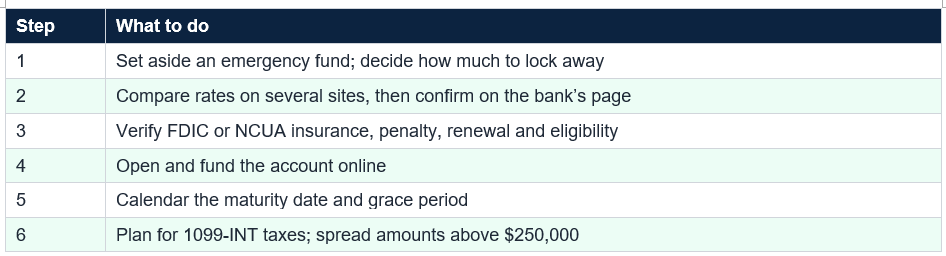
Sixth, plan for taxes: you will receive a Form 1099-INT for interest earned. If you are depositing more than $250,000, spread it across institutions to stay within insurance limits.
Your move: Before you open a CD, check today’s rate on the institution’s own page, write down the penalty and put the maturity date in your calendar. If you cannot say what the money is for, wait.
So treat a one-year CD as what it is: a safe, known return on money you will not need for a year. Verify the rate, the penalty and the insurance, consider a ladder, keep your emergency fund somewhere flexible and remember that after tax a 4.50% CD roughly keeps pace with 3.7% inflation. Compare on the day you buy. This is general education, not personalized advice, and a qualified adviser can help you decide how CDs fit your plan.
As of late October and early November 2026, NerdWallet listed one-year CDs at 4.50% or more at CFG Bank (4.65%), Popular Direct (4.60%), E*TRADE (4.55%), CIBC U.S., Barclays, Live Oak Bank and Sallie Mae Bank (each 4.50%). Forbes Advisor listed Charles Schwab Bank at 4.75%, and WalletHub listed AmeriCU Credit Union at 4.50%. Rates move quickly, so verify on the institution’s site before opening.
Why did one-year CD rates rise this autumn?
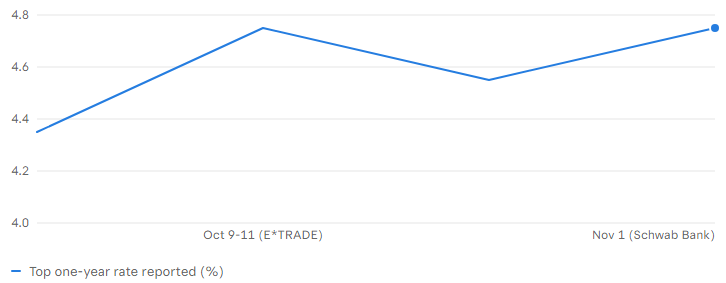
The Federal Reserve raised its target rate by a quarter point on September 16, the first increase since 2023, and held at 3.75% to 4.00% on October 28 with a December hike possible. One source reports leading one-year rates climbing from about 4.35% in late September to 4.75% by October 9 to 11, before easing at some banks. Short-term CD rates tend to follow short-term policy rates.
Is a one-year CD better than a high-yield savings account?
It depends on where rates go. A CD locks in its rate for 12 months, while savings rates are variable: top accounts paid 4.34% to 4.50% in mid-October. If rates fall, the CD wins; if they rise, the savings account may catch up. A CD also charges a penalty for early withdrawal, so it suits money you will not need for a year.
Are one-year CDs safe?
Principal is safe up to the insurance limit: FDIC-insured banks and NCUA-insured credit unions cover up to $250,000 per depositor, per institution, per ownership category. Brokered CDs sold through brokerages are also typically FDIC-insured through the issuing bank, but can have different rules for early sale. Check the issuer’s insurance status before you buy.
What happens if I withdraw early?
You typically pay a penalty expressed as days or months of interest. One comparison site lists 90 days of interest at Barclays and Marcus and 180 days at Bread Savings. On $10,000 at 4.50%, 90 days of interest is about $111 and 180 days about $222. Penalties vary, and I did not retrieve every institution’s terms, so read them first. This is general education, not personal advice.
Table of Contents
- Why One Year, and Why Now
- The Short Answer
- Who Is Paying 4.50% or More
- Where to Look: Four Places
- What 4.50% Earns
- The Fine Print That Matters
- One-Year CD vs. Savings, T-Bills and I Bonds
- The Catch: Tax and Inflation
- Strategies: Ladders and Rolling
- Who Should and Should Not
- How to Open One Step by Step
- Conclusion
- Frequently Asked Questions
One-year CD rates at or above 4.50% vs. the national average (APY %)
APY (%) by NerdWallet and Forbes Advisor (Nov 2026), WalletHub (Oct), Bankrate (Oct 31 average); CFG also appears at 4.46%; rates change daily; insurance not verified
Rates move fast: top one-year CD rates this autumn (APY %)
APY (%) by Moneyverge, BankingPicks and Forbes Advisor; different institutions and sources at each point, so this shows direction, not one bank's history
Locking in vs. staying flexible: $10,000 for one year under three rate paths ($)
Interest ($) by Author's illustration; savings paths are assumptions, not forecasts; CD and T-bill figures from the cited rates
Why One Year, and Why Now
A one-year CD is the short end of the CD family, and this autumn it is having a moment. When the Federal Reserve raised its target rate by a quarter point on September 16, the first increase since 2023, short-term yields jumped, and one-year CD rates followed. One source reports leading 12-month rates rising from about 4.35% in late September to 4.75% by October 9 to 11. Since then some have eased, but many are still at 4.50% or more.At the top, one-year CDs now pay almost as much as five-year CDs, which reach about 5.00%, so you can earn a strong rate without tying up money for five years, while the national average one-year CD paid only about 2.12% on October 31, according to Bankrate. This guide shows where the 4.50% rates are, what the fine print says, what they earn after tax and inflation and how they compare with savings accounts and Treasury bills.
The Short Answer
You can find one-year CDs at 4.50% or more at online banks and brokerages, plus at least one credit union. In the most recent listings, Charles Schwab Bank paid 4.75%, CFG Bank 4.65%, Popular Direct 4.60% and E*TRADE 4.55%, while Barclays, CIBC U.S., Live Oak Bank, Sallie Mae Bank and AmeriCU Credit Union paid 4.50%. On $10,000, 4.50% earns about $450 in a year, against about $212 at the national average. Check the minimum deposit, the early-withdrawal penalty and the insurance status, and remember that rates move quickly.Who Is Paying 4.50% or More
Here are the one-year rates at or above 4.50% that I found, with source and date. The lists differ because each site tracks different institutions, and CFG Bank appeared at 4.65% on NerdWallet and 4.46% on Forbes Advisor, so confirm the current rate directly. Minimums range from $0 at E*TRADE and Barclays to $10,000 at Popular Direct, and Merrick’s is a jumbo CD.One-year CD rates at or above 4.50% (late October to early November 2026): Schwab 4.75%, CFG 4.65%, Merrick jumbo 4.64%, Popular Direct 4.60%, E*TRADE 4.55%, and 4.50% at Barclays, CIBC U.S., Live Oak, Sallie Mae and AmeriCU Credit Union. National average 2.12% (Bankrate); FDIC national rate 1.73% (September). Rates change daily.
Where to Look: Four Places
The best one-year rates cluster in four places. Online banks have lower costs and often pay far more than branch-based banks: Capital One’s brick-and-mortar CD paid 4.00% on WalletHub’s list, well below the online leaders. Brokerage CD platforms such as E*TRADE and Charles Schwab Bank offer CDs alongside investment accounts. Brokered CDs sold through brokerages showed 4.75% for 10 months to a year at Vanguard on October 23 (Forbes Advisor) and 4.60% for one year on October 15 (DepositAccounts).And credit unions, such as AmeriCU at 4.50% with a $50 minimum, though membership rules apply and some pay less: NASA Federal Credit Union’s early savers CD paid 4.35%. Shop on a comparison site, then confirm on the institution’s own page, because the published APY can change while the comparison lags. Also look beyond the one-year term: Forbes Advisor showed Capital One at 4.50% on an 11-month CD, which can be useful if the timing fits.
What 4.50% Earns
In my arithmetic, $10,000 in a one-year CD earns about $475 at 4.75%, $465 at 4.65%, $460 at 4.60%, $455 at 4.55% and $450 at 4.50%, against about $212 at the 2.12% national average. The gap between a top rate and the average is about $238 on $10,000, while the gap between 4.75% and 4.50% is only $25 ($125 on $50,000). Shop for a good rate, but do not let a quarter point override convenience, insurance or terms.
The Fine Print That Matters
A rate is only as good as its terms. First, insurance: FDIC-insured banks and NCUA-insured credit unions cover up to $250,000 per depositor, per institution, per ownership category. Second, the early-withdrawal penalty. BankingPicks lists 90 days of interest at Barclays and Marcus and 180 days at Bread Savings, which on $10,000 at 4.50% is about $111 and $222. Third, the minimum deposit, which ranges from $0 to $10,000 in the table above. Fourth, whether the rate is standard or promotional, since NerdWallet states it considers regular, not promotional or relationship-based, rates.Fifth, maturity: many CDs renew automatically, often at the then-current rate, so note the date and grace period. Sixth, whether the CD is a jumbo, which needs a large deposit, or a brokered CD, which you may sell on a secondary market before maturity instead of paying a penalty. And check that the rate is the one quoted: with rates moving, a comparison site can be out of date by the time you apply.
One-Year CD vs. Savings, T-Bills and I Bonds
A 4.50% one-year CD is not the only way to earn a similar rate. Top high-yield savings accounts paid 4.34% to 4.50% in mid-October, with no lockup but a variable rate. A 52-week Treasury bill yielded about 4.46%, and its interest is exempt from state tax. Brokered one-year CDs showed 4.60% to 4.75%. The new I bond pays 5.51% with a 1.40% fixed rate, but it has a $10,000 annual limit and a 12-month lockup, and the first-year net after the interest penalty can be lower than a CD.The deciding factor is the direction of rates. With the Fed at 3.75% to 4.00% and a December hike possible, savings rates could rise, which would favor a flexible account. If instead rates fall, the CD’s locked 4.50% looks better. In my illustration, $10,000 in a 4.50% CD earns $450 over a year. A savings account starting at 4.40% would earn about $440 if flat, about $390 if rates averaged 3.90% over the year and about $490 if they averaged 4.90%. The CD sits in the middle, which is the point of locking in.
The Catch: Tax and Inflation
A 4.50% rate is not what you keep. Inflation was 3.7% in September, so before tax the real return is about 0.8 points. CD interest is generally taxed as ordinary income federally and by most states, each year as it accrues, which I describe as general knowledge rather than from the sources above. In my illustration, at an assumed 24% federal and 5% state rate, 4.50% nets about 3.19%, about half a point below inflation. At a 12% federal bracket it nets about 3.96%, a small real gain of about 0.26 points.A one-year CD protects your principal and locks your rate, but it does not guarantee your money buys more next year. It is a tool for safety and predictability, especially for money you will need within one to two years, such as a down payment or tuition, where the alternative is a stock market that can fall. After tax, even a strong CD roughly keeps pace with prices, a worthy goal for short-term money.
After tax, a 4.50% CD can earn less than 3.7% inflation. Treat it as a way to hold short-term money safely at a known rate, not as a way to grow your purchasing power.
Strategies: Ladders and Rolling
Because one-year CDs mature quickly, they work well in a rolling strategy. A simple ladder splits money into several CDs that mature at different times, for example four CDs of $5,000 opened every three months. Each time one matures, you can spend it or reinvest it at the then-current rate, which reduces the risk of locking everything in at a rate that later looks low and keeps part of your money available regularly.You can also mix terms. If you believe rates will keep rising, shorter CDs let you reinvest sooner. If you believe they will fall, longer ones, such as the 5.00% five-year CDs, lock in more. With the Fed on hold and a December hike possible, a blend is a reasonable hedge. Bankrate found only 46% of Americans could cover three months of expenses, so keep your emergency fund in a flexible account first, and use CDs for money you will not touch for a year.
Who Should and Should Not
A one-year CD suits people with a defined goal within one to two years, such as a down payment, tuition or a tax bill, who want a guaranteed return and no market risk, savers who think rates may fall and want to lock 4.50% or more, and retirees who want predictable income on part of their cash. Once your emergency fund is built, a CD is a sensible place for the next layer of savings.It is less suitable if you might need the money, since the penalty can cost months of interest, if you expect rates to rise sharply or for long-term growth money. This is general information, not personal advice.
How to Open One Step by Step
First, decide how much you can lock away for 12 months after setting aside an emergency fund. Second, compare rates on at least three sites and confirm on the institution’s own page. Third, verify FDIC or NCUA insurance and read the penalty, renewal and eligibility terms. Fourth, open and fund the account online. Fifth, calendar the maturity date and grace period and decide in advance whether to withdraw, renew or move the money.Sixth, plan for taxes: you will receive a Form 1099-INT for interest earned. If you are depositing more than $250,000, spread it across institutions to stay within insurance limits.
Your move: Before you open a CD, check today’s rate on the institution’s own page, write down the penalty and put the maturity date in your calendar. If you cannot say what the money is for, wait.
Conclusion
If you are looking for a 4.50% one-year CD, you have plenty of options: Charles Schwab Bank at 4.75%, CFG Bank at 4.65%, Popular Direct at 4.60%, E*TRADE at 4.55% and Barclays, CIBC U.S., Live Oak, Sallie Mae and AmeriCU Credit Union at 4.50%, against a 2.12% national average. On $10,000, 4.50% earns about $450 in a year, about $238 more than an average CD, with principal insured up to $250,000. Rates move fast, though: E*TRADE’s fell from 4.75% to 4.55% within about ten days.So treat a one-year CD as what it is: a safe, known return on money you will not need for a year. Verify the rate, the penalty and the insurance, consider a ladder, keep your emergency fund somewhere flexible and remember that after tax a 4.50% CD roughly keeps pace with 3.7% inflation. Compare on the day you buy. This is general education, not personalized advice, and a qualified adviser can help you decide how CDs fit your plan.
Frequently Asked Questions
Where can I find a 4.50% one-year CD?As of late October and early November 2026, NerdWallet listed one-year CDs at 4.50% or more at CFG Bank (4.65%), Popular Direct (4.60%), E*TRADE (4.55%), CIBC U.S., Barclays, Live Oak Bank and Sallie Mae Bank (each 4.50%). Forbes Advisor listed Charles Schwab Bank at 4.75%, and WalletHub listed AmeriCU Credit Union at 4.50%. Rates move quickly, so verify on the institution’s site before opening.
Why did one-year CD rates rise this autumn?
The Federal Reserve raised its target rate by a quarter point on September 16, the first increase since 2023, and held at 3.75% to 4.00% on October 28 with a December hike possible. One source reports leading one-year rates climbing from about 4.35% in late September to 4.75% by October 9 to 11, before easing at some banks. Short-term CD rates tend to follow short-term policy rates.
Is a one-year CD better than a high-yield savings account?
It depends on where rates go. A CD locks in its rate for 12 months, while savings rates are variable: top accounts paid 4.34% to 4.50% in mid-October. If rates fall, the CD wins; if they rise, the savings account may catch up. A CD also charges a penalty for early withdrawal, so it suits money you will not need for a year.
Are one-year CDs safe?
Principal is safe up to the insurance limit: FDIC-insured banks and NCUA-insured credit unions cover up to $250,000 per depositor, per institution, per ownership category. Brokered CDs sold through brokerages are also typically FDIC-insured through the issuing bank, but can have different rules for early sale. Check the issuer’s insurance status before you buy.
What happens if I withdraw early?
You typically pay a penalty expressed as days or months of interest. One comparison site lists 90 days of interest at Barclays and Marcus and 180 days at Bread Savings. On $10,000 at 4.50%, 90 days of interest is about $111 and 180 days about $222. Penalties vary, and I did not retrieve every institution’s terms, so read them first. This is general education, not personal advice.
0 Comments
Be the first to share your thoughts on this article.