
Vehicles & Cars
Which EV Has the Most Recalls in 2026? Here’s What Data Show

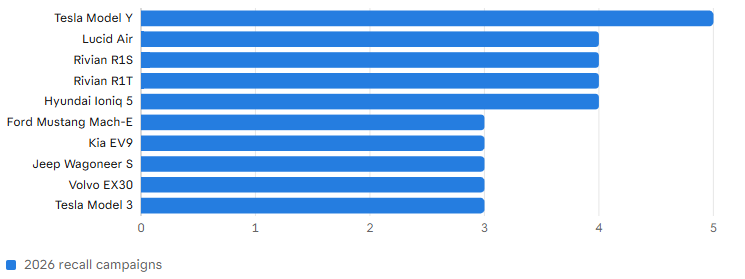
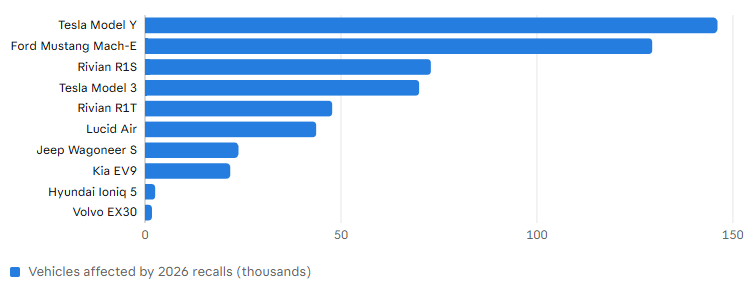
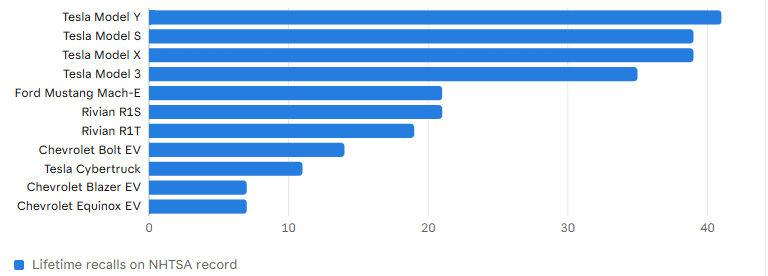
Tesla Model Y 5 recalls (146,040 vehicles; 787 complaints); Lucid Air, Rivian R1S, Rivian R1T and Hyundai Ioniq 5 4 each; Ford Mustang Mach-E, Kia EV9, Jeep Wagoneer S, Volvo EX30 and Tesla Model 3 3 each; the top 10 total 36 recall campaigns. Lifetime counts (The Charge Port): Tesla Model Y 41, Model S 39, Model X 39, Model 3 35, Ford Mustang Mach-E 21, Rivian R1S 21, Rivian R1T 19, Chevrolet Bolt EV 14, Tesla Cybertruck 11, Chevrolet Blazer EV and Equinox EV 7 each; PlainVIN: Rivian 23 EV-only campaigns covering 243,097 vehicles. My arithmetic: the Model Y’s 146,040 vehicles over 5 recalls average about 29,200 a recall and the Mach-E’s 129,410 over 3 about 43,100; Tesla’s two models account for 8 of the top 10’s 36 campaigns (22%) but about 39% of the vehicles counted; the Ioniq 5 had 4 recalls on only about 2,600 vehicles but 610 complaints, showing the measures differ.
I use data from NHTSA, the federal safety regulator, as analyzed by several sites that count and present it differently, and I flag where they disagree. I also look at what the recalls were actually for, which matters more than the number, and at the money side: recalls are free to fix, but they can affect your time, your trust and a used car’s value. This is general information, not a recommendation of any vehicle.
The rest of the top 10 each have three recalls: the Ford Mustang Mach-E, covering about 129,410 vehicles, the Kia EV9 at about 21,740, the Jeep Wagoneer S at about 23,830, the Volvo EX30 at about 1,790 and the Tesla Model 3 at about 69,940 with 412 complaints. In my arithmetic, those ten models add up to 36 recall campaigns, though some campaigns cover more than one model, so the overlap means the vehicle counts should not simply be added. The list shows the pattern: a few popular models with large fleets dominate.
2026 NHTSA recalls by model (Rerev via Kiplinger, over 50 EVs): Tesla Model Y 5; Lucid Air, Rivian R1S, Rivian R1T, Hyundai Ioniq 5 4 each; Ford Mustang Mach-E, Kia EV9, Jeep Wagoneer S, Volvo EX30, Tesla Model 3 3 each. Model Y: about 146,040 vehicles and 787 complaints; Mach-E: about 129,410 vehicles.
GM recalled nearly 23,000 Chevrolet Equinox EV and Cadillac Optiq vehicles because tire tread could fall off, and earlier recalled over 23,000 2024 Equinox EVs because they might not make enough noise (a pedestrian-warning requirement, in my understanding). PlainVIN also lists a July recall of certain 2026 Model Y and 2024 Model 3 vehicles incorrectly imported, with only 15 vehicles. So a recall can mean a sticker, a software bug, a pedestrian-warning sound or a part that could cause a loss of power. Read the details of any recall on a car you own or plan to buy.
Sources conflict. America’s Lemon Lawyer lists Tesla’s lifetime counts as Model 3 at 31, Model S at 28, Model X at 31 and Model Y at 41, against The Charge Port’s 35, 39, 39 and 41, and two sites disagree on how many of the Cybertruck’s 11 recalls came in 2026. Counting rules explain some of it: one recall can cover several models, such as the one that included the Ford Maverick, Bronco Sport and Mach-E, and expansions may be counted separately. PlainVIN’s count of Rivian is 23 EV-only campaigns covering 243,097 vehicles. Treat each number as approximate.
Fifth, how it is fixed. In my general knowledge, some recalls on connected cars are fixed by over-the-air software updates without a dealer visit, which may make them less disruptive. Sixth, how the count is made: one campaign can cover several models, and expansions are sometimes counted separately. And complaints are not recalls: the Ioniq 5 had four recalls on about 2,600 vehicles but 610 complaints, showing they measure different things, and complaints are unverified. As one tracker puts it, a recall is the system working: a known issue gets documented and, almost always, fixed for free.
What the numbers cannot tell you is the rate: recalls per vehicle sold, or per mile. Sales figures were not in the sources I retrieved, so I cannot compute that fairly. Nor can they tell you how EVs compare with gasoline cars, since NHTSA does not label recalls as EV or gas and I found no like-for-like comparison. The fair summary is that the biggest sellers lead the lists, new entrants show up with several recalls in their early years and every make has some. The question to ask is not how many but what, and how well it was fixed.
Think about the money side too. A recall repair costs you nothing, but it can cost time, and an unresolved or repeated recall can affect resale value, which I note from general knowledge. If you are buying used, check for open recalls on the VIN, since a recall can remain open on a car whose owner never got the notice, and ask for proof of completed repairs. If a car has repeated, unresolved problems, consumer-protection or lemon law options may apply in your state, a point I did not research. Keep emails and service records.
Look up your car’s VIN at NHTSA.gov today. It takes a minute, and recalls can be open on a car you already own without you knowing.
Think about the money, too. The total cost of owning an EV includes purchase price, insurance, charging, tires, depreciation and repairs, and a recall history is only one piece. If you are looking at a used EV, a clean recall record, with every open recall repaired, is a better sign than a short one. If you are buying new, the warranty and the maker’s record of fixing problems matter. I would be wary of anyone who says to avoid a model purely on its recall count.
Common mistakes include treating the recall count as a reliability score, ignoring what the recall was for, comparing models of very different age and sales, trusting one source’s count, never checking your own VIN, buying a used EV without checking open recalls, skipping a recall repair because the car seems fine and assuming a model with fewer recalls is safer, since a new model may simply have fewer miles behind it. A clear head and a VIN lookup are the best tools.
Use recall data wisely: read what each recall was for, check your own VIN at NHTSA, confirm any used car’s open recalls are fixed, and weigh the count alongside warranty, reliability and cost. Recalls are free to fix, and a recall is, as one tracker says, the safety system working. If you want a rate rather than a count, you would need sales data, which I did not retrieve. This is general information, not purchasing or financial advice.
By the number of separate recall campaigns this year, the Tesla Model Y leads with five, according to an analysis of NHTSA data by Rerev reported by Kiplinger. Four models follow with four each: the Lucid Air, Rivian R1S, Rivian R1T and Hyundai Ioniq 5. Over its whole time on sale, the Model Y also has the most on record, 41, per one tracker. Counts differ slightly between sources.
Does more recalls mean a worse car?
Not necessarily. Recalls reflect how many vehicles are sold, how long a model has been on sale, how aggressively the maker reports and how serious the problem is. Several trackers note that a recall is the safety system working, and most come with a free fix. A missing certification label and a part that can fracture are very different problems, so read what the recall is for.
Are EVs recalled more than gasoline cars?
I could not find a reliable like-for-like comparison, so I cannot say. PlainVIN’s analysis notes that NHTSA does not label recalls as EV or gas, and that EV recalls once came almost entirely from Tesla, Nissan and GM, which has changed as more brands sell EVs. Treat any sweeping claim with caution.
How do I check whether my EV has an open recall?
Enter your 17-character VIN at NHTSA’s recall lookup, or check the maker’s website or your owner account. Remedies are free from dealers, and some are delivered by over-the-air software update. Also check for open recalls before buying a used EV, because a recall can be open on a car whose owner never received the notice.
Should recall counts influence which EV I buy?
They are one input. Look at what each recall was for, whether a remedy exists and how it was delivered, the open investigations and the warranty, alongside reliability surveys and the total cost of ownership. This is general education, not personal advice.
Table of Contents
- A Simple Question With a Complicated Answer
- The Short Answer
- The 2026 Top 10
- What the Recalls Were Actually For
- Lifetime Recall Counts
- Why Counts Can Mislead
- Putting the Numbers in Context
- If Your EV Is Recalled
- Using Recall Data When You Shop
- Common Mistakes
- Conclusion
- Frequently Asked Questions
The 2026 EV recall leaderboard: recall campaigns by model (NHTSA data)
Recall campaigns in 2026 by Rerev analysis of NHTSA data (over 50 EVs) counts are separate recall campaigns in 2026; a count is not a quality score
Count vs. reach: vehicles covered by 2026 recalls, top-10 models (thousands)
Vehicles affected (thousands) by Rerev analysis of NHTSA the Ioniq 5 has four recalls but only about 2,600 vehicles, while Mach-E's three recalls cover about 129,000; campaigns that span models can overlap
Over a model's lifetime: total NHTSA recall campaigns on record
Lifetime recall campaigns by The Charge Port (NHTSA data, about three months old); other trackers list lower Tesla counts (Model 3 31, S 28, X 31); older models naturally accumulate more recallsA Simple Question With a Complicated Answer
If you are thinking about an electric car, you have probably wondered which models are the most trouble. A recall list seems like a natural place to look: count the recalls, avoid the worst. It is a reasonable instinct, and this guide will give you the counts. But it will also show why the answer to “which EV has the most recalls” is both easy to state and easy to misread.I use data from NHTSA, the federal safety regulator, as analyzed by several sites that count and present it differently, and I flag where they disagree. I also look at what the recalls were actually for, which matters more than the number, and at the money side: recalls are free to fix, but they can affect your time, your trust and a used car’s value. This is general information, not a recommendation of any vehicle.
The Short Answer
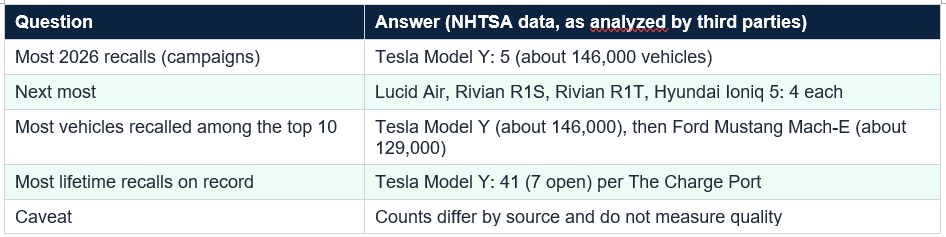
The Tesla Model Y has the most recalls of any EV in 2026 by campaign count, five, according to a Rerev analysis of NHTSA data reported by Kiplinger, covering about 146,000 vehicles. The Lucid Air, Rivian R1S, Rivian R1T and Hyundai Ioniq 5 follow with four each. Over their whole time on sale, the Model Y also leads with 41 recalls on one tracker. But the counts depend on how many cars are sold, how long a model has been on sale and what each recall was for, so a long list is not the same as a bad car. Several of the 2026 recalls were minor, such as a missing certification label.
The 2026 Top 10
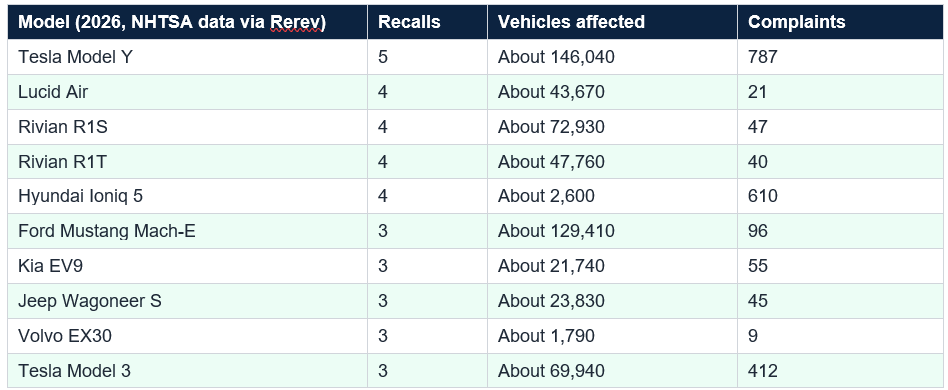
Rerev examined more than 50 electric models sold in the US and counted, for each model, the separate NHTSA recalls in 2026, the vehicles each covered and the complaints filed. The Tesla Model Y leads with five recalls affecting about 146,040 vehicles and 787 complaints. The Lucid Air has four recalls but only about 43,670 vehicles, and the Rivian R1S and R1T each have four, covering about 72,930 and 47,760 vehicles. The Hyundai Ioniq 5 has four recalls, with only about 2,600 vehicles but 610 complaints, the second-highest complaint count.The rest of the top 10 each have three recalls: the Ford Mustang Mach-E, covering about 129,410 vehicles, the Kia EV9 at about 21,740, the Jeep Wagoneer S at about 23,830, the Volvo EX30 at about 1,790 and the Tesla Model 3 at about 69,940 with 412 complaints. In my arithmetic, those ten models add up to 36 recall campaigns, though some campaigns cover more than one model, so the overlap means the vehicle counts should not simply be added. The list shows the pattern: a few popular models with large fleets dominate.
2026 NHTSA recalls by model (Rerev via Kiplinger, over 50 EVs): Tesla Model Y 5; Lucid Air, Rivian R1S, Rivian R1T, Hyundai Ioniq 5 4 each; Ford Mustang Mach-E, Kia EV9, Jeep Wagoneer S, Volvo EX30, Tesla Model 3 3 each. Model Y: about 146,040 vehicles and 787 complaints; Mach-E: about 129,410 vehicles.
What the Recalls Were Actually For
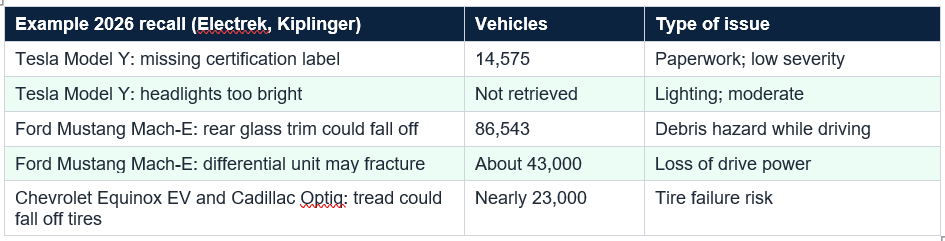
The reasons matter more than the totals. Kiplinger notes the Model Y’s recalls were not too severe: one was for headlights that were too bright, and another for a missing certification label, and Electrek reports Tesla recalling 14,575 Model Y vehicles built between November 2025 and April 2026 for the label. Other recalls are more serious. Ford recalled 86,543 Mustang Mach-E models in August because a piece of rear glass trim could fall off while driving, and about 43,000 in July because a faulty differential unit may fracture, causing a loss of drive power.GM recalled nearly 23,000 Chevrolet Equinox EV and Cadillac Optiq vehicles because tire tread could fall off, and earlier recalled over 23,000 2024 Equinox EVs because they might not make enough noise (a pedestrian-warning requirement, in my understanding). PlainVIN also lists a July recall of certain 2026 Model Y and 2024 Model 3 vehicles incorrectly imported, with only 15 vehicles. So a recall can mean a sticker, a software bug, a pedestrian-warning sound or a part that could cause a loss of power. Read the details of any recall on a car you own or plan to buy.
Lifetime Recall Counts
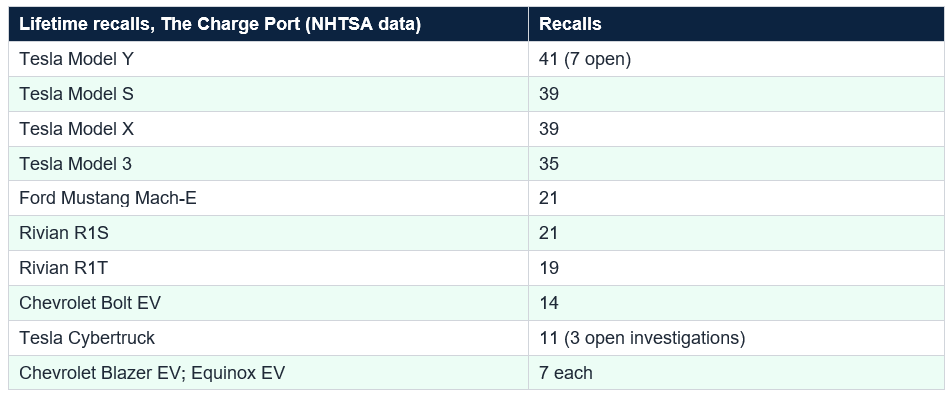
The 2026 list covers one year. Over their whole time on sale, a different picture emerges. The Charge Port, which matches every US EV to its NHTSA file, lists the Tesla Model Y with 41 recalls (7 still open), the Model S and Model X with 39 each, the Model 3 with 35, the Ford Mustang Mach-E and Rivian R1S with 21 each, the Rivian R1T with 19, the Chevrolet Bolt EV with 14, the Cybertruck with 11 and the Chevrolet Blazer EV and Equinox EV with 7 each. The same site cautions that older models naturally accumulate more recalls, so a higher count often reflects age and popularity.Sources conflict. America’s Lemon Lawyer lists Tesla’s lifetime counts as Model 3 at 31, Model S at 28, Model X at 31 and Model Y at 41, against The Charge Port’s 35, 39, 39 and 41, and two sites disagree on how many of the Cybertruck’s 11 recalls came in 2026. Counting rules explain some of it: one recall can cover several models, such as the one that included the Ford Maverick, Bronco Sport and Mach-E, and expansions may be counted separately. PlainVIN’s count of Rivian is 23 EV-only campaigns covering 243,097 vehicles. Treat each number as approximate.
Why Counts Can Mislead
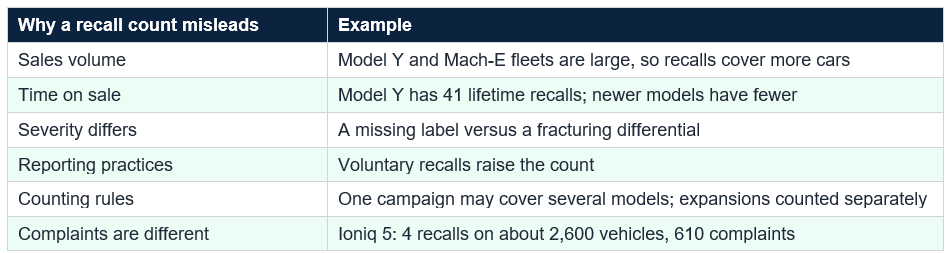
There are several reasons a recall count is a weak quality score. First, volume: a model that sells in the hundreds of thousands has more vehicles to recall, more chances for a fault to appear and more attention from regulators. Second, time on sale: a model on the market for years accumulates recalls, while a brand new one may not yet have been tested by millions of miles. Third, severity: a missing label and a fracturing differential count the same. Fourth, reporting: makers that issue many voluntary recalls can look worse than those that act less.Fifth, how it is fixed. In my general knowledge, some recalls on connected cars are fixed by over-the-air software updates without a dealer visit, which may make them less disruptive. Sixth, how the count is made: one campaign can cover several models, and expansions are sometimes counted separately. And complaints are not recalls: the Ioniq 5 had four recalls on about 2,600 vehicles but 610 complaints, showing they measure different things, and complaints are unverified. As one tracker puts it, a recall is the system working: a known issue gets documented and, almost always, fixed for free.
Putting the Numbers in Context
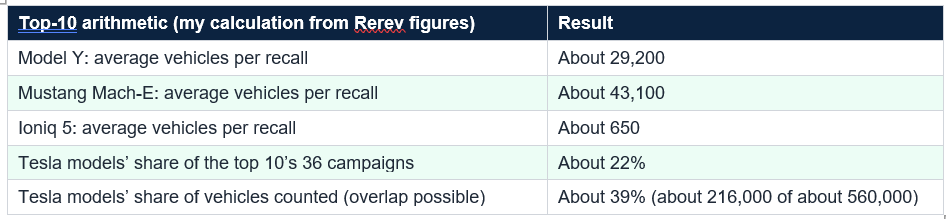
To add context, I did some simple arithmetic on the top 10. The Model Y’s 146,040 vehicles over five recalls average about 29,200 vehicles a recall, and the Mach-E’s 129,410 over three about 43,100, which shows some recalls are enormous, while the Ioniq 5’s four recalls average about 650 vehicles, so its count is high but its reach small. Tesla’s two models account for 8 of the 36 campaigns in the top 10, 22%, but about 39% of the vehicles counted, about 216,000 of roughly 560,000, which reflects the size of its fleets. The Rivian R1S and R1T together have eight campaigns on about 120,700 vehicles.What the numbers cannot tell you is the rate: recalls per vehicle sold, or per mile. Sales figures were not in the sources I retrieved, so I cannot compute that fairly. Nor can they tell you how EVs compare with gasoline cars, since NHTSA does not label recalls as EV or gas and I found no like-for-like comparison. The fair summary is that the biggest sellers lead the lists, new entrants show up with several recalls in their early years and every make has some. The question to ask is not how many but what, and how well it was fixed.
If Your EV Is Recalled
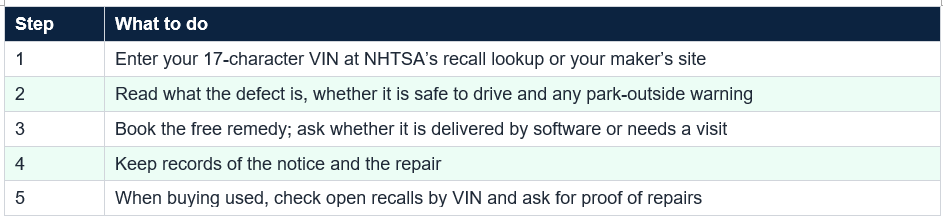
If your car is recalled, do not panic. Recall repairs are free, and almost all recalls on file have a remedy available, according to The Charge Port. Check your VIN at NHTSA’s recall lookup, or your maker’s site, to see open recalls. Read the notice: it should say what the defect is, whether it is safe to keep driving and what the fix is. Some recalls carry specific warnings, such as to park outside, which you should follow, and PlainVIN tracks battery recalls that carry a fire warning. Book the repair promptly, and keep a record of it.Think about the money side too. A recall repair costs you nothing, but it can cost time, and an unresolved or repeated recall can affect resale value, which I note from general knowledge. If you are buying used, check for open recalls on the VIN, since a recall can remain open on a car whose owner never got the notice, and ask for proof of completed repairs. If a car has repeated, unresolved problems, consumer-protection or lemon law options may apply in your state, a point I did not research. Keep emails and service records.
Look up your car’s VIN at NHTSA.gov today. It takes a minute, and recalls can be open on a car you already own without you knowing.
Using Recall Data When You Shop
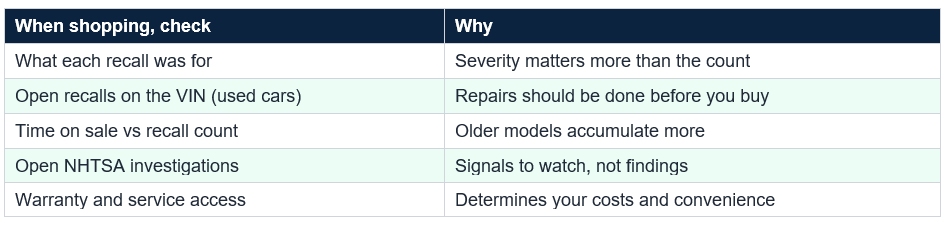
Recall data is useful when you use it as one signal among several. Look at what each recall was for, how serious it was, whether a remedy exists and how it was delivered. Look at open investigations: The Charge Port notes three open NHTSA investigations on the Cybertruck, which it describes as questions, not findings of a defect. Compare the number of recalls with the time a model has been on sale. Then add other evidence: reliability surveys, warranty length, the cost of repairs, charging reliability and your own use.Think about the money, too. The total cost of owning an EV includes purchase price, insurance, charging, tires, depreciation and repairs, and a recall history is only one piece. If you are looking at a used EV, a clean recall record, with every open recall repaired, is a better sign than a short one. If you are buying new, the warranty and the maker’s record of fixing problems matter. I would be wary of anyone who says to avoid a model purely on its recall count.
Common mistakes include treating the recall count as a reliability score, ignoring what the recall was for, comparing models of very different age and sales, trusting one source’s count, never checking your own VIN, buying a used EV without checking open recalls, skipping a recall repair because the car seems fine and assuming a model with fewer recalls is safer, since a new model may simply have fewer miles behind it. A clear head and a VIN lookup are the best tools.
Conclusion
So which EV has the most recalls in 2026? On the NHTSA data analyzed by Rerev and reported by Kiplinger, it is the Tesla Model Y, with five recalls covering about 146,000 vehicles, followed by the Lucid Air, Rivian R1S, Rivian R1T and Hyundai Ioniq 5 with four each. Over its life, the Model Y also leads with 41 on one tracker. But the biggest sellers lead the lists, older models pile up recalls, severity ranges from a missing label to a differential that can fracture, and the counts differ by source.Use recall data wisely: read what each recall was for, check your own VIN at NHTSA, confirm any used car’s open recalls are fixed, and weigh the count alongside warranty, reliability and cost. Recalls are free to fix, and a recall is, as one tracker says, the safety system working. If you want a rate rather than a count, you would need sales data, which I did not retrieve. This is general information, not purchasing or financial advice.
Frequently Asked Questions
Which EV has the most recalls in 2026?By the number of separate recall campaigns this year, the Tesla Model Y leads with five, according to an analysis of NHTSA data by Rerev reported by Kiplinger. Four models follow with four each: the Lucid Air, Rivian R1S, Rivian R1T and Hyundai Ioniq 5. Over its whole time on sale, the Model Y also has the most on record, 41, per one tracker. Counts differ slightly between sources.
Does more recalls mean a worse car?
Not necessarily. Recalls reflect how many vehicles are sold, how long a model has been on sale, how aggressively the maker reports and how serious the problem is. Several trackers note that a recall is the safety system working, and most come with a free fix. A missing certification label and a part that can fracture are very different problems, so read what the recall is for.
Are EVs recalled more than gasoline cars?
I could not find a reliable like-for-like comparison, so I cannot say. PlainVIN’s analysis notes that NHTSA does not label recalls as EV or gas, and that EV recalls once came almost entirely from Tesla, Nissan and GM, which has changed as more brands sell EVs. Treat any sweeping claim with caution.
How do I check whether my EV has an open recall?
Enter your 17-character VIN at NHTSA’s recall lookup, or check the maker’s website or your owner account. Remedies are free from dealers, and some are delivered by over-the-air software update. Also check for open recalls before buying a used EV, because a recall can be open on a car whose owner never received the notice.
Should recall counts influence which EV I buy?
They are one input. Look at what each recall was for, whether a remedy exists and how it was delivered, the open investigations and the warranty, alongside reliability surveys and the total cost of ownership. This is general education, not personal advice.
0 Comments
Be the first to share your thoughts on this article.