

Finance
Why Most People Never Become Wealthy: 7 Reasons and the Cure

Saving and ownership: US personal saving rate 4.6% in 2025 and about 4.1% in August 2026 (long-run average about 8.4%); the bottom 50% of households hold about 1.1% of corporate equities and mutual fund shares; the top 10% hold 87.4%. Cushion and debt: only 46% of Americans could cover three months of expenses (Bankrate 2026); credit card balances $1.263 trillion at about 21% APR; 19.5% of 401(k) savers have a loan and 3% took a hardship withdrawal (Fidelity, Q2 2026). Behavior and costs: average investor earned about 6.8% a year vs 10.2% for the S&P 500 over 30 years (DALBAR); 79% of active large-cap funds trailed the index in 2025; inflation 3.7%, real hourly earnings −0.7%. My arithmetic: a $60,000 earner saving 4% for 35 years at a constant 7% builds about $332,000; 15% builds about $1.24 million. $10,000 at 10.2% for 30 years is about $184,000 vs about $72,000 at 6.8%.
This post lists seven reasons most people never build real wealth, each backed by 2026 data, with a practical fix for each. I will also be honest about what is outside your control, because blaming individuals for everything is both unfair and unhelpful. The goal is not shame. It is a map.
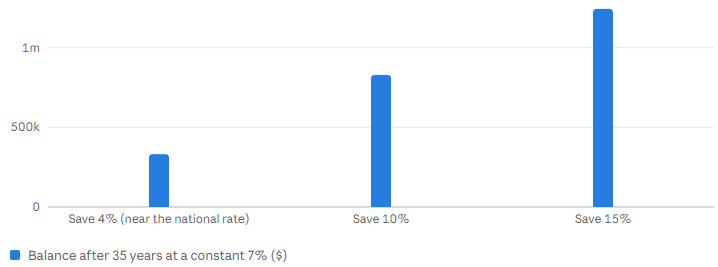
But who saves matters. EBRI data show workers earning over $150,000 saved an average of 12.3% and 94.5% participated in a retirement plan, while those earning under $50,000 saved 4.6% and only 52.9% participated. The cost is huge. In my own illustration, a $60,000 earner saving 4% for 35 years at a constant 7% builds about $332,000. At 10% it builds about $829,000, and at 15% about $1.24 million. The savings rate is the biggest lever.

The fix: Raise your savings rate by one percentage point every few months until you reach 12% to 15% including any employer match. Automate it, so it happens before you can spend it.
That does not mean ownership is out of reach. A broad index fund gives you a slice of hundreds of companies, fractional shares start from $1 at several brokers and workplace plans can automate it. The barrier is often not money but hesitation, and the gap widens every year assets rise and you are not holding them. Federal Reserve DFA, Q1 2026: top 10% hold 87.4% of corporate equities and mutual fund shares; the bottom 50% about 1.1%. US saving rate: 4.6% in 2025; about 4.1% in August 2026.
The trap is that minimum payments feel affordable while interest quietly consumes the rest. Paying off a 21% card is a guaranteed 21% return, far above what savings or most investments can promise. Student loans add another weight: about 14.3 million federal borrowers are aged 25 to 34, with an average balance of more than half a year’s median salary, according to one summary of government data. List every debt by interest rate, pay the minimum on all, and send every extra dollar to the highest rate. Keep a $1,000 starter fund so a surprise does not go back on the card.
Every raid has a double cost: you lose the money and the decades of growth it would have earned. A $10,000 withdrawal at 40 is not $10,000 at 67. At a constant 7% it is about $62,000. An emergency fund is not a boring extra. It is what protects every other plan.
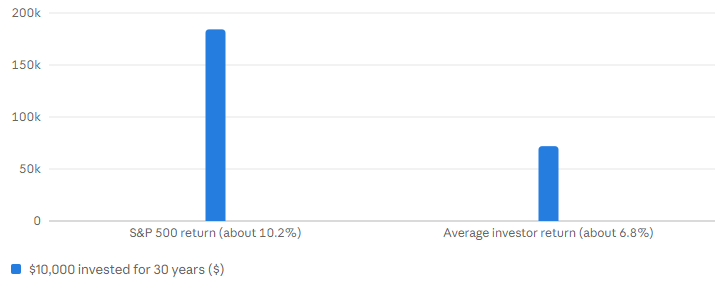
Chasing tips and high fees add to the damage. A Swiss Finance Institute study found that 56% of finfluencers had negative skill, and S&P Dow Jones Indices found that 79% of active large-cap funds trailed the S&P 500 in 2025. The unglamorous alternative, a low-cost diversified fund held for decades, is what behavior research favors. The enemy of wealth is often the urge to do something. Over 30 years, average investor about 6.8% a year vs 10.2% for the S&P 500 (DALBAR). $10,000: about $184,000 at 10.2% vs about $72,000 at 6.8%. Illustrative constant-return arithmetic.
There is also lifestyle inflation, the habit of raising spending every time income rises. A raise that is entirely spent changes nothing about your wealth. The people who build wealth tend to save a fixed share of every raise before it becomes part of their lifestyle. You do not have to live like a monk. You have to decide the share, and automate it first.
The fix is not guilt. It is to start now at any size, increase it steadily and avoid interrupting it. Even small automatic contributions create a habit and an account, and the habit is what scales when income rises.
So the honest message is two-sided. Structure matters, and it is fair to want better policies and prices. But within your own circumstances, the parts you control, savings rate, debt, investing and behavior, still decide a great deal. You can only play the hand you have, and the evidence says that small improvements to it compound.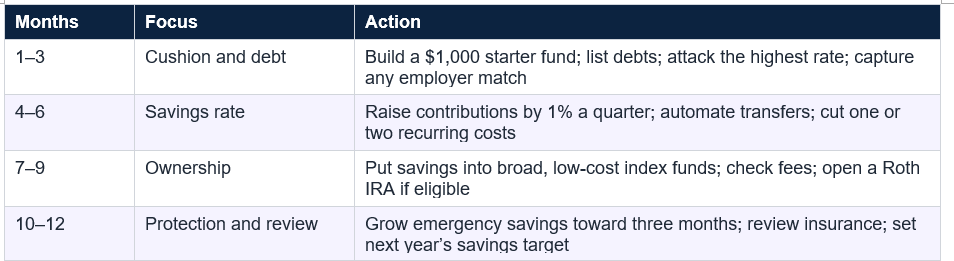
This plan will not make you rich in a year. It sets the habits that make wealth possible, and it keeps you out of the most common traps. Repeat the cycle, raise the targets and let time do the rest.
But the same numbers show the way out. A higher savings rate, broad ownership, debt payoff, a cushion and patience change the outcome dramatically, as the 401(k) millionaires show. Start where you are, automate the next step and keep going. This is general education, not personalized advice, and a qualified adviser can help you apply it.
Usually a combination of low saving, little ownership of appreciating assets, expensive debt, no emergency cushion, costly behavior mistakes and starting late, all made harder by rising costs. The national personal saving rate was 4.6% in 2025 and about 4% in 2026, and the bottom half of households hold roughly 1.1% of corporate equities and mutual fund shares.
What counts as wealthy?
There is no official line. A common reference is a net worth of $1 million or more. Fidelity counted a record 654,000 401(k) accounts above $1 million in the second quarter of 2026. For many people the more useful goal is financial security: no high-interest debt, a solid emergency fund and enough invested to retire when you want.
Is it all about personal choices?
No. Housing costs, inflation, student debt, stagnant real wages for some workers and unequal access to employer plans are real headwinds. But choices still matter: savings rate, debt, investing and behavior are the parts you control, and the gains from controlling them compound over decades.
How much should I save to build wealth?
Vanguard recommends 12% to 15% of income, including employer contributions. Fidelity found the average total savings rate in the second quarter of 2026 was 14.4%, while 401(k) millionaires saved 17.3% of pay, or 25.8% with their employer’s share. Start with what you can and raise it with every pay rise.
Can I still become wealthy if I start late?
You can improve your position at any age, but time is a powerful ally. In my illustration, a $60,000 earner saving 15% for 35 years at a constant 7% reaches about $1.24 million, versus about $332,000 at 4%. If you start late, save more, work a little longer and keep costs low.
Table of Contents
- An Uncomfortable Question
- The Short Answer
- Reason 1: They Save Too Little
- Reason 2: They Do Not Own Assets
- Reason 3: Expensive Debt Eats the Future
- Reason 4: No Cushion, So Savings Get Raided
- Reason 5: Behavior Costs Real Money
- Reason 6: Lifestyle and Housing Costs Rise Faster
- Reason 7: They Start Late or Stop Early
- The Headwinds Are Real
- What the Exceptions Do Differently
- A 12-Month Plan
- Conclusion
- Frequently Asked Questions
Reason 1: the savings rate is the biggest lever ($60,000 salary, 35 years, 7%)
Balance ($) by Author's illustration: constant salary and return; BEA national saving rate was 4.6% in 2025
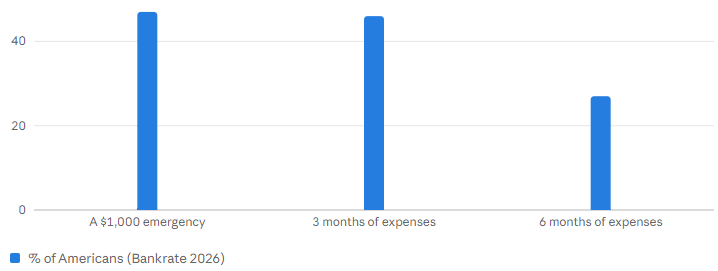
No cushion. How many Americans could cover an emergency (%)
% of Americans by Source: Bankrate 2026 Annual Emergency Savings Report
The behavior gap. $10,000 for 30 years at 10.2% vs. 6.8% ($)
Value after 30 years ($) by DALBAR returns as cited by MyETFJourney; author's constant-return arithmetic
An Uncomfortable Question
Most people work hard for decades and still never feel wealthy. That is not a character flaw. It is a pattern, and patterns have causes. If you are going to beat the odds, it helps to understand exactly what the odds are made of.This post lists seven reasons most people never build real wealth, each backed by 2026 data, with a practical fix for each. I will also be honest about what is outside your control, because blaming individuals for everything is both unfair and unhelpful. The goal is not shame. It is a map.
The Short Answer
Most people never become wealthy because they save little, own few appreciating assets, carry expensive debt, lack a cushion that keeps them from raiding their savings, make costly behavior mistakes, watch living costs outrun their income and start late or stop early. None of these is mysterious. Together they explain why the gap between a person who builds wealth and one who does not is usually decades of small, repeated decisions rather than one big break.Reason 1: They Save Too Little
Start with the simplest number. The US personal saving rate, income left after taxes and spending, was 4.6% in 2025 and fell to about 4.1% in August 2026, according to the Bureau of Economic Analysis, well below its long-run average of around 8.4%. Individual savers do better when they join a plan: Fidelity found the average total savings rate in the second quarter of 2026 was 14.4%, employee plus employer.But who saves matters. EBRI data show workers earning over $150,000 saved an average of 12.3% and 94.5% participated in a retirement plan, while those earning under $50,000 saved 4.6% and only 52.9% participated. The cost is huge. In my own illustration, a $60,000 earner saving 4% for 35 years at a constant 7% builds about $332,000. At 10% it builds about $829,000, and at 15% about $1.24 million. The savings rate is the biggest lever.
The fix: Raise your savings rate by one percentage point every few months until you reach 12% to 15% including any employer match. Automate it, so it happens before you can spend it.
Reason 2: They Do Not Own Assets
Savings sitting in a checking account do not build wealth, because inflation, at 3.7% in September, erodes them. Wealth is built by owning things that grow: shares in businesses, property and your own company. The Federal Reserve’s data show how unevenly that ownership is spread. In the first quarter of 2026, the top 10% of households held 87.4% of corporate equities and mutual fund shares, while the bottom half held about 1.1%.That does not mean ownership is out of reach. A broad index fund gives you a slice of hundreds of companies, fractional shares start from $1 at several brokers and workplace plans can automate it. The barrier is often not money but hesitation, and the gap widens every year assets rise and you are not holding them. Federal Reserve DFA, Q1 2026: top 10% hold 87.4% of corporate equities and mutual fund shares; the bottom 50% about 1.1%. US saving rate: 4.6% in 2025; about 4.1% in August 2026.
Reason 3: Expensive Debt Eats the Future
Debt is the opposite of an asset: it takes your future income. Americans owed $1.263 trillion on credit cards in the second quarter, and the average card rate was about 21%, according to Federal Reserve data cited by a secondary source. Experian’s 2025 data put the average millennial balance at $6,961, which at 20.9% costs roughly $1,455 a year in interest, money that could otherwise compound. Bankrate found that 35% of millennials have more credit card debt than emergency savings.The trap is that minimum payments feel affordable while interest quietly consumes the rest. Paying off a 21% card is a guaranteed 21% return, far above what savings or most investments can promise. Student loans add another weight: about 14.3 million federal borrowers are aged 25 to 34, with an average balance of more than half a year’s median salary, according to one summary of government data. List every debt by interest rate, pay the minimum on all, and send every extra dollar to the highest rate. Keep a $1,000 starter fund so a surprise does not go back on the card.
Reason 4: No Cushion, So Savings Get Raided
Even people who save often cannot keep it, because life interrupts. Bankrate’s 2026 survey found that only 47% of Americans could cover a $1,000 emergency, 46% three months of expenses and 27% six months. Without a cushion, a car repair or job loss becomes a reason to tap retirement accounts. Fidelity reported that 19.5% of retirement savers had an outstanding 401(k) loan in the second quarter and 3% took a hardship withdrawal, up from 2.6% a year earlier.Every raid has a double cost: you lose the money and the decades of growth it would have earned. A $10,000 withdrawal at 40 is not $10,000 at 67. At a constant 7% it is about $62,000. An emergency fund is not a boring extra. It is what protects every other plan.
Reason 5: Behavior Costs Real Money
Investing mistakes are mostly behavioral. DALBAR research, cited by MyETFJourney, found that over 30 years the average equity investor earned about 6.8% a year while the S&P 500 returned about 10.2%, because people bought after rallies and sold after falls. In my illustration, $10,000 at 10.2% for 30 years becomes about $184,000, while at 6.8% it becomes about $72,000. On $500 a month, the gap is about $1.18 million versus $586,000.Chasing tips and high fees add to the damage. A Swiss Finance Institute study found that 56% of finfluencers had negative skill, and S&P Dow Jones Indices found that 79% of active large-cap funds trailed the S&P 500 in 2025. The unglamorous alternative, a low-cost diversified fund held for decades, is what behavior research favors. The enemy of wealth is often the urge to do something. Over 30 years, average investor about 6.8% a year vs 10.2% for the S&P 500 (DALBAR). $10,000: about $184,000 at 10.2% vs about $72,000 at 6.8%. Illustrative constant-return arithmetic.
Reason 6: Lifestyle and Housing Costs Rise Faster
Costs are rising. Inflation was 3.7% in September and real hourly earnings fell 0.7%, so many paychecks buy less. Housing is the biggest squeeze: with the median existing home at $417,500 and the 30-year mortgage at 7.40%, principal and interest on 20% down is about $2,313 a month. That is about 31.7% of the $87,460 median household income, before taxes, insurance and repairs. The median first-time buyer is now 40, according to one summary.There is also lifestyle inflation, the habit of raising spending every time income rises. A raise that is entirely spent changes nothing about your wealth. The people who build wealth tend to save a fixed share of every raise before it becomes part of their lifestyle. You do not have to live like a monk. You have to decide the share, and automate it first.
Reason 7: They Start Late or Stop Early
Compounding rewards the early and punishes the late. A single $100,000 invested at a constant 7% grows to about $197,000 in ten years, $387,000 in twenty and $761,000 in thirty. Waiting five extra years to start saving can cost hundreds of thousands of dollars by retirement. And stopping early, by cashing out an old 401(k) or pausing contributions for years, interrupts the process at the worst moment.The fix is not guilt. It is to start now at any size, increase it steadily and avoid interrupting it. Even small automatic contributions create a habit and an account, and the habit is what scales when income rises.
The Headwinds Are Real
It would be wrong to suggest that choices explain everything. A BEA-BLS distributional study, cited by Walnut Invest, found that the bottom 50% of the income distribution had negative net saving in 2022, meaning they spent more than they earned. When rent, food and fuel take most of a paycheck, saving is not a matter of willpower. Unequal access to employer plans, high housing costs, medical bills and student debt create real obstacles.So the honest message is two-sided. Structure matters, and it is fair to want better policies and prices. But within your own circumstances, the parts you control, savings rate, debt, investing and behavior, still decide a great deal. You can only play the hand you have, and the evidence says that small improvements to it compound.
What the Exceptions Do Differently
Fidelity’s data on 401(k) millionaires offer clues. The count reached a record 654,000 in the second quarter. They saved an average of 17.3% of pay, or 25.8% with their employer’s share, versus 14.4% for the average saver. Gen X made up 62% of them, which fits decades of consistent saving. They did not need a windfall. They needed a high rate, broad investments, time and the discipline to leave the money alone.A 12-Month Plan
This plan will not make you rich in a year. It sets the habits that make wealth possible, and it keeps you out of the most common traps. Repeat the cycle, raise the targets and let time do the rest.
Conclusion
Most people never become wealthy because of seven repeatable patterns: they save little, own few assets, carry expensive debt, lack a cushion, let behavior eat their returns, watch costs outrun income and start late or stop early. The numbers are stark: a saving rate near 4%, half of households holding about 1% of stocks and funds, only 46% able to cover three months of expenses and credit cards at about 21%.But the same numbers show the way out. A higher savings rate, broad ownership, debt payoff, a cushion and patience change the outcome dramatically, as the 401(k) millionaires show. Start where you are, automate the next step and keep going. This is general education, not personalized advice, and a qualified adviser can help you apply it.
Frequently Asked Questions
Why do most people never become wealthy?Usually a combination of low saving, little ownership of appreciating assets, expensive debt, no emergency cushion, costly behavior mistakes and starting late, all made harder by rising costs. The national personal saving rate was 4.6% in 2025 and about 4% in 2026, and the bottom half of households hold roughly 1.1% of corporate equities and mutual fund shares.
What counts as wealthy?
There is no official line. A common reference is a net worth of $1 million or more. Fidelity counted a record 654,000 401(k) accounts above $1 million in the second quarter of 2026. For many people the more useful goal is financial security: no high-interest debt, a solid emergency fund and enough invested to retire when you want.
Is it all about personal choices?
No. Housing costs, inflation, student debt, stagnant real wages for some workers and unequal access to employer plans are real headwinds. But choices still matter: savings rate, debt, investing and behavior are the parts you control, and the gains from controlling them compound over decades.
How much should I save to build wealth?
Vanguard recommends 12% to 15% of income, including employer contributions. Fidelity found the average total savings rate in the second quarter of 2026 was 14.4%, while 401(k) millionaires saved 17.3% of pay, or 25.8% with their employer’s share. Start with what you can and raise it with every pay rise.
Can I still become wealthy if I start late?
You can improve your position at any age, but time is a powerful ally. In my illustration, a $60,000 earner saving 15% for 35 years at a constant 7% reaches about $1.24 million, versus about $332,000 at 4%. If you start late, save more, work a little longer and keep costs low.
0 Comments
Be the first to share your thoughts on this article.