

Financial Literacy
21 Money Lessons I Wish I Knew Earlier
80% of Americans have financial regrets for 2025. The top UK regret is not saving more when younger. Ramit Sethi, after 20 years in personal finance, says the number one thing people wish they had done is invest sooner. These 21 lessons distil the most expensive, most universal, and most fixable financial mistakes into plain language — with the real numbers behind each one. Whether you are 22 or 52, at least half of these will still be actionable today. Not financial advice.
The research confirms this is almost universal. 80% of Americans have financial regrets for 2025, according to the Omni Calculator survey. Bankrate found that the top two US financial regrets are not saving for retirement early enough (22%) and taking on too much credit card debt (15%). In the UK, a survey of 4,000 adults found nearly half have financial regrets, with not saving more when younger topping the list; one in three wish they had started saving for retirement earlier, rising to more than half of over-55s (SWNS/Yorkshire Evening Post).
Ramit Sethi, after 20 years in personal finance with over a million YouTube subscribers, made a video in June 2026 titled ‘After 20 Years in Personal Finance, THIS Is What People Regret Most.’ His conclusion: the regrets are not primarily about the money lost. They are about the time and relationships affected by the decisions. The cost of a financial mistake at 25 is not just the pounds or dollars. It is the compounded future value of every year that money could have been growing.
These 21 lessons are the distilled version of what most people learn too late. Not all of them will be new to you. But the ones you already know are worth examining again — because knowing and doing are not the same thing. Not financial advice.
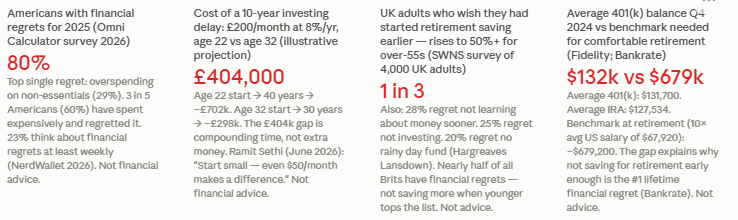
80% of Americans have financial regrets for 2025 (Omni Calculator 2026). Top regret: overspending on non-essentials (29%). Top two lifetime regrets: not saving for retirement early enough (22%) and too much credit card debt (15%) (Bankrate). 3 in 5 Americans have spent money expensively and regretted it; 23% think about financial regrets at least weekly (NerdWallet 2026). UK: nearly half of Brits have financial regrets; not saving more when younger tops the list; 1 in 3 wish they had started retirement saving earlier (SWNS; Hargreaves Lansdown). Average 401(k) balance Q4 2024: $131,700 vs benchmark of ~$679,200 needed for comfortable retirement (Fidelity; Bankrate). 19% of Americans have NO savings (GOBankingRates 2025). Not financial advice.
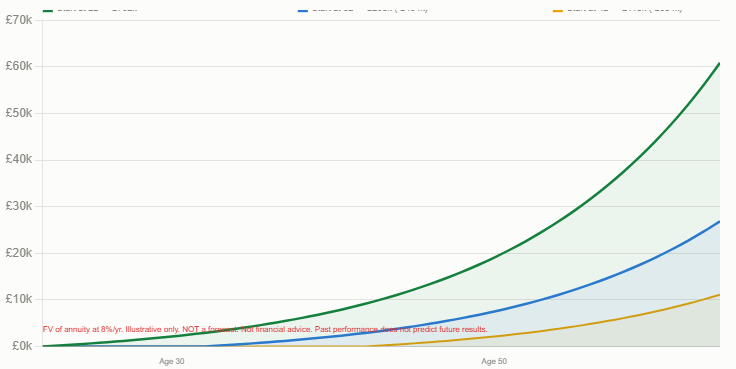
£200 per month invested from age 22 at 8% annual return produces approximately £702,000 by age 62. The same £200 per month starting at 32 produces approximately £298,000. A ten-year delay costs approximately £404,000 — despite only investing £24,000 less in total. The additional £404,000 is pure time: the compounding of 10 more years of growth on the early contributions. This is the lesson that most people learn too late to fully exploit.
The cost of delay at £200/month at 8%/yr: Age 22 start → 40 years → ~£702,000. Age 32 start → 30 years → ~£298,000. Age 42 start → 20 years → ~£118,000. Delay cost of starting at 32 vs 22: ~£404,000. Delay cost of starting at 42 vs 22: ~£584,000. Not a forecast. FV of annuity = PMT × ((1+r)^n - 1)/r. Not financial advice. Past performance does not predict future results.
Start investing now, regardless of amount. Ramit Sethi (June 2026): 'Start small -- even $50 a month will still make a difference. The sooner an investor starts, the sooner they can take advantage of compound growth, which is built on time in the market, not timing the market.' The only irreversible financial mistake is waiting. Not financial advice.
The automation is essential. A manual savings habit requires a decision every month; an automated transfer requires a decision once. Human willpower is not reliable over decades; automatic systems are. The person who sets up a standing order to move £300 to a savings account on the 1st of every month and builds their budget around what remains will consistently out-save the person who intends to save whatever is left at the end of the month. Not financial advice.
The standard recommendation of three to six months of core living expenses in an accessible, high-interest savings account is the minimum. People with variable income, dependants, or high-cost risks (homeowners, self-employed) should target six to twelve months. This is not money that will grow quickly; it is insurance against having to borrow at punishing rates during a difficult period. Not financial advice.
The cost of not having an emergency fund: a £3,000 emergency on a credit card at 22% APR with minimum payments is paid off in 25+ years with approximately £3,000-£4,500 in additional interest. The same £3,000 held in a savings account costs you approximately £135/year in foregone interest at 4.5% -- far less than the credit card cost. The emergency fund is not a cost; it is the cheapest insurance available. Not financial advice.
The behavioural trap: credit card minimum payments are specifically designed to maximise the lifetime interest paid. Making the minimum payment on a £3,000 balance at 22% APR keeps the debt alive for approximately 25–30 years and costs more in interest than the original balance. The correct response is to pay the maximum affordable amount every month and eliminate high-interest debt before directing money to investments. Not financial advice.
This lesson matters because social comparison almost always operates on visible income signals (the car, the house, the holidays) rather than the invisible net worth underneath. As discussed in the previous chapter on money dysmorphia, the people whose lifestyles appear most financially impressive are not always the people with the strongest financial foundations. Track net worth quarterly. Income is the input; net worth is the score. Not financial advice.
Most people who track their spending for the first time are surprised by the results. The coffee, the subscriptions, the takeaways, the impulse purchases — the aggregated spending on non-essentials is almost always higher than the person estimated. The NerdWallet 2026 study found that 60% of Americans have spent money on something expensive they later regretted, with non-essentials leading. A budget is the early warning system that makes the regret preventable. Not financial advice.
The practical test for any debt decision: is the expected return on what the debt finances higher than the interest cost? A mortgage on a property in a growing market: typically yes. A car on PCP finance at 9% APR that depreciates 15% in year one: typically no. Credit card debt for a holiday: definitively no. Not financial advice.
The stock market’s long-run average return of approximately 8–10% per year since 1926 has been achieved across every period of fear, uncertainty, and apparent catastrophe in that time: the Great Depression, World War II, the 1987 crash, the dot-com bust, the 2008 financial crisis, COVID, and everything in between. Waiting for certainty means waiting forever. A low-cost index fund, invested in consistently over decades, with dividends reinvested, captures this return with minimal effort and minimal expertise required. Not financial advice.
The practical implication: every percentage point of annual fee matters enormously over a long investment horizon. A SIPP or ISA holding a Vanguard Lifestrategy fund at 0.22% expense ratio is categorically different in 30-year outcome from an investment bond or managed fund at 1.5–2.0%. The difference between these two, on a £500 per month contribution over 30 years at 8% base return, is hundreds of thousands of pounds. Not financial advice.
The employer match on a workplace pension or 401(k) is the closest thing to free money in personal finance. An employer who matches 5% of salary is offering a 100% immediate return on that 5% contribution — a guaranteed return unavailable anywhere else in financial markets. Not contributing at least enough to capture the full employer match is leaving a pay rise on the table. Not financial advice.
The comparison: £500 per month overpaying a mortgage at 4% interest versus £500 per month invested in a pension (with basic-rate tax relief at 20%, effectively becoming £625). At 8% investment return over 20 years, the pension route produces significantly more accessible wealth, with tax advantages that the property route does not offer. Both have value; the pension is typically more financially productive, especially for younger workers. Not financial advice.
£2,000 per year additional salary, invested at 7% for 40 years (the career-long impact), produces approximately £424,000 in additional wealth. The conversation that achieves it takes perhaps ten minutes and requires only a reasonable case and the willingness to have it. Research the market rate for your role, quantify your contribution, and ask. The worst outcome is the salary you have now. Not financial advice.
The principle: if you cannot explain what you are buying in two sentences, you should not buy it yet. If the person selling it cannot explain the fees, the exit costs, and the downside scenario in plain language, that is a signal to slow down. Financial product complexity is not a sign of sophistication; it is usually a sign of cost that is difficult to see. Not financial advice.
Income protection insurance — which pays a percentage of salary if you are unable to work due to illness or injury — is one of the most underused and most valuable financial products for working-age adults. The average UK worker is statistically more likely to suffer a serious illness or injury during their career than to die before retirement, yet life insurance uptake massively exceeds income protection uptake. Not financial advice.
The counter-move is deliberate lifestyle lag: when income rises, commit the majority of the increase to savings or investment and allow lifestyle to rise only modestly. A household that commits 70% of every income increase to savings and 30% to lifestyle improvement will accumulate dramatically more wealth over a career than one that consumes every income gain immediately. The lifestyle is still improving; it is just improving more slowly than the wealth position. Not financial advice.
£200/month redirected from this category into an investment account at 8% for 30 years produces approximately £298,000. The daily coffee and the streaming subscriptions are not trivial: they represent a specific financial choice to consume rather than compound. The lesson is not asceticism; it is visibility. Most people significantly underestimate their discretionary spending until they track it. Not financial advice.
The reframe: financial decisions are conversations between your present self and your future self. Every pound invested today is a gift to the person you will be in 20 or 30 years. Every pound spent on something trivial today is a withdrawal from that future person’s security. This is not an argument for joyless austerity; it is an argument for intentional spending that allocates generously to both present enjoyment and future security. Not financial advice.
The list of topics that produce the highest return on the time invested: compound interest and the time value of money; pension mechanics (tax relief, employer matching, lifetime allowance); the difference between savings, investing, and speculating; how credit scores work and how to improve them; tax-efficient wrappers (ISAs, SIPPs, 401(k)s, Roth IRAs); and the basics of insurance and protection. None of these requires professional expertise to understand at a level sufficient to make better decisions. All of them can be learned from credible free sources in a few hours. Not financial advice.
As detailed in the chapter on money dysmorphia and wealth comparison, the peer group visible on social media is not representative of typical financial reality — it skews toward the upper tail of consumption display. Spending to match this distorted peer group produces real financial costs in pursuit of approval from a fictional average. The most financially successful people are typically those who have explicitly decided to measure themselves against their own financial goals rather than against their social environment. Not financial advice.
Every financial problem that is addressable becomes more expensive with each passing year. The credit card balance at 22% APR costs £880 in interest annually while it remains at £4,000. The pension contribution not made at 40 is never recovered by a later contribution at 60, because the 20 years of compound growth on that money cannot be rebuilt. The answer to the question ‘when should I start?’ is always the same: now. Not financial advice.
Ramit Sethi (June 24, 2026, MoneyLion): 'Money regrets are hard not because of the potential money lost but because of the time and relationships affected by the decisions.' And: 'There is never a perfect time to invest and not investing is usually driven by fear. Start now. Start small -- even $50 a month will still make a difference.' Source: MoneyLion.com, June 24, 2026.
This is not a counsel of cynicism; most financial professionals operate with genuine integrity. It is a counsel of engagement. Your pension, your investments, your insurance, your mortgage, your savings rate — these need active oversight from you, because no one else will optimise them for your specific situation, your specific goals, and your specific timeline. The 23% of Americans who think about their financial regrets weekly (NerdWallet 2026) are not regretting the advice they got; they are regretting the decisions they made or did not make. That is where the power always was. Not financial advice.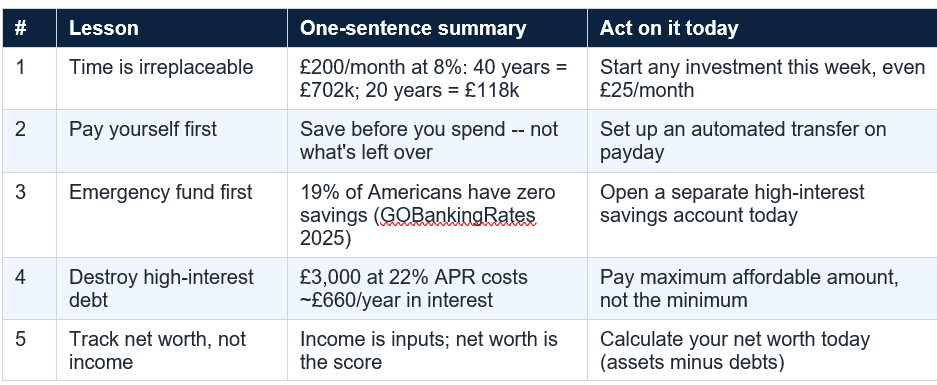
All projections are illustrative mathematical examples only. Not forecasts or guarantees. Not financial advice. Individual circumstances vary. Sources cited throughout this article. Consult a qualified independent financial adviser.
These 21 lessons are not all equally urgent for every reader. Lesson 3 (emergency fund) is more urgent than Lesson 12 (salary negotiation) for someone with credit card debt and no savings buffer. Lesson 4 (destroy high-interest debt) is more urgent than Lesson 11 (pension strategy) for someone paying 22% APR on a credit card balance. The sequencing matters: fix the highest-cost problem first, then work forward.
But every lesson in this list is actionable today at some level. You do not need to solve your entire financial life this week; you need to make one decision that moves in the right direction. Compound growth works on habits as well as money: one decision made today produces a slightly better position tomorrow, which makes the next decision slightly easier, which produces a slightly better outcome, which accumulates over years into the financial life you intended to build. Start the lesson you have been avoiding. Not financial advice. Consult a qualified independent financial adviser.
The most common financial regrets in 2025-2026, across multiple major surveys: (1) Not saving enough money (38%, Intuit Credit Karma 2025). (2) Overspending on non-essentials (29%, Omni Calculator 2026). (3) Not saving for retirement early enough (22%, Bankrate). (4) Too much credit card debt (15%, Bankrate). In the UK specifically (SWNS/Yorkshire Evening Post survey of 4,000 adults): not saving more when younger tops the list; one in three wished they had started saving for retirement earlier; 28% regret not educating themselves more about money; one in four regret not investing. Ramit Sethi (June 2026, MoneyLion), after 20 years in personal finance, notes the biggest regret he hears is not investing soon enough. 3 in 5 Americans (60%) have spent money on something expensive they later regretted (NerdWallet 2026). Not financial advice.
What is the most important money lesson for someone in their 20s?
The compound interest lesson -- specifically, the cost of delay. £200 per month invested from age 22 at 8% annual return produces approximately £702,000 by age 62. The same amount starting at age 32 produces approximately £298,000. A ten-year delay costs approximately £404,000 despite only investing £24,000 less in total. This gap is entirely composed of compounding time that cannot be recovered. Ramit Sethi (June 2026): 'Start now. Start small -- even $50 a month will still make a difference. The sooner an investor starts, the sooner they can take advantage of compound growth, which is built on time in the market, not timing the market.' In the UK: capture the full employer pension match (a 100% instant return on that portion of salary), open a stocks and shares ISA with a low-cost index fund, and build an emergency fund of 3-6 months' expenses in a high-interest cash account. Not financial advice.
How do I stop spending money on things I regret?
The evidence-based approach to reducing regret-spending: (1) Track spending for one full month before making any changes. Most people significantly underestimate their discretionary spending. The NerdWallet 2026 study found 60% of Americans have expensive spending regrets, with non-essentials leading. (2) Implement a 24-48 hour waiting period for any non-essential purchase above a threshold (e.g. £50). Most impulse purchases lose appeal after a day. (3) Delete saved payment details from shopping sites that trigger impulse buying. Friction reduces spending. (4) Identify the comparison pressure driving the spending -- social media accounts, peer groups, environments -- and reduce exposure. 29% of Americans' biggest 2025 financial regret was overspending on non-essentials (Omni Calculator 2026), much of it comparison-driven. (5) Automate savings before the money is available to spend. If it never appears in your current account, it cannot be spent. Not financial advice.
Is it too late to start saving for retirement at 40?
No. Starting at 40 is not ideal but it is vastly better than not starting. A 40-year-old investing £500/month at 8% annual return until age 65 (25 years) accumulates approximately £473,000. With tax relief on pension contributions (basic rate: 20%), an effective contribution of £625 per month produces approximately £591,000. In the UK, the state pension (£12,548/year in 2026) provides an additional foundation. In the US, Social Security supplements pension savings. One in three UK adults wish they had started retirement saving earlier, with this rising to more than half of over-55s (SWNS study) -- the regret grows with age precisely because the compound growth window is visible closing. Starting at 40 captures 25 years of compound growth. Not starting at 40 captures zero. Not financial advice. Consult a qualified financial adviser for a personalised retirement plan.
What is the single most impactful financial habit?
Automating savings before spending -- 'pay yourself first.' This single habit, applied consistently, addresses more of the 21 lessons in this article simultaneously than any other action. It implements Lesson 2 (pay yourself first), reduces Lesson 15 (lifestyle inflation) by removing money before lifestyle spending can claim it, builds Lesson 3 (emergency fund), contributes to Lesson 10 (pension), and combats Lesson 19 (comparison-driven spending) by reducing the money available for impulsive social-comparison purchases. The automation is what makes it powerful: a monthly standing order to a savings account on payday requires no willpower, no monthly decision, and no discipline -- it is structurally imposed. This is what separates financial systems that work from financial intentions that fail. Not financial advice.
Table of Contents
- Introduction: The Most Expensive Education
- Lessons 1–7: The Foundation (What Nobody Teaches You)
- Lessons 8–14: The Building Phase (What Costs You Most)
- Lessons 15–21: The Mindset (What Changes Everything)
- The 21 Lessons: A Quick-Reference Summary Table
- Conclusion: Start the Lesson You’ve Been Avoiding
- Frequently Asked Questions
The cost of delay — compound growth by starting age
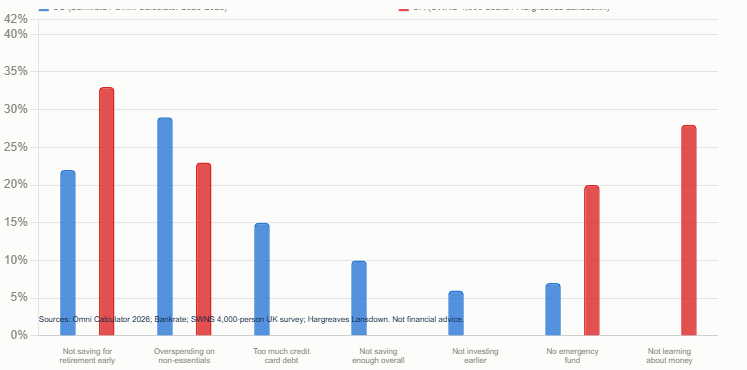
Top financial regrets — US & UK 2025-2026
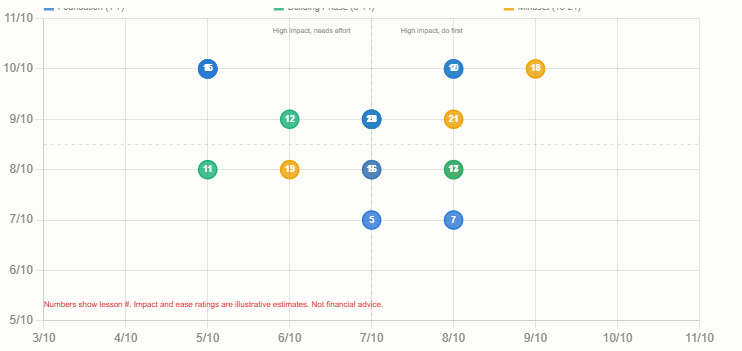
The 21 lessons — impact vs ease of action
The Most Expensive Education
Financial education does not come with a timetable. Nobody sits you down at 22 and explains compound interest, the true cost of credit card debt, the difference between income and wealth, or the reason that buying a car on finance every four years quietly destroys retirement prospects. Most people learn these things by doing them wrong first — and by the time the lesson lands, the opportunity cost is already paid.The research confirms this is almost universal. 80% of Americans have financial regrets for 2025, according to the Omni Calculator survey. Bankrate found that the top two US financial regrets are not saving for retirement early enough (22%) and taking on too much credit card debt (15%). In the UK, a survey of 4,000 adults found nearly half have financial regrets, with not saving more when younger topping the list; one in three wish they had started saving for retirement earlier, rising to more than half of over-55s (SWNS/Yorkshire Evening Post).
Ramit Sethi, after 20 years in personal finance with over a million YouTube subscribers, made a video in June 2026 titled ‘After 20 Years in Personal Finance, THIS Is What People Regret Most.’ His conclusion: the regrets are not primarily about the money lost. They are about the time and relationships affected by the decisions. The cost of a financial mistake at 25 is not just the pounds or dollars. It is the compounded future value of every year that money could have been growing.
These 21 lessons are the distilled version of what most people learn too late. Not all of them will be new to you. But the ones you already know are worth examining again — because knowing and doing are not the same thing. Not financial advice.
80% of Americans have financial regrets for 2025 (Omni Calculator 2026). Top regret: overspending on non-essentials (29%). Top two lifetime regrets: not saving for retirement early enough (22%) and too much credit card debt (15%) (Bankrate). 3 in 5 Americans have spent money expensively and regretted it; 23% think about financial regrets at least weekly (NerdWallet 2026). UK: nearly half of Brits have financial regrets; not saving more when younger tops the list; 1 in 3 wish they had started retirement saving earlier (SWNS; Hargreaves Lansdown). Average 401(k) balance Q4 2024: $131,700 vs benchmark of ~$679,200 needed for comfortable retirement (Fidelity; Bankrate). 19% of Americans have NO savings (GOBankingRates 2025). Not financial advice.
Lessons 1–7: The Foundation
These are the lessons that most people miss in their teens and twenties — not because they are complicated, but because nobody teaches them.Lesson 1 Time Is the Asset That Cannot Be Replaced
Compound interest is often called the eighth wonder of the world. The mechanism is simple: money invested earns a return, and then the return earns a return, and then that return earns a return. Over years and decades, this produces outcomes that feel mathematically impossible until you see the calculation.£200 per month invested from age 22 at 8% annual return produces approximately £702,000 by age 62. The same £200 per month starting at 32 produces approximately £298,000. A ten-year delay costs approximately £404,000 — despite only investing £24,000 less in total. The additional £404,000 is pure time: the compounding of 10 more years of growth on the early contributions. This is the lesson that most people learn too late to fully exploit.
The cost of delay at £200/month at 8%/yr: Age 22 start → 40 years → ~£702,000. Age 32 start → 30 years → ~£298,000. Age 42 start → 20 years → ~£118,000. Delay cost of starting at 32 vs 22: ~£404,000. Delay cost of starting at 42 vs 22: ~£584,000. Not a forecast. FV of annuity = PMT × ((1+r)^n - 1)/r. Not financial advice. Past performance does not predict future results.
Start investing now, regardless of amount. Ramit Sethi (June 2026): 'Start small -- even $50 a month will still make a difference. The sooner an investor starts, the sooner they can take advantage of compound growth, which is built on time in the market, not timing the market.' The only irreversible financial mistake is waiting. Not financial advice.
Lesson 2 Pay Yourself First — Before the Bills
Most people budget by paying all expenses first and saving whatever remains. The problem: whatever remains is typically zero. The effective savings system runs in reverse: set a savings allocation first (automatically transferred on payday), then live on what is left. This is the ‘pay yourself first’ principle, and it converts saving from an aspiration into a guaranteed event.The automation is essential. A manual savings habit requires a decision every month; an automated transfer requires a decision once. Human willpower is not reliable over decades; automatic systems are. The person who sets up a standing order to move £300 to a savings account on the 1st of every month and builds their budget around what remains will consistently out-save the person who intends to save whatever is left at the end of the month. Not financial advice.
Lesson 3 An Emergency Fund Is Not Optional
19% of Americans have no savings at all and the majority have less than $500 (GOBankingRates 2025). The consequence: any unexpected expense — a car repair, a boiler breakdown, a medical bill, a period of reduced income — goes directly onto a credit card at 22–24% APR. The emergency fund is what stands between a temporary setback and an expensive spiral.The standard recommendation of three to six months of core living expenses in an accessible, high-interest savings account is the minimum. People with variable income, dependants, or high-cost risks (homeowners, self-employed) should target six to twelve months. This is not money that will grow quickly; it is insurance against having to borrow at punishing rates during a difficult period. Not financial advice.
The cost of not having an emergency fund: a £3,000 emergency on a credit card at 22% APR with minimum payments is paid off in 25+ years with approximately £3,000-£4,500 in additional interest. The same £3,000 held in a savings account costs you approximately £135/year in foregone interest at 4.5% -- far less than the credit card cost. The emergency fund is not a cost; it is the cheapest insurance available. Not financial advice.
Lesson 4 High-Interest Debt Is the Fastest Way to Destroy Wealth
Credit card debt at 22–24% APR is the inverse of compound growth: it compounds against you. £3,000 in credit card debt costs approximately £660–£720 per year in interest alone. That same £3,000 invested at 8% per year earns approximately £240. The net swing between having credit card debt and having the equivalent invested is approximately £900–£960 per year on just £3,000 — a difference that compounds with the debt balance.The behavioural trap: credit card minimum payments are specifically designed to maximise the lifetime interest paid. Making the minimum payment on a £3,000 balance at 22% APR keeps the debt alive for approximately 25–30 years and costs more in interest than the original balance. The correct response is to pay the maximum affordable amount every month and eliminate high-interest debt before directing money to investments. Not financial advice.
Lesson 5 Net Worth, Not Income, Is the Real Measure of Financial Progress
Income is what flows in each month. Net worth is what accumulates. A person earning £80,000 per year and spending £82,000 has a declining net worth. A person earning £35,000 per year and spending £28,000 has a growing net worth. The second person is building genuine financial security; the first is not, despite the higher income.This lesson matters because social comparison almost always operates on visible income signals (the car, the house, the holidays) rather than the invisible net worth underneath. As discussed in the previous chapter on money dysmorphia, the people whose lifestyles appear most financially impressive are not always the people with the strongest financial foundations. Track net worth quarterly. Income is the input; net worth is the score. Not financial advice.
Lesson 6 The Budget Is a Plan, Not a Punishment
One in five UK adults wishes they had made and stuck to a budget (SWNS study). In the US, not making a budget is among the top financial regrets. The resistance to budgeting is almost entirely psychological: it feels like constraint, deprivation, or an admission of financial inadequacy. In practice, a budget is the opposite. It is the tool that converts a vague aspiration to ‘save more’ into a specific, enforced allocation — and the tool that identifies where money is actually going rather than where you imagine it is going.Most people who track their spending for the first time are surprised by the results. The coffee, the subscriptions, the takeaways, the impulse purchases — the aggregated spending on non-essentials is almost always higher than the person estimated. The NerdWallet 2026 study found that 60% of Americans have spent money on something expensive they later regretted, with non-essentials leading. A budget is the early warning system that makes the regret preventable. Not financial advice.
Lesson 7 Learn the Difference Between Good Debt and Bad Debt
Not all debt is equal. A mortgage at 4% APR on a property that appreciates and generates implicit rental savings is categorically different from a personal loan at 22% APR for a holiday. The first is leverage on an appreciating, income-producing asset; the second is paying a premium to consume something that leaves no lasting value. Good debt typically has a low interest rate, finances an asset that maintains or grows in value, and has a clear repayment structure. Bad debt has high interest rates, finances consumption, and grows through minimum payments.The practical test for any debt decision: is the expected return on what the debt finances higher than the interest cost? A mortgage on a property in a growing market: typically yes. A car on PCP finance at 9% APR that depreciates 15% in year one: typically no. Credit card debt for a holiday: definitively no. Not financial advice.
Lessons 8–14: The Building Phase
These lessons cover the financial decisions that have the greatest impact during the primary wealth-building years — roughly the 30s and 40s.Lesson 8 Invest Before You Feel Ready
The most common reason people give for not investing is that they are waiting until they know more, have more money, or find the right moment. All three reasons are expressions of the same underlying pattern: fear rationalised as prudence. Ramit Sethi (June 2026): ‘There is never a perfect time to invest and not investing is usually driven by fear.’The stock market’s long-run average return of approximately 8–10% per year since 1926 has been achieved across every period of fear, uncertainty, and apparent catastrophe in that time: the Great Depression, World War II, the 1987 crash, the dot-com bust, the 2008 financial crisis, COVID, and everything in between. Waiting for certainty means waiting forever. A low-cost index fund, invested in consistently over decades, with dividends reinvested, captures this return with minimal effort and minimal expertise required. Not financial advice.
Lesson 9 Fees Compound Against You Just as Returns Compound For You
A 1% annual management fee on a £100,000 investment portfolio reduces the terminal value at 8% over 30 years from approximately £1,006,000 to approximately £761,000 — a difference of £245,000, paid not in cash you hand over but in compound growth you never receive. Fees do not feel expensive because they are expressed as small percentages. But they compound in the wrong direction for exactly as long as your returns compound in the right direction.The practical implication: every percentage point of annual fee matters enormously over a long investment horizon. A SIPP or ISA holding a Vanguard Lifestrategy fund at 0.22% expense ratio is categorically different in 30-year outcome from an investment bond or managed fund at 1.5–2.0%. The difference between these two, on a £500 per month contribution over 30 years at 8% base return, is hundreds of thousands of pounds. Not financial advice.
Lesson 10 Your Pension Is Your Biggest Financial Asset. Treat It Like One.
In the UK, auto-enrolment has made pension contribution the financial floor rather than the ceiling for most employed workers. But the minimum contribution — 8% combined employer and employee — is widely insufficient for comfortable retirement at current salary levels. The average 401(k) balance in the US as of Q4 2024 was $131,700 (Fidelity), against a benchmark of approximately $679,200 needed for comfortable retirement at the average US salary of $67,920.The employer match on a workplace pension or 401(k) is the closest thing to free money in personal finance. An employer who matches 5% of salary is offering a 100% immediate return on that 5% contribution — a guaranteed return unavailable anywhere else in financial markets. Not contributing at least enough to capture the full employer match is leaving a pay rise on the table. Not financial advice.
Lesson 11 Your House Is Not an Investment. Your Pension Is.
The UK specifically has a cultural tendency to treat residential property as the primary vehicle for wealth building. This is understandable given the property price appreciation of the past three decades. But a primary residence is not a productive investment in the standard sense: it does not generate income, it consumes money through maintenance and insurance, and its value cannot be realised without selling and living somewhere. Equity in your home is not accessible wealth; it is illiquid capital.The comparison: £500 per month overpaying a mortgage at 4% interest versus £500 per month invested in a pension (with basic-rate tax relief at 20%, effectively becoming £625). At 8% investment return over 20 years, the pension route produces significantly more accessible wealth, with tax advantages that the property route does not offer. Both have value; the pension is typically more financially productive, especially for younger workers. Not financial advice.
Lesson 12 Negotiate. Always Negotiate.
3% of Americans say their biggest 2025 financial regret was not negotiating a higher salary (Omni Calculator 2026). The real cost of not negotiating is not the headline amount of the raise you did not get; it is the compound career effect. A salary of £32,000 instead of £30,000 at age 25 — a £2,000 difference achieved in a single conversation — compounds through every future pay review based on that baseline, every pension contribution calculated as a percentage of salary, and every mortgage affordability assessment.£2,000 per year additional salary, invested at 7% for 40 years (the career-long impact), produces approximately £424,000 in additional wealth. The conversation that achieves it takes perhaps ten minutes and requires only a reasonable case and the willingness to have it. Research the market rate for your role, quantify your contribution, and ask. The worst outcome is the salary you have now. Not financial advice.
Lesson 13 Understand What You Are Buying Before You Buy It
28% of UK adults regret not educating themselves more about money (SWNS study). Financial products are often complex, and complexity almost always benefits the seller rather than the buyer. Endowment mortgages, payment protection insurance, interest-only mortgages without a clear repayment vehicle, investment bonds with high charges, structured products with embedded fees — all of these products have cost consumers hundreds of billions of pounds over the past three decades, primarily because buyers did not understand what they were purchasing.The principle: if you cannot explain what you are buying in two sentences, you should not buy it yet. If the person selling it cannot explain the fees, the exit costs, and the downside scenario in plain language, that is a signal to slow down. Financial product complexity is not a sign of sophistication; it is usually a sign of cost that is difficult to see. Not financial advice.
Lesson 14 Insurance Is for Risks You Cannot Afford to Bear
Insurance is the mechanism for converting uncertain large losses into certain small costs. The financial logic: insure the risks whose materialisation would be catastrophic (your income, your life if you have dependants, your home, your health in systems without universal coverage) and self-insure the small risks you can afford to cover from savings (extended warranties, phone insurance, most travel insurance on cards you do not need). The error in both directions is expensive: being underinsured against catastrophic risk is financially devastating; being over-insured against trivial risks wastes money that could compound.Income protection insurance — which pays a percentage of salary if you are unable to work due to illness or injury — is one of the most underused and most valuable financial products for working-age adults. The average UK worker is statistically more likely to suffer a serious illness or injury during their career than to die before retirement, yet life insurance uptake massively exceeds income protection uptake. Not financial advice.
Lessons 15–21: The Mindset
These final seven lessons are not primarily about financial products or calculations. They are about the mental models and habits that make the difference between knowing what to do and actually doing it.Lesson 15 Lifestyle Inflation Is the Retirement Killer
The most common pattern in personal finance is that income grows steadily over a career while lifestyle grows at the same rate or faster — leaving the savings rate permanently low regardless of the income level. This is lifestyle inflation: the ratcheting up of spending as income rises, such that the gap between income and expenditure never widens enough to produce real wealth accumulation.The counter-move is deliberate lifestyle lag: when income rises, commit the majority of the increase to savings or investment and allow lifestyle to rise only modestly. A household that commits 70% of every income increase to savings and 30% to lifestyle improvement will accumulate dramatically more wealth over a career than one that consumes every income gain immediately. The lifestyle is still improving; it is just improving more slowly than the wealth position. Not financial advice.
Lesson 16 The Spending That Looks Small Is Often Largest in Total
Small, recurring spending is the hardest to track and the most significant in aggregate. A daily £5 coffee (£150/month, £1,825/year), a streaming subscription collection (£40/month), a gym membership rarely used (£35/month), a takeaway delivery habit (£120/month through apps at inflated prices) — these individually feel trivial. Collectively they represent £345/month or £4,140/year in discretionary spending, much of it invisible.£200/month redirected from this category into an investment account at 8% for 30 years produces approximately £298,000. The daily coffee and the streaming subscriptions are not trivial: they represent a specific financial choice to consume rather than compound. The lesson is not asceticism; it is visibility. Most people significantly underestimate their discretionary spending until they track it. Not financial advice.
Lesson 17 Your Future Self Is a Real Person. Treat Them Well.
One of the most powerful insights from behavioural economics is that most people treat their future self as a stranger — someone whose interests are real but abstract, easier to discount than the needs of the present self who wants the coffee, the holiday, and the new car now. Pension underfunding is partly a manifestation of this: the 65-year-old you would be will desperately want the pension contributions the 32-year-old you is declining to make.The reframe: financial decisions are conversations between your present self and your future self. Every pound invested today is a gift to the person you will be in 20 or 30 years. Every pound spent on something trivial today is a withdrawal from that future person’s security. This is not an argument for joyless austerity; it is an argument for intentional spending that allocates generously to both present enjoyment and future security. Not financial advice.
Lesson 18 Financial Education Pays the Best Interest
One in ten UK adults wishes they had learned about money earlier (Hargreaves Lansdown). 28% of UK adults regret not educating themselves more on financial matters (SWNS study). The return on financial education is asymmetric: one piece of knowledge — about compound interest, about pension tax relief, about the power of the employer match, about the difference between index funds and actively managed funds — applied for a lifetime can be worth hundreds of thousands of pounds.The list of topics that produce the highest return on the time invested: compound interest and the time value of money; pension mechanics (tax relief, employer matching, lifetime allowance); the difference between savings, investing, and speculating; how credit scores work and how to improve them; tax-efficient wrappers (ISAs, SIPPs, 401(k)s, Roth IRAs); and the basics of insurance and protection. None of these requires professional expertise to understand at a level sufficient to make better decisions. All of them can be learned from credible free sources in a few hours. Not financial advice.
Lesson 19 Comparison to Others Is the Engine of Financial Mistakes
The NerdWallet 2026 financial regrets study found that 60% of Americans have spent money on something expensive and later regretted it — and the Omni Calculator survey found that overspending on non-essentials was the single most common financial regret for 2025 (29%). Much of this overspending is driven by social comparison: spending to signal status to a peer group, to match the visible lifestyle of colleagues and friends, or to demonstrate financial success through consumption.As detailed in the chapter on money dysmorphia and wealth comparison, the peer group visible on social media is not representative of typical financial reality — it skews toward the upper tail of consumption display. Spending to match this distorted peer group produces real financial costs in pursuit of approval from a fictional average. The most financially successful people are typically those who have explicitly decided to measure themselves against their own financial goals rather than against their social environment. Not financial advice.
Lesson 20 The Best Time to Fix a Money Problem Is Now
44% of adults with financial regrets have made no progress addressing them in the past 12 months (Bankrate, 2026). The most common reason for inaction on financial problems is that the problem has been present so long that it has become normalised. The credit card debt that has been at £4,000 for three years feels permanent. The pension that has never been started feels impossible to begin at 40. The budget that has never been followed feels beyond reach.Every financial problem that is addressable becomes more expensive with each passing year. The credit card balance at 22% APR costs £880 in interest annually while it remains at £4,000. The pension contribution not made at 40 is never recovered by a later contribution at 60, because the 20 years of compound growth on that money cannot be rebuilt. The answer to the question ‘when should I start?’ is always the same: now. Not financial advice.
Ramit Sethi (June 24, 2026, MoneyLion): 'Money regrets are hard not because of the potential money lost but because of the time and relationships affected by the decisions.' And: 'There is never a perfect time to invest and not investing is usually driven by fear. Start now. Start small -- even $50 a month will still make a difference.' Source: MoneyLion.com, June 24, 2026.
Lesson 21 Nobody Cares About Your Money as Much as You Do
The final and most liberating lesson: no financial adviser, no employer, no bank, no government, and no financial institution has your financial interests as their primary concern. Advisers have their own incentives. Employers design pension contributions and salary structures around their own costs. Banks design products around profitability. The person who makes the biggest difference to your financial outcome is you.This is not a counsel of cynicism; most financial professionals operate with genuine integrity. It is a counsel of engagement. Your pension, your investments, your insurance, your mortgage, your savings rate — these need active oversight from you, because no one else will optimise them for your specific situation, your specific goals, and your specific timeline. The 23% of Americans who think about their financial regrets weekly (NerdWallet 2026) are not regretting the advice they got; they are regretting the decisions they made or did not make. That is where the power always was. Not financial advice.
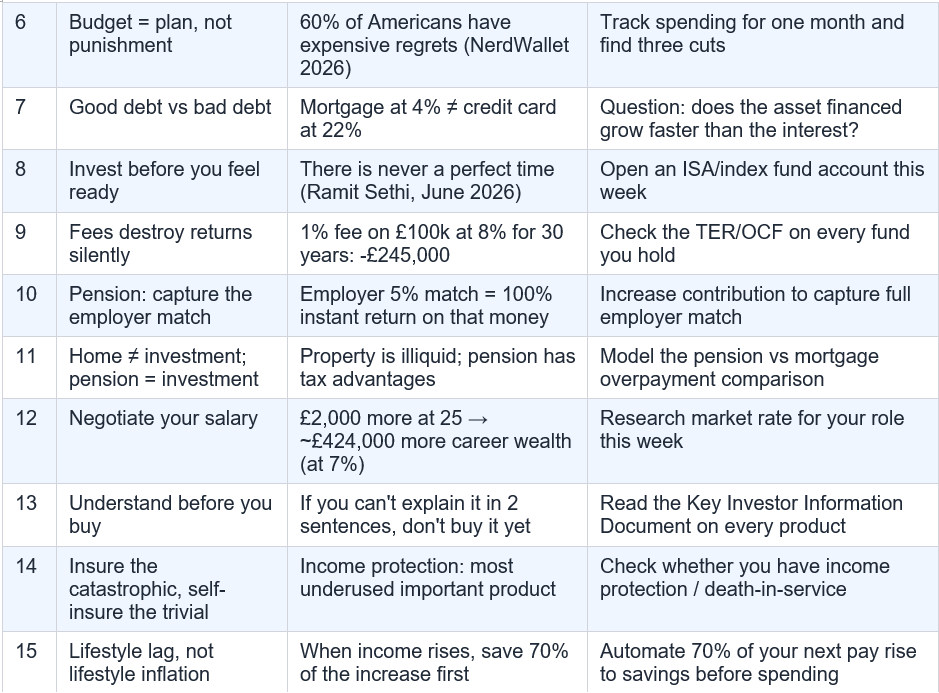
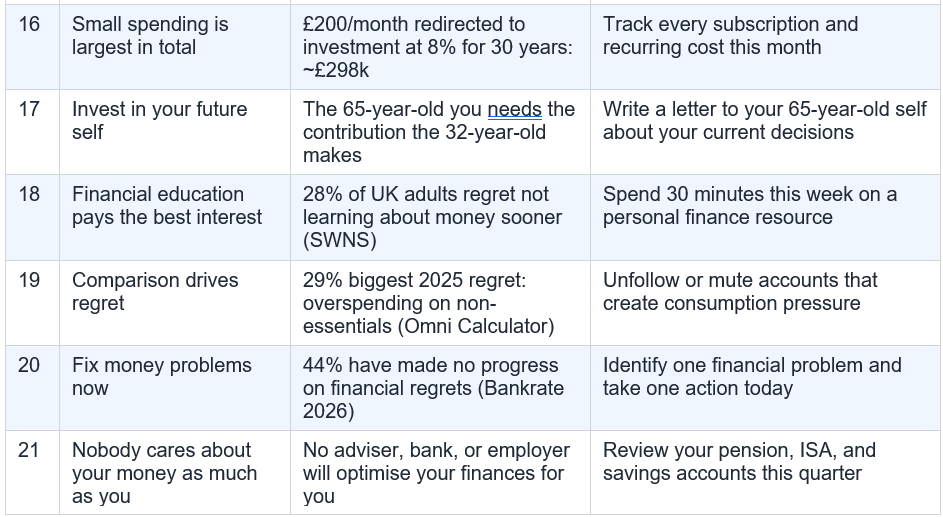
The 21 Lessons: Quick-Reference Summary
All projections are illustrative mathematical examples only. Not forecasts or guarantees. Not financial advice. Individual circumstances vary. Sources cited throughout this article. Consult a qualified independent financial adviser.
Conclusion
The most expensive financial lesson is the one that stays in the ‘I should do something about that’ drawer for years. 44% of people with financial regrets made no progress on them in the past 12 months (Bankrate 2026). Not because they do not know what to do. In most cases, they know exactly what to do. The gap is between knowing and doing, and it is paid for in compound interest working against rather than for them.These 21 lessons are not all equally urgent for every reader. Lesson 3 (emergency fund) is more urgent than Lesson 12 (salary negotiation) for someone with credit card debt and no savings buffer. Lesson 4 (destroy high-interest debt) is more urgent than Lesson 11 (pension strategy) for someone paying 22% APR on a credit card balance. The sequencing matters: fix the highest-cost problem first, then work forward.
But every lesson in this list is actionable today at some level. You do not need to solve your entire financial life this week; you need to make one decision that moves in the right direction. Compound growth works on habits as well as money: one decision made today produces a slightly better position tomorrow, which makes the next decision slightly easier, which produces a slightly better outcome, which accumulates over years into the financial life you intended to build. Start the lesson you have been avoiding. Not financial advice. Consult a qualified independent financial adviser.
Frequently Asked Questions
What are the biggest financial regrets people have?The most common financial regrets in 2025-2026, across multiple major surveys: (1) Not saving enough money (38%, Intuit Credit Karma 2025). (2) Overspending on non-essentials (29%, Omni Calculator 2026). (3) Not saving for retirement early enough (22%, Bankrate). (4) Too much credit card debt (15%, Bankrate). In the UK specifically (SWNS/Yorkshire Evening Post survey of 4,000 adults): not saving more when younger tops the list; one in three wished they had started saving for retirement earlier; 28% regret not educating themselves more about money; one in four regret not investing. Ramit Sethi (June 2026, MoneyLion), after 20 years in personal finance, notes the biggest regret he hears is not investing soon enough. 3 in 5 Americans (60%) have spent money on something expensive they later regretted (NerdWallet 2026). Not financial advice.
What is the most important money lesson for someone in their 20s?
The compound interest lesson -- specifically, the cost of delay. £200 per month invested from age 22 at 8% annual return produces approximately £702,000 by age 62. The same amount starting at age 32 produces approximately £298,000. A ten-year delay costs approximately £404,000 despite only investing £24,000 less in total. This gap is entirely composed of compounding time that cannot be recovered. Ramit Sethi (June 2026): 'Start now. Start small -- even $50 a month will still make a difference. The sooner an investor starts, the sooner they can take advantage of compound growth, which is built on time in the market, not timing the market.' In the UK: capture the full employer pension match (a 100% instant return on that portion of salary), open a stocks and shares ISA with a low-cost index fund, and build an emergency fund of 3-6 months' expenses in a high-interest cash account. Not financial advice.
How do I stop spending money on things I regret?
The evidence-based approach to reducing regret-spending: (1) Track spending for one full month before making any changes. Most people significantly underestimate their discretionary spending. The NerdWallet 2026 study found 60% of Americans have expensive spending regrets, with non-essentials leading. (2) Implement a 24-48 hour waiting period for any non-essential purchase above a threshold (e.g. £50). Most impulse purchases lose appeal after a day. (3) Delete saved payment details from shopping sites that trigger impulse buying. Friction reduces spending. (4) Identify the comparison pressure driving the spending -- social media accounts, peer groups, environments -- and reduce exposure. 29% of Americans' biggest 2025 financial regret was overspending on non-essentials (Omni Calculator 2026), much of it comparison-driven. (5) Automate savings before the money is available to spend. If it never appears in your current account, it cannot be spent. Not financial advice.
Is it too late to start saving for retirement at 40?
No. Starting at 40 is not ideal but it is vastly better than not starting. A 40-year-old investing £500/month at 8% annual return until age 65 (25 years) accumulates approximately £473,000. With tax relief on pension contributions (basic rate: 20%), an effective contribution of £625 per month produces approximately £591,000. In the UK, the state pension (£12,548/year in 2026) provides an additional foundation. In the US, Social Security supplements pension savings. One in three UK adults wish they had started retirement saving earlier, with this rising to more than half of over-55s (SWNS study) -- the regret grows with age precisely because the compound growth window is visible closing. Starting at 40 captures 25 years of compound growth. Not starting at 40 captures zero. Not financial advice. Consult a qualified financial adviser for a personalised retirement plan.
What is the single most impactful financial habit?
Automating savings before spending -- 'pay yourself first.' This single habit, applied consistently, addresses more of the 21 lessons in this article simultaneously than any other action. It implements Lesson 2 (pay yourself first), reduces Lesson 15 (lifestyle inflation) by removing money before lifestyle spending can claim it, builds Lesson 3 (emergency fund), contributes to Lesson 10 (pension), and combats Lesson 19 (comparison-driven spending) by reducing the money available for impulsive social-comparison purchases. The automation is what makes it powerful: a monthly standing order to a savings account on payday requires no willpower, no monthly decision, and no discipline -- it is structurally imposed. This is what separates financial systems that work from financial intentions that fail. Not financial advice.

0 Comments Comments