

Financial Literacy
5 Habits That Transformed My Finances: The Full Guide

Table of Contents
- Five Habits That Change Everything -- Without Requiring a Higher Income
- The Financial Reality: Why These Five Habits Are the Response
- The Five Habits in Detail: What They Are, What They Produce, and How to Build Each One
- The 5-Habit Transformation Timeline: What Each Habit Produces Over Time
- Conclusion: Five Habits, One Direction of Travel
- Frequently Asked Questions (FAQ)
Five Habits That Change Everything -- Without Requiring a Higher Income
Financial transformation does not usually arrive through a single dramatic event -- a windfall, a promotion, a lucky investment. For most people who achieve it, it arrives through the accumulated effect of five specific habits applied consistently over time. These habits do not require exceptional income, specialist knowledge, or unusual self-discipline. They require a system: a set of decisions made once that then operate automatically, redirecting money from consumption into security and growth.The data on where most people currently stand is sobering. SoFi (May 11, 2026 -- most current): 'Nearly 25% of U.S. households are living paycheck to paycheck, according to one 2025 report. That means their spending on necessities leaves virtually nothing for savings or discretionary spending.' Twenty-five percent is the acute end. A far larger proportion -- sometimes cited at 60-70% in various surveys -- have inadequate emergency funds, minimal investment portfolios, and income profiles that are entirely dependent on continued employment. This is not because these households lack earning capacity. It is because the five habits in this guide are not automatic. They require building.
Intuit (January 2026): '58% of 18-35-year-olds are integrating financial management into their daily routines.' The cultural shift toward financial intentionality is real -- driven by inflation, stagnant real wages, and a generation that watched their parents' generation discover that job security and pension promises were not as durable as assumed. The five habits in this guide are the specific practices that represent this shift in practical form. Each one is examined with the current data on what it actually produces, the specific actions required to implement it, and the compounding effect when all five work together.
The Financial Reality: Why These Five Habits Are the Response
Before examining each habit, understanding the specific financial conditions that make them necessary -- and the specific outcomes the data shows they produce -- provides the motivation that sustains them: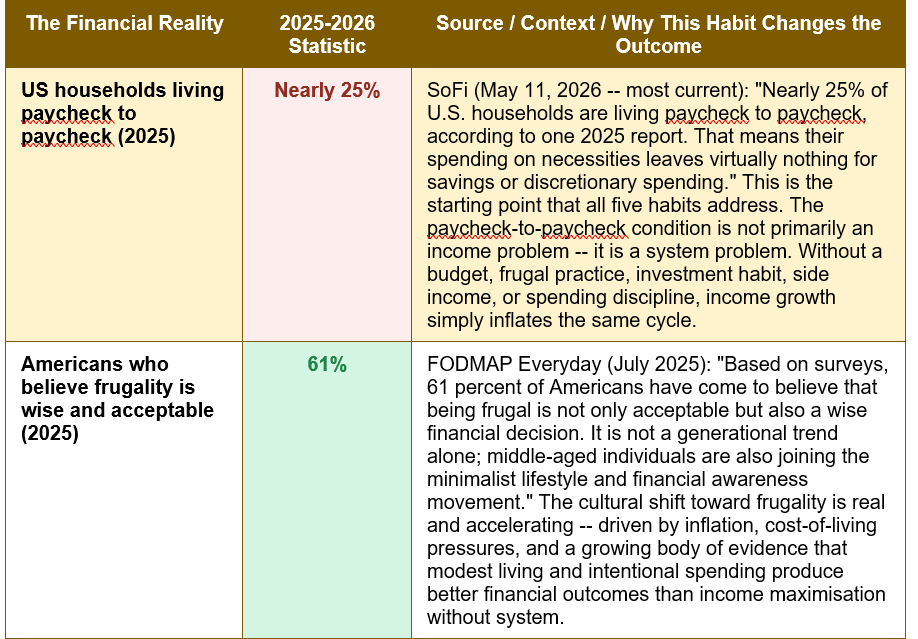
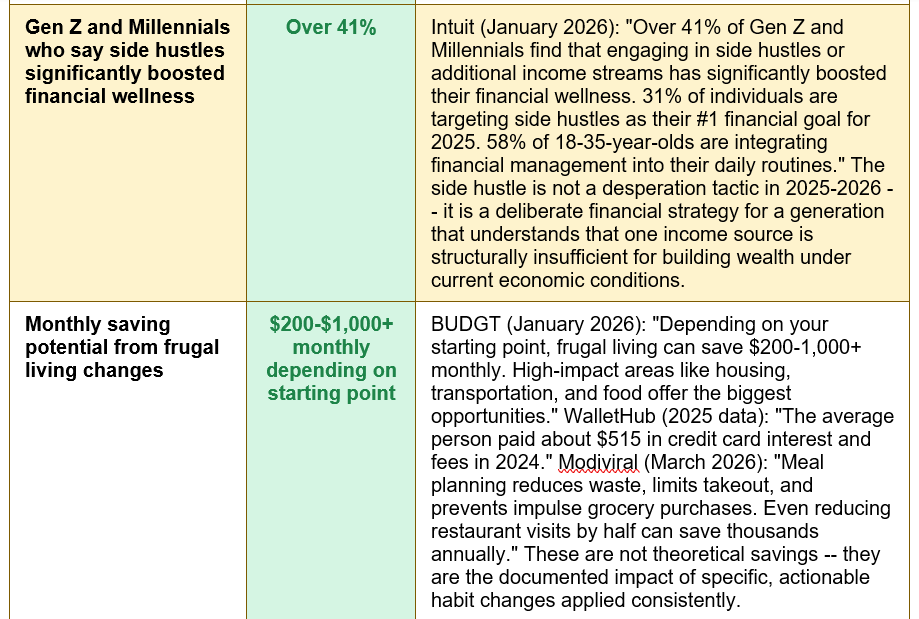
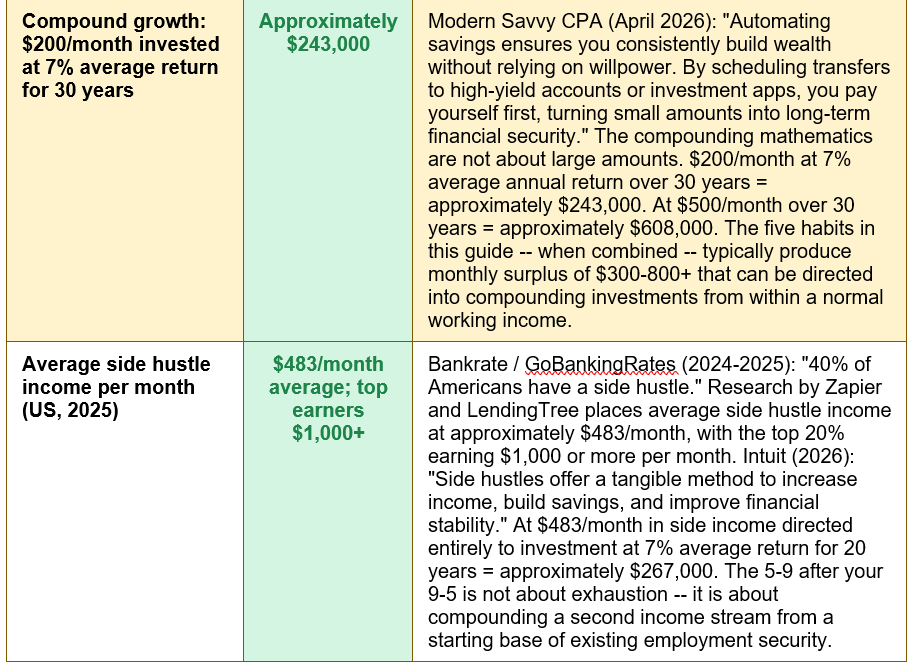
The five habits at a glance: Budget: find $200-400 surplus. Frugal: save $200-1,000+/month. Invest: $200/month for 30 years = $243,000. 5-9: average $483/month side income. Live below means: the gap that compounds. — SoFi (May 2026): '25% of US households live paycheck to paycheck.' BUDGT (Jan 2026): 'Frugal living saves $200-1,000+/month.' Modern Savvy CPA (April 2026): '$200/month at 7% for 30 years = $243,000.' Intuit (Jan 2026): '41% of Gen Z and Millennials say side hustles significantly boosted financial wellness. 31% targeting side hustles as #1 financial goal for 2025.' FODMAP Everyday (2025): '61% of Americans believe frugality is wise and a smart financial decision.'
The Five Habits in Detail: What They Are, What They Produce, and How to Build Each One
HABIT #1 BUDGETING | The habit that makes everything else possible
Budgeting is not about restriction. It is about clarity. Before you implement a budget, your money is managed by habit and circumstance. After you implement one, your money is managed by decision. The difference between these two conditions is the difference between drifting and directing -- and it is the foundation on which all four other habits depend. Modiviral (March 2026): 'A zero-based budget ensures that every dollar you earn is assigned a purpose. At the start of each month, allocate income to expenses, savings, investments, and debt repayment until you reach zero. Track all income sources. List fixed and variable expenses. Assign remaining funds to savings or debt reduction. This approach promotes intentional spending and eliminates financial guesswork.' There are several effective budgeting frameworks and the right one is the one you will actually use. The 50/30/20 rule (50% needs, 30% wants, 20% savings and debt) provides a starting framework. Zero-based budgeting (every pound or dollar is allocated before the month begins) is the most rigorous and produces the most surplus. The envelope method (physical or digital cash envelopes for each spending category) is most effective for people who tend to overspend in specific areas. WalletHub (2025): 'The average person paid about $515 in credit card interest and fees in 2024.' A budget prevents the accidental carrying of credit card balances -- one of the most common and costly financial leaks. The transformation the budget produces is not dramatic in month one. It is the steady accumulation of clarity: knowing where your money goes, identifying the leaks, redirecting the surplus, and building the monthly margin that funds every other habit. Most people who implement a genuine budget for the first month discover $200-$400 in monthly spending that was producing no value -- subscriptions unused, food wasted, convenience spending unreflected-upon. That $200-$400 per month, redirected, is $2,400-$4,800 per year in new financial capacity. That is the budget's first gift.BUDGETING RESULT: Month 1-3: full visibility of income and spending for the first time. Month 6: $200-400/month surplus identified and redirected to savings or debt. Year 1: first annual financial review completed. Goals have numbers and deadlines. The budget is the system that makes all other habits financially possible.
HABIT #2 FRUGAL LIVING | Spending intentionally -- not spending less on what matters, more on what doesn't
Frugal living is the habit most often misunderstood. It is not deprivation. It is not extreme coupon-clipping or living without enjoyment. It is the practice of spending intentionally -- which means spending less on things that do not matter to you so you can spend more (or save and invest more) on the things that do. FODMAP Everyday (July 2025): 'According to experts, frugality has nothing to do with deprivation or sacrifice; rather, it is about making intelligent, purposeful decisions that can maximise savings and minimise financial stress.' Modern Savvy CPA (April 2026): 'Living below your means doesn't mean deprivation, it means intentional restraint. Many wealthy individuals avoid lifestyle inflation by focusing on assets instead of expensive status symbols. Books like The Millionaire Next Door show that modest living creates unexpected wealth over time.' The high-impact areas where frugality produces the largest returns are always the same: housing (the single largest expense for most households -- every pound or dollar saved here compounds the most), food (meal planning and cooking at home can save hundreds per month; Modiviral: 'even reducing restaurant visits by half can save thousands annually'), transport (the choice between a reliable used car and a new car on finance represents a financial difference of thousands per year), and subscriptions (a monthly audit of recurring payments typically reveals $50-150 in unused or underused services). BUDGT (January 2026): 'Depending on your starting point, frugal living can save $200-1,000+ monthly. High-impact areas like housing, transportation, and food offer the biggest opportunities.' The key principle: frugality should be asymmetric. Cut ruthlessly on the things that do not contribute to your happiness or goals. Spend without guilt on the things that genuinely do. The frugal person who spends freely on experiences they love but drives a five-year-old car, cancels eight subscriptions, and meal-preps Monday to Friday is not depriving themselves -- they are directing their money according to their actual values.FRUGAL LIVING RESULT: Month 1-3: subscription audit saves $50-150/month. Meal planning saves $150-300/month on food. Month 6: housing and transport decisions reviewed. Total monthly savings unlocked: $200-800+ depending on starting point. Year 1-3: frugal system is habitual, not effortful. Lifestyle inflation arrested permanently.
HABIT #3 INVESTING | The habit that makes your money work when you are not working
Investing is the habit that converts the surplus created by budgeting and frugal living into compounding wealth. Without investing, savings sit in a bank account earning rates that rarely match inflation. With investing -- specifically, consistent investment in a diversified, low-cost portfolio -- that surplus begins producing returns that generate further returns, in a compounding process that accelerates over time. Modern Savvy CPA (April 2026): 'Automating savings ensures you consistently build wealth without relying on willpower. By scheduling transfers to high-yield accounts or investment apps, you pay yourself first, turning small amounts into long-term financial security.' The core principle -- paying yourself first -- means that investment transfers happen automatically on payday before spending decisions compete with them. The amount matters less than the consistency. At $200/month invested at 7% average annual return for 30 years: approximately $243,000. At $500/month for 30 years: approximately $608,000. At $1,000/month for 30 years: approximately $1.2 million. These are not exceptional outcomes requiring exceptional skill. They are the outcome of consistent monthly investment in a low-cost global index fund, automated, and sustained. The Modern Savvy CPA (April 2026): 'Experts agree that consistency, not willpower, is what creates financial stability.' The specific investment vehicles most commonly recommended for employed workers: in the UK, a Stocks & Shares ISA (up to £20,000/year, tax-free growth and withdrawals, accessible from major platforms including Vanguard, AJ Bell, and Fidelity) invested in a low-cost global index fund. In the US, a Roth IRA or 401(k) invested in an index fund tracking the S&P 500 or a total world fund. The automation is everything: set up the monthly transfer and the investment platform purchase on the same day as payday, and do not touch it. Investing is the habit that converts earned income into passive growth -- the transition from trading time for money to money generating money.INVESTING RESULT: Month 1: first investment account opened. First index fund bought. Month 6: first market fluctuation survived without panic (the test of every investor's conviction). Year 1: $200-500/month invested consistently. 5-year mark: compound growth is visible and motivating. 10-year mark: the investment portfolio is a meaningful financial asset in its own right.
HABIT #4 THE 5-9 SIDE HUSTLE | Building a second income stream while the first one pays the bills
The 5-9 is the work you do after your 9-5 -- the hours from 5pm to 9pm (or Saturday mornings, or Sunday afternoons) during which your employer does not own your time and your skills can generate value for you rather than for someone else. Intuit (January 2026): 'Over 41% of Gen Z and Millennials find that engaging in side hustles or additional income streams has significantly boosted their financial wellness. 31% of individuals are targeting side hustles as their #1 financial goal for 2025. Side hustles offer a tangible method to increase income, build savings, and improve financial stability.' GoBankingRates / Bankrate (2024-2025): 40% of Americans have a side hustle, with average monthly income of approximately $483 and top earners generating $1,000+. The 5-9 is powerful for two specific reasons. First, it diversifies income. A single income source -- employment -- creates a binary risk: employed or unemployed. A side income that covers even 15-20% of essential expenses means a job loss produces a financial emergency rather than a financial catastrophe. Second, every dollar of side hustle income earned after essential expenses are already covered by employment income can be directed entirely to investment. $483/month directed to investment at 7% average return for 20 years = approximately $267,000. The 5-9 does not have to be your passion to transform your finances. The most profitable early-stage side hustles are often skills-adjacent to your main employment: freelance writing, graphic design, software development, accountancy, tutoring, photography, coaching, virtual assistance. These leverage what you already know for income that starts immediately. Over time, the 5-9 can grow into something more -- a business with multiple clients, a scalable product, a passive income stream. Or it can remain a reliable secondary income that funds your investment habit. Either outcome is financially transformative. The key rule: treat side hustle income as investment capital, not lifestyle expansion. Every month that side hustle income is spent on lifestyle rather than investment is a month of compounding lost.5-9 SIDE HUSTLE RESULT: Month 1-3: first paying client or first sale. Proof of concept established. Month 6: $300-800/month in consistent side income -- all directed to investment or debt reduction. Year 1: side income covers one core monthly expense independently. Year 3-5: Intuit (2026): '41% of Gen Z and Millennials report side hustles significantly boosted financial wellness.' For some, side income approaches or matches primary income within 5 years.
HABIT #5 LIVING BELOW YOUR INCOME | The gap between what you earn and what you spend is the only number that determines your financial future
Living below your income is the meta-habit that unifies all four others. Budgeting reveals the gap between income and spending. Frugal living widens it. Investing deploys it. The side hustle expands the income side of the equation. Living below your income is the commitment to ensure the gap always exists -- regardless of income level, regardless of peer spending, regardless of marketing pressure and lifestyle inflation. SoFi (May 11, 2026): 'Living below your means is about spending less than you earn, however you might choose to do that. With so many people barely able to pay their bills, you may wonder if it's possible to live below your means. The answer is yes. It involves some budgeting, a little determination, and a few smart strategies.' The enemy of this habit is lifestyle inflation: the pattern of increasing spending in proportion to every income increase. The person who earns £35,000, saves 15%, and earns a promotion to £45,000 then adjusts lifestyle until they are again saving 15% of a higher income -- but the absolute amount saved has not fundamentally changed the financial trajectory. The person who earns the same promotion and keeps spending at the £35,000-income level while directing the entire £10,000 increment to investment has changed their financial trajectory permanently. Modern Savvy CPA (April 2026): 'Preventing lifestyle inflation accelerates wealth building. Frugality is easier when tied to meaningful goals.' Living below your income is not painful when it is understood as the practice that produces the freedom to change career, to weather income disruption, to invest opportunistically, to retire earlier than default, or to start a business from a position of financial security rather than necessity. SoFi: 'Living below your means can help you achieve greater financial security, reduce financial stress, and free up money for savings and investments that can grow your wealth over time.' The specific practice: every time income increases (a raise, a bonus, a side hustle scaling up), direct a minimum of 50% of the increment to savings or investment before adjusting lifestyle spending. The other 50% can improve quality of life. This asymmetric response to income growth is the mechanism that converts earning power into lasting wealth.LIVING BELOW INCOME RESULT: Month 1-6: spending consistently below income by 15-20% for the first time. Emergency fund fully funded. Month 12: no financial emergencies converted into debt. Year 3: lifestyle inflation arrested. Income has grown; the gap between income and spending has grown proportionally. Year 5: SoFi (May 2026): 'living below your means can help you achieve financial security, reduce financial stress, and free up money for savings and investments that grow wealth over time.' The gap, compounding, is the entire story.
The 5-Habit Transformation Timeline: What Each Habit Produces Over Time
The following table maps the compounding effect of all five habits applied simultaneously across a 3-5 year horizon:
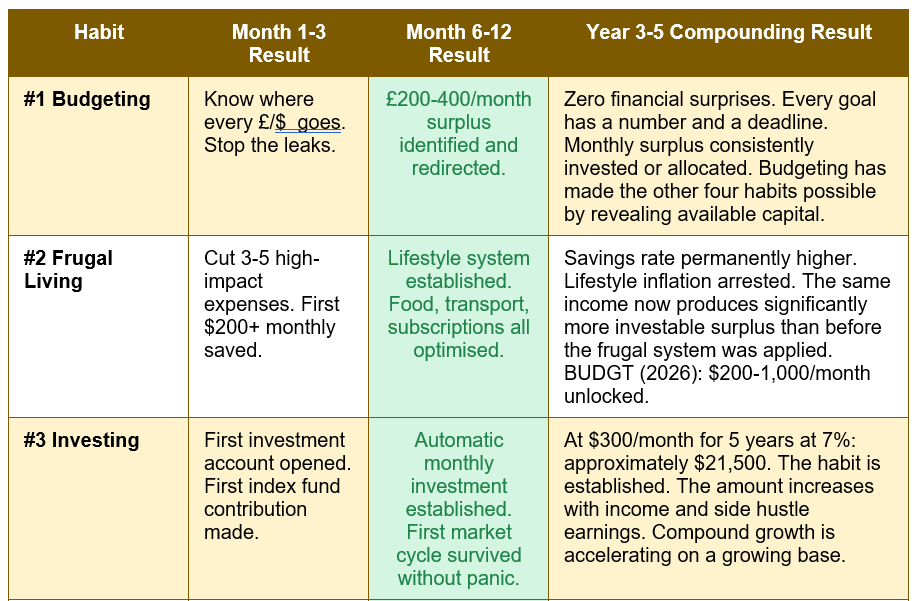
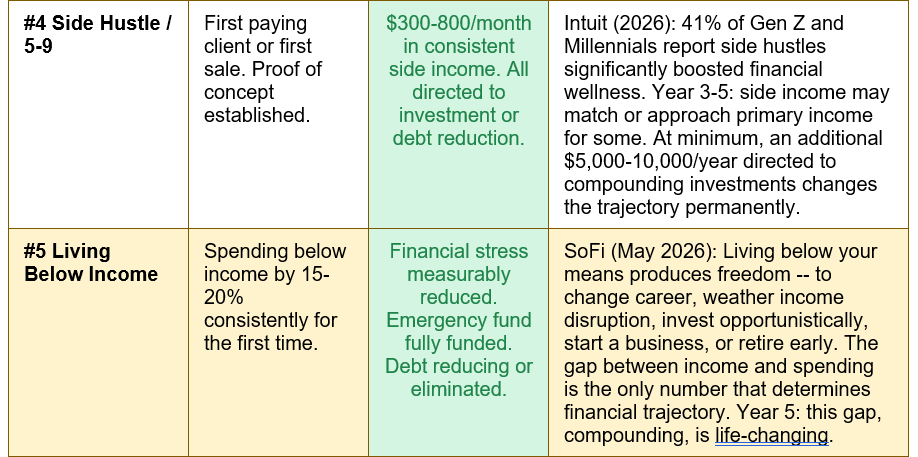
The combination effect: why five habits together outperform any one habit alone. The five habits in this guide are individually powerful but collectively transformative because each one amplifies the others. Budgeting reveals the surplus that frugal living then expands. The expanded surplus is directed into investment by the pay-yourself-first automation. The side hustle adds a parallel income stream that -- because essential expenses are already covered by employment -- can be directed entirely to investment. And living below income ensures that as earnings grow, the investable surplus grows proportionally rather than being absorbed by lifestyle. Modern Savvy CPA (April 2026): 'Consistency, not willpower, is what creates financial stability.' The five habits, implemented as systems rather than willpower exercises, produce a monthly financial structure that operates automatically. The budget runs. The frugal practices are habitual. The investment transfer happens on payday. The side hustle generates income. The spending stays below income regardless of earning growth. A person operating all five habits simultaneously -- starting with an annual income of $50,000 and a monthly investable surplus of $600 (from the combination of frugal savings and side hustle income) -- at 7% average annual return for 25 years accumulates approximately $475,000. This is not luck. It is the arithmetic of consistent habit.
FIVE MISTAKES THAT PREVENT THE HABITS FROM WORKING: (1) STARTING TOO MANY CHANGES AT ONCE. BUDGT (Jan 2026): 'Going too extreme too fast: drastic cuts lead to burnout and binge spending. Gradual changes stick.' Build one habit at a time. Start with the budget (it makes all others possible). Add frugal practices in months 2-3. Begin investing in month 3-4. Launch the side hustle in month 4-6. The sequence matters. (2) DIRECTING SIDE HUSTLE INCOME TO LIFESTYLE INSTEAD OF INVESTMENT. This is the most common failure point. Every month of side hustle income spent on lifestyle is compounding lost forever. Treat side hustle income as investment capital, not bonus spending money. Automate its transfer to your investment account on the same day it arrives. (3) STOPPING INVESTING WHEN THE MARKET FALLS. The instinct to sell investments or stop contributions during market downturns is financially costly. Modiviral (March 2026): 'Clear goals provide motivation for consistent smart spending.' The same principle applies to investing: clear long-term goals (retirement, financial independence, a property deposit) sustain contributions through market volatility. (4) LIFESTYLE INFLATION AFTER EVERY INCOME INCREASE. The promotion, the bonus, the side hustle scaling up -- each income increase is a fork in the road. Spending the increment maintains the current financial position. Investing the increment changes the trajectory. The asymmetric rule: 50% of every income increase to investment before any lifestyle adjustment. (5) TREATING FRUGALITY AS TEMPORARY. FODMAP Everyday (2025): '61% of Americans believe frugality is wise.' But believing it and practising it are different. Frugality works because it becomes a permanent way of relating to money -- spending intentionally, always -- not a temporary sacrifice endured until something improves. The habit works when it is a philosophy, not a diet.
THE 5-HABIT IMPLEMENTATION PLAN: START THIS WEEK WEEK 1 -- BUDGET: (1) List all income sources and amounts. (2) List all fixed monthly expenses (rent, utilities, subscriptions, loan payments). (3) Track all variable spending for 7 days without changing anything -- just observe. (4) On Day 8: review. Identify the top 3 spending categories where money is going without deliberate decision. These are your first frugal targets. WEEK 2 -- FRUGAL LIVING: (5) Run a subscription audit: list every recurring payment. Cancel or pause everything not used in the past 30 days. (6) Plan 4 meals for the coming week and buy only what those meals require. Estimated saving: £30-60 / $40-80 in the first week alone. WEEK 3 -- INVESTING: (7) Open an investment account if you do not have one. UK: Stocks & Shares ISA (Vanguard at vanguard.co.uk, AJ Bell, Fidelity). US: Roth IRA or 401k (Fidelity, Vanguard, Schwab). (8) Choose a single global index fund. Set up a monthly standing order for the amount your budget has identified as surplus -- even £25 or $25. WEEK 4 -- THE 5-9: (9) Identify one skill you already have that others would pay for. (10) Create one simple offer: a freelance profile on Upwork, Fiverr, or LinkedIn; a tutoring listing on Superprof; a product listing on Etsy or eBay. The first client is the hardest. Once that client exists, the system is started. MONTH 2 ONWARDS -- LIVING BELOW INCOME: (11) Every time income increases (raise, bonus, side hustle scaling), automate 50% of the increase to your investment account before your bank statement even reflects the new income. (12) Annual review: calculate your savings rate (savings + investment as % of net income). Target 20% in Year 1, 25% in Year 2, 30% in Year 3. FREE GUIDANCE: UK: MoneyHelper 0800 138 7777 | MoneySavingExpert.com. US: CFPB consumerfinance.gov | NFCC nfcc.org.
Conclusion: Five Habits, One Direction of Travel
Financial transformation is not a single event. It is the accumulated result of five habits practised consistently over time, each one amplifying the others. Budgeting reveals the financial picture clearly for the first time. Frugal living widens the gap between income and spending. Investing deploys that gap into compounding growth. The 5-9 side hustle expands income while employment provides the security to take the risk. And living below income ensures that as earnings grow, the investable surplus grows proportionally rather than being absorbed by lifestyle.The data confirms that these habits work. BUDGT (January 2026): frugal living saves $200-1,000+ per month depending on the starting point. Intuit (January 2026): 41% of Gen Z and Millennials say side hustles significantly boosted their financial wellness. Modern Savvy CPA (April 2026): automating savings and investing consistently produces long-term financial security without requiring willpower. FODMAP Everyday (July 2025): 61% of Americans now believe frugality is wise and a smart financial decision. And SoFi (May 2026): living below your means reduces financial stress and frees up money for savings and investments that grow wealth over time.
None of these habits require an exceptional income, specialist knowledge, or unusual discipline once the systems are in place. They require a decision -- to budget before spending, to spend intentionally rather than habitually, to automate investment before lifestyle can absorb the surplus, to use the evening hours for financial building rather than financial drift, and to resist the lifestyle inflation that converts every income increase into a new spending floor. The direction of travel changes with the first budget. The compounding begins with the first investment. And the financial life that results from five years of consistent habit is, by any measure, significantly different from the one produced by another five years of the same.
Frequently Asked Questions (FAQ)
Which of the five habits should I start with?Start with budgeting -- it is the foundational habit that makes all four others possible. Without a budget, you do not know how much surplus exists to save, invest, or direct to a side hustle. Modiviral (March 2026): 'A zero-based budget ensures that every dollar you earn is assigned a purpose. This approach promotes intentional spending and eliminates financial guesswork.' The specific first step: list every source of income and every known expense for the coming month. Assign every pound or dollar to a category before the month begins. At the end of the month, compare what you planned to what you actually spent. The gap between these two reveals the specific areas where money is going without decision. These areas are your frugal living targets for month two. BUDGT (January 2026): 'Going too extreme too fast: drastic cuts lead to burnout and binge spending. Gradual changes stick.' After one month of budgeting, add one or two frugal practices (a subscription audit, meal planning for the week). After two to three months, open an investment account and automate a contribution from the surplus the budget has revealed. The sequence -- budget first, frugal second, invest third, side hustle fourth, living below income as the overarching framework -- gives each habit time to become habitual before the next one is added.
Is frugal living the same as being cheap?
No -- and the distinction matters both practically and psychologically. BUDGT (January 2026): 'Frugal means spending intentionally to maximise value -- sometimes that means spending more for quality that lasts. Cheap means spending the least possible regardless of value, often leading to replacing items frequently or sacrificing quality of life. Frugal considers long-term costs; cheap only looks at the sticker price.' A frugal person might buy quality boots that last ten years instead of cheap boots that need replacing every year. They might spend freely on experiences that genuinely improve their life while refusing to pay for things that don't. They might invest in a good slow cooker that reduces the cost and time of home cooking for years. The defining characteristic of frugal is intentionality, not minimalism. FODMAP Everyday (July 2025): '61 percent of Americans have come to believe that being frugal is not only acceptable but also a wise financial decision.' The cultural shift away from frugality as embarrassing toward frugality as intelligent reflects an accurate reassessment: the wealthiest households in the US and UK consistently demonstrate that modest spending habits -- not high income -- are the primary driver of net worth accumulation. Choosing to live on less than you earn is not a sacrifice of enjoyment. It is a reallocation of resources from things that do not matter to things that do -- including financial security, freedom from debt, and the ability to choose your own future.
How much should I invest each month as a beginner?
The answer is: as much as your budget surplus allows, automated from the first month. The amount is less important than the habit and the automation. Modern Savvy CPA (April 2026): 'Automating savings ensures you consistently build wealth without relying on willpower. By scheduling transfers to high-yield accounts or investment apps, you pay yourself first, turning small amounts into long-term financial security.' Even £25 or $25 per month is the right starting point if that is the genuine surplus available -- because the habit of automated monthly investment is worth more than the amount of any individual contribution. At $200/month at 7% average annual return for 30 years: approximately $243,000. At $50/month for 30 years: approximately $61,000. At $500/month for 30 years: approximately $608,000. The most important investment decision is the first one: opening the account, choosing a low-cost global index fund, and setting up the automatic monthly transfer. After that, the job is not to pick stocks, time the market, or find exciting investments -- it is to increase the monthly contribution every time the budget, frugal practices, or side hustle income creates additional surplus. The recommended investment vehicles for beginners: UK: Stocks & Shares ISA (up to £20,000/year, tax-free growth, no capital gains tax on withdrawal) via Vanguard (vanguard.co.uk), AJ Bell, or Fidelity. US: Roth IRA (up to $7,000/year in 2025-26, tax-free growth if held to retirement age) via Fidelity, Vanguard, or Schwab. Both should hold a single global index fund with the lowest available annual management charge.
How do I start a side hustle while still working full time?
The most practical approach to starting a 5-9 side hustle while working full time is to identify the skill you most credibly possess and find the lowest-friction way to offer it to paying customers. Intuit (January 2026): 'Side hustles offer a tangible method to increase income, build savings, and improve financial stability. 31% of individuals are targeting side hustles as their #1 financial goal for 2025.' The most common successful approaches for employed people: (1) Skills-adjacent freelancing -- if you work in marketing, offer freelance content writing or social media management. If you work in finance, offer bookkeeping or tax preparation. If you work in technology, offer web development or technical consulting. The credibility of your existing role is your most powerful marketing asset. (2) Knowledge monetisation -- tutoring in a subject you know, online course creation in your specialism, coaching in an area of genuine expertise. (3) Service businesses with low start-up costs -- photography, cleaning, landscaping, delivery, pet care, personal training. (4) Digital products -- templates, ebooks, design assets, photography licences -- that generate passive income once created. The critical starting principle: begin before you are ready, with the minimum viable offer. Your first client at $50 is worth more than the perfect business plan you have not executed. GoBankingRates (2024-2025): 40% of Americans already have a side hustle -- average income $483/month. All of that income, directed to investment from the start, is the compounding engine the 5-9 adds to the five-habit system.
How do I stop lifestyle inflation when my income rises?
Lifestyle inflation is the most persistent enemy of the five-habit financial system, because it is the most natural and socially reinforced response to income growth. A raise arrives. Rent and spending adjust upward over the following months. The felt sense of financial tightness returns to its previous level. The net result: higher income, same financial stress, no material change in wealth trajectory. SoFi (May 11, 2026): 'Living below your means involves spending less than you earn, however you might choose to do that. With so many people barely able to pay their bills, the answer is yes -- it involves some budgeting, a little determination, and a few smart strategies.' The specific strategies that prevent lifestyle inflation: first, automate the investment increase before the lifestyle increase. When a pay rise takes effect, on the same day, increase the monthly investment standing order by at least 50% of the increment. The increase happens automatically before spending patterns have time to adjust. Second, name what you are saving the increment for. Modern Savvy CPA (April 2026): 'frugality is easier when tied to meaningful goals.' The increment directed to investment is not an abstraction -- it is the down payment on financial independence, or early retirement, or the ability to start a business without desperation. Named goals sustain the discipline that prevents inflation. Third, give yourself permission to spend the other 50%. The asymmetric rule -- 50% of every income increase to investment, 50% to lifestyle improvement -- is not deprivation. It is a deliberate, sustainable approach that allows genuine life improvement while ensuring financial trajectory change. FODMAP Everyday (2025): '61% of Americans believe frugality is wise.' Applying that belief specifically to income growth -- treating it as an investment opportunity rather than a spending opportunity -- is the practice that converts earnings into lasting wealth.

0 Comments Comments