

Retirement
5 Questions to Inflation-Proof Your Retirement Plan
At 2.5% annual inflation, a fixed retirement income loses nearly 40% of its purchasing power over 20 years. At 4.2%, it loses half in just 17 years. Inflation has slowed from its 2022 peak of 9.1%, but healthcare costs are still rising at 3.8%, shelter at 4.1%, and prices overall are 20% higher than 2021 with no reversal in sight. The five questions in this guide are the ones every retirement plan needs to answer to stay ahead of rising prices.
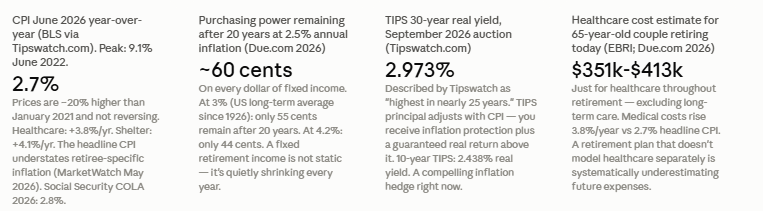
The 2021–2023 inflation surge made this vulnerability visceral for millions of Americans who had never experienced it before. Prices peaked at 9.1% annual inflation in June 2022 — the highest in 40 years — and while they have moderated since (the Consumer Price Index rose 2.6% year-over-year through April 2026 and 2.7% in June 2026, per the Bureau of Labor Statistics and Tipswatch.com), prices are now approximately 20% higher than they were in January 2021 and are not coming back down. Inflation is slowing, not reversing. Retirees who were living comfortably on their income in 2020 have seen the real purchasing power of that income fall significantly — permanently.
The categories that affect retirees most are rising faster than headline CPI. Healthcare costs increased 3.8% year-over-year in the most recent BLS data (Due.com, April 2026). Shelter costs rose 4.1%. The Employee Benefit Research Institute estimates that a 65-year-old couple retiring today will need between $351,000 and $413,000 just to cover healthcare expenses throughout retirement, excluding long-term care. These are not modest numbers, and they will not stay static.
The five questions in this guide are designed to identify the specific gaps in a retirement plan that leave it vulnerable to inflation over 20 to 30 years. They are not abstract — each question maps directly to a concrete portfolio or income adjustment that addresses the specific mechanism by which inflation erodes retirement security.
CPI rose 2.6% year-over-year through April 2026 and 2.7% in June 2026 (BLS; Tipswatch.com). Peak inflation: 9.1% June 2022. Prices are ~20% higher than January 2021 (Due.com 2026). Healthcare costs rose 3.8% year-over-year; shelter +4.1% (BLS; Due.com 2026). At 2.5% inflation: fixed income loses 22% of real value in 10 years and nearly 40% in 20 years (Due.com). EBRI: 65-year-old couple needs $351,000-$413,000 for healthcare in retirement (excluding long-term care). Social Security COLA 2026: 2.8% (~$56/month average increase). 74% of retirement-age respondents say inflation raised concerns about having enough money in retirement (BMO February 2026). 30% say they do not know how long their money will last.
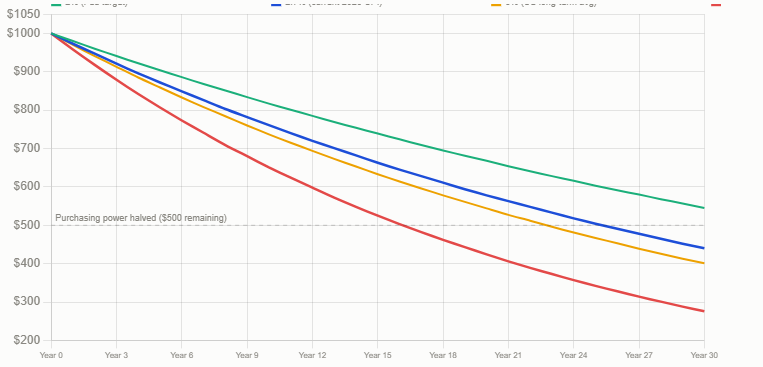
Purchasing power remaining after inflation (FreeFinCalc.net 2026; Due.com 2026): AT 2% INFLATION: After 10 years: $820 real value of $1,000. After 20 years: $673. After 30 years: $552. AT 3% INFLATION (US long-term average since 1926): After 10 years: $744. After 20 years: $554. After 30 years: $412. AT 4.2% INFLATION (higher 2026 forecast scenario): After 10 years: $664. After 17 years: ~$500 (purchasing power halved). After 20 years: $439. PRACTICAL EXAMPLE: Retiree needs $50,000/year today. At 2% inflation over 20 years: needs $74,300/year to maintain same standard. At 3% inflation: needs $90,300/year. At 4%: needs $109,600/year. If income is fixed at $50,000, the real shortfall after 20 years at 3% inflation is approximately $40,300/year — more than the entire original income. Source: FreeFinCalc.net Inflation Calculator 2026; Due.com 2026; Real Investment Advice. Not financial advice. All projections illustrative only.
The MarketWatch analysis quoted in May 2026 retirement planning coverage adds a critical nuance: the official CPI may understate the real-world inflation experience for older households, which tend to spend a larger share of their income on healthcare and energy — both of which consistently rise faster than headline CPI. This means a retirement plan built on standard CPI assumptions may be systematically under-accounting for the actual inflation rate facing the plan’s beneficiary.
The asymmetry of inflation risk in retirement: during the accumulation phase, inflation reduces the real value of contributions but does not reduce the compounding rate of returns. During the distribution phase, inflation reduces the real value of withdrawals without any automatic offset. A $1 million portfolio generating 6% nominal returns and drawing $40,000 per year at a fixed withdrawal amount will produce a different real standard of living in year 20 than in year 1, even if the portfolio performs exactly as expected. Building inflation adjustments into the withdrawal plan is not optional — it is the only way to preserve the standard of living the plan was designed to support. Not financial advice.
In practice, the 4% rule in an inflationary environment means: in year one, withdraw $40,000. In year two, if inflation was 2.6%, withdraw $41,040. In year three, if inflation was 2.7%, withdraw $42,148. And so on. The dollar withdrawal grows each year to preserve real purchasing power. This requires the portfolio itself to generate returns above the withdrawal rate to sustain this pattern. At 4% withdrawal and 3% inflation, the portfolio needs to generate approximately 7% nominal returns to remain viable over 30 years — consistent with long-term equity market historical returns but not guaranteed.
The specific 2026 context matters here. Withdrawals in retirement plans were stress-tested against low-inflation assumptions through much of the 2010s. A plan modelled on 2% perpetual inflation that is instead experiencing 2.6% to 4.2% inflation (depending on the forecast scenario) will exhaust its real purchasing power more quickly than the model projected. The 2021–2023 inflation surge may have already accelerated the depletion timeline for plans that did not adjust.
Inflation-adjusting your withdrawal strategy: Step 1: Determine your current annual withdrawal in dollars. Step 2: Multiply by this year’s actual CPI increase to find next year’s inflation-adjusted target. At 2.6% CPI: $40,000 × 1.026 = $41,040. Step 3: Compare this inflated withdrawal to your portfolio’s total return over the past year. If the portfolio grew by 7% and you inflated the withdrawal by 2.6%, the real withdrawal rate declined (positive). If the portfolio returned 1% and you inflated the withdrawal by 2.6%, the plan is stress-testing in the wrong direction. Step 4: Review with a financial adviser at each annual portfolio review. Not financial advice.
Income that adjusts for inflation automatically in the US system includes: Social Security benefits (which receive an annual Cost-of-Living Adjustment — COLA — set at 2.8% for 2026, per the Social Security Administration, adding approximately $56/month for the average beneficiary); some pension plans with COLA provisions (government and some union pensions, though most private sector pensions do not include COLA adjustments); and Treasury Inflation-Protected Securities (TIPS), whose principal is indexed to the CPI and which are paying approximately 1.9% real yield above inflation as of 2026 (Due.com April 2026).
Income that does NOT adjust for inflation includes: most private sector defined benefit pensions (fixed dollar amount for life); traditional fixed annuities (fixed payment, no COLA unless specifically purchased as a rider, at significant additional cost); most CD or bond interest income (the coupon rate is fixed; the real value declines as prices rise); and fixed-rate mortgage income from rental properties (the rent can be raised, but the income stream itself may not keep pace in practice).
The key diagnostic: if 80% of your retirement income is from Social Security (COLA-adjusted) and 20% from a fixed pension, your plan has significant inflation exposure in the 20% component but a strong natural hedge in the 80%. If the proportions are reversed — 80% fixed pension, 20% Social Security — the inflation risk is much more severe. A retiree entirely dependent on a fixed pension and portfolio withdrawals with no Social Security has no automatic inflation adjustment at all, and must build inflation-proofing entirely through the portfolio.
The 2026 Social Security COLA of 2.8% is determined by the September CPI reading and represents the SSA’s best mechanism for maintaining the real value of benefits. But Social Security is not a perfect inflation hedge: the COLA calculation uses CPI-W (the Consumer Price Index for Urban Wage Earners and Clerical Workers), which weights spending categories differently from actual retiree spending patterns. Healthcare, which takes a larger share of retiree spending than working-age spending, carries a lower weight in CPI-W than it does in actual retiree budgets. Tipswatch.com and the MarketWatch analysis both note this mismatch. Not financial advice.
The Employee Benefit Research Institute’s estimate that a 65-year-old couple retiring today will need between $351,000 and $413,000 just for healthcare expenses throughout retirement (excluding long-term care) is based on actuarial projections of how healthcare costs compound over a retirement spanning 20 to 30 years. The lower end of that range assumes Medicare remains in its current form, the couple has no significant chronic conditions, and healthcare inflation does not accelerate from its current levels. The upper end accounts for higher healthcare utilisation in later retirement years and faster-than-expected medical cost inflation.
A retirement budget that does not separately model healthcare inflation — or that lumps healthcare costs into a general ‘3% inflation’ assumption — will systematically underestimate costs in the later years of retirement, when healthcare utilisation is highest and budget flexibility is lowest. The practical consequence: a plan that looks financially sound at 70 may show a significant projected shortfall at 80, not because investment returns disappointed, but because the healthcare cost assumption was too conservative.
Medicare Part B premiums, which cover outpatient care, have risen consistently faster than headline CPI. The MarketWatch analysis published in May 2026 notes that healthcare, insurance, and energy categories ‘continue to see double-digit percentage increases’ even as headline CPI has moderated. This creates what the analysis calls a ‘hidden drag’ on fixed-income retiree budgets: the official numbers suggest inflation is under control, but the categories that take the largest share of retiree spending are still rising sharply.
Healthcare inflation action steps: (1) Model healthcare costs separately in your retirement plan, using an assumed annual healthcare inflation rate of 5-7% rather than the general CPI figure. (2) Request a personalised healthcare cost projection from your financial adviser or use the EBRI’s published estimates as a baseline ($351,000-$413,000 for a couple, excluding long-term care). (3) Consider a health savings account (HSA) if still eligible: 2026 limits are $4,400 self-only / $8,750 family, and invested HSA funds grow tax-free and are withdrawn tax-free for qualified medical expenses. An HSA invested in a low-cost index fund can serve as a dedicated inflation-adjusted healthcare reserve. (4) Evaluate long-term care insurance: long-term care costs are not included in the EBRI estimate and can add significantly to total lifetime healthcare costs. Not financial advice.
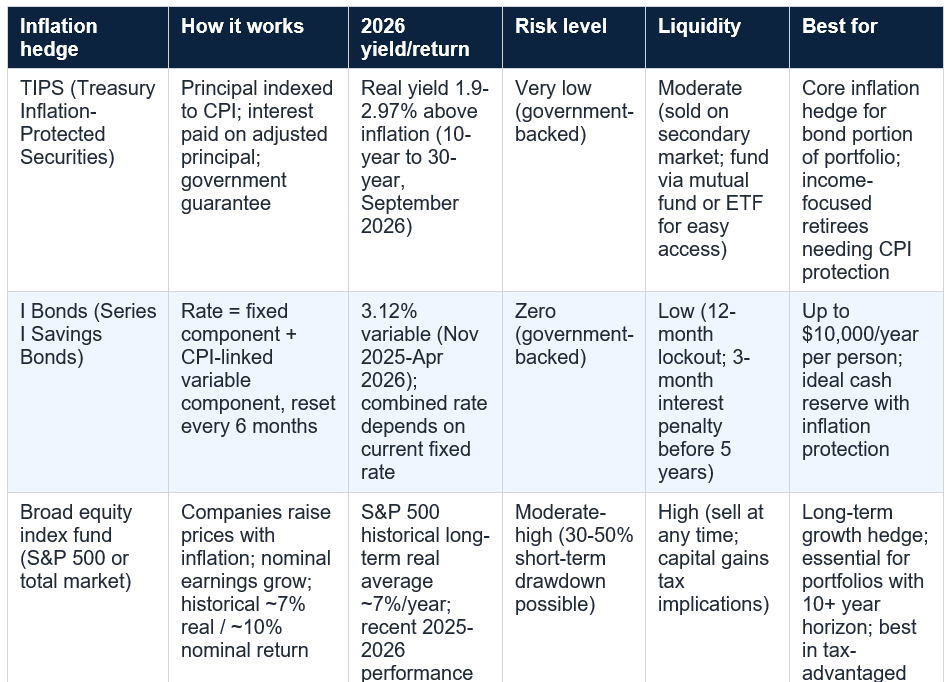
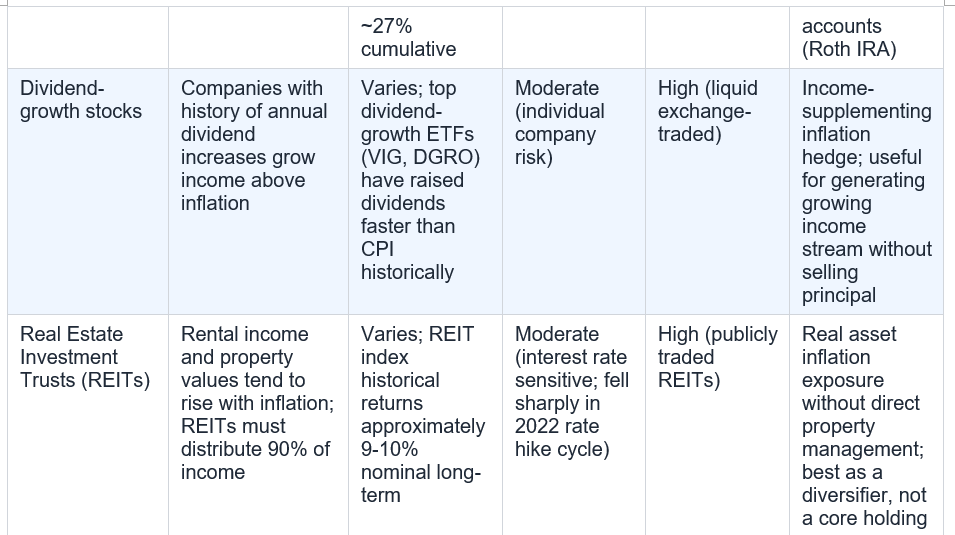
The three primary inflation hedges available to individual investors in 2026 are TIPS, equities (particularly broad equity index funds), and real assets. Each has specific characteristics that make it more or less suitable depending on time horizon, income need, and risk tolerance.
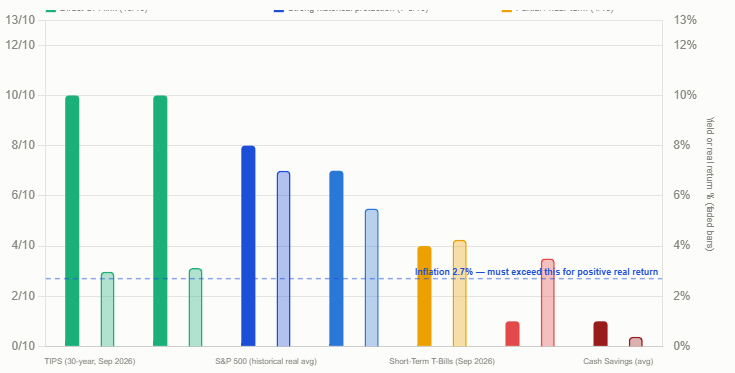
Treasury Inflation-Protected Securities (TIPS) are US government bonds whose principal is indexed to the Consumer Price Index. When inflation rises, the principal value of the TIPS adjusts upward, and interest payments (which are calculated as a fixed percentage of the adjusted principal) also increase. At maturity, the holder receives the greater of the inflation-adjusted principal or the original face value, providing a floor against deflation. The current TIPS real yield environment is unusually attractive: the 30-year TIPS auction in September 2026 produced a real yield of 2.973% — described by Tipswatch.com as the ‘highest in nearly 25 years’ — and 10-year TIPS real yields are approximately 2.438%. Due.com’s April 2026 retirement guide notes TIPS real yields of approximately 1.9% above inflation.
Equities represent the most powerful long-term inflation hedge historically available to individual investors. The S&P 500 has delivered approximately 7% average annual real returns over long periods, well above any historical US inflation rate. The mechanism is straightforward: companies generate real economic output and can raise prices when their input costs rise, meaning corporate earnings tend to grow in nominal terms alongside the economy. A broad equity index fund held for 10 or more years has, historically, significantly outpaced inflation in almost all environments. The trade-off is short-term volatility: equities can lose 30–50% of their value in any given year, making them inappropriate as the sole income source for near-term retirement needs.
I Bonds (Series I US Savings Bonds) provide another direct inflation link: their interest rate is composed of a fixed component plus a variable component that adjusts with CPI every six months. The November 2025 to April 2026 I Bond variable rate was 3.12% (Tipswatch.com), combining with the fixed rate. I Bonds are limited to $10,000 per person per year, require a 12-month holding period before redemption, and forfeit three months of interest if redeemed before five years. For the inflation-hedging portion of a retirement portfolio, I Bonds are compelling but capacity-constrained.
Real assets — real estate, commodities, infrastructure — have historically correlated positively with inflation over long periods. A REIT (real estate investment trust) portfolio, for example, derives income from rent, which can be adjusted as prices rise. However, real estate also carries interest rate sensitivity (rising rates reduce property values) and liquidity constraints that make it less straightforward as an inflation hedge than TIPS or diversified equities.
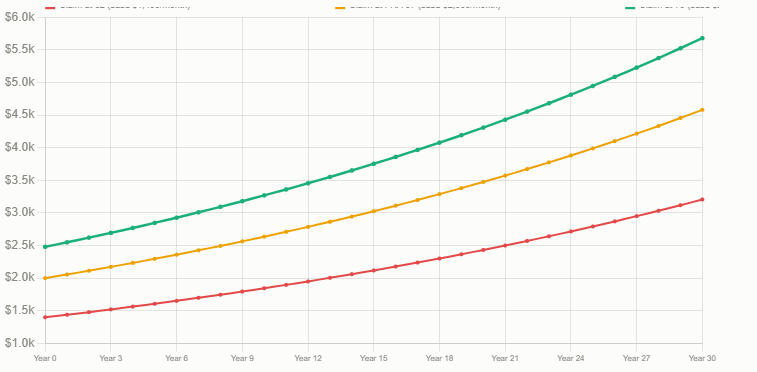
The Social Security benefit increases by approximately 6–8% for each year a claim is delayed beyond the full retirement age (FRA, currently 67 for those born in 1960 or later), up to age 70. Claiming at 62 rather than 70 reduces the monthly benefit by approximately 30%. Conversely, claiming at 70 rather than 62 increases the monthly benefit by approximately 76%. When the 2.8% COLA is applied to the higher age-70 benefit rather than the lower age-62 benefit, the dollar difference in each year’s COLA is substantial — and it compounds over a 20–30 year retirement.
Social Security COLA compounding by claiming age (illustrative). Assume base FRA benefit: $2,000/month. Age 62 claim (30% reduction): $1,400/month. Age 70 claim (24% increase): $2,480/month. Annual COLA 2.8% applied to each: Age 62 base: $1,400 × 2.8% = $39.20 more per month in year 1. Age 70 base: $2,480 × 2.8% = $69.44 more per month in year 1. DOLLAR COLA DIFFERENCE IN YEAR 1: $30.24/month ($363/year) more from the age-70 base. AFTER 20 YEARS of 2.8% annual COLA: Age 62 monthly benefit: $1,400 × (1.028)^20 = approximately $2,454/month. Age 70 monthly benefit: $2,480 × (1.028)^20 = approximately $4,349/month. MONTHLY GAP AFTER 20 YEARS: approximately $1,895/month — far larger than the initial $1,080/month gap at claim. This illustrates why the COLA, applied to a higher base, becomes increasingly powerful over time. Not financial advice. Illustrative only. Individual benefits depend on earnings history.
The inflation-proofing implication is direct: every year of Social Security delay between FRA and 70 purchases a higher COLA base that compounds indefinitely. For a healthy individual with a family history of longevity, maximising the Social Security base by delaying to 70 is one of the most effective lifetime inflation hedges available. The break-even point (the age at which cumulative higher benefits from waiting exceed the cumulative benefits from claiming earlier) typically falls between ages 78 and 82, depending on assumptions — an age that many Americans will reach.
For those who cannot afford to delay Social Security due to immediate income needs: the Roth IRA and taxable portfolio can serve as bridge income from retirement age to 70, funding living expenses while Social Security accrues its delayed credits. This ‘Social Security bridge’ strategy is documented in retirement planning literature as one of the most effective tools for maximising lifetime inflation-adjusted income.
The key distinction for retirees is not the headline CPI but the sector-specific inflation in the categories that dominate retiree spending. Healthcare costs rose 3.8% year-over-year. Shelter costs rose 4.1%. The MarketWatch analysis of CPI data published in May 2026 notes that ‘certain essential categories continue to experience double-digit percentage increases’ even as the headline figure has moderated. This creates a gap between what the official statistics show and what retirees are actually experiencing in their monthly budgets.
The 2026 Tipswatch.com analysis of Social Security COLA forecasting provides important context on the trajectory: the 2026 COLA was set at 2.8%, and the 2027 COLA is being forecast at approximately 3.6% based on current inflation trends. A COLA above 3% would suggest that the inflation situation for retirees is modestly worsening relative to 2026’s adjustment, despite the headline CPI remaining below 3%.
Prices from the 2021–2023 surge are not going to reverse. They have been permanently absorbed into the price level. A retirement plan that was designed before 2021 on the assumption of 2–3% inflation has already experienced a one-time permanent reduction in real purchasing power. The forward-looking question is not about recovering from 2021–2023 but about ensuring the plan can sustain its real value against the 2–4% inflation environment that currently prevails.
The five questions — Does my withdrawal rate account for inflation? How much of my income is inflation-adjusted? Am I budgeting for healthcare’s faster rate? Does my portfolio have inflation hedges? Have I optimised Social Security for its COLA? — are the minimum diagnostic for any retirement plan. Each question has a concrete answer and a concrete corrective action: inflation-adjusted withdrawals, COLA-indexed income maximisation, separate healthcare modelling, TIPS and equity allocation, and Social Security delay optimisation.
None of these are complex in concept. All of them require attention and periodic review as the inflation environment, portfolio performance, and personal circumstances evolve. The retirees who answer these questions explicitly — who have a documented answer to each one in their financial plan — are far better positioned than those whose plans assume inflation away as a background condition. Not financial advice — always consult a qualified financial adviser.
Inflation reduces the purchasing power of money over time — meaning the same nominal dollar amount buys fewer goods and services each year. For retirees on fixed incomes, this erosion is particularly damaging because there is no salary increase or additional working hours to offset it. At 2.5% annual inflation, a fixed income loses approximately 22% of its real purchasing power over 10 years and nearly 40% over 20 years (Due.com 2026). At 3% — the US long-term average since 1926 — $1,000 in purchasing power today is worth only approximately $554 in 20 years (FreeFinCalc.net 2026). The categories that affect retirees most — healthcare (rising 3.8%/year) and shelter (rising 4.1%/year) — are inflating faster than the headline CPI. A retirement plan that does not explicitly account for inflation compounding will face a widening gap between income and expenses as the retirement progresses. Not financial advice.
What are the best investments to protect against inflation in retirement?
The three primary inflation hedges for retirement portfolios in 2026 are TIPS, broad equity index funds, and I Bonds. Treasury Inflation-Protected Securities (TIPS) are government bonds whose principal adjusts with the CPI, providing direct inflation protection with very low credit risk. The September 2026 30-year TIPS auction produced a real yield of 2.973% — the highest in nearly 25 years according to Tipswatch.com. Broad equity index funds (S&P 500, total market) have delivered approximately 7% average annual real returns historically, significantly outpacing inflation over long periods, though with significant short-term volatility. I Bonds combine a fixed rate with a CPI-linked variable rate, with the November 2025 to April 2026 variable rate at 3.12% (Tipswatch.com), but are limited to $10,000 per person per year. For income-producing real assets, dividend-growth stock ETFs and REIT index funds provide additional inflation linkage. The appropriate mix depends on time horizon, income needs, and risk tolerance. Not financial advice — consult a qualified financial adviser.
What is the Social Security COLA and how does it protect against inflation?
The Social Security Cost-of-Living Adjustment (COLA) is an annual automatic increase to Social Security benefits designed to preserve their purchasing power against inflation. The 2026 COLA was set at 2.8%, adding approximately $56 per month to the average beneficiary’s benefit. The 2027 COLA is forecast at approximately 3.6% based on current inflation trends (Tipswatch.com). The COLA is calculated based on the September CPI-W (Consumer Price Index for Urban Wage Earners and Clerical Workers) reading compared to the prior year. The COLA does not perfectly protect against retiree-specific inflation because healthcare, which takes a larger share of retiree budgets, carries a lower weight in CPI-W than in actual retiree spending. The critical strategic point: the COLA is applied to your base benefit amount, which is determined by the age at which you claim. Delaying Social Security to age 70 increases your base benefit by approximately 76% compared to claiming at 62. The COLA then compounds annually on this higher base, making early delay compoundingly valuable over a long retirement. Not financial advice.
What is the 4% rule and does it account for inflation?
The 4% rule — derived from the Trinity Study and subsequent research — suggests that withdrawing 4% of a portfolio in the first year of retirement, then increasing the dollar amount withdrawn each year by the actual inflation rate, provides approximately a 95% probability of the portfolio lasting 30 years for a diversified stock-and-bond portfolio. The rule is inflation-adjusted by design: the annual withdrawal amount grows with CPI each year, not stays flat. A retiree with a $1 million portfolio withdraws $40,000 in year one; if inflation is 2.6%, they withdraw $41,040 in year two; and so on. The common misapplication is treating the 4% rule as a fixed dollar withdrawal — which would leave the retiree with declining real purchasing power each year. The 2021–2023 inflation surge, which pushed CPI far above the 2–3% range most versions of the study assumed, has prompted debate among retirement researchers about whether 4% remains sufficiently conservative in a higher-inflation environment. Not financial advice — consult a financial adviser for guidance tailored to your situation.
What are TIPS and how do they work for retirement inflation protection?
Treasury Inflation-Protected Securities (TIPS) are US government bonds whose principal value is indexed to the Consumer Price Index. When the CPI rises, the principal value of the TIPS adjusts upward. Interest payments are calculated as a fixed percentage of the adjusted (higher) principal, so both the principal and the interest payments grow with inflation. At maturity, the holder receives the greater of the inflation-adjusted principal or the original face value, which provides a floor against deflation. TIPS are backed by the full faith and credit of the US government, making them among the safest inflation hedges available. Current TIPS real yields are unusually attractive: the September 2026 30-year TIPS auction produced a real yield of 2.973% above inflation — described by Tipswatch.com as the highest in nearly 25 years. 10-year TIPS real yields are approximately 2.438%. TIPS can be purchased directly at TreasuryDirect.gov or through mutual funds and ETFs that hold TIPS portfolios (such as Vanguard’s VTIP or iShares’ SCHP). For retirees, TIPS are best suited for the fixed-income portion of the portfolio where direct CPI-linkage is most valuable. Note: TIPS pay annual ‘phantom income’ on the principal adjustment, which is taxable even if not received as cash — making them most tax-efficient in a tax-advantaged account (IRA, 401(k)). Not financial advice.
Table of Contents
- Why Inflation Hits Retirees Harder Than Anyone Else
- The Compound Maths: What Inflation Actually Does to a Fixed Income
- Question 1: Does My Withdrawal Rate Account for Inflation?
- Question 2: How Much of My Income Is Actually Inflation-Adjusted?
- Question 3: Am I Budgeting for Healthcare’s Faster-Than-CPI Inflation?
- Question 4: Does My Portfolio Have Any Inflation Hedges?
- Question 5: Have I Optimised Social Security for Its Built-In COLA?
- The Inflation-Proofing Tool Kit: What Each Hedge Actually Does
- The 2026 Inflation Environment: Moderated but Not Gone
- Building an Inflation-Resistant Withdrawal Strategy
- Conclusion: Answer the Five Questions Before the Price Rise Does
- Frequently Asked Questions
Inflation erodes purchasing power — how fast and how much
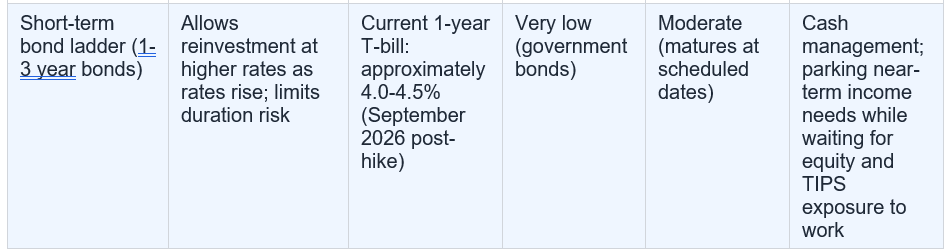
Inflation hedges: what each tool does in 2026
Social Security delay: the COLA compounding advantage
Why Inflation Hits Retirees Harder Than Anyone Else
Inflation affects everyone, but it damages retirees in a way that working-age people can at least partially offset. When prices rise, an employed person can negotiate a raise, take on additional hours, or find a better-paying job. A retiree drawing from a fixed pension, an annuity with no cost-of-living adjustment, or a portfolio with a fixed withdrawal rate has none of those levers. Every dollar of price increase is a dollar of purchasing power permanently lost, and in a retirement that might last 25 to 30 years, the compounding of even moderate inflation is economically devastating.The 2021–2023 inflation surge made this vulnerability visceral for millions of Americans who had never experienced it before. Prices peaked at 9.1% annual inflation in June 2022 — the highest in 40 years — and while they have moderated since (the Consumer Price Index rose 2.6% year-over-year through April 2026 and 2.7% in June 2026, per the Bureau of Labor Statistics and Tipswatch.com), prices are now approximately 20% higher than they were in January 2021 and are not coming back down. Inflation is slowing, not reversing. Retirees who were living comfortably on their income in 2020 have seen the real purchasing power of that income fall significantly — permanently.
The categories that affect retirees most are rising faster than headline CPI. Healthcare costs increased 3.8% year-over-year in the most recent BLS data (Due.com, April 2026). Shelter costs rose 4.1%. The Employee Benefit Research Institute estimates that a 65-year-old couple retiring today will need between $351,000 and $413,000 just to cover healthcare expenses throughout retirement, excluding long-term care. These are not modest numbers, and they will not stay static.
The five questions in this guide are designed to identify the specific gaps in a retirement plan that leave it vulnerable to inflation over 20 to 30 years. They are not abstract — each question maps directly to a concrete portfolio or income adjustment that addresses the specific mechanism by which inflation erodes retirement security.
CPI rose 2.6% year-over-year through April 2026 and 2.7% in June 2026 (BLS; Tipswatch.com). Peak inflation: 9.1% June 2022. Prices are ~20% higher than January 2021 (Due.com 2026). Healthcare costs rose 3.8% year-over-year; shelter +4.1% (BLS; Due.com 2026). At 2.5% inflation: fixed income loses 22% of real value in 10 years and nearly 40% in 20 years (Due.com). EBRI: 65-year-old couple needs $351,000-$413,000 for healthcare in retirement (excluding long-term care). Social Security COLA 2026: 2.8% (~$56/month average increase). 74% of retirement-age respondents say inflation raised concerns about having enough money in retirement (BMO February 2026). 30% say they do not know how long their money will last.
The Compound Maths: What Inflation Actually Does to a Fixed Income
The most important concept for understanding inflation’s threat to retirement is purchasing power erosion through compounding. A 2.5% annual inflation rate sounds modest — it is the difference between a $4.00 and a $4.10 gallon of milk. But compounded over 20 years, 2.5% annual inflation reduces the purchasing power of a fixed dollar amount by nearly 40%. Compounded over 30 years, it reduces it by more than 53%. A retiree who retired with $80,000 per year in 2006 and depended on a fixed income that never increased would have had the equivalent of approximately $43,000 of purchasing power by 2026.Purchasing power remaining after inflation (FreeFinCalc.net 2026; Due.com 2026): AT 2% INFLATION: After 10 years: $820 real value of $1,000. After 20 years: $673. After 30 years: $552. AT 3% INFLATION (US long-term average since 1926): After 10 years: $744. After 20 years: $554. After 30 years: $412. AT 4.2% INFLATION (higher 2026 forecast scenario): After 10 years: $664. After 17 years: ~$500 (purchasing power halved). After 20 years: $439. PRACTICAL EXAMPLE: Retiree needs $50,000/year today. At 2% inflation over 20 years: needs $74,300/year to maintain same standard. At 3% inflation: needs $90,300/year. At 4%: needs $109,600/year. If income is fixed at $50,000, the real shortfall after 20 years at 3% inflation is approximately $40,300/year — more than the entire original income. Source: FreeFinCalc.net Inflation Calculator 2026; Due.com 2026; Real Investment Advice. Not financial advice. All projections illustrative only.
The MarketWatch analysis quoted in May 2026 retirement planning coverage adds a critical nuance: the official CPI may understate the real-world inflation experience for older households, which tend to spend a larger share of their income on healthcare and energy — both of which consistently rise faster than headline CPI. This means a retirement plan built on standard CPI assumptions may be systematically under-accounting for the actual inflation rate facing the plan’s beneficiary.
The asymmetry of inflation risk in retirement: during the accumulation phase, inflation reduces the real value of contributions but does not reduce the compounding rate of returns. During the distribution phase, inflation reduces the real value of withdrawals without any automatic offset. A $1 million portfolio generating 6% nominal returns and drawing $40,000 per year at a fixed withdrawal amount will produce a different real standard of living in year 20 than in year 1, even if the portfolio performs exactly as expected. Building inflation adjustments into the withdrawal plan is not optional — it is the only way to preserve the standard of living the plan was designed to support. Not financial advice.
Question 1: Does My Withdrawal Rate Account for Inflation?
Question 1: Does my withdrawal rate account for inflation? Or is it a fixed dollar amount that stays flat while prices rise around it?
The classic 4% withdrawal rule — popularised by the Trinity Study — was designed to provide approximately 30 years of inflation-adjusted income from a diversified portfolio. The key word is inflation-adjusted. The rule assumes that the withdrawer increases the dollar amount withdrawn each year in line with inflation, not that they take a flat dollar amount forever. A retiree who misunderstands the 4% rule as ‘I withdraw $40,000 per year from my $1 million portfolio and never change the amount’ is not following the inflation-proofing logic the rule embeds.In practice, the 4% rule in an inflationary environment means: in year one, withdraw $40,000. In year two, if inflation was 2.6%, withdraw $41,040. In year three, if inflation was 2.7%, withdraw $42,148. And so on. The dollar withdrawal grows each year to preserve real purchasing power. This requires the portfolio itself to generate returns above the withdrawal rate to sustain this pattern. At 4% withdrawal and 3% inflation, the portfolio needs to generate approximately 7% nominal returns to remain viable over 30 years — consistent with long-term equity market historical returns but not guaranteed.
The specific 2026 context matters here. Withdrawals in retirement plans were stress-tested against low-inflation assumptions through much of the 2010s. A plan modelled on 2% perpetual inflation that is instead experiencing 2.6% to 4.2% inflation (depending on the forecast scenario) will exhaust its real purchasing power more quickly than the model projected. The 2021–2023 inflation surge may have already accelerated the depletion timeline for plans that did not adjust.
Inflation-adjusting your withdrawal strategy: Step 1: Determine your current annual withdrawal in dollars. Step 2: Multiply by this year’s actual CPI increase to find next year’s inflation-adjusted target. At 2.6% CPI: $40,000 × 1.026 = $41,040. Step 3: Compare this inflated withdrawal to your portfolio’s total return over the past year. If the portfolio grew by 7% and you inflated the withdrawal by 2.6%, the real withdrawal rate declined (positive). If the portfolio returned 1% and you inflated the withdrawal by 2.6%, the plan is stress-testing in the wrong direction. Step 4: Review with a financial adviser at each annual portfolio review. Not financial advice.
Question 2: How Much of My Income Is Actually Inflation-Adjusted?
Question 2: Of all my income sources in retirement, what percentage automatically adjusts for inflation? What percentage is fixed forever?
Most retirement income falls into two categories: income that automatically adjusts for inflation, and income that does not. Understanding which bucket each source falls into is the most practical first step to diagnosing inflation vulnerability.Income that adjusts for inflation automatically in the US system includes: Social Security benefits (which receive an annual Cost-of-Living Adjustment — COLA — set at 2.8% for 2026, per the Social Security Administration, adding approximately $56/month for the average beneficiary); some pension plans with COLA provisions (government and some union pensions, though most private sector pensions do not include COLA adjustments); and Treasury Inflation-Protected Securities (TIPS), whose principal is indexed to the CPI and which are paying approximately 1.9% real yield above inflation as of 2026 (Due.com April 2026).
Income that does NOT adjust for inflation includes: most private sector defined benefit pensions (fixed dollar amount for life); traditional fixed annuities (fixed payment, no COLA unless specifically purchased as a rider, at significant additional cost); most CD or bond interest income (the coupon rate is fixed; the real value declines as prices rise); and fixed-rate mortgage income from rental properties (the rent can be raised, but the income stream itself may not keep pace in practice).
The key diagnostic: if 80% of your retirement income is from Social Security (COLA-adjusted) and 20% from a fixed pension, your plan has significant inflation exposure in the 20% component but a strong natural hedge in the 80%. If the proportions are reversed — 80% fixed pension, 20% Social Security — the inflation risk is much more severe. A retiree entirely dependent on a fixed pension and portfolio withdrawals with no Social Security has no automatic inflation adjustment at all, and must build inflation-proofing entirely through the portfolio.
The 2026 Social Security COLA of 2.8% is determined by the September CPI reading and represents the SSA’s best mechanism for maintaining the real value of benefits. But Social Security is not a perfect inflation hedge: the COLA calculation uses CPI-W (the Consumer Price Index for Urban Wage Earners and Clerical Workers), which weights spending categories differently from actual retiree spending patterns. Healthcare, which takes a larger share of retiree spending than working-age spending, carries a lower weight in CPI-W than it does in actual retiree budgets. Tipswatch.com and the MarketWatch analysis both note this mismatch. Not financial advice.
Question 3: Am I Budgeting for Healthcare’s Faster-Than-CPI Inflation?
Question 3: Does my retirement budget assume healthcare costs rise at the same rate as general inflation — or at their own faster rate?
Healthcare inflation is the single most significant inflation-related threat to retirement financial plans, and it operates at a consistently higher rate than the headline CPI figure that most retirement plans are built around. Medical care costs rose 3.8% year-over-year in the most recent BLS data through April 2026 (Due.com). Historical estimates from retirement planning researchers put the long-term average healthcare cost inflation rate for retirees at 5–7% annually — two to three times the general long-term CPI average.The Employee Benefit Research Institute’s estimate that a 65-year-old couple retiring today will need between $351,000 and $413,000 just for healthcare expenses throughout retirement (excluding long-term care) is based on actuarial projections of how healthcare costs compound over a retirement spanning 20 to 30 years. The lower end of that range assumes Medicare remains in its current form, the couple has no significant chronic conditions, and healthcare inflation does not accelerate from its current levels. The upper end accounts for higher healthcare utilisation in later retirement years and faster-than-expected medical cost inflation.
A retirement budget that does not separately model healthcare inflation — or that lumps healthcare costs into a general ‘3% inflation’ assumption — will systematically underestimate costs in the later years of retirement, when healthcare utilisation is highest and budget flexibility is lowest. The practical consequence: a plan that looks financially sound at 70 may show a significant projected shortfall at 80, not because investment returns disappointed, but because the healthcare cost assumption was too conservative.
Medicare Part B premiums, which cover outpatient care, have risen consistently faster than headline CPI. The MarketWatch analysis published in May 2026 notes that healthcare, insurance, and energy categories ‘continue to see double-digit percentage increases’ even as headline CPI has moderated. This creates what the analysis calls a ‘hidden drag’ on fixed-income retiree budgets: the official numbers suggest inflation is under control, but the categories that take the largest share of retiree spending are still rising sharply.
Healthcare inflation action steps: (1) Model healthcare costs separately in your retirement plan, using an assumed annual healthcare inflation rate of 5-7% rather than the general CPI figure. (2) Request a personalised healthcare cost projection from your financial adviser or use the EBRI’s published estimates as a baseline ($351,000-$413,000 for a couple, excluding long-term care). (3) Consider a health savings account (HSA) if still eligible: 2026 limits are $4,400 self-only / $8,750 family, and invested HSA funds grow tax-free and are withdrawn tax-free for qualified medical expenses. An HSA invested in a low-cost index fund can serve as a dedicated inflation-adjusted healthcare reserve. (4) Evaluate long-term care insurance: long-term care costs are not included in the EBRI estimate and can add significantly to total lifetime healthcare costs. Not financial advice.
Question 4: Does My Portfolio Have Any Inflation Hedges?
Question 4: Does my investment portfolio contain any assets specifically designed to maintain their real value when inflation rises?
A portfolio composed entirely of fixed-income assets — bonds, CDs, fixed annuities, money market accounts — is maximally exposed to inflation risk. The nominal value of these instruments does not decline with inflation, but the real purchasing power of their income streams does. A bond paying 4% while inflation runs at 4.2% is generating a negative real return: the holder is losing purchasing power even while receiving regular interest payments.The three primary inflation hedges available to individual investors in 2026 are TIPS, equities (particularly broad equity index funds), and real assets. Each has specific characteristics that make it more or less suitable depending on time horizon, income need, and risk tolerance.
Treasury Inflation-Protected Securities (TIPS) are US government bonds whose principal is indexed to the Consumer Price Index. When inflation rises, the principal value of the TIPS adjusts upward, and interest payments (which are calculated as a fixed percentage of the adjusted principal) also increase. At maturity, the holder receives the greater of the inflation-adjusted principal or the original face value, providing a floor against deflation. The current TIPS real yield environment is unusually attractive: the 30-year TIPS auction in September 2026 produced a real yield of 2.973% — described by Tipswatch.com as the ‘highest in nearly 25 years’ — and 10-year TIPS real yields are approximately 2.438%. Due.com’s April 2026 retirement guide notes TIPS real yields of approximately 1.9% above inflation.
Equities represent the most powerful long-term inflation hedge historically available to individual investors. The S&P 500 has delivered approximately 7% average annual real returns over long periods, well above any historical US inflation rate. The mechanism is straightforward: companies generate real economic output and can raise prices when their input costs rise, meaning corporate earnings tend to grow in nominal terms alongside the economy. A broad equity index fund held for 10 or more years has, historically, significantly outpaced inflation in almost all environments. The trade-off is short-term volatility: equities can lose 30–50% of their value in any given year, making them inappropriate as the sole income source for near-term retirement needs.
I Bonds (Series I US Savings Bonds) provide another direct inflation link: their interest rate is composed of a fixed component plus a variable component that adjusts with CPI every six months. The November 2025 to April 2026 I Bond variable rate was 3.12% (Tipswatch.com), combining with the fixed rate. I Bonds are limited to $10,000 per person per year, require a 12-month holding period before redemption, and forfeit three months of interest if redeemed before five years. For the inflation-hedging portion of a retirement portfolio, I Bonds are compelling but capacity-constrained.
Real assets — real estate, commodities, infrastructure — have historically correlated positively with inflation over long periods. A REIT (real estate investment trust) portfolio, for example, derives income from rent, which can be adjusted as prices rise. However, real estate also carries interest rate sensitivity (rising rates reduce property values) and liquidity constraints that make it less straightforward as an inflation hedge than TIPS or diversified equities.
Question 5: Have I Optimised Social Security for Its Built-In COLA?
Question 5: Am I drawing Social Security at the age that maximises the lifetime, inflation-adjusted income that the system’s built-in COLA will grow?
Social Security is America’s most underutilised inflation hedge. Its 2026 COLA of 2.8% — which added approximately $56/month to the average beneficiary’s check — applies to the benefit amount, not just a fixed nominal payment. This means the COLA compounds on a growing base, and that base is determined by the age at which benefits are claimed. A higher base grows more from the same COLA percentage.The Social Security benefit increases by approximately 6–8% for each year a claim is delayed beyond the full retirement age (FRA, currently 67 for those born in 1960 or later), up to age 70. Claiming at 62 rather than 70 reduces the monthly benefit by approximately 30%. Conversely, claiming at 70 rather than 62 increases the monthly benefit by approximately 76%. When the 2.8% COLA is applied to the higher age-70 benefit rather than the lower age-62 benefit, the dollar difference in each year’s COLA is substantial — and it compounds over a 20–30 year retirement.
Social Security COLA compounding by claiming age (illustrative). Assume base FRA benefit: $2,000/month. Age 62 claim (30% reduction): $1,400/month. Age 70 claim (24% increase): $2,480/month. Annual COLA 2.8% applied to each: Age 62 base: $1,400 × 2.8% = $39.20 more per month in year 1. Age 70 base: $2,480 × 2.8% = $69.44 more per month in year 1. DOLLAR COLA DIFFERENCE IN YEAR 1: $30.24/month ($363/year) more from the age-70 base. AFTER 20 YEARS of 2.8% annual COLA: Age 62 monthly benefit: $1,400 × (1.028)^20 = approximately $2,454/month. Age 70 monthly benefit: $2,480 × (1.028)^20 = approximately $4,349/month. MONTHLY GAP AFTER 20 YEARS: approximately $1,895/month — far larger than the initial $1,080/month gap at claim. This illustrates why the COLA, applied to a higher base, becomes increasingly powerful over time. Not financial advice. Illustrative only. Individual benefits depend on earnings history.
The inflation-proofing implication is direct: every year of Social Security delay between FRA and 70 purchases a higher COLA base that compounds indefinitely. For a healthy individual with a family history of longevity, maximising the Social Security base by delaying to 70 is one of the most effective lifetime inflation hedges available. The break-even point (the age at which cumulative higher benefits from waiting exceed the cumulative benefits from claiming earlier) typically falls between ages 78 and 82, depending on assumptions — an age that many Americans will reach.
For those who cannot afford to delay Social Security due to immediate income needs: the Roth IRA and taxable portfolio can serve as bridge income from retirement age to 70, funding living expenses while Social Security accrues its delayed credits. This ‘Social Security bridge’ strategy is documented in retirement planning literature as one of the most effective tools for maximising lifetime inflation-adjusted income.
The 2026 Inflation Environment: Moderated but Not Gone
Understanding the current inflation environment is essential context for evaluating retirement plan inflation exposure. The CPI rose 2.6% year-over-year through April 2026 and 2.7% in June 2026, significantly below the 9.1% peak of June 2022. The Federal Reserve’s September 16, 2026 rate hike — bringing the federal funds rate to 3.75–4.00% — reflects ongoing concern about inflation returning to target. The Fed’s 2% inflation target has not been consistently achieved since 2021.The key distinction for retirees is not the headline CPI but the sector-specific inflation in the categories that dominate retiree spending. Healthcare costs rose 3.8% year-over-year. Shelter costs rose 4.1%. The MarketWatch analysis of CPI data published in May 2026 notes that ‘certain essential categories continue to experience double-digit percentage increases’ even as the headline figure has moderated. This creates a gap between what the official statistics show and what retirees are actually experiencing in their monthly budgets.
The 2026 Tipswatch.com analysis of Social Security COLA forecasting provides important context on the trajectory: the 2026 COLA was set at 2.8%, and the 2027 COLA is being forecast at approximately 3.6% based on current inflation trends. A COLA above 3% would suggest that the inflation situation for retirees is modestly worsening relative to 2026’s adjustment, despite the headline CPI remaining below 3%.
Prices from the 2021–2023 surge are not going to reverse. They have been permanently absorbed into the price level. A retirement plan that was designed before 2021 on the assumption of 2–3% inflation has already experienced a one-time permanent reduction in real purchasing power. The forward-looking question is not about recovering from 2021–2023 but about ensuring the plan can sustain its real value against the 2–4% inflation environment that currently prevails.
Building an Inflation-Resistant Withdrawal Strategy
Bringing together the five questions produces a practical framework for an inflation-resistant retirement income strategy. The five elements work together:- Inflation-adjusted withdrawals: set annual withdrawals to increase each year by actual CPI, not a fixed dollar amount. Review the withdrawal rate relative to portfolio balance at each annual renewal and adjust if the portfolio’s real returns have underperformed the inflation-adjusted withdrawal path.
- Income diversification: ensure that a meaningful share of retirement income (ideally the majority of non-discretionary spending) is covered by COLA-adjusted sources — Social Security, TIPS income, or a pension with COLA provisions. The higher the proportion of fixed income sources, the more important the portfolio’s inflation hedges become.
- Healthcare reserve: set aside a dedicated healthcare reserve, modelled separately from general retirement spending, using a 5–7% annual healthcare inflation assumption. An HSA invested in low-cost index funds provides a tax-efficient vehicle for this reserve.
- Inflation hedge allocation: include TIPS, I Bonds, and/or a meaningful equity allocation in the portfolio. For retirees with a 15–20 year horizon or longer, broad equity index funds remain one of the most powerful inflation hedges available. For those needing near-term income stability, TIPS and short-term bond ladders provide more predictable cash flows.
- Social Security optimisation: delay Social Security to the latest financially viable date to maximise the COLA base. Use portfolio assets to bridge the income gap between early retirement and age-70 Social Security commencement. Consult a Social Security specialist or financial adviser to model break-even ages and spousal benefit coordination.
Conclusion
Inflation at 2.6–2.7% is not the emergency of 2022’s 9.1%. But it is the steady, compounding mechanism that will determine whether a 30-year retirement ends with financial security or a steadily narrowing budget. At 2.5% inflation, a fixed income loses nearly 40% of its purchasing power over 20 years. At 4.2%, it loses half in 17 years. Prices are 20% higher than 2021 and not reversing. Healthcare, which takes an outsized share of retiree budgets, is rising faster than the headline number.The five questions — Does my withdrawal rate account for inflation? How much of my income is inflation-adjusted? Am I budgeting for healthcare’s faster rate? Does my portfolio have inflation hedges? Have I optimised Social Security for its COLA? — are the minimum diagnostic for any retirement plan. Each question has a concrete answer and a concrete corrective action: inflation-adjusted withdrawals, COLA-indexed income maximisation, separate healthcare modelling, TIPS and equity allocation, and Social Security delay optimisation.
None of these are complex in concept. All of them require attention and periodic review as the inflation environment, portfolio performance, and personal circumstances evolve. The retirees who answer these questions explicitly — who have a documented answer to each one in their financial plan — are far better positioned than those whose plans assume inflation away as a background condition. Not financial advice — always consult a qualified financial adviser.
Frequently Asked Questions
How does inflation affect retirement savings?Inflation reduces the purchasing power of money over time — meaning the same nominal dollar amount buys fewer goods and services each year. For retirees on fixed incomes, this erosion is particularly damaging because there is no salary increase or additional working hours to offset it. At 2.5% annual inflation, a fixed income loses approximately 22% of its real purchasing power over 10 years and nearly 40% over 20 years (Due.com 2026). At 3% — the US long-term average since 1926 — $1,000 in purchasing power today is worth only approximately $554 in 20 years (FreeFinCalc.net 2026). The categories that affect retirees most — healthcare (rising 3.8%/year) and shelter (rising 4.1%/year) — are inflating faster than the headline CPI. A retirement plan that does not explicitly account for inflation compounding will face a widening gap between income and expenses as the retirement progresses. Not financial advice.
What are the best investments to protect against inflation in retirement?
The three primary inflation hedges for retirement portfolios in 2026 are TIPS, broad equity index funds, and I Bonds. Treasury Inflation-Protected Securities (TIPS) are government bonds whose principal adjusts with the CPI, providing direct inflation protection with very low credit risk. The September 2026 30-year TIPS auction produced a real yield of 2.973% — the highest in nearly 25 years according to Tipswatch.com. Broad equity index funds (S&P 500, total market) have delivered approximately 7% average annual real returns historically, significantly outpacing inflation over long periods, though with significant short-term volatility. I Bonds combine a fixed rate with a CPI-linked variable rate, with the November 2025 to April 2026 variable rate at 3.12% (Tipswatch.com), but are limited to $10,000 per person per year. For income-producing real assets, dividend-growth stock ETFs and REIT index funds provide additional inflation linkage. The appropriate mix depends on time horizon, income needs, and risk tolerance. Not financial advice — consult a qualified financial adviser.
What is the Social Security COLA and how does it protect against inflation?
The Social Security Cost-of-Living Adjustment (COLA) is an annual automatic increase to Social Security benefits designed to preserve their purchasing power against inflation. The 2026 COLA was set at 2.8%, adding approximately $56 per month to the average beneficiary’s benefit. The 2027 COLA is forecast at approximately 3.6% based on current inflation trends (Tipswatch.com). The COLA is calculated based on the September CPI-W (Consumer Price Index for Urban Wage Earners and Clerical Workers) reading compared to the prior year. The COLA does not perfectly protect against retiree-specific inflation because healthcare, which takes a larger share of retiree budgets, carries a lower weight in CPI-W than in actual retiree spending. The critical strategic point: the COLA is applied to your base benefit amount, which is determined by the age at which you claim. Delaying Social Security to age 70 increases your base benefit by approximately 76% compared to claiming at 62. The COLA then compounds annually on this higher base, making early delay compoundingly valuable over a long retirement. Not financial advice.
What is the 4% rule and does it account for inflation?
The 4% rule — derived from the Trinity Study and subsequent research — suggests that withdrawing 4% of a portfolio in the first year of retirement, then increasing the dollar amount withdrawn each year by the actual inflation rate, provides approximately a 95% probability of the portfolio lasting 30 years for a diversified stock-and-bond portfolio. The rule is inflation-adjusted by design: the annual withdrawal amount grows with CPI each year, not stays flat. A retiree with a $1 million portfolio withdraws $40,000 in year one; if inflation is 2.6%, they withdraw $41,040 in year two; and so on. The common misapplication is treating the 4% rule as a fixed dollar withdrawal — which would leave the retiree with declining real purchasing power each year. The 2021–2023 inflation surge, which pushed CPI far above the 2–3% range most versions of the study assumed, has prompted debate among retirement researchers about whether 4% remains sufficiently conservative in a higher-inflation environment. Not financial advice — consult a financial adviser for guidance tailored to your situation.
What are TIPS and how do they work for retirement inflation protection?
Treasury Inflation-Protected Securities (TIPS) are US government bonds whose principal value is indexed to the Consumer Price Index. When the CPI rises, the principal value of the TIPS adjusts upward. Interest payments are calculated as a fixed percentage of the adjusted (higher) principal, so both the principal and the interest payments grow with inflation. At maturity, the holder receives the greater of the inflation-adjusted principal or the original face value, which provides a floor against deflation. TIPS are backed by the full faith and credit of the US government, making them among the safest inflation hedges available. Current TIPS real yields are unusually attractive: the September 2026 30-year TIPS auction produced a real yield of 2.973% above inflation — described by Tipswatch.com as the highest in nearly 25 years. 10-year TIPS real yields are approximately 2.438%. TIPS can be purchased directly at TreasuryDirect.gov or through mutual funds and ETFs that hold TIPS portfolios (such as Vanguard’s VTIP or iShares’ SCHP). For retirees, TIPS are best suited for the fixed-income portion of the portfolio where direct CPI-linkage is most valuable. Note: TIPS pay annual ‘phantom income’ on the principal adjustment, which is taxable even if not received as cash — making them most tax-efficient in a tax-advantaged account (IRA, 401(k)). Not financial advice.

0 Comments Comments