

Financial Literacy
Biggest Money Wins Before 35 That Aren't Buying a House

Table of Contents
- The Decade That Determines Decades
- Why 'Before 35' Is the Most Important Financial Deadline You Have
- Where You Should Be Financially by 35: The 2026 Benchmarks
- The 7 Biggest Money Wins Before 35 (That Aren't Buying a House)
- The Compound Interest Power Chart: Why Starting Before 35 Changes Everything
- The Financial Priority Hierarchy for Under-35s
- Conclusion 1
- Frequently Asked Questions (FAQ)
- What is the biggest financial mistake people make before 35?
- How much should I have saved or invested by age 35?
- Should I pay off debt or invest if I'm under 35?
- What is the best investment for someone under 35 in the UK?
- Why is an emergency fund a money win rather than just a safety net?
The Decade That Determines Decades
The personal finance conversation about people in their 20s and early 30s tends to collapse into one question: are you on track to buy a house? And while homeownership is a legitimate and valuable financial goal, framing it as the singular definition of financial success before 35 misses something more important -- and in purely mathematical terms, more powerful.The most significant financial advantage available to people under 35 is time. Not income. Not property. Time -- and specifically, the effect of compound interest on money that has more time to grow than money invested later. Savvy Wealth illustrates this with one of the most striking figures in personal finance: investing £/$5,000 per year from age 25 and stopping completely at 35 generates £/$787,000 by retirement age. Investing the same £/$5,000 per year starting at 35 and continuing for 30 years generates only £/$612,000. Ten years of contributions beats thirty years. Less money in, more money out. The early years of investing are genuinely worth more than the later years.
This guide identifies the seven biggest money wins available before 35 that are not about buying a house -- wins that build wealth, reduce risk, generate guaranteed returns, and use the one advantage every person under 35 has in abundance: the time for compound growth to work. The data comes from the most current available sources, including Siebert Financial (1 month ago), Motley Fool (March 20, 2026), WealthVieu (May 5, 2026), and BestMoney (December 2025). These wins are presented in order of financial impact -- the ones that matter most, with the clearest evidence for why they matter, and the specific actions that capture them.
Why 'Before 35' Is the Most Important Financial Deadline You Have
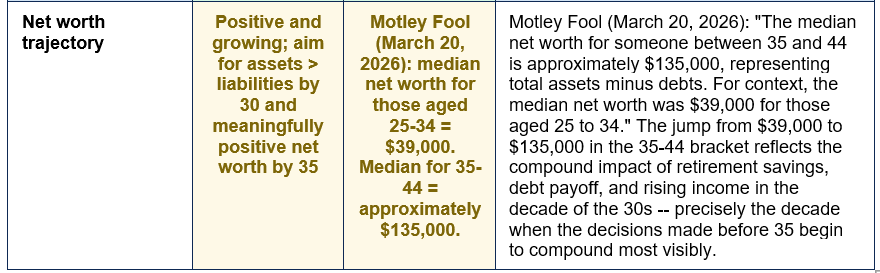
The framing of 'before 35' as a financial deadline is not arbitrary or motivational. It reflects a mathematical reality about how compound interest works and what the data shows about wealth accumulation patterns across age groups. The earlier money is invested or debt is cleared, the more time the positive effects have to compound. The late-30s and 40s are typically when incomes rise most significantly -- but the wealth advantage of acting in the 20s cannot be fully recovered by higher contributions in the 30s and 40s.Motley Fool (March 20, 2026): 'The median net worth for someone between 35 and 44 is approximately $135,000, representing total assets minus debts. For context, the median retirement account balance for those aged 25 to 34 was less than $19,000, and the median net worth was $39,000.' The jump from $39,000 to $135,000 net worth in the next decade reflects the compounding of exactly the decisions described in this guide -- made in the years before 35. BestMoney (December 2025): 'Retirement savings milestone: aim to have saved one year's salary in retirement accounts by age 35.'
WealthVieu (May 5, 2026) provides the most direct statement of the priority order: 'Focus on the three things that matter most: build a 6-month emergency fund, invest 15%+ of income consistently, and eliminate high-interest debt.' Three things. These three, done consistently before 35, are not supplementary to a financial plan -- they are the financial plan for this decade. Everything else is secondary. The seven wins in this guide build on this foundation, arranged in order of the financial impact they generate over the subsequent decades.
Before 35 -- the data case for acting now: £/$50,000 invested age 25-35 = £/$787,000 at 65. Median net worth age 25-34: $39,000. Median net worth age 35-44: $135,000. 3.5x increase in one decade. — Savvy Wealth: 'Investing £/$5,000/year at age 25 and stopping at 35 = £/$787,000 by age 65. Delay to age 35 for 30 years = only £/$612,000.' Motley Fool (March 20, 2026): 'Median net worth for 25-34 = $39,000; median for 35-44 = approximately $135,000.' BestMoney (December 2025): 'Aim to have 1x annual salary saved in retirement accounts by age 35.' Siebert (1 month ago): 'Top HYSA offering 4-5% APY in early 2026. On £/$10,000 balance, the difference between average and best savings rate = £/$360-460/year.'
Where You Should Be Financially by 35: The 2026 Benchmarks
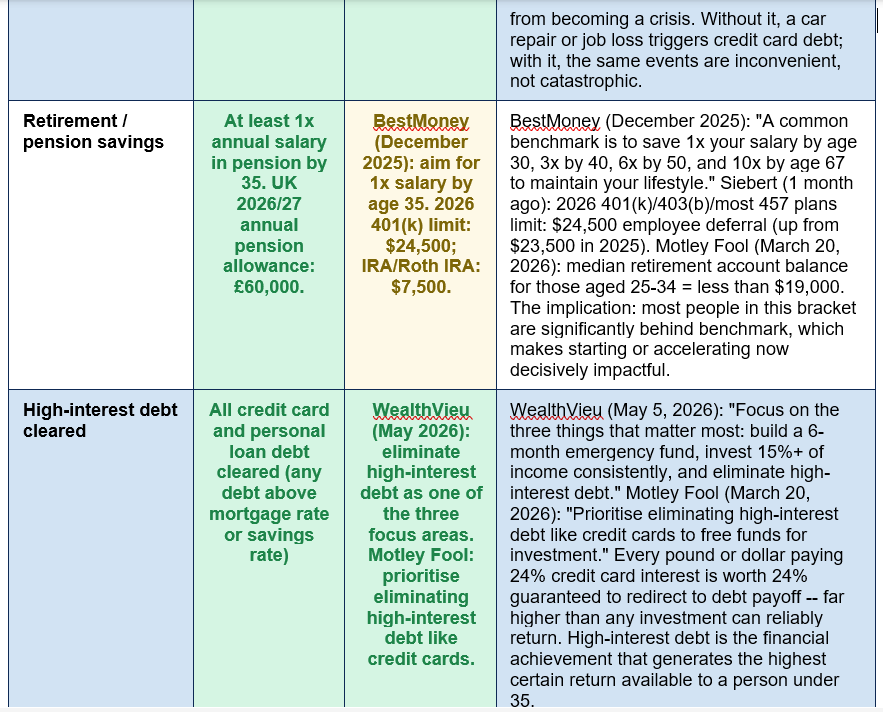
Before addressing the wins, it helps to understand the evidence-based benchmarks for financial position by age 35. These are not targets designed to induce anxiety -- they are reference points from which to measure progress and identify where action has the most impact: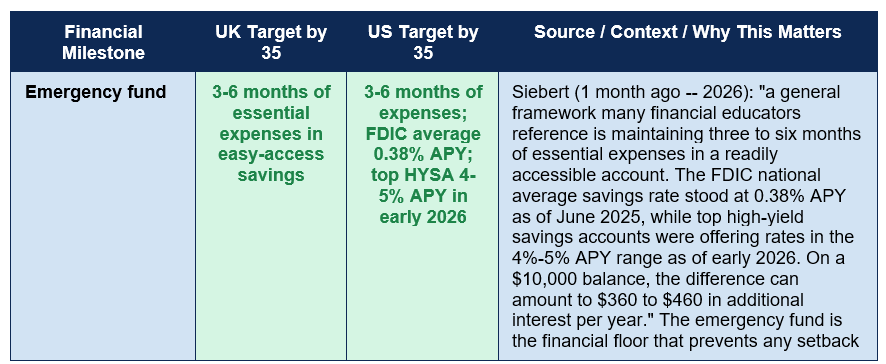
The 7 Biggest Money Wins Before 35 (That Aren't Buying a House)
WIN #1: Starting to Invest -- ANY Amount -- Before 30 | The Win Worth More Than Any Pay Rise
This is the single biggest money win available to anyone under 35 -- not because the amounts invested early are large, but because the time advantage is irreplaceable and cannot be bought back later. Savvy Wealth makes this concrete: investing £/$5,000 per year from age 25 to 35 (then stopping completely) generates £/$787,000 by retirement. Investing the same amount every year from 35 to 65 generates only £/$612,000. The early investor contributed £/$50,000 and ended up with more than the investor who contributed £/$150,000 over three times as many years. This is not a quirk of the calculation -- it is the mathematical nature of compound interest. The implication for a 22-year-old reading this guide: starting a £/$100 per month investment today, even if income is tight, is a more valuable financial action than waiting until income improves to invest £/$400 per month. The time advantage is worth more than the amount advantage, every time. UK: the Stocks and Shares ISA (up to £20,000 per year, all gains tax-free) is the most accessible and tax-efficient starting point. US: the Roth IRA (£/$7,500 per year limit in 2026) allows after-tax contributions with completely tax-free growth and withdrawals in retirement -- particularly powerful for people currently in low tax brackets who will be in higher brackets later. The action: open a Stocks and Shares ISA or Roth IRA this month. Set up an automatic monthly contribution at whatever amount is affordable. Review in 6 months and increase if possible. This is the win that time makes impossible to replicate later.WIN #2: Capturing Every Penny of Your Employer Pension or 401(k) Match | The 50-100% Guaranteed Instant Return
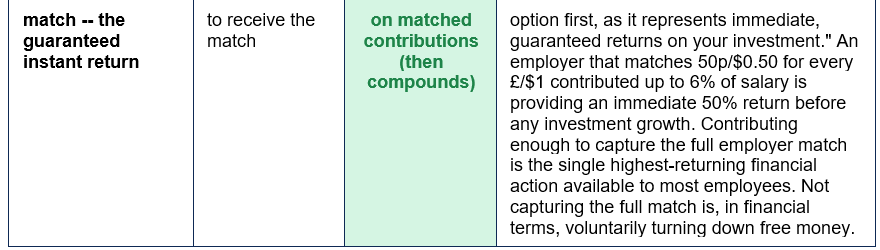
An employer pension or 401(k) match is the highest-returning financial action available to most employees, and yet significant proportions of the workforce fail to capture the full match available to them. Siebert (1 month ago): 'If your employer offers a matching contribution, prioritise this option first, as it represents immediate, guaranteed returns on your investment.' The mechanics: an employer that matches 50p for every £1 contributed up to 5% of salary is providing an immediate 50% return on money that has not yet experienced a single day of market growth. At a £/$40,000 salary with a 50% match up to 5%: the maximum match is £/$1,000 per year -- free money that only requires contributing £/$2,000 to receive. The combined £/$3,000 then compounds over 30+ years into a sum worth potentially £/$25,000-£/$40,000. The 2026 US 401(k) contribution limit is $24,500 per employee (Siebert Financial, 1 month ago). The UK annual pension allowance is £60,000. The action: log into your employer's pension or 401(k) portal today. Find out: what is the maximum employer match available? What percentage of salary must you contribute to receive the full match? If you are contributing below the match threshold, increase your contribution to capture the full match at the next available opportunity (next pay period or open enrolment). This is a pay rise you are currently refusing.WIN #3: Eliminating All High-Interest Debt | The Guaranteed 20-24% Return Available to Everyone
The best guaranteed financial return available before 35 does not come from the stock market. It comes from paying off debt that charges 20-24% APR. Every pound or dollar directed toward a credit card charging 24% interest generates an immediate, guaranteed, risk-free return of 24% -- because it eliminates interest that would otherwise be charged at that rate. No investment available to a retail investor reliably generates 24% annual returns. Paying off a 24% APR credit card does. WealthVieu (May 5, 2026): 'Eliminate high-interest debt' as one of the three primary focus areas for wealth building. Motley Fool (March 2026): 'Prioritise eliminating high-interest debt like credit cards to free funds for investment.' The sequencing matters: emergency fund first (so debt payoff is not interrupted by unexpected costs forcing new debt); then all credit cards and personal loans above approximately 8-10% interest; then student loans with higher rates; then lower-rate debt (student loans below 5%, car finance at low rates) can be balanced against investment returns. UK average credit card APR is approximately 24.65% (Bank of England data). US credit card APR averages approximately 22-25%. Any under-35 person carrying a balance on a credit card while also having money in a savings account earning 4-5% is losing approximately 19-20 percentage points per year on the gap. The action: list every debt with its interest rate. Pay minimums on all. Direct every additional available pound or dollar to the highest-rate debt until it is gone. Roll that payment to the next highest. Repeat until all credit card and high-rate personal loan debt is cleared. This is the debt avalanche and it is the most mathematically efficient path to financial freedom.WIN #4: Building a 6-Month Emergency Fund in a High-Yield Account | The Safety Net That Makes Every Other Win Possible
The emergency fund is not the most exciting money win. It does not compound into seven figures. It does not generate a career-changing return. What it does is provide the financial stability that makes every other win in this guide sustainable. Without an adequate emergency fund, any disruption -- job loss, medical expense, car repair, family emergency -- forces the use of credit cards at 24% APR or the liquidation of investments at whatever the market happens to be doing that week. With an adequate emergency fund, the same disruptions are inconvenient rather than financially catastrophic. Siebert (1 month ago): 'A general framework many financial educators reference is maintaining three to six months of essential expenses in a readily accessible account. The FDIC national average savings rate stood at 0.38% APY as of June 2025, while top high-yield savings accounts were offering rates in the 4%-5% APY range as of early 2026. On a £/$10,000 balance, the difference between those rates can amount to £/$360 to £/$460 in additional interest per year without taking on any market risk.' The two decisions embedded in this win: the amount (3-6 months of essential expenses, not 3-6 months of total spending) and the location (a high-yield savings account, not a standard current/checking account paying near-zero). An emergency fund of £/$15,000 earning 4.5% generates £/$675 per year in interest -- enough to cover several months of subscriptions or utilities -- while remaining instantly accessible. UK options: easy-access ISAs paying competitive rates; high-interest easy-access savings accounts from online and challenger banks. US options: high-yield savings accounts from online banks (Marcus, Ally, SoFi, Capital One 360); money market accounts. The action: calculate 3 months of essential expenses. Open a high-yield savings account today. Set up a standing order or automatic transfer of a fixed monthly amount until the target is reached.WIN #5: Understanding and Actively Managing Your Credit Score | The Number That Will Save (or Cost) You £/$100,000s
The credit score is the financial number that most people in their 20s understand the least and that has the most significant single financial impact over the next 30 years. A credit score affects the interest rate on every future mortgage, car loan, personal loan, and credit card -- and the difference between a good and excellent credit score on a 25-year mortgage at current rates can represent tens of thousands of pounds or dollars in total interest paid. BestMoney (December 2025): 'Establish your credit history: start building credit with a basic credit card or secured card if you have limited credit history. Aim for a credit score above 650 by age 30. Pay your full balance every month and keep utilisation below 30% of your credit limit.' The actions that build a strong credit score by 35 are straightforward but require consistency: pay every bill and credit commitment on time, every month, without exception (payment history is the single largest component of credit scoring in both the UK and the US); keep credit card utilisation below 30% of available limit (ideally below 10%); do not close old credit accounts; avoid multiple hard credit applications in short periods. UK: check your credit score for free with Experian, Equifax, or ClearScore. US: check at annualcreditreport.com (free once per year from each bureau) or through your bank's credit score service. The long-term payoff: a person with an excellent credit score who buys a home at 35 will pay a lower interest rate on their mortgage for 25 years than a person with a fair credit score. The cumulative difference on a £/$300,000 mortgage at a 1% rate differential is approximately £/$50,000-£/$65,000 in total interest. Building the score before 35 captures this saving in full.WIN #6: Increasing Your Income (and Investing the Difference) | The Win That All Other Wins Multiply
The preceding wins are all about what to do with money. This win is about getting more of it -- and specifically, about the compound effect of income increases in the 20s and early 30s when the money gained has the most time to compound. Carry.com (February 20, 2026): 'By midlife, households often enter peak earning years. Net worth typically climbs as salaries stabilize at higher levels.' The decade before 35 is when income trajectories are most malleable -- through negotiation, skill development, career switches, side income, and entrepreneurship. The critical discipline that converts income growth into a money win: directing the majority of each income increase directly to investment and debt payoff, rather than allowing lifestyle inflation to absorb it. Motley Fool (March 20, 2026): 'Aim to save twice your annual income by age 35, approximately £/$130,000 for average earners. Contribute aggressively to retirement plans, aiming for 15-20% of pre-tax income.' The practical version of this win: every time income increases (pay rise, promotion, side income starting), direct at least 50% of the net increase to the automatic investment or debt payoff programme, and allow no more than 50% to increase lifestyle spending. The specific income-increasing actions with the highest ROI for under-35s in 2026: negotiating salary at every annual review (research shows most people who negotiate get an increase -- those who do not, do not); developing skills that command premium rates in the current labour market (data analysis, AI tools, project management, financial modelling); building a professional profile and network that creates options; and exploring whether a side income stream is feasible alongside primary employment. The action: calculate what you currently invest as a percentage of gross income. If it is below 15%, identify the specific income changes or spending reductions that would bring it to 15%. Set a date by which to implement them.WIN #7: Learning the Basics of Tax Efficiency | Keeping More of What You Earn
The final win before 35 is less about a specific financial product and more about a mindset: understanding how to legally keep more of what you earn. For most people under 35, the most significant tax efficiency opportunities are: UK: using the full ISA allowance (£20,000 per year in Stocks and Shares or Cash ISAs) to shelter investment growth from capital gains tax and dividend tax permanently; contributing to a pension above employer minimums (contributions receive income tax relief at your marginal rate -- a 40p in the pound top-up from HMRC for higher-rate taxpayers); understanding the Marriage Allowance if applicable; and if self-employed, understanding allowable business expenses. US: maximising contributions to the Roth IRA (£/$7,500 per year limit in 2026) -- Siebert: 'Consistent, automated contributions to tax-advantaged retirement accounts represent one of the more structurally efficient ways to build long-term wealth, reducing taxable income today in the case of traditional accounts, or allowing tax-free growth in the case of Roth accounts'; contributing to a Health Savings Account (HSA) if eligible (triple tax advantage: tax-deductible contributions, tax-free growth, tax-free withdrawals for qualified medical expenses); and understanding whether a traditional or Roth 401(k) contribution suits your current and expected future tax bracket. The value of tax efficiency compounds over time: an investment growing at 7% per year inside a tax-sheltered ISA or Roth IRA will be worth significantly more over 30 years than the same investment growing at 7% in a taxable account with capital gains tax applied to withdrawals. The action: UK: check whether you are using your full ISA allowance. US: check whether you are contributing the maximum to your Roth IRA and whether your HSA is being used. In both cases, if pension/401(k) contributions are below the employer match maximum: fix that first (Win #2), then maximise the ISA/Roth IRA.The Compound Interest Power Chart: Why Starting Before 35 Changes Everything
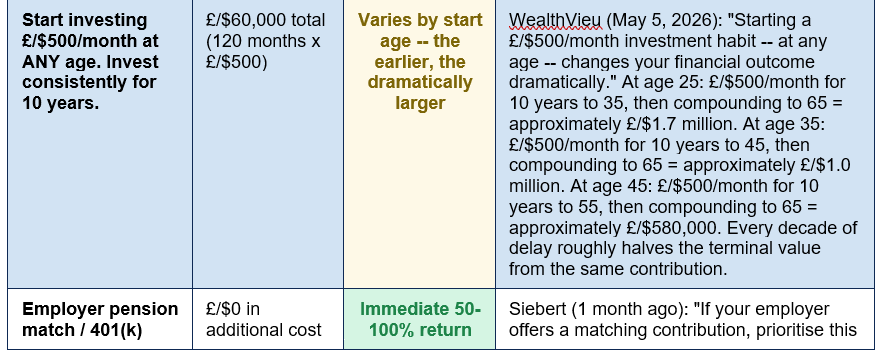
The following table maps the mathematical reality of compound growth that makes the wins in this guide so powerful for under-35s: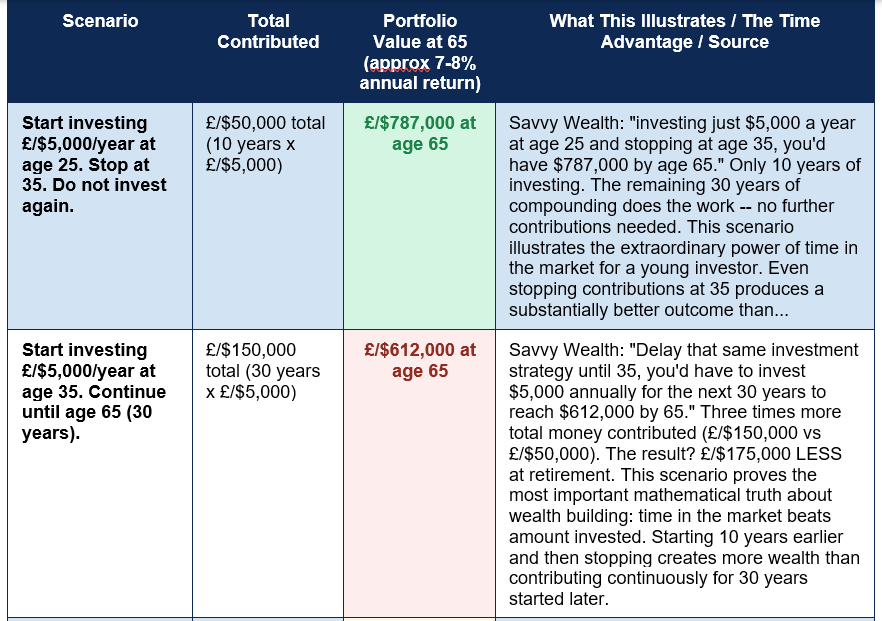
The Financial Priority Hierarchy for Under-35s
Not all financial wins are created equal, and not all can be pursued simultaneously with limited income. The following priority order reflects the sequence that generates the maximum financial benefit for most under-35s: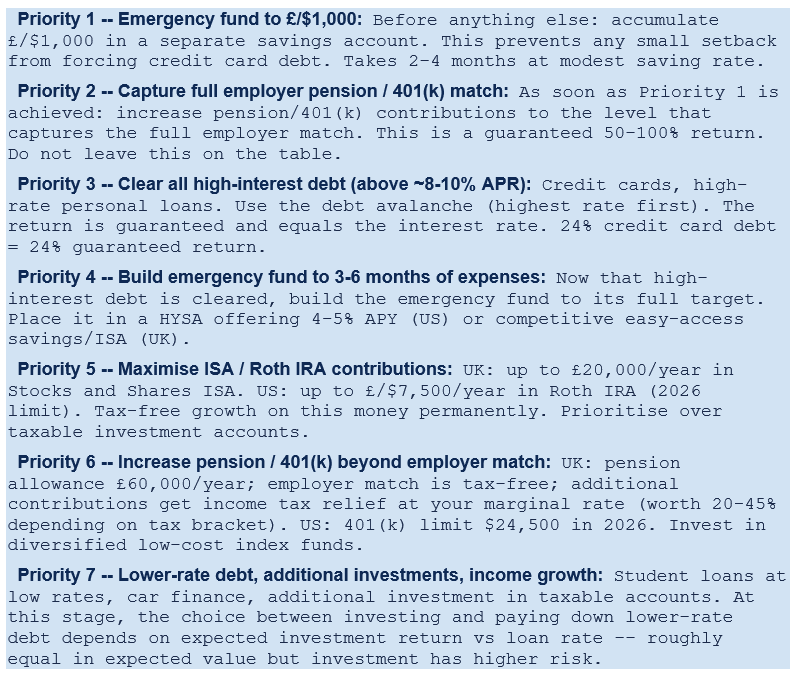
The ISA vs Roth IRA time advantage: why the tax shelter matters more under 35 than at any other age. UK: money invested in a Stocks and Shares ISA grows tax-free from investment to withdrawal. There is no capital gains tax and no dividend tax on ISA-held investments, regardless of the amount. A £500/month ISA investment from age 25 to 65 generates a substantially larger tax-free pot than the same investment outside an ISA (where gains above the annual CGT allowance are taxed at 18-24% on withdrawal). US: the Roth IRA specifically favours young investors because contributions are made with after-tax money -- and if current income is low (as is common in the 20s), the tax bracket at point of contribution is low. All future growth is then tax-free, meaning the tax is paid now at a low rate rather than later at a potentially higher rate. Both products benefit most from early and sustained use. The longer the money remains in the tax shelter, the greater the compounding advantage over a taxable account with the same pre-tax investment. Starting before 35 means the tax shelter works for 30+ years -- the maximum possible benefit.
YOUR BEFORE-35 MONEY WIN ACTION PLAN: 30 MINUTES THIS WEEK: (1) Calculate your monthly essential expenses. Multiply by 3 = your emergency fund minimum target. Multiply by 6 = your emergency fund full target. (2) Log into your employer's pension or 401(k) portal. Find the maximum employer match. Check whether you are currently capturing it in full. If not: increase your contribution rate at the next available opportunity. (3) List every debt with its interest rate. Identify any above 10% APR. These are Priority 3. (4) Open a high-yield savings account or easy-access ISA if you do not already have one. Start the emergency fund there. THIS MONTH: (5) Open a Stocks and Shares ISA (UK) or Roth IRA (US) if you do not have one. Set up a monthly automatic contribution of whatever is currently affordable -- even £/$25/month. The habit is more important than the amount right now. (6) Check your credit score. UK: Experian, Equifax, or ClearScore (free). US: annualcreditreport.com (free). Identify what is bringing it down and make a specific plan to improve it. THIS YEAR: (7) Apply the priority hierarchy above. Work through each level systematically. Review monthly. Increase contribution levels as income grows. The goal by 35: emergency fund at 3-6 months; all high-interest debt cleared; at least 1x annual salary in pension/retirement accounts; pension/401(k) match captured in full; ISA or Roth IRA regularly funded. UK FREE HELP: MoneyHelper 0800 138 7777. US FREE HELP: CFPB consumerfinance.gov.
FIVE MONEY MISTAKES THAT UNDO WINS BEFORE 35: (1) LIFESTYLE INFLATION ABSORBING EVERY PAY RISE. The single biggest threat to wealth building in the 20s and early 30s is allowing spending to rise in proportion to income, leaving nothing extra to invest. Every time income increases: commit to investing at least 50% of the net increase before it is allocated to spending. The wealth is built from the gap between what you earn and what you spend -- protect that gap at every income increase. (2) LEAVING EMPLOYER PENSION MATCH UNCAPTURED. Failing to contribute enough to receive the full employer match is turning down free money. This is the highest-returning financial action available to most employees and it is structured to be easy to miss. Check the match threshold and contribute at least to that level. (3) HOLDING SAVINGS IN A LOW-INTEREST ACCOUNT. Siebert (1 month ago): FDIC average savings rate 0.38% APY vs top HYSA at 4-5% APY in early 2026. On £/$20,000 in savings, this difference is £/$720-£/$920 per year for doing nothing differently except moving the account. The money is still accessible. The return is dramatically higher. (4) INVESTING IN TAXABLE ACCOUNTS BEFORE MAXING TAX-SHELTERED ACCOUNTS. Every pound/dollar invested outside an ISA or Roth IRA will be subject to capital gains tax on withdrawal. Every pound/dollar inside an ISA or Roth IRA will not. Fill the tax-sheltered accounts to their maximum before investing in taxable accounts. This sequencing is worth thousands over a 30-year investment horizon. (5) WAITING FOR THE 'RIGHT TIME' TO START INVESTING. The right time to start investing is the earliest time possible. WealthVieu (May 5, 2026): 'Starting a £/$500/month investment habit -- at any age -- changes your financial outcome dramatically.' Waiting for the market to be in the right place, for income to be higher, for uncertainty to reduce, or for a 'perfect' investment to appear all have the same mathematical effect: they reduce the number of years of compound growth available. Every year of delay costs more than almost any other financial mistake.
Conclusion
The biggest money win available before 35 that is not buying a house is the decision to start investing early -- any amount, consistently, in a tax-efficient account. This is the win that compounds over 30+ years into a sum no later investor can match with the same contributions. Savvy Wealth's illustration is the clearest statement of this truth: £/$50,000 invested from age 25 to 35 grows to £/$787,000 by retirement. The same £/$150,000 invested from 35 to 65 grows to only £/$612,000. Time, not money, is the primary wealth-building resource for people under 35.The six other wins -- capturing the full employer pension match, eliminating high-interest debt, building a proper emergency fund in a high-yield account, managing the credit score actively, growing income and investing the difference, and using every available tax-efficient account -- each compound the primary win. They remove the obstacles (debt, financial instability) that interrupt investing; they add free money to the investment pot (employer match); they ensure the most favourable terms on future major financial decisions (credit score); and they ensure the maximum proportion of investment growth is retained rather than given to the government (ISA, Roth IRA).
WealthVieu (May 5, 2026) provides the right summary: 'Focus on the three things that matter most: build a 6-month emergency fund, invest 15%+ of income consistently, and eliminate high-interest debt.' If the only financial decisions you make before 35 are those three -- consistently, year after year -- the compound effect will deliver a financial position by 45 that most people do not reach by 55. The house can follow. The investments should come first.
Frequently Asked Questions (FAQ)
What is the biggest financial mistake people make before 35?The biggest financial mistake people make before 35 is delaying investment -- waiting until income is higher, debt is fully cleared, or the 'right time' arrives. This delay is the most financially costly single decision available to someone under 35, because of the irreplaceable value of compounding time. Savvy Wealth quantifies this precisely: investing £/$5,000 per year from age 25 to 35 and then stopping completely generates £/$787,000 by retirement. The same investment of £/$5,000 per year started at 35 and continued for 30 years generates only £/$612,000, despite contributing three times more money in total. The investor who starts at 25 contributed £/$50,000 and had more money than the investor who contributed £/$150,000 starting at 35. The mathematical implication: every year of delay in starting to invest costs more than almost any subsequent financial mistake. Starting with £/$25 per month today, increased when possible, is financially superior to waiting until £/$200 per month becomes comfortable. The second most common and costly mistake is failing to capture the full employer pension or 401(k) match -- leaving free money (50-100% guaranteed instant return) uncollected because the contribution level is not high enough to trigger the full match.
How much should I have saved or invested by age 35?
The evidence-based benchmarks for financial position by age 35 are: emergency fund of 3-6 months of essential expenses in an accessible account (BestMoney, December 2025); at least 1x annual salary saved in pension or retirement accounts (BestMoney: 'A common benchmark is to save 1x your salary by age 30, 3x by 40, 6x by 50, and 10x by age 67'); all high-interest debt (credit cards, personal loans above ~8-10% APR) cleared; and positive and growing net worth. Motley Fool (March 20, 2026): 'The median net worth for someone between 35 and 44 is approximately $135,000, representing total assets minus debts. For context, the median retirement account balance for those aged 25 to 34 was less than $19,000, and the median net worth was $39,000.' This means the current median is significantly behind the recommended benchmarks -- which is not cause for panic, but for urgency. Motley Fool: 'Aim to save twice your annual income by age 35, approximately £/$130,000 for average earners. Contribute aggressively to retirement plans, aiming for 15-20% of pre-tax income.' If you are at 35 with less than these benchmarks, the right response is not discouragement -- it is the immediate implementation of the priority hierarchy in this guide, starting with capturing any uncaptured employer pension/401(k) match.
Should I pay off debt or invest if I'm under 35?
The answer depends on the interest rate of the debt relative to the expected return from investing. The general framework: (1) Always capture the employer pension or 401(k) match first -- the 50-100% guaranteed instant return beats both debt payoff and investment in expected value. (2) Clear all debt above approximately 8-10% interest before investing in non-match investments -- the 24% guaranteed return from paying off a 24% credit card beats any realistic investment return. (3) Once high-interest debt is cleared, invest rather than accelerating payoff of low-rate debt (student loans below 5%, car finance at 3%) because the expected long-term investment return (approximately 7% in diversified index funds) likely exceeds the cost of the debt. (4) Build the emergency fund alongside high-interest debt payoff, not after it -- the emergency fund prevents the debt payoff from being interrupted by unexpected costs that force new credit card use. WealthVieu (May 5, 2026): 'Eliminate high-interest debt' as one of the three primary financial focus areas. Motley Fool (March 2026): 'Prioritise eliminating high-interest debt like credit cards to free funds for investment.' The exception to the 'invest before paying low-rate debt' rule: if the psychological weight of carrying debt significantly affects financial decision-making or wellbeing, paying it off first and then investing is a legitimate and defensible choice -- the expected value difference between the two approaches at low interest rates is modest, and the wellbeing benefit of being debt-free is real.
What is the best investment for someone under 35 in the UK?
For a UK investor under 35 with no existing investments, the priority order is: (1) Employer pension to capture the full match: the highest returning first action for most employees. (2) Stocks and Shares ISA: up to £20,000 per year with all gains permanently tax-free. For a long-term horizon (30+ years), a low-cost globally diversified index fund within a Stocks and Shares ISA is the evidence-based recommendation of the majority of independent financial advisers. Low-cost means total annual charges (OCF or TER) below 0.25%; globally diversified means a world index fund or similar rather than a single-country fund; index fund rather than actively managed because the overwhelming majority of actively managed funds underperform their index benchmark over 20+ years after fees. Providers for a Stocks and Shares ISA: Vanguard UK (low costs, limited fund range), Hargreaves Lansdown (broader range, higher costs), Trading 212, InvestEngine, Fidelity. (3) Additional pension contributions above the employer match: contributions receive income tax relief at your marginal rate (worth 20p per £1 for basic rate taxpayers; 40p per £1 for higher rate taxpayers). UK pension contributions are one of the most efficient tax-reduction tools available. The key actions for a UK investor under 35: open a Stocks and Shares ISA this tax year; set up a regular monthly contribution to a global index fund (the Vanguard FTSE All-World ETF, HSBC FTSE All-World Index Fund, or equivalent are commonly cited starting points); review annually and increase contributions as income grows. Always read the investment risks disclosure and consider consulting a regulated financial adviser for personalised advice.
Why is an emergency fund a money win rather than just a safety net?
The emergency fund is classified as a money win -- not just a financial precaution -- because of its compounding impact on every other financial decision. Without an emergency fund, any unexpected cost (job loss, medical bill, car failure, appliance breakdown) is funded by credit card debt at 24%+ APR. With an emergency fund, the same events are funded at 0% with immediate effect. The cost difference over the 20s and early 30s -- a period when unexpected events are common and income may not be fully established -- is significant. Additionally, the emergency fund enables consistent investment to be maintained during difficult periods. An investor who keeps monthly contributions running through a financial setback because the emergency fund covers the cost finishes significantly ahead of one who liquidates investments at adverse prices to cover the same setback. Siebert (1 month ago) adds the 2026-specific point: 'The FDIC national average savings rate stood at 0.38% APY as of June 2025, while top high-yield savings accounts were offering rates in the 4%-5% APY range as of early 2026. On a £/$10,000 balance, the difference can amount to £/$360 to £/$460 in additional interest per year without taking on any market risk.' An emergency fund held in the wrong account costs real money relative to the best available easy-access rates. The win is both having the fund and placing it in an account that generates meaningful returns while remaining instantly accessible.

0 Comments Comments